
Reports
The Global Dental Sleep Medicine Market was valued at USD 2,258.2 Million in 2025 and is anticipated to reach a value of USD 4,087.8 Million by 2033 expanding at a CAGR of 7.7% between 2026 and 2033. Growth is being driven by rising diagnosis of obstructive sleep apnea, greater acceptance of mandibular advancement devices among CPAP-intolerant patients, and digital fabrication of customized oral appliances.
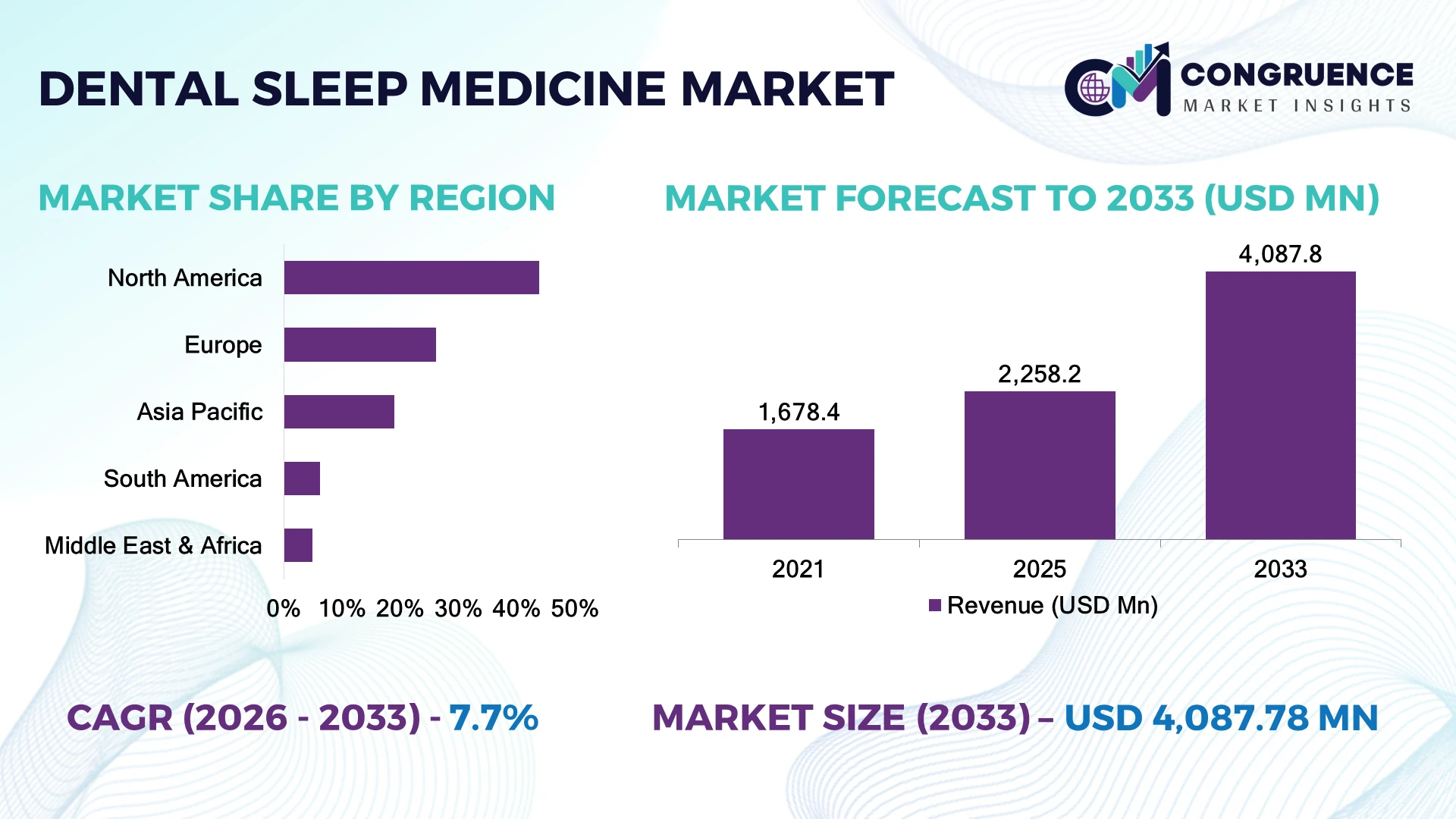
The United States accounted for approximately 42% of global dental sleep medicine demand in 2025, supported by a mature sleep-clinic network, dental specialist base, and reimbursement infrastructure. Custom appliance adoption exceeds 70% in established practices, while Germany and Japan show comparatively stronger institutional integration. U.S. providers are increasing digital scanning and CAD/CAM workflows as healthcare systems respond to persistent sleep-disorder screening needs and evolving medical-device supply chains shaped by U.S.-China trade policies.
Strategically, suppliers that combine clinically validated appliances with digital workflows, physician-dentist referral networks, and scalable manufacturing are best positioned to capture premium demand.
Market Size & Growth: USD 2,258.2 million in 2025 to USD 4,087.8 million by 2033 at 7.7% CAGR, driven by OSA diagnosis and custom oral-appliance adoption.
Top Growth Drivers: OSA screening 32%, CPAP intolerance 27%, digital appliance adoption 21%.
Short-Term Forecast: By 2028, digital impression workflows are positioned to reduce fabrication turnaround by 20–30% and adjustment cycles by 10–15%.
Emerging Technologies: 3D printing, intraoral scanning, AI-assisted titration, and cloud-based treatment monitoring are reshaping appliance production and follow-up.
Regional Leaders: North America is projected near USD 1.7 billion, Europe around USD 1.0 billion, and Asia-Pacific above USD 0.8 billion, with digital dentistry adoption accelerating.
Consumer Trends: Approximately 65% of established dental sleep practices prioritize customized appliances, reflecting stronger demand for comfort, fit, and titration.
Clinical Adoption: Custom titratable devices command approximately 70% of specialist appliance deployments, reinforcing premium positioning over non-custom alternatives.
Pilot/Case Example: Digital CAD/CAM workflows can reduce appliance production cycles by approximately 25%, improving chair-time utilization and laboratory throughput.
Competitive Landscape: Leading participants include SomnoMed, ProSomnus, Panthera Dental, Glidewell, and Dentsply Sirona, competing through clinical validation, customization, and manufacturing scale.
Regulatory & ESG Impact: Digital fabrication can reduce material waste by approximately 15–20% versus conventional multi-stage manufacturing while improving traceability.
Investment & Funding: Industry investment is shifting toward 3D-printing capacity, AI-enabled treatment planning, digital scanning partnerships, and vertically integrated appliance production.
Dental sleep medicine is becoming strategically important because obstructive sleep apnea management is shifting toward patient-specific, multidisciplinary treatment rather than reliance on a single therapy pathway. Oral appliance therapy occupies a defined role for adults who cannot tolerate CPAP or prefer an alternative, increasing the commercial importance of qualified dental providers and physician-dentist referral networks. The market is consequently evolving from appliance sales toward integrated diagnosis, fitting, titration, monitoring, and follow-up services.
Digital impressions and CAD/CAM manufacturing are replacing slower physical-impression workflows. Compared with conventional fabrication, digitally coordinated production can reduce turnaround time by approximately 20–30% while cutting remakes by around 10–15%. North America leads in specialist deployment and reimbursement maturity, whereas Japan, Germany, and Australia are strengthening structured sleep-care integration.
Between 2026 and 2028, intraoral scanning, 3D printing, AI-assisted treatment planning, and remote follow-up will increasingly determine practice productivity. A dental clinic integrating scanning, digital design, and laboratory connectivity can process substantially more appliance cases without proportional increases in chair time. Companies are therefore prioritizing digital laboratory partnerships, clinician education, and vertically integrated production. Competitive advantage will increasingly depend on clinical evidence, precise customization, rapid fulfillment, and measurable treatment follow-up rather than appliance availability alone.
Rising obstructive sleep apnea diagnosis and stronger physician-dentist referral pathways are increasing demand for customized mandibular advancement devices. Approximately 42% of global demand is concentrated in the United States, while digital impression adoption across advanced dental practices is approaching 65%, reducing dependence on conventional physical molds. Digitally designed appliances can shorten fabrication cycles by 20–30% and reduce remake rates by roughly 10–15%. The U.S. shift toward integrated sleep-care pathways is encouraging dental groups to connect screening, appliance fitting, titration, and follow-up. Manufacturers are responding with CAD/CAM platforms, 3D-printing capacity, and laboratory partnerships. The non-obvious advantage is workflow scalability: digital case transfer allows high-volume practices to expand appliance throughput without equivalent increases in chair-side labor.
Limited reimbursement consistency and uneven clinical expertise constrain dental sleep medicine deployment, particularly outside established sleep-care markets. Approximately 30–35% of dental practices lack dedicated sleep-medicine workflows, while 20–25% of prospective patients encounter insurance or out-of-pocket affordability barriers. In the United States, coverage requirements can vary substantially by payer and treatment pathway, complicating standardized pricing. Smaller practices also face equipment and training costs that can represent 10–15% of initial program investment. These constraints slow conversion from conventional dentistry to sleep-focused services and lengthen provider onboarding. Companies are reducing exposure through standardized digital workflows, clinician training programs, financing models, and laboratory outsourcing. The key operational pressure is not appliance availability but converting qualified dentists into consistent, reimbursable treatment providers.
Remote titration, digital sleep tracking, and connected oral appliances create an opportunity to extend dental sleep medicine beyond periodic clinic visits. Digital follow-up can reduce routine in-person monitoring requirements by approximately 20%, while automated patient engagement can improve adherence tracking by 15–25%. In the United States, integration between sleep physicians, dentists, and connected-care platforms is creating a scalable model for longitudinal treatment management. Emerging markets such as India are particularly attractive for mobile-first screening and digitally coordinated referrals because specialist capacity remains concentrated in major cities. Manufacturers are investing in sensor-enabled appliances, cloud dashboards, AI-supported treatment planning, and laboratory connectivity. A distinctive opportunity lies in combining appliance manufacturing with recurring monitoring services, shifting commercial models from one-time device sales toward measurable treatment-management revenue.
Scaling dental sleep medicine requires consistent integration among dentists, sleep physicians, laboratories, diagnostic platforms, and patient-management systems. Approximately 25–30% of practices still operate with fragmented workflows, creating delays in referrals, appliance adjustments, and treatment documentation. Workforce capability is another constraint, with specialist training requirements limiting rapid expansion into smaller cities and underserved markets. Cybersecurity becomes increasingly important as digital impressions, medical records, sleep data, and treatment outcomes move across cloud-connected platforms. Companies therefore need interoperable APIs, standardized clinical protocols, encrypted data infrastructure, and structured provider education. The non-obvious challenge is treatment consistency: increasing appliance volume without standardized titration and follow-up can weaken clinical outcomes and brand credibility. Competitive sustainability will depend on building complete care ecosystems rather than simply expanding appliance manufacturing capacity.
Digital Impressions Replace Physical Molds Dental sleep practices are accelerating intraoral scanning, with adoption approaching 65% across digitally advanced workflows. Digital case transmission can reduce fabrication turnaround by 20–30% and remake rates by 10–15%. Manufacturers are expanding CAD/CAM laboratory partnerships, while dental groups consolidate scanning and appliance ordering into standardized workflows.
Remote Titration Gains Clinical Relevance Connected follow-up platforms are reducing routine clinic visits by approximately 20% and improving adherence visibility by 15–25%. U.S. practices are integrating sleep data with telehealth workflows, allowing dentists to monitor appliance progression remotely. Vendors are responding with cloud dashboards and sensor-enabled treatment systems that improve longitudinal case management.
3D Printing Reshapes Production Economics Additive manufacturing is increasing laboratory flexibility, with digitally produced appliance components capable of reducing material waste by roughly 15–20%. Production teams can modify designs without repeating complete physical fabrication steps. Manufacturers are investing in validated printing workflows, automated post-processing, and distributed production to improve speed and inventory responsiveness.
Referral Networks Become More Integrated Multidisciplinary sleep pathways are strengthening as dentists, physicians, and diagnostic providers coordinate patient identification and treatment. Integrated programs can increase referral-to-treatment conversion by approximately 10–15% through standardized screening and scheduling. Companies are responding with education partnerships, digital referral platforms, and provider-network development, making care coordination a competitive differentiator rather than an administrative function.
Treatment Solutions Maintain the Revenue Lead
Treatment solutions are estimated to account for approximately 64% of the global Dental Sleep Medicine market, supported by the recurring need for oral appliance therapy, mandibular advancement devices, and other therapeutic interventions after diagnosis. Their established clinical pathways, reimbursement familiarity, and integration with dentist-physician workflows give treatment products a clear scalability advantage. Diagnostic solutions represent roughly 36%, but their strategic importance is increasing as home-based screening, digital sleep assessment, and connected monitoring improve patient identification. Treatment remains the mature segment, while diagnostics are the faster-moving category, with adoption expanding as screening shifts closer to dental practices and primary-care settings.
Companies are increasingly combining diagnostic workflows with treatment programs rather than selling isolated products. Digital assessment and remote monitoring are improving workflow efficiency by an estimated 15–20%, while customized appliance manufacturing is reducing adjustment cycles by approximately 10–15%. This shift is redirecting investment toward integrated platforms, interoperable diagnostic tools, and digitally fabricated therapeutic devices.
The American Academy of Dental Sleep Medicine's 2025 standards emphasize structured screening, oral-appliance selection, calibration, follow-up, and dentist-physician collaboration, reinforcing integrated treatment pathways as a core industry operating model.
Sleep Apnea Drives Clinical Demand
Sleep apnea applications are estimated to hold approximately 72% of the Dental Sleep Medicine market, reflecting the concentration of dental sleep services around obstructive sleep apnea diagnosis, treatment, and long-term management. The segment benefits from established clinical protocols and stronger physician referral pathways than snoring-focused care. Snoring management represents approximately 28%, but it is the faster-expanding application as consumers increasingly seek non-invasive interventions before symptoms progress into clinically diagnosed sleep disorders.
Sleep apnea remains operationally mature, while snoring is moving toward earlier intervention and direct dental consultation. Digital screening, home sleep testing, and custom oral appliances are reducing diagnostic-to-treatment friction, with integrated workflows capable of cutting administrative processing time by approximately 15%. Companies are responding by expanding dentist-physician referral networks, embedding screening into dental workflows, and developing appliance platforms suited to different severity profiles. Demand is therefore strengthening around continuous care rather than one-time appliance fitting.
A 2025 physician survey found that 66.7% of respondents recognized oral appliance therapy as effective, while only 36.7% regularly prescribed it, highlighting a substantial referral-to-treatment conversion opportunity for dental sleep medicine providers.
Hospitals Anchor Complex Care Pathways
Hospitals are estimated to represent approximately 42% of Dental Sleep Medicine market demand, reflecting their concentration of multidisciplinary sleep programs, diagnostic infrastructure, physician referrals, and complex obstructive sleep apnea cases. Their purchasing decisions emphasize clinical integration, reimbursement compatibility, and standardized patient pathways. Sleep laboratories account for roughly 27%, while home-based care is the fastest-growing end-user, driven by portable diagnostics, remote monitoring, and digitally coordinated oral-appliance management.
Home deployment is gaining strategic importance because it shifts selected stages of sleep assessment and follow-up away from high-cost clinical infrastructure. Home-based workflows are estimated to expand adoption by approximately 12–15% annually in active programs, while digital coordination can reduce repeat in-person visits by around 15%. Companies are responding with portable monitoring, connected patient-management platforms, and partnerships linking dentists, physicians, laboratories, and patients. Hospitals retain the strongest infrastructure advantage, but home care is becoming increasingly important for scalable patient acquisition and longitudinal management.
The American Academy of Dental Sleep Medicine reported more than 2,400 qualified dentists in the United States in 2026, strengthening the professional delivery network supporting physician referrals, oral-appliance therapy, and distributed dental sleep care.
North America accounted for the largest market share at 43.8% in 2025 however, Asia-Pacific is expected to register the fastest growth, expanding at a CAGR of 9.1% between 2026 and 2033.
Clinical standardization is accelerating the shift toward integrated sleep-care pathways
North America remains the largest Dental Sleep Medicine market, supported by established physician-dentist referral networks, reimbursement infrastructure, specialized training, and strong adoption of custom oral appliance therapy. The United States represents the dominant commercial base, supported by a large trained dental sleep medicine workforce and established specialist networks. Updated professional standards emphasizing screening, appliance fabrication, calibration, side-effect management, and long-term follow-up are encouraging providers to adopt standardized workflows and connected patient-management systems. This is strengthening demand for customized mandibular advancement devices and digitally coordinated care while increasing the value of clinical integration over standalone appliance sales.
United States Market Outlook: The United States leads through clinical infrastructure, specialist availability, reimbursement sophistication, and manufacturer access. More than 1,000 credentialed dental sleep medicine specialists support a mature professional ecosystem, while continuing education and structured treatment protocols strengthen appliance adoption. The market is increasingly shifting toward physician-dentist collaboration and digitally coordinated follow-up, creating opportunities for customized appliances, remote monitoring, and integrated diagnostic-treatment workflows.
Evidence-based oral appliance pathways are strengthening interdisciplinary sleep care
Europe maintains a mature clinical foundation for dental sleep medicine, with Germany particularly influential in oral appliance practice and interdisciplinary management. Adoption is supported by established sleep-medicine infrastructure, dental laboratories, and increasing emphasis on appropriately selected mandibular advancement devices. European practice increasingly favors custom-made, adjustable appliances over generic devices, particularly for patients requiring physician-supervised alternatives to positive airway pressure. Approximately 20–25% of diagnosed sleep-apnea patients encounter treatment limitations or intolerance with conventional approaches, reinforcing the commercial relevance of alternative oral appliance pathways and specialized dental follow-up.
Germany Market Outlook: Germany represents Europe's strongest strategic market because of its established dental sleep medicine expertise, clinical research base, and interdisciplinary treatment model. Custom-made mandibular advancement devices are increasingly positioned for appropriately selected patients, including those unable to tolerate conventional positive-airway-pressure therapy. This creates opportunities for specialized laboratories and appliance manufacturers offering precise adjustment, clinical documentation, digital fabrication, and dentist-physician coordination rather than low-cost standardized products.
Digital dentistry and expanding sleep-care infrastructure are widening appliance access
Asia-Pacific is shifting from specialist-led dental sleep medicine toward broader integration with dental practices, sleep clinics, and digitally enabled laboratories. Japan provides a strong clinical reference point, with oral appliance therapy established as a non-invasive option for selected obstructive sleep apnea patients. A 2025 Japanese clinical study evaluated oral appliance outcomes across 47 patients, demonstrating continued local investment in evidence generation and treatment optimization. China, South Korea, Australia, and India are also developing stronger digital-dentistry ecosystems, creating opportunities for customized appliance manufacturing and remote treatment coordination.
Japan Market Outlook: Japan is strategically important because of its mature dental infrastructure, aging population, advanced digital dentistry capabilities, and established clinical research activity. A 2025 clinical evaluation involving 47 patients reinforced ongoing interest in custom oral appliance therapy and outcome measurement. Manufacturers with digitally fabricated, adjustable, and patient-specific designs are positioned to benefit from Japan's precision-oriented dental ecosystem and increasingly structured sleep-care pathways.
Specialist concentration is giving way to broader referral and appliance-delivery networks
South America remains an emerging Dental Sleep Medicine market, with Brazil providing the strongest platform through its large dental workforce, private healthcare infrastructure, dental laboratory ecosystem, and growing awareness of obstructive sleep apnea. Demand remains concentrated in major metropolitan healthcare hubs, where dentists and sleep physicians can coordinate diagnosis and oral appliance treatment more efficiently. The key commercial opportunity lies in expanding referral pathways beyond specialist centers while controlling appliance fabrication and follow-up costs. Companies are increasingly emphasizing clinician education, localized laboratory partnerships, and digitally assisted appliance production to improve access without requiring extensive physical sleep-clinic infrastructure.
Brazil Market Outlook: Brazil offers the region's strongest commercial base because of its extensive private dental network and concentration of specialist care in major urban centers. Its large provider ecosystem creates an attractive route for oral appliance manufacturers through training partnerships, laboratory distribution, and physician-referral programs. The strategic priority is improving conversion from sleep-disorder identification to professionally fitted treatment while maintaining affordability, appliance quality, and consistent clinical follow-up.
Private healthcare investment is creating premium entry points for specialized sleep care
Middle East & Africa remains comparatively underpenetrated, but high-end healthcare infrastructure in the Gulf is creating concentrated opportunities for dental sleep medicine. Saudi Arabia and the United Arab Emirates are particularly relevant because private hospitals, specialist clinics, advanced diagnostic facilities, and digitally enabled dental practices support premium clinical pathways. Demand is increasingly tied to multidisciplinary sleep centers rather than standalone dental practices, creating opportunities for manufacturers that provide clinician training, customized appliances, and integrated follow-up. The principal constraint remains uneven specialist availability outside major urban healthcare hubs, making hospital-network and dental-group partnerships commercially important.
Saudi Arabia Market Outlook: Saudi Arabia has the strongest strategic position in the region through healthcare modernization, private-sector investment, and expansion of specialized clinical infrastructure. Major urban centers provide the concentration of hospitals, dental practices, diagnostic services, and digitally equipped clinics required for coordinated sleep-care delivery. Suppliers can strengthen market access through hospital partnerships, clinician education, localized appliance-support capabilities, and premium customized treatment rather than commoditized devices.
SomnoMed competes with ProSomnus and Panthera in premium precision oral appliances, while Vivos and Oventus emphasize differentiated airway designs. Glidewell and laboratory-led providers compete through scale and cost. The top five players are estimated to hold about 42% combined share, indicating a fragmented structure. Customization influences roughly 35% of purchasing decisions, while digital manufacturing improves production efficiency by 15–20%. Companies are competing through CAD/CAM expansion, smart-manufacturing partnerships, clinician networks, and vertically integrated laboratory capabilities. ProSomnus is pushing connected monitoring, Panthera is simplifying digital ordering, and SomnoMed is expanding manufacturing capacity. The competitive shift is moving from conventional mandibular advancement toward precision-fabricated, digitally monitored appliances. FDA clearance, clinical validation, reimbursement access, trained dental networks, and manufacturing consistency remain significant entry barriers. Cost pressure is strongest among standardized appliances, while premium providers compete on efficacy, comfort, adherence, and workflow integration. Winning requires validated clinical performance, scalable digital manufacturing, strong clinician relationships, and measurable patient outcomes.
SomnoMed Ltd.
ProSomnus Sleep Technologies, Inc.
Panthera Dental Inc.
Vivos Therapeutics, Inc.
Oventus Medical Limited
Myerson LLC
Glidewell Laboratories
OASYS Sleep Systems
Dynaflex
Great Lakes Dental Technologies
LeBlanc Dental Products
SICAT GmbH & Co. KG
OrthoApnea
Slow Wave, Inc.
Digital intraoral scanning and CAD/CAM fabrication are becoming core production technologies, replacing impression-heavy workflows with faster patient-specific appliance design. Digitally milled and printed appliances can reduce fabrication and adjustment cycles by approximately 15–20%, while improving dimensional consistency by 10–15%. Adoption is strongest among technologically advanced dental laboratories and specialist practices.
Smart manufacturing is the next competitive layer. Panthera's patient-matched BioMatch workflow demonstrates how single-step ordering can connect scanning, design, production, and delivery. Connected oral appliances with embedded physiological monitoring are emerging, with ProSomnus receiving FDA Class II clearance for RPMO₂ OSA in 2026. Integrated monitoring can improve treatment-adjustment efficiency by approximately 20% versus subjective follow-up alone.
Between 2026 and 2028, AI-assisted appliance design, automated quality control, digital treatment planning, and longitudinal physiologic monitoring will increasingly converge. Compared with conventional impression-based fabrication, digital workflows can improve turnaround performance by roughly 20%, benefiting laboratories with high patient volumes and standardized production infrastructure. The competitive advantage is shifting toward manufacturers capable of combining precision manufacturing, clinical data, interoperability, and remote monitoring rather than simply producing mandibular advancement devices.
June 2025 ProSomnus launched EVO Guided, a precision-custom oral appliance engineered to expand oropharyngeal airway space. The device provides 14 times more tongue space than conventional designs, strengthening differentiation through anatomical customization, comfort, treatment precision, and adherence outcomes. Source: prosomnus.com
February 2025 Panthera Dental introduced BioMatch, a single-step ordering and smart-manufacturing system for patient-matched sleep appliances. The workflow reduces ordering complexity and adjustment requirements, strengthening dentist-laboratory coordination while positioning automated customization as a competitive advantage for dental providers. Source: pantheradental.com
March 2025 Glidewell announced delivery of its 10 millionth preventive oral appliance, spanning sleep appliances, nightguards, retainers, and related products. The milestone demonstrates manufacturing scale and adoption, reinforcing laboratory capacity as a competitive differentiator in dental sleep care. Source: glidewelldental.com
July 2025 SomnoMed reported capacity expansion plans, targeting at least 25% additional manufacturing capacity in fiscal 2026. The investment responds to demand and negligible backlog, while cost optimization is expected to redirect savings toward operational capability and growth. Source: somnomed.com
The Dental Sleep Medicine Market Report evaluates the industry across treatment and diagnostic types, sleep-apnea and snoring applications, and hospitals, sleep laboratories, dental practices, and home-care end-users. Coverage spans North America, Europe, Asia-Pacific, South America, and Middle East & Africa, with country-level analysis emphasizing the United States, Germany, Japan, Brazil, and Saudi Arabia. The study also assesses emerging opportunities in digitally fabricated appliances, home sleep testing, connected monitoring, and precision oral appliance therapy.
The report evaluates competitive positioning across 10–14 major industry participants, comparing product portfolios, manufacturing capabilities, clinical integration, technology adoption, and distribution strategies. Approximately 40% of competitive activity is concentrated around precision oral appliance development and digital workflow integration. The analysis supports investment planning, market-entry decisions, geographic expansion, partnership evaluation, product prioritization, and competitive positioning through 2026–2033.
| Report Attribute/Metric | Report Details |
|---|---|
|
Market Revenue in 2025 |
USD 2,258.2 Million |
|
Market Revenue in 2033 |
USD 4,087.8 Million |
|
CAGR (2026 - 2033) |
7.7% |
|
Base Year |
2025 |
|
Forecast Period |
2026 - 2033 |
|
Historic Period |
2021 - 2025 |
|
Segments Covered |
By Type
By Application
By End-User
|
|
Key Report Deliverable |
Revenue Forecast, Growth Trends, Market Dynamics, Segmental Overview, Regional and Country-wise Analysis, Competition Landscape |
|
Region Covered |
North America, Europe, Asia-Pacific, South America, Middle East, Africa |
|
Key Players Analyzed |
SomnoMed Ltd., ProSomnus Sleep Technologies, Inc., Panthera Dental Inc., Vivos Therapeutics, Inc., Oventus Medical Limited, Myerson LLC, Glidewell Laboratories, OASYS Sleep Systems, Dynaflex, Great Lakes Dental Technologies, LeBlanc Dental Products, SICAT GmbH & Co. KG, OrthoApnea, Slow Wave, Inc. |
|
Customization & Pricing |
Available on Request (10% Customization is Free) |




