
Reports
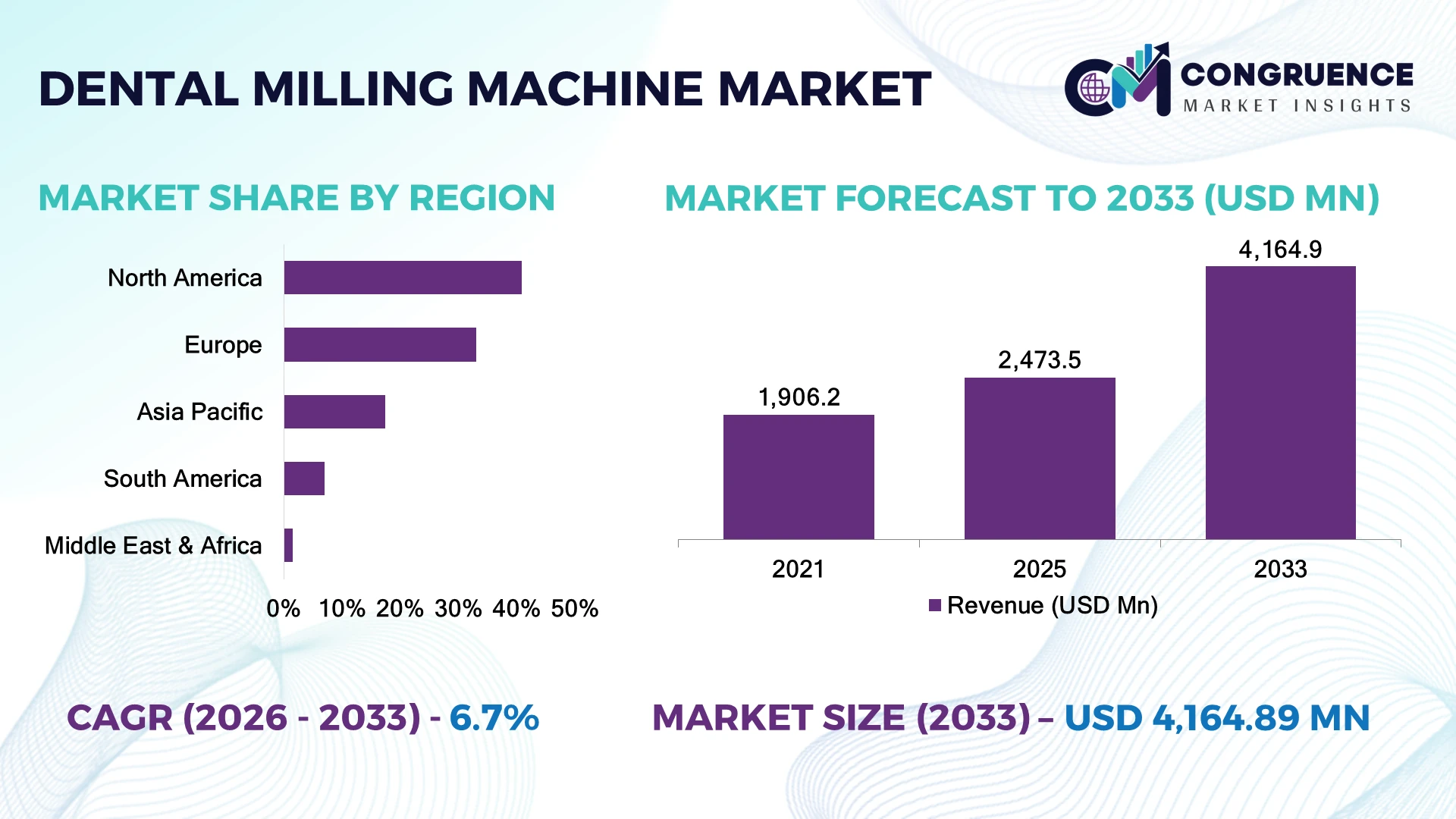
The Global Dental Milling Machine Market was valued at USD 2,473.5 Million in 2025 and is anticipated to reach a value of USD 4,164.9 Million by 2033 expanding at a CAGR of 6.73% between 2026 and 2033. Growth is driven by 5-axis CAD/CAM milling, automated tool changing, zirconia processing, and the shift toward digitally integrated chairside and laboratory workflows.
The United States remains the dominant country market, supported by more than 200,000 dental practices and advanced CAD/CAM infrastructure, while North America holds about 37.6% of global demand. India shows faster digital adoption, with 86.8% of surveyed dentists regularly using CAD/CAM, compared with more established laboratory-centered workflows in Germany and Switzerland. Supply-chain restructuring following COVID-19 disruptions is also encouraging localized equipment servicing, material sourcing, and distributor expansion.
Strategically, manufacturers should prioritize interoperable 5-axis platforms, localized service networks, and multi-material capabilities to secure high-value laboratory and chairside deployments.
Market Size & Growth: USD 2,473.5 Million in 2025 to USD 4,164.9 Million by 2033 at 6.73%, supported by advanced CAD/CAM automation and zirconia milling.
Top Growth Drivers: CAD/CAM adoption 86.8%, digital workflow utilization 81.4%, and laboratory deployment 72.2%.
Short-Term Forecast: By 2028, automated milling workflows are positioned to deliver 20–30% higher production efficiency versus conventional machining processes.
Emerging Technologies: AI-assisted toolpaths, 5-axis automation, hybrid wet/dry milling, and advanced zirconia processing are reshaping high-precision production.
Regional Leaders: North America is projected at about USD 1.56 billion, Europe at USD 1.10 billion, and Asia-Pacific at USD 0.96 billion, with digital deployment accelerating fastest in Asia-Pacific.
Consumer/End-User Trends: Dental laboratories account for approximately 72.2% of demand, while clinic-based chairside adoption is expanding through same-day restoration workflows.
Pilot/Case Example: 2025 high-speed 5-axis zirconia workflows demonstrated approximately 20–30% cycle-efficiency improvement, strengthening automated laboratory production.
Competitive Landscape: North America leads with about 37.6% share; Dentsply Sirona, Straumann, Ivoclar, Amann Girrbach, and vhf remain major competitors.
Regulatory & ESG Impact: Digital production and dry milling can reduce coolant dependence by more than 50%, while standardized material validation strengthens manufacturing consistency.
Investment & Funding: Approximately USD 1 billion in projected industry expansion through 2033 is supporting equipment upgrades, distributor partnerships, software integration, and regional service infrastructure.
Innovation & Future Outlook: Next-generation systems are shifting toward AI optimization, automated calibration, cloud connectivity, and multi-material production, moving competition toward complete digital manufacturing ecosystems.
The Dental Milling Machine Market is seeing strong demand for zirconia crowns, bridges, implant components, veneers, and digitally designed prosthetics. Five-axis systems, automated tool changers, high-speed spindles, and integrated CAD/CAM software are improving production precision and turnaround. Approximately 72.2% of demand comes from dental laboratories, while clinics increasingly adopt chairside production. Supply-chain localization and stronger service infrastructure are becoming important purchasing considerations.
Dental milling machines are becoming strategically important as dental laboratories and clinics shift from outsourced, labor-intensive fabrication toward digitally controlled production. The competitive advantage increasingly depends on connected CAD/CAM workflows, machine uptime, material flexibility, and rapid restoration delivery rather than machine capacity alone. This shift is strengthening investment in automated production cells and integrated digital dentistry infrastructure.
Five-axis milling provides a measurable advantage over conventional 4-axis machining by reducing repositioning requirements and improving access to complex geometries, with advanced systems delivering approximately 20–30% higher workflow efficiency. North America maintains greater deployment maturity, while India and China are expanding digital infrastructure and technician capabilities at a faster pace. Over the next 2–3 years, automated tool changing, AI-assisted toolpaths, and hybrid wet/dry platforms will become increasingly important purchasing criteria.
A practical deployment model is emerging among multi-location dental groups that combine intraoral scanning, CAD design, centralized laboratory production, and selective chairside milling. Manufacturers are responding through regional partnerships, software integration, financing programs, and localized technical support. The strategic priority is clear: vendors that deliver reliable end-to-end digital workflows will secure stronger operational positioning than suppliers competing on machine specifications alone.
CAD/CAM integration is restructuring dental manufacturing, with approximately 81.4% of market activity associated with digitally controlled milling workflows and 86.8% of surveyed Indian dentists reporting regular CAD/CAM use. Five-axis platforms are gaining importance as complex implant and full-arch cases require fewer manual repositioning steps. Automated tool changing can reduce operator intervention by approximately 20–30% in repetitive workflows. The transition from conventional impressions to digital scanning is also compressing production handoffs. Manufacturers are responding with integrated scanners, CAM software, automated calibration, and higher-speed milling platforms. The non-obvious advantage is improved production scheduling: connected workflows allow laboratories to batch similar materials and tooling requirements, increasing machine utilization and reducing idle capacity.
High equipment costs remain a structural barrier for smaller dental laboratories and clinics. Approximately 89% of surveyed Indian dentists identify cost as a major obstacle to digital dentistry, while more than 60% of dental professionals cite affordability as a limitation for advanced digital manufacturing technologies. Four-axis machines continue to hold roughly 55.3% of installed demand because they offer a lower entry cost than sophisticated 5-axis platforms. Imported components, specialized cutting tools, software licenses, and maintenance contracts further increase total ownership costs. Supply-chain disruptions affecting precision components can extend replacement cycles and raise inventory requirements. Manufacturers are reducing exposure through leasing, distributor financing, modular upgrades, localized spare-parts inventories, and service contracts. The key operational priority is lowering lifecycle cost rather than simply reducing the initial machine price.
AI-assisted toolpaths and automated process optimization are creating an opportunity to increase machine utilization without proportional increases in skilled labor. Five-axis equipment is expanding at approximately 11.6%, while chairside milling is advancing at about 10.4% as clinics bring selected restoration production in-house. Advanced systems combining automated tool changing and multi-material processing can improve production efficiency by approximately 20–30%. India, China, and Southeast Asian dental hubs offer particularly strong deployment potential as digital infrastructure expands. Manufacturers are positioning through AI-enabled CAM software, material partnerships, cloud platforms, and regional training ecosystems. A non-obvious opportunity is distributed production: compact chairside systems can handle standardized restorations locally while centralized laboratories reserve high-capacity equipment for complex prosthetics, improving asset allocation across multi-site networks.
The long-term challenge is integrating milling hardware with scanners, CAD software, materials, laboratory management platforms, and cybersecurity controls without creating workflow fragmentation. Approximately 90% of surveyed dental professionals recognize training as necessary for effective digital technology use, while workforce capability remains uneven across emerging markets. Software interoperability can also increase implementation time when machines operate within closed ecosystems. Germany and Switzerland demonstrate stronger digital maturity, whereas developing dental hubs often require additional technician training and technical support. Increasing connectivity introduces further requirements for secure patient-data exchange and remote diagnostics. Companies must therefore invest in open interfaces, cybersecurity, predictive maintenance, technical education, and regional service centers. The strategic issue is not machine deployment alone but maintaining consistent restorative quality and uptime across distributed production environments.
Five-Axis Systems Gain Share: Five-axis machines are expanding as complex implant and full-arch cases require fewer repositioning steps, with adoption advancing about 11.6% while four-axis systems retain nearly 55.3% of installed equipment. Germany-based laboratories are upgrading toward automated tool changing and multi-material compatibility, improving throughput and reducing manual intervention. Manufacturers are prioritizing premium configurations and software integration as labor availability becomes a stronger operational constraint.
Dry Processing Improves Economics: Dry milling is gaining preference for zirconia and PMMA production, representing approximately 63.5% of milling deployments. Reduced coolant consumption and simpler maintenance can lower process-related operating costs by 15–25%, while automated extraction improves laboratory cleanliness. Manufacturers are strengthening dry-milling portfolios and partnering with material suppliers to validate cutting parameters, particularly as supply-chain disruptions encourage laboratories to standardize commonly available materials.
Chairside Production Moves Upstream: In-office milling is expanding at approximately 10.4% as clinics bring selected restorative workflows closer to patients. Digital scanning-to-milling workflows can reduce restoration turnaround from multiple days to same-day production, while automation reduces operator touchpoints by roughly 20%. U.S. dental groups are increasingly adopting integrated equipment packages, prompting vendors to offer compact systems, financing programs, training, and bundled software rather than standalone machines.
Service Models Reshape Procurement: Dental laboratories are increasingly evaluating uptime, maintenance, and material availability alongside machine specifications. Approximately 72.2% of demand comes from laboratories, where utilization intensity makes downtime particularly costly. European regulatory harmonization and post-pandemic supply-chain restructuring are encouraging manufacturers to strengthen regional service centers and spare-parts inventories. The non-obvious shift is toward service-backed procurement, with vendors using remote diagnostics, preventive maintenance, and long-term contracts to secure recurring customer relationships.
Four-axis dental milling machines remain the leading type, accounting for approximately 55.3% of installed equipment in 2025. Their dominance reflects lower acquisition costs, established laboratory workflows, simpler operator requirements, and sufficient performance for conventional crowns, bridges, and routine prosthetics. Five-axis systems represent the fastest-growing type, supported by complex implant structures, full-arch restorations, undercuts, and advanced anatomical geometries. Their ability to reduce repositioning improves production consistency and supports higher-value cases. Manufacturers are therefore directing investment toward five-axis automation, higher-speed spindles, intelligent toolpaths, and automatic calibration, while retaining four-axis platforms for price-sensitive laboratories.
The gap between the two types is becoming strategically important. Four-axis equipment remains attractive for high-volume standardized work, while five-axis platforms increasingly serve laboratories seeking premium restorative capabilities. Five-axis adoption is advancing at roughly 11.6%, compared with the more mature four-axis installed base. Companies are also developing modular product families to allow customers to upgrade capacity without replacing complete digital workflows. This shifts purchasing decisions from initial machine price toward utilization, case complexity, material compatibility, and lifecycle economics.
Restorative dentistry remains the leading application, representing approximately 44% of dental milling machine demand in 2025. Crowns, bridges, veneers, inlays, and onlays generate consistent milling volumes because their geometries are highly compatible with standardized CAD/CAM workflows. Prosthodontics follows as an established application, particularly within laboratories handling complex rehabilitation cases. Implant dentistry is the fastest-growing application as digital implant planning, customized abutments, and full-arch workflows require greater machining precision. Companies are responding with five-axis systems, improved CAM algorithms, and material-specific milling strategies.
The application mix is shifting from routine restoration toward digitally planned complex cases. Implant-focused production is increasing machine utilization because customized geometries demand greater axis movement and tighter dimensional control than conventional restorations. Restorative dentistry continues to prioritize throughput and material efficiency, while orthodontic applications remain more specialized. Approximately 72.2% of global demand is concentrated within laboratory-based production, reinforcing the importance of high-utilization applications. Manufacturers are strengthening application-specific software libraries and clinical partnerships to convert advanced machine capabilities into repeatable production workflows.
Dental laboratories remain the dominant end-user, accounting for approximately 72.2% of global dental milling machine demand in 2025. Their position reflects centralized case processing, higher equipment utilization, multi-material requirements, and continuous production schedules. Dental clinics represent the fastest-growing buyer group as multi-location practices and larger dental organizations bring selected restorative procedures in-house. Laboratories prioritize throughput, tooling economics, uptime, and material flexibility, whereas clinics emphasize compact equipment, ease of operation, and rapid restoration delivery. Manufacturers are tailoring product configurations, financing structures, and service packages to these distinct purchasing priorities.
The purchasing gap between laboratories and clinics is narrowing as chairside workflows mature. Clinic adoption is supported by digital scanners, simplified CAD interfaces, and automated milling sequences that reduce dependence on specialist technicians. Approximately 90% of surveyed dental professionals identify training as important for effective digital technology use, making education and implementation support a competitive differentiator. Companies are responding through distributor training, managed-service agreements, bundled software, and localized technical support. The strategic shift favors vendors capable of serving both centralized high-volume laboratories and decentralized clinic networks without compromising workflow consistency.
North America accounted for the largest market share at 40.9% in 2025 however, Asia-Pacific is expected to register the fastest growth, expanding at a CAGR of 12.95% between 2026 and 2033.

North America accounted for 40.9% of the global Dental Milling Machine Market in 2025, making it the largest regional market. The United States drives regional demand through extensive dental laboratory capacity, high CAD/CAM penetration, and strong investment by multi-location dental organizations. Approximately 15% of U.S. dental clinics perform in-office milling, reflecting continued movement toward localized restorative production. Large laboratories are increasing 5-axis equipment deployment for implant, crown, bridge, and full-arch applications. Manufacturers are responding with automated tool changing, integrated CAD/CAM platforms, remote diagnostics, and expanded service networks. The region's mature infrastructure supports faster equipment replacement and premium technology adoption. The key business advantage is high machine utilization, allowing laboratories and enterprise dental groups to justify advanced equipment through greater throughput and reduced external production dependence.
United States Market Outlook: The United States represents the primary country market, supported by more than 200,000 dental practices and a sophisticated laboratory ecosystem. Large dental service organizations are consolidating digital workflows across multiple facilities, increasing demand for standardized scanners, CAD software, and milling platforms. Strong private-sector investment also supports adoption of advanced 5-axis systems and chairside production technologies.
Europe accounted for 33.1% of the global Dental Milling Machine Market in 2025, supported by established dental laboratories, sophisticated CAD/CAM infrastructure, and strong precision-engineering capabilities. Germany, Switzerland, Italy, and Austria represent important technology and manufacturing centers. European laboratories increasingly prioritize dimensional accuracy, zirconia processing, multi-material compatibility, and automated production. Germany's advanced dental manufacturing ecosystem strengthens regional equipment development, while stricter digital-data and medical-device requirements encourage secure and standardized workflows. Manufacturers are investing in energy-efficient milling systems, interoperable software, and validated material libraries to improve production consistency. The region's mature installed base also creates replacement demand as laboratories upgrade from conventional 4-axis systems toward more capable configurations. Strategic investment is therefore shifting toward precision, automation, and lifecycle efficiency rather than simple capacity expansion.
Germany Market Outlook: Germany is the leading European country for dental milling technology because of its concentration of dental equipment manufacturers, specialized laboratories, precision-engineering suppliers, and CAD/CAM developers. Its industrial ecosystem supports both domestic deployment and international equipment exports. German manufacturers are particularly active in high-precision milling, zirconia workflows, automated production, and integrated digital laboratory solutions.
Asia-Pacific accounted for 17.4% of the global Dental Milling Machine Market in 2025 and represents the fastest-expanding regional market. China, Japan, South Korea, and India are driving equipment deployment through expanding dental infrastructure, private-clinic investment, and laboratory modernization. India recorded 86.8% regular CAD/CAM use among surveyed dentists, demonstrating strong digital workflow adoption, while China combines large treatment volumes with an expanding domestic dental-equipment manufacturing base. Japan and South Korea contribute advanced precision engineering and automation capabilities. Manufacturers are responding with localized equipment, competitive pricing, distributor partnerships, technician training, and compact 5-axis systems. The region's strategic advantage lies in combining increasing digital treatment capacity with growing domestic manufacturing capabilities, allowing suppliers to address both premium and cost-sensitive laboratory segments.
China Market Outlook: China is the region's most strategically significant market because it combines a large dental-care base with expanding domestic manufacturing capabilities. Local manufacturers are increasingly developing 5-axis milling systems, integrated CAD/CAM solutions, and broader material compatibility. The country's growing private dental sector is supporting laboratory modernization, while domestic production provides advantages in equipment availability, customization, and supply-chain responsiveness.
South America accounted for 7.0% of the global Dental Milling Machine Market in 2025, with Brazil representing the principal deployment and commercial hub. The region's private dental laboratories are progressively adopting CAD/CAM production for crowns, bridges, veneers, and implant-supported restorations. Brazil benefits from a large dental-services ecosystem and established laboratory network, while Argentina, Chile, and Colombia provide secondary adoption opportunities. Imported equipment remains significant, creating sensitivity to currency movements, logistics costs, and replacement-part availability. Manufacturers are addressing these constraints through local distributors, financing programs, technician training, and regional service partnerships. Demand is increasingly concentrated among laboratories seeking higher equipment utilization and shorter production cycles. The strongest strategic opportunity is therefore not broad equipment penetration but conversion of established high-volume laboratories from conventional fabrication to digitally controlled production.
Brazil Market Outlook: Brazil represents the leading country market in South America, supported by its extensive private dental sector and established dental laboratory infrastructure. Digital restorative workflows are increasingly used for crowns, bridges, veneers, and implant applications. Local technical support remains important because imported milling systems require reliable access to specialized tools, materials, maintenance, and replacement components.
Middle East & Africa accounted for 1.6% of the global Dental Milling Machine Market in 2025, with demand concentrated in technologically advanced private healthcare systems. Saudi Arabia and the United Arab Emirates represent the principal deployment centers, supported by healthcare modernization, medical tourism, premium dental services, and investment in advanced clinical infrastructure. Gulf dental providers increasingly integrate digital scanning, CAD/CAM design, and automated milling into implant and aesthetic restoration workflows. Imported equipment remains dominant, making local distributors, spare-parts availability, and technical support critical to equipment utilization. Manufacturers are responding with premium 5-axis platforms, training partnerships, localized service agreements, and integrated software packages. The region's smaller installed base creates a distinct opportunity for suppliers to establish early technology leadership through institutional partnerships and premium restorative applications rather than competing primarily on equipment volume.
Saudi Arabia Market Outlook: Saudi Arabia is the region's most strategically significant market, supported by healthcare modernization and investment under Vision 2030. Private healthcare providers are expanding advanced dental infrastructure and adopting digital technologies for restorative and implant procedures. Demand is increasingly focused on integrated CAD/CAM systems, 5-axis milling, digital scanning, and specialized laboratory capabilities, creating opportunities for suppliers with strong local service and training networks.
Dentsply Sirona, Ivoclar, Straumann, vhf, Planmeca, and Roland DG compete across integrated CAD/CAM ecosystems, premium milling platforms, and specialized cost-efficient systems. Global OEMs compete against precision-focused European manufacturers, while regional suppliers challenge incumbents through pricing, localization, and distributor reach. The top five players collectively account for approximately 35% of market sales, indicating a moderately fragmented structure. Competition centers on technology, price, speed, material flexibility, and service: automated systems target 20–30% efficiency gains, while advanced chairside platforms deliver restorations in under 10 minutes. Companies are expanding through product launches, validated material partnerships, software integration, and regional distribution agreements. Dentsply Sirona is strengthening connected CEREC workflows, while Ivoclar and vhf are deepening machine-material compatibility. The competitive shift is moving from standalone hardware toward interoperable digital ecosystems and recurring service relationships. High R&D costs, software expertise, regulatory validation, and service infrastructure remain key entry barriers. Winning requires precision, interoperability, uptime, material breadth, and localized support.
Dentsply Sirona
Ivoclar
Straumann Group
vhf camfacture AG
Planmeca
Roland DG Corporation
Amann Girrbach
3Shape
Datron AG
Zirkonzahn
imes-icore GmbH
Shining 3D
Aidite Technology
Yucera Dental
Five-axis simultaneous milling is becoming the core precision technology for complex restorations, replacing older four-axis workflows where undercuts and intricate implant geometries require repeated repositioning. Advanced five-axis platforms can improve machining efficiency by approximately 20–30% while increasing geometric access. Four-axis systems still represent about 55.3% of installed equipment, preserving a cost-focused replacement market. Premium laboratories benefit most as automated tool changing, high-speed spindles, and multi-material processing increase machine utilization.
AI is moving upstream into CAD/CAM workflows through automated margin detection, restoration proposals, toolpath optimization, and predictive maintenance. Dentsply Sirona introduced AI-powered CEREC workflow capabilities in 2025, while Planmeca integrated AI functions into its digital software ecosystem. Connected systems reduce manual intervention and can lower troubleshooting and workflow delays by approximately 15–20%. Open CAD/CAM architectures increasingly benefit laboratories seeking broader material and scanner compatibility.
Between 2026 and 2028, autonomous production cells, cloud-connected milling, remote diagnostics, hybrid wet/dry machining, and intelligent material selection will reshape procurement. Ivoclar's 2026 five-axis PrograMill 7 series demonstrates the shift toward higher automation and reduced operator intervention. Competitive advantage will increasingly favor manufacturers combining hardware precision with software intelligence, validated materials, cybersecurity, and service connectivity rather than competing on machine specifications alone.
September 2025 — Dentsply Sirona: The company unveiled an expanded AI-powered CEREC workflow alongside CEREC Primemill Lite and CEREC Go, with zirconia crown milling available in around 5 minutes. The launch broadened access to single-visit digital dentistry and strengthened its connected milling ecosystem. Source: dentsplysirona.com
October 2025 — Ivoclar: Ivoclar and vhf expanded their partnership by validating the vhf Z4 and E4 milling machines for IPS e.max CAD processing, adding two machines to the previously authorized N4+. The move expanded validated material-machine combinations and improved workflow interoperability. Source: ivoclar.com
March 2025 — Planmeca: Planmeca introduced three CAD/CAM products at IDS 2025, including the Onyx intraoral scanner and Creo X 3D printer, while integrating them with PlanMill milling units. Its expanded ecosystem connected scanning, design, milling, and printing across practice and laboratory workflows. Source: planmeca.com
May 2026 — Ivoclar: Ivoclar launched the PrograMill 7 and PrograMill 7 Pure, two new 5-axis milling machines designed around increased automation and reduced operator intervention. The systems support standard and complex restorations across multiple materials, strengthening automated laboratory production. Source: ivoclar.com
The Dental Milling Machine Market Report covers machine types including four-axis and five-axis systems, with analysis of wet, dry, and hybrid processing configurations where applicable. Application coverage includes restorative dentistry, prosthodontics, implant dentistry, orthodontics, and other specialized production workflows. End-user analysis encompasses dental laboratories, dental clinics, hospitals, and other institutional buyers. The report evaluates adoption patterns, machine utilization, material compatibility, automation, CAD/CAM integration, AI-enabled workflows, and chairside manufacturing.
Geographically, the report assesses North America, Europe, Asia-Pacific, South America, and the Middle East & Africa, with country-level insights for major deployment hubs. North America accounted for 40.9% of 2025 demand, while dental laboratories represented approximately 72.2% of end-user demand. The analysis supports investment planning, regional expansion, product positioning, partnership development, technology prioritization, and competitive strategy through 2026–2033.
| Report Attribute / Metric | Details |
|---|---|
| Market Revenue (2025) | USD 2,473.5 Million |
| Market Revenue (2033) | USD 4,164.9 Million |
| CAGR (2026–2033) | 6.73% |
| Base Year | 2025 |
| Forecast Period | 2026–2033 |
| Historic Period | 2021–2025 |
| Segments Covered |
By Type
By Application
By End-User
|
| Key Deliverables | Revenue Forecast; Market Trends; Growth Drivers & Restraints; Technology Insights; Segmentation Analysis; Regional Insights; Competitive Landscape; Regulatory & ESG Overview; Recent Developments |
| Regions Covered | North America; Europe; Asia-Pacific; South America; Middle East & Africa |
| Companies Profiled | Dentsply Sirona; Ivoclar; Straumann Group; vhf camfacture AG; Planmeca; Roland DG Corporation; Amann Girrbach; 3Shape; Datron AG; Zirkonzahn; imes-icore GmbH; Shining 3D; Aidite Technology; Yucera Dental |
| Customization & Pricing | Available on Request (10% Customization Free) |




