
Reports
The Global Dental Hand Tools Market was valued at USD 136.0 Million in 2025 and is anticipated to reach a value of USD 236.1 Million by 2033 expanding at a CAGR of 7.14% between 2026 and 2033. Growth is driven by the shift toward minimally invasive dentistry, increasing endodontic procedures, and greater procurement of ergonomic, sterilization-resistant instruments by organized dental clinic networks.
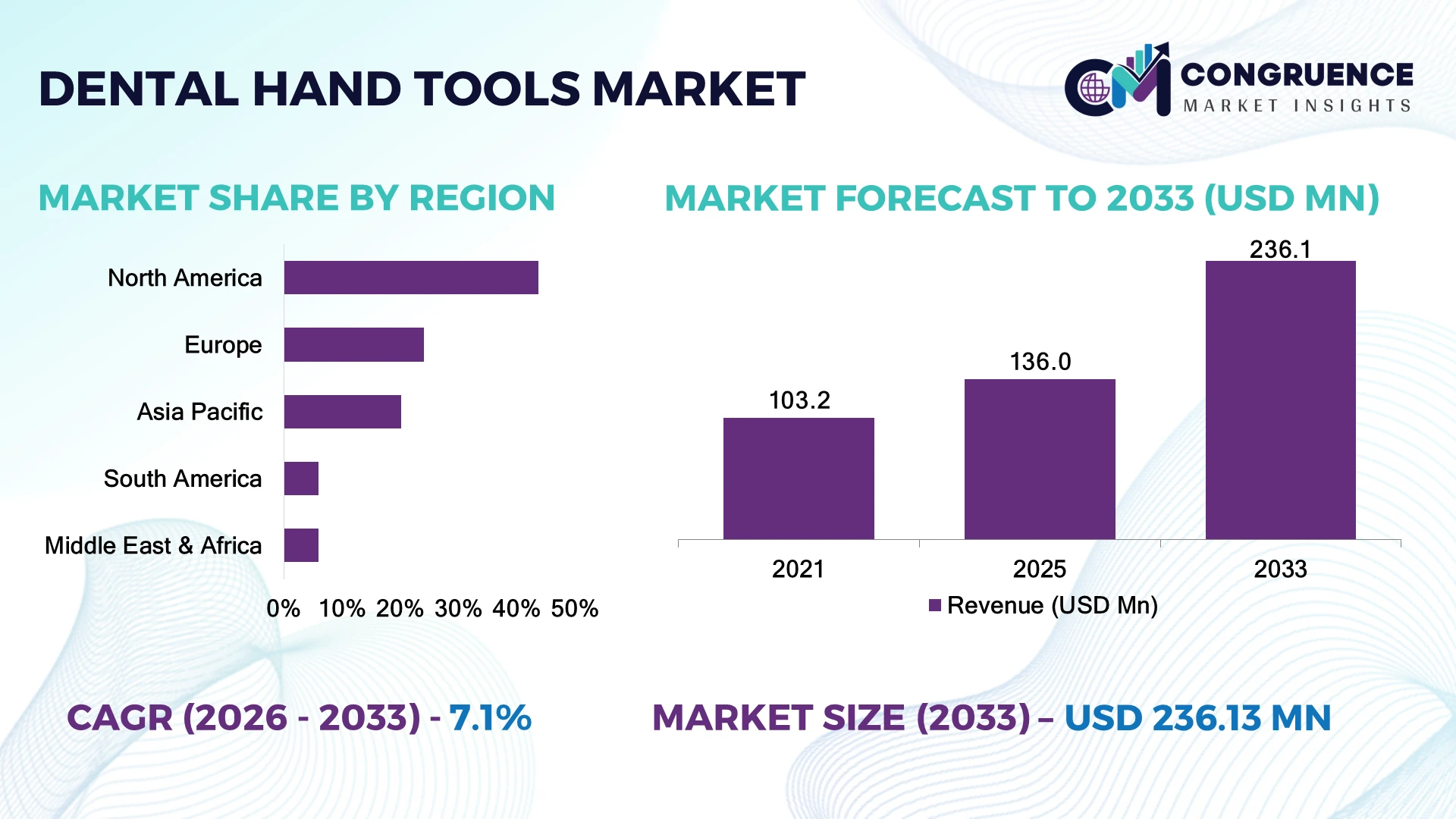
North America dominates with 43.67% market share, supported by high clinical spending, established dental service organizations, and advanced instrument procurement. The United States alone recorded USD 189 billion in dental spending in 2024, compared with rapidly expanding organized dental networks in India, where major clinic chains exceeded 650 locations. Reusable instruments account for 86.32% of usage, reinforcing demand for durable stainless-steel tools.
Strategic implication, manufacturers should prioritize North American institutional contracts while scaling cost-efficient, sterilization-ready portfolios for India and other high-growth markets.
Market Size & Growth: USD 136.0 Million in 2025 is projected to reach USD 236.1 Million by 2033 at a 7.14% CAGR, supported by minimally invasive and endodontic procedure growth.
Top Growth Drivers: Endodontic procedures 6.89%; disposable instruments 7.89%; dental hospitals 7.21%.
Short-Term Forecast: By 2028, automated instrument tracking can reduce processing errors by 15% and improve inventory efficiency by 10%.
Emerging Technologies: AI-assisted treatment planning, ergonomic instrument designs, and advanced corrosion-resistant alloys are reshaping premium tool portfolios.
Regional Leaders: North America reaches about USD 103.1 Million by 2033 with standardized procurement; Europe approaches USD 70.8 Million through premium reusable tools; Asia-Pacific reaches about USD 47.2 Million through organized clinic expansion.
Consumer/End-User Trends: Dental clinics account for 68.12% usage, while reusable instruments represent 86.32%, reflecting preference for durable sterilization-ready products.
Pilot/Case Example: In 2025, organized Indian dental networks exceeding 650 clinics demonstrated how centralized procurement can improve instrument standardization and reduce purchasing fragmentation.
Competitive Landscape: Dentsply Sirona leads at approximately 16% in examination-focused instruments, alongside HuFriedyGroup, Brasseler USA, COLTENE, and Integra LifeSciences.
Regulatory & ESG Impact: The 2025 ISO 13402 update strengthens autoclaving and corrosion-resistance requirements, encouraging longer-life instruments and reduced replacement waste.
Investment & Funding: Approximately USD 165 million in recent dental R&D investment by a leading global dental technology company signals stronger integration of instruments with connected clinical workflows.
Innovation & Future Outlook: Smart tracking, nickel-titanium endodontic systems, modular instrument cassettes, and digitally coordinated procurement will shift competition toward traceability and lifecycle efficiency.
Dental hand tools are gaining traction across preventive dentistry, endodontics, orthodontics, restorative procedures, and surgical applications, with reusable instruments representing 86.32% of market usage. Nickel-titanium systems, ergonomic grips, corrosion-resistant alloys, and traceable instrument cassettes are strengthening clinical efficiency. The 2025 update to international sterilization standards is also pushing manufacturers toward validated, durable designs and tighter reprocessing documentation, creating a stronger transition toward standardized procurement.
Dental hand tools are becoming strategically important because procurement is shifting from individual instruments toward standardized kits, cassettes, and portfolio contracts. Dental clinics represented 68.12% of end-user demand in 2025, giving suppliers with broad portfolios and reliable sterilization documentation a competitive advantage. Organized dental networks are also increasing purchasing consistency across multiple locations.
Technology is changing the economics of instrument management. Digitally tracked instrument sets can reduce manual inventory workloads by roughly 15% compared with paper-based workflows, while ergonomic designs reduce handling inefficiencies during repetitive procedures. North America maintains greater scale and institutional purchasing power, whereas India and Southeast Asia are prioritizing affordable reusable instruments as clinic networks expand.
Over the next 2–3 years, suppliers are positioned to benefit from wider adoption of instrument traceability, standardized cassette systems, and advanced endodontic tools. A practical deployment model is centralized procurement across multi-clinic networks, enabling consistent specifications and lower purchasing fragmentation. Companies are responding through distributor partnerships, localized manufacturing, product-line expansion, and investments in material engineering. Competitive positioning will increasingly depend on lifecycle durability, compliance readiness, and integrated procurement efficiency.
Expansion of organized dental networks is accelerating standardized instrument procurement, with dental clinics accounting for 68.12% of end-user demand and reusable instruments representing 86.32% of usage. Endodontic instruments are also tracking a 6.89% growth rate as tooth-preservation procedures increase. The 2025 ISO 13402 revision places greater emphasis on resistance to autoclaving, corrosion, and thermal exposure. This combination is pushing manufacturers toward stainless-steel optimization, ergonomic engineering, and validated reprocessing documentation. Companies are responding through multi-clinic supply agreements, expanded reusable portfolios, and partnerships with dental distributors. The non-obvious advantage is higher recurring replacement demand from standardized instrument sets rather than isolated individual-tool purchases.
Reusable instruments create substantial lifecycle requirements because 86.32% of usage depends on repeated cleaning, disinfection, packaging, and sterilization. Smaller clinics frequently operate with limited sterilization infrastructure, increasing processing time and equipment utilization. European reprocessing rules also differ across countries, creating additional compliance complexity for manufacturers and distributors. These constraints can increase operating costs by approximately 8–12% for facilities with inefficient instrument workflows and raise purchasing sensitivity among independent practices. Companies are reducing exposure through validated cassette systems, corrosion-resistant materials, longer-life designs, and clearer reprocessing protocols. The strategic pressure is shifting competition from unit price toward total cost of ownership and sterilization efficiency.
Digital traceability represents a significant white-space opportunity as organized clinics seek tighter control over sterilization cycles, inventory, and instrument utilization. Automated tracking can reduce manual inventory workloads by approximately 15% while improving instrument availability by around 10%. India is particularly attractive as organized dental chains expand centralized procurement and standardized clinical workflows. Manufacturers can combine QR-based identification, instrument cassettes, and cloud-linked inventory systems without replacing conventional hand instruments. Companies are positioning through software partnerships, smart packaging, and integrated instrument-management ecosystems. The strongest opportunity lies not in replacing manual tools with electronics, but in connecting durable instruments with digital workflows that increase utilization visibility and reduce avoidable replacements.
Global manufacturers face increasing execution complexity as sterilization, traceability, labeling, and medical-device requirements differ across major markets. The European Union strengthened harmonized sterilization standards in 2025, while national approaches to reprocessing remain differentiated. Compliance-related documentation can increase product-development and validation workloads by 10–15%, particularly for manufacturers serving multiple regulatory jurisdictions. Workforce shortages in specialized dental-device manufacturing add another operational pressure, limiting rapid production scaling and quality-control consistency. Companies must therefore invest in standardized validation platforms, supplier qualification, regional regulatory teams, and manufacturing automation. The key long-term challenge is maintaining identical clinical performance and documentation across distributed production networks without increasing lead times or compromising quality consistency.
Sterilization Workflow Standardization: Dental procurement is shifting toward standardized instrument kits, with reusable tools accounting for 86.32% of 2025 usage while disposable formats expand at 7.89%. Clinics are integrating validated cassette systems, automated tracking, and documented reprocessing workflows. Regulatory tightening around sterilization is accelerating replacement of inconsistent manual protocols, while manufacturers are redesigning handles and surfaces for repeated autoclave exposure and longer service life.
Ergonomic Design Adoption: Instrument manufacturers are prioritizing lightweight handles, textured grips, and balanced force distribution as repetitive clinical tasks increase. Premium ergonomic instruments are gaining adoption across organized practices, with approximately 15% lower handling workload reported in digitally coordinated workflows and efficiency improvements of about 10% in instrument preparation. Companies are expanding ergonomic product lines and partnering with dental-service networks to standardize instrument specifications across multiple facilities.
Localized Supply Networks: Procurement teams are reducing dependence on concentrated overseas supply chains by qualifying regional distributors and secondary manufacturing sources. Stainless-steel instruments still represent roughly 70% of commonly used hand-tool materials, making alloy availability and precision machining important operational factors. India and China are strengthening domestic production capacity, while global manufacturers are increasing regional inventory buffers and supplier diversification to protect delivery schedules and control input-cost volatility.
Digital Inventory Integration: Dental organizations are connecting manual instruments with QR identification, cassette-level tracking, and automated inventory systems. Digital workflows can reduce manual inventory activity by about 15% and improve instrument availability by nearly 10%. The shift is particularly visible among multi-site clinic groups, where standardized tracking reduces misplaced instruments and procurement duplication. Manufacturers are responding by embedding traceability features into packaging, instrument sets, and sterilization-management platforms.
Examination instruments represent the leading type, holding approximately 22.45% market share in 2025. Mirrors, explorers, and periodontal probes remain essential across routine examinations, preventive dentistry, periodontal assessment, and treatment planning, giving this category broader utilization than specialized tools. Their tactile diagnostic function remains relevant even as intraoral scanners and digital imaging become more common. Cutting instruments remain a major mature category because cavity preparation, restorative work, and extraction procedures require dependable manual precision.
Endodontic instruments represent the fastest-growing specialized product group, expanding as tooth-preservation procedures and repeat-use nickel-titanium systems gain adoption. Their recurring replacement cycle creates stronger purchasing frequency than conventional examination tools. Companies are therefore balancing stable examination portfolios with higher-value specialty instruments, investing in corrosion-resistant alloys, ergonomic designs, and precision manufacturing. The strategic shift favors suppliers capable of serving routine-volume demand while developing specialized products with stronger clinical differentiation.
Dental clinics represent the leading application, accounting for approximately 60% of market demand in current industry assessments. Their dominance reflects high volumes of examinations, preventive procedures, restorative treatments, and routine extractions. Hospitals maintain a smaller but strategically important share because their requirements skew toward specialized instruments for oral surgery, trauma-related procedures, and complex cases. Clinic procurement emphasizes durability, standardized sets, and cost efficiency, whereas hospitals place greater emphasis on specialized performance and comprehensive instrument availability.
Hospital applications are emerging as the faster-expanding use case as dental departments become more integrated with multidisciplinary healthcare facilities. Hospital-based procedures require broader instrument configurations and stronger sterilization controls, increasing demand for premium surgical and extraction tools. Companies are responding through application-specific kits, institutional contracts, and distributor partnerships. The key business implication is increasing segmentation between high-volume clinic portfolios optimized for lifecycle economics and hospital portfolios optimized for procedural complexity.
General practitioners constitute the leading end-user group, representing approximately 56% of demand in current market assessments. Their purchasing requirements span examination, cavity preparation, restorative procedures, scaling, and routine extractions, creating broad demand for versatile instruments. Specialists such as oral surgeons and periodontists account for a smaller but higher-value requirement because procedures depend on precision instruments tailored to specific clinical techniques. Academic and research institutions represent a specialized segment where durability, training utility, and instrument variety influence purchasing decisions.
Specialists are the fastest-expanding end-user group as complex procedures, periodontal treatment, endodontics, and cosmetic dentistry become more specialized. Their instrument requirements increasingly favor precision-engineered handles, advanced alloys, and procedure-specific configurations. Manufacturers are responding with specialist-focused portfolios, clinical partnerships, training programs, and premium instrument sets. The commercial implication is clear: general practitioners sustain volume, while specialists increasingly shape innovation priorities and premium product development.
North America accounted for the largest market share at 43.7% in 2025 however, Asia-Pacific is expected to register the fastest growth, expanding at a CAGR of 7.56% between 2026 and 2033.
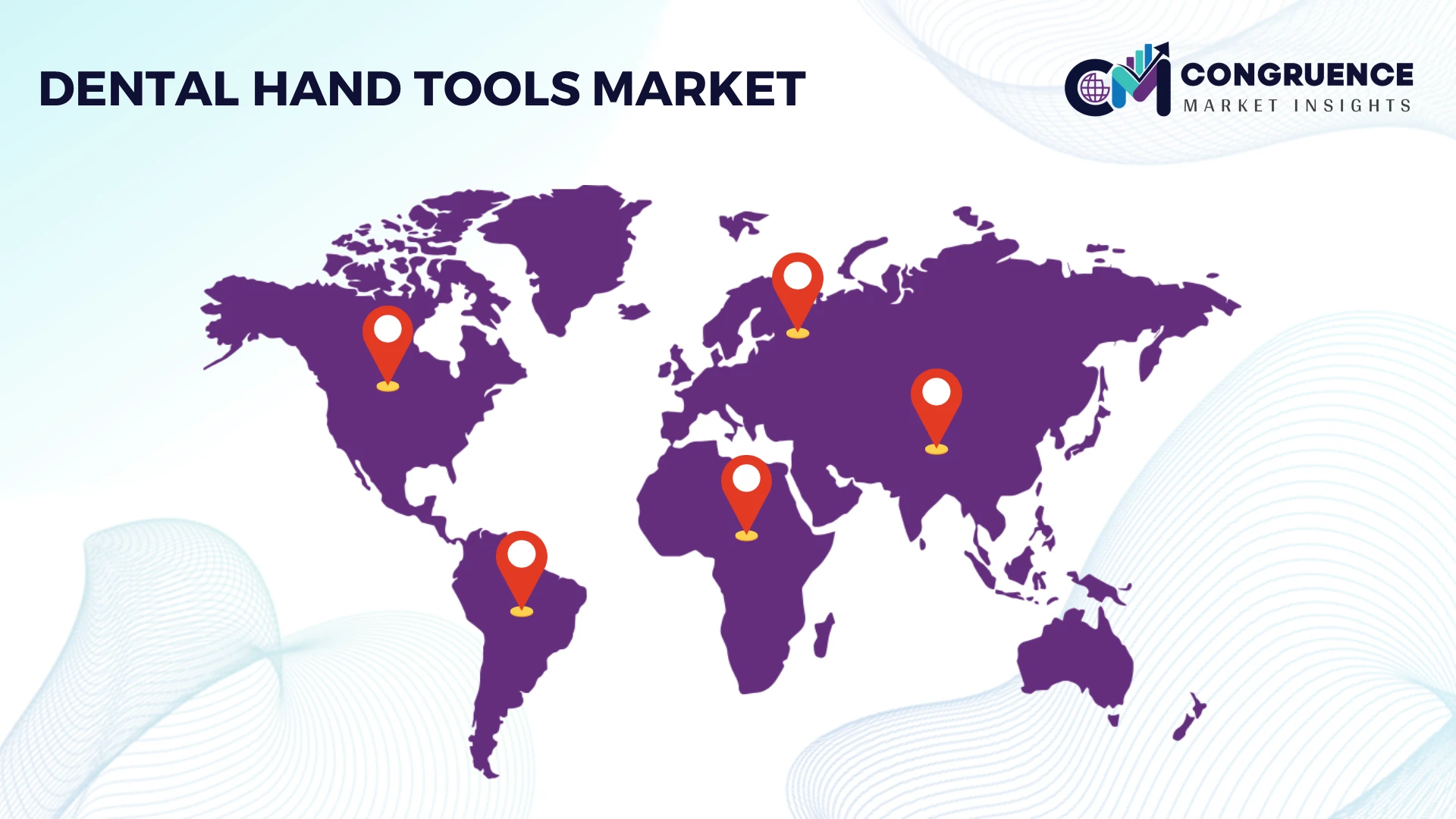
North America held 43.7% of the global dental hand tools market in 2025, supported by extensive dental-service infrastructure, high procedure volumes, and standardized procurement across large practice networks. The United States remains the primary demand center, with national dental expenditure reaching USD 189 billion in 2024 and consumer dental spending increasing 4% through January 2026. Dental service organizations are consolidating purchasing around standardized instrument portfolios, while FDA compliance requirements reinforce demand for validated, traceable products. More than 1,900 practices operated under Heartland Dental in 2025, demonstrating the scale of centralized procurement. Manufacturers are responding with institutional contracts, bundled instrument kits, ergonomic designs, and lifecycle-focused reprocessing solutions.
United States Market Outlook: The United States remains the region's principal commercial and technology hub, combining extensive private-practice infrastructure with large dental-service organizations. Dental expenditure increased 4% in real terms during 2024, strengthening purchasing capacity for advanced instruments. High adoption of digital dentistry also increases the need for precise manual examination and treatment tools that complement imaging and chairside technologies.
Europe represents approximately 24.1% of global dental hand tools demand, supported by mature preventive dentistry systems, specialized manufacturing, and established private dental practices. Germany, the United Kingdom, France, Italy, and Spain form the principal consumption and production centers. Germany accounted for approximately 37.5% of European Union dental-instrument production value in 2025, reinforcing its role as the region's manufacturing anchor. European procurement is increasingly influenced by sterilization documentation, product traceability, and medical-device compliance, while premium clinics prioritize precision-engineered reusable instruments. The United Kingdom accounted for about 24.7% of the European dental-instrument market in 2025, maintaining strong clinical demand despite import and procurement pressures. Manufacturers are strengthening European distribution networks, upgrading material specifications, and aligning portfolios with increasingly stringent compliance requirements.
Germany Market Outlook: Germany combines a substantial dental-care infrastructure with one of Europe's strongest precision-manufacturing ecosystems. Its dental industry generated approximately EUR 6.34 billion in turnover in 2025, while domestic sales increased nearly 6%. This manufacturing depth supports local availability of high-quality dental instruments and accelerates collaboration between equipment producers, dental practices, and engineering specialists.
Asia-Pacific accounted for approximately 20.2% of global dental hand tools demand in 2025 and represents the strongest expansion opportunity as private clinics, dental education, and healthcare infrastructure scale. China led the regional dental-instrument market with a 31.8% share, supported by domestic manufacturing capacity and extensive clinical demand. India followed with approximately 18.6% and is expanding rapidly through private dental chains, dental tourism, and urban healthcare investment. More than 650 clinics operated under Clove Dental in India during 2025, illustrating the growing importance of centralized purchasing. Manufacturers are responding through localized production, lower-cost reusable sets, distributor partnerships, and specialized endodontic portfolios. The region's strategic advantage increasingly combines manufacturing economics with rapidly formalizing dental procurement.
China Market Outlook: China remains the leading Asia-Pacific market because its large patient base, expanding private dental infrastructure, and domestic manufacturing ecosystem support both consumption and supply. Its 31.8% regional share demonstrates significant procurement concentration. Domestic producers are increasingly supplying cost-competitive instruments, while private clinics are upgrading equipment and adopting precision tools for restorative, cosmetic, and endodontic procedures.
South America represented approximately 6.0% of global dental hand tools demand in 2025, with Brazil serving as the principal commercial and clinical hub. A large professional dental workforce, private clinics, dental schools, and expanding specialist services support recurring demand for examination, periodontal, restorative, and extraction instruments. Brazil's extensive dental infrastructure provides greater purchasing depth than Argentina and smaller neighboring markets, while affordability remains an important procurement criterion. Clinics increasingly favor reusable stainless-steel instruments that combine durability with repeated sterilization, supporting lifecycle-oriented purchasing. Import dependence for specialized products creates exposure to currency movements and logistics costs, encouraging distributors to maintain broader inventories. Manufacturers are responding through Brazilian distribution partnerships, localized commercial support, and tiered product portfolios that separate premium precision tools from cost-sensitive routine instruments.
Brazil Market Outlook: Brazil is the region's most strategically significant market because of its extensive dental workforce and established private-practice ecosystem. Its large base of dental professionals supports recurring instrument utilization across general and specialist procedures. Manufacturers can gain scale through national distributor networks, training partnerships, and product portfolios emphasizing durability, sterilization compatibility, and competitive lifecycle costs.
The Middle East & Africa accounted for approximately 6.0% of global dental hand tools demand in 2025, with Gulf countries providing the strongest concentration of advanced clinical infrastructure. Saudi Arabia represents the leading national market, supported by healthcare modernization, private-sector investment, and expanding oral-health awareness. The country's broader dental market reached approximately USD 160 million in 2025, while Turkey is emerging as an important dental-tourism and specialist-treatment hub. New clinics and hospital dental departments are increasingly specifying standardized instrument sets and improved sterilization systems. Partnerships, facility openings, and product launches are strengthening supplier presence across the Gulf. Manufacturers are prioritizing distributor alliances, premium reusable instruments, and procedure-specific portfolios while adapting pricing and inventory strategies to markets with different purchasing capacities.
Saudi Arabia Market Outlook: Saudi Arabia provides the region's strongest combination of healthcare investment, private-sector expansion, and modernization activity. Its dental market reached approximately USD 160 million in 2025, reflecting increasing clinical infrastructure and oral-health awareness. Suppliers are positioning through hospital partnerships, specialized distributors, and premium instrument portfolios suited to modern dental facilities and internationally aligned sterilization practices.
The market pits Dentsply Sirona and HuFriedyGroup against COLTENE, Brasseler USA, Integra LifeSciences, and specialized regional manufacturers. Global leaders compete through premium portfolios and clinical breadth, while regional suppliers emphasize price, customization, and faster distributor fulfillment. The top five players together command an estimated 46.0% share, leaving meaningful room for specialist brands. Competition centers on precision, ergonomic design, sterilization durability, and supply reliability; premium products command roughly 15%–25% price premiums, while localized sourcing can reduce procurement costs by 8%–12%. Players are expanding through distributor agreements, application-specific kits, material innovation, and vertical control of manufacturing and reprocessing ecosystems. The competitive shift is moving from standalone instruments toward integrated procedural portfolios and lifecycle services. Regulatory validation and precision-machining capabilities remain major entry barriers, while stainless-steel input volatility pressures smaller suppliers. Winning requires reliable quality, differentiated ergonomics, broad clinical coverage, responsive supply chains, and partnerships that secure institutional procurement at scale across markets.
Dentsply Sirona
HuFriedyGroup
COLTENE Group
Brasseler USA
Integra LifeSciences
3M
Ultradent Products
Kerr Dental
Premier Dental Products Company
Garrison Dental Solutions
MANI, Inc.
GC Corporation
Septodont
J. MORITA CORP.
Dental hand-tool technology is shifting from conventional stainless-steel designs toward nickel-titanium endodontic files, ergonomic handles, precision-machined tips, and instrument-management systems. Nickel-titanium instruments provide greater flexibility and cyclic-fatigue resistance than traditional hand files, while digitally organized instrument workflows can improve processing efficiency by about 10%–15%. Adoption is strongest among organized clinics and specialist practices.
Connected reprocessing is becoming an important integration layer. Automated cleaning and sterilization systems reduce manual handling, improve process consistency, and support traceability, while cassette-based instrument management standardizes setup and turnover. Practices using automated workflows can achieve approximately 15% lower manual inventory workload than paper-based processes. HuFriedyGroup, COLTENE, and other established suppliers benefit because their portfolios can combine instruments, maintenance, cassettes, and reprocessing solutions.
From 2026–2028, AI-assisted clinical planning will increasingly influence instrument selection without replacing manual tools. Digital imaging and AI-supported workflows will raise demand for precise examination, restorative, and endodontic instruments that integrate with modern procedures. Companies investing in advanced alloys, ergonomic engineering, traceability, and digitally coordinated procurement will gain differentiation. The immediate competitive advantage lies in reducing handling time, extending instrument life, and improving procedural consistency rather than simply adding electronics to conventional tools. Reprocessing data and interoperable procurement increasingly influence institutional purchasing beyond unit price.
June 2025 Dentsply Sirona launched VDW.ROTATE in India, adding an affordable nickel-titanium rotary file system for root-canal preparation. The rollout broadens endodontic access, strengthens emerging-market penetration, and supports faster, standardized preparation workflows for dentists across India and private clinic networks. Source: dentsplysirona.com
March 2025 COLTENE launched six innovations at IDS 2025 spanning endodontics, infection control, restorative care, and polishing. The portfolio expansion strengthened workflow coverage while addressing sterilization compliance, preservation, and clinical efficiency, reinforcing COLTENE’s integrated treatment positioning across global dental practices. Source: coltene.com
January 2025 HuFriedyGroup’s 2025 portfolio expanded coverage across diagnostic, periodontal, surgical, endodontic, orthodontic, and restorative instrumentation, supported by distribution across more than 100 countries. The breadth strengthens bundled procurement, customization, maintenance, and procedural standardization for dental practices and institutions globally. Source: hu-friedy.com
October 2025 Ultradent launched VALO X Colors, expanding its VALO X curing-light range into seven finishes while retaining aerospace-grade aluminum construction and multi-wavelength LED performance. The launch strengthens product differentiation through customization without altering the platform’s clinical positioning for dentists. Source: ultradent.com
The Dental Hand Tools Market Report covers examination instruments, periodontal instruments, restorative instruments, endodontic instruments, surgical instruments, and other specialized hand-tool categories. Application analysis covers dental clinics, hospitals, academic institutions, and specialized treatment settings, while end-user assessment examines general practitioners, specialists, dental organizations, and institutional buyers. The report evaluates procurement patterns, instrument utilization, sterilization requirements, ergonomic adoption, and advanced material integration.
Geographically, the study covers North America, Europe, Asia-Pacific, South America, and the Middle East & Africa, with country-level analysis across major commercial and manufacturing hubs. Particular attention is given to nickel-titanium instruments, ergonomic designs, digital traceability, automated reprocessing, and procedure-specific kits. The analysis supports investment planning, market-entry decisions, supplier diversification, product positioning, institutional contracting, and expansion strategies through 2033, while identifying emerging adoption pockets and competitive shifts shaping 2026–2033.
| Report Attribute / Metric | Details |
|---|---|
| Market Revenue (2025) | USD 136.0 Million |
| Market Revenue (2033) | USD 236.1 Million |
| CAGR (2026–2033) | 7.1% |
| Base Year | 2025 |
| Forecast Period | 2026–2033 |
| Historic Period | 2021–2025 |
| Segments Covered |
By Type
By Application
By End-User
|
| Key Deliverables | Revenue Forecast; Market Trends; Growth Drivers & Restraints; Technology Insights; Segmentation Analysis; Regional Insights; Competitive Landscape; Regulatory & ESG Overview; Recent Developments |
| Regions Covered | North America; Europe; Asia-Pacific; South America; Middle East & Africa |
| Companies Profiled | Dentsply Sirona; HuFriedyGroup; COLTENE Group; Brasseler USA; Integra LifeSciences; 3M; Ultradent Products; Kerr Dental; Premier Dental Products Company; Garrison Dental Solutions; MANI, Inc.; GC Corporation; Septodont; J. MORITA CORP. |
| Customization & Pricing | Available on Request (10% Customization Free) |




