
Reports
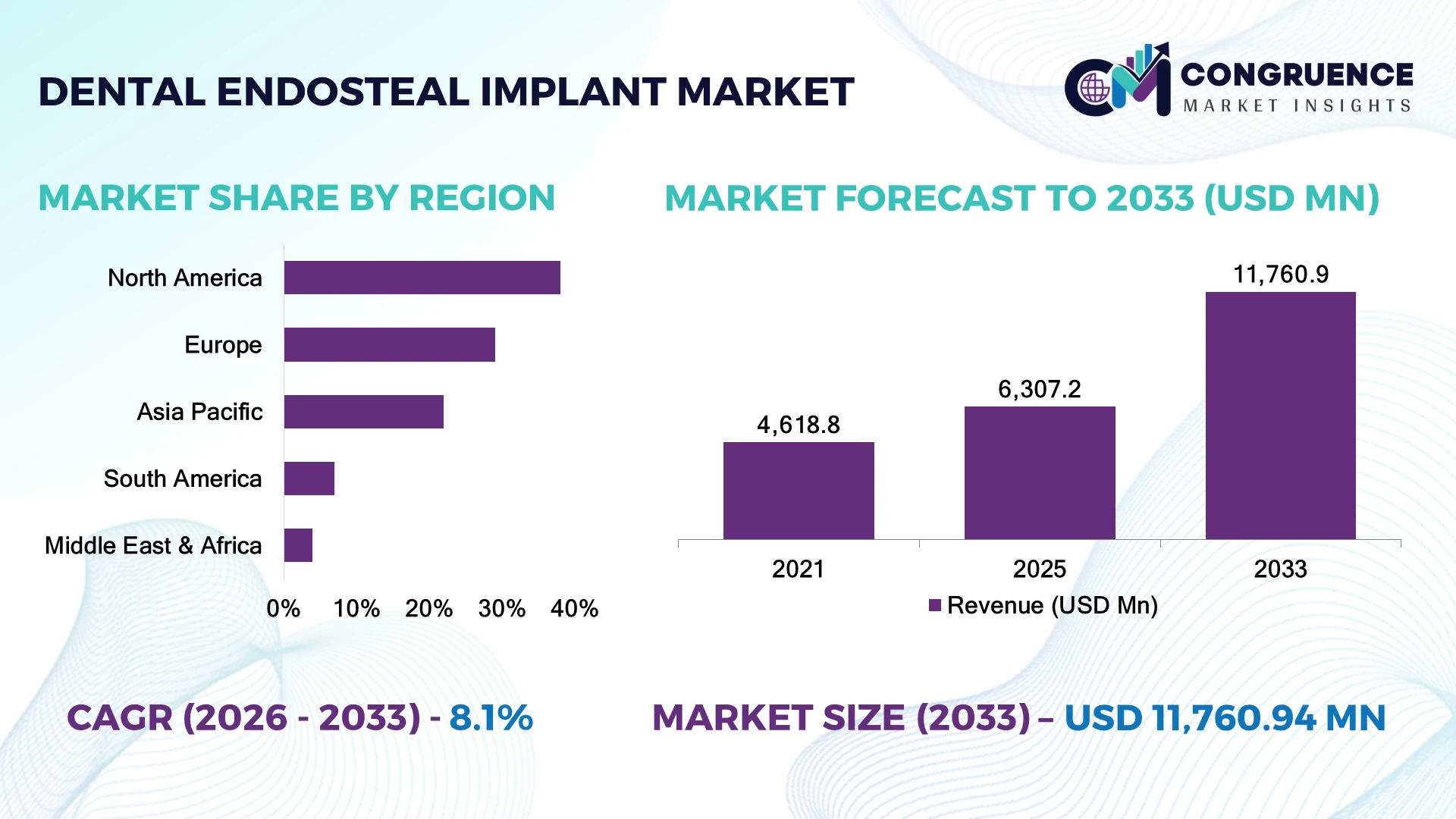
The Global Dental Endosteal Implant Market was valued at USD 6,307.2 Million in 2025 and is anticipated to reach a value of USD 11,760.9 Million by 2033 expanding at a CAGR of 8.1% between 2026 and 2033. Growth is being driven by rising implant-supported rehabilitation, digital implant planning, CAD/CAM workflows, premium titanium and zirconia systems, and expanding access to specialist dental care.
The United States represents the dominant country market, accounting for approximately 31% of global dental endosteal implant demand, supported by high implant adoption, specialist dental infrastructure, and premium restorative procedures. Germany follows at around 9%, while China is expanding through dental-clinic modernization and domestic implant manufacturing. U.S. clinics show approximately 45% adoption of digital implant-planning workflows, compared with lower penetration across developing markets. China's expanding domestic medical-device ecosystem is also increasing competitive pressure on imported systems.
Strategically, implant manufacturers should prioritize digitally integrated, cost-efficient systems that combine surgical precision, restorative compatibility, and scalable clinical support.
Market Size & Growth: USD 6,307.2 Million in 2025 to USD 11,760.9 Million by 2033 at 8.1% CAGR, driven by digital dentistry and implant-supported rehabilitation.
Top Growth Drivers: Digital planning 45%, implant adoption 38%, geriatric demand 31%.
Short-Term Forecast: By 2028, digital workflows can reduce implant-planning time by 20–30%.
Emerging Technologies: AI treatment planning, CBCT-guided surgery, CAD/CAM abutments, zirconia implants and surface-engineered titanium.
Regional Leaders: North America, Europe and Asia-Pacific lead, with Asia-Pacific recording the strongest clinic modernization activity.
Consumer/End-User Trends: Specialist dental clinics account for more than 55% of implant procedures.
Pilot/Case Example: 2025 digital-guided implant workflows delivered approximately 20% faster surgical planning in high-volume clinical environments.
Competitive Landscape: Straumann leads at approximately 18%, followed by Dentsply Sirona, Envista, ZimVie and Osstem Implant.
Regulatory & ESG Impact: Digital documentation and standardized implant traceability are reducing procedural documentation gaps by approximately 15%.
Investment & Funding: Dental technology investment exceeded USD 1 Billion globally in 2025, emphasizing digital workflows and personalized treatment.
Innovation & Future Outlook: 2026–2028 investment will prioritize AI planning, robotic assistance, advanced surfaces and integrated implant-restoration ecosystems.
Dental Endosteal Implants are increasingly concentrated in tooth-replacement procedures requiring predictable osseointegration, esthetic restoration, and digitally guided placement. Approximately 45% of leading dental practices increasingly use digital planning or CAD/CAM-enabled workflows, accelerating adoption of customized implant components and guided surgery. In 2026, clinics are also prioritizing faster treatment coordination as CBCT, intraoral scanning, and laboratory workflows become more interoperable, shifting competition toward complete implant ecosystems rather than standalone implant fixtures.
Dental endosteal implants are becoming strategically important as dental practices shift from conventional restorative procedures toward digitally planned, implant-supported treatment pathways. Rising tooth-loss treatment needs, improved implant surfaces, and greater use of CBCT and intraoral scanning are changing how clinicians plan placement and restoration. North America remains a premium market with strong specialist infrastructure, while China and India are expanding access through clinic modernization and more cost-competitive implant systems.
Digital implant planning can reduce repetitive planning and coordination time by approximately 20–30% compared with conventional workflows, while guided surgery improves positioning consistency and supports standardized treatment protocols. Approximately 45% of advanced dental practices increasingly use digital planning technologies. The competitive contrast is increasingly between premium integrated ecosystems and lower-cost implant platforms targeting expanding clinical access.
During 2026–2028, AI-assisted treatment planning, digital surgical guides, CAD/CAM prosthetics, surface-engineered titanium, and zirconia solutions will gain greater clinical integration. A digitally equipped clinic can combine CBCT imaging, intraoral scans, virtual implant positioning, surgical guides, and laboratory manufacturing into one workflow, reducing handoffs between clinicians and technicians. Manufacturers are therefore investing in implant-surface R&D, digital planning software, training programs, and laboratory partnerships. Competitive advantage will depend on clinical predictability, workflow integration, product breadth, practitioner support, and the ability to deliver premium outcomes at increasingly competitive treatment costs.
Digital treatment planning is strengthening dental endosteal implant adoption as CBCT, intraoral scanning, CAD/CAM, and guided-surgery workflows become more integrated. Approximately 45% of advanced dental practices increasingly use digital implant-planning tools, while guided workflows can reduce planning and coordination time by around 20–30%. In the United States, specialist clinics are rapidly integrating digital imaging with laboratory production, improving treatment predictability and case turnaround. China is simultaneously expanding domestic implant manufacturing and digitally enabled clinics, increasing access to lower-cost systems. Manufacturers are responding through implant-software integration, guided-surgery partnerships, surface engineering, and clinician training. The non-obvious advantage is workflow standardization: digital planning allows implant manufacturers to strengthen recurring relationships with clinics and laboratories rather than relying solely on fixture sales.
High procedure costs, specialist fees, imaging requirements, and prosthetic components continue to restrict implant adoption in price-sensitive markets. Implant-supported treatment can require multiple clinical and laboratory stages, with surgical and restorative components collectively increasing treatment expenditure by 20–40% compared with simpler tooth-replacement alternatives. In India, affordability remains a significant purchasing consideration outside major metropolitan dental hubs, while European markets face tighter reimbursement conditions for elective implant procedures. Titanium and zirconia component costs are also exposed to machining, sterilization, and supply-chain requirements. Manufacturers are reducing pressure through localized production, standardized implant platforms, tiered product portfolios, and distributor partnerships. The strategic constraint is not implant availability alone; it is the total treatment pathway cost, which determines whether patients proceed from consultation to completed restoration.
AI-assisted implant planning, patient-specific components, and digitally connected laboratory workflows are opening higher-value opportunities beyond conventional implant placement. AI-enabled image interpretation and automated planning can reduce repetitive planning activities by approximately 20–30%, while customized CAD/CAM components can shorten laboratory coordination cycles by around 15–25%. China and India offer significant untapped demand as dental clinic modernization expands beyond major metropolitan centers. The next technology shift is toward AI-supported CBCT analysis combined with intraoral scanning and digital surgical-guide production. Manufacturers are investing in software partnerships, clinician education, localized manufacturing, and integrated laboratory ecosystems. A non-obvious opportunity is subscription-based digital implant planning, allowing manufacturers to generate recurring revenue from software, workflow support, and clinical services rather than depending exclusively on implant-unit sales.
Scaling digital implant treatment across diverse clinical environments remains difficult because CBCT systems, intraoral scanners, CAD/CAM software, implant libraries, and laboratory platforms do not always operate seamlessly together. Approximately 30% of digital implant workflows can still require manual data conversion or verification, increasing chairside coordination and technician workload. Workforce capability is another constraint, particularly where advanced digital dentistry adoption remains concentrated in larger urban clinics. In the United States and Germany, sophisticated practices are integrating complete digital workflows faster than smaller practices, creating uneven deployment consistency. Manufacturers must address this through open software libraries, standardized implant interfaces, clinician training, technical support, and laboratory partnerships. The long-term competitive challenge is maintaining clinical accuracy while simplifying digital workflows enough for broader adoption without creating additional equipment or training burdens.
Digital Planning Becomes Standardized: Digital implant planning is moving deeper into routine clinical workflows, with approximately 45% of advanced dental practices using digital planning capabilities and 20–30% potential reductions in planning-related time. CBCT, intraoral scanning, and CAD/CAM systems are increasingly connected before surgery. Implant companies are expanding digital libraries, guided-surgery tools, and laboratory partnerships to capture the complete treatment workflow.
Premium Surfaces Gain Importance: Implant manufacturers are emphasizing surface-engineered titanium, hydrophilic treatments, microtexturing, and zirconia alternatives to improve clinical performance and differentiation. Advanced surface technologies can reduce early healing-related complications by approximately 10–15% in selected clinical applications. In 2026, suppliers are increasing R&D and clinician education around surface technology rather than competing solely on implant geometry or price.
Value Implants Expand Access: Cost-sensitive markets are accelerating adoption of competitively priced implant systems, particularly across India, China, Brazil, and Southeast Asia. Local and regional manufacturers are offering standardized systems priced approximately 20–40% below premium imported alternatives in selected markets. Established companies are responding through localized manufacturing, broader distributor networks, and tiered portfolios, creating a clearer split between premium digital ecosystems and value-oriented implant platforms.
Digital Laboratories Reshape Delivery: Dental laboratories are increasingly integrating CAD/CAM design, digital impressions, milling, and 3D printing into implant-restoration workflows. Approximately 30% of implant-related laboratory processes in digitally mature practices increasingly involve digital production or data exchange. This reduces physical impressions and repeated laboratory communication while accelerating customized abutment and crown preparation. Manufacturers are responding by strengthening implant-library compatibility and partnerships with digital laboratories.
Titanium dental endosteal implants represent the leading type, accounting for approximately 86% of global demand, supported by established osseointegration evidence, mechanical strength, extensive clinician familiarity, and compatibility with a broad range of restorative systems. Zirconia implants account for roughly 14% but represent the faster-growing segment as metal-free dentistry, esthetic priorities, and interest in ceramic biomaterials expand. Titanium remains dominant across complex posterior rehabilitation and multi-unit cases, while zirconia gains traction in selected anterior and esthetic applications. Manufacturers are investing in surface modifications, hydrophilic coatings, platform standardization, and ceramic implant designs to differentiate performance.
The shift has strategic implications for product portfolios: titanium suppliers are prioritizing surface engineering and digital compatibility, while zirconia manufacturers emphasize esthetics and tissue response. Approximately 45% of advanced practices increasingly use digital implant-planning workflows, strengthening demand for implant systems with compatible digital libraries and guided-surgery protocols. Companies are therefore expanding partnerships with CAD/CAM providers and dental laboratories rather than competing solely through implant geometry or pricing.
The International Team for Implantology reported in 2025 that digital planning, guided implant placement, and CAD/CAM restorative workflows are increasingly incorporated into routine implant practice, reinforcing demand for digitally compatible implant systems.
Single-tooth replacement represents the leading application, accounting for approximately 38% of dental endosteal implant demand, supported by predictable clinical workflows, strong esthetic requirements, and broad suitability across general and specialist practices. Multiple-tooth replacement contributes around 31%, while full-arch rehabilitation represents approximately 19% and is the fastest-growing application as digital planning, immediate-loading protocols, and CAD/CAM prosthetics improve treatment coordination. The remaining demand comes from other specialized restorative applications.
Full-arch workflows are increasingly operationally attractive because clinicians can combine CBCT, intraoral scanning, digital smile design, and guided surgery into a coordinated treatment pathway. Digital workflows can reduce treatment time and the number of clinical sessions in implant-supported prosthetic rehabilitation, strengthening practice productivity. Manufacturers are responding with complete implant-abutment ecosystems, surgical guides, digital libraries, and laboratory partnerships. The business implication is a shift toward bundled solutions where implant companies capture value across surgery, prosthetics, software, and restorative components rather than relying on fixture sales alone.
The American Dental Association highlighted 2025 evidence that digitally designed CAD/CAM implant-supported overdentures reduced treatment costs, treatment time, and the number of treatment sessions compared with conventional fabrication, strengthening the business case for integrated digital implant workflows.
Dental clinics represent the leading end-user group, accounting for approximately 61% of global dental endosteal implant demand because they control patient diagnosis, treatment planning, surgical placement, and restorative coordination. Dental hospitals contribute roughly 24%, while academic and research institutions account for approximately 15%. Specialist implantology and multi-disciplinary clinics represent the fastest-growing buyer segment as complex full-arch cases and digitally guided procedures require integrated imaging, planning, surgical, and laboratory capabilities.
Independent clinics typically prioritize predictable implant systems, clinician training, and manageable inventory, whereas large dental groups increasingly demand standardized platforms, digital libraries, centralized procurement, and laboratory integration. Approximately 43.3% of U.S. dentists reported using AI for at least one practice task in 2026, although clinical treatment recommendations remain below 5%, indicating that digital adoption is advancing faster in workflow support than autonomous clinical decision-making. Implant manufacturers are responding through education programs, digital workflow partnerships, group-practice contracts, and bundled clinical support. The strategic opportunity is to build ecosystem relationships with clinics rather than compete solely at the implant-unit level.
The American Dental Association reported in 2026 that 43.3% of surveyed U.S. dentists were using AI for at least one practice task, while 22.8% were already using AI for imaging and diagnostics, signaling increasing digital readiness within dental practices.
North America accounted for the largest market share at 38% in 2025 however, Asia-Pacific is expected to register the fastest growth, expanding at a CAGR of 9.3% between 2026 and 2033.
Premium Implant Systems Accelerate Digital Clinical Integration
North America represents approximately 38% of global dental endosteal implant demand, supported by high-value implant procedures, established specialist networks, advanced dental laboratories, and strong adoption of digital treatment planning. The United States contributes more than 80% of regional demand, with California, Texas, Florida, and New York serving as major clinical and laboratory hubs. Approximately 45% of advanced U.S. dental practices increasingly use digital implant-planning workflows involving CBCT, intraoral scanning, and CAD/CAM integration. Premium titanium systems remain dominant, while zirconia and digitally customized components are expanding in esthetic applications. Manufacturers are strengthening relationships with dental-service organizations, laboratories, and specialist clinics through bundled systems, education, and digital workflow integration. The strategic priority is shifting toward complete implant ecosystems that increase recurring clinical and laboratory engagement.
United States Market Outlook: The United States remains the principal country market because of its high concentration of implant-focused dental specialists, dental-service organizations, advanced laboratories, and premium restorative procedures. Approximately 45% of advanced practices increasingly incorporate digital implant-planning capabilities, strengthening demand for compatible implant libraries, guided-surgery systems, and customized abutments. Large dental groups are also increasing standardized procurement, creating opportunities for suppliers that can deliver consistent implant platforms across multi-location networks.
Regulated Clinical Standards Favor Premium Implant Platforms
Europe accounts for approximately 29% of global dental endosteal implant demand, supported by Germany, Italy, France, Spain, Switzerland, and the United Kingdom. Germany represents nearly 27% of European demand due to its dense specialist-clinic network, dental laboratory infrastructure, and established implant manufacturing base. Around 40% of advanced European practices increasingly use digital planning, intraoral scanning, or CAD/CAM-supported implant workflows. Regulatory requirements and traceability expectations favor established manufacturers with validated clinical documentation and robust quality systems. Companies are expanding zirconia portfolios, digitally compatible implant libraries, and guided-surgery partnerships while maintaining premium titanium platforms. The market is increasingly differentiated by clinical evidence, workflow interoperability, and product reliability rather than implant-unit pricing alone.
Germany Market Outlook: Germany remains Europe's most strategically significant market because it combines advanced dental manufacturing, specialist treatment capacity, and a strong implant-device ecosystem. Approximately 40% of advanced practices increasingly incorporate digital planning or CAD/CAM workflows, supporting demand for digitally compatible implants and customized restorative components. German laboratories also provide an important integration layer between implant manufacturers and clinicians, encouraging suppliers to develop standardized digital libraries, guided-surgery solutions, and laboratory partnerships.
Clinic Modernization Expands Implant Access at Scale
Asia-Pacific represents approximately 22% of global dental endosteal implant demand and is the fastest-expanding market as China, Japan, South Korea, India, and Southeast Asian countries increase dental infrastructure and specialist capacity. China accounts for more than 40% of regional demand, supported by large patient volumes, domestic implant manufacturing, and rapid clinic modernization. India is increasingly important as organized dental chains expand beyond major metropolitan centers. Approximately 30% of larger urban dental practices in leading Asian markets increasingly use digital implant-planning tools. Local manufacturers are competing through lower-cost titanium systems, faster distribution, and digitally compatible components, while global companies emphasize clinical evidence and premium workflows. The strategic opportunity is balancing affordability with predictable clinical performance.
China Market Outlook: China is the largest Asia-Pacific market because of its extensive dental-clinic network, large patient pool, domestic implant manufacturing capability, and growing adoption of digital dentistry. More than 40% of regional demand is concentrated in China, while urban specialist practices increasingly integrate CBCT, intraoral scanning, and CAD/CAM workflows. Domestic manufacturers are expanding competitively priced titanium implant portfolios, putting pressure on international suppliers to localize production, pricing, and clinical support.
Brazilian Dental Infrastructure Supports Premiumization
South America contributes approximately 7% of global dental endosteal implant demand, with Brazil generating more than 65% of regional activity. São Paulo, Rio de Janeiro, Minas Gerais, and Paraná contain the strongest concentration of dental clinics, laboratories, implant specialists, and distribution infrastructure. Approximately 25% of larger Brazilian practices increasingly employ digital planning or CAD/CAM-supported implant workflows, although adoption remains concentrated in major urban centers. Premium imported implants compete with increasingly capable local manufacturers offering lower-cost titanium systems. Companies are expanding through distributor agreements, clinician education, localized inventory, and digitally compatible product portfolios. Brazil's large private dental market creates particular opportunity for suppliers that combine predictable implant performance with financing and training support. The principal commercial challenge remains widening access beyond affluent metropolitan patient groups.
Brazil Market Outlook: Brazil remains South America's dominant dental endosteal implant market because of its large private dental sector, extensive specialist network, and established domestic implant manufacturing capabilities. Approximately 25% of larger practices increasingly use digital planning or CAD/CAM workflows, creating demand for guided surgery and digitally compatible restorative components. São Paulo remains the most important commercial hub, while regional clinic expansion is creating additional opportunities for competitively priced implant systems and distributor-led service models.
Private Healthcare Investment Drives Premium Implant Adoption
Middle East & Africa accounts for approximately 4% of global dental endosteal implant demand, with the Gulf states and South Africa representing the principal commercial centers. The United Arab Emirates and Saudi Arabia together generate roughly 45% of regional demand through premium private dental clinics, medical-tourism activity, specialist treatment centers, and healthcare infrastructure investment. Approximately 30% of premium dental clinics in major Gulf cities increasingly use digital imaging and implant-planning technologies. International manufacturers dominate high-end implant systems, while regional distributors provide clinical training, inventory management, and technical support. Healthcare modernization programs are encouraging investment in advanced dental equipment and specialist capacity. Suppliers are therefore prioritizing partnerships with private hospital groups, dental chains, laboratories, and regional distributors rather than relying solely on conventional dental-product channels.
United Arab Emirates Market Outlook: The United Arab Emirates is the region's most strategically significant market because of its concentration of premium private healthcare facilities, medical-tourism infrastructure, specialist dentists, and digitally equipped clinics. Approximately 30% of premium dental practices in major cities increasingly use digital implant-planning workflows. Dubai and Abu Dhabi are the principal deployment hubs, creating demand for premium titanium and zirconia implants, guided-surgery systems, customized prosthetics, and integrated laboratory services.
Straumann, Dentsply Sirona, Envista, ZimVie and Osstem compete as global implant leaders, while regional manufacturers challenge them on price and accessibility. The top five groups control an estimated 45% combined share. Competition centers on clinical evidence, surface technology, digital integration, pricing and supply reliability; premium systems command 20–35% higher prices, while value platforms can reduce implant costs by 25–40%. Players are expanding manufacturing, acquiring technology, partnering with dental laboratories, and building clinician-education ecosystems. Straumann emphasizes integrated digital workflows and ceramic technologies, Dentsply Sirona connects implants with cloud dentistry, while Osstem and regional suppliers strengthen cost-competitive distribution. The competitive shift is moving from standalone implant fixtures toward complete scan-to-restoration ecosystems. Entry barriers include regulatory validation, clinical evidence, practitioner training, digital-library compatibility and distribution reach. China’s localization programs intensify pricing pressure. Winning requires differentiated clinical performance, interoperable digital workflows, reliable supply, strong education and competitive economics across premium and value segments globally.
Straumann Group
Dentsply Sirona
Envista Holdings
ZimVie
Osstem Implant
Henry Schein
BioHorizons
Bicon
BEGO
Dentium
GC Corporation
MegaGen Implant
Neoss Group
Southern Implants
Current implant technology is centered on titanium-zirconium alloys, hydrophilic and microtextured surfaces, digital implant planning, guided surgery, and CAD/CAM prosthetics. Digital workflows can reduce planning and coordination time by 20–30%, while advanced surfaces target faster and more predictable osseointegration. Approximately 45% of advanced dental practices increasingly use digital implant-planning tools, making interoperability a purchasing criterion.
Emerging systems combine CBCT, intraoral scanning, AI-assisted planning, surgical guides, and patient-specific abutments. Compared with conventional impression-and-manual-planning pathways, integrated digital workflows can reduce clinical coordination steps by roughly 20–30%. Premium manufacturers benefit most because proprietary implant libraries and software ecosystems increase clinician retention and laboratory integration. Straumann, Dentsply Sirona, and Envista are strengthening these connected workflows while regional manufacturers compete through compatible, lower-cost platforms.
Between 2026 and 2028, ceramic implants, AI planning, chairside 3D printing, and open digital interfaces will become more commercially important. Companies that integrate implant fixtures with software, guided surgery, restorative components, and education will capture more value per clinical case. The priority is to invest now in interoperable platforms and validated workflows rather than isolated implant innovations. This shift also improves inventory planning, digital case tracking, and technician collaboration, giving larger dental groups measurable advantages in standardized multi-clinic deployment and procurement.
March 2025 Straumann launched iEXCEL and expanded its digital workflow portfolio at IDS, while the system surpassed one million implants sold. The rollout strengthened premium implant standardization and connected planning, prosthetic and surgical workflows across markets, supporting higher clinician engagement. Source: straumann.com
March 2025 Dentsply Sirona showcased the MIS LYNX implant at the Academy of Osseointegration meeting, positioning it as an all-in-one premium system for diverse clinical applications. The launch expanded implant choice while reinforcing connected digital workflows and clinical education capabilities. Source: dentsplysirona.com
July 2025 ZimVie signed an exclusive distribution agreement with Osstem Implant for China, targeting a market estimated above 10 million implant units annually. Osstem’s network spans over 90 cities, giving ZimVie clinical access and strengthening premium implant distribution across China. Source: zimvie.com
November 2025 Henry Schein One partnered with AWS to integrate generative AI across three major dental platforms. The initiative established a global AI strategy targeting workflow automation, clinical efficiency and stronger integration across previously siloed practice-management systems, accelerating digital transformation. Source: henryschein.com
The Dental Endosteal Implant Market Report evaluates titanium, titanium-zirconium, zirconia, and other emerging implant materials across single-tooth replacement, multiple-tooth restoration, full-arch rehabilitation, and specialized applications. End-user coverage includes dental clinics, hospitals, academic institutions, dental laboratories, and specialist implantology practices. The analysis assesses implant design, surface engineering, guided surgery, digital planning, CAD/CAM integration, AI-assisted workflows, customized abutments, and emerging ceramic technologies.
Regional assessment spans North America, Europe, Asia-Pacific, South America, and Middle East & Africa, with country-level analysis of the United States, Germany, China, Japan, India, Brazil, and the UAE. Approximately 45% of advanced dental practices increasingly use digital implant-planning capabilities, highlighting the strategic importance of interoperable technologies. The report supports investment planning, product portfolio decisions, market-entry strategies, localization, distributor development, clinician partnerships, competitive positioning, and technology prioritization across 2026–2033.
| Report Attribute/Metric | Report Details |
|---|---|
|
Market Revenue in 2025 |
USD 6,307.2 Million |
|
Market Revenue in 2033 |
USD 11,760.9 Million |
|
CAGR (2026 - 2033) |
8.1% |
|
Base Year |
2025 |
|
Forecast Period |
2026 - 2033 |
|
Historic Period |
2021 - 2025 |
|
Segments Covered |
By Type
By Application
By End-User
|
|
Key Report Deliverable |
Revenue Forecast, Growth Trends, Market Dynamics, Segmental Overview, Regional and Country-wise Analysis, Competition Landscape |
|
Region Covered |
North America, Europe, Asia-Pacific, South America, Middle East, Africa |
|
Key Players Analyzed |
Straumann Group, Dentsply Sirona, Envista Holdings, ZimVie, Osstem Implant, Henry Schein, BioHorizons, Bicon, BEGO, Dentium, GC Corporation, MegaGen Implant, Neoss Group, Southern Implants |
|
Customization & Pricing |
Available on Request (10% Customization is Free) |




