
Reports
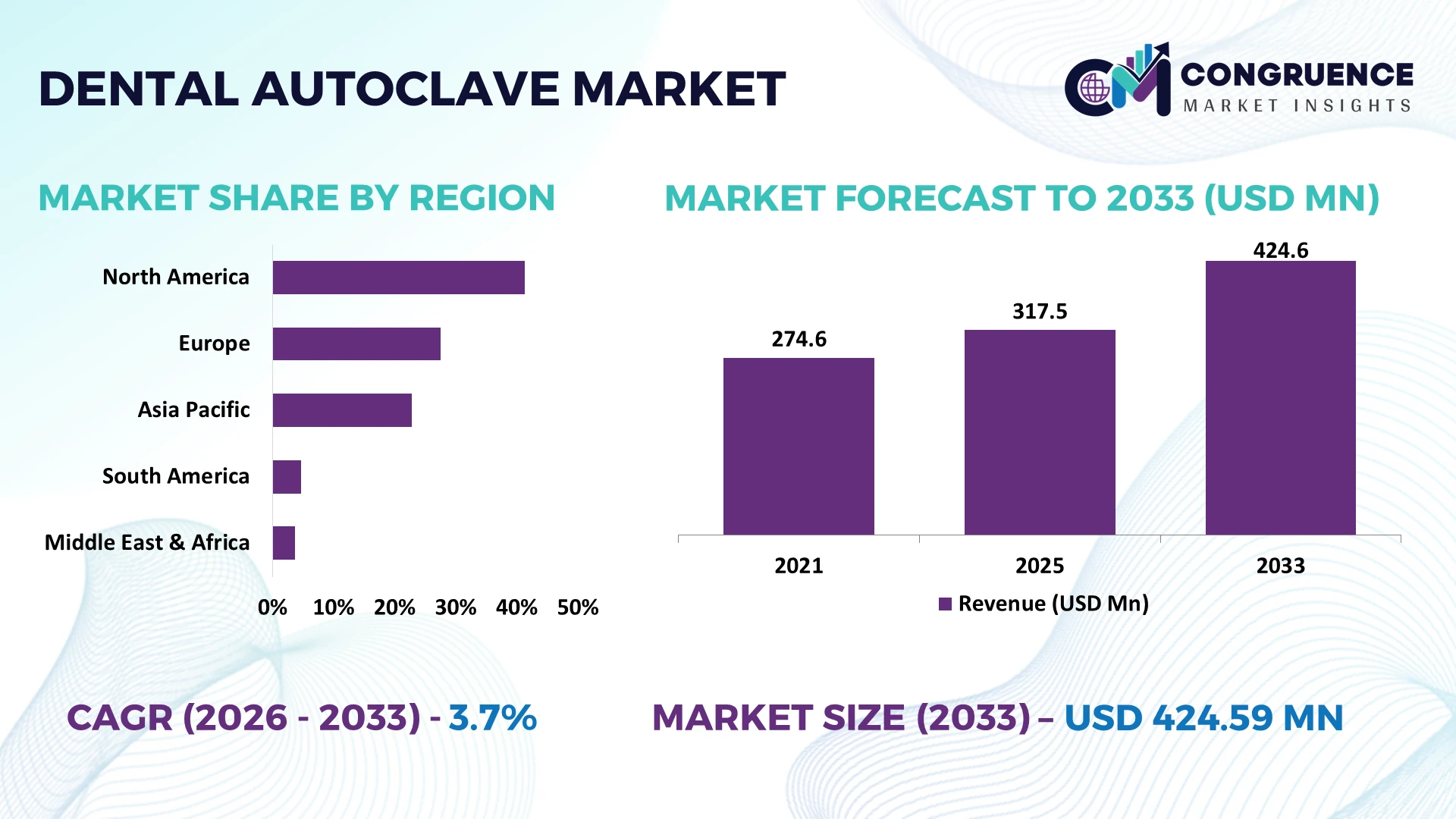
The Global Dental Autoclave Market was valued at USD 317.5 Million in 2025 and is anticipated to reach a value of USD 424.6 Million by 2033 expanding at a CAGR of 3.7% between 2026 and 2033. Growth is being driven by replacement of manual sterilizers with Class B vacuum, fully automatic, IoT-connected systems, alongside tighter infection-control documentation and traceability requirements.
The United States remains the dominant country market, representing about 28.5% of the global stationary dental autoclave market in 2025, while U.S. practices average 1.2–1.4 autoclaves each. About 26.5% of U.S. dentists planned major equipment purchases for 2025, supporting replacement demand across private practices, DSOs, hospitals, and dental schools. FDA recognition of ISO 17665 in 2024 further strengthens validated sterilization workflows, while Class B systems already represent 41.22% of global dental-autoclave revenue.
For strategic decisions, manufacturers should prioritize digitally traceable Class B platforms, water-efficient designs, and scalable service networks across mature U.S. markets and faster-expanding Asian dental hubs.
Market Size & Growth: USD 317.5 Million in 2025 is projected to reach USD 424.6 Million by 2033 at 3.7% CAGR, supported by automated Class B replacement cycles.
Top Growth Drivers: Class B adoption at 41.22%, fully automatic systems at 44.68%, and 20–50-liter units at 59.82% are reshaping purchasing priorities.
Short-Term Forecast: By 2028, automated cycle documentation and connected monitoring are positioned to reduce compliance-related workflow friction by approximately 20–30%.
Emerging Technologies: IoT cycle tracking, predictive-maintenance AI, rapid-cycle Class B vacuum systems, and water-saving sterilization are moving into mainstream procurement.
Regional Leaders: North America leads with 41.26% share; Europe emphasizes EN 13060-compliant systems, while Asia Pacific targets portable and import-substituted equipment.
Consumer/End-User Trends: Dental clinics represented 36.44% of 2025 demand, while hospitals and multispecialty centers are expanding adoption through higher-throughput sterilization workflows.
Pilot/Case Example: In 2025, U.S. dental practices reported 19.5% having already made major equipment purchases, demonstrating active modernization of clinical infrastructure.
Competitive Landscape: Leading suppliers include Dentsply Sirona, Midmark, Getinge, MELAG, COLTENE, Euronda, and Tuttnauer, competing through automation, connectivity, service coverage, and Class B performance.
Regulatory & ESG Impact: Weekly biological monitoring remains recommended, while water-saving autoclaves address tightening sustainability pressures and European wastewater costs.
Investment & Funding: U.S. dentists allocated major-equipment purchasing plans at 26.5% for 2025, reinforcing capital investment in modernized clinical infrastructure.
Innovation & Future Outlook: The strategic shift is toward connected sterilization ecosystems combining automated cycles, digital records, predictive maintenance, lower water consumption, and centralized DSO workflows.
The Global Dental Autoclave Market is increasingly centered on advanced infection-control infrastructure rather than standalone sterilization equipment. Class B vacuum systems, automated controls, and connected cycle records are gaining traction as dental practices standardize reprocessing workflows; fully automatic units already represented 44.68% of 2025 sales. In the U.S., regulatory traceability and equipment modernization are reinforcing replacement demand, while Asia Pacific is expanding portable and cost-efficient deployments.
Dental autoclaves are becoming strategic infrastructure because sterilization performance increasingly affects clinical throughput, regulatory documentation, equipment utilization, and practice operating costs. The U.S. regulatory environment is reinforcing this shift: FDA recognition of ISO 17665 and the February 2026 Quality Management System Regulation have increased the importance of documented cycle validation and traceability.
Technology adoption is moving from conventional manual systems toward fully automatic Class B platforms. Fully automatic units accounted for 44.68% of 2025 sales, while Class B vacuum systems held 41.22%. IoT-enabled cycle tracking can reduce compliance risks by 40% versus less-integrated documentation workflows. North America remains the scale leader, whereas Asia Pacific is advancing through compact equipment, dental-tourism demand, and import-substitution strategies.
Over the next 2–3 years, manufacturers will increasingly target DSOs and multisite clinics with connected sterilization fleets, predictive maintenance, and centralized data management. In the U.S., 26.5% of dentists planned major equipment purchases for 2025, creating a clear replacement channel. Companies combining validated sterilization, digital traceability, energy efficiency, and service partnerships will strengthen operational positioning.
The strongest structural driver is the replacement of basic sterilizers with automated Class B vacuum systems that provide deeper penetration, drying, cycle validation, and digital records. Class B units held 41.22% of 2025 market revenue, while fully automatic models accounted for 44.68%. In the U.S., regulatory emphasis on validated sterilization and traceability is accelerating modernization. CDC guidance also requires mechanical, chemical, and biological monitoring of sterilization processes. Manufacturers are responding with automated printouts, onboard monitoring, IoT connectivity, and predictive diagnostics, turning compliance functionality into a measurable procurement differentiator.
High acquisition costs and component dependency constrain adoption among smaller dental practices. Advanced Class B and fully automatic systems require greater upfront capital, while dental equipment and supplies in the U.S. increased 5% between January and September 2025. Vacuum pumps and specialized control components also remain supply-chain pressure points. These conditions can lengthen replacement cycles and compress clinic-level investment budgets. Manufacturers are responding through modular configurations, financing arrangements, localized sourcing, and service contracts. The key operational issue is shifting from equipment price alone toward total cost of ownership, where water consumption, maintenance frequency, downtime, and validation costs increasingly determine purchasing decisions.
Connected sterilization represents a high-value opportunity as clinics integrate autoclaves with broader digital practice-management infrastructure. Fully automatic systems already captured 44.68% of 2025 sales, while portable designs are expanding at 7.81% as mobile and dental-tourism facilities seek compact workflows. IoT cycle tracking, predictive maintenance, automated compliance records, and water-reduction technologies can create recurring software and service opportunities beyond hardware sales. India and Southeast Asia offer particularly relevant expansion channels as private dental infrastructure develops and import-substitution policies encourage local manufacturing. Companies that combine autoclaves with monitoring platforms, consumables, validation services, and distributor partnerships can capture a larger share of the sterilization workflow.
Long-term competitiveness depends on integrating advanced autoclaves into consistently executed reprocessing workflows rather than simply installing higher-specification equipment. CDC evidence indicates that operator error accounted for 87% of sterilization failures in one assessed dental-office study, demonstrating that equipment capability alone does not guarantee process reliability. Workforce training, cycle selection, load configuration, maintenance, and biological monitoring remain critical execution variables. Companies must therefore invest in intuitive interfaces, automated cycle verification, remote diagnostics, training programs, and service infrastructure. The strategic challenge is maintaining standardized performance across independent clinics and geographically dispersed DSOs while meeting evolving regulatory documentation requirements without increasing workflow complexity.
Connected Cycle Documentation: Digital cycle records, automated alerts, and remote monitoring are moving from premium features toward standard procurement criteria, with fully automatic systems representing about 44.7% of demand. Multi-site dental operators are integrating sterilization logs into centralized workflows, reducing manual documentation and improving audit readiness. Manufacturers are responding with cloud connectivity, touchscreen controls, and remote diagnostics rather than treating the autoclave as a standalone device.
Compact High-Throughput Systems: The 20–50-liter capacity class is gaining traction as clinics balance chamber utilization with limited sterilization-room space, while 59.8% of demand is concentrated in mid-sized capacity configurations. U.S. and European practices are replacing oversized legacy equipment with faster-cycle systems that improve instrument turnaround without expanding floor space. Suppliers are consequently emphasizing modular chambers, rapid cycles, and lower water consumption.
Supply Chains Favor Localization: Tariff pressure, longer component lead times, and geopolitical disruption are encouraging manufacturers to diversify sourcing for pumps, sensors, valves, and electronic controls. Component localization is increasingly important as equipment manufacturers seek to protect service levels and reduce inventory exposure. The non-obvious shift is that after-sales parts availability is becoming a purchasing criterion alongside sterilization performance, prompting regional stocking hubs and distributor partnerships.
Energy-Efficient Sterilization Gains Ground: Water consumption, electricity use, and maintenance frequency are increasingly evaluated during equipment replacement, particularly among larger clinic groups. Advanced systems can reduce resource consumption by roughly 15–25% versus older-generation equipment under comparable operating patterns. European sustainability requirements are strengthening this transition, while manufacturers are redesigning heating systems, drying cycles, and standby modes to lower total operating costs.
Automatic dental autoclaves represent the leading technology category, with fully automatic systems accounting for approximately 44.7% of global demand. Their dominance reflects automated air removal, steam admission, drying, cycle verification, and digital documentation, which reduce operator intervention and standardize sterilization outcomes. Semi-automatic units remain important for cost-sensitive clinics because preset programs provide a balance between automation and acquisition economics, while manual systems increasingly serve smaller or replacement-driven installations.
The fastest adoption is shifting toward automatic platforms as dental groups standardize equipment across multiple locations. Approximately 30–35% of procurement decisions increasingly emphasize integrated monitoring and documentation rather than basic sterilization capability alone. Manual systems retain relevance in price-sensitive markets, but their strategic role is narrowing as compliance workflows become more digitized. Manufacturers are therefore prioritizing automatic portfolios, modular upgrades, service contracts, and connected software ecosystems. The investment implication is clear: automation capability is becoming a stronger differentiator than chamber size alone.
Dental clinics represent the leading application, accounting for approximately 43.7% of demand in comparable tabletop sterilization deployments. High procedure frequency, repeated handpiece processing, and limited sterilization-room capacity keep clinics dependent on compact, rapid-cycle systems. Hospitals require larger throughput and more complex load management, while laboratories and other applications prioritize specialized instrument-processing requirements. This creates a clear split between high-frequency clinical sterilization and specialized institutional workloads.
The fastest operational shift is occurring in multi-chair clinics and corporate dental networks, where standardized sterilization workflows are replacing location-specific equipment practices. Approximately 35–40% of purchasing priorities increasingly center on turnaround speed, automated documentation, and equipment reliability. Hospitals continue favoring higher-throughput systems, while laboratories emphasize load flexibility. Manufacturers are responding with compact Class B configurations, rapid cycles, standardized interfaces, and centralized monitoring. The business implication is that application-specific workflow design is becoming essential for securing repeat equipment orders.
Dental practitioners and private clinical operators form the core end-user base because sterilization occurs continuously between patient procedures. Dental laboratories represent a more specialized demand pool, while academic and research institutes purchase equipment according to training, testing, and laboratory throughput requirements. Approximately 40–45% of purchasing priorities across clinical users increasingly emphasize reliability and turnaround time, compared with a stronger upfront-cost orientation among smaller practices.
The fastest shift is occurring among organized dental groups and multi-site operators, which are standardizing sterilization equipment, service agreements, consumables, and digital records across locations. Independent practices remain more price-sensitive and continue using semi-automatic configurations where capital budgets are constrained. Academic and research users prioritize programmability and validation, while laboratories favor flexible loading configurations. Manufacturers are responding with tiered product portfolios, financing programs, distributor partnerships, and enterprise service contracts. This is shifting competition from one-time equipment sales toward standardized installed-base management and recurring service relationships.
North America accounted for the largest market share at 41.3% in 2025 however, Asia Pacific is expected to register the fastest growth, expanding at a CAGR of 5.33% between 2026 and 2033.

North America held approximately 41.3% of the global dental autoclave market in 2025, supported by dense private-practice networks, dental service organizations, and established infection-control protocols. The United States represents the overwhelming regional deployment base, with practices averaging roughly 1.2–1.4 autoclaves each. Class B vacuum systems and automated cycle documentation are increasingly prioritized as clinics modernize sterilization rooms. Canada maintains strong adoption through standardized infection-prevention practices, while Mexico presents a wider technology gap between urban and rural facilities. Manufacturers are expanding distributor coverage, remote diagnostics, and service contracts to protect installed bases. The strategic shift is toward connected equipment that reduces manual documentation while supporting consistent sterilization across multi-location dental groups.
United States Market Outlook: The United States remains the principal country market because of its extensive private dental infrastructure, high equipment-replacement activity, and mature DSO ecosystem. Approximately 26.5% of U.S. dentists planned major equipment purchases in 2025, supporting continued modernization of sterilization equipment. Manufacturers are increasingly targeting group practices with standardized platforms, automated documentation, preventive maintenance, and fleet-level service agreements.
Europe represented approximately 27.5% of global dental autoclave demand in 2025, with Germany, the United Kingdom, France, Italy, and Spain forming the principal installed-base markets. EN 13060 compliance, MDR requirements, and stronger documentation practices favor Class B systems with validated cycles and traceability. Germany's engineering ecosystem supports premium equipment adoption, while the United Kingdom is increasingly focused on consistent compliance and equipment servicing. Sustainability is also becoming operationally relevant as clinics assess water and electricity consumption alongside acquisition cost. Manufacturers are responding with energy-efficient heating, optimized drying cycles, water-recycling configurations, and digital maintenance platforms. Approximately 30% of European procurement priorities increasingly emphasize lifecycle efficiency rather than purchase price alone, strengthening the position of premium manufacturers with established service networks.
Germany Market Outlook: Germany is the leading European country market, supported by advanced dental infrastructure, domestic medical-device engineering capabilities, and strong compliance requirements. Its established network of specialist dental practices favors high-performance Class B systems with automated documentation. Manufacturers benefit from Germany's concentration of technically sophisticated buyers, while local production and service capabilities shorten equipment-maintenance cycles and strengthen customer retention.
Asia Pacific accounted for approximately 22.8% of global dental autoclave demand in 2025 and represents the fastest-expanding regional deployment base. China, Japan, India, South Korea, and Australia anchor demand, but their purchasing profiles differ sharply. China combines manufacturing depth with rapidly expanding private dental infrastructure, while India emphasizes cost-efficient equipment and localized servicing. Portable systems are expanding particularly quickly, with deployment growth of about 7.8% as smaller clinics and dental-tourism facilities seek compact sterilization solutions. Manufacturers are responding through local assembly, distributor partnerships, mid-tier product lines, and component localization. The strategic opportunity is not simply unit-volume expansion: localized production can reduce landed costs, shorten replacement lead times, and improve after-sales coverage in price-sensitive markets.
China Market Outlook: China represents the region's largest manufacturing and deployment opportunity, combining domestic medical-equipment production with a rapidly expanding private dental network. National initiatives emphasizing dental-facility construction and service-quality supervision are strengthening the infrastructure base. Manufacturers are increasingly localizing components and developing mid-range automated autoclaves to compete on acquisition cost, service availability, and replacement-part accessibility.
South America represented approximately 4.7% of global dental autoclave demand in 2025, with Brazil and Argentina providing the largest installed bases. Brazil's extensive private dental network creates sustained equipment demand, while Mexico-linked supply chains and imported medical-device components influence availability across Latin American markets. Approximately 25–30% of procurement activity increasingly favors automated or semi-automatic equipment where clinics can justify higher upfront investment through faster turnaround and simplified cycle control. Smaller practices remain more price-sensitive, creating a two-tier market between advanced metropolitan clinics and lower-resource facilities. Manufacturers are responding with distributor-led expansion, localized service partnerships, financing arrangements, and tiered product portfolios. Brazil's scale makes it the primary platform for establishing regional service and replacement networks.
Brazil Market Outlook: Brazil is the strategically significant South American market because of its large private dental sector, extensive network of dental professionals, and concentration of specialized clinics in major urban centers. São Paulo and other metropolitan hubs support greater adoption of automated sterilization equipment, while smaller practices continue to favor cost-controlled configurations. Manufacturers are strengthening distributor relationships and technical-service coverage to expand beyond premium urban buyers.
The Middle East & Africa accounted for approximately 3.7% of global dental autoclave demand in 2025, with purchasing concentrated in Gulf healthcare hubs and major urban centers across South Africa, Egypt, and selected Middle Eastern markets. Hospital modernization, private dental-clinic development, medical tourism, and new healthcare facilities are supporting adoption of automated sterilization equipment. The United Arab Emirates and Saudi Arabia are particularly important deployment centers because premium private healthcare infrastructure supports higher-specification equipment. Approximately 20–25% of procurement priorities increasingly emphasize automation, traceability, and after-sales support rather than basic sterilization capability. Manufacturers are responding through local distributors, hospital partnerships, regional service centers, and bundled maintenance agreements. The key commercial constraint remains uneven infrastructure, making service availability as important as equipment specification.
Saudi Arabia Market Outlook: Saudi Arabia represents a strategically important country market because healthcare infrastructure investment is expanding modern private and institutional dental capacity. New clinical facilities increasingly require standardized infection-control equipment, creating demand for automated autoclaves with documented cycles and dependable service support. Manufacturers are positioning through local distribution partnerships, technical training, and maintenance contracts designed for large healthcare operators and expanding dental networks.
The competitive field pits global OEMs such as Midmark, Tuttnauer, MELAG, W&H, and COLTENE against regional sterilization specialists and lower-cost manufacturers competing for dental-clinic replacement programs. The top five players collectively control an estimated 38% of the market, leaving room for regional suppliers. Competition centers on technology, price, service reach, and supply reliability: connected systems command 10–15% higher positioning, automation can reduce operator workload 20–30%, and premium Class B platforms differentiate through faster drying and traceability. Midmark is expanding installed-base conversion through trade-in programs, while Tuttnauer uses purchasing partnerships. W&H and COLTENE emphasize capacity, connectivity, and workflow integration; regional manufacturers compete through lower acquisition costs and localized service. The competitive shift is moving from hardware specifications toward integrated sterilization ecosystems and lifecycle support. Entry barriers include validation requirements, distributor networks, technical servicing, and established clinical trust. Winning requires consistently reliable Class B performance, digital traceability, service, and total cost of ownership.
Midmark Corporation
Tuttnauer
MELAG Medizintechnik
W&H Dentalwerk Bürmoos GmbH
COLTENE Group
Euronda S.p.A.
Dentsply Sirona
Getinge AB
Mocom S.r.l.
SciCan
Runyes Medical Instrument Co., Ltd.
Ningbo Runyes Medical Instrument Co., Ltd.
Systec GmbH
Shinva Medical Instrument Co., Ltd.
Dental autoclave technology is shifting from standalone steam chambers toward automated, connected sterilization platforms. Class B vacuum systems improve steam penetration and drying, while IoT-enabled models transmit cycle data, maintenance alerts, and compliance records. Connected monitoring can reduce documentation workload by roughly 20–30%, and automated controls improve process consistency by about 10–15%. Adoption is strongest among multi-chair practices and dental groups standardizing reprocessing.
The emerging layer combines artificial-intelligence assistance, predictive maintenance, touchscreen workflow guidance, and remote diagnostics. AI-supported operator guidance can reduce cycle-selection and procedural errors by an estimated 10–15%, while predictive servicing can cut avoidable downtime by 5–10%. Wi-Fi-enabled sterilizers are increasingly deployed where centralized oversight matters, allowing technical teams to identify maintenance needs without waiting for onsite failure. This favors manufacturers with software, service, and installed-base capabilities.
From 2026–2028, disruptive differentiation will center on integrated reprocessing ecosystems, larger compact chambers, water-efficient cycles, and automated traceability. Newer connected systems can deliver roughly 15–25% faster workflow turnaround than older manual configurations when cycle documentation and drying are included. Technology leaders benefit most because recurring software, service, and consumables strengthen customer retention. Companies acting now can lock in clinic networks before connected sterilization becomes a standard procurement requirement across major markets.
May 2025 Midmark launched its 2025 Sterilizer Trade-In Promotion, offering rebates up to $500 for qualifying M9 and M11 purchases. The program targets replacement of legacy tabletop units, accelerating automated workflow upgrades and creating a installed-base conversion channel. Source: midmark.com
February 2025 Tuttnauer secured Premier’s Technology Breakthrough designation for its T-Top Autoclaves, effective January 17, expanding access to pre-negotiated sterilization solutions. The agreement strengthens institutional purchasing reach while positioning cost-efficient sterilization technology for broader U.S. dental practice deployment. Source: tuttnauer.com
February 2025 W&H introduced the Lara XXL sterilizer with a 38-liter chamber, supporting up to 10 kg of packaged instruments and 12 kg of containers. The high-capacity design targets throughput bottlenecks and strengthens productivity for high-volume dental practices. Source: wh.com
March 2025 Euronda presented E9 and E8 autoclaves with an artificial-intelligence-based upgrade at IDS 2025. The technology provides immediate operator support tools, reinforcing automated sterilization workflows and differentiating Euronda through software-enabled process assistance and traceability systems for clinics. Source: euronda.com
The Dental Autoclave Market Report covers product segmentation by type, application, and end-user, assessing how automation, Class B vacuum technology, compact systems, connected monitoring, and high-capacity sterilizers are reshaping procurement. Application coverage evaluates dental clinics, hospitals, laboratories, and other sterilization-intensive environments, while end-user analysis examines private practitioners, organized dental groups, laboratories, and institutional buyers.
Geographically, the report evaluates North America, Europe, Asia Pacific, South America, and the Middle East & Africa, with country-level assessment of deployment, infrastructure, manufacturing, regulation, and technology adoption. Approximately 40–45% of purchasing priorities increasingly emphasize reliability and turnaround performance, highlighting the strategic value of advanced systems. The analysis supports investment planning, regional expansion, product positioning, partnership development, supply-chain planning, and competitive strategy throughout 2026–2033.
| Report Attribute / Metric | Details |
|---|---|
| Market Revenue (2025) | USD 317.5 Million |
| Market Revenue (2033) | USD 424.6 Million |
| CAGR (2026–2033) | 3.7% |
| Base Year | 2025 |
| Forecast Period | 2026–2033 |
| Historic Period | 2021–2025 |
| Segments Covered |
By Type
By Application
By End-User
|
| Key Deliverables | Revenue Forecast; Market Trends; Growth Drivers & Restraints; Technology Insights; Segmentation Analysis; Regional Insights; Competitive Landscape; Regulatory & ESG Overview; Recent Developments |
| Regions Covered | North America; Europe; Asia-Pacific; South America; Middle East & Africa |
| Companies Profiled | Midmark Corporation; Tuttnauer; MELAG Medizintechnik; W&H Dentalwerk Bürmoos GmbH; COLTENE Group; Euronda S.p.A.; Dentsply Sirona; Getinge AB; Mocom S.r.l.; SciCan; Runyes Medical Instrument Co., Ltd.; Systec GmbH; Shinva Medical Instrument Co., Ltd. |
| Customization & Pricing | Available on Request (10% Customization Free) |




