
Reports
The Global Customer Experience Outsourcing Services Market was valued at USD 79320 Million in 2025 and is anticipated to reach a value of USD 183720.18 Million by 2033 expanding at a CAGR of 11.07% between 2026 and 2033. Rising enterprise investment in AI-enabled omnichannel support, multilingual customer engagement platforms, and outsourced digital interaction management across banking, telecom, retail, and healthcare sectors is accelerating high-volume contract expansion and operational scalability worldwide.
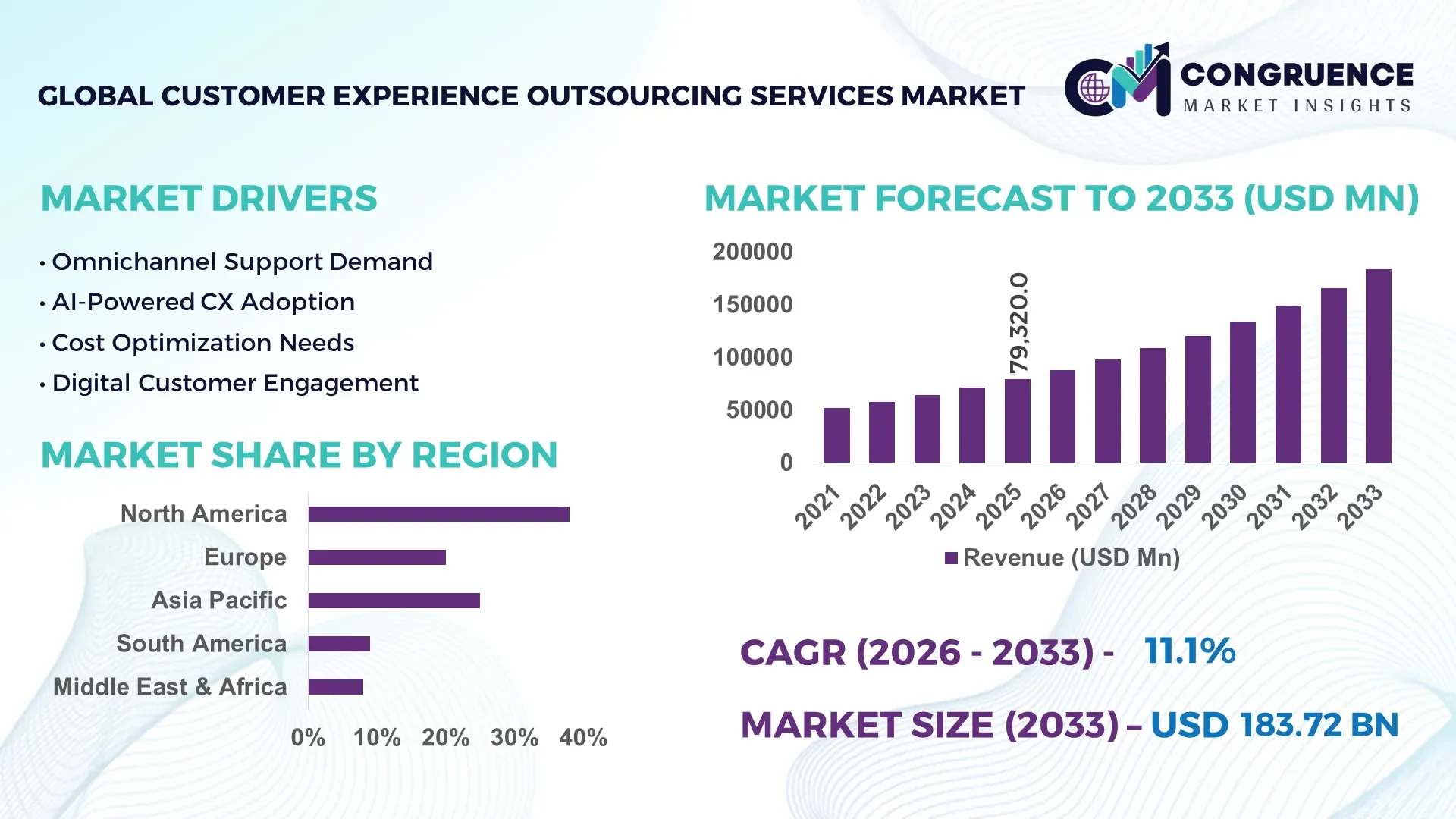
The United States dominated the global Customer Experience Outsourcing Services Market with over 34% service demand share in 2025, supported by large-scale outsourcing contracts from BFSI, e-commerce, healthcare, and technology enterprises managing more than 70% of customer interactions through cloud-based engagement systems. India remained the largest offshore delivery hub, accounting for nearly 28% of global CX outsourcing workforce capacity due to lower operational costs, advanced digital support infrastructure, and strong AI integration across contact centers. The Philippines sustained leadership in voice-based outsourcing, with voice support contributing over 55% of its CX export operations. Geopolitical supply-chain diversification following Red Sea shipping disruptions and enterprise continuity planning accelerated nearshore expansion across Eastern Europe and Latin America, where automation-assisted CX operations improved ticket resolution efficiency by 31% compared to traditional legacy models.
Enterprises prioritizing scalable AI-assisted outsourcing ecosystems and geographically diversified delivery networks are securing faster customer retention gains, stronger operational resilience, and lower service management costs in the global competitive environment.
Market Size & Growth: USD 79.3 billion in 2025 advancing toward USD 183.7 billion by 2033, driven by AI-powered omnichannel customer engagement and enterprise cloud migration acceleration.
Top Growth Drivers: AI automation adoption exceeded 48%, cloud CX deployment crossed 61%, and multilingual outsourcing demand expanded by 37% globally.
Short-Term Forecast: By 2027, automated ticket handling reduces response time by 32% while operational support efficiency improves by 29% across advanced CX outsourcing networks.
Emerging Technologies: Generative AI, predictive analytics, and conversational automation increased first-contact resolution rates by nearly 35% in enterprise-scale deployments.
Regional Leaders: North America surpassed USD 31 billion demand, Asia-Pacific crossed USD 24 billion delivery value, while Europe accelerated digital CX adoption by 26%.
Consumer/End-User Trends: More than 67% of enterprises shifted toward hybrid digital-human engagement models to improve retention and personalized service delivery performance.
Pilot/Case Example: In 2025, a global telecom outsourcing transition integrated AI chat routing, reducing customer escalation rates by 41% within 12 months.
Competitive Landscape: Top providers controlled nearly 39% market concentration, led by multinational outsourcing firms alongside advanced digital CX specialists and cloud-native operators.
Regulatory & ESG Impact: Data localization compliance investments increased by 33% as cross-border outsourcing operations adapted to stricter digital governance frameworks.
Investment & Funding: Global CX outsourcing infrastructure investments exceeded USD 14 billion, fueled by automation partnerships, cybersecurity upgrades, and regional delivery center expansion.
Innovation & Future Outlook: AI copilots, sentiment analytics, and hyper-personalized engagement platforms are reshaping high-growth customer experience outsourcing transformation strategies.
Enterprise demand for multilingual digital engagement, AI-assisted support operations, and industry-specific customer retention services continues expanding across banking, retail, healthcare, and telecom environments. Advanced conversational AI platforms improved resolution productivity by 30% in large-scale deployments during 2026, while stricter data governance regulations accelerated regional delivery diversification and cybersecurity investments, setting the foundation for broader strategic transformation across the Customer Experience Outsourcing Services Market.
Customer experience outsourcing services are becoming strategically critical as enterprises compete on retention efficiency, digital responsiveness, and multilingual engagement quality rather than product pricing alone. Large enterprises shifted over 58% of customer interaction management toward outsourced digital ecosystems in 2026 to reduce infrastructure overhead and accelerate service scalability. The market is also benefiting from global supply-chain restructuring and data localization mandates, forcing companies to diversify delivery centers across India, Poland, Mexico, and the Philippines to improve continuity, compliance, and operational resilience.
AI-assisted CX platforms are outperforming legacy call-center systems with nearly 34% lower handling time and 29% higher first-contact resolution efficiency through predictive routing, sentiment analytics, and automation-led workforce orchestration. The United States leads in high-value omnichannel deployment, while India dominates scalable offshore digital support operations with over 6 million CX employees supporting global contracts. In contrast, Eastern European providers are expanding cybersecurity-focused CX delivery models for regulated industries including banking and healthcare.
Telecom and retail operators are increasingly partnering with cloud-native outsourcing firms to deploy integrated AI chat support, reducing escalation rates by more than 40% during peak service periods. Over the next three years, enterprise investment priorities will center on automation integration, multilingual digital engagement, and secure decentralized delivery infrastructure, positioning advanced CX outsourcing providers as long-term strategic partners rather than transactional service vendors.
Enterprise migration toward AI-enabled omnichannel customer management platforms is accelerating outsourcing demand across telecom, banking, healthcare, and e-commerce industries. More than 63% of large enterprises integrated conversational AI and automated ticket orchestration into outsourced operations during 2026, while cloud-native CX systems reduced average response handling costs by nearly 28%. India and the Philippines expanded digital delivery capacity through workforce upskilling and automation-centric contact center modernization as enterprises shifted away from fragmented legacy support models. Rising cross-border digital commerce and stricter customer retention benchmarks are forcing companies to prioritize real-time multilingual engagement capabilities. In response, outsourcing providers are investing in predictive analytics, cybersecurity infrastructure, and regional delivery diversification partnerships to secure high-value enterprise contracts and improve operational resilience.
Data sovereignty regulations and fragmented digital infrastructure are creating operational constraints for cross-border customer experience outsourcing deployments. More than 41% of multinational enterprises reported increased compliance costs linked to regional data storage mandates and AI governance requirements in 2026. European financial institutions faced deployment delays averaging 18% due to interoperability limitations between legacy CRM systems and cloud-based outsourcing platforms. Rising cybersecurity incidents targeting customer interaction databases also increased enterprise spending on compliance audits and secure infrastructure upgrades. Companies operating in Latin America and Southeast Asia continue facing bandwidth inconsistency and uneven cloud infrastructure maturity, limiting advanced omnichannel integration scalability. To reduce operational exposure, providers are localizing data centers, restructuring vendor contracts, and prioritizing region-specific compliance frameworks across regulated industries.
Industry-specific outsourcing ecosystems integrating predictive analytics, AI copilots, and customer sentiment intelligence are opening high-value opportunities across healthcare, fintech, logistics, and retail sectors. Automated engagement systems improved customer retention performance by nearly 26% in subscription-based businesses, while AI-enabled workforce optimization reduced staffing inefficiencies by 31%. Japan and the United Arab Emirates accelerated smart-service infrastructure investments to strengthen digital citizen engagement and multilingual support operations. Demand for low-latency customer support integrated with real-time analytics is also expanding nearshore outsourcing opportunities in Mexico and Poland. Outsourcing firms are increasingly forming cloud partnerships and investing in proprietary AI training models to differentiate specialized service offerings, creating competitive advantages beyond labor arbitrage and traditional voice-support operations.
Rapid AI integration and increasingly complex digital interaction environments are creating long-term execution challenges across the customer experience outsourcing ecosystem. Nearly 46% of outsourcing providers reported talent shortages in AI supervision, multilingual analytics, and cybersecurity operations during 2026. Hybrid support environments combining automated workflows with human escalation systems increased integration complexity by over 32%, particularly across healthcare and banking deployments handling sensitive customer data. Rising cyberattack pressure on cloud-based CX platforms is forcing providers to strengthen encryption standards, identity management, and zero-trust infrastructure capabilities. The Philippines and South Africa continue facing workforce reskilling pressures as enterprises demand higher-value digital support expertise instead of traditional voice-processing roles. Sustained competitiveness will depend on continuous employee upskilling, infrastructure modernization, and stronger technology alliance ecosystems.
• AI Routing Reshapes Workflows Enterprise outsourcing providers increased AI-based interaction routing adoption by 52% during 2026, while automated ticket categorization reduced average handling time by 27%. Companies in India and the United States are restructuring support operations around predictive analytics and sentiment intelligence to manage rising multilingual customer demand. This transition is lowering escalation pressure and improving workforce utilization across telecom and banking deployments.
• Nearshore Expansion Accelerates Deployment Mexico, Poland, and Colombia recorded over 35% growth in nearshore CX delivery capacity as enterprises diversified operations away from single-country outsourcing dependency. Data localization policies and geopolitical supply-chain disruptions pushed regulated industries toward distributed support infrastructure. Providers are responding through regional acquisitions, localized compliance hubs, and hybrid workforce models to improve continuity, latency management, and enterprise-level service resilience.
• Voice Support Shifts Digitally Traditional voice-based outsourcing operations declined by nearly 18% in enterprise retail support environments as chat, video, and integrated messaging channels expanded rapidly. More than 64% of customer interactions now involve at least one digital self-service layer before human escalation. Outsourcing firms are scaling omnichannel engagement suites and low-code automation platforms to reduce staffing volatility and improve interaction consistency during peak demand periods.
• Specialized CX Models Expand Healthcare and fintech outsourcing contracts increased by 33% as enterprises prioritized compliance-intensive customer management capabilities integrated with cybersecurity monitoring. Non-obvious demand is emerging from subscription-based digital services requiring proactive retention analytics rather than reactive complaint resolution. Providers are forming cloud-security partnerships and deploying industry-specific AI copilots to strengthen retention accuracy, reduce fraud exposure, and improve regulatory audit readiness.
Omnichannel Support remained the leading segment in the Customer Experience Outsourcing Services Market, accounting for nearly 36% of enterprise outsourcing deployments in 2026 due to its ability to integrate voice, chat, email, video, and social interaction workflows into unified engagement ecosystems. Large retailers and telecom operators prioritized omnichannel outsourcing because integrated platforms improved customer response consistency by 31% while reducing service duplication costs. Social Media Support emerged as the fastest-growing segment as digital-first brands accelerated real-time engagement strategies across messaging platforms and community channels, with adoption rising more than 28% among consumer-facing enterprises. Customer Support and Technical Support continue holding strong operational relevance across banking and IT service environments where issue resolution speed remains contract critical. Meanwhile, Back Office Services are increasingly integrated with automation-led CX operations to improve processing accuracy and workflow continuity. Providers are expanding AI-enabled support suites, investing in multilingual automation, and forming cloud platform partnerships to strengthen integrated service delivery competitiveness.
Customer Care continued dominating application demand due to large-scale enterprise dependence on outsourced engagement management across telecom, banking, retail, and healthcare sectors. More than 42% of outsourced CX contracts in 2026 focused primarily on customer care functions including onboarding, inquiry management, and service continuity support. Customer Retention emerged as the fastest-growing application as subscription-based business models and rising acquisition costs pushed enterprises toward proactive loyalty management strategies. AI-driven retention analytics improved repeat customer conversion rates by nearly 24% in digital commerce environments. Complaint Management remains strategically important for regulated industries handling compliance-sensitive customer interactions, while Technical Assistance demand continues expanding across cloud software and connected-device ecosystems. Sales Support outsourcing is also strengthening as enterprises integrate AI-assisted lead qualification and multilingual customer engagement tools. Outsourcing providers are scaling predictive analytics deployment, integrating automation-led escalation systems, and restructuring delivery teams around high-value lifecycle management operations.
BFSI remained the dominant end-user segment due to high transaction volumes, regulatory complexity, and continuous demand for secure customer engagement infrastructure. Nearly 34% of enterprise outsourcing contracts in 2026 originated from banking and financial institutions prioritizing fraud monitoring, multilingual service support, and AI-enabled customer verification systems. Healthcare emerged as the fastest-growing end-user category as hospitals, insurers, and digital health providers expanded outsourced patient interaction management and compliance-focused support operations. Retail and E-commerce continue accelerating omnichannel outsourcing adoption, with digital commerce support interactions increasing by more than 29% during seasonal demand peaks. IT and Telecom sectors remain major consumers of technical assistance outsourcing due to rising cloud-service subscriptions and connected-device ecosystems. Travel and Hospitality operators are increasingly deploying AI-assisted multilingual booking support, while Media and Entertainment companies are outsourcing subscription retention and streaming support workflows. Providers are targeting these sectors through vertical-specific AI deployment, cybersecurity partnerships, and customized pricing models focused on long-term enterprise integration.
North America accounted for the largest market share at 38% in 2025 however, Asia-Pacific is expected to register the fastest growth, expanding at a CAGR of 13.2% between 2026 and 2033.
AI-Centric Enterprise CX Modernization
North America maintained leadership in the Customer Experience Outsourcing Services Market due to high enterprise outsourcing penetration across banking, healthcare, retail, and telecom sectors. More than 64% of large enterprises in the United States and Canada integrated AI-assisted customer engagement tools into outsourced workflows during 2026 to improve service continuity and reduce response delays. Cloud-based omnichannel infrastructure and rising cybersecurity investment continue reshaping regional outsourcing strategies, particularly among regulated industries handling sensitive consumer data. Nearshore expansion into Mexico also accelerated operational flexibility and multilingual support deployment. Enterprises increasingly favor outcome-based outsourcing contracts tied to retention efficiency, digital responsiveness, and customer satisfaction metrics rather than traditional transaction-based pricing structures.
United States Market Outlook: The United States remains the largest operational hub for advanced CX outsourcing deployment due to strong enterprise cloud adoption, mature digital infrastructure, and high-volume customer interaction management requirements. More than 72% of Fortune 500 firms outsourced at least part of their customer engagement operations in 2026, with financial services and healthcare sectors leading deployment intensity. Companies are prioritizing AI copilots, predictive analytics, and integrated CRM ecosystems to improve personalization accuracy and operational scalability.
Compliance-Driven Digital Service Restructuring
Europe is strengthening its position through compliance-focused outsourcing modernization and multilingual digital engagement expansion. Financial institutions, telecom operators, and public-service enterprises accelerated investment in GDPR-aligned customer management systems, with automated compliance monitoring deployments increasing by nearly 29% during 2026. Eastern European countries including Poland and Romania expanded nearshore outsourcing capacity to support German, French, and Nordic enterprises seeking lower operational costs without sacrificing regulatory alignment. Sustainability-linked operational efficiency initiatives also influenced vendor selection strategies, encouraging cloud-based support infrastructure and remote workforce optimization. Outsourcing providers are increasingly integrating cybersecurity monitoring and localized data management frameworks to support regulated enterprise environments.
Germany Market Outlook: Germany leads the European market due to strong industrial digitization, enterprise cybersecurity investment, and high adoption of multilingual customer engagement systems across automotive, banking, and industrial manufacturing sectors. More than 46% of large German enterprises expanded outsourced digital support operations during 2026 to improve operational responsiveness and regulatory compliance. Providers are forming partnerships with enterprise software firms to integrate AI-enabled customer analytics into industry-specific support ecosystems.
Large-Scale Delivery Expansion Accelerates
Asia-Pacific is emerging as the fastest-scaling operational center for customer experience outsourcing services due to workforce depth, digital infrastructure investment, and competitive delivery economics. India and the Philippines collectively accounted for over 52% of global outsourced CX workforce capacity in 2026, supported by rapid AI integration and multilingual support expansion. Enterprises across Japan, Australia, and Singapore increased outsourcing of digital interaction management and automated service orchestration to improve operational agility. Regional providers are investing heavily in cloud-native engagement platforms, cybersecurity infrastructure, and workforce upskilling programs. Increased demand for regional language support and hybrid digital-human engagement models is also driving localized deployment expansion.
India Market Outlook: India remains the strategic backbone of the global Customer Experience Outsourcing Services Market due to its large skilled workforce, advanced IT ecosystem, and extensive enterprise outsourcing infrastructure. More than 1.8 million employees were engaged in digitally integrated CX operations during 2026, with AI-assisted support systems rapidly replacing traditional voice-only service models. Indian providers are expanding partnerships with cloud and analytics firms to strengthen omnichannel delivery capabilities and industry-specific automation services across healthcare, telecom, and banking sectors.
Nearshore Outsourcing Gains Momentum
South America is gaining strategic relevance as enterprises diversify outsourcing operations closer to North American markets to improve latency management and operational continuity. Brazil and Colombia increased multilingual CX delivery deployment by more than 24% during 2026 as retail, fintech, and telecom clients expanded digital engagement operations. Regional outsourcing providers are investing in cloud-enabled service centers and automation-assisted customer management systems to strengthen scalability and service consistency. However, infrastructure unevenness and fluctuating currency conditions continue creating operational planning complexity for long-term enterprise contracts. Companies are responding through localized hiring strategies, hybrid workforce deployment, and selective investment in urban digital service hubs.
Brazil Market Outlook: Brazil leads the South American market through strong enterprise outsourcing demand, expanding fintech ecosystems, and large-scale Portuguese-language support operations. More than 48% of regional digital customer interaction deployments in 2026 were concentrated in Brazil, particularly across banking, retail, and telecommunications sectors. Providers are prioritizing automation integration and regional cybersecurity investment to improve customer retention efficiency and support growing cross-border digital commerce activity.
Digital Infrastructure Investment Expands Capacity
Middle East & Africa markets are accelerating customer experience outsourcing modernization through digital transformation programs, smart-service initiatives, and enterprise cloud adoption. Gulf countries increased AI-enabled public-service and telecom outsourcing deployments by nearly 27% during 2026 to support digital citizen engagement and multilingual interaction management. South Africa continues serving as a strategic outsourcing hub for English-language support operations due to workforce scalability and competitive operating costs. Enterprises are increasingly adopting cloud-native engagement infrastructure and automated customer analytics systems to improve responsiveness across banking, aviation, and retail sectors. Regional deployment growth remains tied to infrastructure modernization and enterprise cybersecurity readiness.
United Arab Emirates Market Outlook: The United Arab Emirates is emerging as a regional innovation center for advanced CX outsourcing deployment through aggressive smart-government programs, enterprise digitalization, and AI infrastructure investment. More than 58% of large enterprises in the country integrated automated customer engagement tools into outsourced workflows during 2026, particularly across aviation, financial services, and retail sectors. Companies are forming strategic technology partnerships to expand Arabic-language AI support capabilities and strengthen cloud-based customer interaction ecosystems.
Global CX outsourcing leaders including Teleperformance, Concentrix, Foundever, TTEC, and Webhelp compete aggressively against regional specialists and AI-native service providers focused on automation-led engagement delivery. The top five players collectively control nearly 42% of enterprise outsourcing contracts, primarily through scale, multilingual workforce capacity, and integrated cloud partnerships. Competition increasingly centers on AI deployment speed, customer retention analytics, cybersecurity infrastructure, and omnichannel orchestration efficiency rather than labor-cost arbitrage alone. Automated interaction management reduced operating costs by nearly 28% for advanced providers, while AI-assisted routing improved resolution efficiency by over 30% across telecom and banking deployments. Companies are expanding through nearshore acquisitions, enterprise software alliances, and industry-specific delivery centers targeting healthcare and fintech clients. Market consolidation accelerated as enterprises prioritized vendors capable of combining automation, compliance management, and scalable digital infrastructure. High entry barriers stem from cybersecurity investment intensity, enterprise integration complexity, and workforce reskilling requirements. Winning requires advanced automation ecosystems, compliance reliability, and vertically specialized engagement capabilities.
Teleperformance
Concentrix
Foundever
TTEC Holdings
Alorica
Genpact
TaskUs
Infosys BPM
Wipro
HCLTech
Tech Mahindra
Sutherland Global Services
Startek
TELUS Digital
AI-driven omnichannel engagement platforms are becoming the operational core of the Customer Experience Outsourcing Services Market, with over 62% of enterprise providers deploying conversational AI, automated routing, and predictive analytics across customer interaction workflows in 2026. Advanced AI-assisted support systems reduced average handling time by nearly 34% compared to legacy voice-centric models while improving first-contact resolution efficiency by 29%. Cloud-native customer orchestration tools integrated with CRM ecosystems are also lowering infrastructure maintenance costs by approximately 22%, enabling outsourcing providers to scale multilingual operations faster across banking, retail, and healthcare contracts.
Emerging technologies including agentic AI, sentiment analytics, and real-time translation engines are reshaping workflow automation between 2026 and 2028. More than 48% of global outsourcing operators are integrating AI copilots into live customer support environments to reduce escalation dependency and improve personalization accuracy. New-generation AI interaction platforms are outperforming rule-based automation systems with nearly 31% faster query resolution and stronger contextual understanding. Providers operating in India, the Philippines, and Poland are rapidly expanding AI-integrated delivery centers to strengthen enterprise retention performance and compliance responsiveness.
Disruptive technologies such as voice-cloning moderation, automated compliance intelligence, and zero-trust cloud security frameworks are intensifying competitive differentiation. Large global outsourcing firms benefit most due to deeper AI infrastructure investment capacity, while smaller regional providers face rising integration and cybersecurity costs. Companies acting now through AI partnerships, cloud modernization, and workforce reskilling are securing operational advantages before enterprise demand shifts fully toward automation-led engagement ecosystems.
May 2026 – Concentrix expanded its partnership with NiCE to deploy agentic AI integration across regulated enterprise environments, accelerating end-to-end automated interactions and improving enterprise AI operational scalability. Source: concentrix.com
May 2026 – Konecta partnered with NiCE to integrate AI-powered CXone and Cognigy technologies into industry-ready digital engagement platforms, strengthening autonomous customer journey execution and deployment efficiency. Source: konecta.com
February 2025 – Teleperformance implemented AI-based accent translation technology for Indian customer support operations, reducing communication friction and improving international customer interaction clarity during voice-based engagements. Source: nypost.com
September 2025 – Minerva CQ deployed real-time agentic AI copilots in production CX environments, integrating transcription, sentiment analysis, and contextual workflows to improve agent productivity and customer resolution performance. Source: arxiv.org
The Customer Experience Outsourcing Services Market report provides detailed analysis across service types including Customer Support, Technical Support, Back Office Services, Social Media Support, and Omnichannel Support, alongside application-level assessment covering Customer Care, Complaint Management, Technical Assistance, Sales Support, and Customer Retention. The study evaluates operational deployment patterns across BFSI, Retail and E-commerce, Healthcare, IT and Telecom, Travel and Hospitality, and Media and Entertainment sectors. More than 60% of enterprise outsourcing transitions analyzed within the report involve AI-enabled omnichannel engagement infrastructure and cloud-native workflow integration.
The report delivers region-wise strategic insights across North America, Europe, Asia-Pacific, South America, and Middle East & Africa while examining emerging technologies such as agentic AI, predictive analytics, sentiment intelligence, and automated compliance systems. It also assesses competitive positioning, outsourcing expansion strategies, nearshore delivery trends, and cybersecurity modernization priorities shaping enterprise investment decisions between 2026 and 2033.
v




