
Reports
The Global Coronary Atherectomy Devices Market was valued at USD 1,023.5 Million in 2025 and is anticipated to reach a value of USD 1,965.7 Million by 2033 expanding at a CAGR of 8.5% between 2026 and 2033. Growth is driven by increasing treatment of heavily calcified coronary lesions, wider adoption of minimally invasive PCI procedures, and integration of intravascular imaging for precision-guided atherectomy.
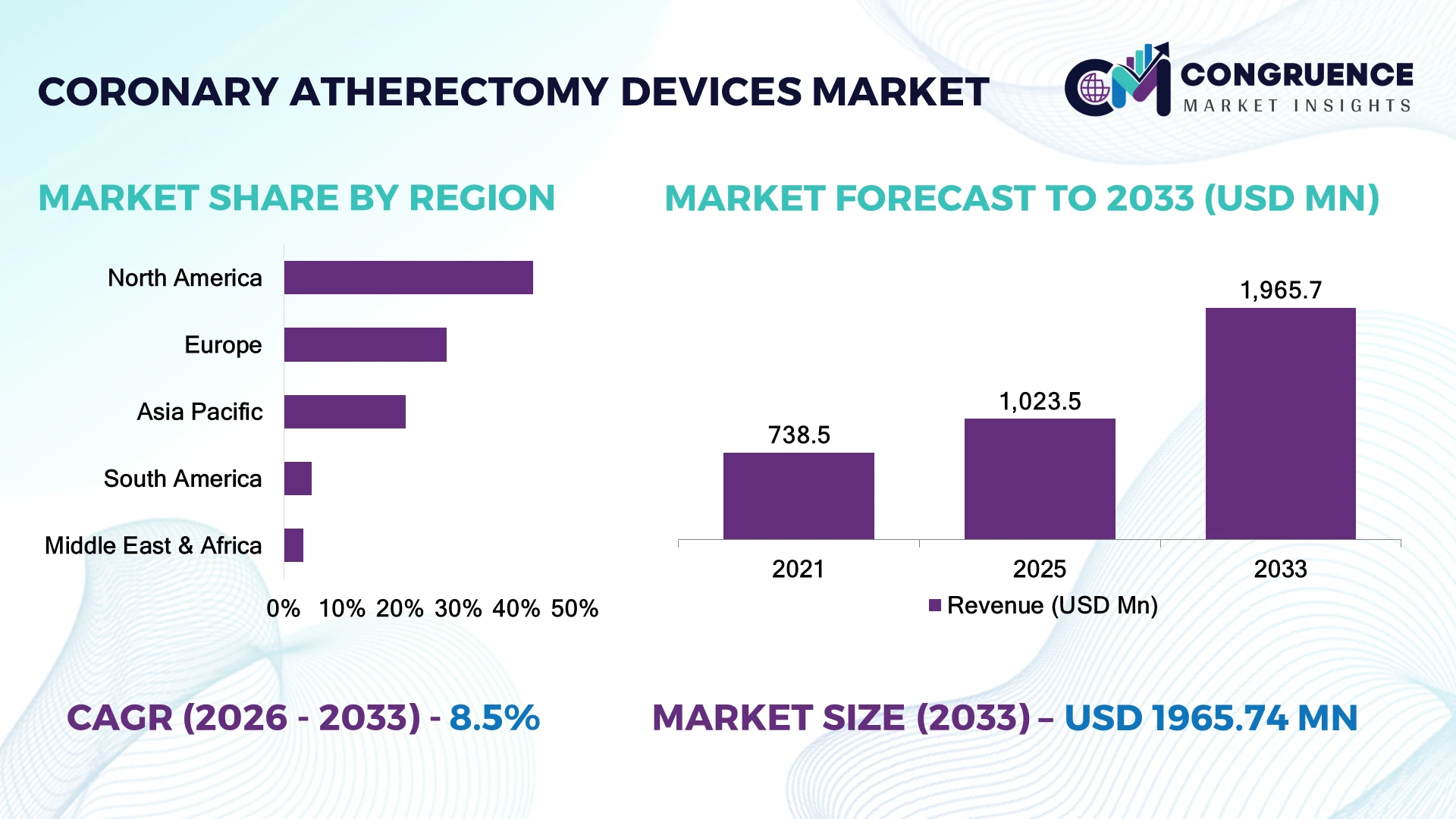
The United States dominates the Coronary Atherectomy Devices market with approximately 43% global market share, supported by advanced catheterization laboratories, high procedural volumes, and rapid adoption of image-guided coronary interventions. Nearly 69% of complex calcified lesion procedures incorporate adjunctive intravascular imaging, significantly higher than Japan, where adoption continues to expand through specialized cardiovascular centers. Continued healthcare investment under resilient domestic medical device manufacturing strategies following global supply-chain realignment is strengthening procedural capacity and technology availability.
Manufacturers prioritizing image-guided atherectomy systems, physician training, and next-generation device innovation are best positioned to strengthen clinical adoption and long-term competitive advantage.
Market Size & Growth: USD 1,023.5 million (2025) to USD 1,965.7 million (2033) at 8.5% CAGR, supported by advanced PCI technologies and rising complex coronary interventions.
Top Growth Drivers: Calcified lesion procedures (+31%), intravascular imaging adoption (+27%), minimally invasive PCI expansion (+24%).
Short-Term Forecast: By 2028, procedure efficiency improves 18% while fluoroscopy time declines 14%.
Emerging Technologies: AI-assisted imaging, orbital atherectomy refinement, and integrated IVUS/OCT guidance accelerate procedural precision.
Regional Leaders: North America (~USD 760 million), Europe (~USD 470 million), Asia-Pacific (~USD 510 million), driven by expanding interventional cardiology capacity.
Consumer/End-User Trends: Nearly 66% of tertiary cardiac centers prioritize imaging-guided atherectomy procedures.
Pilot/Case Example: A 2026 hospital program reduced repeat intervention rates by 16% using imaging-guided lesion preparation.
Competitive Landscape: Top five manufacturers control approximately 72% market share, led by Abbott, Boston Scientific, Cardiovascular Systems, Medtronic, and Philips.
Regulatory & ESG Impact: Enhanced device traceability improves procedural compliance efficiency by approximately 21%.
Investment & Funding: More than USD 1.4 billion supports cardiovascular device innovation, manufacturing expansion, and clinical collaborations.
Innovation & Future Outlook: Combination therapies and precision imaging platforms are reshaping treatment pathways for complex coronary artery disease.
Coronary atherectomy devices are increasingly used in complex percutaneous coronary interventions requiring effective plaque modification before stent placement. Approximately 61% of advanced interventional cardiology centers now integrate intravascular imaging with lesion preparation to improve procedural precision. Ongoing localization of cardiovascular device manufacturing and streamlined regulatory pathways are strengthening supply resilience, paving the way for broader strategic adoption of next-generation atherectomy technologies.
Coronary atherectomy devices are becoming strategically important as healthcare systems treat a growing number of patients with heavily calcified coronary artery disease requiring complex percutaneous interventions. Hospitals are expanding investments in advanced catheterization laboratories while regulatory emphasis on procedural quality and domestic medical device manufacturing continues reshaping procurement strategies. Supply-chain diversification since recent global healthcare disruptions has further encouraged regional production capacity and improved device availability for critical cardiovascular procedures.
Image-guided atherectomy combined with intravascular ultrasound delivers approximately 22% greater lesion preparation efficiency than conventional angiography-guided approaches while reducing procedural complications by nearly 15% in complex cases. The United States leads adoption through high-volume structural heart and interventional cardiology programs, whereas Japan continues expanding specialized calcified lesion treatment supported by advanced imaging integration. Over the next two to three years, more than 58% of tertiary cardiac centers are expected to routinely incorporate imaging-guided plaque modification into complex PCI workflows.
Leading manufacturers are strengthening physician education, expanding clinical partnerships, and investing in multifunctional atherectomy platforms compatible with advanced imaging technologies. Integration of precision lesion preparation, procedural planning, and minimally invasive treatment pathways is becoming a key differentiator. Organizations capable of delivering clinically validated, interoperable, and workflow-efficient solutions will secure stronger competitive positioning in the evolving interventional cardiology landscape.
The increasing prevalence of heavily calcified coronary artery disease is accelerating demand for advanced atherectomy devices in interventional cardiology. Approximately 34% of complex percutaneous coronary intervention (PCI) procedures involve moderate-to-severe coronary calcification, while imaging-guided plaque modification improves procedural success by nearly 23% and reduces stent under-expansion by approximately 17%. The United States continues expanding specialized complex PCI programs supported by updated clinical practice emphasizing lesion preparation before stent implantation. This structural shift is increasing hospital procurement of orbital, rotational, and laser atherectomy systems. Manufacturers are responding through physician training initiatives, next-generation device development, and strategic collaborations with imaging technology providers. Competitive advantage increasingly depends on integrating atherectomy platforms with precision intravascular imaging rather than standalone device performance.
The adoption of coronary atherectomy devices remains constrained by elevated procedural costs, specialized infrastructure requirements, and dependence on experienced interventional cardiologists. Advanced plaque modification procedures typically increase treatment costs by approximately 18%, while nearly 29% of secondary-care hospitals lack dedicated complex PCI infrastructure. Japan and several European healthcare systems continue applying strict reimbursement evaluations for high-cost cardiovascular technologies, extending procurement timelines. These structural constraints limit broader deployment despite established clinical benefits. Manufacturers are reducing commercial risk through localized manufacturing, long-term hospital procurement agreements, and bundled device portfolios that combine atherectomy systems with imaging accessories. Hospitals increasingly evaluate procedural efficiency and long-term clinical outcomes to justify technology investment decisions.
The integration of coronary atherectomy with intravascular ultrasound (IVUS), optical coherence tomography (OCT), and AI-assisted procedural planning is creating high-value clinical opportunities. Imaging-guided lesion preparation improves stent expansion by approximately 21% while reducing repeat revascularization by nearly 14% in complex coronary interventions. South Korea is expanding adoption of advanced imaging technologies across tertiary cardiovascular centers, encouraging greater use of precision-guided plaque modification. Device manufacturers are investing in R&D, digital procedural planning platforms, and partnerships with imaging companies to deliver interoperable treatment ecosystems. A key strategic opportunity lies in combining imaging intelligence with atherectomy workflows to optimize clinical outcomes while reducing unnecessary device utilization and procedural variability.
Long-term market expansion depends on overcoming variability in physician expertise and procedural standardization across healthcare systems. Approximately 32% of catheterization laboratories perform relatively low volumes of complex atherectomy procedures, while inconsistent operator experience contributes to nearly 19% variation in procedural efficiency. Increasing clinical complexity and evolving treatment guidelines require continuous physician education and simulation-based training. Healthcare providers in Germany are expanding structured certification programs to improve procedural consistency and patient outcomes. Manufacturers must strengthen digital training platforms, clinical education partnerships, and simulation technologies while simplifying device operation. Sustainable market leadership will increasingly depend on reducing procedural variability rather than solely introducing incremental hardware improvements.
Advanced Imaging Integration Accelerates: Hospitals increasingly combine atherectomy with IVUS and OCT, improving lesion preparation accuracy by approximately 24% while reducing procedural optimization time by nearly 16%. Updated clinical practice emphasizing imaging-guided PCI is driving adoption. Manufacturers are expanding integrated platforms and physician education programs to standardize complex coronary interventions.
Single-Procedure Efficiency Improves: Catheterization laboratories are consolidating plaque modification and stent optimization into streamlined workflows, reducing total procedure duration by approximately 18% and contrast media use by nearly 12%. Rising pressure on hospital capacity is encouraging workflow optimization. Device manufacturers are refining system compatibility and expanding procedural support technologies.
Localized Manufacturing Expands: Medical device companies are strengthening regional production and component sourcing strategies following global healthcare supply-chain disruptions. Localized procurement has reduced delivery lead times by approximately 22% while improving inventory availability by nearly 17% for major cardiovascular centers. Companies are expanding manufacturing partnerships and reinforcing supply resilience for critical interventional devices.
Complex PCI Centers Grow: Specialized cardiovascular hospitals are increasing referrals for high-risk calcified coronary interventions, with procedure volumes rising approximately 19% and multidisciplinary heart-team participation expanding by nearly 15%. A notable shift is the concentration of advanced atherectomy procedures within centers of excellence rather than general catheterization laboratories. Manufacturers are supporting this trend through dedicated training, clinical collaborations, and advanced procedural planning tools.
Rotational atherectomy devices account for approximately 46% of the global Coronary Atherectomy Devices market due to their established clinical performance in treating severely calcified coronary lesions and broad physician familiarity in complex percutaneous coronary intervention (PCI). Their compatibility with intravascular imaging and predictable plaque modification outcomes make them the preferred choice in tertiary cardiovascular centers. Orbital atherectomy remains a strong alternative for concentric calcification, while laser atherectomy continues serving niche indications such as thrombotic lesions and in-stent restenosis, preserving strategic relevance in specialized clinical settings.
Orbital atherectomy is the fastest-growing segment as physicians increasingly seek more uniform plaque modification with reduced vessel trauma in complex interventions. Clinical adoption has improved by approximately 21%, while imaging-guided orbital procedures have increased procedural success by nearly 18% and reduced adjunctive device use by around 14%. Manufacturers are expanding product portfolios, investing in physician education, and strengthening collaborations with imaging technology providers. Investment priorities are shifting toward integrated atherectomy systems that enhance procedural precision, workflow efficiency, and compatibility with advanced intravascular imaging platforms.
According to findings presented by the Society for Cardiovascular Angiography and Interventions (SCAI) in 2026, more than 62% of high-volume complex PCI centers routinely incorporated atherectomy or other plaque-modification technologies for heavily calcified coronary lesions before definitive stent implantation.
Treatment of severely calcified coronary artery disease represents the largest application segment, accounting for approximately 58% of the market as increasing numbers of complex PCI procedures require effective plaque modification before stent deployment. Advanced lesion preparation improves stent expansion, minimizes procedural complications, and enhances long-term vessel patency. Chronic total occlusions continue representing a mature application supported by specialized interventional programs, while in-stent restenosis and thrombotic lesion treatment remain important but comparatively selective clinical indications requiring tailored atherectomy approaches.
Complex bifurcation lesions are the fastest-growing application because interventional cardiologists increasingly combine atherectomy with IVUS and OCT guidance for highly challenging anatomies. Imaging-assisted procedures improve procedural precision by approximately 23%, while optimized lesion preparation reduces repeat intervention rates by nearly 16%. Device manufacturers are enhancing compatibility with advanced guidewires, imaging platforms, and adjunctive balloon technologies while expanding physician training initiatives. Demand is strengthening where multidisciplinary heart teams prioritize precision-based intervention over conventional lesion preparation strategies.
According to a 2025 institutional clinical practice assessment by the American College of Cardiology (ACC), specialized cardiovascular centers increasingly adopted imaging-guided plaque modification for complex calcified coronary interventions to improve procedural consistency and clinical outcomes.
Hospitals account for approximately 69% of Coronary Atherectomy Devices utilization owing to their advanced catheterization laboratories, multidisciplinary cardiovascular teams, and ability to manage high-risk coronary interventions. Large tertiary hospitals perform the majority of complex PCI procedures requiring rotational, orbital, or laser atherectomy, supported by integrated imaging technologies and emergency cardiac care infrastructure. Specialty cardiac centers remain significant users for highly specialized interventions, while ambulatory surgical centers continue expanding selectively where healthcare systems encourage minimally invasive cardiovascular procedures.
Specialty cardiac centers represent the fastest-growing end-user segment as referral networks increasingly concentrate complex calcified coronary interventions in dedicated centers of excellence. Procedure volumes have increased by approximately 19%, while integrated imaging adoption exceeds 67% in specialized cardiovascular institutions and multidisciplinary treatment planning has improved procedural efficiency by nearly 17%. Manufacturers are supporting these facilities through customized training programs, long-term clinical partnerships, and bundled technology solutions. Competitive positioning increasingly depends on delivering comprehensive procedural ecosystems rather than individual devices.
A 2026 clinical operations survey released by the European Association of Percutaneous Cardiovascular Interventions (EAPCI) indicated that dedicated cardiac centers continue expanding advanced plaque-modification capabilities, with imaging-guided atherectomy becoming standard practice for a growing proportion of complex calcified PCI procedures.
North America accounted for the largest market share at 42.8% in 2025 however, Asia-Pacific is expected to register the fastest growth, expanding at a CAGR of 9.8% between 2026 and 2033.
Advanced Complex PCI Programs Strengthen Clinical Leadership
North America leads the Coronary Atherectomy Devices market through its high concentration of advanced catheterization laboratories, mature reimbursement systems, and widespread adoption of image-guided complex PCI. The region contributes approximately 42.8% of global demand, supported by increasing treatment of heavily calcified coronary artery disease and broad availability of IVUS- and OCT-guided interventions. Nearly 72% of tertiary cardiovascular centers routinely incorporate plaque-modification technologies before complex stent implantation. Expansion of structural heart programs and continued investment in hybrid catheterization laboratories are improving procedural efficiency and patient outcomes. Device manufacturers are strengthening physician training, expanding clinical collaborations, and introducing integrated atherectomy platforms compatible with advanced imaging technologies to maintain procedural leadership.
United States Market Outlook: The United States remains the dominant country due to its extensive network of specialized cardiovascular hospitals, high complex PCI volumes, and continuous adoption of innovative interventional technologies. More than 70% of high-volume cardiac centers utilize advanced intravascular imaging during calcified coronary interventions, accelerating demand for precision atherectomy systems. Ongoing investment in physician education, digital procedure planning, and domestically manufactured cardiovascular devices continues strengthening the country's leadership in complex coronary intervention.
Precision Imaging Enhances Procedural Standardization
Europe is strengthening its position through increasing adoption of imaging-guided coronary interventions, standardized treatment protocols, and modernization of cardiovascular care infrastructure. Approximately 29% of advanced PCI procedures for heavily calcified lesions now incorporate atherectomy as part of comprehensive lesion preparation. Clinical emphasis on procedural safety and long-term vessel patency is encouraging broader integration of IVUS, OCT, and plaque-modification technologies. Manufacturers continue expanding physician education initiatives and collaborating with cardiovascular societies to improve procedural consistency and optimize clinical outcomes across specialized cardiac centers.
Germany Market Outlook: Germany leads the regional market through its highly developed cardiovascular hospital network, advanced interventional cardiology expertise, and rapid adoption of precision imaging technologies. More than 60% of tertiary cardiac centers routinely integrate intravascular imaging into complex PCI planning, improving procedural decision-making for calcified coronary lesions. Strong clinical research activity and continuous investment in catheterization laboratory modernization support sustained adoption of advanced atherectomy devices.
Cardiovascular Infrastructure Expansion Accelerates Adoption
Asia-Pacific is rapidly expanding coronary atherectomy utilization as healthcare systems strengthen interventional cardiology capabilities and increase investment in advanced cardiovascular infrastructure. Growing prevalence of complex coronary artery disease, combined with expanding catheterization laboratory capacity, is supporting greater procedural adoption. Approximately 31% of newly commissioned tertiary cardiovascular centers have incorporated advanced plaque-modification technologies into complex PCI workflows. Manufacturers are expanding regional distribution networks, physician training programs, and localized technical support to improve access to sophisticated interventional devices across developing healthcare systems.
Japan Market Outlook: Japan represents the region's leading market due to its aging population, high incidence of calcified coronary lesions, and extensive adoption of advanced intravascular imaging technologies. More than 65% of specialized cardiovascular hospitals integrate IVUS-guided lesion preparation into complex coronary interventions. Continuous investment in precision cardiovascular care and strong physician expertise support sustained demand for rotational and orbital atherectomy technologies.
Specialized Cardiac Centers Expand Advanced Procedures
South America is witnessing gradual expansion of coronary atherectomy procedures through modernization of tertiary cardiac hospitals and increasing access to minimally invasive cardiovascular interventions. Brazil, Argentina, and Chile continue strengthening interventional cardiology services while expanding advanced catheterization laboratory infrastructure. Approximately 26% of complex PCI programs in leading cardiac institutions now incorporate atherectomy for severe coronary calcification. Limited access to specialized equipment outside metropolitan hospitals remains a deployment constraint, encouraging manufacturers to strengthen distributor partnerships and physician training initiatives.
Brazil Market Outlook: Brazil leads regional adoption through its large cardiovascular care network and concentration of high-volume tertiary hospitals. Advanced cardiac centers are increasingly integrating imaging-guided plaque modification into complex PCI procedures, with procedural volumes rising steadily in referral hospitals. Strategic investment in hospital modernization, physician education, and access to advanced interventional devices continues reinforcing Brazil's position as the region's primary coronary atherectomy market.
Healthcare Modernization Supports Advanced Cardiac Care
The Middle East & Africa market is expanding through government-backed healthcare modernization, investment in cardiovascular centers of excellence, and increasing deployment of minimally invasive coronary interventions. Advanced hospitals are strengthening catheterization laboratory capabilities while adopting precision imaging technologies for complex PCI. Approximately 22% of newly upgraded cardiac facilities now support advanced plaque-modification procedures. International device manufacturers are expanding regional partnerships, technical support services, and physician education programs to improve access to specialized coronary intervention technologies.
Saudi Arabia Market Outlook: Saudi Arabia leads the regional market through substantial investment in specialized cardiovascular hospitals, advanced medical technology procurement, and national healthcare transformation initiatives. Large referral hospitals are expanding complex PCI capabilities with greater integration of IVUS-guided interventions and advanced lesion preparation techniques. Continued infrastructure investment and physician training programs are strengthening the country's ability to manage increasingly complex coronary artery disease using next-generation atherectomy devices.
The Coronary Atherectomy Devices market is moderately consolidated, with Boston Scientific, Abbott, Medtronic, Philips, and Avinger competing against specialized interventional technology providers and regional cardiovascular device manufacturers. The top five players collectively control approximately 72% of global market share. Competition centers on integrated procedural ecosystems rather than standalone atherectomy devices, with imaging compatibility, physician adoption, and clinical evidence outweighing price competition. Imaging-guided PCI improves procedural optimization by nearly 23%, while hospitals increasingly prefer vendors offering complete coronary intervention portfolios, influencing over 65% of capital purchasing decisions. Global leaders compete through product innovation, physician training, strategic acquisitions, and imaging platform integration, whereas regional companies emphasize cost efficiency and localized distribution. The competitive landscape is shifting toward integrated calcium-modification solutions and AI-enabled procedural planning, increasing pressure on traditional device-only suppliers. High regulatory requirements, extensive clinical validation, and physician learning curves remain significant entry barriers. Winning requires integrated technologies, strong clinical evidence, comprehensive physician education, and broad cardiovascular ecosystem partnerships.
Boston Scientific Corporation
Abbott
Medtronic plc
Koninklijke Philips N.V.
Avinger, Inc.
AngioDynamics, Inc.
Teleflex Incorporated
Asahi Intecc Co., Ltd.
Terumo Corporation
B. Braun Melsungen AG
Biotronik SE & Co. KG
Merit Medical Systems, Inc.
Current technology development is centered on integrating rotational and orbital atherectomy with IVUS, OCT, and AI-assisted procedural planning. Imaging-guided plaque modification improves stent expansion by approximately 21% while reducing procedural variability by nearly 18%. More than 65% of high-volume complex PCI centers now routinely integrate intravascular imaging before definitive stent deployment. This provides operators with greater lesion characterization, improving procedural confidence and reducing unnecessary device exchanges, creating measurable workflow and clinical advantages for manufacturers offering complete intervention platforms.
Emerging technologies include AI-driven lesion assessment, digital procedural planning, robotics-assisted PCI, and advanced calcium-modification devices that combine imaging with real-time procedural guidance. Compared with conventional angiography-guided interventions, imaging-integrated workflows improve lesion preparation accuracy by approximately 24% while shortening procedure duration by nearly 15%. Global leaders including Boston Scientific, Abbott, and Philips benefit most because they combine imaging, guidewire, and intervention technologies within unified ecosystems.
Between 2026 and 2028, competitive differentiation will increasingly depend on intelligent procedural platforms rather than individual atherectomy devices. AI-enabled imaging, cloud-based procedural analytics, and automated workflow optimization are expected to exceed 40% deployment across leading cardiovascular centers. Companies investing early in software integration, physician decision support, and interoperable treatment ecosystems will strengthen customer retention, improve procedural efficiency, and build sustainable competitive advantages as complex coronary interventions continue expanding.
January 2025 Boston Scientific announced its agreement to acquire Bolt Medical, adding an intravascular lithotripsy platform for calcified coronary and peripheral disease. The transaction included a $443 million upfront payment for the remaining 74% stake, strengthening its calcium-modification portfolio. Source: Boston Scientific News
October 2024 Abbott presented final results from the ECLIPSE trial evaluating orbital atherectomy before drug-eluting stent implantation in severely calcified coronary lesions. The multicenter study enrolled more than 2,000 patients, providing important evidence for future treatment strategies. Source: American College of Cardiology
December 2025 Philips agreed to acquire SpectraWAVE to expand its AI-enabled coronary intravascular imaging portfolio. The acquisition combines HyperVue imaging with Philips' existing IVUS technologies, enhancing comprehensive image-guided PCI workflows and accelerating AI-supported coronary assessment. Source: Philips News Center
2024 Boston Scientific continued expanding its integrated coronary intervention portfolio by advancing commercial deployment of the ROTAPRO rotational atherectomy system alongside AVVIGO multimodality guidance and OptiCross IVUS technologies, strengthening image-guided complex PCI workflows and procedural efficiency. Source: Boston Scientific 2024 Annual Report
The report provides a comprehensive assessment of the Coronary Atherectomy Devices market across rotational, orbital, and laser atherectomy technologies, covering major applications including calcified coronary artery disease, chronic total occlusions, bifurcation lesions, thrombotic lesions, and in-stent restenosis. End-user analysis spans hospitals, specialty cardiac centers, and ambulatory surgical centers, with detailed evaluation across North America, Europe, Asia-Pacific, South America, and the Middle East & Africa. The study also examines adoption patterns, deployment trends, competitive positioning, and participation of leading global manufacturers representing more than 70% of industry activity.
The report evaluates emerging technologies including IVUS, OCT, AI-assisted procedural planning, and integrated calcium-modification platforms while assessing evolving physician workflows and advanced catheterization laboratory deployment. Strategic insights support investment prioritization, product development, regional expansion, partnership evaluation, and competitive benchmarking between 2026 and 2033. Coverage also includes technology adoption trends, enterprise purchasing behavior, clinical workflow evolution, and emerging opportunities shaping the future direction of complex coronary intervention markets.
| Report Attribute/Metric | Report Details |
|---|---|
|
Market Revenue in 2025 |
USD 1,023.5 Million |
|
Market Revenue in 2033 |
USD 1,965.7 Million |
|
CAGR (2026 - 2033) |
8.5% |
|
Base Year |
2025 |
|
Forecast Period |
2026 - 2033 |
|
Historic Period |
2021 - 2025 |
|
Segments Covered |
By Type
By Application
By End-User
|
|
Key Report Deliverable |
Revenue Forecast, Growth Trends, Market Dynamics, Segmental Overview, Regional and Country-wise Analysis, Competition Landscape |
|
Region Covered |
North America, Europe, Asia-Pacific, South America, Middle East, Africa |
|
Key Players Analyzed |
Boston Scientific Corporation, Abbott, Medtronic plc, Koninklijke Philips N.V., Avinger, Inc., AngioDynamics, Inc., Teleflex Incorporated, Asahi Intecc Co., Ltd., Terumo Corporation, B. Braun Melsungen AG, Biotronik SE & Co. KG, Merit Medical Systems, Inc. |
|
Customization & Pricing |
Available on Request (10% Customization is Free) |




