
Reports
The Global Confocal Raman Spectroscopy Market was valued at USD 525.6 Million in 2025 and is anticipated to reach a value of USD 951.4 Million by 2033 expanding at a CAGR of 7.7% between 2026 and 2033. Growth is being driven by semiconductor failure analysis, pharmaceutical characterization, advanced-materials research, and non-destructive chemical mapping requiring micron-scale spatial resolution.
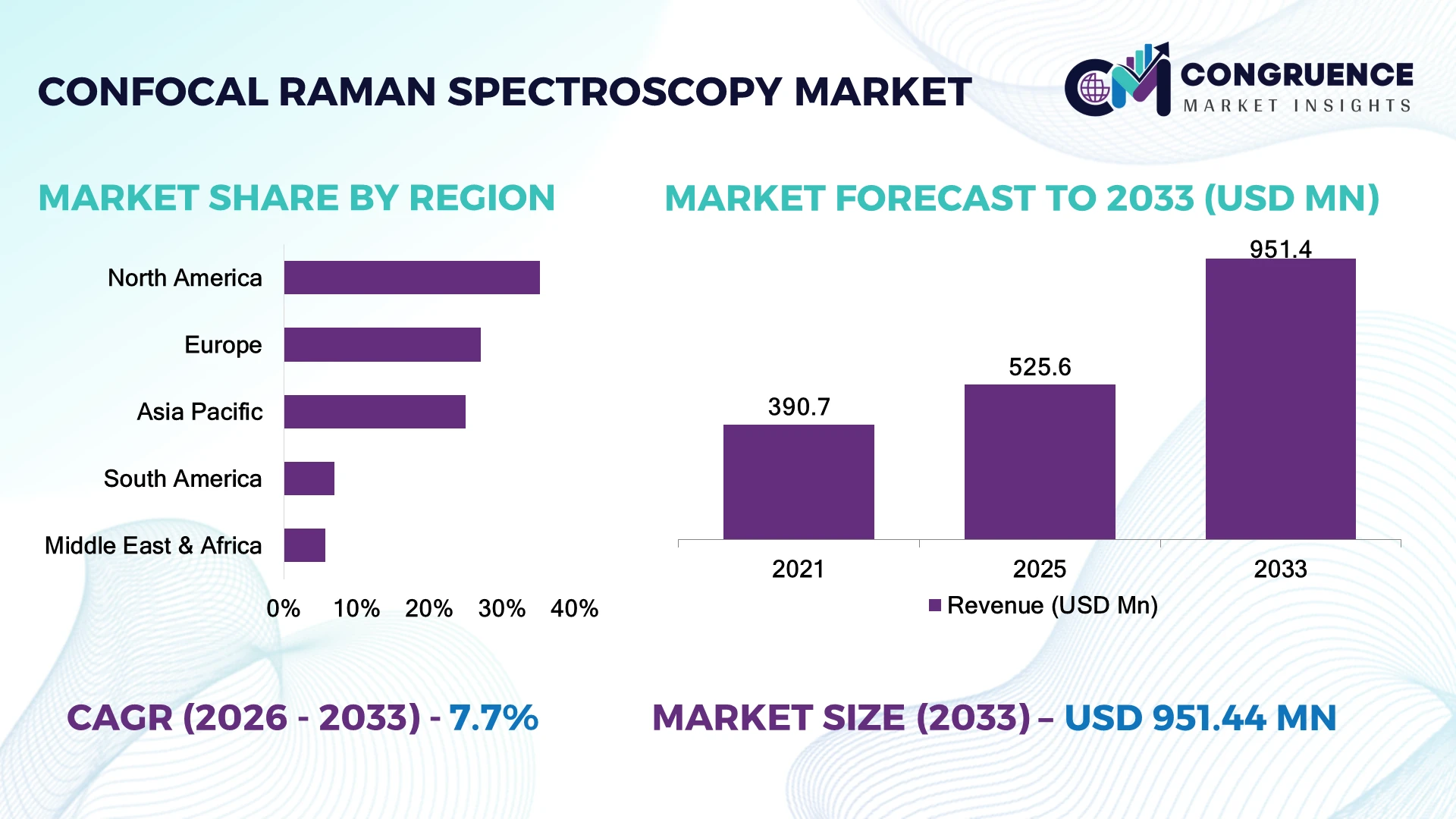
The United States remains the dominant commercial market, supported by semiconductor, pharmaceutical, biotechnology, and university research infrastructure, with North America estimated at about 35% of global demand in 2025. China is expanding faster through semiconductor and advanced-material investments, while Japan retains strong analytical-instrument adoption. Geopolitical semiconductor supply-chain restructuring is accelerating domestic materials characterization, with automated Raman workflows improving analytical throughput by approximately 15–25%.
Strategic implication: instrument suppliers should prioritize automated confocal mapping, application-specific software, and localized technical support where high-value analytical workflows justify premium systems.
Market Size & Growth: USD 525.6 million in 2025 to USD 951.4 million by 2033 at 7.7% CAGR, driven by semiconductor inspection and advanced-material characterization.
Top Growth Drivers: Semiconductor applications 9–12%; pharmaceutical analysis 7–10%; materials research 8–11%.
Short-Term Forecast: By 2028, automated spectral acquisition can improve laboratory throughput 15–25% and reduce manual analysis time 20–30%.
Emerging Technologies: AI-assisted spectral classification, automated confocal mapping, hyperspectral Raman imaging, and improved laser stability are reshaping workflows.
Regional Leaders: North America approaches USD 250 million by 2028; Europe exceeds USD 180 million; Asia-Pacific approaches USD 200 million as semiconductor and electronics laboratories expand.
Consumer/End-User Trends: Industrial and academic laboratories increasingly prioritize automated mapping, with advanced imaging workflows representing approximately 25–35% of new high-end system deployments.
Pilot/Case Example: 2026 semiconductor characterization workflows using automated Raman mapping target 20%+ reductions in operator-intensive inspection time.
Competitive Landscape: Renishaw, HORIBA, Thermo Fisher Scientific, Bruker, and WITec compete through approximately 10–20% improvements in sensitivity, automation, imaging, and software integration.
Regulatory & ESG Impact: Non-destructive Raman analysis can reduce destructive sample preparation by approximately 20–40%, supporting material conservation and lower laboratory waste.
Investment & Funding: Semiconductor and pharmaceutical analytical-infrastructure investments are directing funding toward automated microscopy, spectroscopy, and integrated characterization platforms.
Innovation & Future Outlook: Next-generation systems will combine confocal Raman imaging, AI interpretation, multimodal microscopy, and automated sample handling for faster materials qualification.
Confocal Raman spectroscopy is increasingly used for semiconductor defect analysis, pharmaceutical polymorph identification, battery materials, polymers, coatings, and biological research. High-resolution chemical mapping can improve characterization productivity by approximately 15–25% when automated acquisition and software-assisted analysis replace manual spectral workflows. In 2026, semiconductor supply-chain localization and advanced-material qualification are strengthening investment in laboratory characterization, creating a clear transition toward automated analytical platforms.
Confocal Raman spectroscopy is becoming strategically important because manufacturers need chemical identification and spatial mapping without destroying increasingly expensive semiconductor, pharmaceutical, battery, and advanced-material samples. The competitive shift is toward instruments that combine spectroscopy, microscopy, automation, and software rather than standalone Raman measurement.
Modern automated Raman mapping can increase analytical throughput by approximately 15–25% compared with operator-intensive acquisition, while AI-assisted spectral classification can reduce interpretation time by roughly 20–30%. North America remains strong in pharmaceutical, semiconductor, and research applications; Europe emphasizes materials science and industrial quality control; China, Japan, and South Korea are expanding deployment alongside electronics and semiconductor manufacturing.
Over the next 2–3 years, automated focusing, AI spectral libraries, hyperspectral imaging, multimodal Raman-electron microscopy workflows, and robotic sample handling will become increasingly important. A semiconductor laboratory can deploy automated wafer mapping to screen material variations across multiple locations without destructive preparation, improving reproducibility and traceability. Instrument manufacturers are therefore expanding software capabilities, application-specific modules, and integration partnerships. Competitive advantage will increasingly depend on reducing operator time while delivering defensible chemical maps, faster qualification, and seamless integration with existing laboratory characterization infrastructure.
Semiconductor manufacturing is increasing demand for non-destructive chemical and structural characterization as advanced nodes tighten process tolerances. Automated confocal Raman workflows can improve analytical throughput by 15–25%, while software-assisted spectral classification reduces interpretation time by 20–30%. In the United States, semiconductor reshoring is expanding domestic materials-analysis infrastructure, while Taiwan and South Korea continue integrating spectroscopy into advanced wafer and materials workflows. Instrument manufacturers are responding with automated wafer mapping, higher-stability lasers, and integrated microscopy platforms. The non-obvious advantage is earlier defect localization: identifying material anomalies before destructive testing reduces downstream qualification cycles and protects expensive samples. Companies are therefore prioritizing semiconductor-specific Raman configurations, application software, and partnerships with equipment and research laboratories.
Confocal Raman systems require precision optics, stable lasers, sensitive detectors, vibration control, and specialized operators, keeping acquisition and installation complexity high. Advanced configurations can require 15–30% more integration effort than conventional Raman platforms, while skilled analysis workflows can increase operating costs by 10–20%. Laboratories in emerging manufacturing centers often lack experienced Raman specialists and dedicated characterization infrastructure. Supply constraints affecting lasers, detectors, and precision optical components can also extend system lead times. Manufacturers are mitigating these limitations through modular architectures, automated calibration, remote diagnostics, and regional service partnerships. The strategic pressure is shifting from instrument sensitivity alone toward total laboratory usability: reducing setup and operator dependence directly expands the addressable customer base and improves equipment utilization.
AI-assisted spectral interpretation and automated confocal mapping are creating a high-value opportunity for laboratories processing large sample volumes. Automated workflows can increase mapping productivity by 20–30%, while machine-learning classification can reduce manual spectral interpretation by approximately 25–40%. Pharmaceutical manufacturers can apply these capabilities to polymorph identification and formulation analysis, while battery and semiconductor laboratories can map composition across complex material structures. China and South Korea are particularly positioned for deployment as electronics and advanced-material characterization capacity expands. Instrument companies are developing embedded spectral libraries, automated focusing, and multimodal microscopy integration. The non-obvious opportunity is converting Raman instruments into continuous analytical platforms rather than standalone laboratory equipment, enabling higher utilization, automated reporting, and recurring software value alongside hardware sales.
Integrating confocal Raman with optical microscopy, electron microscopy, atomic-force microscopy, or automated sample handling creates significant data and calibration complexity. Multimodal workflows can increase dataset volumes by 20–40%, while cross-instrument registration errors of 5–10% can compromise spatial correlation. Semiconductor and pharmaceutical laboratories increasingly demand interoperable datasets rather than isolated spectra, placing pressure on software architecture and metadata standards. Manufacturers must invest in standardized interfaces, automated calibration, cloud-enabled data management, and specialist application support. The long-term competitive challenge is maintaining measurement reproducibility when instruments, lasers, objectives, and analytical software evolve simultaneously. Companies that solve interoperability can lock in laboratory workflows more effectively than suppliers competing only on optical sensitivity, strengthening customer retention and expanding instrument-platform value.
Automated Mapping Gains Ground — Laboratories are replacing manually positioned Raman measurements with automated stage movement, focusing, and spectral acquisition. Automated workflows can increase mapping throughput by 15–25% and reduce operator intervention by approximately 20–30%. Semiconductor and pharmaceutical laboratories are prioritizing these systems because unattended mapping improves reproducibility while allowing skilled analysts to focus on interpretation rather than repetitive acquisition.
AI Interpretation Enters Workflows — Machine-learning spectral classification is moving from experimental research into routine analytical software. Automated classification can reduce manual interpretation time by 25–40%, while curated spectral libraries improve identification consistency by approximately 10–20%. Instrument suppliers are embedding AI-assisted workflows directly into acquisition software, reducing dependence on highly experienced Raman specialists.
Wafer Analysis Becomes More Integrated — Semiconductor laboratories are combining confocal Raman with optical inspection, wafer mapping, and complementary metrology. Integrated workflows can reduce sample-transfer and repositioning steps by approximately 10–20%, improving traceability across characterization stages. U.S., Taiwanese, and South Korean facilities are strengthening these integrations as advanced-node manufacturing increases the value of non-destructive material analysis.
Portable Systems Target Field Use — Raman suppliers are extending compact confocal architectures toward battery, pharmaceutical, environmental, and industrial inspection applications. Miniaturized systems can reduce instrument footprint by approximately 30–50% compared with large laboratory configurations while shortening deployment time. Manufacturers are responding with ruggedized optics, automated calibration, and simplified software, creating new use cases outside centralized analytical laboratories.
Confocal Raman microscopes represent the leading product type, accounting for approximately 55.1% of 2025 market demand. Their dominance reflects the combination of molecular identification, depth-resolved imaging, and sub-micrometer spatial analysis in pharmaceutical development, semiconductor inspection, and materials research. Dedicated confocal Raman spectrometers retain relevance where spectroscopy is prioritized over advanced imaging, while Raman imaging systems are gaining traction as laboratories move toward high-throughput chemical mapping. Raman imaging is the fastest-growing product category, supported by demand for larger-area mapping and automated sample characterization.
Raman imaging systems are increasingly targeted toward semiconductor wafers, battery electrodes, pharmaceutical formulations, and advanced materials, where automated mosaicking can reduce operator-intensive workflows by approximately 20–30%. Hybrid Raman-FTIR platforms remain strategically relevant for laboratories requiring complementary molecular fingerprints. Vendors are therefore shifting investment toward integrated optics, automated stages, AI-assisted analysis, and application-specific software. The business implication is a move from instrument sales based primarily on spectral sensitivity toward complete characterization platforms that improve workflow throughput and expand analytical utilization.
A 2025 market analysis found confocal Raman microscopes accounted for 55.1% of product-type demand, while Raman imaging systems represented the fastest-growing product category, highlighting the industry's shift toward automated chemical mapping.
Pharmaceutical and biotechnology workflows represent the leading application, accounting for approximately 33.1% of 2025 demand. Raman systems are extensively applied to raw-material identification, polymorph characterization, formulation analysis, and process monitoring because measurements are non-destructive and chemically specific. Semiconductor and microelectronics quality control forms another established application, particularly for stress mapping, material composition, and wafer analysis. Battery and energy-storage research is the fastest-growing application, with adoption accelerating as manufacturers require chemical mapping of cathodes, anodes, and electrolyte systems.
Battery research is strengthening demand for automated mapping and in-line Raman capabilities, while pharmaceutical laboratories increasingly prioritize validated, software-assisted workflows. Battery and energy-storage applications are projected to expand at approximately 14% annually in current market assessments, substantially faster than mature pharmaceutical workflows. For suppliers, this is shifting application investment toward electrochemical materials, process analytics, and automated spectral interpretation. For established pharmaceutical customers, instrument upgrades increasingly emphasize compliance, reproducibility, and integration with laboratory information systems rather than simply higher optical performance.
A 2025 review of AI-guided Raman spectroscopy identified deep-learning methods as increasingly important for pattern recognition, feature extraction, and analytical efficiency in biomedical and biopharmaceutical workflows.
Pharmaceutical and biotechnology companies constitute the leading end-user group, representing approximately 37.0% of 2025 demand. Their purchasing is supported by drug-development workflows, raw-material verification, formulation characterization, and process analytical technology requirements. Academic and research institutes remain important because they drive advanced Raman methodologies and early adoption of new imaging techniques. Industrial manufacturing enterprises are the fastest-changing customer group as Raman moves from centralized laboratory analysis toward process monitoring and quality control.
Industrial manufacturers are increasingly deploying Raman systems for chemical, polymer, semiconductor, battery, and advanced-material applications, with current estimates placing their growth at approximately 10.2%. Inline and automated systems can reduce manual sampling and accelerate detection of off-specification material, creating direct production benefits. Government laboratories, clinical facilities, and specialist research centers remain smaller but strategically important for forensic, environmental, and diagnostic applications. Suppliers are responding with application-specific software, portable configurations, automated focusing, and integration partnerships. The commercial shift is therefore toward recurring industrial workflows where utilization rates and process-control value justify higher system sophistication.
Current industry analysis places pharmaceutical and biotechnology companies at 37.0% of end-user demand, while industrial manufacturing is identified as the fastest-advancing customer segment at approximately 10.2% growth.
North America accounted for the largest market share at 35.2% in 2025 however, Asia-Pacific is expected to register the fastest growth, expanding at a CAGR of 8.5% between 2026 and 2033.
Semiconductor Reshoring Strengthens High-End Analytical Demand
North America remains the largest commercial base for confocal Raman spectroscopy, supported by U.S. semiconductor manufacturing, pharmaceutical R&D, biotechnology, aerospace materials, and university research infrastructure. The region accounted for approximately 35.2% of global demand in 2025, with advanced laboratories increasingly replacing standalone spectroscopy workflows with automated Raman imaging and multimodal characterization. U.S. semiconductor investment is strengthening demand for wafer-level materials analysis, while pharmaceutical manufacturers prioritize non-destructive polymorph and formulation characterization. Automated mapping can improve laboratory throughput by 15–25%, creating a clear productivity case for premium systems. Instrument suppliers are responding through application-specific software, automated stages, and partnerships with research and industrial laboratories.
U.S. Market Outlook: The United States remains the region's technology and purchasing center, supported by semiconductor fabrication investments, pharmaceutical research, national laboratories, and advanced-material development. Domestic semiconductor capacity expansion is increasing requirements for non-destructive characterization of wafers, thin films, and compound materials. High-end laboratories increasingly deploy automated Raman mapping, which can reduce operator-intensive acquisition time by approximately 20–30%. Instrument suppliers benefit from strong demand for integrated Raman-microscopy platforms and specialized analytical software.
Advanced Materials Research Drives Integrated Characterization
Europe represented approximately 27.1% of global confocal Raman spectroscopy demand in 2025, supported by Germany, the United Kingdom, France, Switzerland, and the Netherlands. Pharmaceutical research, specialty chemicals, polymers, automotive materials, and academic laboratories form the core customer base. European laboratories increasingly prioritize automated workflows, traceable analytical data, and lower sample consumption. Raman imaging adoption is strengthening as manufacturers evaluate batteries, coatings, composites, and semiconductor materials. Automated spectral acquisition can reduce manual workflow requirements by approximately 20–30%, supporting higher utilization of existing laboratory assets. Instrument manufacturers are responding with integrated microscopy, advanced mapping software, and application partnerships focused on materials science and pharmaceutical characterization.
Germany Market Outlook: Germany provides a strong industrial base through automotive engineering, specialty chemicals, pharmaceutical manufacturing, and research-intensive universities. Confocal Raman systems are increasingly relevant for polymers, coatings, battery materials, and semiconductor-related characterization. German laboratories emphasize reproducibility and integration with established analytical infrastructure, supporting demand for automated stages and software-driven spectral analysis. Industrial users can achieve approximately 15–25% higher analytical throughput through automated mapping compared with manually positioned measurements.
Semiconductor Expansion Accelerates Analytical Infrastructure
Asia-Pacific is becoming the most strategically dynamic market for confocal Raman spectroscopy, supported by semiconductor fabrication, electronics, battery manufacturing, pharmaceuticals, and advanced-material research. China, Japan, South Korea, and Taiwan account for the strongest deployment concentration, while India is expanding research and pharmaceutical applications. Semiconductor and electronics laboratories are increasingly adopting automated wafer characterization and Raman imaging as process complexity rises. Automated workflows can reduce repetitive operator intervention by approximately 20–30%, improving laboratory utilization. Instrument suppliers are expanding local application support, distributor networks, and technical partnerships, while Chinese manufacturers increasingly compete on system integration and price. The region's manufacturing density gives Raman suppliers a direct route from laboratory research into industrial quality-control applications.
China Market Outlook: China offers the strongest manufacturing-driven opportunity, supported by semiconductor, electronics, battery, pharmaceutical, and advanced-material production. Government-backed manufacturing modernization is strengthening demand for domestic analytical infrastructure and reducing reliance on imported characterization equipment. Confocal Raman deployment is increasingly linked to materials qualification and process-development laboratories. Automated mapping and AI-assisted spectral interpretation can improve analytical throughput by approximately 15–25%, creating demand for integrated platforms rather than conventional standalone spectrometers.
Pharmaceutical and Materials Research Support Selective Adoption
South America remains a specialized market, with Brazil representing the dominant commercial base through pharmaceutical research, chemicals, mining, polymers, food science, and university laboratories. Adoption is concentrated in São Paulo, Rio de Janeiro, and other research-intensive industrial centers where advanced analytical infrastructure is established. Confocal Raman systems are increasingly used for material identification, pharmaceutical characterization, mineral analysis, and polymer research. Automated spectral acquisition can reduce repetitive operator involvement by approximately 15–20%, improving utilization where specialist staff are limited. High equipment costs and dependence on imported analytical components constrain broader deployment, encouraging distributors to emphasize service contracts, application support, and financing. Suppliers with strong local technical coverage are better positioned than purely price-led entrants.
Brazil Market Outlook: Brazil provides the strongest addressable market because of its pharmaceutical, chemical, mining, materials, and academic research infrastructure. São Paulo's concentration of industrial laboratories and research institutions supports premium spectroscopy deployment. Raman analysis is particularly relevant to mineral characterization, polymers, pharmaceuticals, and advanced materials. Companies entering Brazil benefit from localized technical service and application training, while automated systems can improve laboratory productivity by approximately 15–20% where skilled spectroscopy personnel are constrained.
Research Infrastructure and Industrial Diversification Expand Demand
Middle East & Africa remains a smaller but strategically developing market, with Saudi Arabia, the UAE, Israel, and South Africa providing the strongest analytical infrastructure. Demand is linked to petrochemicals, pharmaceuticals, materials research, energy, mining, and university-led scientific programs. Saudi Arabia and the UAE are expanding advanced research infrastructure as industrial diversification creates demand for higher-value analytical capabilities. Confocal Raman systems are particularly relevant to catalyst, polymer, coating, mineral, and energy-material characterization. Automated workflows can improve analytical throughput by 15–25%, helping new laboratories operate with smaller specialist teams. Suppliers are responding through local distributors, technical partnerships, application laboratories, and integrated microscopy platforms rather than relying solely on centralized sales models.
Saudi Arabia Market Outlook: Saudi Arabia is the region's strongest emerging market because industrial diversification, energy technology, pharmaceuticals, and research infrastructure are expanding simultaneously. New research and manufacturing facilities increasingly require advanced materials characterization for catalysts, polymers, coatings, and energy-storage materials. Confocal Raman systems provide non-destructive chemical mapping suited to these applications. Companies with local application support, training capabilities, and integration partnerships are positioned to capture institutional and industrial laboratory demand as analytical infrastructure becomes more sophisticated.
HORIBA, Renishaw, Bruker, Thermo Fisher Scientific, and WITec compete as global technology leaders, while JASCO and Asian specialists challenge through application-focused systems and pricing. The top five players control approximately 58.7% of global market value. Competition centers on technology, customization, throughput, and service: automated imaging can improve acquisition efficiency by 15–25%, while advanced systems command premium pricing of 10–20%. HORIBA expands multimodal platforms, Renishaw integrates time-resolved detection, and Bruker strengthens Raman capabilities through Nanophoton integration and expanded Asian infrastructure. Thermo Fisher targets simplified, application-centric workflows, while WITec emphasizes high-resolution imaging and flexible research configurations. The competitive shift is moving from standalone spectroscopy toward automated, multimodal, software-enabled characterization. Entry barriers include optical engineering, detector integration, application libraries, calibration expertise, and established laboratory relationships. Winning requires superior imaging speed, reliable spectral performance, application-specific customization, strong technical support, and continuous integration of automation and analytical intelligence.
HORIBA Ltd.
Renishaw plc
Bruker Corporation
Thermo Fisher Scientific Inc.
WITec GmbH
JASCO Corporation
Oxford Instruments plc
Shimadzu Corporation
Agilent Technologies, Inc.
Metrohm AG
Tokyo Instruments, Inc.
Kaiser Optical Systems, Inc.
B&W Tek, LLC
Tornado Spectral Systems Inc.
Confocal Raman platforms are shifting from manual point-and-shoot analysis toward automated mapping, AI-assisted interpretation, and multimodal microscopy. Automated stages, autofocus, self-calibration, and intelligent sampling can improve laboratory throughput by 15–30%. High-speed galvanometer scanning already enables hundreds of spectra per exposure, while automated systems reduce operator intervention and improve reproducibility. Adoption is strongest in semiconductor, pharmaceutical, battery, and advanced-material laboratories where spatially resolved chemical information directly supports quality decisions.
Emerging platforms combine Raman with AFM, photoluminescence, fluorescence lifetime imaging, or infrared spectroscopy. Multimodal integration reduces sample transfers and alignment steps by approximately 10–20%, while correlative datasets improve characterization depth. Time-resolved Raman detection represents a disruptive development by separating Raman photons from fluorescence backgrounds using picosecond-scale timing, extending analysis to previously difficult samples. AI-based spectral classification can reduce manual interpretation requirements by 25–40%.
Between 2026 and 2028, competitive advantage will increasingly depend on intelligent acquisition rather than optical specifications alone. Compared with conventional raster scanning, adaptive and galvanometer-based approaches can reduce imaging time by more than 80% in suitable workflows. HORIBA, Renishaw, and Bruker benefit from integrated hardware-software ecosystems, while customers gain faster characterization, lower labor intensity, and broader sample coverage.
January 2026 Renishaw integrated time-resolved Raman spectroscopy into its inVia confocal microscope, using a SPAD detector with 50-picosecond temporal precision. The innovation separates Raman signals from fluorescence, expanding analysis of previously difficult samples and improving overall laboratory throughput. Source: renishaw.com
March 2025 HORIBA launched SignatureSPM, integrating automated AFM with Raman and photoluminescence for simultaneous colocalized measurements. The platform combines multiple material-property measurements in one workflow, strengthening nanoscale characterization for semiconductor, materials, biology, and nanotechnology research laboratories and industry. Source: horiba.com
May 2025 Bruker opened its Raman-IR Imaging Center in Tokyo following its 2024 Nanophoton merger. The facility showcases Raman and infrared microscopy together, expanding access to high-speed Raman imaging and materials characterization while strengthening application and support infrastructure. Source: bruker.com
April 2025 Thermo Fisher highlighted process Raman spectroscopy for lithium-ion battery manufacturing, covering synthesis, electrode production, electrolyte filling, and recycling. Real-time, nondestructive monitoring supports tighter process control and quality decisions as battery production becomes increasingly complex for manufacturers. Source: thermofisher.com
The report covers confocal Raman microscopes, dedicated confocal Raman spectrometers, Raman imaging systems, hybrid Raman-FTIR platforms, accessories, and software across pharmaceutical and biotechnology, semiconductor and microelectronics, materials science, batteries, forensic analysis, food, and other specialized applications. End-user coverage includes industrial manufacturers, pharmaceutical companies, research institutions, government laboratories, and clinical or diagnostic facilities, with emphasis on automated and multimodal deployment.
Geographic analysis spans North America, Europe, Asia-Pacific, South America, and Middle East & Africa, including strategically important markets such as the United States, Germany, China, Japan, Brazil, and Saudi Arabia. The report evaluates automation, AI-assisted spectral interpretation, ultrafast Raman imaging, time-resolved detection, correlative microscopy, and emerging portable configurations. It supports investment planning, regional expansion, technology positioning, supplier assessment, application prioritization, and competitive strategy through 2026–2033.
| Report Attribute/Metric | Report Details |
|---|---|
|
Market Revenue in 2025 |
USD 525.6 Million |
|
Market Revenue in 2033 |
USD 951.4 Million |
|
CAGR (2026 - 2033) |
7.7% |
|
Base Year |
2025 |
|
Forecast Period |
2026 - 2033 |
|
Historic Period |
2021 - 2025 |
|
Segments Covered |
By Type
By Application
By End-User
|
|
Key Report Deliverable |
Revenue Forecast, Growth Trends, Market Dynamics, Segmental Overview, Regional and Country-wise Analysis, Competition Landscape |
|
Region Covered |
North America, Europe, Asia-Pacific, South America, Middle East, Africa |
|
Key Players Analyzed |
HORIBA Ltd., Renishaw plc, Bruker Corporation, Thermo Fisher Scientific Inc., WITec GmbH, JASCO Corporation, Oxford Instruments plc, Shimadzu Corporation, Agilent Technologies, Inc., Metrohm AG, Tokyo Instruments, Inc., Kaiser Optical Systems, Inc., B&W Tek, LLC, Tornado Spectral Systems Inc. |
|
Customization & Pricing |
Available on Request (10% Customization is Free) |




