
Reports
The Global Computational Biology Market was valued at USD 2707.3 Million in 2025 and is anticipated to reach a value of USD 6284.32 Million by 2033 expanding at a CAGR of 11.1% between 2026 and 2033. Growth is driven by AI-enabled protein modeling, multi-omics analytics, high-performance computing, and virtual drug screening that compress biological discovery cycles while improving target validation and molecular design accuracy.
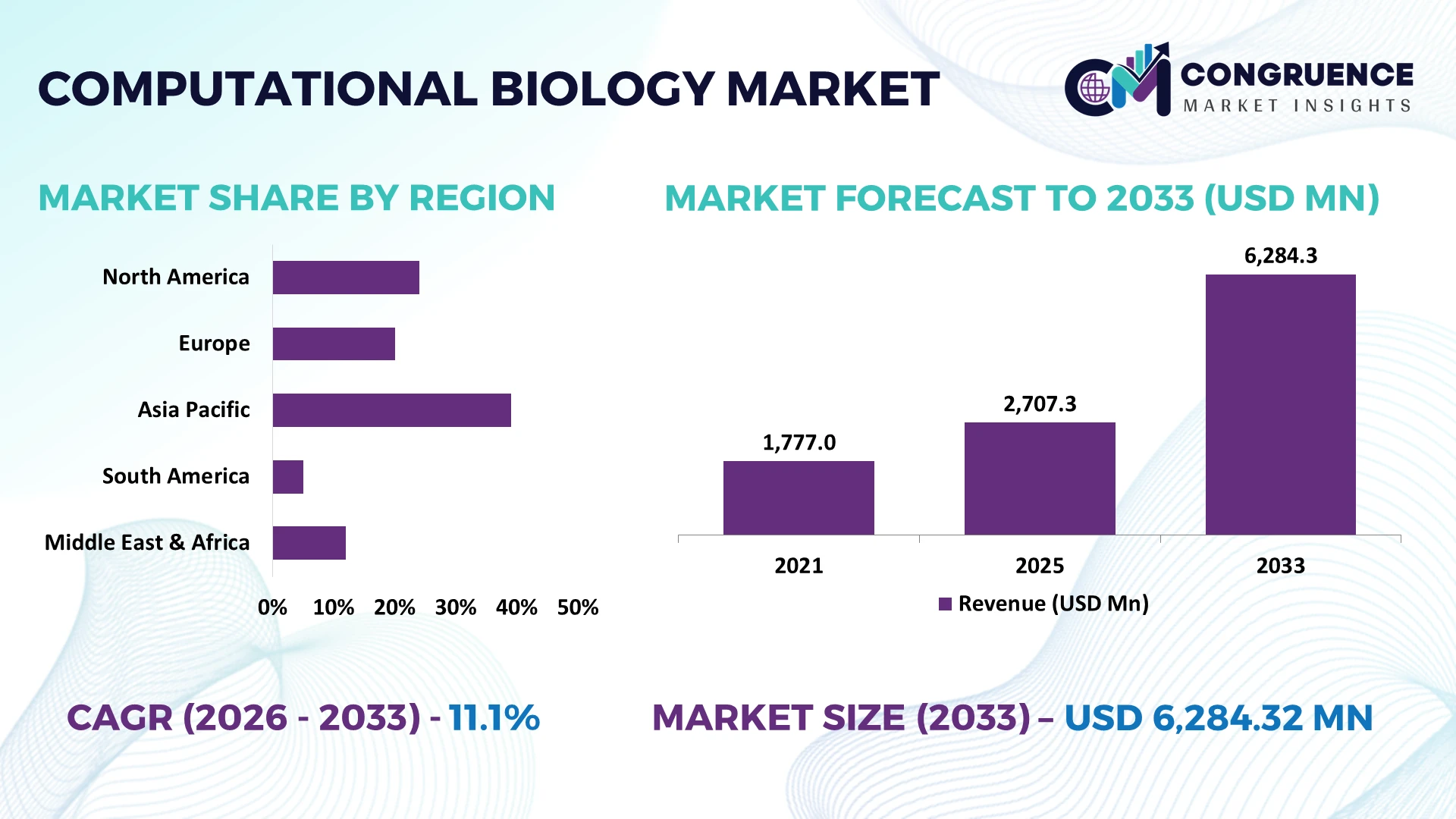
The United States remains the dominant country, representing approximately 42% of North America's computational biology activity, supported by pharmaceutical R&D, genomics infrastructure, cloud-HPC deployment, and AI drug-discovery programs. U.S. industrial end users represented 62.6% of domestic activity in 2023, while Asia-Pacific is expanding faster through China and India’s biotech investments and computational research capacity. The 2024–2026 shift toward AI-native biology platforms is widening this competitive gap.
Strategically, suppliers should prioritize AI-native platforms, scalable HPC infrastructure, and integrated multi-omics workflows in North America while targeting faster-growing Asian research ecosystems.
Market Size & Growth: USD 2.71 billion in 2025 rising to USD 6.28 billion by 2033 at 11.1% CAGR, driven by AI-based drug discovery and multi-omics analytics.
Top Growth Drivers: AI adoption 35%, multi-omics integration 28%, precision-medicine workflows 24%.
Short-Term Forecast: By 2028, automated computational workflows are positioned to reduce analysis costs by 15% and increase research efficiency by 20%.
Emerging Technologies: Protein foundation models, generative chemistry, and AI molecular simulation are reshaping advanced computational biology platforms.
Regional Leaders: North America is projected near USD 2.8 billion, Europe around USD 1.7 billion, and Asia-Pacific near USD 1.4 billion, with cloud and AI deployment accelerating.
Consumer/End-User Trends: Industrial users represented 62.6% of U.S. computational biology activity, reinforcing pharmaceutical and biotechnology leadership.
Pilot/Case Example: In 2024, NVIDIA BioNeMo deployments demonstrated up to 5× faster protein-structure prediction and 16% higher molecular docking accuracy.
Competitive Landscape: North America holds approximately 42% global share, with Schrödinger, Illumina, Thermo Fisher Scientific, DNAnexus, and QIAGEN competing across software, genomics, and data platforms.
Regulatory & ESG Impact: FDA movement toward computational models and reduced animal testing is strengthening demand for validated in-silico workflows and measurable model performance.
Investment & Funding: AI-driven drug discovery attracted approximately USD 2.2 billion in 2025, accelerating venture funding, pharmaceutical partnerships, and platform expansion.
Innovation & Future Outlook: Agentic AI, autonomous laboratories, foundation models, and cloud-HPC integration are shifting competition toward end-to-end computational discovery ecosystems.
Computational biology demand is concentrating around drug discovery, disease modeling, computational genomics, clinical-trial analytics, and personalized medicine. AI-native protein prediction and generative molecular design are increasing workflow automation, with leading platforms delivering performance gains above 15%. Regulatory momentum in the United States toward computational alternatives and continued semiconductor supply-chain expansion are accelerating enterprise adoption, positioning integrated AI-biology platforms as the next strategic growth frontier.
Computational biology is becoming strategically important because pharmaceutical competitiveness increasingly depends on how quickly companies convert biological data into validated targets, candidate molecules, and clinical decisions. AI-driven protein modeling, multi-omics integration, and cloud-HPC workflows are shifting investment from isolated software tools toward integrated discovery infrastructure. This transformation is also strengthening demand for reproducible, data-governed computational pipelines.
A major market shift is the restructuring of drug-discovery workflows around AI-native platforms and scalable computing. Modern GPU-accelerated workflows can deliver roughly 20–30% higher analytical throughput than conventional CPU-based environments for intensive modeling tasks. The United States maintains greater deployment scale through established pharmaceutical and biotechnology ecosystems, while China is expanding computational research capacity through domestic AI and genomics infrastructure. Over the next 2–3 years, enterprise adoption of automated computational workflows is positioned to rise by approximately 15–20%.
Companies are responding through cloud-HPC modernization, strategic AI partnerships, and investments in foundation models for protein and molecular analysis. A practical deployment model combines genomic databases, automated annotation, molecular simulation, and AI-based candidate ranking within one workflow, reducing manual data transfers and improving reproducibility. Competitive advantage will increasingly favor companies that control interoperable biological data pipelines, computing capacity, and validated AI models rather than standalone analytical tools.
AI-enabled molecular modeling is the strongest structural driver, with pharmaceutical organizations reporting computational workflow adoption gains of roughly 20%, while automated data processing can reduce manual analysis requirements by nearly 25%. U.S. drug developers are increasingly integrating protein foundation models with molecular simulation and multi-omics platforms, accelerating target prioritization and candidate screening. The shift from fragmented computational tools toward integrated AI-HPC environments is improving utilization of expensive research infrastructure. Companies are responding through GPU expansion, cloud partnerships, and acquisitions of specialized AI-biology platforms. The non-obvious advantage is workflow continuity: organizations connecting genomic, structural, and chemical datasets gain faster iteration cycles than firms operating disconnected analytical systems.
High-performance computing requirements remain a structural constraint, particularly for organizations lacking GPU infrastructure and curated biological datasets. Advanced computational workloads can increase infrastructure expenditure by approximately 15–25%, while fragmented datasets can create 10–20% additional preprocessing effort. In India and emerging Asian biotechnology hubs, limited access to specialized computing capacity continues to constrain large-scale model deployment. Semiconductor availability and elevated demand for AI accelerators also create procurement pressure. Companies are mitigating exposure through cloud-computing contracts, hybrid infrastructure, and multi-vendor procurement. The key operational issue is not software availability but sustained access to compute, governed datasets, and interoperable infrastructure at predictable costs.
Generative AI is opening high-value opportunities across protein engineering, molecular design, biomarker discovery, and personalized medicine. AI-assisted workflows can improve candidate-screening productivity by approximately 20–30%, while automated model interpretation can reduce repetitive analytical tasks by around 15%. China is expanding domestic AI-biology capabilities, creating opportunities for localized computational platforms and strategic partnerships. Generative protein models and autonomous experiment-design systems are emerging as the next investment frontier. Companies are increasing R&D allocations toward foundation models, cloud-native platforms, and laboratory-computing integration. A distinctive opportunity lies in linking computational predictions directly with automated laboratory validation, creating closed-loop discovery systems that reduce iteration time and improve research asset utilization.
Long-term competitiveness depends on integrating computational biology platforms with laboratory, clinical, and enterprise data environments without sacrificing security or reproducibility. Data harmonization can consume 15–20% of computational project effort, while legacy interfaces frequently create 10% or more workflow inefficiency. U.S. pharmaceutical organizations face increasing requirements for model validation, traceability, and controlled data handling as computational evidence becomes more influential in development decisions. Cybersecurity exposure also rises as biological datasets move across cloud and collaborative environments. Companies must invest in standardized APIs, model governance, secure cloud architectures, and specialized talent. The strategic challenge is building scalable infrastructure that supports rapid AI experimentation while maintaining regulatory-grade provenance and operational consistency.
Software remains the leading type, accounting for approximately 39% of computational biology activity, supported by scalable analytics, visualization, simulation, and workflow orchestration. Its dominance reflects lower deployment friction and easier integration with cloud-HPC environments than highly customized computational tools. Bioinformatics Platforms follow closely at about 28%, particularly among pharmaceutical and genomics organizations requiring integrated pipelines. Computational Tools retain strategic importance for specialized molecular modeling and structural analysis, while Databases provide the foundational biological datasets required across every workflow.
Computational Tools represent the fastest-growing type, expanding adoption by roughly 17% as AI-enhanced molecular simulation and protein modeling become embedded in discovery pipelines. Software providers are responding with modular architectures, API connectivity, and subscription-based deployment, while platform vendors increasingly bundle databases and analytical functions. The mature software segment therefore faces pressure to differentiate through interoperability and model performance rather than basic functionality.
Drug Discovery leads with approximately 42% of computational biology application demand because virtual screening, target identification, molecular simulation, and candidate optimization directly affect pharmaceutical pipeline economics. Genomics accounts for roughly 23%, supported by expanding sequencing datasets and cloud-based interpretation, while Proteomics represents about 14% as protein-level analysis becomes increasingly integrated with multi-omics workflows. Disease Modeling remains specialized, whereas Precision Medicine is accelerating as computational methods connect genomic profiles with treatment decisions.
Precision Medicine is the fastest-growing application, with adoption increasing approximately 19% as healthcare systems move toward biomarker-driven treatment selection. Companies are integrating genomic, clinical, and molecular datasets to improve patient stratification and trial design. The competitive implication is significant: mature drug-discovery platforms increasingly compete on AI prediction accuracy, while emerging precision-medicine solutions compete on data interoperability and clinical usability.
Pharmaceutical Companies represent the dominant end-user group at approximately 44% share, reflecting intensive use of computational biology across target discovery, molecular design, biomarker analysis, and pipeline prioritization. Biotechnology Companies account for nearly 24% and increasingly favor cloud-native platforms that reduce infrastructure requirements. Research Institutes and Academic Institutions remain important for algorithm development and open biological datasets, while Contract Research Organizations provide outsourced computational capabilities for organizations seeking flexible specialist capacity.
Biotechnology Companies are the fastest-growing end-user category, with deployment expanding by approximately 18% as smaller firms adopt external HPC, AI platforms, and partnership-led research models. Pharmaceutical companies are increasing platform standardization, while biotech firms emphasize rapid cloud deployment and pay-per-use economics. CROs are differentiating through specialized computational services, and academic institutions are strengthening collaborative data ecosystems. The strategic shift favors vendors capable of serving both enterprise-scale infrastructure and modular research environments.
North America accounted for the largest market share at 44% in 2025 however, Asia-Pacific is expected to register the fastest growth, expanding at a CAGR of 13.4% between 2026 and 2033.
AI-HPC Integration Reshapes Enterprise Discovery
North America commands approximately 44% of the global computational biology market, supported by dense pharmaceutical R&D, advanced genomics infrastructure, and high-performance computing capacity. U.S. pharmaceutical and biotechnology companies are concentrating computational workloads around protein modeling, virtual screening, multi-omics, and AI-enabled target identification. More than 60% of large biopharma organizations now prioritize AI capabilities within research modernization programs, strengthening demand for integrated platforms rather than isolated analytical tools. Strategic partnerships between drug developers, cloud providers, GPU specialists, and computational software companies are accelerating deployment. The region's strongest advantage is its ability to combine biological datasets with scalable computing and commercial drug-development pipelines. Companies are increasing GPU capacity, expanding cloud environments, and acquiring specialized AI-biology capabilities to shorten discovery cycles.
United States Market Outlook: The United States remains the principal national market because pharmaceutical R&D spending, genomics infrastructure, AI computing capacity, and biotechnology commercialization are highly concentrated there. More than 60% of major U.S. biopharma organizations prioritize AI-related research capabilities, supporting sustained platform deployment and specialized computational partnerships.
Regulated Data Ecosystems Drive Platform Modernization
Europe represents approximately 27% of global computational biology activity, with Germany, the United Kingdom, France, and Switzerland forming major research and pharmaceutical clusters. The region's competitive position is shaped by advanced pharmaceutical manufacturing, genomics programs, and stringent data-governance requirements that favor traceable computational workflows. EU research infrastructure is increasingly connecting genomic databases, HPC resources, and AI-enabled analytics, while pharmaceutical companies are expanding computational validation for drug development. Approximately 45% of European life-science organizations are increasing investment in AI-enabled research workflows, supporting demand for interoperable platforms. Regulatory emphasis on data provenance and responsible AI is pushing vendors toward auditable model architectures. Companies are responding through consortium partnerships, cloud modernization, and localized data infrastructure, creating a market where compliance capability increasingly functions as a commercial differentiator.
United Kingdom Market Outlook: The United Kingdom benefits from concentrated pharmaceutical research, advanced genomics infrastructure, and strong university-industry collaboration. Its national genomics ecosystem has generated datasets covering more than 500,000 participants, providing a valuable foundation for computational disease modeling, biomarker discovery, and precision-medicine applications.
China and India Accelerate Computational Scale
Asia-Pacific is the fastest-expanding major market, accounting for approximately 18% of global activity, with China, Japan, South Korea, Singapore, and India driving deployment. China is strengthening domestic AI and genomics capabilities, while India combines expanding biotechnology research with comparatively cost-efficient computational talent. Pharmaceutical companies and research institutions are increasing cloud-HPC adoption as sequencing datasets and molecular-modeling workloads grow. Enterprise computational infrastructure investments have increased by roughly 20% across leading life-science organizations, strengthening demand for scalable platforms. Regional players are also building localized databases and forming partnerships with global technology providers to reduce dependence on external infrastructure. The strategic advantage is the combination of expanding biological datasets, technical talent, and lower operating costs, although advanced accelerator availability remains an important infrastructure consideration.
China Market Outlook: China holds the strongest national position in Asia-Pacific through extensive pharmaceutical R&D, domestic AI development, genomics research, and expanding HPC infrastructure. Government-backed biotechnology initiatives and growing computational capacity are accelerating local platform development, while domestic AI capabilities increasingly support protein modeling and molecular-design workflows.
Brazil Leads Research Infrastructure Adoption
South America contributes approximately 6% of global computational biology activity, with Brazil representing the largest national market because of its pharmaceutical research base, agricultural biotechnology capabilities, and expanding genomics infrastructure. Brazilian universities, research centers, and biotechnology companies are increasing cloud-based computational deployment to manage sequencing, disease-modeling, and molecular-analysis workloads. Approximately 30% of active life-science research programs increasingly incorporate computational analysis, creating demand for specialized bioinformatics platforms and databases. Infrastructure concentration remains uneven outside major research hubs, raising the importance of cloud delivery and collaborative computing models. Companies are responding through partnerships with universities, CROs, and technology providers rather than relying exclusively on owned infrastructure. The key strategic opportunity lies in scalable platforms that deliver advanced analytics without requiring large local HPC investments.
Brazil Market Outlook: Brazil dominates regional computational activity through its research institutions, biotechnology ecosystem, and large-scale biological datasets. Its agricultural and biomedical research programs create diversified computational demand, while public research infrastructure supports genomics and disease-modeling initiatives. Cloud deployment is increasingly important for extending advanced analytical capabilities beyond major research centers.
National Innovation Programs Build Bioinformatics Capacity
Middle East & Africa represents approximately 5% of global computational biology activity, with the United Arab Emirates, Saudi Arabia, Israel, and South Africa forming important technology and research centers. Investment is increasingly directed toward genomics, precision medicine, AI infrastructure, and national healthcare modernization. Saudi Arabia and the UAE are developing advanced digital-health ecosystems that incorporate large-scale genomic and clinical datasets, while Israel contributes strong computational biology and biotechnology expertise. Regional life-science organizations are increasing AI and cloud adoption by roughly 15%, improving access to sophisticated modeling without equivalent growth in physical infrastructure. Companies are targeting government-backed programs through partnerships, localized data platforms, and specialized analytics services. The market's non-obvious advantage is the rapid creation of centralized genomic datasets that can support population-specific computational models.
Saudi Arabia Market Outlook: Saudi Arabia is emerging as a strategically important national market through large-scale healthcare digitization, genomics initiatives, and government-backed biotechnology investment. National genomic programs are building population-scale datasets, strengthening demand for computational analytics, AI modeling, secure cloud infrastructure, and precision-medicine platforms.
Schrödinger, Illumina, QIAGEN, Thermo Fisher Scientific, and DNAnexus compete across computational platforms, genomics infrastructure, biological databases, and cloud-enabled analytics, while specialized AI-biology innovators challenge established vendors on model performance. The top five players collectively account for approximately 28% of market activity, reflecting a fragmented structure with strong specialist participation. Technology performance influences roughly 30% of enterprise selection criteria, while interoperability contributes about 20% and deployment speed nearly 15%. Leaders are expanding through pharmaceutical partnerships, cloud integrations, AI-model development, and vertically integrated data workflows. Established genomics suppliers are broadening software capabilities, while computational specialists are adding proprietary datasets and workflow automation. The competitive shift is moving from standalone bioinformatics tools toward integrated AI-HPC ecosystems. High-quality biological datasets, GPU infrastructure, validated models, and regulatory-grade data governance create substantial entry barriers. Winning requires superior model accuracy, interoperable infrastructure, rapid deployment, and strategic partnerships with drug developers and research institutions.
Schrödinger, Inc.
Illumina, Inc.
QIAGEN N.V.
Thermo Fisher Scientific Inc.
DNAnexus, Inc.
Dassault Systèmes SE
Certara, Inc.
Benchling, Inc.
Tempus AI, Inc.
Insilico Medicine
Bio-Rad Laboratories, Inc.
PerkinElmer
Charles River Laboratories International, Inc.
Recursion Pharmaceuticals, Inc.
AI-accelerated protein modeling, multi-omics analytics, GPU computing, and cloud-native bioinformatics are now the core technology stack. GPU-optimized workflows can deliver roughly 20–30% higher analytical throughput than CPU-led systems, while automated data processing cuts manual workload by 15–20%. Enterprise deployment is increasingly centered on integrated AI-HPC environments, giving pharmaceutical and biotechnology companies faster target validation and scalable discovery operations.
Emerging technologies include protein foundation models, generative molecular design, spatial multi-omics, and federated learning. Schrödinger demonstrated computational exploration of 23 billion molecular designs in six days, highlighting a dramatic shift from conventional sequential screening. Illumina and NVIDIA are integrating sequencing, multi-omic datasets, and generative AI, while Illumina’s 2026 Billion Cell Atlas expansion is adding AI-native drug developers to a large-scale biological data ecosystem.
By 2026–2028, agentic AI and virtual-cell models will increasingly orchestrate computational workflows, experimental design, and interpretation. Schrödinger’s Bunsen combines agentic AI with physics-based simulation and NVIDIA/Google Cloud infrastructure. Adoption of automated computational workflows is positioned to increase 15–20%, with 10–15% potential efficiency gains from deeper integration. Technology leaders with proprietary datasets, validated models, and scalable compute capacity will gain the strongest competitive advantage.
December 2024 Bristol Myers Squibb partnered with AI Proteins for computational miniprotein discovery across two targets, with the agreement valued up to $400 million, strengthening AI-led protein design and expanding computational drug-discovery pipelines. Source: fiercebiotech.com
January 2025 Schrödinger expanded its Otsuka collaboration and reported a $150 million Novartis upfront payment, while increasing enterprise computational-platform access, strengthening commercial-scale AI and physics-based discovery deployment. Source: schrodinger.com
October 2025 Bristol Myers Squibb, Takeda, AbbVie, Johnson & Johnson, and Astex joined an AI structural-biology consortium, pooling thousands of protein-small-molecule structures to improve OpenFold3 training and computational drug-discovery accuracy. Source: reuters.com
May 2026 QIAGEN partnered with NVIDIA to integrate graph-based AI, curated biomedical knowledge, and accelerated computing; initial pilots target pharmaceutical and biotechnology partners, improving target, biomarker, and pathway analysis workflows. Source: qiagen.com
The report covers Computational Biology across Software, Databases, Bioinformatics Platforms, and Computational Tools, with application analysis spanning Drug Discovery, Genomics, Proteomics, Disease Modeling, and Precision Medicine. End-user coverage includes Pharmaceutical Companies, Biotechnology Companies, Research Institutes, Academic Institutions, and Contract Research Organizations, providing a structured view of demand concentration, deployment intensity, and technology adoption.
Regional assessment covers North America, Europe, Asia-Pacific, South America, and Middle East & Africa, with country-level analysis emphasizing infrastructure, enterprise adoption, research capacity, and investment activity. The scope also evaluates AI-enabled protein modeling, multi-omics, cloud-HPC, generative molecular design, and emerging agentic workflows. Approximately 40–45% of demand remains concentrated around pharmaceutical-led computational applications, while biotechnology adoption is shifting toward cloud-native and AI-integrated platforms. The analysis supports investment planning, geographic expansion, partnership selection, competitive positioning, and technology priorities through 2033.
| Report Attribute/Metric | Report Details |
|---|---|
Market Revenue in 2025 | USD 2707.3 Million |
Market Revenue in 2033 | USD 6284.32 Million |
CAGR (2026 - 2033) | 11.1% |
Base Year | 2025 |
Forecast Period | 2026 - 2033 |
Historic Period | 2021 - 2025 |
Segments Covered | By Type
By Application
By End-User
|
Key Report Deliverable | Revenue Forecast, Growth Trends, Market Dynamics, Segmental Overview, Regional and Country-wise Analysis, Competition Landscape |
Region Covered | North America, Europe, Asia-Pacific, South America, Middle East, Africa |
Key Players Analyzed | Schrödinger, Inc., Illumina, Inc., QIAGEN N.V., Thermo Fisher Scientific Inc., DNAnexus, Inc., Dassault Systèmes SE, Certara, Inc., Benchling, Inc., Tempus AI, Inc., Insilico Medicine, Bio-Rad Laboratories, Inc., PerkinElmer, Charles River Laboratories International, Inc., Recursion Pharmaceuticals, Inc. |
Customization & Pricing | Available on Request (10% Customization is Free) |




