
Reports
The Global Compounding Pharmacies Market was valued at USD 13210.38 Million in 2025 and is anticipated to reach a value of USD 19076.06 Million by 2033 expanding at a CAGR of 4.7% between 2026 and 2033. Growth is supported by rising demand for personalized medications, increasing shortages of commercially manufactured drugs, and wider adoption of precision dosing across chronic disease, pediatric, hormone replacement, and veterinary therapies.
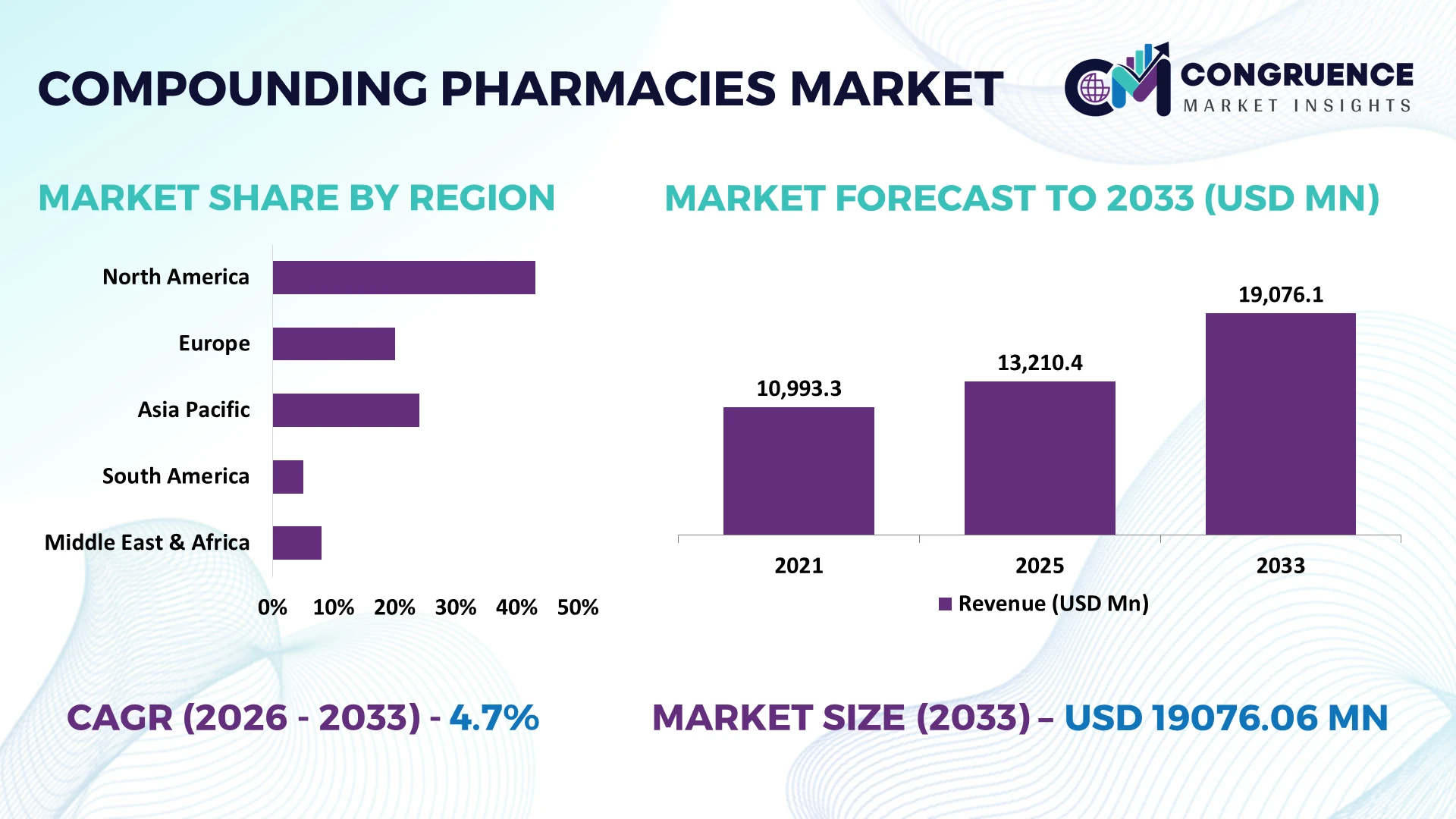
The United States leads the global Compounding Pharmacies Market, accounting for over 42% of global activity through its extensive network of accredited compounding facilities, advanced sterile preparation capabilities, and strong healthcare infrastructure. Following continued pharmaceutical supply-chain adjustments after the Red Sea shipping disruptions, domestic production investments accelerated, while Germany maintains a comparatively smaller but highly regulated market with increasing hospital-based compounding adoption exceeding 18% across specialized care settings.
Strategically, companies should prioritize sterile compounding capacity, digital quality assurance systems, and regulatory compliance to strengthen long-term competitive positioning.
Market Size & Growth: USD 13,210.38 million in 2025, reaching USD 19,076.06 million by 2033 at 4.7% CAGR, supported by personalized medicine adoption and persistent drug shortage management.
Top Growth Drivers: Personalized therapies (+28%), sterile compounding demand (+24%), and specialty chronic care prescriptions (+19%) continue accelerating global market expansion.
Short-Term Forecast: By 2028, automated workflow integration improves prescription processing efficiency by approximately 22% while reducing dispensing errors by nearly 16%.
Emerging Technologies: AI-assisted formulation validation, robotic sterile compounding, and digital quality monitoring improve consistency, compliance, and operational scalability across advanced facilities.
Regional Leaders: North America exceeds USD 8.5 billion, Europe surpasses USD 4.3 billion, and Asia-Pacific reaches USD 3.8 billion, driven by hospital pharmacy modernization and regional healthcare expansion.
Consumer/End-User Trends: Nearly 34% of personalized prescriptions involve customized dosage forms, with pediatric, geriatric, and hormone replacement therapies leading demand.
Pilot/Case Example: A 2025 hospital pharmacy automation program reduced sterile preparation turnaround time by 27% while improving batch documentation accuracy by 31%.
Competitive Landscape: The leading participant holds approximately 9% market share, with Fagron, B. Braun, Fresenius Kabi, Medisca, and Wedgewood Pharmacy remaining prominent competitors.
Regulatory & ESG Impact: Enhanced quality compliance programs lowered formulation deviations by approximately 18%, while sustainability initiatives reduced pharmaceutical packaging waste by nearly 14%.
Investment & Funding: More than USD 1.2 billion supports facility expansion, digital pharmacy platforms, and strategic partnerships as regional supply-chain localization strengthens.
Innovation & Future Outlook: Next-generation sterile manufacturing, AI-enabled prescription verification, and precision compounding platforms reinforce high-growth healthcare delivery and specialized pharmaceutical services.
Personalized treatment protocols, sterile injectable formulations, and customized hormone therapies continue expanding demand across hospitals, specialty clinics, and outpatient care. AI-supported formulation verification and automated cleanroom operations are improving accuracy by nearly 20%, while regional pharmaceutical supply-chain diversification and tighter regulatory oversight are encouraging investment in resilient, compliant compounding infrastructure, setting the stage for the following strategic market assessment.
The Compounding Pharmacies Market has become strategically important as healthcare providers increasingly require customized therapies that standard pharmaceutical manufacturing cannot consistently supply. Ongoing drug shortage management, tighter quality oversight, and digital prescription workflows are reshaping competitive priorities across pharmacy networks. Organizations are expanding sterile compounding infrastructure and strengthening compliance systems to improve continuity of care while supporting precision medicine initiatives across oncology, pediatrics, pain management, and hormone replacement therapies.
Technology modernization is redefining operational efficiency. AI-assisted formulation verification and automated cleanroom workflows reduce manual verification time by nearly 30% while lowering documentation errors by approximately 25% compared with conventional paper-based processes. The United States continues leading large-scale sterile compounding through accredited facilities and digital quality management, whereas Japan emphasizes hospital-integrated compounding supported by advanced pharmacy automation and standardized aseptic procedures. During the next two to three years, automated prescription validation is expected to exceed 40% adoption among larger specialty pharmacy operators, improving workflow consistency and regulatory readiness.
A practical example is the deployment of robotic sterile preparation systems that standardize high-volume injectable production while enhancing traceability and reducing preparation variability. Companies are increasing investments in digital infrastructure, regional sterile production capacity, and technology partnerships to strengthen operational resilience. Organizations capable of combining advanced automation with regulatory excellence and scalable personalized medication services will secure stronger competitive positioning as healthcare systems prioritize dependable pharmaceutical customization.
Personalized medicine continues to reshape compounding pharmacy operations as healthcare providers seek patient-specific formulations unavailable through conventional manufacturing. More than 35% of specialty prescriptions require customized dosage strengths or alternative delivery formats, while sterile compounded preparations have increased by approximately 18% across major hospital systems. Persistent pharmaceutical supply disruptions have reinforced investment in domestic compounding capacity within the United States, encouraging pharmacies to expand cleanroom facilities and digital quality controls. Companies are responding through automation investments, strategic partnerships with healthcare providers, and accreditation-focused expansion, allowing faster prescription fulfillment, improved compliance, and stronger differentiation in high-value therapeutic segments.
Maintaining consistent compliance across sterile and non-sterile compounding environments remains a significant operational constraint. Quality assurance activities account for nearly 20% of operating expenditure in advanced facilities, while compliance-related documentation workloads have increased by approximately 25% under stricter inspection frameworks. Dependence on imported pharmaceutical ingredients also exposes pharmacies to procurement delays and pricing fluctuations, particularly during international logistics disruptions. Companies are mitigating these pressures by diversifying supplier networks, increasing domestic ingredient sourcing, and implementing electronic batch documentation systems that reduce audit preparation time while improving operational consistency and long-term business resilience.
Digital transformation creates substantial opportunities for advanced compounding services beyond traditional prescription fulfillment. Automated dispensing technologies improve formulation accuracy by approximately 24%, while AI-supported prescription review reduces verification time by nearly 28%. Australia and Singapore are expanding digital health ecosystems that encourage integration between physicians, pharmacies, and electronic prescribing platforms, accelerating personalized medication delivery. Companies are investing in intelligent workflow software, robotics, and precision formulation research while forming partnerships with specialty clinics. A particularly valuable opportunity lies in expanding customized therapies for rare diseases and home-based healthcare, where standardized commercial medicines frequently fail to address individualized clinical requirements.
Scaling sterile compounding operations while maintaining uniform quality standards presents a long-term execution challenge. Industry surveys indicate workforce shortages exceeding 15% for experienced sterile compounding professionals, while advanced cleanroom validation can extend facility commissioning timelines by more than 30%. Increasing cybersecurity requirements for connected pharmacy management platforms also add complexity to digital transformation initiatives. Companies must invest in workforce development, automated environmental monitoring, secure digital infrastructure, and standardized operating procedures to ensure consistent production quality across multiple facilities. Organizations that successfully integrate skilled personnel, validated technology, and resilient operational governance will establish durable competitive advantages in increasingly regulated healthcare environments.
Advanced Sterile Workflow Automation: Automated aseptic preparation, barcode verification, and digital batch documentation are transforming sterile compounding operations. Automated validation reduces preparation errors by nearly 28% while improving production throughput by approximately 22%. Following stricter quality oversight in the United States, pharmacies are expanding robotic compounding systems and integrating electronic quality management platforms to improve compliance, accelerate prescription turnaround, and reduce manual intervention across high-volume facilities.
Domestic Supply Network Expansion: Pharmaceutical ingredient sourcing strategies continue shifting toward diversified domestic procurement following global logistics disruptions. Nearly 35% of larger compounding organizations have expanded secondary supplier agreements, while localized inventory planning has reduced critical ingredient shortages by about 18%. Companies are restructuring procurement networks, increasing warehouse capacity, and strengthening manufacturer partnerships to improve operational resilience while maintaining uninterrupted customized medication availability.
Digital Prescription Integration: Electronic prescribing platforms are becoming central to customized medication workflows. Integrated prescription verification improves processing efficiency by approximately 24%, while digital clinical documentation reduces administrative workload by nearly 20%. Healthcare providers in Germany and Australia are strengthening interoperability between physicians and pharmacies, prompting compounding organizations to expand secure digital infrastructure and standardized workflow management for faster, more accurate prescription fulfillment.
Specialized Therapy Portfolio Expansion: Pharmacies are broadening customized formulations for hormone replacement, pediatric care, and veterinary medicine as patient-specific treatment requirements become more complex. Customized dosage requests have increased by roughly 26%, while specialized non-sterile formulations account for nearly 30% of new service additions. Companies are expanding formulation libraries, collaborating with specialty clinics, and investing in pharmacist training to strengthen differentiation through highly personalized therapeutic solutions.
Non-Sterile Compounding remains the leading segment, representing approximately 39% of the Compounding Pharmacies Market due to its broad application across dermatology, hormone therapy, pediatric formulations, and chronic disease management. Lower infrastructure requirements, faster preparation cycles, and flexible dosage customization support strong operational scalability. Pharmaceutical Ingredient Alteration continues serving patients requiring allergen-free or modified formulations, while Customized Dosage Forms strengthen adherence through individualized strengths and alternative delivery systems. Companies are expanding formulation capabilities and investing in digital prescription management to improve efficiency and regulatory consistency.
Veterinary Compounding is emerging as the fastest-growing segment, supported by increasing companion animal healthcare expenditure and demand for species-specific medications. Adoption has increased by nearly 21%, while customized dosage formulations have expanded by approximately 19% across specialty pharmacies. Compounding providers are developing dedicated veterinary divisions, strengthening partnerships with animal hospitals, and broadening product portfolios. Investment priorities increasingly favor automation, quality assurance, and formulation flexibility that support both established human healthcare services and expanding veterinary pharmaceutical markets.
Pain Management remains the largest application, accounting for approximately 34% of overall compounded prescriptions because individualized dosing, alternative formulations, and opioid-sparing treatment strategies require customized pharmaceutical preparation. Dermatology continues generating consistent prescription demand through topical therapies, while Hormone Replacement Therapy benefits from personalized treatment protocols. Pharmacies are strengthening physician collaboration and expanding digital prescribing integration to improve treatment precision, workflow efficiency, and patient adherence across high-frequency therapeutic categories.
Veterinary Medicine represents the fastest-growing application, supported by increasing demand for flavored formulations and customized strengths designed for companion animals. Prescription volumes in this segment have increased by approximately 23%, while pediatric compounded medications have expanded by nearly 17% through age-specific dosing requirements. Companies are increasing pharmacist specialization, expanding formulation libraries, and strengthening relationships with specialty clinics. These operational adjustments enable faster prescription fulfillment while supporting individualized treatment across emerging therapeutic segments where commercially manufactured alternatives remain limited.
Hospitals remain the dominant end-user segment with approximately 41% market share because advanced sterile preparation, oncology support, intensive care requirements, and integrated pharmacy infrastructure drive sustained demand. Retail Pharmacies continue serving large outpatient prescription volumes, while Ambulatory Care Centers expand utilization through same-day medication management. Companies are strengthening hospital partnerships, implementing automated sterile production systems, and enhancing digital quality management to support high-volume operations with greater consistency and regulatory compliance.
Specialty Clinics represent the fastest-growing end-user category as precision medicine and individualized treatment protocols become increasingly common across endocrinology, dermatology, and pain management services. Adoption has increased by approximately 22%, while customized prescription demand from clinic-based providers has grown by nearly 20%. Veterinary Clinics continue expanding through companion animal healthcare, encouraging pharmacies to develop specialized formulation capabilities. Companies are targeting these segments through dedicated service agreements, customized pricing strategies, and integrated prescription support platforms that improve long-term customer retention and operational efficiency.
North America accounted for the largest market share at 43.8% in 2025 however, Asia-Pacific is expected to register the fastest growth, expanding at a CAGR of 6.2% between 2026 and 2033.
Strategic Leadership Through Sterile Compounding Modernization
North America maintains the highest concentration of accredited compounding pharmacies, supported by advanced healthcare infrastructure, strong specialty care demand, and mature regulatory oversight. The region contributes nearly 44% of global market activity, with sterile compounding representing a significant share of hospital pharmacy operations. Investments in automated cleanroom technologies, electronic quality management, and digital prescription workflows continue improving operational efficiency and regulatory readiness. More than 35% of large pharmacy operators have expanded sterile production capacity through facility upgrades or workflow automation initiatives. Partnerships between health systems and specialized compounding providers are strengthening medication availability during commercial drug shortages while improving supply continuity for oncology, pediatric, and hormone replacement therapies.
United States Market Outlook: The United States remains the operational center of the regional market because of its extensive accredited compounding network, sophisticated hospital pharmacy infrastructure, and widespread adoption of sterile preparation technologies. Nearly 42% of high-volume specialty pharmacies have implemented automated verification systems, reducing documentation time and improving batch consistency. Continued investment in domestic pharmaceutical supply resilience and pharmacy technology modernization reinforces the country's leadership in customized medication services.
Quality Standardization Driving Operational Excellence
Europe continues strengthening its position through harmonized quality practices, advanced hospital pharmacy services, and increasing adoption of digital medication management. The region represents approximately 28% of global market activity, with Germany, France, and the United Kingdom leading specialized pharmaceutical preparation. Hospital modernization programs and standardized aseptic processing are improving operational consistency, while electronic prescribing integration enhances prescription accuracy across healthcare networks. Approximately 30% of large institutional pharmacies have expanded digital quality documentation over the past two years. Companies continue investing in specialized formulation capabilities and collaborative healthcare partnerships to support individualized therapies under increasingly stringent pharmaceutical quality frameworks.
Germany Market Outlook: Germany leads the European market through its advanced hospital pharmacy infrastructure, highly regulated pharmaceutical environment, and extensive adoption of standardized sterile preparation procedures. More than 40% of tertiary-care hospitals continue expanding digital pharmacy management systems integrated with clinical workflows. Investments in automated compounding technologies and pharmacist specialization strengthen operational efficiency while supporting growing demand for personalized medicines across complex therapeutic applications.
Healthcare Expansion Accelerates Customized Therapy Adoption
Asia-Pacific is rapidly expanding through healthcare infrastructure investment, increasing chronic disease management, and broader deployment of digital pharmacy services. The region accounts for approximately 22% of global activity while recording the fastest adoption of customized pharmaceutical services. Hospital pharmacy modernization, expanding specialty clinics, and rising electronic prescribing utilization are accelerating demand across urban healthcare systems. More than 32% of newly established tertiary hospitals have integrated advanced pharmacy automation into medication preparation workflows. Companies are expanding regional manufacturing partnerships, investing in pharmacist training, and developing localized formulation capabilities to support growing demand for individualized therapies.
Japan Market Outlook: Japan remains the region's most strategically significant market due to its sophisticated healthcare infrastructure, aging population, and strong emphasis on medication precision. Hospital-integrated compounding services continue expanding, with approximately 38% of major healthcare institutions implementing advanced automated pharmacy systems. Ongoing investment in digital prescription management and standardized sterile preparation enhances operational quality while supporting personalized treatment strategies across specialized medical disciplines.
Expanding Specialty Pharmacy Networks
South America continues progressing through expanding specialty healthcare services and improving pharmaceutical distribution infrastructure despite operational capacity differences across countries. The region contributes roughly 5% of global market activity, with Brazil accounting for the largest deployment base. Growing demand for individualized dermatology, hormone therapy, and pediatric medications is encouraging pharmacies to expand formulation capabilities and strengthen local ingredient sourcing. Approximately 18% of larger pharmacy operators have upgraded laboratory infrastructure to improve preparation quality and regulatory compliance. Companies are focusing on regional partnerships, pharmacist training, and operational standardization to enhance service reliability while addressing infrastructure limitations affecting specialized pharmaceutical delivery.
Brazil Market Outlook: Brazil leads regional development through its large healthcare network, expanding specialty pharmacy sector, and increasing investment in pharmaceutical modernization. Customized medication demand continues rising across metropolitan healthcare centers, supported by broader deployment of digital prescription platforms. Nearly 25% of major pharmacy organizations have expanded specialized compounding facilities, strengthening operational capacity while improving access to patient-specific therapeutic formulations.
Healthcare Modernization Supports Specialized Pharmacy Services
The Middle East & Africa market is expanding through healthcare infrastructure development, pharmaceutical localization initiatives, and increasing investment in specialized clinical services. The region represents approximately 4% of global activity, with Gulf countries leading deployment of advanced pharmacy technologies. Hospital expansion programs and digital healthcare transformation are strengthening demand for customized medications across oncology, endocrinology, and critical care. Around 20% of newly commissioned tertiary healthcare facilities have incorporated upgraded pharmacy preparation units supporting higher-quality compounded formulations. Companies are entering strategic partnerships, expanding technical training, and investing in standardized sterile compounding environments to improve long-term healthcare capability.
Saudi Arabia Market Outlook: Saudi Arabia remains the leading market due to sustained healthcare infrastructure investment, expanding hospital capacity, and national pharmaceutical localization initiatives. Advanced healthcare projects continue increasing demand for specialized pharmacy services, while approximately 30% of newly developed tertiary hospitals incorporate modern sterile medication preparation facilities. Continued investment in digital health systems and pharmaceutical workforce development strengthens the country's long-term position in customized medication delivery.
The Compounding Pharmacies Market features competition between global formulation specialists including Fagron, Medisca, Wedgewood Pharmacy, Empower Pharmacy, and Dougherty's Pharmacy against regional compounding providers focused on localized prescription fulfillment. The top five participants collectively control approximately 32% of the market, leaving significant opportunities for specialized operators. Competition centers on formulation customization, sterile production quality, delivery speed, and digital workflow integration rather than price alone. Automated compounding reduces preparation time by nearly 25%, while electronic quality management lowers documentation errors by approximately 20%, creating measurable operational advantages. Leading companies are expanding sterile facilities, strengthening healthcare partnerships, investing in pharmacy automation, and vertically integrating ingredient procurement to improve supply reliability. Regional providers differentiate through physician relationships and faster prescription turnaround for personalized therapies. Regulatory compliance, accreditation requirements, and cleanroom infrastructure remain major entry barriers. Winning requires scalable sterile capacity, technology-enabled quality assurance, resilient pharmaceutical sourcing, and strong clinical partnerships delivering consistently personalized, compliant medications across diverse therapeutic segments.
Fagron
Medisca
Wedgewood Pharmacy
Empower Pharmacy
Triangle Compounding Pharmacy
Olympia Pharmaceuticals
Pavilion Compounding Pharmacy
Dougherty's Pharmacy
CareFirst Specialty Pharmacy
Town & Country Compounding Pharmacy
The Compounding Pharmacy of America
Aurora Compounding Pharmacy
Automation and digital quality management have become core technologies transforming compounding pharmacy operations. Robotic sterile compounding, AI-assisted prescription verification, and electronic batch documentation improve formulation consistency while reducing manual intervention. Automated preparation workflows increase operational efficiency by approximately 27%, and digital quality platforms reduce documentation errors by nearly 22%. More than 40% of large specialty compounding facilities have deployed integrated workflow management systems, enabling faster regulatory reporting and stronger production traceability. Healthcare organizations benefit through improved turnaround times and higher prescription accuracy across complex therapeutic formulations.
Emerging technologies are shifting the market beyond conventional pharmacy operations. Compared with legacy manual verification, AI-supported formulation validation shortens prescription review time by roughly 30% while improving compliance consistency. RFID-enabled inventory monitoring and environmental sensor networks reduce ingredient waste by approximately 15% through real-time tracking. Large hospital pharmacies and accredited compounding providers gain the greatest competitive advantage because higher prescription volumes justify investment in intelligent automation and connected pharmacy infrastructure.
Between 2026 and 2028, predictive analytics, cloud-connected pharmacy platforms, and advanced robotic aseptic systems will redefine operational performance. Adoption of intelligent production scheduling is expected to exceed 45% among larger compounding organizations, improving equipment utilization and workflow planning. Companies investing early in integrated digital ecosystems, cybersecurity, and scalable sterile automation will strengthen regulatory readiness, reduce operating costs, and secure sustainable competitive differentiation as personalized pharmaceutical services continue expanding.
April 2024 Empower Pharmacy expanded its executive leadership team by appointing three senior executives to accelerate manufacturing scale, operational excellence, and innovation as the company continued rapid capacity growth. The initiative supported a workforce exceeding 1,100 employees and strengthened long-term expansion execution. Source: empowerpharmacy.com
September 2025 Fagron announced the acquisition of University Compounding Pharmacy in California, strengthening its North American 503A platform and creating a broader coast-to-coast service network. The acquired business added established hormone and urology compounding capabilities, reinforcing nationwide personalized medicine coverage. Source: fagron.com
December 2025 Fagron signed acquisitions of Amber Compounding Pharmacy and Vepakum, expanding pharmaceutical compounding operations across Singapore, Malaysia, and Brazil. The company simultaneously extended its presence to more than 35 countries, improving supply-chain diversification and regional manufacturing capabilities. Source: investors.fagron.com
January 2026 Fagron completed the acquisition of University Compounding Pharmacy following regulatory clearance, integrating specialized 503A compounding operations with its existing North American network. The transaction strengthened nationwide patient-specific and outsourcing service capabilities while accelerating strategic platform integration.
This report delivers comprehensive analysis across the Compounding Pharmacies Market by evaluating Non-Sterile Compounding, Pharmaceutical Ingredient Alteration, Customized Dosage Forms, Veterinary Compounding, and related service categories. It assesses demand across pain management, hormone replacement therapy, dermatology, pediatric care, and veterinary medicine while examining procurement trends among hospitals, retail pharmacies, specialty clinics, ambulatory care centers, and veterinary clinics. The study also benchmarks more than 12 leading industry participants alongside evolving competitive strategies and operational positioning.
Regional assessment spans North America, Europe, Asia-Pacific, South America, and the Middle East & Africa, highlighting deployment intensity, infrastructure modernization, and technology adoption patterns. The report evaluates automation, AI-enabled prescription verification, robotic sterile compounding, and digital quality management while identifying emerging niche opportunities in personalized medicine and specialty therapeutics. It supports investment prioritization, expansion planning, partnership evaluation, competitive benchmarking, and strategic decision-making through 2033 with actionable operational and market intelligence.
| Report Attribute/Metric | Report Details |
|---|---|
Market Revenue in 2025 | USD 13210.38 Million |
Market Revenue in 2033 | USD 19076.06 Million |
CAGR (2026 - 2033) | 4.7% |
Base Year | 2025 |
Forecast Period | 2026 - 2033 |
Historic Period | 2021 - 2025 |
Segments Covered | By Type
By Application
By End-User
|
Key Report Deliverable | Revenue Forecast, Growth Trends, Market Dynamics, Segmental Overview, Regional and Country-wise Analysis, Competition Landscape |
Region Covered | North America, Europe, Asia-Pacific, South America, Middle East, Africa |
Key Players Analyzed | Fagron, Medisca, Wedgewood Pharmacy, Empower Pharmacy, Triangle Compounding Pharmacy, Olympia Pharmaceuticals, Pavilion Compounding Pharmacy, Dougherty's Pharmacy, CareFirst Specialty Pharmacy, Town & Country Compounding Pharmacy, The Compounding Pharmacy of America, Aurora Compounding Pharmacy |
Customization & Pricing | Available on Request (10% Customization is Free) |




