
Reports
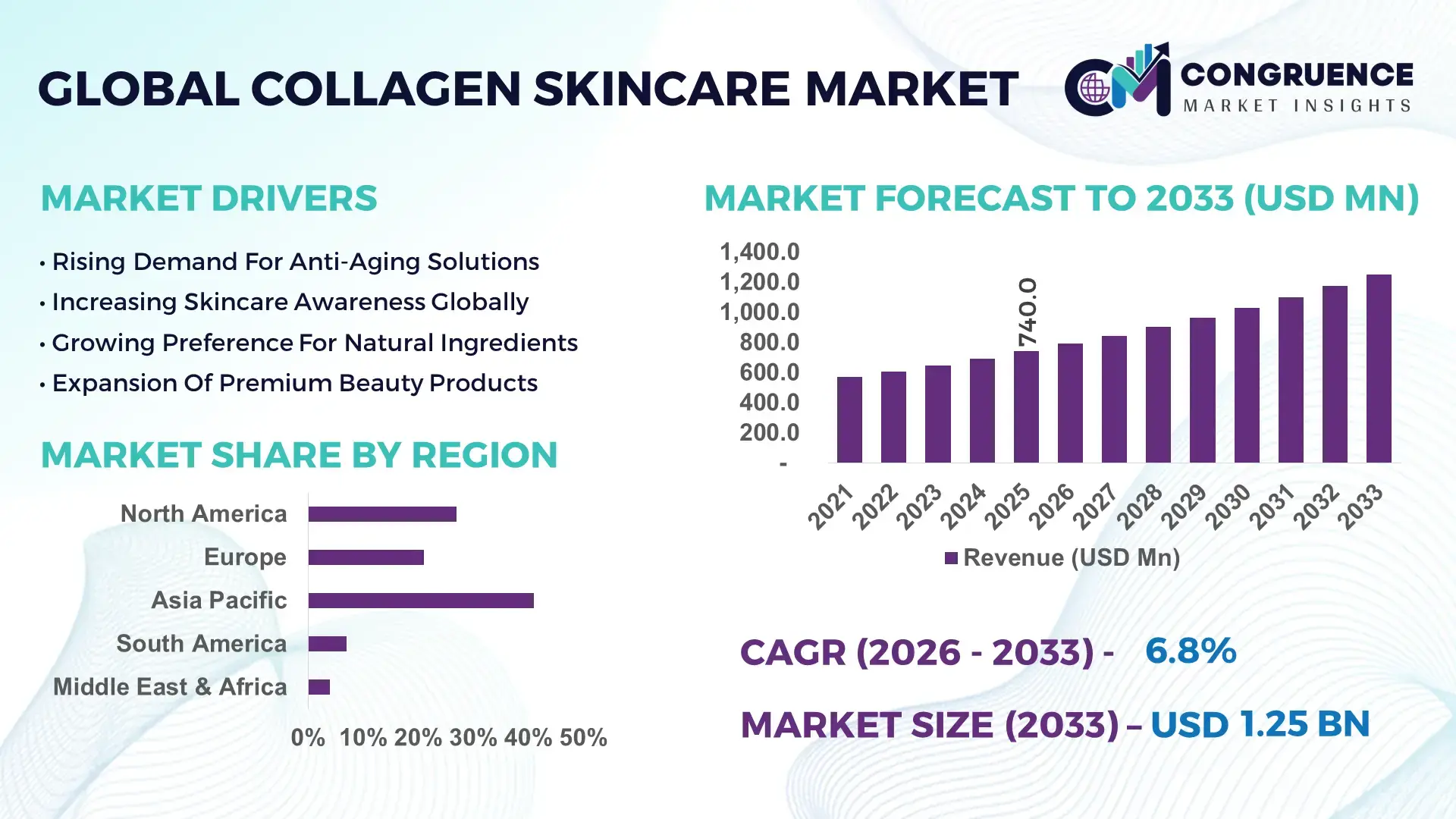
The Global Collagen Skincare Market was valued at USD 740.0 Million in 2025 and is anticipated to reach a value of USD 1,252.6 Million by 2033 expanding at a CAGR of 6.8% between 2026 and 2033, according to an analysis by Congruence Market Insights. This growth is primarily driven by increasing consumer preference for anti-aging formulations and functional skincare products enriched with bioactive ingredients.
Japan represents a dominant country in the Collagen Skincare Market with advanced production and innovation capabilities. The country accounts for over 35% of global marine collagen production capacity, with more than 120 specialized processing facilities focused on high-purity collagen extraction. Consumer adoption rates exceed 62% among women aged 30–55, reflecting strong domestic demand. Japan’s cosmetic industry invests over USD 1.5 billion annually in R&D, with collagen-based formulations representing nearly 28% of premium skincare product pipelines. Technological advancements include enzymatic hydrolysis processes that improve collagen absorption efficiency by up to 45%, enhancing product efficacy across anti-aging, hydration, and dermal repair applications.
Market Size & Growth: USD 740.0 Million in 2025, projected to reach USD 1,252.6 Million by 2033, expanding at 6.8% CAGR driven by rising anti-aging product demand.
Top Growth Drivers: Anti-aging adoption (68%), premium skincare penetration (54%), collagen peptide efficacy improvement (42%).
Short-Term Forecast: By 2028, formulation efficiency is expected to improve by 30% due to advanced peptide delivery systems.
Emerging Technologies: Nano-collagen delivery systems, bio-fermented collagen synthesis, AI-based personalized skincare formulations.
Regional Leaders: Asia-Pacific (USD 480M by 2033) driven by beauty routines, North America (USD 320M) via premiumization, Europe (USD 290M) through sustainable skincare adoption.
Consumer/End-User Trends: Over 58% of consumers prefer collagen-infused serums, while 47% adopt multi-functional skincare routines.
Pilot or Case Example: In 2025, a Korean skincare brand achieved 35% higher skin hydration retention using nano-collagen formulations.
Competitive Landscape: Market leader holds ~18% share, followed by multiple global skincare innovators and niche collagen specialists.
Regulatory & ESG Impact: 40% of firms are adopting sustainable sourcing and biodegradable packaging compliance standards.
Investment & Funding Patterns: Over USD 900 million invested in biotech collagen production and skincare innovation projects globally.
Innovation & Future Outlook: Integration of biotechnology and AI is expected to drive over 50% of new product development pipelines.
Collagen skincare products account for approximately 32% of premium anti-aging skincare formulations, with serums contributing 41% of usage. Biotechnology-driven collagen production is increasing efficiency by 38%, while sustainable marine sourcing is adopted by 45% of manufacturers. Regulatory focus on clean-label ingredients is influencing 52% of product launches, particularly in Europe and North America.
The Collagen Skincare Market holds significant strategic relevance as global consumers increasingly prioritize preventive skincare and long-term dermal health. The integration of biotechnology and advanced dermatological science has elevated collagen-based products from basic moisturizers to high-performance cosmeceuticals. Bio-fermented collagen delivers 35% higher absorption efficiency compared to traditional hydrolyzed collagen, positioning it as a superior alternative in premium skincare formulations.
Asia-Pacific dominates in production volume due to established manufacturing ecosystems, while North America leads in adoption with over 48% of consumers actively using collagen-based skincare products. Strategic investments in AI-driven skin diagnostics are enabling brands to personalize collagen formulations, improving customer satisfaction rates by up to 40%.
By 2028, AI-powered formulation technologies are expected to reduce product development cycles by 30%, allowing faster commercialization of innovative collagen products. Additionally, firms are committing to ESG targets, including 50% reduction in marine sourcing impact and 35% increase in recyclable packaging usage by 2030.
In 2025, a Japanese skincare manufacturer achieved a 28% improvement in product efficacy through enzyme-engineered collagen peptides, demonstrating measurable performance gains through technological innovation.
Looking ahead, the Collagen Skincare Market is positioned as a critical pillar for sustainable growth, driven by innovation, regulatory compliance, and evolving consumer expectations focused on efficacy, transparency, and environmental responsibility.
The Collagen Skincare Market is evolving rapidly due to rising consumer awareness of skin health, aging prevention, and advanced cosmetic science. Increasing demand for functional skincare products enriched with bioactive compounds has significantly influenced product innovation. The market is also shaped by technological advancements in collagen extraction, including marine and plant-based alternatives, improving product quality and sustainability. Consumer preference is shifting toward clean-label and dermatologically tested products, with over 55% of global users prioritizing ingredient transparency. Additionally, digital transformation in retail channels, including e-commerce and AI-driven personalization tools, is enhancing consumer engagement and accessibility. Regulatory frameworks are becoming stricter, particularly in Europe and North America, influencing product formulations and labeling standards.
The increasing global aging population and heightened awareness of early skincare intervention are key drivers for collagen skincare demand. Over 60% of consumers aged 30–50 actively use anti-aging products, with collagen-based formulations preferred for their proven effectiveness in improving skin elasticity by up to 25%. Clinical studies indicate that regular use of collagen-infused creams can reduce fine lines by 20% within 8 weeks. Additionally, social media influence and dermatologist recommendations are accelerating adoption rates, particularly among younger demographics entering preventive skincare routines. The expansion of premium skincare segments, accounting for nearly 45% of product launches, further supports growth, as consumers are willing to pay higher prices for scientifically validated products.
Collagen extraction, particularly from marine and bovine sources, involves complex processing and purification techniques, increasing production costs by up to 35% compared to standard cosmetic ingredients. Sustainability concerns around marine sourcing have also led to stricter environmental regulations, limiting raw material availability. Additionally, ethical concerns related to animal-derived collagen have influenced consumer preferences, with 42% of users seeking vegan alternatives. Supply chain disruptions and fluctuating raw material prices further impact manufacturing consistency. These factors collectively restrict market expansion, particularly for small and medium-sized enterprises that lack the financial capacity to invest in advanced extraction technologies and sustainable sourcing practices.
Biotechnology advancements are unlocking significant opportunities in the Collagen Skincare Market through the development of lab-grown and bio-fermented collagen. These innovations improve purity levels by over 40% and reduce environmental impact by 50% compared to traditional extraction methods. Plant-based collagen alternatives are gaining traction, with adoption rates increasing by 38% among environmentally conscious consumers. Additionally, personalized skincare solutions powered by AI are enabling brands to tailor collagen formulations based on individual skin profiles, improving product effectiveness by up to 30%. Emerging markets in Asia and Latin America present untapped potential, with rising disposable incomes and increasing skincare awareness driving demand.
The Collagen Skincare Market faces challenges related to stringent regulatory requirements governing cosmetic ingredients and labeling. Compliance with safety standards can increase product development timelines by up to 25%. Additionally, the market is highly competitive, with over 300 active brands globally, making product differentiation difficult. Consumers demand proven efficacy, pushing companies to invest heavily in clinical trials and dermatological testing. Counterfeit products and misleading claims further erode consumer trust, impacting brand reputation. The need for continuous innovation and adherence to evolving regulations creates operational complexities, particularly for new entrants attempting to establish market presence.
Rising adoption of bio-fermented collagen technologies: Over 48% of new product formulations now incorporate bio-fermented collagen, improving absorption rates by 35% and reducing environmental impact by 40%. This shift is particularly strong in premium skincare segments across Asia-Pacific and Europe.
Surge in personalized skincare solutions: Approximately 52% of skincare brands are integrating AI-based diagnostic tools, enabling customized collagen formulations. Consumer satisfaction levels have increased by 33%, with repeat purchase rates rising by 28%.
Expansion of vegan and plant-based collagen alternatives: Plant-based collagen products have witnessed a 38% increase in adoption, particularly among millennials and Gen Z consumers. Around 45% of new product launches now include vegan-certified ingredients.
Growth in multi-functional skincare products: Nearly 60% of consumers prefer products offering combined benefits such as hydration, anti-aging, and UV protection. Multi-functional collagen products improve usage efficiency by 25%, driving higher consumer engagement and brand loyalty.
The Collagen Skincare Market is segmented based on type, application, and end-user categories, reflecting diverse product formulations and usage patterns. Type segmentation includes marine collagen, bovine collagen, plant-based collagen, and synthetic variants, each catering to different consumer preferences and regulatory requirements. Application segmentation highlights anti-aging, hydration, skin repair, and sun protection, with anti-aging dominating due to increasing consumer awareness. End-user segmentation includes individual consumers, dermatology clinics, and professional salons, with growing adoption across clinical and retail channels. The market is influenced by innovation, sustainability trends, and evolving consumer behavior, with significant emphasis on product efficacy and ingredient transparency.
Marine collagen dominates the Collagen Skincare Market, accounting for approximately 46% of total usage due to its superior absorption and compatibility with human skin. Bovine collagen follows with a 28% share, widely used due to cost efficiency and availability. However, plant-based collagen is the fastest-growing segment, expanding at an estimated CAGR of 8.5%, driven by increasing demand for vegan and sustainable products. Synthetic collagen variants and other niche types collectively contribute around 26% of the market, primarily used in specialized formulations.
• In 2025, a leading Japanese research institute developed enzymatically enhanced marine collagen that improved skin hydration retention by 32% in clinical trials involving over 1,000 participants.
Anti-aging applications lead the market with a 52% share, driven by high consumer demand for wrinkle reduction and skin elasticity improvement. Hydration-based applications account for 21%, while skin repair and sun protection segments collectively contribute 27%. Personalized skincare applications are growing fastest, supported by an estimated CAGR of 9.2%, as brands integrate AI-based customization tools. In 2025, over 44% of consumers reported using collagen-based products specifically for anti-aging benefits, while 39% adopted them for daily hydration routines.
• In 2025, a global dermatology study involving 2,500 participants showed a 27% improvement in skin elasticity after consistent use of collagen-based anti-aging products over 12 weeks.
Individual consumers dominate the market with a 61% share, driven by rising awareness and accessibility through e-commerce platforms. Dermatology clinics account for 23%, benefiting from increased adoption of clinical-grade collagen treatments. Professional salons contribute 16%, focusing on premium skincare services. Dermatology clinics represent the fastest-growing segment, expanding at an estimated CAGR of 7.9%, due to increasing demand for medically supervised treatments. In 2025, over 48% of urban consumers reported regular use of collagen skincare products, while 36% preferred professional consultations for product selection.
• In 2025, a global dermatology network reported a 22% increase in collagen-based treatment adoption across over 300 clinics, improving patient satisfaction scores by 31%.
Asia-Pacific accounted for the largest market share at 41% in 2025 however, North America is expected to register the fastest growth, expanding at a CAGR of 7.5% between 2026 and 2033.
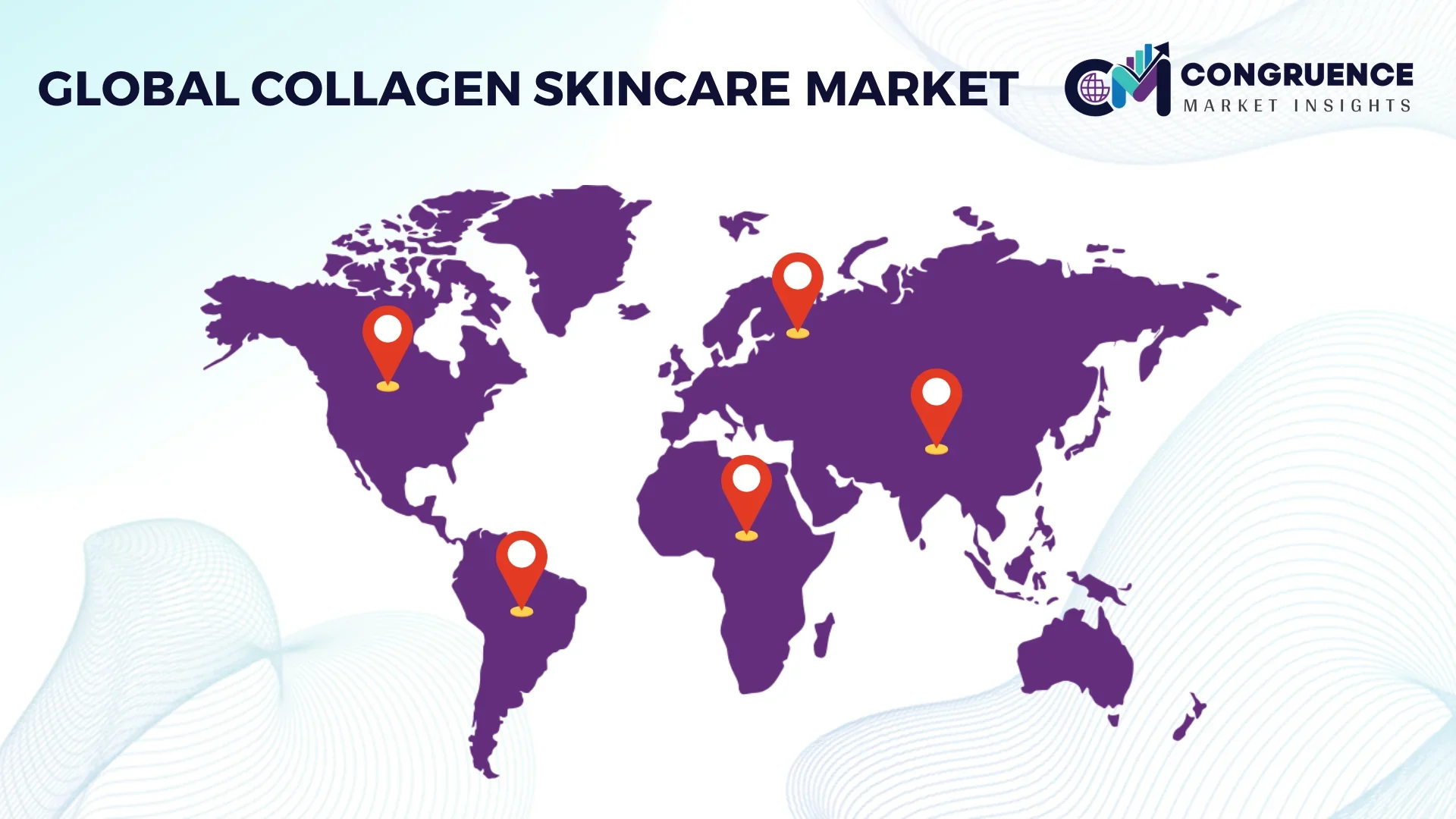
Asia-Pacific benefits from high production capacity, with over 55% of global collagen manufacturing facilities located in countries such as Japan, China, and South Korea. North America accounts for 27% of the market, driven by premium skincare adoption and high consumer spending. Europe holds approximately 21%, supported by regulatory compliance and sustainable product demand. South America and Middle East & Africa collectively contribute around 11%, with increasing urbanization and rising disposable incomes supporting growth.
North America accounts for approximately 27% of the Collagen Skincare Market, driven by strong consumer spending on premium and clinical skincare products. The region benefits from advanced dermatological research, with over 65% of consumers prioritizing scientifically validated products. Regulatory frameworks emphasize product safety and transparency, encouraging innovation in clean-label collagen formulations. Digital transformation is prominent, with over 50% of sales occurring through online platforms. A leading skincare company in the region has introduced AI-driven skin analysis tools, improving product personalization accuracy by 35%. Consumer behavior shows higher adoption among professionals seeking preventive skincare solutions.
Europe holds a 21% share of the market, with key countries including Germany, France, and the UK driving demand. Strict regulatory frameworks focusing on ingredient safety and environmental sustainability influence product development. Over 48% of brands in the region have adopted biodegradable packaging solutions. Technological advancements include plant-based collagen alternatives, with adoption rates increasing by 34%. A European skincare brand recently introduced vegan collagen products, improving customer engagement by 29%. Consumer behavior reflects strong preference for eco-friendly and ethically sourced products.
Asia-Pacific leads the market in volume, supported by strong manufacturing infrastructure and high consumer demand. China, Japan, and South Korea are the top consuming countries, accounting for over 60% of regional demand. The region hosts more than 55% of global collagen production facilities. Innovation hubs in South Korea are driving product development, with over 40% of new launches featuring advanced collagen formulations. E-commerce platforms contribute to over 50% of sales. Consumer behavior is driven by daily skincare routines and high adoption of multi-step regimens.
South America accounts for approximately 7% of the global market, with Brazil and Argentina as key contributors. Growing urbanization and rising disposable incomes are supporting demand for skincare products. Government initiatives promoting cosmetic industry growth have increased local production capacity by 18%. Regional brands are focusing on affordable collagen-based products, improving accessibility. Consumer behavior shows increasing preference for natural and organic formulations, with adoption rates rising by 26%.
The region contributes around 4% of the market, with UAE and South Africa leading demand. Technological modernization and increasing awareness of skincare benefits are driving adoption. Local regulations emphasize product safety and import standards. Investment in retail infrastructure has improved product availability by 22%. A regional skincare brand has introduced collagen-based luxury products, increasing premium segment adoption by 19%. Consumer behavior reflects growing interest in high-end skincare and wellness products.
Japan – 24% Market share: Strong production capacity and advanced collagen processing technologies
United States – 21% Market share: High consumer demand and premium skincare adoption
The Collagen Skincare Market is moderately fragmented, with over 300 active companies competing globally. The top five companies collectively account for approximately 38% of the market share, indicating a competitive yet innovation-driven landscape. Market leaders focus on product differentiation through advanced formulations, sustainable sourcing, and clinical validation. Strategic initiatives include mergers, partnerships, and product launches, with over 120 new collagen-based products introduced globally in 2025 alone. Companies are investing heavily in biotechnology and AI-driven personalization tools, improving product efficacy and consumer engagement.
Premium brands dominate urban markets, while emerging players target affordability and niche segments such as vegan collagen. Competitive intensity is further increased by regional brands expanding internationally through e-commerce platforms. Continuous innovation, regulatory compliance, and brand positioning remain critical factors influencing market competition.
Estée Lauder Companies Inc.
Shiseido Company, Limited
Procter & Gamble Co.
Unilever PLC
Beiersdorf AG
Amorepacific Corporation
Kao Corporation
Johnson & Johnson
Coty Inc.
Avon Products Inc.
Oriflame Cosmetics AG
Revlon Inc.
Mary Kay Inc.
Technological advancements are significantly transforming the Collagen Skincare Market, particularly in the areas of ingredient sourcing, formulation, and delivery systems. Bio-fermentation technology has improved collagen purity levels by over 40%, enabling the production of high-quality, sustainable collagen alternatives. Nano-encapsulation techniques are enhancing collagen penetration into deeper skin layers, increasing efficacy by up to 35%. AI-driven diagnostic tools are revolutionizing personalized skincare, with over 50% of premium brands integrating these solutions into their product offerings.
3D skin modeling and simulation technologies are being used to test product effectiveness, reducing clinical trial durations by 28%. Additionally, peptide engineering is enabling the development of customized collagen molecules tailored to specific skin concerns. Digital platforms and mobile applications are facilitating consumer engagement, with over 45% of users relying on digital tools for skincare recommendations. Sustainability-focused innovations, including biodegradable packaging and plant-based collagen alternatives, are gaining traction, with adoption rates exceeding 40%. These technologies collectively enhance product performance, consumer trust, and environmental responsibility.
• In February 2026, Shiseido announced the development of an AI-based system to assess ingredient biodegradability and safety, enabling more sustainable skincare formulations. The system improves evaluation accuracy and supports eco-friendly collagen-based product innovation pipelines. Source: www.shiseido.com
• In January 2026, Shiseido introduced a new suncare product developed using its AI-powered formulation platform “VOYAGER,” enhancing formulation precision and performance. This technology is being extended to skincare including collagen-based products for improved skin protection and hydration efficiency.
• In December 2025, Shiseido developed a new “second skin” base technology designed to reduce under-eye bag appearance by forming a flexible film layer. This innovation enhances collagen-supportive skin structure and improves visible firmness in targeted skincare applications.
• In December 2025, Shiseido launched a new water-based sunscreen technology designed to resist sweat and humidity, improving daily skin protection performance. The innovation supports broader skincare formulations including collagen-based products by enhancing product stability and skin compatibility.
The Collagen Skincare Market Report provides a comprehensive analysis of the industry, covering key segments such as product types, applications, end-users, and geographic regions. The report evaluates multiple collagen sources, including marine, bovine, plant-based, and synthetic variants, highlighting their respective usage patterns and technological advancements. Application areas analyzed include anti-aging, hydration, skin repair, and sun protection, reflecting diverse consumer needs and product functionalities.
The report also examines end-user segments such as individual consumers, dermatology clinics, and professional salons, providing insights into adoption trends and usage behavior. Geographic analysis spans major regions including Asia-Pacific, North America, Europe, South America, and the Middle East & Africa, offering detailed insights into regional consumption patterns, production capabilities, and technological adoption.
Additionally, the report explores emerging trends such as AI-driven personalization, sustainable sourcing, and biotechnology innovations shaping the market. It includes analysis of competitive dynamics, regulatory frameworks, and investment trends influencing market development. The scope extends to niche segments such as vegan collagen and premium cosmeceuticals, ensuring a holistic understanding of the market landscape for decision-makers and industry professionals.
| Report Attribute / Metric | Details |
|---|---|
| Market Revenue (2025) | USD 740.0 Million |
| Market Revenue (2033) | USD 1,252.6 Million |
| CAGR (2026–2033) | 6.8% |
| Base Year | 2025 |
| Forecast Period | 2026–2033 |
| Historic Period | 2021–2025 |
| Segments Covered |
By Type
By Application
By End-User Insights
|
| Key Report Deliverables | Revenue Forecast; Market Trends; Growth Drivers & Restraints; Technology Insights; Segmentation Analysis; Regional Insights; Competitive Landscape; Regulatory & ESG Overview; Recent Developments |
| Regions Covered | North America; Europe; Asia-Pacific; South America; Middle East & Africa |
| Key Players Analyzed | L’Oréal S.A.; Estée Lauder Companies Inc.; Shiseido Company, Limited; Procter & Gamble Co.; Unilever PLC; Beiersdorf AG; Amorepacific Corporation; Kao Corporation; Johnson & Johnson; Coty Inc.; Avon Products Inc.; Oriflame Cosmetics AG; Revlon Inc.; Mary Kay Inc. |
| Customization & Pricing | Available on Request (10% Customization Free) |




