
Reports
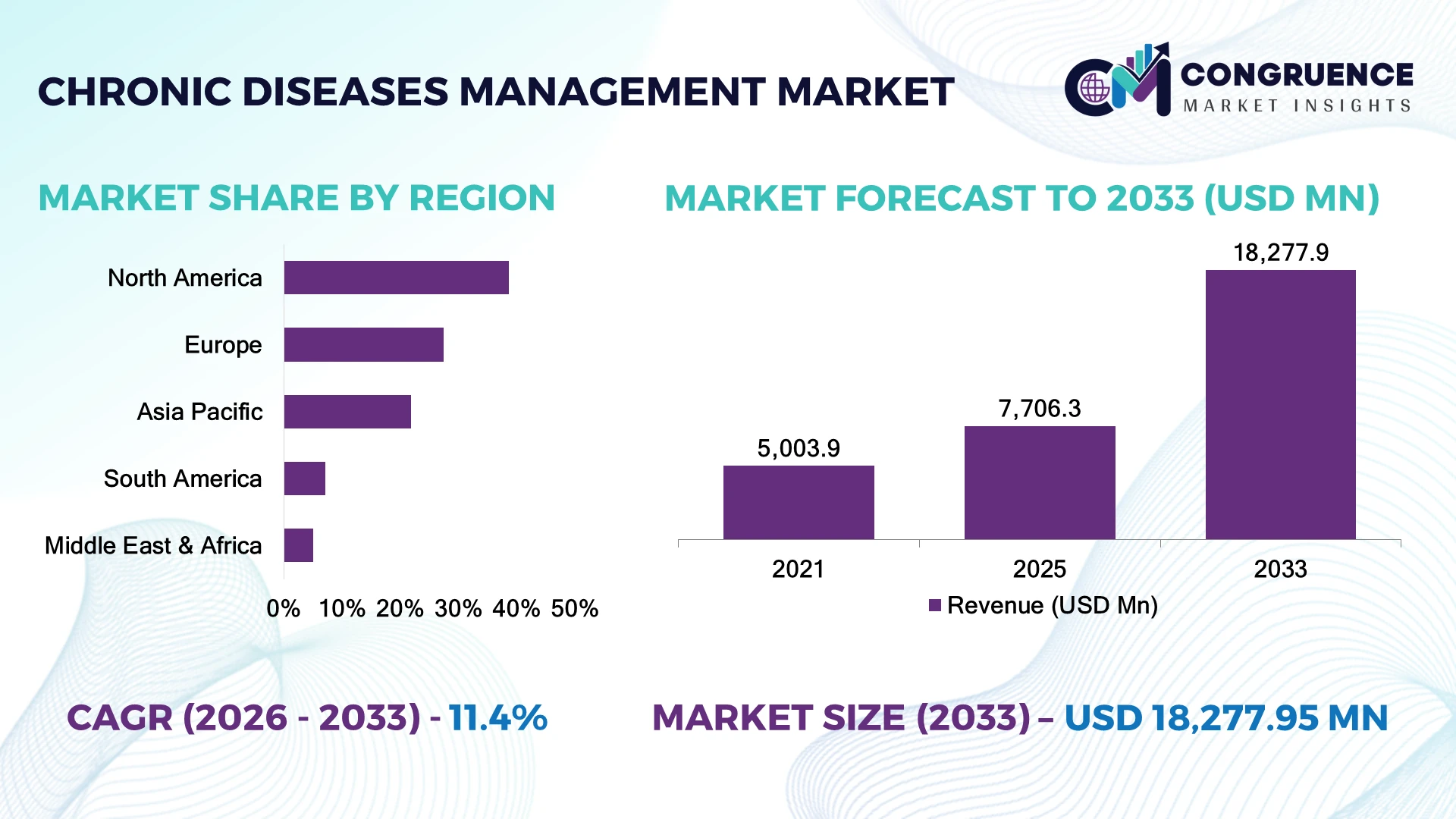
The Global Chronic Diseases Management Market was valued at USD 7,706.3 Million in 2025 and is anticipated to reach a value of USD 18,277.9 Million by 2033 expanding at a CAGR of 11.4% between 2026 and 2033. Growth is being driven by remote patient monitoring, outcome-based reimbursement, AI-enabled care coordination, and rising multimorbidity across aging populations.
The U.S. remains the dominant country market, supported by 76.4% of adults reporting at least one chronic condition and 95% physician-office EHR adoption. In 2026, CMS launched ACCESS, a 10-year technology-supported chronic-care model covering conditions affecting more than two-thirds of Medicare beneficiaries. India and China are scaling digital-first chronic-care delivery faster from a lower infrastructure base.
Strategic priority is shifting toward interoperable, technology-enabled platforms that combine monitoring, clinical workflows, and outcome-based care.
Market Size & Growth: USD 7,706.3 million in 2025 to USD 18,277.9 million by 2033 at 11.4% CAGR, driven by digital chronic-care adoption and multimorbidity.
Top Growth Drivers: Remote monitoring 42%; digital care coordination 36%; AI-assisted clinical workflows 29%.
Short-Term Forecast: By 2028, connected monitoring can reduce avoidable follow-up workload by 15–20% while improving intervention speed by 20%.
Emerging Technologies: AI risk stratification, wearable monitoring, and predictive analytics are moving from pilots toward integrated care platforms.
Regional Leaders: North America is projected near USD 7.0 billion; Europe near USD 4.6 billion; Asia-Pacific near USD 4.2 billion, with Asia-Pacific showing the strongest digital-care deployment acceleration.
Consumer/End-User Trends: U.S. adults with diabetes recorded 39.4% telemedicine use in 2022, reinforcing demand for hybrid chronic-care models.
Pilot/Case Example: 2026 ACCESS deployment targets technology-supported chronic care, with more than 150 organizations accepted for launch.
Competitive Landscape: Integrated healthcare-technology leaders retain strong positions, while digital therapeutics and remote-monitoring specialists compete through interoperability and outcome-based models.
Regulatory & ESG Impact: Outcome-linked reimbursement is shifting approximately 20–30% of purchasing priorities toward measurable clinical performance and resource efficiency.
Investment & Funding: CMS committed up to USD 100 million for lifestyle-focused chronic-disease interventions, strengthening prevention-oriented care models.
Innovation & Future Outlook: By 2028, AI-enabled triage, continuous monitoring, and personalized care pathways will shift competition from software features toward measurable patient outcomes.
The Chronic Diseases Management Market is increasingly centered on diabetes, cardiovascular disease, hypertension, respiratory disorders, and multimorbidity programs. Connected devices, medication-adherence platforms, virtual consultations, and predictive analytics are strengthening demand for continuous rather than episodic care. Approximately 40% of U.S. adults with diabetes used telemedicine in 2022, while 2026 outcome-based reimbursement initiatives are accelerating technology integration. This transition is reshaping provider procurement and competitive positioning.
Chronic disease management is becoming strategically important because healthcare systems are moving from episodic treatment toward continuous, measurable disease control. In the U.S., 51.4% of adults reported multiple chronic conditions in 2023, increasing pressure on providers to coordinate medication, monitoring, lifestyle intervention, and specialist care through unified workflows.
The major structural shift is outcome-linked digital care. Traditional periodic visits depend heavily on manual data collection, whereas connected blood-pressure monitors, glucose devices, wearables, and telehealth platforms continuously transmit patient information. This model can reduce manual monitoring workload by roughly 15–20% and accelerate identification of deterioration by around 20%. U.S. providers have stronger digital infrastructure, while India and other Asian markets are expanding from hospital-centered care toward mobile and hybrid models.
Between 2026 and 2028, investment is shifting toward interoperable platforms that connect EHRs, remote monitoring, AI-assisted risk stratification, and medication management. The 2026 ACCESS model demonstrates this direction by linking technology-supported chronic care with measurable outcomes. Companies that combine clinical integration, patient engagement, analytics, and scalable reimbursement models will secure the strongest competitive position.
Remote patient monitoring and virtual chronic-care pathways are accelerating adoption as providers shift from episodic visits to continuous disease surveillance. Approximately 51% of U.S. adults live with multiple chronic conditions, while around 76% of adults have at least one chronic disease, creating strong demand for integrated monitoring. Telehealth utilization remains materially above pre-pandemic levels, supporting digital follow-up and medication-management workflows. In 2026, outcome-based reimbursement initiatives are strengthening incentives for measurable disease control rather than visit volume. Companies are responding by integrating wearable sensors, AI risk stratification, and EHR connectivity into unified platforms. The non-obvious advantage is operational: continuous data allows providers to prioritize high-risk patients, improving clinician capacity without proportionally increasing staffing.
Fragmented health-data infrastructure remains a major deployment constraint, particularly where chronic-care platforms must connect multiple EHR, device, and payer environments. Approximately 20–30% of digital-care implementation effort can be absorbed by integration, configuration, and workflow adaptation rather than clinical functionality. Smaller providers face additional financial pressure because technology procurement and cybersecurity requirements can consume a significant share of digital-health budgets. In India, uneven interoperability across private and public healthcare networks complicates standardized longitudinal monitoring, while U.S. providers face complex payer-specific reimbursement structures. Companies are reducing exposure through API-based architectures, modular platforms, multi-year contracts, and partnerships with established health-information vendors. The strategic pressure point is not device availability but the ability to convert disconnected clinical data into reimbursable care workflows.
AI-driven predictive analytics creates a high-value opportunity by identifying deterioration before acute intervention becomes necessary. Algorithms combining medication history, vital signs, laboratory data, and behavioral signals can improve risk prioritization by approximately 15–25%, while automated patient segmentation can reduce routine review workload by 10–20%. India, China, and Southeast Asian markets offer particularly strong opportunities for mobile-first chronic-care models because smartphone penetration supports lower-cost digital engagement without extensive physical infrastructure. Companies are investing in AI-assisted triage, personalized care pathways, and automated adherence management, while health systems are expanding remote-monitoring partnerships. A distinctive opportunity lies in targeting multimorbidity rather than single diseases: one integrated platform can manage overlapping cardiovascular, metabolic, and respiratory conditions, increasing utilization per deployed system.
Scaling chronic-disease platforms from pilot programs to enterprise networks introduces complex cybersecurity, clinical-validation, workforce, and data-governance requirements. Connected monitoring can generate 30–50% more patient data than conventional periodic workflows, increasing the burden on clinicians unless triage is automated effectively. AI-supported decision systems also require continuous validation as patient populations, treatment protocols, and regulatory requirements evolve. In the U.S., healthcare organizations must balance automation with clinician oversight, while emerging markets face shortages of digitally trained care teams. Companies are responding through explainable AI, automated alert prioritization, cybersecurity investment, and partnerships with health systems for controlled deployment. The critical long-term challenge is maintaining clinical reliability while scaling patient coverage faster than staffing and infrastructure capacity.
Connected Monitoring Becomes Standard: Remote patient monitoring is shifting from supplemental telehealth toward core chronic-care workflows, with connected-device utilization increasing across diabetes, hypertension, and cardiovascular programs. Approximately 40% of U.S. adults with diabetes used telemedicine in 2022, while providers are integrating wearable data directly into clinical workflows. Companies are responding with interoperable platforms, automated alerts, and subscription-based monitoring services.
AI Moves Into Care Triage: AI-assisted risk stratification is moving beyond experimentation as providers seek faster identification of high-risk patients. Predictive models can improve prioritization accuracy by roughly 15–25% and reduce manual chart-review workload by 10–20%. U.S. health systems are increasingly embedding algorithms into population-health platforms, while vendors are strengthening explainability, clinical validation, and workflow integration to support enterprise deployment.
Hybrid Care Expands Patient Reach: Chronic-care delivery is increasingly combining clinic visits with virtual consultations, home monitoring, and digital adherence programs. Hybrid pathways can reduce unnecessary in-person follow-ups by approximately 15–20% while increasing monitoring frequency. In India, private hospital networks are expanding mobile-enabled programs to extend specialist oversight beyond metropolitan facilities. Companies are responding through localized partnerships and lower-infrastructure deployment models.
Outcome-Based Models Reshape Procurement: Reimbursement is increasingly rewarding measurable disease control, adherence, and reduced acute-care utilization rather than service volume alone. Outcome-linked programs can place 20–30% greater emphasis on measurable performance during technology procurement. The 2026 U.S. ACCESS model reinforces this shift toward technology-supported chronic care. Vendors are consequently bundling analytics, monitoring, patient engagement, and reporting capabilities rather than selling standalone software or devices.
Integrated chronic disease management platforms represent the leading type, accounting for approximately 46% of market demand, supported by their ability to combine patient records, remote monitoring, analytics, care coordination, and adherence workflows. Their scalability gives health systems a stronger economic case than fragmented point solutions. Standalone monitoring solutions retain roughly 31% share, particularly in hypertension and diabetes programs where rapid deployment and lower initial costs remain important.
Connected remote-care platforms are the fastest-growing type, with adoption expanding approximately 18% annually across digitally enabled provider networks as reimbursement increasingly recognizes remote monitoring. Companies are prioritizing interoperable APIs, AI-assisted risk scoring, and modular architectures to capture enterprise contracts. The investment shift favors platforms capable of supporting multiple chronic conditions rather than single-disease tools, creating stronger cross-selling potential and higher utilization per deployment.
The World Health Organization reported in 2025 that Durg, India, increased follow-up rates among ABHA-linked hypertension and diabetes patients to 68%, compared with 37% among non-linked patients, demonstrating the operational value of integrated digital records.
Cardiovascular disease and hypertension management represent the leading application cluster, accounting for approximately 39% of chronic disease management demand because these conditions require recurring monitoring, medication adherence, and measurable risk-factor control. Diabetes follows closely at about 28%, supported by continuous glucose monitoring, digital coaching, and medication-management workflows. Respiratory disease and cancer management remain important specialized applications, but their technology requirements are more condition-specific and less broadly deployable.
Diabetes management is the fastest-growing application, with digital monitoring adoption increasing by roughly 20% across technology-enabled care programs as providers shift toward continuous rather than appointment-based intervention. Companies are integrating glucose data, medication records, behavioral signals, and predictive analytics into unified workflows. The strategic implication is clear: platforms supporting multiple cardiometabolic conditions gain greater provider value than disease-specific systems, while automated alerts and remote monitoring strengthen operational scalability.
In 2025, the World Health Organization reported that 94 million people across Southeast Asia had been placed on protocol-based hypertension and diabetes management, with 8.4 million achieving controlled blood pressure, demonstrating large-scale institutional adoption of structured chronic-care pathways.
Hospitals and integrated health systems represent the leading end-user group, capturing approximately 52% of market demand because they manage high patient volumes, specialist networks, diagnostic infrastructure, and complex multimorbidity. Specialty clinics account for nearly 24%, supported by focused programs for diabetes, cardiovascular, respiratory, and metabolic conditions. Home-based care is the fastest-growing end-user, expanding as providers shift monitoring and follow-up beyond facility settings.
Home-care adoption is increasing approximately 19% as connected devices, telehealth, and remote patient monitoring reduce dependence on routine in-person visits. Hospitals prioritize interoperable enterprise platforms and centralized analytics, while specialty clinics favor modular solutions with faster implementation and lower integration requirements. Vendors are responding through tiered pricing, hospital partnerships, and device-plus-software bundles. The competitive opportunity is moving toward home-centered chronic care, where companies that combine monitoring, patient engagement, and clinician escalation pathways can extend provider capacity without matching growth in physical facilities.
The American Medical Association reported in 2026 that 52.5% of surveyed physicians worked in practices using telehealth to manage chronic disease, while a separate 2026 international physician survey found strong interest in wearable data but identified workflow and reimbursement barriers to routine integration.
North America accounted for the largest market share at 38.6% in 2025 however, Asia-Pacific is expected to register the fastest growth, expanding at a CAGR of 13.1% between 2026 and 2033.
Digital-first chronic care is shifting from episodic treatment toward continuous patient management
North America maintains the strongest commercial position, supported by mature reimbursement structures, extensive electronic health record infrastructure, and high utilization of remote patient monitoring. The United States concentrates the region’s deployment activity, with Medicare remote-monitoring services rising from 160,595 in 2019 to 5.52 million in 2023, a more than 3,300% increase. Health systems are integrating connected blood-pressure, glucose, cardiac, and respiratory monitoring into primary-care workflows, while AI-assisted risk stratification is improving escalation decisions. Enterprise adoption increasingly favors interoperable platforms rather than isolated devices, strengthening demand for integrated data architectures. Providers are also expanding home-based pathways to reduce avoidable facility utilization and clinician workload. The competitive advantage is moving toward vendors capable of combining monitoring, analytics, clinical workflow integration, and reimbursement support within one scalable platform.
United States Market Outlook:
The United States remains the principal national market because of its extensive payer ecosystem, large chronic-care population, and established digital-health infrastructure. Remote monitoring is increasingly embedded in primary care and specialty workflows, while Medicare reimbursement supports commercially scalable models. The country’s 5.52 million remote patient monitoring services recorded in 2023 demonstrate the operational maturity of digitally enabled chronic-care delivery.
Interoperable health infrastructure is becoming the foundation for coordinated chronic care
Europe is accelerating chronic disease management through electronic health records, integrated care pathways, telehealth, and population-health platforms. The EU’s average eHealth maturity score reached 87% in 2025, up 4 percentage points from 2024, strengthening the digital infrastructure available for chronic-care coordination. Germany, France, the United Kingdom, and Italy remain important deployment markets, while national health systems increasingly prioritize preventive monitoring and data-sharing capabilities. Regulatory emphasis on secure health-data exchange is pushing vendors toward interoperable architectures rather than standalone applications. Providers are combining remote monitoring with medication management and virtual consultations, improving continuity across primary and specialist care. Companies are responding through cloud integration, localized compliance capabilities, and partnerships with healthcare networks, positioning interoperability and clinical workflow compatibility as stronger differentiators than hardware functionality alone.
Germany Market Outlook:
Germany offers a strong commercial base through its advanced hospital infrastructure, statutory healthcare system, and established digital-health regulatory pathway. The country is particularly relevant for vendors developing reimbursable digital therapeutics, remote monitoring, and interoperable chronic-care platforms. Its large network of physicians and hospitals supports scalable deployment, while growing integration of digital health into routine care creates opportunities for condition-specific management solutions.
Large-scale digital infrastructure is compressing the adoption curve
Asia-Pacific is becoming the fastest-expanding deployment zone as India, China, Japan, South Korea, and Australia combine large chronic-disease populations with rapidly improving digital-health infrastructure. India’s National NCD Programme had enrolled more than 76.9 crore beneficiaries by June 2026, with 9.36 crore patients under treatment for hypertension and diabetes, demonstrating the scale of digitally supported population management. China is advancing hospital digitization and connected monitoring, while Japan emphasizes home-based care for an aging population. The region is shifting from facility-centric management toward hybrid and community-based models. Vendors are adapting through lower-cost connected devices, mobile-first platforms, local partnerships, and multilingual interfaces. The strategic opportunity is not simply device penetration; it is integration with national health platforms and large-scale primary-care workflows.
India Market Outlook:
India represents the strongest scale opportunity because its national digital-health infrastructure connects an expanding population with standardized health identities and disease-management programs. The National NCD Programme spans 31 states and union territories, while more than 9 crore patients were under treatment for hypertension and diabetes by June 2026. This infrastructure favors scalable remote monitoring, AI-supported screening, and population-health platforms.
Primary-care digitization is creating new pathways for chronic disease follow-up
South America is progressing through Brazil-led investment in primary-care digitization, telemedicine, electronic records, and remote patient engagement. Brazil represents the region’s largest addressable market because of its healthcare scale, established private-provider networks, and expanding digital-care infrastructure. Chronic disease programs increasingly use virtual consultations and connected monitoring to extend specialist access beyond major urban centers. Adoption remains uneven because technology availability and clinical integration differ substantially between metropolitan and secondary markets. Providers are therefore favoring mobile-first systems and cloud-based platforms that require limited onsite infrastructure. Companies are strengthening local partnerships and flexible deployment models rather than relying exclusively on large hospital contracts. The strongest commercial opportunity is concentrated around solutions that combine affordability with clinical interoperability, allowing providers to manage dispersed patient populations without proportional expansion of physical facilities.
Brazil Market Outlook:
Brazil dominates South American demand through its large healthcare ecosystem, extensive private hospital networks, and growing digital-care capabilities. Major urban centers provide the strongest deployment environment for remote monitoring and integrated chronic-care platforms, while public-health initiatives create opportunities to extend digitally enabled management into underserved areas. Vendors with localized workflows and scalable cloud infrastructure are positioned to expand beyond premium private providers.
Healthcare transformation programs are accelerating digitally coordinated chronic care
The Middle East & Africa market is being shaped by healthcare modernization, hospital digitization, telemedicine, and government-backed transformation programs. Saudi Arabia is the principal regional investment hub, with more than USD 33 billion in healthcare investments and partnerships announced during the 2025 Global Health Exhibition. The country is combining virtual care, connected monitoring, AI, and centralized health infrastructure to manage chronic and complex conditions more efficiently. Seha Virtual Hospital has connected 242 hospitals and served more than 597,000 beneficiaries, demonstrating the operational scale of virtual-care infrastructure. Gulf countries are moving faster than many African markets because of stronger technology budgets and centralized procurement. Companies are responding through government partnerships, localized digital platforms, and integrated care ecosystems, while African markets increasingly favor mobile-enabled and lower-infrastructure solutions.
Saudi Arabia Market Outlook:
Saudi Arabia offers the region’s strongest strategic environment through Vision 2030, centralized healthcare transformation, and substantial investment in digital infrastructure. Its virtual-care ecosystem already links 242 hospitals, enabling centralized specialist support and chronic-condition follow-up across geographically dispersed populations. The country’s emphasis on AI, telemedicine, and preventive care creates a strong launch market for integrated chronic-disease management platforms.
Teladoc Health, Philips, Abbott, Medtronic, and GE HealthCare compete as integrated chronic-care leaders, while Cadence, Innovaccer, and regional platforms challenge them through AI-enabled care coordination. The top five players hold approximately 31%, indicating moderate market fragmentation. Competition centers on platform integration (35%), clinical analytics (28%), and deployment scalability (22%), with pricing secondary to measurable outcomes. Philips and GE HealthCare emphasize connected monitoring ecosystems; Abbott and Medtronic leverage diagnostics, devices, and therapeutic portfolios; Teladoc and Cadence compete through virtual-care scale and recurring patient engagement. Innovaccer differentiates through unified data infrastructure and population-health analytics. Players are expanding through health-system contracts, payer partnerships, interoperable APIs, AI investment, and vertical integration of monitoring with clinical workflows. The competitive shift is moving from standalone tools toward integrated, outcome-oriented platforms. High interoperability requirements, regulatory compliance, clinical validation, and enterprise procurement cycles raise entry barriers. Winning requires scalable infrastructure, validated analytics, workflow integration, and strong payer-provider distribution.
Teladoc Health
Philips
Abbott
Medtronic
GE HealthCare
Roche
Siemens Healthineers
Johnson & Johnson
AstraZeneca
Novo Nordisk
Omron Healthcare
ResMed
Cadence
Innovaccer
AI-driven risk stratification, remote patient monitoring, and interoperable health-data platforms are becoming the technology stack for chronic disease management. Predictive analytics can reduce avoidable escalation workloads by roughly 10–15%, while automated data aggregation cuts clinician review time by about 20%. Adoption is strongest in hypertension, diabetes, heart failure, and cardiometabolic programs.
Connected wearables and cellular medical devices are moving beyond passive measurement toward continuous, actionable monitoring. New-generation devices can improve measurement continuity by 15–25% versus intermittent legacy workflows, while automated alerts shorten intervention cycles by approximately 10%. Platforms integrating device streams with electronic health records are gaining preference because they eliminate duplicate documentation and support longitudinal patient profiles.
From 2026 to 2028, generative AI copilots, digital twins, predictive deterioration models, and ambient clinical documentation will increasingly differentiate enterprise platforms. AI-supported workflows are positioned to improve care-team productivity by another 10–20%, where workforce shortages constrain scaling. Leaders benefit from installed infrastructure, while specialists gain speed through focused algorithms. Companies acting now on interoperability, cybersecurity, validated AI, and device ecosystems will secure stronger positioning as chronic care shifts toward continuous, home-centered management. Procurement priorities are shifting toward measurable clinical value, secure interoperability, and lower total cost of ownership.
June 2025 Abbott partnered with MSD to distribute sitagliptin products in India, addressing 101 million people with diabetes. The agreement expands treatment access through Abbott’s national footprint, strengthening chronic-care commercialization and diabetes portfolio penetration across priority markets nationally. Source: abbott.com
July 2025 Cadence launched its AI-powered Proactive Care Engine nationwide for Medicare patients, extending remote chronic-care infrastructure across 18 health systems serving more than 50,000 patients. The rollout strengthens scalable primary-care delivery and workforce capacity and providers. Source: cadence.care
July 2025 Innovaccer partnered with AMGA to advance data-driven integrated care across 400+ member organizations representing 1 in 3 Americans. The collaboration expands population-health analytics and care-coordination capabilities, strengthening enterprise adoption of platforms for chronic disease management. Source: innovaccer.com
September 2025 Philips renewed its multi-year partnership with Masimo to integrate advanced sensing technologies into multi-parameter monitoring platforms. Masimo SET is used in more than 100 million patients globally, supporting interoperability and expanding connected monitoring capabilities globally. Source: philips.com
The Chronic Diseases Management Market Report evaluates the commercial landscape across digital and technology-enabled care models, including remote patient monitoring, chronic care management platforms, telehealth, disease-specific management solutions, connected medical devices, analytics, and integrated care services. Segmentation analysis covers type, application, and end-user structures, with emphasis on diabetes, cardiovascular disease, respiratory disorders, hypertension, and other high-burden conditions.
Regional coverage spans North America, Europe, Asia-Pacific, South America, and the Middle East & Africa, with country-level assessment of healthcare infrastructure, reimbursement, digital adoption, provider deployment, and regulatory conditions. The report evaluates AI, predictive analytics, wearable monitoring, interoperability, and automation, while benchmarking major participants and partnership strategies. Quantitative adoption indicators, deployment patterns, and competitive positioning support investment prioritization, market-entry decisions, expansion planning, technology selection, and strategic positioning through 2033.
| Report Attribute/Metric | Report Details |
|---|---|
|
Market Revenue in 2025 |
USD 7,706.3 Million |
|
Market Revenue in 2033 |
USD 18,277.9 Million |
|
CAGR (2026 - 2033) |
11.4% |
|
Base Year |
2025 |
|
Forecast Period |
2026 - 2033 |
|
Historic Period |
2021 - 2025 |
|
Segments Covered |
By Type
By Application
By End-User
|
|
Key Report Deliverable |
Revenue Forecast, Growth Trends, Market Dynamics, Segmental Overview, Regional and Country-wise Analysis, Competition Landscape |
|
Region Covered |
North America, Europe, Asia-Pacific, South America, Middle East, Africa |
|
Key Players Analyzed |
Teladoc Health, Philips, Abbott, Medtronic, GE HealthCare, Roche, Siemens Healthineers, Johnson & Johnson, AstraZeneca, Novo Nordisk, Omron Healthcare, ResMed, Cadence, Innovaccer |
|
Customization & Pricing |
Available on Request (10% Customization is Free) |




