
Reports
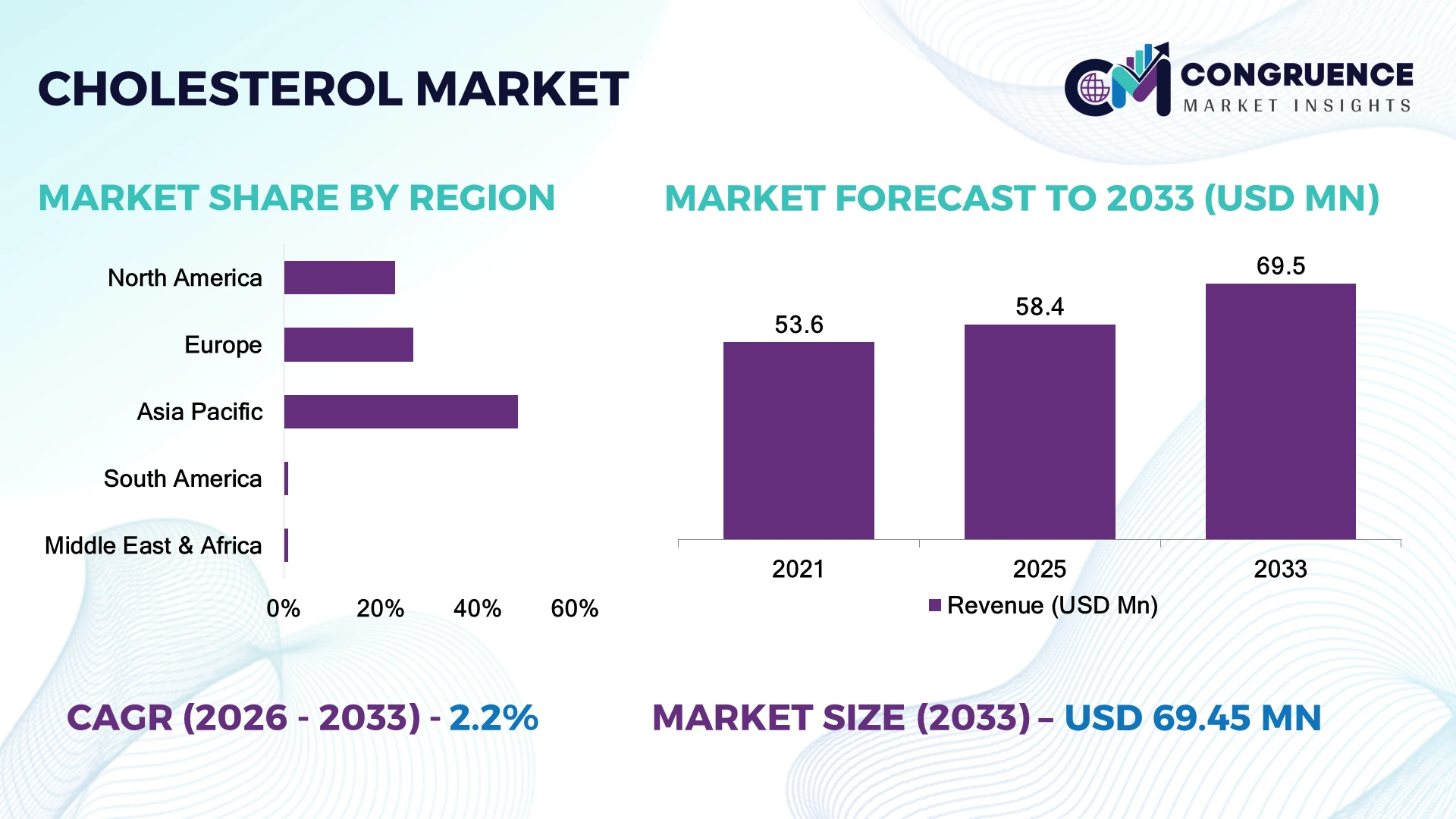
The Global Cholesterol Market was valued at USD 58.4 Million in 2025 and is anticipated to reach a value of USD 69.5 Million by 2033 expanding at a CAGR of 2.19% between 2026 and 2033. Growth is driven by expanding use of high-purity cholesterol in lipid nanoparticles, pharmaceutical formulations, vaccine technologies, and advanced drug-delivery systems, alongside the shift toward synthetic and plant-derived alternatives.
China remains a dominant manufacturing hub, accounting for an estimated 34% share of global cholesterol production capacity, supported by pharmaceutical synthesis, nutraceutical processing, and export-oriented API infrastructure. India is strengthening its position through domestic API investments, while U.S. demand is more innovation-led, particularly in lipid-based therapeutics. India’s pharmaceutical manufacturing initiatives have already created 56,800 metric tonnes per year of critical API capacity, strengthening supply resilience amid post-pandemic supply-chain restructuring.
Strategically, manufacturers prioritizing high-purity grades, diversified sourcing, and advanced bioprocessing will secure stronger positions in pharmaceutical and drug-delivery applications.
Market Size & Growth: Market value rises from USD 58.4 million in 2025 to USD 69.5 million by 2033 at a 2.19% CAGR, supported by lipid-nanoparticle and pharmaceutical applications.
Top Growth Drivers: Lipid-based drug delivery contributes to approximately 30% of incremental demand, pharmaceutical formulations 25%, and advanced vaccine applications 18%.
Short-Term Forecast: By 2028, advanced purification adoption is projected to improve production efficiency by 10–15%, reducing processing losses and improving high-purity output.
Emerging Technologies: Synthetic cholesterol, plant-derived cholesterol, continuous processing, and lipid-nanoparticle technologies are reshaping pharmaceutical-grade production and quality control.
Regional Leaders: Asia-Pacific is projected to approach USD 29 million, North America USD 19 million, and Europe USD 16 million by 2033, with adoption shifting toward high-purity pharmaceutical grades.
Consumer/End-User Trends: Pharmaceutical and biotechnology users account for more than 60% of premium-grade applications, reflecting increasing preference for controlled-purity cholesterol inputs.
Pilot/Case Example: In 2025, India’s API manufacturing program created 56,800 tonnes per year of capacity across critical materials, strengthening localization and reducing exposure to concentrated Asian supply chains.
Competitive Landscape: Leading supplier groups hold approximately 18% share, with Zhejiang Garden Biochemical, Nippon Fine Chemical, Dishman Carbogen Amcis, Merck, and specialized Chinese producers competing on purity, consistency, and supply reliability.
Regulatory & ESG Impact: GMP, pharmacopoeial, and solvent-control requirements are increasing qualification costs, while plant-derived and synthetic routes can reduce dependence on animal-derived inputs by 20–30%.
Investment & Funding: India recorded ₹4,814 crore in greenfield critical-material investments by December 2025, reinforcing localization, backward integration, and pharmaceutical supply-chain resilience.
Innovation & Future Outlook: Next-generation purification, fermentation-based synthesis, automated quality monitoring, and cholesterol-enabled lipid nanoparticles are shifting competition toward technology-intensive, specification-driven production.
Cholesterol demand is increasingly concentrated in pharmaceutical-grade applications, particularly lipid nanoparticles, targeted delivery systems, vaccines, and biotechnology research. High-purity grades represent an estimated 60%+ of premium application requirements as manufacturers move toward tighter impurity control. The shift is reinforced by supply-chain localization programs and stricter GMP expectations, creating stronger opportunities for suppliers capable of consistent pharmaceutical-grade production and traceable sourcing.
The cholesterol market is becoming strategically important because cholesterol has shifted from a conventional pharmaceutical ingredient toward a critical functional material in lipid-based drug delivery, vaccines, gene therapies, and advanced biotechnology. Pharmaceutical manufacturers increasingly prioritize high-purity, specification-controlled grades, making supplier qualification, traceability, and production consistency important competitive factors. Over the next 2–3 years, demand is expected to increasingly favor suppliers with integrated purification and quality-control capabilities.
Technology adoption is also changing manufacturing economics. Continuous purification and advanced extraction can reduce processing time by more than 20% compared with conventional batch-intensive workflows, while automated analytical monitoring improves batch consistency. China retains scale advantages in manufacturing, whereas the United States emphasizes high-value therapeutic applications and Europe places greater weight on regulatory compliance and sustainable processing. India is strengthening its position through domestic API manufacturing and localization programs.
A practical deployment pathway involves pharmaceutical manufacturers securing multi-year supply agreements with qualified API producers while diversifying China-centric sourcing through Indian and European facilities. Companies are increasing investment in synthetic production, plant-derived alternatives, process automation, and strategic partnerships. Competitive advantage will increasingly depend on reliable pharmaceutical-grade supply, regulatory readiness, and the ability to support advanced drug-delivery platforms.
Lipid-nanoparticle and advanced drug-delivery platforms are creating a structural demand shift for pharmaceutical-grade cholesterol. Lipid-based formulations can represent 20–30% of formulation inputs in selected delivery systems, while high-purity requirements increasingly exceed 95% assay specifications. The post-COVID expansion of mRNA and nucleic-acid therapeutics has strengthened demand for specialized lipid components. China continues to provide manufacturing scale, while the United States concentrates on high-value therapeutic development. Companies are responding through purification upgrades, synthetic-route development, and contract manufacturing partnerships. The strategic opportunity is moving beyond commodity cholesterol toward specification-controlled grades with stronger margins, traceability, and formulation compatibility.
Supply concentration remains a significant constraint because cholesterol production depends on specialized sterol feedstocks, purification infrastructure, and qualified pharmaceutical manufacturing capacity. China controls an estimated 70–80% of global key starting-material supply across the broader API ecosystem, increasing exposure to upstream disruptions and price volatility. Imported inputs can represent 35% or more of requirements for some pharmaceutical manufacturing chains in India. Regulatory qualification further limits rapid supplier switching because alternative producers require extensive validation. Companies are reducing exposure through dual sourcing, local API investments, longer-term procurement contracts, and backward integration. The operational priority is securing qualified feedstock and purification capacity before demand expansion creates procurement bottlenecks.
Synthetic and plant-derived cholesterol offer an important opportunity as pharmaceutical developers seek consistent purity, traceability, and reduced dependence on animal-derived materials. Plant-based and synthetic routes can reduce animal-origin exposure by approximately 20–30% in applications where substitution is technically feasible. Fermentation-based synthesis and advanced purification are also expanding the technology frontier, particularly for lipid nanoparticles and gene-delivery formulations. India’s pharmaceutical localization initiatives provide an additional platform for capacity expansion and export-oriented manufacturing. Companies are directing R&D toward scalable bioprocessing, cleaner extraction, and modular purification while forming partnerships with biotechnology developers. The non-obvious opportunity lies in supplying customized cholesterol grades engineered for specific lipid-delivery platforms rather than competing primarily on bulk volume.
Scaling pharmaceutical-grade cholesterol production requires tight control of oxidation, moisture, residual solvents, particle characteristics, and impurity profiles. Manufacturing systems targeting more than 95% purity must maintain narrow specification windows across multiple processing stages, increasing analytical and validation requirements. Supplier qualification cycles can extend beyond 12 months for regulated pharmaceutical applications, slowing commercialization and capacity utilization. Europe’s tighter chemical and environmental controls add additional compliance pressure, while emerging biotechnology applications require rapid adaptation to changing formulation specifications. Companies must invest in automated analytical systems, modular production lines, workforce specialization, and regulatory partnerships. The strategic challenge is balancing flexible production with validated consistency; manufacturers that cannot rapidly switch between customer specifications risk losing high-value contracts despite having adequate physical capacity.
Pharmaceutical Purity Intensifies: Pharmaceutical buyers are increasingly specifying cholesterol above 99.9% purity, while high-purity requirements now influence more than 60% of premium-grade procurement. Manufacturers are upgrading chromatography, crystallization, and analytical-control workflows to reduce batch variability. Stricter GMP expectations are accelerating supplier qualification, making documented traceability and impurity profiling more important than simple volume availability.
Lipid Delivery Scales Up: Cholesterol is becoming more deeply integrated into lipid-nanoparticle workflows, with 87.5% of surveyed nanomedicine developers using cholesterol as a lipid excipient. LNP adoption is shifting procurement toward tightly controlled pharmaceutical grades and formulation-specific specifications. Companies are responding by strengthening technical partnerships with drug developers and expanding cholesterol qualification for RNA, vaccine, and targeted-delivery platforms.
Supply Chains Diversify: Pharmaceutical manufacturers are reducing concentrated sourcing exposure as geopolitical trade friction and logistics volatility reshape API procurement. India is expanding domestic critical-material capacity, while Chinese producers continue emphasizing manufacturing scale. Multi-sourcing programs, longer-term contracts, and regional qualification are becoming standard procurement practices, with supply continuity increasingly weighted alongside price in vendor selection.
Process Automation Advances: Continuous manufacturing and automated analytical monitoring are moving from experimental workflows toward practical pharmaceutical production. Continuous processing can reduce operating costs and shorten manufacturing cycles, while automated controls improve batch consistency by approximately 10–15% in suitable workflows. Companies are integrating real-time quality monitoring, advanced purification, and digital process controls to improve throughput without compromising regulatory specifications.
NF Grade Cholesterol remains the leading type, accounting for approximately 55% of the market, supported by broad acceptance in pharmaceutical formulations, established quality specifications, and compatibility with high-purity manufacturing workflows. BP Grade Cholesterol represents roughly 35%, retaining strong relevance where British Pharmacopoeia specifications and established procurement protocols determine purchasing decisions. Other Grade Cholesterol accounts for approximately 10% and remains concentrated in specialized technical and lower-specification applications. NF Grade benefits from greater scalability and wider pharmaceutical integration, while BP Grade maintains a strong position among internationally regulated manufacturers. Companies are prioritizing purification capacity and certification systems, with high-purity production increasingly exceeding 99.9% for specialized applications.
The fastest-moving shift is toward specification-driven NF grades for advanced drug-delivery systems, particularly lipid nanoparticles. Pharmaceutical manufacturers are increasing supplier qualification for cholesterol with tighter impurity controls, while producers are expanding analytical laboratories and customized grades. The non-obvious investment priority is not simply additional tonnage but flexible purification infrastructure capable of serving different pharmacopeial specifications without major process redesign.
Pharmaceuticals represent the leading application at approximately 53.9% of market demand, supported by cholesterol’s use in drug formulations, steroid-related manufacturing, liposomal systems, and lipid nanoparticles. Cosmetics account for approximately 27.9%, benefiting from cholesterol’s conditioning and barrier-support properties, while Feeds and Others collectively represent about 18.2%. Pharmaceutical demand carries higher qualification requirements and stronger supplier retention than cosmetic applications, where pricing, formulation trends, and product positioning exert greater influence. Producers are therefore allocating more purification and quality-control capacity toward pharmaceutical specifications.
The fastest-growing application shift is occurring within advanced drug-delivery formulations, where cholesterol functions as a structural lipid rather than a conventional formulation ingredient. Lipid nanoparticles are expanding into RNA, vaccine, and oncology applications, increasing demand for consistent particle-formulation performance and low impurity profiles. Companies are responding through formulation partnerships, dedicated pharmaceutical-grade production, and tighter customer-specific specifications. The strategic implication is that future application value increasingly depends on functional performance and regulatory qualification rather than bulk cholesterol volume.
Pharmaceutical companies represent the dominant end-user group, accounting for approximately 43% of industrial cholesterol consumption, supported by large-scale formulation requirements, stringent quality specifications, and long-term supplier agreements. Cosmetic product formulators represent roughly 29%, while Animal Nutrition Companies and Vitamin Manufacturers account for smaller shares. Pharmaceutical buyers typically demand validated purity, documented traceability, and regulatory-grade testing, creating stronger supplier retention than price-sensitive cosmetic procurement. Companies are therefore directing sales and production resources toward qualified pharmaceutical accounts and contract manufacturing relationships.
The fastest-growing end-user opportunity is within pharmaceutical manufacturers and contract development and manufacturing organizations supporting lipid-based therapeutics. Advanced delivery platforms require specialized cholesterol grades and reliable replenishment, encouraging buyers to establish dual-sourcing arrangements and technical partnerships. Cosmetic manufacturers continue adopting cholesterol for premium skincare formulations, but pharmaceutical procurement is becoming more technically demanding and strategically important. Suppliers are responding with customized specifications, multi-year contracts, localized inventory, and application-development support. The key competitive shift is from transactional ingredient supply toward integrated quality, technical support, and supply-assurance relationships.
Asia-Pacific accounted for the largest market share at 48.3%in 2025 however, Asia-Pacific is expected to register the fastest growth, expanding at a CAGR of 2.2% between 2026 and 2033.
North America represented approximately 23.0% of the global Cholesterol Market in 2025, supported by sophisticated pharmaceutical manufacturing, biotechnology research, and strong adoption of lipid-based drug-delivery technologies. The United States accounts for the majority of regional demand, particularly for pharmaceutical-grade cholesterol used in lipid nanoparticles and specialized formulations. North American lipid-nanoparticle activity is strengthening requirements for cholesterol with purity levels above 99.9%, tighter impurity profiles, and validated supply chains. Pharmaceutical and biotechnology companies are increasingly establishing qualified secondary suppliers to reduce exposure to international logistics disruptions. The region’s combination of advanced formulation infrastructure and high-value therapeutic development gives suppliers opportunities to compete through technical support, customized grades, and regulatory-grade quality systems rather than commodity pricing.
United States Market Outlook: The United States remains North America’s primary demand center, supported by extensive pharmaceutical R&D, biotechnology manufacturing, and advanced drug-delivery development. The country accounted for more than 40.0% of North American cholesterol-related demand in several downstream pharmaceutical applications. Strong investment in lipid nanoparticles, RNA therapeutics, and precision delivery platforms is encouraging suppliers to expand high-purity production and application-specific technical support.
Europe accounted for approximately 26.8% of global cholesterol demand in 2025, making it the second-largest market. Demand is concentrated in Germany, France, Italy, Switzerland, and the United Kingdom, where pharmaceutical manufacturing and biotechnology operations require stringent quality documentation. Germany provides a particularly strong industrial base, with more than 650 pharmaceutical companies and substantial pharmaceutical R&D investment. European manufacturers are increasingly emphasizing traceability, validated purification, and environmentally controlled production as regulatory expectations tighten. Sustainability considerations are also influencing sourcing, encouraging greater interest in synthetic and plant-derived alternatives where technically suitable. Suppliers are responding by strengthening GMP capabilities, investing in analytical laboratories, and establishing partnerships with pharmaceutical formulation companies. The competitive advantage increasingly comes from compliance reliability and specification consistency rather than production volume alone.
Germany Market Outlook: Germany is Europe’s strongest pharmaceutical manufacturing hub and a major center for cholesterol-intensive formulation activity. Its pharmaceutical industry generated substantial industrial output in 2025, while more than 133,000 workers supported pharmaceutical production, research, and distribution. The country’s established clinical-research ecosystem and high pharmaceutical export capacity create strong demand for validated, high-purity cholesterol inputs.
Asia-Pacific held the leading position with approximately 48.3% of the global Cholesterol Market in 2025. China, India, Japan, and South Korea form the principal industrial centers, combining pharmaceutical manufacturing, API production, biotechnology, cosmetics, and export-oriented chemical processing. China provides significant production scale, while India is strengthening domestic pharmaceutical supply through localization and API-capacity investments. Pharmaceutical-grade cholesterol above 99.9% purity is gaining importance as lipid nanoparticles and specialized drug-delivery systems expand. Regional manufacturers are increasingly investing in purification, quality-control automation, and integrated production rather than relying exclusively on bulk processing. Supply-chain diversification following pandemic-era disruptions is also encouraging multinational pharmaceutical companies to qualify Indian suppliers alongside established Chinese producers, creating a more distributed procurement structure across the region.
China Market Outlook: China remains the strategically significant country because of its extensive chemical-processing infrastructure, pharmaceutical manufacturing base, and export-oriented supply chains. Its cholesterol industry spans pharmaceutical, cosmetic, and biotechnology applications, while domestic producers increasingly focus on higher-purity specifications. Expansion of advanced purification capacity and closer integration with API manufacturing strengthens China’s ability to supply both regional customers and international pharmaceutical companies.
South America represents a comparatively small portion of global cholesterol demand, with the broader Latin American market accounting for approximately 1.0% in 2025. Brazil is the principal commercial center because of its large pharmaceutical, cosmetics, food-processing, and healthcare industries. Demand is increasingly concentrated around pharmaceutical-grade ingredients and premium personal-care formulations, while domestic manufacturers continue to depend on imported specialized chemical inputs. Currency fluctuations, import lead times, and qualification requirements influence procurement decisions more strongly than in mature pharmaceutical markets. Companies are responding through distributor partnerships, regional inventory buffers, and longer-term supply agreements. Brazil’s expanding pharmaceutical manufacturing capabilities provide an important entry point for suppliers, but local availability and regulatory registration remain essential for improving deployment consistency and reducing exposure to international logistics disruptions.
Brazil Market Outlook: Brazil is the region’s most important market because of its population scale, pharmaceutical manufacturing base, and established cosmetics industry. Its large domestic healthcare system creates recurring demand for pharmaceutical ingredients, while local formulation companies increasingly seek reliable suppliers capable of meeting controlled-purity specifications. Strategic partnerships with Brazilian distributors and pharmaceutical manufacturers can improve market access and reduce import-related operational friction.
Middle East & Africa accounted for approximately 1.0% of global cholesterol demand in 2025, with purchasing concentrated in Gulf healthcare systems and larger African pharmaceutical markets. Saudi Arabia and the United Arab Emirates are emerging as strategically relevant markets because healthcare modernization programs are expanding pharmaceutical manufacturing, hospital infrastructure, and biotechnology capabilities. The region remains more import-dependent than Asia-Pacific, North America, or Europe, making logistics reliability and distributor networks critical purchasing factors. Pharmaceutical manufacturers are increasingly evaluating local packaging, regional warehousing, and strategic inventory arrangements to reduce supply interruptions. The expansion of healthcare infrastructure in Gulf economies is gradually shifting procurement from purely price-based sourcing toward quality-assured, regulatory-compliant supply. Suppliers that combine pharmaceutical-grade certification with regional distribution capabilities are positioned to capture higher-value opportunities.
Saudi Arabia Market Outlook: Saudi Arabia is the most strategically significant market in the region because its healthcare transformation agenda is accelerating pharmaceutical localization and advanced manufacturing. The country’s growing pharmaceutical ecosystem is increasing demand for qualified imported and locally processed ingredients. Suppliers can strengthen positioning through local manufacturing partnerships, regional warehousing, and technical collaborations with pharmaceutical producers supporting domestic medicine production.
The market pits global specialty-lipid suppliers such as Evonik, Croda, Merck, and Dishman Carbogen Amcis against Asian cost-focused cholesterol manufacturers and specialized research-grade suppliers. The top five players are estimated to control about 35% of supply. Competition centers on purity, certification, price, continuity, customization, and speed. High-purity grades command roughly 15–25% premiums, while validated pharmaceutical supply can reduce switching by 20%. Croda and Evonik are expanding lipid and plant-derived cholesterol capabilities; Dishman is strengthening integrated cholesterol manufacturing; Asian producers emphasize capacity and cost. The competitive shift is toward application-specific pharmaceutical grades, non-animal inputs, and integrated lipid platforms rather than commodity volume. Entry barriers include GMP validation, pharmacopeial compliance, analytical infrastructure, and customer qualification cycles exceeding 12 months. Supply-chain diversification is pressuring incumbents to localize inventory and secure feedstocks. Winning requires validated purity, dependable multi-region supply, flexible specifications, and technical partnerships with pharmaceutical developers. This favors suppliers combining scale with depth.
Evonik Industries AG
Croda International Plc
Merck KGaA
Dishman Carbogen Amcis Limited
Nippon Fine Chemical Co., Ltd.
CordenPharma International
Cayman Chemical Company
LGC Standards
Tokyo Chemical Industry Co., Ltd.
Spectrum Chemical Manufacturing Corp.
Anhui Xinhong Pharmaceutical Co., Ltd.
Avanti Research
Thermo Fisher Scientific
BASF SE
Advanced purification is becoming the core production technology, combining chromatography, crystallization, solvent recovery, and automated analytical controls. Compared with conventional batch purification, integrated process monitoring can improve usable yield by about 10–15% and reduce rework. Adoption is strongest among pharmaceutical-grade producers targeting specifications above 99.9% purity, giving established GMP manufacturers an advantage in qualification-sensitive accounts.
Plant-derived and biosynthetic cholesterol is emerging as an alternative to animal-derived material for injectable formulations, lipid nanoparticles, and animal-free bioprocessing. Non-animal routes can reduce animal-origin dependence by approximately 20–30% and improve supply traceability. Evonik and other specialty suppliers benefit by offering validated alternatives with pharmacopeial compliance, while customers gain sourcing flexibility and stronger ESG positioning.
Lipid-nanoparticle integration is the disruptive pathway through 2026–2028. Cholesterol is increasingly engineered as part of complete lipid systems rather than purchased as an isolated ingredient. More than 60% of premium pharmaceutical demand is linked to high-purity applications, supporting supplier partnerships with drug developers. Automated quality analytics, continuous processing, and application-specific lipid design will shorten qualification cycles and improve consistency, shifting competition toward integrated technology platforms. Companies acting now can lock in formulation partnerships, qualify differentiated grades earlier, and capture switching costs before next-generation delivery platforms scale broadly. Advantage determines procurement.
March 2025 — Evonik presented PhytoChol BioPharma for animal-free cell culture and lipid applications; its life-science portfolio serves more than 1,000 customers, strengthening premium non-animal cholesterol adoption across regulated biopharmaceutical workflows to support higher-specification formulation programs worldwide biopharma customers. Source: evonik.com
January 2025 — CARBOGEN AMCIS reported successful Swissmedic inspection of its Vionnaz facility, reaffirming regulatory compliance and supporting dependable pharmaceutical manufacturing for cholesterol-related supply chains serving regulated customers across Europe and strengthen regulated European supply continuity for regulated customers. Source: carbogen-amcis.com
February 2026 — Croda reported about £140 million spent through 2025 on large-scale pharma-lipid manufacturing, strengthening capacity across the United States, United Kingdom, and Korea and improving readiness for larger commercial demand worldwide. Source: croda.com
August 2025 — Piramal Pharma Solutions opened a dedicated oral-solid-dosage suite in Pennsylvania after a multi-million-dollar investment, creating more than 20 jobs and supporting cholesterol-therapy manufacturing for future commercial supply requirements and supporting future commercial-scale manufacturing demand at scale. Source: pharmamanufacturing.com
The report covers the Global Cholesterol Market across NF Grade Cholesterol, BP Grade Cholesterol, and Other Grade Cholesterol, with application analysis spanning Pharmaceuticals, Cosmetics, Feeds, and Others. End-user coverage includes Pharmaceutical Companies, Cosmetic Product Formulators, Animal Nutrition Companies, and Vitamin Manufacturers. The assessment evaluates demand concentration, specification requirements, procurement behavior, and high-purity applications, including lipid nanoparticles and advanced drug-delivery systems.
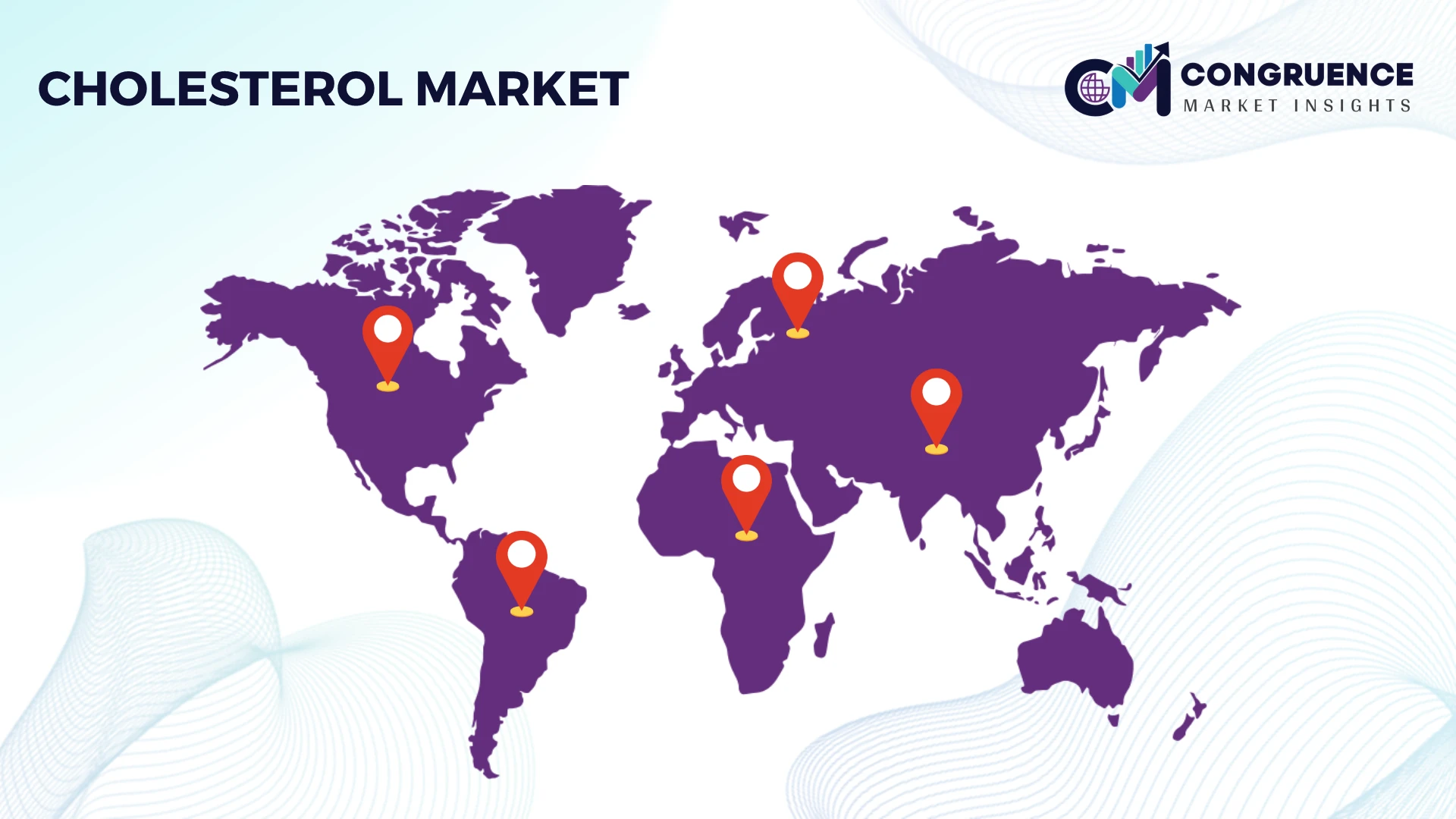
Geographic coverage includes North America, Europe, Asia-Pacific, South America, and Middle East & Africa, with country-level emphasis on major production and consumption centers. The report evaluates plant-derived cholesterol, synthetic processing, purification, automation, and supply-chain diversification. Competitive analysis covers leading global and regional participants, with approximately 10–14 influential companies assessed for positioning. The analysis supports supplier selection, capacity planning, investment allocation, expansion strategy, partnership development, and competitive positioning through 2026–2033.
| Report Attribute / Metric | Details |
|---|---|
| Market Revenue (2025) | USD 58.4 Million |
| Market Revenue (2033) | USD 69.5 Million |
| CAGR (2026–2033) | 2.2% |
| Base Year | 2025 |
| Forecast Period | 2026–2033 |
| Historic Period | 2021–2025 |
| Segments Covered |
By Type
By Application
By End-User
|
| Key Deliverables | Revenue Forecast; Market Trends; Growth Drivers & Restraints; Technology Insights; Segmentation Analysis; Regional Insights; Competitive Landscape; Regulatory & ESG Overview; Recent Developments |
| Regions Covered | North America; Europe; Asia-Pacific; South America; Middle East & Africa |
| Companies Profiled | Evonik Industries AG; Croda International Plc; Merck KGaA; Dishman Carbogen Amcis Limited; Nippon Fine Chemical Co., Ltd.; CordenPharma International; Cayman Chemical Company; LGC Standards; Tokyo Chemical Industry Co., Ltd.; Spectrum Chemical Manufacturing Corp.; Anhui Xinhong Pharmaceutical Co., Ltd.; Avanti Research; Thermo Fisher Scientific; BASF SE |
| Customization & Pricing | Available on Request (10% Customization Free) |




