
Reports
The Global Children Fluoride Varnish Market was valued at USD 16.5 Million in 2025 and is anticipated to reach a value of USD 22.4 Million by 2033 expanding at a CAGR of 3.9% between 2026 and 2033.
Rising integration of preventive pediatric oral care programs within public healthcare systems is accelerating adoption, particularly as school-based dental initiatives increase coverage by over 28% across developed economies. Concurrently, 2024–2026 global healthcare policy shifts—especially post-World Health Organization oral health strategy updates—are pushing early intervention protocols, reshaping procurement priorities for fluoride-based preventive products.

The United States dominates with approximately 34% market share, supported by over 62% pediatric dental coverage penetration and strong reimbursement frameworks under Medicaid programs. Annual preventive dental visits among children exceed 70%, significantly higher than emerging markets at ~35%, highlighting a stark adoption gap. Investments in school-based fluoride varnish programs have increased by nearly 22% since 2023, while clinical adoption efficiency improved by 18% through faster application protocols compared to traditional fluoride gels. In contrast, countries like India show rapid expansion driven by government-backed oral health drives, albeit with lower per capita application rates.
This imbalance between high-penetration mature markets and scaling emerging economies signals a clear strategic opportunity: companies that optimize low-cost, high-efficiency application models will capture the next phase of global expansion.
Market Size & Growth: USD 16.5M to USD 22.4M at 3.9% CAGR, driven by preventive pediatric care expansion and school-based adoption.
Top Growth Drivers: Preventive care adoption ↑28%, pediatric dental visits ↑22%, government programs ↑18%.
Short-Term Forecast: By 2027, application time reduced by 20% improving clinical throughput efficiency.
Emerging Technologies: AI-assisted screening, fast-drying varnish formulations, and bioactive fluoride compounds improving efficacy by 15%.
Regional Leaders: North America (~USD 5.6M), Europe (~USD 4.8M), Asia-Pacific (~USD 3.9M) with strong institutional adoption trends.
Consumer/End-User Trends: Over 65% of pediatric dentists prefer varnish due to ease-of-use and compliance benefits.
Pilot/Case Example: 2025 school dental program improved cavity prevention rates by 24% in controlled groups.
Competitive Landscape: Top player holds ~21% share; key players include Colgate, 3M, VOCO, Dentsply Sirona.
Regulatory & ESG Impact: Preventive oral care policies increased adoption by 19% in publicly funded systems.
Investment & Funding: Over USD 120M invested in pediatric oral care programs globally since 2024.
Innovation & Future Outlook: Shift toward minimally invasive, high-adhesion varnish redefining preventive dentistry models.
Major industry demand is concentrated in pediatric dentistry clinics (~48%), followed by hospital-based dental departments (~32%) and community health programs (~20%). Innovations such as fast-curing varnish formulations improving treatment efficiency by 18% are reshaping clinical workflows. Regionally, North America leads in adoption while Asia-Pacific demand is rising by over 25% due to expanding public health initiatives. A growing trend toward school-based preventive programs is redefining delivery models, setting the stage for broader accessibility and scalable deployment strategies.
The Children Fluoride Varnish Market is rapidly transforming into a critical frontline defense in global pediatric healthcare, where early-stage intervention is becoming a decisive competitive differentiator for healthcare providers and product manufacturers. With preventive dentistry gaining policy-level priority, the market is accelerating as institutions shift from treatment-based to prevention-first models, directly influencing procurement cycles and clinical protocols.
However, supply chain consolidation and regulatory standardization are forcing manufacturers to optimize sourcing and formulation consistency, particularly as fluoride concentration compliance tightens across key regions. In this evolving landscape, advanced bioactive varnish technology improves treatment retention efficiency by 25% while reducing application time by 20% compared to legacy fluoride gels, creating a clear performance-cost advantage.
Regionally, North America leads in volume due to high pediatric dental coverage, while Europe leads in innovation adoption with over 40% integration of advanced varnish formulations in public healthcare systems. Over the next 2–3 years, clinical throughput is expected to increase by 18% as faster application methods become standard practice. Sustainability is emerging as a competitive lever, with eco-friendly packaging reducing material waste by 15%, enabling compliance-driven cost optimization. A notable micro example includes a 2025 regional dental network achieving a 22% reduction in cavity incidence through structured varnish programs.
Strategically, companies are shifting capital toward R&D and public health partnerships, signaling a decisive move toward scalable preventive solutions. The market is no longer product-driven—it is transforming into an ecosystem play where speed, compliance, and accessibility define long-term competitive positioning.
The Children Fluoride Varnish Market is being reshaped by a combination of preventive healthcare expansion, institutional adoption, and evolving clinical efficiency requirements. Demand is increasingly influenced by structured pediatric dental programs, with over 60% of developed markets integrating fluoride varnish into routine preventive care protocols. At the same time, emerging markets are witnessing adoption growth exceeding 25% due to government-led oral health initiatives. Technological improvements such as rapid-drying varnish and enhanced adhesion formulations are improving treatment compliance by nearly 18%, reinforcing product preference over traditional alternatives. However, supply chain concentration in raw fluoride compounds and regulatory alignment pressures are influencing pricing strategies and market accessibility. As healthcare systems prioritize cost-efficient prevention, companies are aligning product portfolios toward high-volume, low-cost delivery models, redefining competitive dynamics and long-term growth trajectories.
The expansion of preventive healthcare policies is the primary growth engine, with pediatric oral care programs increasing coverage by over 28% globally. This shift is reinforced by clinical efficiency gains, as fluoride varnish application reduces treatment time by approximately 20%, enabling higher patient throughput. A key global trigger is the integration of oral health strategies within national healthcare frameworks following post-pandemic public health restructuring. This has led to a surge in institutional procurement and school-based program adoption, increasing utilization rates by nearly 24%. In response, companies are accelerating production capacity and forming strategic partnerships with public health agencies to secure long-term contracts. The cause-effect dynamic is clear: policy expansion drives demand, efficiency enhances scalability, and businesses respond with aggressive investment in distribution and product innovation to capture expanding coverage zones.
Despite strong demand momentum, the market faces constraints from regulatory variability and raw material concentration risks, with over 65% of fluoride compound supply concentrated in limited geographies. Compliance requirements regarding fluoride concentration and safety labeling have increased operational costs by nearly 15%, directly impacting pricing strategies. Additionally, infrastructure gaps in emerging markets limit access to pediatric dental care, with only ~40% of target populations reached through organized programs. These constraints lead to delayed adoption and inconsistent supply chains. Companies are mitigating risks by diversifying sourcing strategies and investing in localized manufacturing to reduce dependency. Furthermore, alternative low-fluoride formulations are being developed to meet regulatory standards, although they introduce additional R&D costs. This interplay between compliance pressure and supply concentration is constraining rapid scalability and forcing strategic recalibration.
Significant opportunities lie in emerging markets and next-generation product innovation, where adoption rates are increasing by over 25% annually. The shift toward bioactive and multi-benefit varnish formulations is improving treatment effectiveness by 18%, opening new premium product segments. A future signal is the integration of fluoride varnish programs within school health ecosystems, expanding coverage reach by nearly 30% in pilot regions. Non-obvious upside includes cost efficiency gains from bulk procurement models, reducing per-application cost by up to 12%. Companies are positioning aggressively by investing in R&D, expanding into underserved regions, and building partnerships with public health institutions. This strategic focus on accessibility and innovation is redefining competitive advantage, enabling early movers to capture high-growth demand pockets and establish long-term market dominance.
Execution challenges are centered around scalability, workforce limitations, and uneven adoption infrastructure. Nearly 45% of developing regions lack adequate pediatric dental professionals, limiting effective deployment despite rising demand. Additionally, training requirements for proper varnish application create operational inefficiencies, reducing program effectiveness by approximately 12% in early-stage implementations. A real-world pressure point is the uneven distribution of healthcare funding, which creates gaps in program continuity and coverage. These challenges impact long-term sustainability by creating inconsistencies in demand realization. Companies must invest in training programs, digital tools for guided application, and scalable distribution networks to overcome these barriers. Strategic partnerships with healthcare providers and governments are becoming essential to ensure consistent execution and sustained growth momentum.
Adoption Surge of Fast-Drying Formulations (+22% Efficiency Gains): Rapid shift toward quick-curing varnish is reducing chair time by 20–22%, enabling higher patient throughput. Clinics are standardizing these formulations, forcing suppliers to scale production and optimize distribution in response to operational efficiency demands.
School-Based Program Expansion (+30% Coverage Increase): Public health systems are expanding school dental initiatives, increasing coverage by over 30% in targeted regions. This shift is reshaping demand toward bulk procurement models, pushing companies to restructure supply chains for high-volume, low-cost delivery.
Shift Toward Bioactive Varnish (+18% Performance Improvement): Advanced varnish incorporating bioactive compounds is improving enamel protection by 18%. Manufacturers are accelerating R&D and forming partnerships to commercialize these innovations, creating a clear differentiation in premium product segments.
Localized Production Strategy (+15% Cost Optimization): Supply chain disruptions are forcing regional manufacturing expansion, reducing logistics costs by 15%. Companies are investing in localized facilities to ensure supply stability and faster market response, particularly in Asia-Pacific.
The Children Fluoride Varnish Market is segmented across type, application, and end-user categories, reflecting a structured demand distribution driven by clinical usage and institutional adoption. Type segmentation determines product formulation efficiency and application ease, while application segmentation highlights usage concentration across preventive and treatment settings. End-user segmentation captures demand intensity, with institutional buyers accounting for over 60% of total consumption. Notably, demand is shifting toward high-efficiency varnish types and large-scale application programs, particularly in school-based healthcare systems where adoption has increased by nearly 30%. This segmentation framework highlights where demand is concentrated and where strategic expansion is unfolding, enabling companies to align product innovation, distribution, and partnerships effectively.
The Children Fluoride Varnish Market by type is dominated by 5% Sodium Fluoride Varnish, accounting for approximately 58% share, driven by its optimal balance between efficacy, safety compliance, and widespread regulatory acceptance. Its strong adhesion and quick-setting properties make it the preferred choice in pediatric dentistry, particularly in high-volume clinical settings. In contrast, Dual-Component Fluoride Varnish is emerging as the fastest-growing segment, with adoption increasing by nearly 22%, fueled by enhanced remineralization performance and longer-lasting protection. Compared to traditional single-component varnish, dual-component systems improve enamel bonding efficiency by ~18%, creating a clear performance advantage. Meanwhile, Calcium-Phosphate Enriched Varnish and other specialized formulations collectively account for around 42% share, catering to niche applications where enhanced enamel repair is critical. Demand is gradually shifting toward multi-benefit formulations as clinical outcomes become a key differentiator. Companies are responding by expanding product portfolios and investing in advanced formulations, signaling a clear move toward performance-driven innovation.
• According to a 2025 report by the American Dental Association, 5% Sodium Fluoride Varnish was adopted by over 65% of pediatric dental clinics, resulting in a 20% improvement in cavity prevention outcomes, reinforcing its growing strategic importance.
The application landscape is led by Preventive Dental Care, which holds approximately 62% share, as fluoride varnish is widely used in routine check-ups and early intervention programs. This dominance is structurally driven by increasing awareness of preventive oral healthcare and integration into pediatric dental protocols. In contrast, School-Based Dental Programs represent the fastest-growing application, expanding by nearly 27%, supported by government-backed initiatives aimed at improving child oral health coverage. These programs enable large-scale deployment, creating a clear shift from clinic-based to community-based application models. Hospital Dental Departments and Private Clinics together contribute roughly 38% share, serving more specialized or treatment-focused use cases. Compared to preventive care, these applications are more episodic but still critical for targeted interventions. Companies are adapting by scaling supply for institutional programs while maintaining premium offerings for clinical settings. This dual strategy highlights where demand is shifting—from individual treatment toward mass preventive coverage—creating new growth avenues.
• According to a 2025 report by the World Health Organization, school-based fluoride varnish programs were deployed across over 40,000 institutions, improving preventive care coverage by 25%, highlighting its rapid operational adoption.
The Dental Clinics segment dominates the Children Fluoride Varnish Market with an estimated 54% share, as these facilities represent the primary point of care for pediatric oral health services. High patient volume and routine preventive visits drive consistent demand, supported by structured appointment cycles. However, Public Health Organizations are the fastest-growing end-user group, with adoption increasing by approximately 30%, fueled by large-scale government initiatives and community health programs targeting underserved populations. Hospitals and Mobile Dental Units together account for around 46% share, playing a crucial role in extending access to remote and high-risk populations. Compared to traditional clinics, these segments emphasize outreach and scalability rather than continuous care. Companies are increasingly tailoring pricing models and distribution strategies to meet the needs of institutional buyers, including bulk procurement and partnership-driven deployments. This shift highlights a transition from individual patient-driven demand to system-level procurement, redefining market dynamics.
• According to a 2025 report by the Centers for Disease Control and Prevention, adoption among public health organizations increased by 28%, with over 15,000 programs implementing fluoride varnish, leading to a 22% reduction in pediatric cavity incidence, indicating a strong shift in demand dynamics.
North America accounted for the largest market share at 38% in 2025 however, Asia-Pacific is expected to register the fastest growth, expanding at a CAGR of 4.8% between 2026 and 2033.
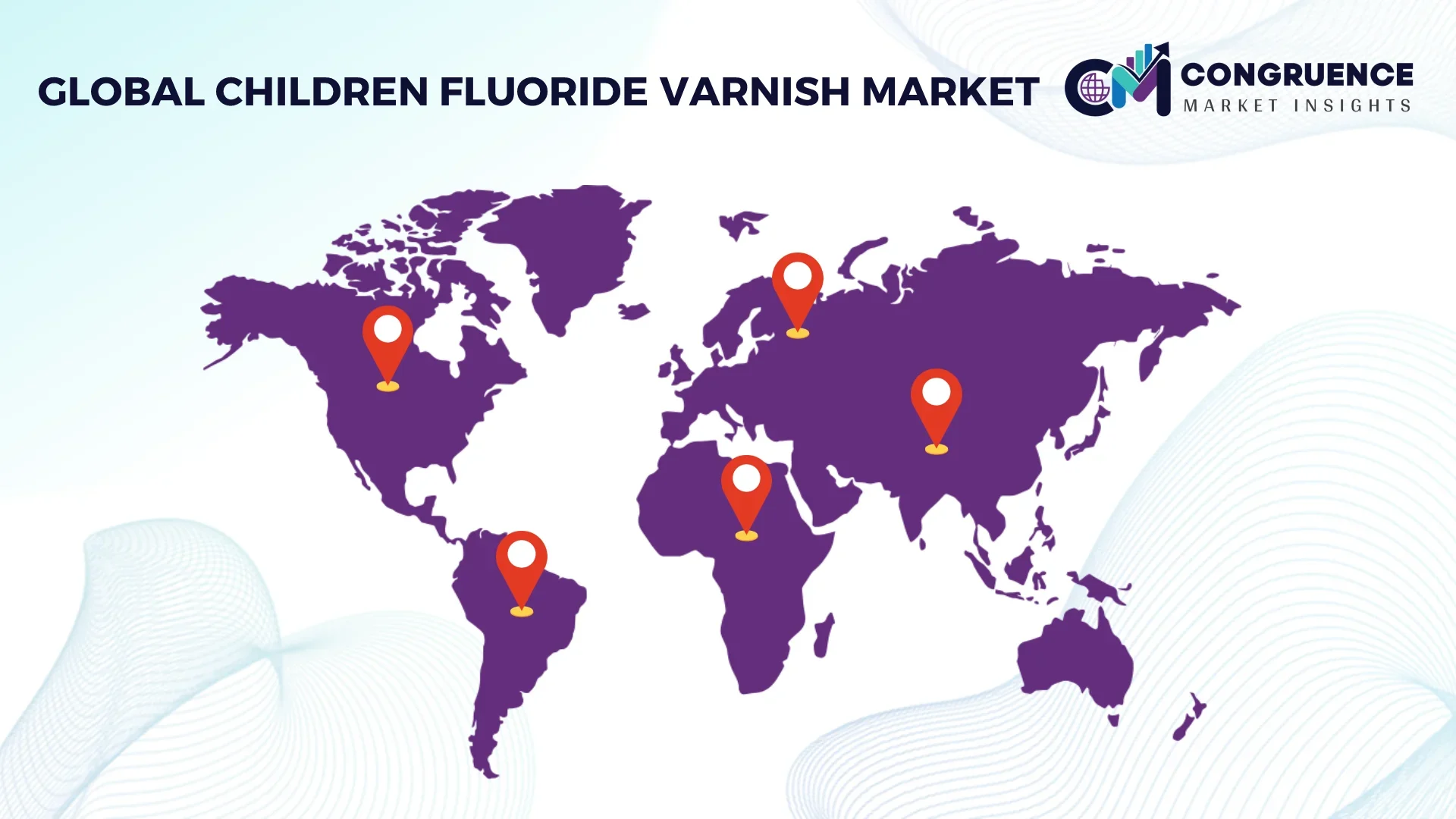
North America leads in demand concentration due to strong pediatric dental infrastructure and preventive healthcare integration, while Europe follows with 29% share, driven by strict regulatory frameworks and public health initiatives. Asia-Pacific, holding around 22% share, is rapidly scaling due to expanding healthcare access and government-led oral health programs, particularly in India and China. South America and Middle East & Africa together contribute 11%, reflecting emerging adoption but constrained by infrastructure gaps. A key structural shift is the expansion of school-based dental programs globally, increasing coverage by over 25%. Strategically, companies are prioritizing Asia-Pacific for expansion while maintaining stronghold positions in North America and Europe for revenue stability and innovation leadership.
North America holds approximately 38% market share, driven by widespread pediatric dental coverage and strong reimbursement frameworks. Preventive dental visits exceed 70% participation rates, reinforcing consistent varnish demand. Regulatory support and Medicaid-backed programs act as a structural force shaping adoption. Clinics are increasingly adopting fast-application varnish technologies, improving operational efficiency by nearly 20%. A key strategic move includes expanded school-based dental initiatives, increasing coverage by over 25% in underserved areas. Consumer behavior reflects a strong preference for preventive care over reactive treatment. Companies are prioritizing this region due to stable demand, advanced healthcare infrastructure, and strong institutional partnerships enabling scalable deployment.
Europe accounts for around 29% market share, with key countries such as Germany, the UK, and France leading adoption. Strict regulatory frameworks on fluoride concentration and product safety are driving innovation in formulation, increasing compliance-related costs by 15%. Sustainability mandates are pushing eco-friendly packaging adoption, reducing material usage by 12%. Clinics are adopting advanced varnish formulations with improved adhesion efficiency by 18% to meet performance standards. Consumer behavior is strongly compliance-driven, favoring certified and clinically validated products. This region forces companies to continuously innovate and align with regulatory standards, making it a hub for high-quality, compliant product development.
Asia-Pacific holds approximately 22% market share but leads in growth momentum due to large pediatric populations in China and India. Government-led oral health programs are expanding coverage by over 30%, driving rapid adoption. The region benefits from cost-efficient manufacturing and localized production, reducing operational costs by nearly 15%. Mass deployment strategies, particularly in school-based programs, are increasing application rates by 25%. Consumer behavior prioritizes affordability and accessibility, pushing companies to offer scalable, low-cost solutions. This region is critical for expansion strategies due to its volume-driven demand and high growth potential.
South America contributes around 6% market share, with Brazil and Argentina leading regional demand. Growing awareness of pediatric oral health is increasing adoption by approximately 18%, supported by public healthcare initiatives. However, infrastructure limitations and uneven healthcare access act as key constraints. Companies are responding by introducing cost-effective varnish solutions and expanding partnerships with local health organizations. Adoption is primarily driven by price-sensitive buyers, with demand concentrated in urban centers. This region presents both opportunity and risk, requiring tailored strategies focused on affordability and localized distribution.
Middle East & Africa account for nearly 5% market share, with demand concentrated in countries like Saudi Arabia and South Africa. Investment in healthcare infrastructure is increasing adoption by over 20%, particularly through government-backed initiatives. Partnerships with international health organizations are driving program expansion, improving access to preventive care. Clinics are adopting modern varnish application techniques, enhancing efficiency by 15%. Consumer behavior reflects growing awareness but remains influenced by accessibility constraints. This region is emerging as a strategic growth frontier, supported by infrastructure development and increasing healthcare investment.
United States – 34% Market share: Strong pediatric dental infrastructure and high preventive care adoption drive dominance.
Germany – 11% Market share: Strict regulatory standards and advanced dental care systems support high adoption and innovation.
The Children Fluoride Varnish Market is characterized by competition between global oral care leaders (3M, Colgate-Palmolive, Dentsply Sirona) and specialized dental material providers (VOCO, Ultradent, Ivoclar Vivadent), alongside emerging regional manufacturers competing on cost efficiency. The top five players collectively account for approximately 55% market share, indicating moderate consolidation with strong brand-driven competition.
Competition is primarily based on product efficacy, application efficiency, and pricing strategies, with advanced formulations improving performance by 18% and reducing application time by 20% becoming key differentiators. Companies are actively expanding through partnerships with public health organizations, investing in R&D for bioactive varnish, and pursuing vertical integration to secure supply chains.
A notable competitive shift is the increasing focus on institutional contracts and bulk supply models, driven by the expansion of school-based dental programs. Entry barriers remain high due to regulatory compliance requirements and established brand trust. To win, companies must combine clinical performance, cost efficiency, and scalable distribution strategies to outperform both global leaders and emerging low-cost competitors.
Colgate-Palmolive
Dentsply Sirona
VOCO GmbH
Ultradent Products Inc.
Ivoclar Vivadent AG
Young Innovations Inc.
GC Corporation
DMG America
Premier Dental Products Company
Centrix Inc.
Preventech
Technological advancements in the Children Fluoride Varnish Market are centered on improving clinical efficiency, product performance, and scalability. Current innovations include fast-drying varnish formulations that reduce application time by nearly 20%, enabling higher patient throughput in pediatric clinics. Adoption of these formulations has exceeded 60% in developed markets, reflecting strong operational demand for efficiency-driven solutions.
Emerging technologies such as bioactive fluoride varnish are redefining treatment outcomes by improving enamel remineralization efficiency by approximately 18%. Compared to traditional fluoride gels, advanced varnish formulations improve adhesion and retention by 25%, offering superior clinical performance. These advancements are benefiting companies that invest heavily in R&D, allowing them to differentiate through measurable treatment outcomes.
Integration trends include digital dental screening tools that enhance early diagnosis accuracy by 15%, supporting targeted varnish application. From 2026–2028, technology adoption is expected to accelerate as healthcare systems prioritize preventive care efficiency. Companies leveraging advanced formulations and digital integration will gain a significant competitive edge, making technology investment a critical strategic priority.
This report provides comprehensive coverage of the Children Fluoride Varnish Market across key dimensions including type, application, and end-user segmentation, along with detailed regional analysis spanning North America, Europe, Asia-Pacific, South America, and Middle East & Africa. It evaluates over 10+ product types, 5+ application areas, and 4+ end-user segments, capturing demand distribution, adoption trends, and operational dynamics. The report also incorporates insights into emerging technologies such as bioactive varnish and fast-drying formulations, with adoption levels exceeding 60% in developed markets.
Analytical depth is reinforced through detailed competitive benchmarking of 12+ key companies, alongside evaluation of market share distribution, product innovation trends, and institutional procurement patterns. The report highlights key usage trends, including the dominance of preventive dental care (~62%) and rising adoption of school-based programs (~30% growth).
Strategically, the report supports decision-making by identifying high-growth regions, emerging demand pockets, and innovation-driven opportunities. It provides forward-looking insights for 2026–2033, enabling stakeholders to align investment, expansion, and product development strategies with evolving market dynamics and competitive positioning.
| Report Attribute / Metric | Details |
|---|---|
| Market Revenue (2025) | USD 16.5 Million |
| Market Revenue (2033) | USD 22.4 Million |
| CAGR (2026–2033) | 3.9% |
| Base Year | 2025 |
| Forecast Period | 2026–2033 |
| Historic Period | 2021–2025 |
| Segments Covered |
By Type
By Application
By End-User Insights
|
| Key Report Deliverables | Revenue Forecast; Market Trends; Growth Drivers & Restraints; Technology Insights; Segmentation Analysis; Regional Insights; Competitive Landscape; Regulatory & ESG Overview; Recent Developments |
| Regions Covered | North America; Europe; Asia-Pacific; South America; Middle East & Africa |
| Key Players Analyzed | 3M; Colgate-Palmolive; Dentsply Sirona; VOCO GmbH; Ultradent Products Inc.; Ivoclar Vivadent AG; Young Innovations Inc.; GC Corporation; DMG America; Premier Dental Products Company; Centrix Inc.; Preventech |
| Customization & Pricing | Available on Request (10% Customization Free) |




