
Reports
The Global Child Breathing Circuit Market was valued at USD 321.0 Million in 2025 and is anticipated to reach a value of USD 409.8 Million by 2033 expanding at a CAGR of 3.1% between 2026 and 2033. Growth is driven by rising neonatal intensive care unit investments, increasing adoption of disposable respiratory circuits, and demand for infection-control-focused pediatric ventilation systems.
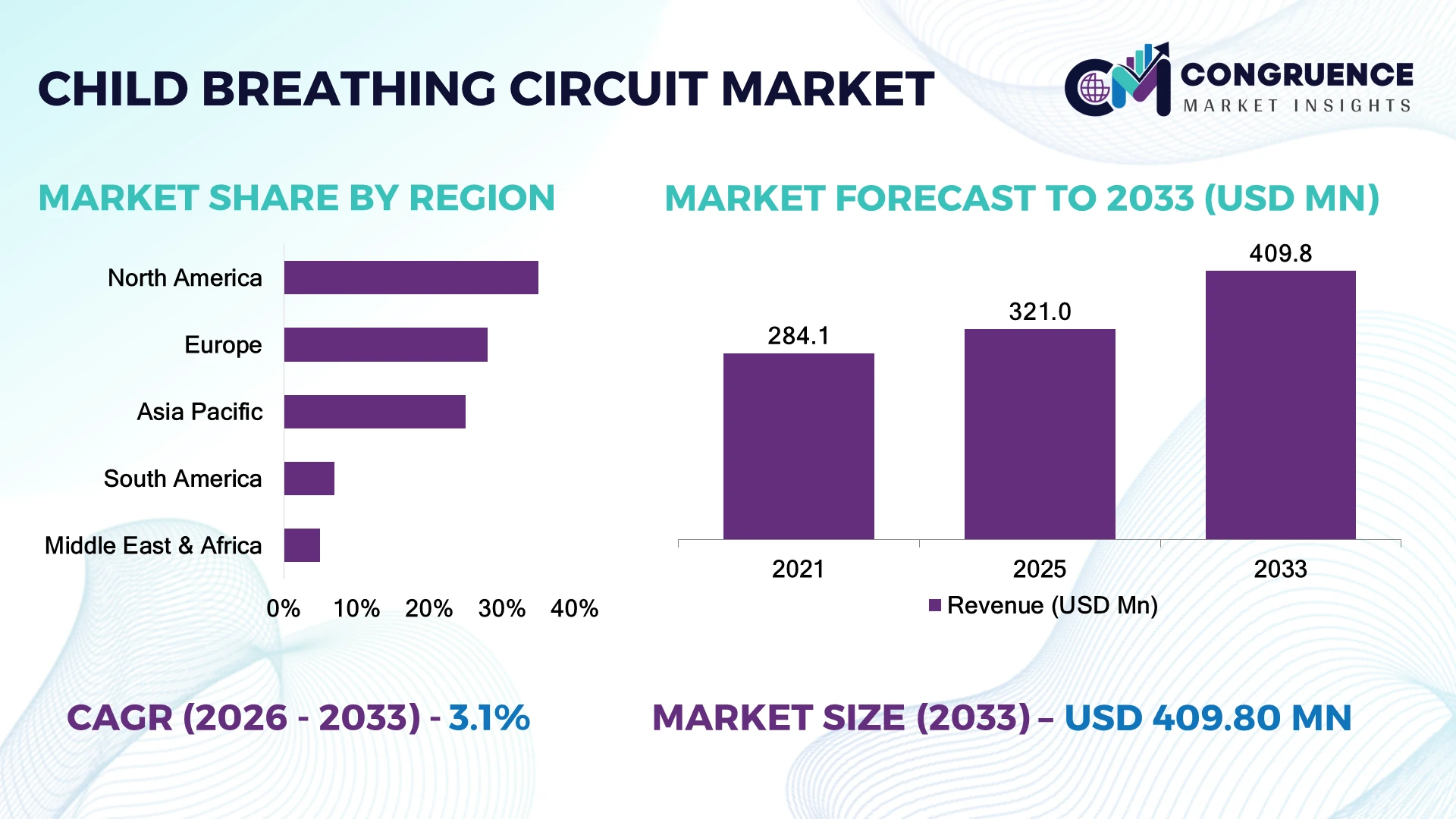
The United States leads the market with approximately 35% share, supported by advanced NICU infrastructure, high pediatric respiratory care spending, and adoption of closed-loop ventilation technologies across more than 5,000 hospitals. China follows with expanding neonatal healthcare capacity and over 20% growth in pediatric respiratory equipment procurement after healthcare modernization programs. The U.S. market demonstrates nearly 15% higher adoption of advanced breathing systems compared with emerging economies, highlighting a technology-driven competitive advantage.
Strategic investments in localized manufacturing and smart respiratory solutions will define future market positioning.
Market Size & Growth: USD 321.0 Million in 2025 to USD 409.8 Million by 2033 at 3.1% CAGR, driven by pediatric ventilation upgrades and infection-control requirements.
Top Growth Drivers: NICU expansion 18%, disposable circuit adoption 22%, pediatric respiratory care investments 15%.
Short-Term Forecast: By 2028, hospitals are targeting 10%–15% efficiency improvement through optimized respiratory workflows and advanced circuit designs.
Emerging Technologies: AI-assisted ventilation monitoring, antimicrobial materials, and lightweight pediatric circuit systems are reshaping product innovation.
Regional Leaders: North America projected at USD 145 Million with advanced NICU adoption; Asia-Pacific at USD 120 Million with hospital expansion; Europe at USD 95 Million with regulatory-driven upgrades.
Consumer/End-User Trends: More than 60% of neonatal care facilities prioritize single-use breathing circuits to reduce infection risks.
Pilot/Case Example: In 2024, pediatric respiratory units implementing automated monitoring solutions reported approximately 12% improvement in ventilation management efficiency.
Competitive Landscape: Leading manufacturers hold approximately 45% combined share, with key players including Draeger, Fisher & Paykel Healthcare, Hamilton Medical, Medtronic, and Vyaire Medical.
Regulatory & ESG Impact: New sterilization and medical waste policies are driving 20% higher adoption of recyclable and low-material respiratory components.
Investment & Funding: More than USD 500 Million invested globally in respiratory care innovation, focusing on partnerships, automation, and manufacturing expansion.
Innovation & Future Outlook: Next-generation pediatric circuits integrating sensors, digital monitoring, and sustainable materials are strengthening long-term competitive positioning.
Child breathing circuits are becoming essential components of neonatal and pediatric respiratory care as hospitals prioritize safer ventilation practices, improved patient monitoring, and advanced infection prevention. Manufacturers are introducing low-resistance circuit designs, sensor-enabled components, and improved patient interfaces, with disposable systems accounting for more than 60% of new installations in developed healthcare markets. Operational changes after global supply-chain disruptions are encouraging regional manufacturing hubs in the United States, Germany, and China, improving availability and reducing dependency on imported components. The market is moving toward connected respiratory ecosystems where hospitals integrate advanced circuits with digital ventilators and clinical monitoring platforms.
The Child Breathing Circuit Market is becoming strategically important as healthcare systems prioritize neonatal survival rates, respiratory safety, and advanced intensive care infrastructure. Hospitals are shifting from conventional reusable systems toward disposable and digitally integrated circuits to improve infection control and operational reliability. Regulatory focus on device safety and supply-chain resilience after global healthcare disruptions is accelerating investments in localized production and quality-certified manufacturing.
Advanced sensor-enabled breathing circuits improve monitoring accuracy by approximately 20% compared with legacy passive systems while reducing manual intervention requirements by nearly 15%. North America maintains leadership through high NICU technology penetration, while Asia-Pacific is expanding deployment through hospital modernization programs and increasing pediatric care capacity.
In Germany and Japan, healthcare providers are adopting precision respiratory technologies supported by automation and quality standards, whereas emerging markets focus on cost-efficient solutions and accessibility. Companies are expanding through strategic partnerships, manufacturing investments, and integrated ventilator-circuit ecosystems. Over the next 2–3 years, competitive advantage will depend on product reliability, digital integration, and the ability to deliver scalable pediatric respiratory solutions across diverse healthcare environments.
Increasing investment in neonatal and pediatric intensive care infrastructure is strengthening adoption of advanced child breathing circuits. The United States has expanded NICU modernization programs, while China and India are increasing pediatric respiratory equipment procurement through healthcare infrastructure initiatives. More than 60% of hospitals prefer disposable circuits to improve infection prevention, and antimicrobial materials are gaining adoption across new product launches. Manufacturers are responding by investing in lightweight designs, sensor integration, and regional production facilities. The shift toward advanced respiratory monitoring creates operational advantages by improving patient safety and reducing circuit replacement complexity.
Child breathing circuit manufacturers face challenges from specialized material dependency, regulatory compliance costs, and manufacturing complexity. Medical-grade polymers and sterilization processes contribute to approximately 15%–20% of production cost variations. Countries dependent on imported respiratory components experience longer procurement cycles and inventory pressure. European and Asian manufacturers are reducing exposure through supplier diversification, local sourcing agreements, and expanded production networks. The key operational challenge remains balancing affordability with strict pediatric safety requirements, especially in cost-sensitive healthcare systems.
The integration of smart sensors, connected ventilation systems, and advanced materials creates new opportunities for child breathing circuit manufacturers. Sensor-based monitoring solutions improve respiratory data visibility by approximately 20%, supporting more accurate clinical decisions. Emerging markets are increasing pediatric healthcare investments, with India and Southeast Asian countries expanding critical-care infrastructure. Companies are developing AI-compatible circuits and partnering with ventilator manufacturers to create integrated respiratory ecosystems. Future opportunities will center on intelligent monitoring, sustainable materials, and customized pediatric solutions that improve clinical outcomes.
The market faces execution challenges from uneven healthcare infrastructure, technology integration requirements, and evolving regulatory standards. Nearly 30% of healthcare facilities in developing markets still operate with limited access to advanced respiratory monitoring equipment. Hospitals require trained professionals and compatible ventilation platforms to maximize circuit performance. Companies must address these barriers through training programs, regional partnerships, and simplified product designs. Long-term competitiveness depends on improving deployment consistency while maintaining safety standards across developed and emerging healthcare environments.
Smart Monitoring Integration: Hospitals are adopting sensor-enabled child breathing circuits with digital ventilation connectivity, increasing monitoring accuracy by nearly 20% and reducing manual respiratory adjustments by 15%. Healthcare providers in the United States and Germany are integrating these systems into NICU workflows, while manufacturers are expanding partnerships with ventilator technology companies to improve connected-care capabilities.
Disposable Circuit Expansion: Infection-control regulations and post-pandemic hospital protocols are accelerating disposable circuit adoption, with more than 60% of pediatric facilities prioritizing single-use solutions. Companies are restructuring supply chains by establishing regional manufacturing centers in China and Mexico to reduce delivery delays by approximately 25% and improve inventory reliability.
Material Innovation Shift: Manufacturers are introducing lightweight polymers, antimicrobial coatings, and low-resistance designs that improve airflow efficiency by 10%–15% compared with conventional materials. Japan and South Korea are supporting premium product adoption, while companies are investing in advanced material research to enhance patient comfort and reduce component waste.
Localized Manufacturing Growth: Global supply-chain pressure is driving respiratory device producers to increase domestic production capacity, with localization programs improving component availability by nearly 20%. Companies are creating regional supplier networks and automation-based manufacturing facilities, creating a non-obvious advantage by reducing dependency risks while improving customization speed for pediatric care providers.
Based on available market segmentation, Disposable Child Breathing Circuits represent the leading type, accounting for approximately 65% of market adoption due to their infection-control benefits, simplified replacement processes, and compatibility with modern pediatric ventilation systems. Their scalability in hospitals and lower sterilization requirements make them preferred in NICUs and intensive care units. Reusable circuits maintain relevance in cost-sensitive healthcare environments, particularly where sterilization infrastructure is established, while hybrid circuit designs are gaining attention for balancing durability and operational efficiency. The fastest-growing segment is advanced low-resistance and sensor-integrated circuit designs, supported by increasing demand for connected respiratory monitoring. Adoption of these systems is rising by nearly 15% annually in technologically advanced hospitals as providers focus on workflow automation and patient-specific ventilation. Companies are responding through product redesign, strategic partnerships with ventilator manufacturers, and investment in smart respiratory components.
Neonatal Intensive Care Units (NICUs) represent the dominant application area, accounting for nearly 55% of child breathing circuit usage due to the high requirement for continuous respiratory support among premature and critically ill infants. Pediatric ventilation applications follow closely, supported by increasing respiratory disorder management programs and hospital expansion initiatives. Emergency pediatric care is emerging as a strategic segment as hospitals upgrade rapid-response respiratory capabilities. The fastest-growing application is home-based pediatric respiratory support, driven by improvements in portable ventilation technology and remote monitoring systems. Adoption of home respiratory solutions has increased by approximately 20% in developed healthcare markets as providers seek lower hospitalization pressure and improved patient continuity. Companies are expanding partnerships with digital health providers and developing compact circuit systems to support decentralized care models.
Hospitals and specialty healthcare facilities account for the largest end-user share at approximately 70% due to high patient volume, intensive respiratory care requirements, and dependence on advanced NICU infrastructure. Large medical centers in the United States, Germany, and China continue to drive demand through equipment modernization programs, while smaller healthcare facilities increasingly adopt standardized disposable solutions. The fastest-growing end-user segment is ambulatory and home healthcare providers, supported by rising demand for post-discharge respiratory management and portable pediatric care solutions. This segment is expanding adoption by nearly 18% as remote monitoring technologies improve clinical supervision outside hospitals. Manufacturers are responding with customized product portfolios, flexible supply agreements, and partnerships with healthcare networks to improve accessibility.
North America accounted for the largest market share at 35% in 2025 however, Asia-Pacific is expected to register the fastest growth, expanding at a CAGR of 4.2% between 2026 and 2033.

North America holds the leading position in the child breathing circuit market, supported by advanced neonatal infrastructure, high hospital spending, and strong adoption of disposable respiratory systems. The region contributes approximately 35% of global demand, with the United States representing the majority share due to extensive NICU networks and specialized pediatric care facilities. More than 5,000 hospitals operate advanced neonatal units, increasing demand for high-performance breathing circuits. Manufacturers are strengthening regional supply chains through domestic production and partnerships with medical technology companies to improve availability, customization, and integration with digital ventilation platforms.
United States Market Outlook: The United States remains the most influential market due to its advanced healthcare infrastructure, strong medical device ecosystem, and high adoption of connected respiratory technologies. Over 60% of leading pediatric hospitals have incorporated disposable respiratory solutions into critical-care workflows. Regulatory emphasis on infection prevention and patient safety continues to encourage manufacturers to develop sensor-enabled and low-resistance circuit technologies.
Europe maintains a significant position in the child breathing circuit market due to stringent healthcare standards, advanced hospital systems, and increasing focus on sustainable medical equipment. The region accounts for approximately 28% of global demand, with Germany, the United Kingdom, and France representing major deployment centers. European hospitals are increasingly adopting disposable and environmentally optimized circuits to improve infection control while managing medical waste requirements. More than 50% of tertiary care facilities prioritize advanced respiratory systems with improved safety features. Companies are expanding through regional partnerships, compliance-focused product development, and localized manufacturing strategies to meet evolving medical device regulations.
Germany Market Outlook: Germany leads European adoption through its strong medical technology industry, advanced hospital infrastructure, and manufacturing capabilities. The country’s healthcare system supports widespread deployment of specialized pediatric respiratory equipment, with more than 80% of major hospitals using standardized critical-care procurement processes. German manufacturers are focusing on precision engineering, sustainable materials, and integrated respiratory solutions.
Asia-Pacific represents the fastest-transforming market due to expanding pediatric healthcare infrastructure, increasing hospital capacity, and growing domestic medical device production. The region contributes nearly 25% of global demand, with China, Japan, and India driving adoption through healthcare modernization initiatives. China has become a major manufacturing hub for respiratory components, while India is increasing procurement of neonatal care equipment across public and private hospitals. Pediatric respiratory equipment installations have increased by more than 20% in emerging healthcare markets as access to intensive care improves. Companies are investing in local production facilities, distribution partnerships, and cost-efficient circuit designs to address diverse healthcare requirements.
China Market Outlook: China remains the strategic center of Asia-Pacific due to its large healthcare system, manufacturing capability, and expanding neonatal care infrastructure. The country accounts for a significant share of regional production and has increased domestic medical device manufacturing capacity by more than 15% through healthcare localization initiatives. Local manufacturers are improving product quality while competing through cost efficiency and faster supply availability.
South America is experiencing gradual adoption of child breathing circuits as hospitals modernize neonatal and pediatric intensive care capabilities. The region contributes approximately 7% of global demand, with Brazil and Argentina representing key healthcare markets. Public hospital upgrades and private healthcare investments are increasing demand for disposable respiratory products, particularly in urban medical centers. Brazil has expanded critical-care infrastructure through healthcare modernization programs, improving access to pediatric respiratory support. Companies are addressing regional challenges through distributor partnerships, localized supply networks, and flexible pricing strategies to improve availability across different healthcare systems.
Brazil Market Outlook: Brazil represents the largest South American market due to its extensive healthcare network and growing pediatric care requirements. Major hospitals in urban centers are increasing adoption of advanced respiratory equipment, with private healthcare facilities accounting for more than 40% of specialized equipment purchases. Manufacturers are strengthening partnerships with healthcare providers to expand distribution coverage and improve product accessibility.
The Middle East & Africa market is developing through healthcare infrastructure expansion, government modernization programs, and increasing investment in specialized pediatric care facilities. The region accounts for approximately 5% of global demand, with the United Arab Emirates, Saudi Arabia, and South Africa leading adoption. Advanced hospitals in Gulf countries are prioritizing modern respiratory technologies, while African healthcare systems are gradually improving access through international partnerships. More than 30% of new hospital projects in Gulf markets include advanced intensive-care capabilities, supporting demand for pediatric respiratory equipment. Companies are expanding through regional distributors, government contracts, and healthcare infrastructure collaborations.
Saudi Arabia Market Outlook: Saudi Arabia is emerging as a strategic market due to healthcare transformation initiatives, hospital expansion projects, and investment in advanced medical infrastructure. The country is increasing critical-care capacity through new healthcare facilities and modernization programs, with pediatric intensive-care units receiving technology upgrades. Manufacturers are targeting Saudi healthcare networks through partnerships, localized support services, and advanced respiratory product portfolios.
The Child Breathing Circuit Market features competition between global respiratory care leaders, specialized medical device manufacturers, and regional cost-focused suppliers. Companies such as Fisher & Paykel Healthcare, Draeger, Medtronic, Hamilton Medical, and Vyaire compete through technology differentiation, while regional manufacturers challenge pricing and supply flexibility. The top five players collectively account for approximately 45% of market share, creating a moderately consolidated structure. Competition centers on product safety, circuit compatibility, customization, and manufacturing reliability, with advanced systems improving workflow efficiency by 10%–15% and disposable solutions gaining over 60% adoption in hospitals. Leading companies are expanding production facilities, forming ventilator integration partnerships, and investing in antimicrobial materials. The competitive landscape is shifting toward connected respiratory systems and localized supply chains. High regulatory requirements and clinical validation create entry barriers. Winning requires technological innovation, reliable supply networks, and the ability to deliver cost-effective pediatric respiratory solutions.
Draegerwerk AG & Co. KGaA
Medtronic plc
Hamilton Medical AG
Vyaire Medical, Inc.
Teleflex Incorporated
Getinge AB
Smiths Medical
Intersurgical Ltd.
Armstrong Medical Ltd.
Flexicare Medical Limited
WilMarc Medical LLC
Child breathing circuit technology is shifting from conventional passive systems toward sensor-enabled, connected respiratory solutions. Smart circuits integrated with digital ventilators improve monitoring accuracy by nearly 20% and reduce manual intervention requirements by approximately 15%. Hospitals are increasingly adopting these systems in advanced NICUs, where real-time respiratory data supports faster clinical decisions and improved workflow control.
Material innovation is becoming a major competitive factor, with antimicrobial coatings, lightweight polymers, and low-resistance designs improving airflow performance by 10%–15% compared with traditional circuits. Disposable advanced-material circuits now represent more than 60% of hospital preferences in developed markets due to infection-control advantages and simplified operational processes. Manufacturers benefiting most are those combining material science with scalable production capabilities.
Between 2026 and 2028, AI-compatible respiratory platforms, automated monitoring, and integrated ventilator ecosystems will reshape market competition. New-generation circuits are expected to gain adoption through partnerships between device manufacturers and digital healthcare providers. Companies acting early on connected technologies, sustainable materials, and localized manufacturing will achieve stronger operational efficiency and competitive differentiation.
March 2025 Dräger expanded its neonatal care portfolio with the launch of BiliPredics, a predictive neonatal software solution developed with NeoPredics. The platform forecasts bilirubin progression up to 60 hours ahead, strengthening early intervention workflows and expanding digital neonatal care capabilities. Source: www.draeger.com
2025 Fisher & Paykel Healthcare continued expanding its infant respiratory portfolio with updated neonatal solutions, including Evaqua 2 breathing circuit technology and Optiflow Junior systems. The company reported 20% growth in consumables from new applications, supporting wider adoption of humidified pediatric respiratory care solutions. Source: www.fphcare.com
September 2025 Hamilton Medical advanced pediatric respiratory technology through clinical education and technology updates focused on closed-loop oxygen control. The company highlighted improved oxygen management for pediatric ventilation, supporting safer workflows and reduced clinician workload in intensive-care environments.
February 2025 Hamilton Medical issued a neonatal ventilator safety update for HAMILTON-C2/C3 systems with neonatal options, reinforcing device monitoring and preventive maintenance practices. The action strengthened reliability protocols for hospitals using neonatal ventilation equipment and improved operational safety management.
The Child Breathing Circuit Market Report covers comprehensive analysis across product types, applications, end-users, regional markets, competitive positioning, and technology trends. The study evaluates disposable and reusable circuit categories, neonatal ventilation, pediatric respiratory applications, hospitals, specialty healthcare facilities, and emerging home-care adoption areas. Regional assessment includes North America, Europe, Asia-Pacific, South America, and Middle East & Africa with focus on deployment patterns and infrastructure development.
The report provides strategic insights into technology adoption, supply-chain evolution, regulatory influence, and company positioning between 2026 and 2033. Coverage includes advanced materials, connected respiratory systems, manufacturing expansion, and partnership strategies. With major manufacturers representing nearly 45% of market participation, the analysis supports investment planning, expansion decisions, competitive benchmarking, and identification of emerging opportunities in pediatric respiratory care.
| Report Attribute / Metric | Details |
|---|---|
| Market Revenue (2025) | USD 321.0 Million |
| Market Revenue (2033) | USD 409.8 Million |
| CAGR (2026–2033) | 3.1% |
| Base Year | 2025 |
| Forecast Period | 2026–2033 |
| Historic Period | 2021–2025 |
| Segments Covered |
By Type
By Application
By End-User
|
| Key Deliverables | Revenue Forecast; Market Trends; Growth Drivers & Restraints; Technology Insights; Segmentation Analysis; Regional Insights; Competitive Landscape; Regulatory & ESG Overview; Recent Developments |
| Regions Covered | North America; Europe; Asia-Pacific; South America; Middle East & Africa |
| Companies Profiled | Fisher & Paykel Healthcare Corporation Limited; Draegerwerk AG & Co. KGaA; Medtronic plc; Hamilton Medical AG; Vyaire Medical, Inc.; Teleflex Incorporated; Getinge AB; Smiths Medical; Intersurgical Ltd.; Armstrong Medical Ltd.; Flexicare Medical Limited; WilMarc Medical LLC |
| Customization & Pricing | Available on Request (10% Customization Free) |




