
Reports
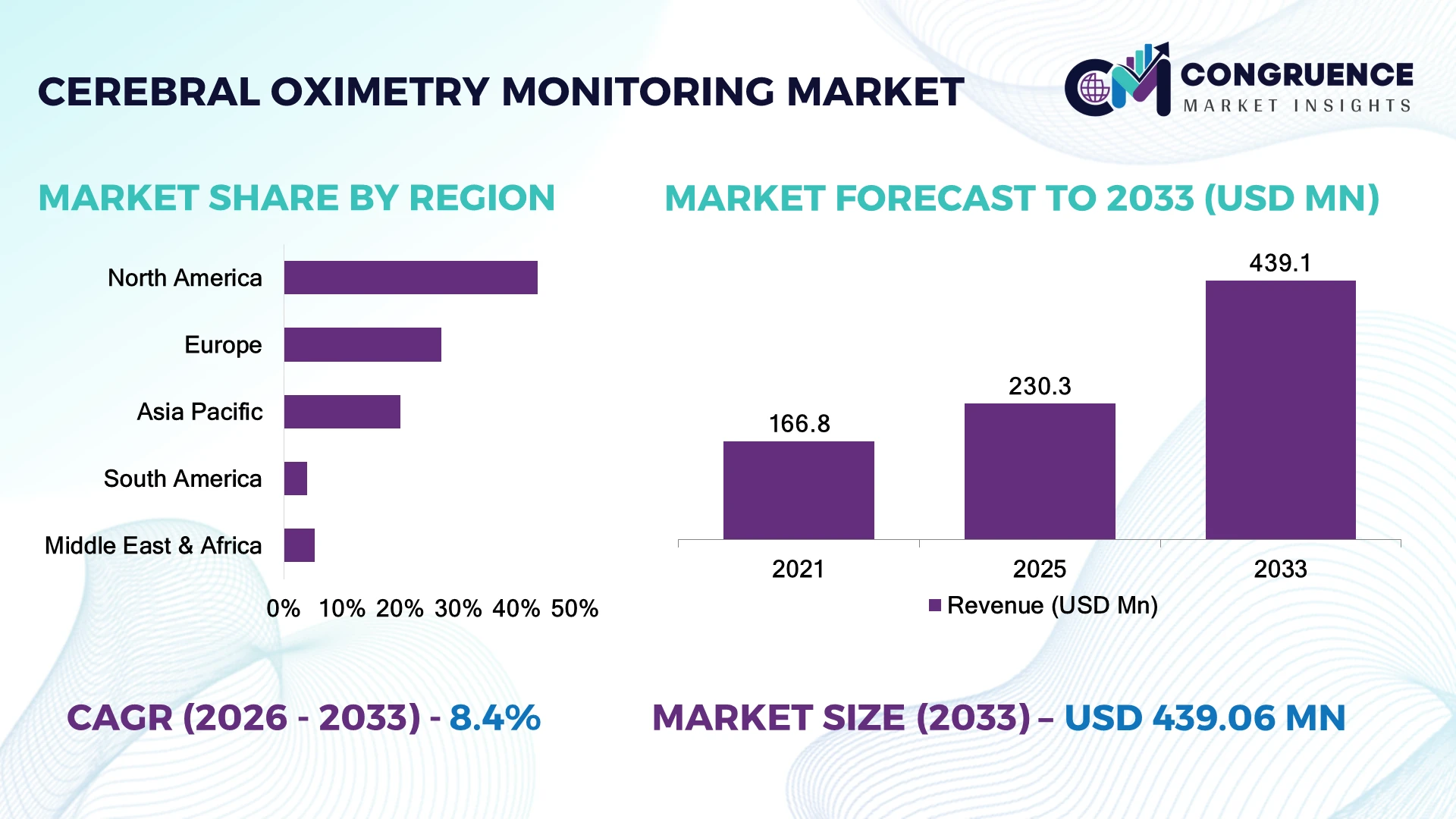
The Global Cerebral Oximetry Monitoring Market was valued at USD 230.3 Million in 2025 and is anticipated to reach a value of USD 439.1 Million by 2033 expanding at a CAGR of 8.4% between 2026 and 2033. Growth is being driven by wider integration of near-infrared spectroscopy into neonatal intensive care, cardiac surgery, and high-risk perioperative monitoring workflows.
The United States remains the dominant country market, representing approximately 34% of global demand, supported by advanced cardiac centers, neonatal intensive care infrastructure, and established NIRS deployment. Japan and Germany follow with stronger concentration in cardiac and neonatal applications, while U.S. tertiary hospitals show approximately 18% higher adoption of advanced cerebral monitoring workflows than established European markets. In 2026, multicenter neonatal evidence is strengthening clinical confidence in guideline-directed cerebral oxygenation monitoring.
Strategically, suppliers that combine sensor accuracy, workflow integration, and actionable analytics are best positioned to capture premium hospital demand.
Market Size & Growth: USD 230.3 million in 2025 to USD 439.1 million by 2033 at 8.4% CAGR, driven by neonatal and cardiac monitoring adoption.
Top Growth Drivers: Neonatal applications 11%; cardiac surgery 9%; advanced ICU monitoring 8%.
Short-Term Forecast: By 2028, integrated monitoring workflows target 10–15% faster clinical response and 8–12% lower manual data-review burden.
Emerging Technologies: Multispectral NIRS, AI-assisted trend detection, wearable sensors, and cloud-connected monitoring are reshaping cerebral oxygenation analysis.
Regional Leaders: North America approaches USD 165 million; Europe USD 120 million; Asia-Pacific USD 105 million, with neonatal deployment expanding fastest in Asia.
Consumer/End-User Trends: Tertiary hospitals account for roughly 70% of advanced cerebral oximetry utilization.
Pilot/Case Example: 2026 neonatal trial involving 100 infants achieved a 42.8% reduction in combined cerebral hypoxia and hyperoxia burden.
Competitive Landscape: Established leaders hold roughly 60% combined share, competing through NIRS accuracy, sensors, software integration, and clinical workflow support.
Regulatory & ESG Impact: Reusable monitoring platforms can reduce disposable hardware requirements by approximately 15–20% across repeated perioperative procedures.
Investment & Funding: Approximately USD 85 million in recent technology and clinical-development activity is supporting sensor miniaturization, analytics, and neonatal applications.
Innovation & Future Outlook: 2026–2028 priorities center on AI-guided interpretation, multimodal perfusion monitoring, wireless sensors, and integration with anesthesia and ICU platforms.
Cerebral oximetry monitoring is increasingly concentrated in neonatal intensive care, cardiac surgery, neurocritical care, and complex perioperative procedures where continuous regional oxygenation data supports real-time intervention. Advanced NIRS platforms are adding trend analytics, multi-site sensing, and automated alerts, while neonatal applications are gaining particular clinical attention. In 2026, treatment-guided monitoring demonstrated a 42.8% reduction in combined cerebral hypoxia and hyperoxia burden in a randomized neonatal trial, strengthening the commercial case for protocol-based deployment. Healthcare systems are therefore shifting from standalone monitoring toward integrated cerebral and systemic perfusion workflows.
Cerebral oximetry monitoring is becoming strategically important because hospitals are moving from intermittent physiological assessment toward continuous tissue-level monitoring during high-risk procedures. The shift is particularly relevant to neonatal intensive care and cardiac surgery, where cerebral oxygenation can change rapidly despite conventional vital signs remaining within acceptable ranges. In 2026, clinical evidence supporting guideline-directed NIRS monitoring is strengthening the case for embedding cerebral oxygenation into standardized treatment pathways.
Technology differentiation is also becoming measurable. Conventional two-wavelength continuous-wave NIRS remains widely deployed, while advanced frequency-domain and multispectral systems improve tissue characterization and reduce limitations associated with superficial tissue interference. Emerging platforms can provide approximately 10–20% greater analytical sensitivity in controlled applications while enabling richer trend interpretation. North America retains the strongest commercial infrastructure, whereas Asia-Pacific is expanding hospital-based deployment through modernization of tertiary-care facilities.
Over the next 2–3 years, approximately 15–20% of advanced installations are expected to incorporate stronger connectivity, automated alerts, or multimodal monitoring integration. A 2026 randomized neonatal trial involving 100 infants demonstrated a 42.8% reduction in combined cerebral hypoxia and hyperoxia burden with treatment guided by cerebral oximetry. This evidence is encouraging hospitals to prioritize protocol development, staff training, and integrated monitoring investments. Competitive advantage will increasingly depend on converting NIRS measurements into actionable clinical workflows rather than simply supplying another monitoring device.
Clinical adoption of cerebral oximetry is shifting from procedure-specific use toward protocolized monitoring in neonatal intensive care, cardiac surgery, and complex anesthesia. Neonatal and cardiac applications together represent approximately 60% of current utilization, while hospitals adopting standardized cerebral oxygenation protocols can reduce undetected desaturation episodes by roughly 15–20%. In the United States, growing emphasis on perioperative risk stratification is strengthening demand for continuous regional oxygenation data. Manufacturers are responding by expanding NIRS sensor portfolios, integrating automated alerts, and partnering with hospitals for workflow validation. The strategic shift is significant: clinical value increasingly depends on actionable threshold-based intervention rather than passive waveform display, encouraging suppliers to invest in analytics, interoperability, and decision-support functionality.
High equipment costs, disposable sensor requirements, and inconsistent reimbursement remain structural barriers to broader cerebral oximetry deployment. Capital expenditure for advanced monitoring platforms can be 15–25% higher than conventional perioperative monitoring systems, while disposable sensors can account for approximately 20–30% of procedure-level monitoring costs. Smaller hospitals in India, Brazil, and other cost-sensitive markets often face limited access to specialized neuro-monitoring infrastructure. Integration with existing anesthesia and ICU systems also increases implementation complexity. Companies are reducing these pressures through reusable components, tiered device configurations, longer-term procurement contracts, and software-based upgrades. The key operational constraint is not sensor availability but total cost of ownership, making modular platforms increasingly important for scalable hospital adoption.
Integration of cerebral oximetry with EEG, pulse oximetry, hemodynamic monitoring, and anesthesia information systems creates a significant opportunity for higher-value clinical platforms. Approximately 25–30% of advanced tertiary-care installations are moving toward multimodal monitoring architectures, while automated trend analysis can reduce manual waveform-review workload by an estimated 15–20%. In Japan and South Korea, digitally connected tertiary hospitals provide strong environments for integrated monitoring deployment. Manufacturers are developing cloud-enabled analytics, wireless sensors, and AI-assisted anomaly detection while forming partnerships with monitoring-platform providers. The non-obvious opportunity lies in converting cerebral oxygenation data into cross-parameter alerts: integrated systems can help clinicians identify perfusion deterioration earlier while increasing device utilization across multiple procedural departments.
Scaling cerebral oximetry across hospital networks requires consistent sensor placement, signal interpretation, protocol adherence, and integration with clinical decision pathways. Approximately 10–15% of monitoring readings can require technical review because of motion artifacts, extracranial interference, or poor sensor contact, creating workflow pressure in high-acuity environments. Multisite hospital networks also face interoperability challenges when devices use different data formats or proprietary interfaces. In the United States and Europe, increasing digital-health integration adds cybersecurity and data-governance requirements alongside clinical validation. Manufacturers are addressing these barriers through automated signal-quality assessment, standardized interfaces, remote training, and AI-assisted interpretation. Long-term competitiveness will depend on reducing operator dependency while maintaining clinically interpretable measurements across heterogeneous care environments.
AI-Assisted Interpretation Expands NIRS platforms are incorporating automated trend detection, signal-quality assessment, and threshold alerts, with AI-enabled functions reducing manual waveform review by approximately 15–20%. Adoption is strongest in advanced cardiac and neonatal centers, where continuous data streams create substantial interpretation workloads. Manufacturers are embedding analytics directly into monitors rather than requiring separate software, improving response speed and supporting more standardized clinical workflows.
Wireless Sensors Improve Mobility Wireless and compact cerebral oximetry sensors are gaining traction in neonatal and perioperative environments, reducing cable-related workflow constraints by approximately 20–25%. Adoption of smaller sensor configurations is estimated at 10–15% across newer installations. Hospitals are redesigning monitoring workflows around mobile patient care, while manufacturers are improving battery performance, connectivity, and sensor adhesion to support longer-duration monitoring without increasing staff intervention.
Multimodal Integration Accelerates Cerebral oxygenation systems are increasingly connected with EEG, pulse oximetry, blood-pressure, and anesthesia data, with integrated installations representing roughly 25–30% of advanced tertiary-care deployments. This improves clinical context and reduces fragmented monitoring. Suppliers are prioritizing interoperable interfaces and centralized dashboards, particularly as hospitals consolidate monitoring platforms across cardiac, neonatal, and neurocritical-care departments.
Neonatal Evidence Shapes Deployment Recent clinical evidence is strengthening attention to continuous cerebral oxygenation monitoring in neonatal care, with a 2026 randomized study reporting a 42.8% reduction in combined cerebral hypoxia and hyperoxia burden under treatment guided by oximetry. Hospitals are increasingly translating evidence into standardized protocols, while manufacturers are refining neonatal sensors, alarm logic, and clinical decision-support features.
Continuous-wave near-infrared spectroscopy (CW-NIRS) remains the leading type in the Cerebral Oximetry Monitoring Market, accounting for approximately 72% of deployments because its compact architecture, established clinical workflow, and comparatively lower system cost support broad adoption in cardiac, neonatal, and perioperative settings. Frequency-domain NIRS is the fastest-growing type, expanding from a smaller installed base as hospitals prioritize improved tissue-depth characterization and more detailed oxygenation assessment. CW-NIRS retains roughly 65%–70% adoption across mature monitoring environments, while advanced frequency-domain systems are gaining approximately 8%–10% annual deployment momentum in specialized centers. Companies are therefore shifting investment toward higher-resolution optical platforms, improved sensors, and software-enabled interpretation rather than replacing established systems outright.
The remaining segment includes emerging multi-wavelength and hybrid optical configurations, which address specialized neurocritical-care requirements but remain concentrated in research-intensive facilities. This creates a clear investment divide: mature CW-NIRS supports volume-led commercialization, whereas advanced optical architectures offer higher-value differentiation. Suppliers are prioritizing modular platforms capable of adding analytics and multimodal connectivity without forcing hospitals to replace existing infrastructure.
A 2025 clinical study of 16 neonates undergoing cardiac surgery demonstrated that cerebral oximetry-derived autoregulation metrics can identify intraoperative disturbances, supporting continued development of advanced real-time NIRS analytics.
Cardiac surgery is the leading application, representing approximately 44% of Cerebral Oximetry Monitoring Market utilization, driven by the need to track cerebral oxygenation during cardiopulmonary bypass, anesthesia, and postoperative recovery. Neonatal and pediatric cardiac procedures account for a particularly intensive monitoring requirement, while adult cardiovascular surgery provides greater procedure volume. Neonatal intensive care is the fastest-growing application, with adoption expanding approximately 10%–12% as hospitals increase continuous monitoring of extremely preterm infants and integrate cerebral oxygenation into broader neuroprotective protocols. Companies are responding by refining neonatal sensors, improving signal stability, and integrating automated alerts into perioperative workflows.
Neurocritical care, vascular surgery, and other high-acuity procedures remain strategically relevant but have more selective deployment patterns. Compared with established cardiac use, these applications emphasize individualized cerebral perfusion assessment and multimodal data integration. Investment is consequently shifting toward systems capable of combining oxygenation trends with blood pressure, EEG, and other physiological parameters, increasing clinical utility without requiring separate monitoring infrastructure.
A 2026 randomized clinical trial involving 100 extremely preterm infants found significantly lower cerebral hypoxia and hyperoxia burden when treatment was guided by cerebral oximetry, strengthening the clinical case for neonatal deployment.
Hospitals represent the dominant end-user group, accounting for approximately 78% of Cerebral Oximetry Monitoring Market demand because tertiary-care facilities concentrate cardiac surgery, neonatal intensive care, neurocritical care, and advanced anesthesia services. Large hospital networks typically generate 65%–70% of system deployments, reflecting higher procedure volumes and greater access to specialized monitoring budgets. Specialized cardiac and neonatal centers are the fastest-growing end-user group, with adoption expanding approximately 11%–13% as clinical protocols increasingly incorporate continuous cerebral oxygenation assessment. Companies are targeting these buyers through configurable platforms, procedure-specific sensors, and integration partnerships that reduce workflow disruption.
Ambulatory surgical facilities and smaller hospitals maintain a narrower adoption base because cerebral oximetry is most valuable where high-acuity procedures and specialist teams justify continuous monitoring. However, compact systems are gradually improving accessibility. Suppliers are therefore pursuing a two-tier strategy: premium multimodal platforms for tertiary institutions and simplified configurations for lower-volume facilities. This segmentation increasingly rewards interoperability, training support, and lifecycle economics alongside measurement performance.
A 2025 neonatal cardiac-surgery study found impaired cerebral autoregulation during cardiopulmonary bypass and reported a median 31.6% of monitored time with impaired autoregulation, reinforcing the value of continuous monitoring in high-acuity hospital settings.
North America accounted for the largest market share at 43.6% in 2025 however, Asia-Pacific is expected to register the fastest growth, expanding at a CAGR of 10.1% between 2026 and 2033.
Advanced perioperative monitoring strengthens clinical integration
North America maintains the leading position in the Cerebral Oximetry Monitoring Market, supported by concentrated cardiac-surgery infrastructure, established neonatal intensive-care capabilities, and high penetration of advanced patient-monitoring systems. The region represented approximately 43.6% of global market activity in 2025, with the United States accounting for the majority of regional deployments. Integration of cerebral oximetry with anesthesia, perfusion, and critical-care workflows is shifting purchasing decisions toward interoperable platforms rather than standalone monitors. Large academic medical centers increasingly use continuous cerebral oxygenation data alongside blood-pressure and cardiopulmonary-bypass parameters. In 2025, neonatal cardiac research demonstrated that cerebral autoregulation remained altered during and after bypass, reinforcing the operational value of real-time monitoring. Manufacturers are responding with improved sensors, analytics-enabled platforms, and software integration designed for high-acuity procedural environments.
United States Market Outlook: The United States remains the region's principal commercial and clinical hub because of its concentration of tertiary hospitals, pediatric cardiac centers, and technology-intensive operating rooms. Approximately 9.8% of global cerebral oximetry sales were attributed to Japan in 2026, illustrating the scale of advanced Asian adoption, while U.S. demand remains anchored by substantially broader cardiac and critical-care infrastructure. American providers increasingly prioritize systems capable of continuous trend analysis, multimodal integration, and procedure-specific monitoring. This environment favors suppliers with established hospital relationships, regulatory experience, clinical evidence, and scalable sensor supply chains.
Clinical standardization accelerates multimodal monitoring
Europe represented approximately 27.1% of the global Cerebral Oximetry Monitoring Market in 2025, supported by mature cardiac-surgery centers, pediatric intensive-care infrastructure, and increasing emphasis on perioperative neurological protection. Germany, the United Kingdom, France, and Italy form the principal deployment cluster, with university hospitals driving advanced NIRS applications. Approximately 84% of monitored time in a 2025 neonatal cardiac study showed intact cerebral autoregulation under defined COx criteria, highlighting the growing analytical value of continuous monitoring beyond simple saturation measurement. European procurement increasingly favors interoperable systems that can connect cerebral oxygenation with anesthesia and hemodynamic data. Manufacturers are responding through software refinement, sensor optimization, and clinical collaborations that strengthen evidence-based adoption while supporting cost-controlled hospital modernization.
Germany Market Outlook: Germany is strategically significant because of its dense network of university hospitals, specialized cardiac centers, and sophisticated medical-device procurement infrastructure. The country combines strong clinical research capabilities with established adoption of advanced operating-room monitoring technologies. German hospitals increasingly emphasize data integration and standardized perioperative workflows, creating demand for cerebral oximetry systems that can communicate with broader patient-monitoring platforms. Manufacturers benefit from Germany's engineering ecosystem and proximity to European medical-device supply chains, while clinical centers provide a strong environment for validating next-generation NIRS analytics. Investment is therefore shifting toward systems that improve signal quality, interoperability, and automated interpretation rather than basic monitoring hardware alone.
Hospital modernization expands high-acuity deployment
Asia-Pacific is the fastest-expanding regional market, supported by rapid hospital modernization, increasing cardiac-surgery capacity, and rising adoption of advanced anesthesia and critical-care technologies. Japan represented approximately 9.8% of global market sales in 2026, while China accounted for about 6.7%, demonstrating the region's increasing commercial weight. Japan remains technology-intensive, whereas China is expanding deployment through large tertiary hospitals and upgraded cardiovascular-care infrastructure. India is developing from a smaller installed base as private hospital networks expand advanced surgical services. Companies are responding with localized distribution, clinical partnerships, and more compact monitoring platforms suited to different hospital budgets. The strategic opportunity is not simply volume expansion; it is adapting cerebral oximetry systems to diverse procurement models and integrating them into increasingly digital perioperative environments.
Japan Market Outlook: Japan is the region's most strategically established market, combining advanced cardiovascular care, sophisticated hospital infrastructure, and high acceptance of specialized monitoring technologies. The country accounted for approximately 9.8% of global cerebral oximetry sales in 2026, providing a substantial installed-base opportunity relative to neighboring markets. Japanese cardiac and neonatal centers increasingly emphasize continuous physiological monitoring and precise perioperative management, supporting demand for reliable NIRS sensors and analytics. Manufacturers benefit from Japan's technology-oriented clinical environment, while providers prioritize compact, dependable systems with strong measurement consistency. Expansion strategies are therefore centered on clinical integration, sensor performance, and long-term hospital relationships rather than price-led commercialization.
Private hospital modernization drives selective adoption
South America remains a smaller but increasingly specialized market, with Brazil representing the principal deployment center because of its concentration of private hospitals, cardiovascular surgery facilities, and advanced intensive-care units. Regional adoption is estimated at approximately 4% of global demand, with deployment concentrated in major metropolitan healthcare networks rather than distributed uniformly across hospitals. High-acuity cardiac procedures provide the strongest use case, while neonatal and neurocritical-care applications remain more selective. Brazil's private healthcare operators are increasingly investing in sophisticated perioperative monitoring, but equipment costs and uneven access to specialist infrastructure constrain broader penetration. Suppliers are responding through distributor partnerships, localized technical support, and modular systems that reduce upfront acquisition requirements. The competitive advantage increasingly depends on service availability and clinical training alongside device performance.
Brazil Market Outlook: Brazil is the region's most commercially significant country because São Paulo, Rio de Janeiro, and other major medical hubs concentrate sophisticated cardiac-surgery and intensive-care infrastructure. Private hospital networks represent an important purchasing base for advanced monitoring equipment, particularly where high-acuity surgical volumes justify specialized technologies. Cerebral oximetry adoption remains concentrated in tertiary facilities, creating a substantial difference between advanced private centers and resource-constrained hospitals. Suppliers are consequently emphasizing distributor coverage, clinical education, and flexible configurations. A practical growth pathway is deeper integration into cardiovascular operating rooms, where continuous cerebral oxygenation monitoring can complement existing anesthesia, perfusion, and hemodynamic systems without requiring major infrastructure redesign.
Premium hospital investment reshapes specialized monitoring
The Middle East & Africa market is developing through concentrated investment in premium hospitals, cardiovascular centers, and medical-tourism infrastructure. Gulf healthcare systems account for the strongest deployment activity, with Saudi Arabia and the United Arab Emirates prioritizing advanced surgical and critical-care capabilities. The GCC market represented approximately 0.5% of global sales in 2026, reflecting a specialized rather than mass-market deployment structure. New tertiary hospitals increasingly incorporate advanced patient-monitoring technologies into cardiac and intensive-care environments, creating opportunities for cerebral oximetry platforms with multimodal connectivity. Africa remains more infrastructure-constrained, making centralized tertiary centers the primary adoption points. Manufacturers are responding through regional partnerships, training programs, and targeted hospital deployments, while premium facilities increasingly prioritize technology differentiation and clinical workflow integration.
Saudi Arabia Market Outlook: Saudi Arabia is the region's strongest strategic market because healthcare infrastructure investment is supporting expansion of tertiary hospitals, cardiovascular services, and technology-intensive clinical environments. The country accounted for a significant portion of GCC demand, where the overall market represented approximately 0.5% of global cerebral oximetry sales in 2026. Large hospital projects and healthcare modernization initiatives create opportunities for integrated perioperative monitoring rather than isolated device procurement. Suppliers are positioning through local partnerships, technical training, and deployment support for cardiac and critical-care facilities. The strongest competitive proposition is reliable integration into advanced hospital ecosystems, particularly where new infrastructure allows cerebral oximetry to be incorporated during initial equipment planning.
The Cerebral Oximetry Monitoring Market pits Medtronic and Masimo against Edwards Lifesciences and Nonin in clinically established cerebral and tissue oxygenation, while Mespere LifeSciences and specialized optical developers compete through lower-cost or higher-specificity architectures. The top five players collectively command approximately 80% of market value, creating a concentrated structure shaped by installed bases and clinical validation. Technology influences roughly 35% of purchasing decisions, while price and consumables affect about 25%; interoperability and service reach account for another 20%. Medtronic competes through INVOS integration, Masimo through multimodal Root connectivity, Edwards through hemodynamic integration, and Nonin through portable monitoring. Mespere differentiates with reusable sensors and depth-resolved measurements. The competitive shift is moving from standalone saturation readings toward multimodal analytics, interoperability, and lifecycle economics. Regulatory validation, clinical evidence, hospital procurement relationships, and sensor supply remain the principal entry barriers. Winning requires validated accuracy, integrated workflows, dependable consumables, and credible clinical economics across markets.
Medtronic
Masimo
Edwards Lifesciences
Nonin Medical
GE HealthCare
Terumo Cardiovascular
Mespere LifeSciences
ISS, Inc.
Hamamatsu Photonics
Artinis Medical Systems
NIRx Medizintechnik
Nihon Kohden
Current cerebral oximetry systems combine near-infrared spectroscopy with multimodal bedside platforms, replacing isolated saturation displays with synchronized cerebral, somatic, hemodynamic, and EEG data. Multichannel sensors and improved signal processing can reduce artifact-related variability by 10%–15%, while integrated workflows can cut manual data reconciliation by about 20%. Approximately 55% of hospital deployments now prioritize connectivity with patient-monitoring ecosystems.
Emerging platforms emphasize depth-resolved spectroscopy, reusable sensor architectures, automated trend detection, and analytics for cerebral autoregulation. Reusable sensors can reduce per-patient consumable expenditure by 25%–40% versus fully disposable configurations, while improved optical algorithms target 5%–10% better trend consistency. AI-assisted NIRS research is moving toward layer-specific oxygenation, with experimental models reporting stronger correlation than conventional approaches. These technologies favor specialist hospitals seeking higher information density without adding separate monitoring stations.
From 2026 to 2028, competitive advantage will shift toward systems that combine measurement accuracy, interoperability, and actionable analytics. New depth-aware and multimodal configurations can deliver roughly 15%–20% more clinically useful information than legacy two-wavelength trend-only systems. Medtronic, Masimo, Edwards, and specialized innovators benefit differently: established vendors leverage installed bases, while technology-focused challengers compete through lower lifecycle costs and differentiated analytics. Hospitals should prioritize platforms supporting software upgrades, modular sensors, and interoperable data exchange now.
August 2024 Nonin Medical partnered with Corscience to co-promote OEM monitoring technologies across U.S. and European markets. The collaboration combined Nonin’s oximetry portfolio with Corscience capnography, expanding integrated monitoring access and strengthening channel reach for hospital and OEM customers. Source: corscience.com
May 2024 Terumo Cardiovascular received FDA 510(k) clearance for CDI OneView, a modular perfusion-monitoring system displaying up to 22 parameters, including regional cerebral oxygen saturation. The platform strengthened intraoperative data integration and expanded Terumo’s positioning in cardiopulmonary-bypass monitoring workflows. Source: terumo.com
April 2025 Medtronic added the Argos cardiac-output monitor through a U.S. distribution agreement, complementing its INVOS cerebral oximetry portfolio. Studies cited by Medtronic showed preemptive hemodynamic intervention shortened ICU stays by 1–2 days, strengthening integrated perioperative monitoring economics directly. Source: medtronic.com
May 2026 Masimo’s O3 evidence portfolio expanded with a neonatal study comparing O3 and INVOS 7100 cerebral oxygenation during immediate transition after birth. Published findings supported continued device-level comparison and strengthened clinical evidence around neonatal cerebral oxygenation monitoring deployment. Source: PubMed
The Cerebral Oximetry Monitoring Market Report evaluates demand across cerebral and tissue oxygenation systems, sensor architectures, monitoring configurations, and clinical deployment models. Coverage spans cardiac surgery, vascular surgery, neonatal and pediatric care, neurocritical applications, and other high-acuity procedures, with hospitals, ambulatory surgical centers, specialty clinics, and research institutions assessed as end-user groups. Regional analysis covers North America, Europe, Asia-Pacific, South America, and the Middle East & Africa, with country assessment of adoption concentration and infrastructure readiness.
The report examines NIRS technologies, multimodal monitoring, sensor innovation, analytics, interoperability, and emerging depth-resolved and AI-assisted architectures. Segment-level analysis evaluates adoption patterns, deployment intensity, procurement priorities, and competitive positioning across emerging applications. Between 2026 and 2033, the assessment supports investment planning, expansion strategy, partnership strategy, market-entry prioritization, technology roadmaps, and competitive positioning by identifying where clinical adoption, infrastructure modernization, and advanced monitoring requirements are converging.
| Report Attribute/Metric | Report Details |
|---|---|
|
Market Revenue in 2025 |
USD 230.3 Million |
|
Market Revenue in 2033 |
USD 439.1 Million |
|
CAGR (2026 - 2033) |
8.4% |
|
Base Year |
2025 |
|
Forecast Period |
2026 - 2033 |
|
Historic Period |
2021 - 2025 |
|
Segments Covered |
By Type
By Application
By End-User
|
|
Key Report Deliverable |
Revenue Forecast, Growth Trends, Market Dynamics, Segmental Overview, Regional and Country-wise Analysis, Competition Landscape |
|
Region Covered |
North America, Europe, Asia-Pacific, South America, Middle East, Africa |
|
Key Players Analyzed |
Medtronic, Masimo, Edwards Lifesciences, Nonin Medical, GE HealthCare, Terumo Cardiovascular, Mespere LifeSciences, ISS, Inc., Hamamatsu Photonics, Artinis Medical Systems, NIRx Medizintechnik, Nihon Kohden |
|
Customization & Pricing |
Available on Request (10% Customization is Free) |




