
Reports
The Global Cardio Surgery Instruments Market was valued at USD 299.0 Million in 2025 and is anticipated to reach a value of USD 535.6 Million by 2033 expanding at a CAGR of 7.56% between 2026 and 2033. Growth is driven by minimally invasive cardiac procedures, advanced surgical visualization systems, and increasing adoption of precision instruments in complex cardiovascular interventions.
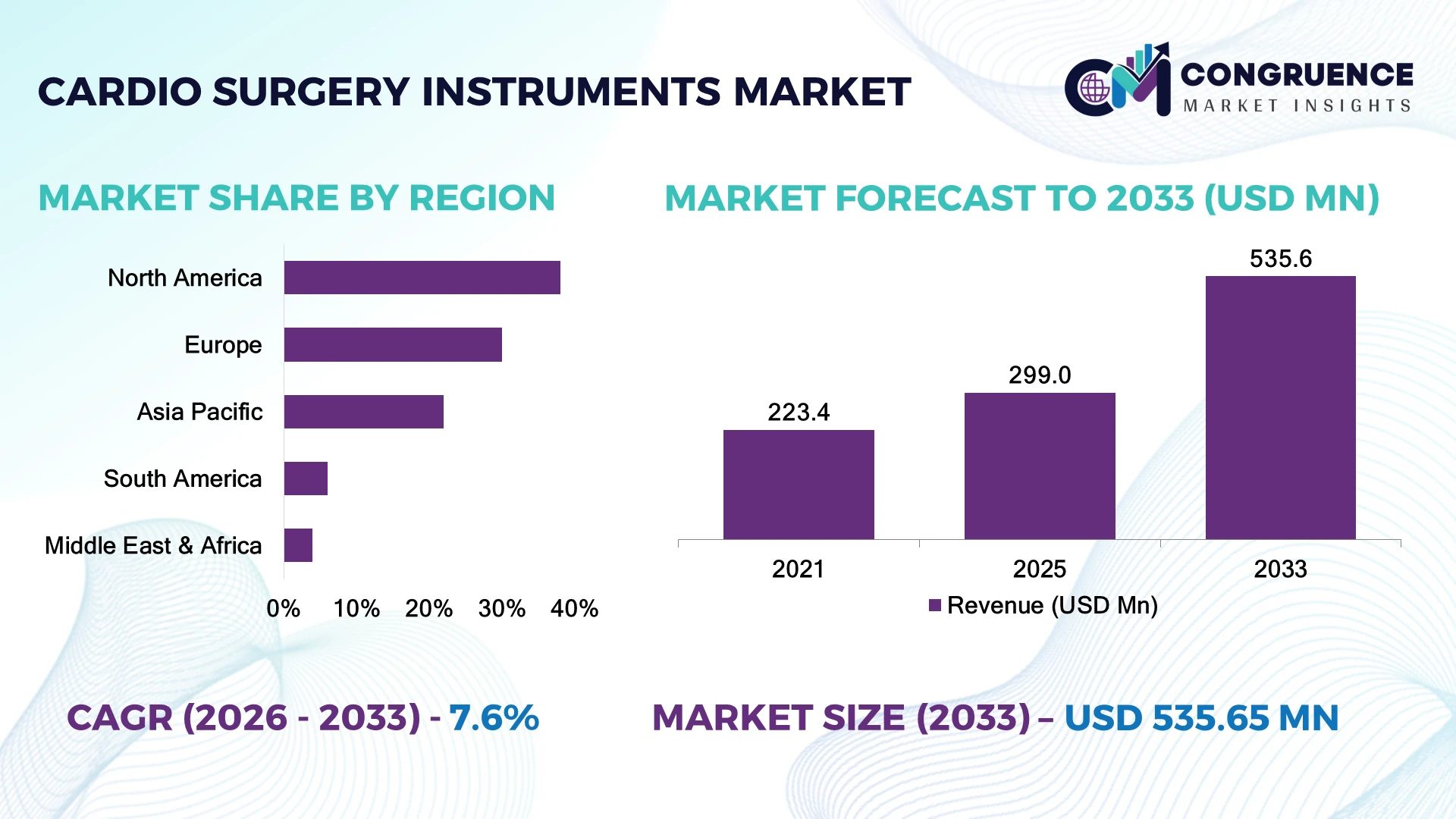
The United States dominates the market with approximately 38% share, supported by advanced cardiac care infrastructure, high procedure volumes, and strong adoption of robotic-assisted surgical platforms. The country performs over 900,000 cardiovascular procedures annually, while Germany and Japan are expanding investments in hybrid operating rooms and advanced surgical technologies. Compared with Japan’s aging-driven cardiac care demand, the U.S. leads in technology integration and device adoption.
Strategic implication companies prioritizing precision tools, digital integration, and localized manufacturing will strengthen competitive positioning.
Market Size & Growth: The market reaches USD 299.0 Million in 2025 and USD 535.6 Million by 2033, expanding at 7.56% CAGR, driven by minimally invasive cardiac surgery adoption and advanced surgical instrument innovation.
Top Growth Drivers: Minimally invasive procedures (42%), robotic-assisted surgery adoption (35%), and cardiovascular disease burden (30%) are accelerating market expansion.
Short-Term Forecast: By 2028, hospitals are targeting 20% faster surgical workflows and 15% reduction in procedure-related resource utilization through advanced instruments.
Emerging Technologies: AI-assisted surgical navigation, robotic cardiac systems, smart surgical tools, and advanced biomaterial instruments are reshaping operating room capabilities.
Regional Leaders: North America is projected at USD 215 Million with robotic adoption; Europe at USD 145 Million with regulatory-driven modernization; Asia-Pacific at USD 130 Million with hospital infrastructure expansion.
Consumer/End-User Trends: Over 60% of cardiac centers are adopting advanced surgical instruments to improve procedural accuracy and patient outcomes.
Pilot/Case Example: In 2024, robotic cardiac surgery programs reported up to 25% improvement in procedural precision and reduced recovery timelines.
Competitive Landscape: Medtronic leads with approximately 20% share, followed by Johnson & Johnson, Stryker, B. Braun, and Boston Scientific competing through innovation and global expansion.
Regulatory & ESG Impact: Sustainable instrument designs and reusable surgical solutions are reducing medical waste by nearly 30% in advanced healthcare systems.
Investment & Funding: More than USD 1.5 Billion has been directed toward cardiovascular technology partnerships, digital surgery platforms, and manufacturing expansion.
Innovation & Future Outlook: Next-generation cardiac instruments will focus on AI integration, connected operating rooms, and precision-based surgical ecosystems.
Cardio Surgery Instruments Market is witnessing increased demand from cardiovascular hospitals, specialty clinics, and hybrid operating centers. Advanced forceps, retractors, cannulas, and minimally invasive tools are gaining adoption as healthcare systems prioritize surgical precision. Around 35% of cardiac facilities are integrating digital-assisted surgical technologies, while regulatory reforms in the U.S. and Europe are encouraging advanced device validation and supply-chain resilience. These shifts create a foundation for strategic technology investments and competitive differentiation.
The Cardio Surgery Instruments Market is becoming strategically important as healthcare providers shift toward precision-driven cardiac procedures, advanced operating room infrastructure, and digitally connected surgical environments. Rising cardiovascular procedure complexity is encouraging hospitals to upgrade from conventional instruments to integrated surgical platforms. Supply-chain restructuring after global disruptions has increased focus on regional manufacturing, supplier diversification, and inventory resilience.
Advanced robotic-assisted and digitally guided surgical instruments improve workflow efficiency compared with traditional manual systems, reducing procedure variability by nearly 20% while improving surgeon control. The United States leads in technology deployment, while China and India are expanding cardiac infrastructure through hospital modernization programs and medical device investments.
Over the next 2–3 years, adoption of AI-enabled surgical assistance, smart instrumentation, and minimally invasive procedures will increase across specialty cardiac centers. Companies are strengthening partnerships with hospitals, investing in R&D facilities, and expanding production capabilities to address localized demand. Strategic success will depend on combining technological innovation, regulatory compliance, and operational agility to maintain long-term market relevance.
The primary growth driver is the rapid transition toward minimally invasive and precision-based cardiac procedures. Minimally invasive techniques account for nearly 40% of advanced cardiac interventions, while robotic-assisted systems improve surgical accuracy by approximately 25%. Increasing cardiovascular disease cases in countries such as the U.S. and China are pushing hospitals to invest in advanced surgical instruments. Companies are responding through R&D expansion, partnerships with cardiac centers, and development of ergonomic instruments with improved visualization capabilities. The shift toward hybrid operating rooms is creating demand for integrated surgical tools and strengthening manufacturers’ focus on digital compatibility and procedural efficiency.
High acquisition costs and complex regulatory requirements remain major limitations for wider adoption of advanced cardio surgery instruments. Premium surgical systems can increase hospital equipment expenses by 20–30%, particularly in emerging healthcare markets. Dependence on specialized components and international supply networks creates procurement challenges during logistics disruptions. Countries such as India and Brazil face infrastructure gaps that limit access to advanced cardiac technologies outside major cities. Manufacturers are reducing risks through regional production facilities, supplier diversification, and long-term procurement agreements to improve affordability and stabilize availability.
Digital transformation in cardiac surgery creates significant opportunities through AI-assisted tools, connected instruments, and automated surgical workflows. AI-based surgical support systems are improving decision accuracy by nearly 30%, while smart instrument tracking reduces operational inefficiencies by around 20%. Emerging markets including India, Southeast Asia, and the Middle East are expanding cardiac care infrastructure through public-private healthcare investments. Companies are positioning through technology partnerships, localized manufacturing, and ecosystem development to capture demand from hospitals seeking cost-efficient and advanced surgical solutions.
The market faces execution challenges related to technology integration, surgeon training, and cybersecurity requirements for connected surgical platforms. Approximately 25% of healthcare facilities report difficulties implementing advanced digital surgical systems due to infrastructure limitations and workforce readiness gaps. Increasing dependence on connected devices introduces cybersecurity pressures for hospitals managing sensitive surgical data. Companies must invest in training programs, secure software development, and collaborative partnerships with healthcare institutions to ensure consistent deployment. Long-term competitiveness will depend on solving operational complexity while maintaining reliability across diverse healthcare environments.
Robotic Surgery Expansion: Cardiac centers in the U.S. and Germany are increasing robotic-assisted procedure adoption, with advanced systems improving surgical precision by nearly 20% and reducing workflow variability by 15%. Companies are scaling partnerships with hospitals and integrating robotic-compatible instruments to capture demand from high-complexity cardiac procedures.
Smart Instrument Integration: Digital tracking, connected surgical tools, and AI-assisted workflow systems are gaining adoption, with approximately 30% of advanced cardiac facilities implementing smart operating room technologies. Manufacturers are investing in automation and data-enabled platforms to improve inventory control, reduce delays, and strengthen hospital efficiency.
Localized Supply Networks: Global supply-chain restructuring is driving manufacturers to expand regional production, especially in India, Japan, and the U.S., where localized sourcing initiatives have reduced component dependency by nearly 25%. Companies are building strategic supplier networks to improve delivery reliability and manage regulatory requirements.
Advanced Minimally Invasive Tools: Hospitals are shifting toward smaller, precision-based instruments as minimally invasive cardiac procedures increase by more than 35% in specialized centers. Companies are responding through ergonomic designs, advanced materials, and surgeon-focused innovation to improve recovery outcomes and procedural speed.
Surgical instruments represent the leading type segment, accounting for approximately 45% of the market due to their broad use across cardiac procedures, operational reliability, and integration with modern surgical workflows. Cardiac clamps, forceps, scissors, and retractors remain essential across hospitals, while specialized minimally invasive instruments are gaining traction. The fastest-growing segment is minimally invasive cardiac instruments, supported by increasing adoption of precision procedures and demand for reduced patient recovery time. Traditional instruments maintain strong demand because of cost advantages and established clinical familiarity, while advanced robotic-compatible and digitally enabled tools are reshaping investment priorities. Approximately 30% of leading cardiac centers are upgrading instrument portfolios toward technology-enhanced solutions. Companies are responding through product innovation, surgeon partnerships, and expansion of specialized cardiac instrument lines.
Coronary artery bypass grafting (CABG) procedures represent the leading application segment with nearly 40% market share, driven by high procedure volumes and continued demand for reliable cardiac surgical tools. Valve repair and replacement procedures are emerging as the fastest-growing application due to increasing adoption of minimally invasive valve technologies and improved diagnostic capabilities. Congenital heart surgery and other cardiac interventions continue to support demand, particularly in specialized pediatric and tertiary care centers. More than 35% of advanced cardiac facilities are expanding minimally invasive capabilities, creating demand for specialized instruments with improved control and visualization. Companies are adapting through application-specific product development, clinical collaborations, and expanded hospital deployment programs.
Hospitals represent the dominant end-user segment with approximately 55% market share due to higher cardiac procedure volumes, advanced infrastructure availability, and continuous demand for specialized surgical instruments. Large multispecialty hospitals and cardiac institutes account for the majority of high-value instrument adoption because of their extensive operating room requirements. Ambulatory surgical centers and specialty cardiac clinics are the fastest-growing end-user groups, supported by outpatient procedure expansion and increasing preference for efficient surgical pathways. Around 25% of emerging cardiac facilities are investing in compact and cost-efficient surgical setups. Companies are targeting these buyers through customized product portfolios, service agreements, and regional partnerships.
North America accounted for the largest market share at 38% in 2025 however, Asia-Pacific is expected to register the fastest growth, expanding at a CAGR of 9.2% between 2026 and 2033.
North America held the dominant position with approximately 38% market share in 2025, supported by advanced cardiac care infrastructure, high surgical volumes, and strong adoption of minimally invasive technologies. The U.S. contributes the majority of regional demand due to extensive hospital networks, specialized cardiac centers, and rapid integration of robotic-assisted surgical platforms. More than 60% of leading cardiac hospitals in the region have adopted advanced surgical technologies to improve procedural efficiency. Companies are strengthening their presence through hospital partnerships, product innovation, and localized supply-chain expansion to support growing demand for precision instruments.
United States Market Outlook: The United States remains the key country due to its advanced healthcare ecosystem, high cardiac procedure volumes, and strong medical device innovation base. The country performs over 900,000 cardiovascular procedures annually, driving demand for specialized instruments, minimally invasive tools, and digitally integrated surgical systems. Manufacturers are expanding production capabilities and collaborating with healthcare providers to enhance technology adoption.
Europe accounted for approximately 30% of the global market share in 2025, supported by strong healthcare infrastructure, advanced medical device regulations, and increasing modernization of cardiac surgery facilities. Germany, France, and the United Kingdom represent major demand centers due to established cardiac hospitals and high adoption of minimally invasive procedures. Around 45% of European cardiac centers are upgrading operating rooms with advanced visualization and precision surgical technologies. Sustainability initiatives and stricter medical device compliance standards are encouraging manufacturers to develop reusable instruments and efficient production systems.
Germany Market Outlook: Germany leads the European market due to its advanced healthcare infrastructure, strong medical technology manufacturing base, and high adoption of surgical innovations. More than 70% of major German hospitals operate specialized cardiac departments, supporting demand for high-performance instruments. Companies are investing in local partnerships and technology development to strengthen their position in the country’s competitive medical device sector.
Asia-Pacific represented approximately 22% of the market share in 2025 and is emerging as the fastest-expanding market due to healthcare infrastructure development, rising cardiac procedures, and increasing medical technology investments. China, India, Japan, and South Korea are driving regional adoption through hospital expansion and advanced surgical facility development. The region is witnessing rapid growth in minimally invasive cardiac procedures, with adoption increasing by nearly 35% across leading urban hospitals. Companies are expanding manufacturing networks, forming healthcare partnerships, and developing cost-efficient instruments to address diverse healthcare requirements.
China Market Outlook: China is the largest contributor within Asia-Pacific due to its expanding hospital infrastructure, medical device manufacturing capabilities, and government-supported healthcare modernization programs. The country has more than 30,000 hospitals, creating substantial demand for cardiac surgical equipment. Manufacturers are increasing domestic production and improving distribution networks to support wider adoption of advanced surgical instruments.
South America accounted for approximately 6% of the global market share in 2025, supported by improving healthcare infrastructure and rising investments in specialized cardiac facilities. Brazil and Argentina represent the largest demand centers due to increasing cardiovascular disease management programs and hospital modernization initiatives. Public and private healthcare providers are expanding access to advanced cardiac procedures, although technology availability remains concentrated in major urban hospitals. Nearly 25% of leading cardiac centers are upgrading surgical equipment portfolios to improve procedural capabilities. Companies are focusing on distributor partnerships, localized support networks, and affordable instrument solutions.
Brazil Market Outlook: Brazil dominates the South American market due to its large healthcare system, growing cardiac treatment capacity, and increasing investment in specialized hospitals. The country has more than 6,000 hospitals, creating significant opportunities for surgical instrument suppliers. Companies are strengthening local partnerships and expanding service networks to improve access to advanced cardiac technologies.
Middle East & Africa accounted for approximately 4% of the global market share in 2025, supported by healthcare modernization programs, private hospital expansion, and increasing investment in specialized medical facilities. Countries such as Saudi Arabia, the United Arab Emirates, and South Africa are leading adoption through advanced cardiac centers and technology-focused healthcare initiatives. More than 20% of major hospitals in Gulf countries are upgrading surgical infrastructure with advanced equipment. Companies are targeting the region through strategic partnerships, infrastructure projects, and customized product offerings to address evolving healthcare needs.
Saudi Arabia Market Outlook: Saudi Arabia represents the leading market within the region due to healthcare transformation programs, investment in specialized hospitals, and adoption of advanced surgical technologies. The country is expanding cardiac care capacity through new medical facilities and modernization projects. Manufacturers are increasing partnerships with healthcare providers to support deployment of advanced cardiac surgery instruments.
The Cardio Surgery Instruments Market features competition between global medical device leaders such as Medtronic, Johnson & Johnson MedTech, Abbott, and Boston Scientific, alongside specialized cardiovascular instrument manufacturers including Terumo, LivaNova, and Getinge. Global OEMs compete with regional suppliers through advanced technology integration, pricing strategies, supply reliability, and customized surgical solutions. The top five companies account for approximately 55% of the market, reflecting a moderately consolidated competitive structure. Players differentiate through robotic compatibility, minimally invasive instrument design, clinical support, and manufacturing efficiency, with advanced systems improving workflow efficiency by nearly 20% and reducing procedural preparation time by around 15%. Companies are expanding through strategic hospital partnerships, regional production facilities, product innovation, and integrated surgical platforms. The market is shifting toward digitally connected instruments and precision-based solutions. Regulatory approvals, clinical validation requirements, and specialized manufacturing capabilities remain major entry barriers. Success depends on technology leadership, supply-chain resilience, and strong healthcare partnerships.
Johnson & Johnson MedTech
Abbott
Terumo Corporation
LivaNova PLC
Boston Scientific Corporation
Stryker Corporation
B. Braun Melsungen AG
Edwards Lifesciences Corporation
Getinge AB
CONMED Corporation
Aesculap AG
Scanlan International
Artificial intelligence, robotic-assisted surgery, and connected operating room technologies are transforming cardio surgery instrument capabilities. AI-supported surgical systems improve procedural planning and decision accuracy by nearly 20%, while robotic platforms enhance precision and reduce manual variability by approximately 15%. Hospitals in the United States, Japan, and Germany are increasingly integrating digital surgical ecosystems, encouraging companies to develop software-enabled instruments and data-driven platforms.
Minimally invasive instruments and advanced biomaterial-based tools are replacing conventional surgical equipment through improved ergonomics, smaller access requirements, and enhanced procedural control. Compared with traditional instruments, next-generation precision systems improve workflow efficiency by around 25% and reduce preparation time by approximately 10%. Adoption is increasing across specialized cardiac centers seeking shorter recovery pathways and improved operating room utilization.
Between 2026 and 2028, AI-assisted surgical planning, automation, and connected device platforms will become major competitive differentiators. Technology-focused companies will benefit from hospital collaborations and ecosystem partnerships, while cost-focused manufacturers will compete through simplified designs and localized production. Early investment in digital integration will strengthen operational advantage and long-term market positioning.
June 2025 Johnson & Johnson MedTech launched the ETHICON™ 4000 Stapler with 3D Stapling Technology and enhanced Gripping Surface Technology to improve tissue management in surgical procedures. The system demonstrated a 23% reduction in staple-line interventions related to bleeding compared with traditional stapling technologies, strengthening minimally invasive surgery capabilities. Source: www.jnjmedtech.com
January 2025 Abbott introduced Navitor™ Vision in India, expanding its structural heart portfolio with an enhanced transcatheter aortic valve implantation technology. The system includes three radiopaque markers for improved valve positioning visibility during deployment and supports valve sizes from 19 mm to 27 mm, improving access to minimally invasive cardiac procedures. Source: www.abbott.com
March 2025 Medtronic released new clinical evidence for its Evolut™ TAVR system, highlighting five-year outcomes from the Evolut Low Risk Trial in low-risk aortic stenosis patients. The findings reinforced long-term valve performance and supported expansion of transcatheter cardiac treatment approaches over traditional surgical pathways. Source: www.news.medtronic.com
April 2026 Johnson & Johnson received CE Mark approval for the ETHICON™ 4000 Stapler, expanding availability across European Union markets. The technology supports open and laparoscopic procedures across multiple specialties and is planned for future integration with the OTTAVA™ robotic surgical system, strengthening robotic surgery readiness.
The report covers the Cardio Surgery Instruments Market across key product types, applications, end-users, and global regions. The segmentation framework analyzes surgical instruments, minimally invasive tools, advanced cardiac devices, coronary procedures, valve surgeries, hospitals, specialty cardiac centers, and emerging healthcare facilities. Regional coverage includes North America, Europe, Asia-Pacific, South America, and Middle East & Africa, focusing on adoption patterns, healthcare infrastructure development, manufacturing activity, and technology deployment.
The study evaluates AI-enabled surgical systems, robotic-assisted platforms, advanced materials, connected operating room solutions, and precision-based instrument innovations shaping market transformation. It provides strategic insights into competitive positioning, investment priorities, expansion opportunities, partnership models, and evolving procurement strategies. The report supports manufacturers, healthcare providers, investors, and technology companies in identifying high-potential segments, operational shifts, and market opportunities influencing industry direction between 2026 and 2033.
| Report Attribute / Metric | Details |
|---|---|
| Market Revenue (2025) | USD 299.0 Million |
| Market Revenue (2033) | USD 535.6 Million |
| CAGR (2026–2033) | 7.56% |
| Base Year | 2025 |
| Forecast Period | 2026–2033 |
| Historic Period | 2021–2025 |
| Segments Covered |
By Type
By Application
By End-User
|
| Key Deliverables | Revenue Forecast; Market Trends; Growth Drivers & Restraints; Technology Insights; Segmentation Analysis; Regional Insights; Competitive Landscape; Regulatory & ESG Overview; Recent Developments |
| Regions Covered | North America; Europe; Asia-Pacific; South America; Middle East & Africa |
| Companies Profiled | Medtronic; Johnson & Johnson MedTech; Abbott; Terumo Corporation; LivaNova PLC; Boston Scientific Corporation; Stryker Corporation; B. Braun Melsungen AG; Edwards Lifesciences Corporation; Getinge AB; CONMED Corporation; Aesculap AG; Scanlan International |
| Customization & Pricing | Available on Request (10% Customization Free) |




