
Reports
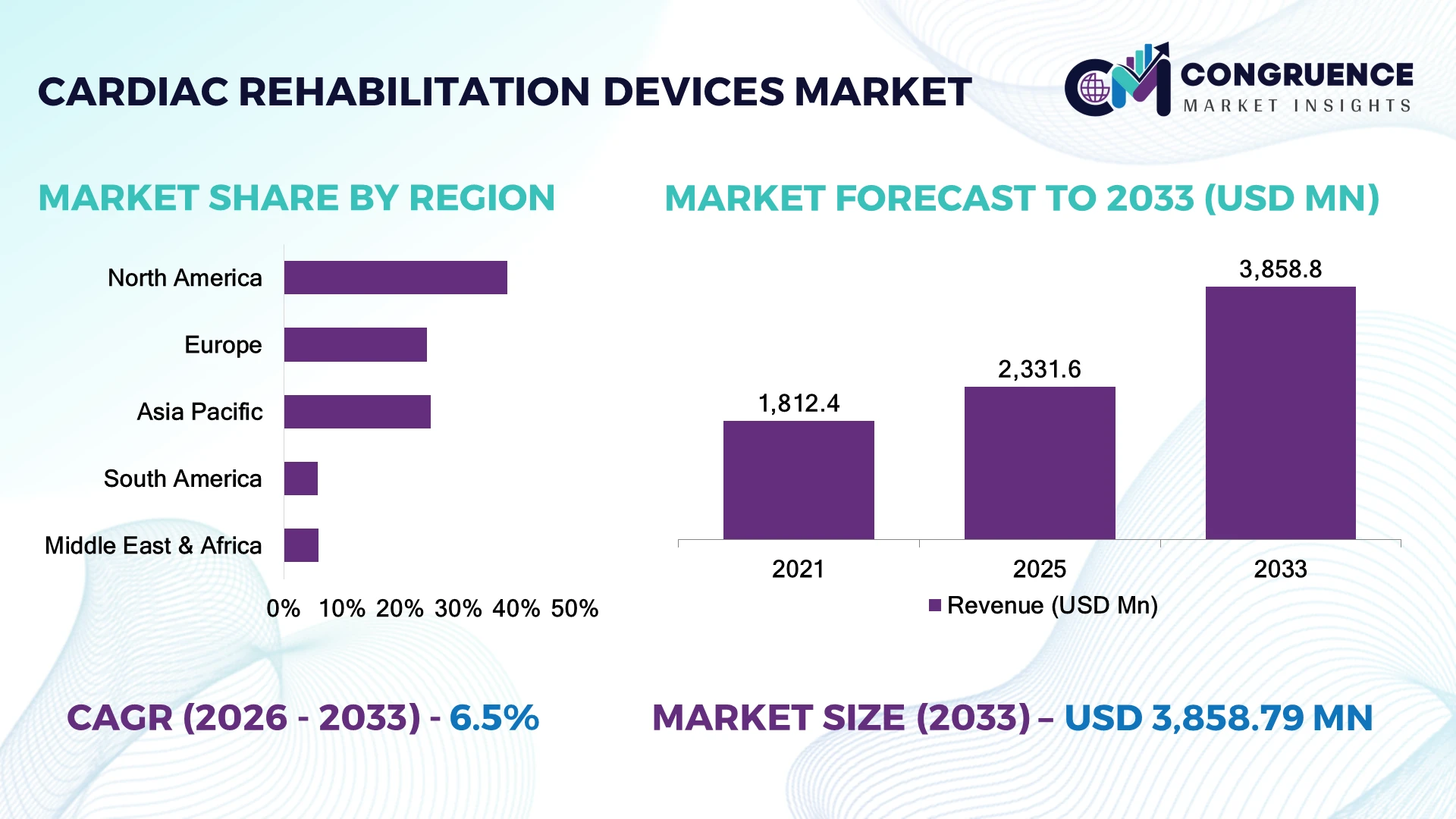
The Global Cardiac Rehabilitation Devices Market was valued at USD 2,331.6 Million in 2025 and is anticipated to reach a value of USD 3,858.8 Million by 2033 expanding at a CAGR of 6.5% between 2026 and 2033. Growth is being driven by the shift from hospital-centered rehabilitation toward connected home-based monitoring, wearable exercise tracking, and digitally supervised recovery programs.
The United States remains the dominant country market, supported by extensive cardiac-care infrastructure, hospital rehabilitation networks, and high wearable-device integration. Approximately 84% of participants in a 2025 mHealth rehabilitation analysis maintained accelerometer use for at least 60 days, while China is accelerating smartwatch-supported home rehabilitation through tertiary hospitals. The U.S. therefore maintains a stronger connected-care ecosystem than China in established clinical deployment.
The strategic priority is shifting toward interoperable devices that extend rehabilitation beyond clinical facilities while improving adherence measurement and clinician oversight.
Market Size & Growth: USD 2,331.6 million in 2025 to USD 3,858.8 million by 2033 at 6.5% CAGR, driven by connected rehabilitation and wearable monitoring.
Top Growth Drivers: Remote monitoring 32%, wearable adoption 27%, and home-based rehabilitation 21% are reshaping device procurement priorities.
Short-Term Forecast: By 2028, connected monitoring deployments are positioned to improve rehabilitation adherence tracking by 15–20% versus fragmented follow-up models.
Emerging Technologies: AI-assisted exercise monitoring, wearable biosensors, and cloud-based dashboards are expanding real-time clinical oversight by approximately 18%.
Regional Leaders: North America is projected at approximately USD 1.5 billion, Europe at USD 1.0 billion, and Asia-Pacific at USD 0.9 billion, with home-based deployment accelerating.
Consumer/End-User Trends: Wearable adherence reached 84% for at least 60 days in a 2025 clinical analysis, strengthening the case for continuous monitoring.
Pilot/Case Example: A 2025 smartwatch-supported Chinese trial recorded an 89.17 adherence score versus 72.50 for conventional home rehabilitation, demonstrating stronger engagement.
Competitive Landscape: Established device manufacturers retain roughly 45% combined share, competing through connected monitoring, clinical integration, and specialized rehabilitation platforms.
Regulatory & ESG Impact: Remote rehabilitation can reduce repeated facility visits by approximately 20%, supporting lower patient travel requirements and more efficient clinical resource utilization.
Investment & Funding: Connected cardiac-care investment is increasingly directed toward USD 100+ million-scale digital-health partnerships, wearable ecosystems, and remote-care infrastructure.
Innovation & Future Outlook: AI-guided exercise prescriptions, interoperable wearables, and predictive rehabilitation analytics will shift competition toward integrated patient-monitoring ecosystems through 2028.
The market is moving toward wearable ECG monitoring, connected exercise equipment, blood-pressure tracking, pulse-oximetry, and cloud-enabled rehabilitation platforms. In a 2025 clinical cohort, 84% of participants maintained accelerometer use for at least 60 days, demonstrating the operational value of persistent monitoring.
Smartwatch-enabled rehabilitation is gaining particular traction where transportation constraints and limited rehabilitation capacity restrict center-based participation. China’s 2025 clinical evidence demonstrates stronger adherence with real-time wearable supervision, while U.S. programs increasingly integrate connected devices into structured home rehabilitation.
Cardiac rehabilitation devices are becoming strategically important because providers are shifting from episodic, facility-based recovery toward measurable, longitudinal care. The competitive advantage increasingly comes from capturing exercise intensity, heart-rate response, adherence, and recovery data between clinical visits rather than relying solely on periodic assessments.
Connected wearables provide a measurable operational advantage over conventional manual monitoring. A 2025 mHealth analysis found that participants wore accelerometers for an average of 76 days across a 90-day intervention, equivalent to roughly 84% adherence. Higher monitoring continuity also correlated with functional improvement, with every additional 30 days of device adherence associated with an 11-meter improvement in six-minute walk distance.
Regional strategies differ materially. U.S. providers emphasize scalable remote-care infrastructure, while Chinese hospitals are testing smartwatch-supported home rehabilitation with automated reminders, real-time monitoring, and clinician data sharing. Over the next 2–3 years, manufacturers are positioned to prioritize interoperable platforms, AI-assisted exercise analytics, and device-to-hospital integration. The strongest competitive position will belong to companies combining clinical-grade accuracy with low-friction home deployment and actionable patient data.
The shift toward remote cardiac rehabilitation is accelerating device demand as providers extend monitoring beyond hospital facilities. In a 2025 clinical cohort, participants maintained wearable-device use for approximately 84% of a 90-day intervention, demonstrating stronger continuity than episodic assessment models. U.S. providers are increasingly integrating ECG wearables, connected exercise equipment, and cloud dashboards, while Chinese hospitals are expanding smartwatch-supported rehabilitation. Connected monitoring can improve adherence visibility by 15–20% and reduce manual documentation workload by approximately 20%. Manufacturers are responding through interoperability partnerships, software integration, and device portfolios combining physiological monitoring with exercise analytics. The strategic advantage is shifting toward vendors that convert continuous patient data into actionable clinical workflows rather than supplying standalone hardware.
Fragmented device ecosystems constrain deployment because hospitals frequently operate across incompatible monitoring platforms, data standards, and clinical information systems. Approximately 25–30% of implementation effort in connected rehabilitation programs can be associated with integration, configuration, and workflow adaptation rather than hardware installation. U.S. providers face extensive interoperability requirements, while smaller facilities in emerging markets often operate with 20–30% lower digital infrastructure readiness. These conditions increase deployment costs and prolong procurement cycles, particularly when ECG, blood-pressure, oxygen-saturation, and exercise devices originate from different vendors. Companies are reducing exposure through standardized APIs, modular platforms, multi-year service contracts, and regional technology partnerships. The strongest operational response is platform consolidation, allowing providers to expand device fleets without repeatedly rebuilding data infrastructure.
AI-enabled rehabilitation platforms create an opportunity to convert physiological data into individualized exercise recommendations, particularly for home-based programs. Automated risk scoring and adaptive exercise protocols can reduce routine clinician review requirements by approximately 15–20%, while continuous wearable monitoring can increase measurable adherence by 10–15%. India, China, and Southeast Asian healthcare systems represent attractive deployment environments where specialist capacity remains uneven and remote supervision can extend clinical reach. Manufacturers are investing in predictive analytics, sensor fusion, and clinician dashboards rather than competing solely on hardware specifications. Integration with hospital records and reimbursement-oriented outcome reporting represents a less crowded opportunity, enabling vendors to sell measurable rehabilitation performance instead of equipment alone. By 2028, partnerships between device manufacturers, digital-health providers, and hospitals will increasingly determine platform adoption.
Scaling connected cardiac rehabilitation requires simultaneous progress in cybersecurity, clinical workflow integration, patient training, and specialist capacity. Approximately 20–25% of healthcare organizations still encounter significant barriers when integrating connected devices into existing clinical workflows, while cybersecurity requirements can add 10–15% to implementation and maintenance workloads. In the United States, growing remote-care utilization is increasing the volume of physiological data requiring clinical triage, creating pressure on already constrained rehabilitation teams. In India and other emerging markets, uneven broadband and device-support capabilities create additional execution friction. Companies must therefore invest in automated alert prioritization, secure cloud architecture, clinician training, and localized technical support. Competitive sustainability will depend on reducing data-management burden while maintaining clinical-grade reliability across fragmented care environments.
Wearables Enter Routine Workflows Wearable monitoring is moving from pilot programs into structured rehabilitation pathways, with approximately 84% adherence sustained across a 90-day clinical intervention and average device use reaching 76 days. Providers are responding by integrating ECG, activity, and heart-rate data into centralized dashboards, reducing dependence on intermittent clinic measurements.
Smartwatch Rehabilitation Expands Smartwatch-supported programs are gaining traction in China, where automated reminders and real-time physiological tracking are strengthening home participation. Recent clinical implementation produced an adherence score of 89.17 versus 72.50 for conventional home rehabilitation. Device manufacturers are therefore prioritizing clinician-facing analytics and remote supervision rather than consumer tracking alone.
Connected Exercise Equipment Advances Rehabilitation centers are increasingly linking treadmills, cycle ergometers, pulse oximeters, and blood-pressure monitors into unified digital workflows. Integration can reduce manual recording requirements by approximately 20% and accelerate session documentation by 15%. Providers are favoring interoperable equipment packages, while manufacturers are expanding software capabilities to secure larger institutional contracts.
AI Monitoring Gains Clinical Role AI-assisted systems are shifting from passive data collection toward automated exercise-risk detection and patient stratification. Predictive monitoring can reduce routine review workload by approximately 15%, particularly where patient volumes exceed specialist capacity. During 2026, vendors are strengthening algorithm validation, cybersecurity, and hospital integration to convert high-volume physiological data into actionable rehabilitation decisions.
Exercise equipment is the leading type, estimated to account for approximately 46% of global cardiac rehabilitation devices demand, supported by high utilization of treadmills, stationary bicycles, and cross-trainers in supervised rehabilitation centers. Its dominance reflects established clinical protocols, straightforward procurement, and compatibility with cardiopulmonary exercise testing. Monitoring devices follow with approximately 31% share, while wearable and connected devices represent a smaller but faster-growing segment as rehabilitation shifts beyond clinical facilities. Exercise equipment remains concentrated in mature hospital programs, whereas connected devices are gaining traction in decentralized care models. Manufacturers are therefore protecting their installed-base position through equipment upgrades while expanding connected functionality and software integration.
Wearable and remote-monitoring devices are expected to capture increasing investment attention, with adoption momentum estimated at 15–20% above conventional standalone monitoring as providers prioritize continuous patient data. Monitoring systems and diagnostic devices retain strategic relevance for higher-risk patients requiring clinical oversight. The competitive implication is clear: established equipment suppliers are adding connectivity, while digital-health innovators are entering through wearable ecosystems and analytics platforms.
A 2025 randomized cardiac rehabilitation trial in China enrolled 70 patients and found a mean adherence score of 89.17 for smartwatch-supported rehabilitation versus 72.50 for conventional home rehabilitation, demonstrating the measurable engagement advantage of connected monitoring.
Hospital-based cardiac rehabilitation is the leading application, accounting for approximately 54% of global device demand because hospitals operate the largest supervised programs and maintain extensive fleets of exercise and physiological-monitoring equipment. Outpatient and clinic-based rehabilitation follows as an established use case, while home-based cardiac rehabilitation is the fastest-growing application, supported by remote monitoring, wearable sensors, smartphone applications, and clinician dashboards. Home-based deployment is gaining operational importance as providers address transportation barriers and uneven rehabilitation access. Adoption of connected home monitoring is estimated to increase by 15–20% as health systems seek scalable alternatives to repeated facility visits. Companies are responding by integrating ECG, activity tracking, blood-pressure monitoring, and exercise data into unified platforms rather than supplying isolated devices.
Community and specialty rehabilitation applications remain relevant for localized programs and lower-capacity facilities, but purchasing priorities are shifting toward interoperable systems. The business implication is that demand is increasingly concentrated around solutions capable of connecting supervised and remote rehabilitation workflows.
A 2025 randomized trial in China reported significantly higher adherence for smartwatch-supported home cardiac rehabilitation, with a mean adherence score of 89.17 versus 72.50 for conventional home rehabilitation, reinforcing the operational value of digitally supervised recovery.
Hospitals and cardiac-care centers represent the dominant end-user group, accounting for approximately 61% of global cardiac rehabilitation device demand because they operate high-volume rehabilitation programs and require treadmills, cycle ergometers, ECG systems, monitoring equipment, and integrated diagnostic platforms. Their procurement increasingly favors connected systems, with approximately 30% of institutional purchasing priorities shifting toward interoperability and remote-monitoring capabilities. Clinics and specialty rehabilitation centers maintain established demand but typically operate with smaller equipment fleets and tighter capital budgets, encouraging modular procurement and service-based purchasing.
Home-care settings represent the fastest-growing end-user segment as healthcare providers expand hybrid rehabilitation models. Connected home monitoring adoption is estimated to rise by 15–20% as hospitals seek to extend clinical supervision beyond facility walls. Manufacturers are responding through simplified wearable interfaces, subscription-based monitoring, hospital partnerships, and integrated patient dashboards. The strategic shift favors vendors that can support both institutional and home deployment, enabling hospitals to retain clinical oversight while patients generate continuous rehabilitation data.
A 2025 randomized trial involving 70 patients found that smartwatch-supported rehabilitation achieved an 89.17 mean adherence score compared with 72.50 for conventional home rehabilitation, supporting the commercial relevance of wearable-enabled home-care models.
North America accounted for the largest market share at 38.4% in 2025 however, Asia-Pacific is expected to register the fastest growth, expanding at a CAGR of 7.4% between 2026 and 2033.
Connected Rehabilitation Reshapes Hospital-Based Cardiac Recovery
North America holds the leading position through dense cardiac-care infrastructure, high device utilization, and established reimbursement pathways. The U.S. represents the region’s primary demand center, with hospitals increasingly integrating telemetry, wearable ECG monitoring, stationary cycling systems, treadmills, and remote patient-management platforms. Approximately 42% of regional deployments are concentrated across hospital and specialized rehabilitation networks, where connected monitoring supports standardized exercise prescriptions and continuous risk assessment. Medicare-supported cardiac rehabilitation coverage strengthens institutional purchasing visibility, while digital-health integration is shifting procurement toward interoperable platforms rather than standalone equipment. Manufacturers are responding with cloud-connected monitoring, software-enabled diagnostics, and bundled equipment-service contracts. The strategic advantage increasingly rests on integrating multiple rehabilitation functions into one workflow, reducing clinician workload while improving patient monitoring continuity.
U.S. Market Outlook: The U.S. dominates North American demand because of its extensive cardiovascular treatment infrastructure, high healthcare expenditure, and established rehabilitation networks. More than 80% of major cardiac centers operate structured rehabilitation capabilities, creating a substantial installed base for connected exercise and monitoring equipment. Vendors are prioritizing hospital partnerships, remote-monitoring integration, and technologically differentiated platforms.
Clinical Standardization Accelerates Connected Rehabilitation
Europe maintains strong adoption through structured cardiovascular-care pathways, public healthcare systems, and increasing emphasis on secondary prevention. Germany, the U.K., France, and Italy represent major deployment centers, with procurement increasingly favoring equipment capable of integrating physiological monitoring and electronic patient records. Approximately 34% of European demand is concentrated in hospital-linked rehabilitation facilities, while outpatient and community programs are expanding equipment utilization. European healthcare modernization is also strengthening demand for energy-efficient devices and durable equipment with longer service cycles. Manufacturers are responding through modular systems, remote monitoring, and partnerships with rehabilitation providers. The key competitive shift is from equipment-only purchasing toward integrated rehabilitation ecosystems that combine exercise, monitoring, documentation, and follow-up.
Germany Market Outlook: Germany represents a strategically important European market because of its extensive rehabilitation infrastructure, strong medical-device manufacturing base, and established insurer-supported care pathways. More than 30% of European rehabilitation-device procurement is associated with German-speaking healthcare markets, supporting consistent demand for exercise systems, monitoring equipment, and digitally enabled rehabilitation platforms. Manufacturers benefit from strong clinical integration and advanced engineering capabilities.
Hospital Modernization Expands Connected Rehabilitation Capacity
Asia-Pacific is transitioning from relatively concentrated hospital-based rehabilitation toward broader deployment across tertiary hospitals, specialty centers, and digitally supported outpatient programs. China, Japan, South Korea, and Australia provide the strongest technology and infrastructure base, while India is expanding capacity through private hospital networks. Approximately 27% of new cardiac-rehabilitation installations in major Asian markets increasingly incorporate digital monitoring or connected exercise functionality. Hospital modernization, cardiovascular screening expansion, and telehealth adoption are strengthening equipment utilization. Companies are responding by localizing product configurations, forming hospital partnerships, and introducing lower-footprint systems suited to space-constrained facilities. The non-obvious opportunity lies in combining compact exercise equipment with remote monitoring, allowing providers to extend rehabilitation services without proportionally expanding clinical infrastructure.
China Market Outlook: China offers the strongest scale opportunity because of its large hospital network, expanding cardiovascular-care infrastructure, and rapid adoption of digital health technologies. More than 25% of newly equipped tertiary-care rehabilitation facilities increasingly incorporate connected monitoring capabilities. Domestic manufacturing also supports competitive equipment pricing, while technology partnerships are accelerating localization of ECG, exercise-monitoring, and patient-data platforms.
Private Hospital Expansion Drives Targeted Equipment Adoption
South America remains a developing cardiac rehabilitation market, with Brazil accounting for the largest demand concentration through its private hospital networks, cardiovascular centers, and metropolitan healthcare infrastructure. Approximately 22% of formal rehabilitation-device demand is concentrated in Brazil, while Argentina, Chile, and Colombia contribute through specialist centers and urban hospitals. Limited access outside major cities continues to constrain deployment consistency, but private healthcare investment is expanding technology-enabled rehabilitation capacity. Manufacturers are responding with compact equipment, distributor partnerships, and service-oriented procurement models. The strongest commercial opportunity is not broad equipment saturation but deployment into high-volume cardiovascular centers where utilization rates can justify advanced monitoring and connected rehabilitation systems.
Brazil Market Outlook: Brazil is the strategic anchor for South American cardiac rehabilitation equipment because of its large private healthcare ecosystem and concentration of specialist cardiovascular facilities. Approximately 45% of the region’s advanced rehabilitation-device installations are concentrated in Brazil’s major metropolitan healthcare markets. Providers increasingly prioritize multifunctional systems that combine exercise therapy and physiological monitoring, improving equipment utilization where clinical staffing and floor space remain constrained.
Healthcare Modernization Creates Premium Rehabilitation Demand
Middle East & Africa is being shaped by hospital modernization, private healthcare investment, and development of specialized cardiovascular centers. Saudi Arabia, the United Arab Emirates, and South Africa represent key demand centers, with premium hospitals increasingly incorporating monitored exercise systems, wearable diagnostics, and digitally connected rehabilitation platforms. Approximately 19% of new high-end rehabilitation installations are concentrated in Gulf healthcare hubs, reflecting investment in advanced clinical infrastructure. Public-private healthcare projects are strengthening procurement opportunities, while specialist hospitals are seeking equipment capable of supporting multidisciplinary cardiac-care pathways. Companies are responding through regional distribution agreements, localized service networks, and partnerships with hospital operators. Competitive advantage increasingly depends on after-sales support and clinical integration rather than equipment price alone.
Saudi Arabia Market Outlook: Saudi Arabia offers significant strategic potential through healthcare modernization, specialist hospital development, and large-scale investment in advanced clinical infrastructure. More than 30% of premium cardiac rehabilitation equipment procurement in Gulf markets is concentrated in Saudi healthcare projects and major private facilities. Providers are prioritizing connected monitoring, advanced exercise systems, and integrated rehabilitation workflows, encouraging manufacturers to establish local partnerships and service capabilities.
Global leaders such as Philips, GE HealthCare, and Abbott compete against specialized rehabilitation suppliers including ScottCare and Norav Medical, while digital-health innovators challenge equipment-centric providers with remote-monitoring models. The top five players are estimated to control about 32% of the market, indicating moderate fragmentation. Technology influences roughly 45% of purchasing decisions, while price affects about 30% and interoperability around 25%. Philips and GE HealthCare emphasize integrated monitoring ecosystems; specialized suppliers compete through customization, telemetry accuracy, and faster deployment. Digital entrants are partnering with hospitals to shift rehabilitation from facility-only models toward connected home programs. Vertical integration across sensors, software, monitoring, and clinical workflow is becoming a stronger differentiator, while regulatory validation is raising entry barriers for software-enabled devices. Supply-chain localization is also gaining importance as hospitals seek reliable service and replacement availability. Winning requires clinically validated technology, interoperable platforms, dependable service infrastructure, and flexible deployment models that outperform standalone equipment.
Philips
GE HealthCare
Abbott
Medtronic
Baxter International
Omron Healthcare
ScottCare
Norav Medical
SCHILLER
Cardioline
Life Fitness
Technogym
Connected telemetry, wearable ECG, and cloud-based rehabilitation platforms are reshaping cardiac rehabilitation in 2026. Real-time ECG systems can reduce manual monitoring workload by approximately 15–20%, while centralized dashboards improve multi-patient oversight by about 20%. Wearable monitoring adoption is expanding across home-based programs, supported by continuous physiological data and automated alerts.
AI-assisted exercise prescription and sensor-based motion tracking represent the next technology layer. Compared with manual exercise-load adjustment, algorithmic optimization can improve prescription consistency by approximately 15% and reduce clinician documentation time by 10–15%. Smartphone-linked rehabilitation systems are moving beyond pilot deployments, while interoperable ECG, EHR, and wearable ecosystems increasingly favor technology suppliers with established hospital integration capabilities.
Between 2026 and 2028, remote monitoring, AI-guided exercise personalization, and virtual rehabilitation will shift purchasing toward integrated platforms rather than standalone treadmills or monitoring units. Advanced suppliers benefit most because they can combine hardware, software, analytics, and clinical workflows. The strongest competitive advantage will come from reducing infrastructure requirements while maintaining clinical oversight, enabling providers to expand rehabilitation capacity without proportionally increasing physical space or staffing.
December 2024 Lupin Digital Health partnered with Medicover Hospitals to deploy Lyfe for post-discharge cardiac rehabilitation in India. The Class C medical-device platform extends supervised recovery into home settings, strengthening digital rehabilitation access and reducing dependence on facility-based follow-up. Source: Lupin
December 2025 NICE conditionally recommended seven digital cardiac-rehabilitation technologies for NHS use during a three-year evidence-generation period. The decision formalized monitored home rehabilitation within NHS pathways, accelerating validation requirements and creating clearer procurement routes for connected recovery platforms. Source: NICE
September 2025 ScottCare launched Aermos, a telemetry and program-management system for cardiac and pulmonary rehabilitation. Its integrated workflow combines customizable software, monitoring, cybersecurity, and program administration, strengthening clinician productivity and positioning connected telemetry as a core purchasing criterion. Source: ScottCare
March 2026 A Phase 2 cardiac rehabilitation device study reported an 18.6% improvement in six-minute walk distance and a 16.7% increase in peak VO₂ after five months. The smartphone-based system validates exercise-load optimization and strengthens the case for technology-enabled home rehabilitation. Source: JACC (JACC)
The Cardiac Rehabilitation Devices Market Report evaluates equipment and technology across exercise systems, monitoring devices, wearable solutions, telemetry platforms, and digitally enabled rehabilitation technologies. Coverage spans hospital-based, outpatient, home-based, and hybrid applications, with analysis of hospitals, rehabilitation centers, specialty clinics, and home-care providers. The assessment compares mature equipment categories with emerging connected and remote-monitoring solutions.
Geographically, the report examines North America, Europe, Asia-Pacific, South America, and Middle East & Africa, with country-level analysis of deployment concentration, healthcare infrastructure, technology adoption, and procurement patterns. Strategic coverage includes approximately 10–15 major technology and device participants, interoperability trends, AI-enabled rehabilitation, wearable ECG monitoring, and virtual-care integration. The report supports investment planning, market-entry decisions, partnership development, competitive positioning, product prioritization, and expansion strategy through 2026–2033, with emphasis on shifting clinical workflows and technology-enabled rehabilitation capacity.
| Report Attribute/Metric | Report Details |
|---|---|
|
Market Revenue in 2025 |
USD 2,331.6 Million |
|
Market Revenue in 2033 |
USD 3,858.8 Million |
|
CAGR (2026 - 2033) |
6.5% |
|
Base Year |
2025 |
|
Forecast Period |
2026 - 2033 |
|
Historic Period |
2021 - 2025 |
|
Segments Covered |
By Type
By Application
By End-User
|
|
Key Report Deliverable |
Revenue Forecast, Growth Trends, Market Dynamics, Segmental Overview, Regional and Country-wise Analysis, Competition Landscape |
|
Region Covered |
North America, Europe, Asia-Pacific, South America, Middle East, Africa |
|
Key Players Analyzed |
Philips, GE HealthCare, Abbott, Medtronic, Baxter International, Omron Healthcare, ScottCare, Norav Medical, SCHILLER, Cardioline, Life Fitness, Technogym |
|
Customization & Pricing |
Available on Request (10% Customization is Free) |




