
Reports
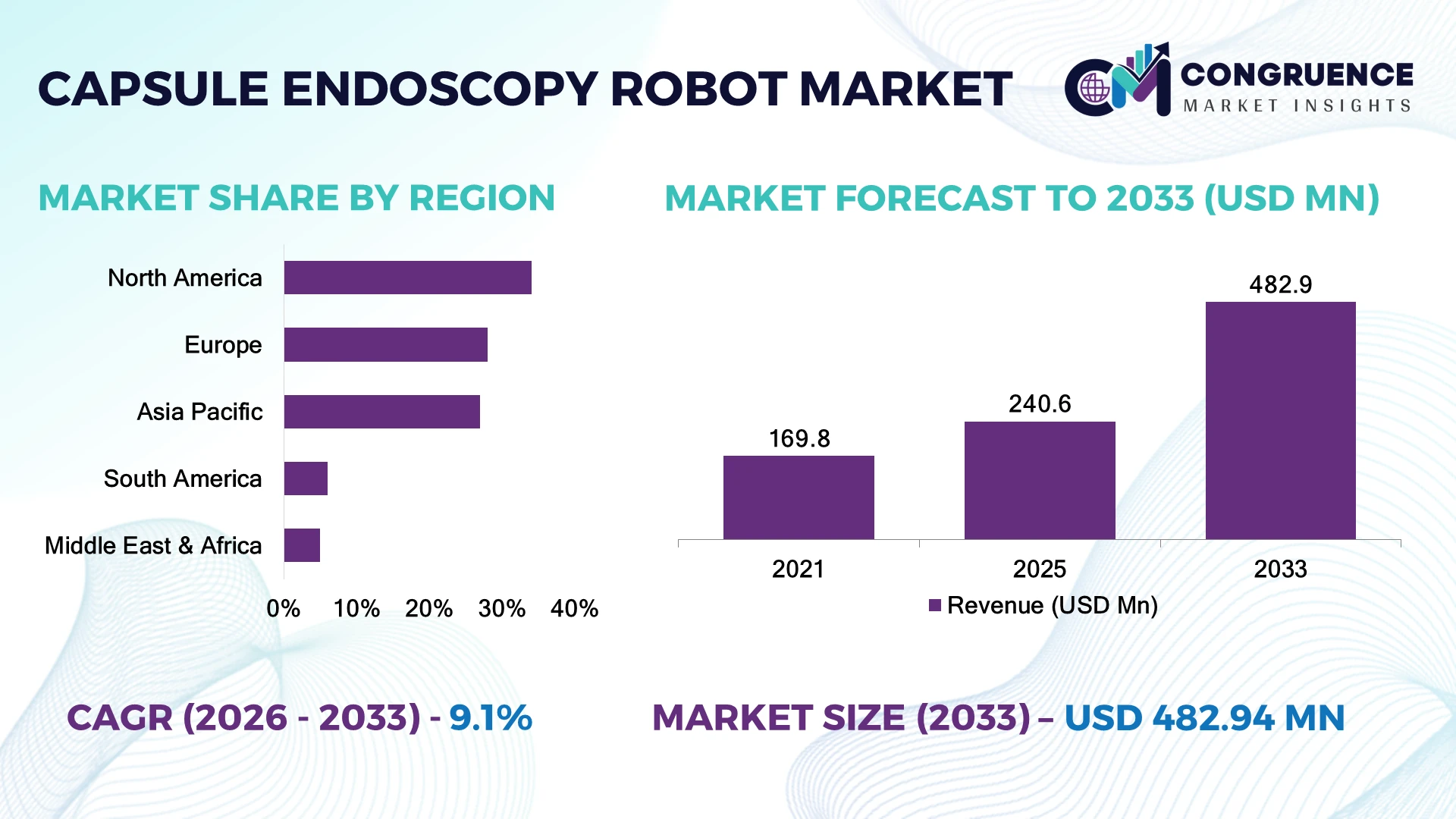
The Global Capsule Endoscopy Robot Market was valued at USD 240.6 Million in 2025 and is anticipated to reach a value of USD 482.9 Million by 2033 expanding at a CAGR of 9.1% between 2026 and 2033. Growth is driven by advances in magnetically controlled capsule navigation, AI-assisted lesion detection, and demand for minimally invasive gastrointestinal examinations that reduce reliance on conventional endoscopic procedures for selected patients.
China is an important development center for magnetically controlled capsule gastroscopy, supported by clinical research and adoption of externally guided capsule systems. A 2026 multicenter randomized study involving 200 patients found that automated quality control reduced the median gastric blind-spot rate from 16.67% to 0% and increased lesion detection from 60.42% to 75.51%. The United States has an established regulatory pathway for magnetically maneuvered capsule systems, while European centers are evaluating robotic capsule endoscopy for combined gastric and small-bowel assessment.
For businesses, the strategic priority is to convert navigation and image-analysis improvements into clinically validated workflows that justify adoption beyond specialist centers.
Market Size & Growth: The market is valued at USD 240.6 million in 2025 and projected to reach USD 482.9 million by 2033, supported by magnetic navigation and AI-assisted gastrointestinal imaging.
Top Growth Drivers: A 2026 clinical study recorded a 15.09-percentage-point increase in lesion detection and a reduction in median blind-spot rate from 16.67% to 0% with automated quality control.
Short-Term Outlook: By 2028, vendors will prioritize navigation accuracy, image completeness, and workflow integration; clinical validation remains essential before assigning universal efficiency targets.
Emerging Technologies: Robotic magnetic steering, AI-based image analysis, and automated examination-quality assessment are improving capsule control and diagnostic consistency.
Regional Positioning: China is active in clinical development, the United States has an established regulatory pathway for magnetically maneuvered capsule systems, and European centers are evaluating combined gastrointestinal applications. Comparable regional revenue estimates are not consistently disclosed.
End-User Trends: Hospitals and specialist gastroenterology centers prioritize reliable visualization, diagnostic yield, patient tolerance, and integration with existing referral pathways.
Clinical Evidence: A 2026 randomized study analyzed 194 patients and reported lesion detection of 75.51% with automated quality control versus 60.42% in the control group.
Competitive Landscape: AnX Robotica, Jinshan Science & Technology, and other capsule-endoscopy developers compete through magnetic navigation, image quality, and software-assisted interpretation. Comparable audited market shares are unavailable.
Regulatory and Clinical Impact: Device clearances and clinical validation govern product access. Manufacturers must demonstrate safety, imaging performance, and appropriate use for the intended gastrointestinal application.
Investment Priorities: Product development centers on navigation systems, AI-assisted interpretation, imaging quality, and clinical validation. A consolidated global investment figure specific to robotic capsule endoscopy is not established.
Innovation and Future Outlook: Competition is shifting from capsule miniaturization alone toward controlled movement, automated quality assessment, and clinically actionable findings across more gastrointestinal regions.
The capsule endoscopy robot market is progressing from passive image capture toward controlled examination and software-supported quality assurance. A 2026 randomized study found that automated quality control reduced blind spots while increasing lesion detection without significantly increasing examination time. These findings highlight the commercial importance of reproducible visualization, not simply higher-resolution cameras. Suppliers that validate performance across patient populations and clinical settings will be better positioned to secure hospital adoption.
Capsule endoscopy robotics is becoming strategically important because it combines minimally invasive gastrointestinal imaging with greater control over examination coverage. Conventional passive capsules move primarily through natural gastrointestinal transit, whereas magnetically controlled systems allow clinicians to guide the capsule through selected regions. This distinction creates opportunities for more systematic gastric visualization and, in some workflows, combined upper-gastrointestinal and small-bowel assessment.
Clinical evidence is strengthening the case for automated examination support. In a 2026 randomized study, an automated quality-control system reduced median blind-spot rates from 16.67% to 0% and increased lesion detection from 60.42% to 75.51%. Examination times remained comparable at 28.63 minutes and 27.58 minutes, respectively. These results demonstrate a potential quality advantage in the studied setting, but they do not establish equivalent performance across every capsule platform or patient population. China is an important clinical development center, while US regulatory access and European clinical evaluation shape other adoption pathways.
During 2026–2028, competitive priorities will include navigation precision, image completeness, AI-assisted interpretation, and evidence of clinical utility. Manufacturers are investing in magnetic control, automated quality assessment, and workflows that address both gastric and small-bowel examination. The strongest commercial position will belong to suppliers that demonstrate reproducible findings, practical clinical integration, and clear advantages over passive capsule systems without overstating the technology’s ability to replace conventional endoscopy.
Magnetic navigation is strengthening the clinical case for robotic capsule endoscopy by enabling clinicians to guide capsule movement through the stomach instead of relying entirely on passive transit. In a 2026 randomized study, automated quality control reduced median blind-spot rates from 16.67% to 0% and raised lesion detection from 60.42% to 75.51%. Examination time remained comparable between groups. These findings support investment in controlled navigation and software that verifies examination completeness. Manufacturers are combining magnetic actuation with real-time visualization and automated image assessment. The commercial advantage is not simply faster imaging: more consistent coverage can improve confidence in the examination and reduce the likelihood that incomplete visualization undermines diagnostic value.
Robotic capsule endoscopy requires more than a disposable imaging capsule: magnetic control equipment, dedicated software, clinical training, and maintenance can increase implementation complexity. Conventional passive capsules remain attractive for small-bowel examination because they avoid the need for an external navigation platform. Robotic systems must therefore justify additional infrastructure through improved visualization or expanded diagnostic utility. In one 2026 real-world series of 85 patients, median gastric transit time was 74 minutes, illustrating that controlled examination can still require meaningful clinical time. Suppliers are refining automated navigation and preparation protocols, while hospitals must assess staffing, room utilization, and patient selection. The core restraint is whether the incremental clinical value supports the additional equipment and workflow requirements.
Combined gastrointestinal assessment presents an opportunity for robotic capsule platforms that can guide examination of the stomach before the capsule proceeds through the small bowel. In a 2026 real-world series of 85 patients, gastric findings were reported in 46% and small-bowel findings in 71%, demonstrating the potential to identify abnormalities across both regions in a selected clinical population. These figures are study-specific, not general diagnostic-yield benchmarks. Developers can expand this opportunity through improved magnetic steering, image quality, automated reporting, and integration with gastroenterology workflows. Partnerships with specialist centers can generate clinical evidence and refine patient-selection criteria. The strategic opportunity is to make a single examination more clinically informative where combined assessment is appropriate, rather than positioning robotic capsules as universal replacements for conventional endoscopy.
Long-term adoption depends on demonstrating that robotic capsule endoscopy delivers reliable results across different patient groups, gastrointestinal conditions, and clinical environments. A 2026 automated quality-control study reported lesion detection of 75.51% compared with 60.42% in the control group, but performance still requires validation across wider settings and disease profiles. Navigation accuracy, capsule retention, preparation quality, and interpretation consistency remain important considerations. In the real-world series of 85 patients, one moderate adverse event involving capsule retention required endoscopic intervention. Manufacturers must invest in safety protocols, clinician training, robust software validation, and post-market monitoring. The principal challenge is to make examination quality reproducible while preserving the patient-comfort advantages of a swallowable device and maintaining clear pathways for follow-up procedures when abnormalities require treatment.
Magnetic Navigation Advances Gastric Control
Robotic magnetic systems allow clinicians to guide capsules through the stomach instead of depending entirely on passive movement. A 2026 real-world series included 85 patients and reported good gastric preparation in 38%, with preparation rated at least fair in 98%. Developers are refining steering and examination protocols to improve visualization and consistency.
Automated Quality Control Reduces Blind Spots
A 2026 randomized study found median blind-spot rates of 0% with automated quality control versus 16.67% in controls. Lesion detection reached 75.51%, compared with 60.42%, while examination times remained similar. This evidence supports software that checks coverage and helps standardize examination quality rather than relying exclusively on operator judgment.
Combined GI Assessment Gains Attention
Robotic capsule workflows increasingly target both gastric and small-bowel assessment in selected patients. In an 85-patient real-world series, gastric findings were identified in 46% and small-bowel findings in 71%. Manufacturers are refining combined workflows, while clinical teams assess whether broader coverage changes referral decisions or reduces the need for separate diagnostic appointments.
Therapeutic Capsule Concepts Progress
Research is extending capsule robotics beyond imaging toward targeted drug delivery. A 2026 experimental platform demonstrated magnetic navigation and microneedle-mediated delivery in ex-vivo intestinal tissue, including controlled epinephrine release of up to 0.4 mg. The approach remains experimental, but it signals a longer-term shift toward combining diagnosis with localized intervention.
Magnetically controlled capsule endoscopy systems are estimated to represent approximately 55% of the capsule endoscopy robot market by type, reflecting their established role in guided gastric examination. External magnetic fields allow clinicians to steer the capsule and inspect gastric regions more systematically than passive capsules, which rely primarily on gastrointestinal transit. Robotic wireless capsule systems also support small-bowel assessment, while hybrid and tether-assisted designs address specialized visualization and retrieval requirements. Magnetic navigation therefore leads through controllability and its ability to improve examination coverage without conventional insertion-based endoscopy. However, equipment requirements and operator training can limit deployment in facilities with restricted budgets.
AI-enabled navigation and examination-quality assessment represent a faster-developing technology segment as hospitals seek consistent visualization and reduced operator variability. A 2026 randomized trial found that automated quality control reduced the median gastric blind-spot rate from 16.67% to 0% and increased lesion detection from 60.42% to 75.51%. These are study-specific outcomes, not universal improvements across devices. Manufacturers are integrating image-analysis software with magnetic navigation and prioritizing clinically validated performance. Investment is shifting toward connected systems that combine capsule control, examination completeness, and structured interpretation rather than hardware miniaturization alone.
Gastric examination is estimated to account for approximately 48% of application demand, reflecting the importance of controlled navigation in visualizing the stomach’s large, fold-rich cavity. Conventional passive capsules remain well established for small-bowel investigation, particularly in patients requiring assessment for suspected bleeding, inflammatory bowel disease, or other intestinal abnormalities. Robotic capsule systems address the limitations of passive gastric transit by enabling more deliberate inspection of anatomical regions. Small-bowel examination remains strategically important, while combined gastric and small-bowel assessment is emerging as a differentiated application that can broaden diagnostic coverage within one capsule-based workflow.
Combined gastrointestinal assessment is positioned for faster adoption as clinical teams evaluate opportunities to investigate multiple regions without automatically scheduling separate procedures. In a 2026 real-world study of 85 patients, gastric findings were identified in 46% and small-bowel findings in 71%; these figures reflect a selected referral population rather than general screening performance. Manufacturers are refining magnetic steering, preparation protocols, and reporting software to support combined examinations. The commercial implication is stronger differentiation through clinically useful coverage, although follow-up endoscopy remains necessary when biopsy or treatment is required.
Hospitals and tertiary-care centers are estimated to account for approximately 62% of end-user demand, reflecting their access to gastroenterologists, diagnostic infrastructure, patient-preparation services, and follow-up endoscopy. These facilities are better positioned to deploy magnetically controlled capsule systems that require dedicated equipment and trained operators. Specialist gastroenterology clinics and diagnostic centers also contribute demand, particularly where capsule examination can be integrated into established referral pathways. Research institutions support clinical validation and protocol development, while smaller outpatient facilities face greater constraints from capital expenditure, staffing, and access to follow-up intervention. Consequently, hospital purchasing decisions emphasize diagnostic quality, equipment utilization, and compatibility with existing gastrointestinal services.
Specialist diagnostic centers are positioned for faster adoption where referral volumes and partnerships with hospitals support efficient use of dedicated systems. In a 2026 clinical series of 85 patients, 13 patients underwent follow-up gastroscopy after robotic capsule examination, including seven therapeutic procedures. This illustrates why referral and escalation pathways remain essential even when capsule testing improves visualization. Manufacturers are targeting specialist centers through operator training, service support, and integrated reporting tools. As adoption expands, procurement will depend on sufficient case volume, reliable preparation protocols, and clear arrangements for conventional endoscopy when findings require confirmation or treatment.
North America accounted for the largest market share at approximately 34% in 2025 however, Asia-Pacific is expected to register the fastest growth, expanding at a CAGR of 10.4% between 2026 and 2033.

Established regulatory pathways and specialist-care infrastructure support adoption.
North America is estimated to represent approximately 34% of the market, supported by specialist gastroenterology services, advanced diagnostic infrastructure, and established medical-device commercialization channels. The United States anchors regional adoption through its clinical research ecosystem and access to technology-intensive hospitals. Magnetic navigation, image-analysis software, and examination-quality controls are becoming important differentiation factors as providers evaluate diagnostic consistency and workflow efficiency. However, robotic capsule endoscopy remains a specialized category rather than a routine replacement for conventional endoscopy. Equipment costs, staff training, reimbursement clarity, and the need for follow-up procedures influence procurement. Suppliers are therefore prioritizing clinical validation, physician education, and integration with existing diagnostic workflows over broad, undifferentiated distribution.
United States Market Outlook: The United States offers the region's strongest combination of medical-device innovation, specialist clinical expertise, and commercialization infrastructure. The FDA granted De Novo classification to AnX Robotica's NaviCam magnetically maneuvered capsule endoscopy system on May 22, 2020, establishing a regulatory pathway for this device category. Hospitals and manufacturers can build on this foundation through clinical evidence generation and workflow integration. Future purchasing decisions will depend on demonstrated examination quality, appropriate patient selection, and economic value relative to established diagnostic options.
Clinical standardization and evidence-led procurement shape regional adoption.
Europe is estimated to account for approximately 28% of the market, supported by established gastroenterology services, specialist hospitals, and structured clinical guidance. Adoption is influenced by national reimbursement arrangements, procurement budgets, and evidence requirements across individual healthcare systems. The European Society of Gastrointestinal Endoscopy updated its small-bowel endoscopy performance measures in 2025, emphasizing measurable quality indicators and patient experience. Although these recommendations address small-bowel endoscopy broadly rather than robotic systems alone, they reinforce the importance of standardized clinical performance. Suppliers are responding with operator training, reporting improvements, and evidence packages suited to hospital procurement. Differences in funding and purchasing processes mean that adoption is likely to progress unevenly between countries.
United Kingdom Market Outlook: The United Kingdom provides a significant environment for clinical evaluation through its specialist gastroenterology services and publicly funded healthcare system. A 2026 study examining robot-assisted magnetically controlled capsule endoscopy for iron-deficiency anemia reflects continuing interest in assessing its clinical role. For suppliers, research partnerships and evaluation within established referral pathways can help clarify patient selection, examination quality, and resource requirements. Wider deployment will depend on evidence that the technology improves diagnostic pathways sufficiently to justify equipment, training, and service costs.
Clinical innovation and expanding specialist capacity create the strongest growth opportunity.
Asia-Pacific is estimated to account for approximately 27% of the market while offering the strongest prospective expansion. China is an important center for magnetically controlled capsule endoscopy development and clinical use, supported by domestic technology capabilities and a large patient base. Japan, South Korea, and Australia contribute through advanced healthcare infrastructure and specialist diagnostic services, although purchasing capacity and adoption patterns differ substantially. Growth opportunities extend beyond major metropolitan hospitals as specialist services expand, but robotic capsule systems still require trained operators, suitable equipment, and reliable follow-up pathways. Manufacturers are positioning products around guided gastric visualization, automated image assessment, and more accessible clinical workflows, while local partnerships can help address procurement and service requirements.
China Market Outlook: China is strategically important because it combines domestic medical-device development with clinical experience in magnetically controlled gastric capsule examination. Its large healthcare system provides opportunities to evaluate systems across different hospital tiers, although adoption will depend on affordability, clinical evidence, and local purchasing priorities. Companies can strengthen their position through hospital collaborations, clinician training, and software localization. Expansion into secondary cities will require dependable maintenance, standardized examination protocols, and clear referral pathways for patients who need conventional endoscopy or treatment.
Specialist-center adoption depends on affordability and referral-network strength.
South America is estimated to account for approximately 6% of the market, with demand concentrated in major urban hospitals and private diagnostic networks. Brazil represents the principal opportunity because of its large healthcare system and established specialist medical services. Adoption remains constrained by capital budgets, uneven access to advanced gastroenterology, equipment-import costs, and differences between public and private purchasing capacity. Passive capsule endoscopy has a broader established clinical role than robotic capsule systems, making evidence of incremental diagnostic value particularly important. Suppliers can improve commercial feasibility through distributor partnerships, clinician education, service agreements, and targeted placement at high-volume referral centers. Wider penetration will depend on affordability and the ability to support patients requiring confirmatory or therapeutic procedures.
Brazil Market Outlook: Brazil offers the region's most significant addressable opportunity through its combination of large urban hospital networks, private diagnostic providers, and specialist gastroenterology services. The country's public and private healthcare structures create different purchasing pathways, requiring suppliers to tailor pricing, financing, and service support. Initial commercialization is likely to be more practical in referral centers able to concentrate suitable cases and support follow-up procedures. Manufacturers should prioritize local clinical partnerships and demonstrate operational value before pursuing broad distribution across geographically dispersed healthcare facilities.
Healthcare modernization creates selective opportunities for advanced diagnostics.
The Middle East and Africa region is estimated to account for approximately 5% of the market, with demand concentrated in better-equipped private hospitals, tertiary-care centers, and selected national referral institutions. Gulf countries offer opportunities through healthcare modernization and investment in specialized services, while several African markets face greater constraints involving capital expenditure, specialist availability, and equipment maintenance. Saudi Arabia's 2025 healthcare investment initiatives and digital-health development illustrate the broader modernization environment, although these investments do not represent capsule-robot purchases specifically. Suppliers are best positioned to pursue targeted hospital partnerships, clinician training, and service-backed procurement. Sustainable expansion will depend on referral capacity, patient affordability, and the availability of conventional endoscopy when intervention is necessary.
Saudi Arabia Market Outlook: Saudi Arabia is a strategically relevant market because of its investment in hospital infrastructure, digital health, and specialized clinical services under Vision 2030. In 2025, the country's Ministry of Health reported healthcare investment and partnership announcements exceeding USD 33 billion at the Global Health Exhibition; this was a broad healthcare investment figure, not a capsule endoscopy allocation. For device suppliers, the opportunity lies in engaging tertiary hospitals and private providers through clinical evaluation, training, and service partnerships. Demonstrating measurable diagnostic value will remain essential to procurement.
The market pits AnX Robotica’s magnetically navigated NaviCam platform against established capsule-endoscopy suppliers, including Medtronic, Olympus, IntroMedic, Jinshan Science & Technology, and CapsoVision. Traditional capsule OEMs compete on installed workflows, imaging reliability, distribution, and consumable economics; robotic specialists differentiate through active steering, examination completeness, and software-assisted interpretation. The market remains fragmented across product categories, and a defensible combined share for the top five players is not publicly established. Assigning a precise percentage would imply unsupported market-share data. Competition increasingly centers on clinical evidence: a 2026 randomized trial reported lesion detection of 75.51% with automated quality control versus 60.42% without it. Smaller capsules, remote ingestion, and AI-assisted reading create additional differentiation, while price and service availability influence hospital procurement. AnX Robotica’s 2025 product launches and CapsoVision’s AI development illustrate competing innovation strategies. Entry barriers include regulatory clearance, clinical validation, specialist training, and dependable follow-up pathways. Winners must prove measurable diagnostic value, integrate smoothly into care pathways, and sustain competitive lifecycle costs.
Magnetic actuation is the defining robotic technology because it enables external steering of an ingestible capsule instead of relying entirely on passive gastrointestinal movement. Compared with passive inspection, controlled navigation can target gastric regions more deliberately, although performance depends on anatomy, preparation, and operator skill. In a 2026 randomized trial involving 194 analyzed patients, automated quality control alongside magnetically controlled gastroscopy reduced the median blind-spot rate from 16.67% to 0% and increased lesion detection from 60.42% to 75.51%. These trial results establish a clinical signal, not a universal 25% market-wide performance gain.
AI-assisted image review is the second major technology shift. Computer vision can flag suspicious frames, assess examination completeness, and prioritize clinician review. The same trial reported gastric-site identification specificity of 98.27–99.30%, demonstrating potential for reliable quality monitoring under study conditions. Adoption remains concentrated in specialist systems; CapsoVision reported more than 161,000 cumulative patient uses of CapsoCam Plus by December 2025, a deployment signal for capsule endoscopy generally, not robotic platforms specifically. Remote ingestion, cloud-based review, and smaller capsule designs also reduce workflow friction and widen patient access.
From 2026 to 2028, competitive advantage will increasingly depend on combining navigation, imaging, AI quality control, and reporting into validated clinical workflows. AnX Robotica benefits from its robotic-navigation focus, while established capsule suppliers can leverage installed relationships and distribution. No reliable industry-wide percentage is available for AI adoption or cost savings. Providers should assess local validation, reading-time effects, interoperability, training requirements, and total procedure cost before scaling deployment.
This report evaluates the capsule endoscopy robot market across system types, including magnetically controlled platforms, robotic navigation systems, and emerging software-integrated designs. Application coverage includes gastric examination, small-bowel assessment, and combined gastrointestinal evaluation. End-user analysis examines hospitals, specialist gastroenterology centers, diagnostic facilities, and research institutions. Regional coverage spans North America, Europe, Asia-Pacific, South America, and the Middle East & Africa, with country-level assessment of clinical infrastructure, regulatory pathways, and adoption readiness.
The report also examines magnetic actuation, AI-assisted image interpretation, examination-quality control, remote ingestion, and cloud-based reporting. Clinical studies are used to distinguish demonstrated performance from broader commercial adoption; for example, one 2026 randomized trial analyzed 194 patients, while CapsoVision reported more than 161,000 cumulative patient uses for its capsule platform by the end of 2025. These indicators provide context rather than market-wide penetration estimates. The analysis supports investment screening, geographic expansion, competitor benchmarking, product prioritization, partnership planning, and strategic decisions for 2026–2033.
| Report Attribute/Metric | Report Details |
|---|---|
|
Market Revenue in 2025 |
USD 240.6 Million |
|
Market Revenue in 2033 |
USD 482.9 Million |
|
CAGR (2026 - 2033) |
9.1% |
|
Base Year |
2025 |
|
Forecast Period |
2026 - 2033 |
|
Historic Period |
2021 - 2025 |
|
Segments Covered |
By Type
By Application
By End-User
|
|
Key Report Deliverable |
Revenue Forecast, Growth Trends, Market Dynamics, Segmental Overview, Regional and Country-wise Analysis, Competition Landscape |
|
Region Covered |
North America, Europe, Asia-Pacific, South America, Middle East, Africa |
|
Key Players Analyzed |
AnX Robotica, Medtronic, Olympus Corporation, Fujifilm Holdings Corporation, CapsoVision, Inc., IntroMedic Co., Ltd., Jinshan Science & Technology (Group) Co., Ltd., RF System Lab, BioCam, Motilis Medica |
|
Customization & Pricing |
Available on Request (10% Customization is Free) |