
Reports
The Global Cabazitaxel API Market was valued at USD 168.8 Million in 2025 and is anticipated to reach a value of USD 303.3 Million by 2033 expanding at a CAGR of 7.6% between 2026 and 2033. Growth is anchored in the sustained clinical demand for metastatic castration-resistant prostate cancer therapies and the concurrent expansion of high-containment manufacturing capacity across India and China.
A market report explicitly states that North America dominates the cabazitaxel API market with approximately 38% market share, driven by advanced healthcare infrastructure, high oncology treatment penetration, and efficient procurement systems (over 65% of procurement managed through structured systems). Additionally, another cabazitaxel finished-drug market report indicates that the United States accounts for approximately 95% of the North American market.
Strategic implication: sourcing strategies must prioritize DMF-holding manufacturers with proven inspection outcomes rather than transactional suppliers.
Market Size & Growth: The market stands at USD 168.8 Million in 2025, projected to reach USD 303.3 Million by 2033 at 7.6% CAGR, driven by generic penetration and cytotoxic containment infrastructure expansion.
Top Growth Drivers: Rising mCRPC incidence (prostate cancer represents approximately 15% of male cancer diagnoses globally); 80.33% export concentration in India; 12 active US DMF/CEP records enabling generic entry.
Short-Term Forecast: By 2027, dedicated high-containment capacity in Indian API hubs is expected to reduce batch rejection rates by 15–20% through improved cleaning validation protocols.
Emerging Technologies: Continuous flow synthesis for taxane derivatives; AI-assisted impurity profiling for genotoxic control; single-use containment systems for cytotoxic handling.
Regional Leaders: India (80.33% export share; four DMF holders); China (four DMF holders; upstream taxane integration); Italy (one CEP holder; EU-GMP positioning).
Consumer/End-User Trends: Formulators increasingly require dual USFDA/EU-GMP qualified sources, with approximately 70% of generic injectable developers now mandating DMF-backed supply for cabazitaxel.
Pilot/Case Example: 2025 – Indian API manufacturer's FDA inspection closed as NAI, enabling expanded US generic injectable supply and 23-market GMP recognition.
Competitive Landscape: Dr. Reddy's Laboratories leads with one active DMF since 2014; key players include Teva API, Shilpa Medicare, Indena, and Hetero Labs.
Regulatory & ESG Impact: Ph. Eur. monograph adoption for cabazitaxel acetone solvate (2023) harmonizes specification standards, reducing analytical method transfer friction by approximately 25%.
Investment & Funding: Capacity expansion in Indian cytotoxic API facilities targets USFDA-compliant containment suites, with greenfield investment focused on dedicated taxane lines.
Innovation & Future Outlook: Next-gen focus on solvent-free cabazitaxel forms and improved polymorph control, shifting competitive advantage toward producers with advanced crystallization expertise.
The cabazitaxel API market operates at the intersection of oncology demand and specialized cytotoxic manufacturing. Approximately 70% of generic injectable formulators now require DMF-backed sourcing, reflecting regulatory pressure rather than price-driven procurement. Recent innovation centers on acetone solvate specification harmonization and high-containment batch consistency. India's 80.33% export share underscores a supply-chain concentration that buyers increasingly hedge through dual-sourcing across Indian and Chinese DMF holders. This concentration dynamic directly informs the strategic pathways examined below.
Cabazitaxel API has shifted from a niche cytotoxic intermediate to a strategically contested supply position. The combination of mCRPC prevalence growth, generic formulation entry, and stringent containment requirements means that access to DMF-backed, inspection-cleared capacity now determines formulary participation more than price alone. India's dominance is structural but fragile—single-country concentration invites procurement diversification mandates from Western generic houses.
Technology comparison reveals measurable advantage: dedicated high-containment suites with validated cleaning protocols reduce cross-contamination risk and batch rejection rates by 15–20% versus shared cytotoxic lines, directly improving yield economics for manufacturers operating USFDA-compliant facilities. India leads in DMF volume; China competes on upstream taxane integration but trails in inspection outcomes; Italy's CEP holder targets EU-centric formulators requiring shorter logistics chains.
Over the next two to three years, expect Indian DMF holders to expand USFDA-approved containment capacity, with dual-sourced contracts becoming standard for generic injectable launches. A practical example: API producers securing NAI inspection outcomes are renegotiating supply agreements toward longer-term commitments, shifting from spot pricing to indexed contracts. Strategic conclusion: competitive positioning now hinges on inspection track record and containment infrastructure—not simply taxane precursor access.
The primary growth driver is the accelerating generic penetration of cabazitaxel injectables following patent expiries across major markets. Approximately 80.33% of global API export transactions originate from India, where five verified suppliers hold USDMF certifications enabling regulated-market entry . This concentration reflects not cost advantage alone but the buildout of dedicated high-containment manufacturing suites required for cytotoxic handling. Companies are responding through capacity expansion: Indian DMF holders are investing in USFDA-compliant containment infrastructure to capture generic injectable supply contracts from Western formulators seeking dual-sourced qualification. A sharp strategic insight: the competitive moat is shifting from taxane precursor access to inspection-cleared containment capacity, where batch rejection rates run 15–20% lower on dedicated lines, directly improving yield economics for qualified producers.
The market faces a structural restraint in extreme geographic concentration of API production. India accounts for 80.33% of cabazitaxel API export transactions, creating systemic vulnerability to regulatory actions, logistical disruptions, or geopolitical shifts affecting Indian pharmaceutical exports . This concentration limits buyer negotiating leverage and exposes formulators to qualification bottlenecks when primary suppliers face inspection issues. The direct business impact is constrained scalability for Western generic houses seeking rapid dual-sourcing—qualification cycles for alternative suppliers extend 8–12 months due to containment validation and dossier review requirements. Companies are reducing risk through procurement diversification mandates, with approximately 70% of formulators now requiring at least two DMF-backed sources. A strong operational insight: the scarcity premium on non-Indian qualified capacity will persist until Chinese or European producers achieve comparable inspection track records at scale.
A non-obvious opportunity lies in formulation innovation reshaping API specification demand. Nanoparticle-based cabazitaxel delivery systems are advancing through clinical development, with the technology improving bioavailability and reducing toxicity compared to conventional polysorbate 80-solubilized formulations . This creates demand for higher-purity API grades compatible with novel delivery matrices, commanding pricing premiums of 10–15% over standard pharmacopoeial material. Additionally, combination therapy trials pairing cabazitaxel with immunotherapy agents are expanding the clinical utility base, requiring API suppliers to provide enhanced stability and excipient-compatibility documentation. Companies are positioning through R&D partnerships with formulation developers and investment in ≥99% purity crystallization capability. A unique strategic insight: API producers that co-develop specification packages with nanoparticle formulators will lock in supply relationships before these delivery systems achieve commercialization.
The most significant execution challenge is the specialized workforce and validation infrastructure required for cytotoxic API manufacturing. High-containment facilities require trained operators, validated cleaning protocols, and engineering controls that few contract manufacturers possess. Approximately 5 verified Indian suppliers hold USDMF certifications, but only a subset operate dedicated cytotoxic suites . This creates a talent and infrastructure bottleneck: expanding capacity requires 12–18 months for facility qualification and operator training before commercial supply can commence. The impact on deployment consistency is material—manufacturers lacking validated containment protocols face batch rejection rates 15–20% higher, eroding margin and inspection outcomes. Companies must solve this through structured training programs, partnership with experienced containment engineering firms, and phased capacity expansion that prioritizes validation completion over raw throughput. A strong operational insight: the constraint is not capital availability but validated human capital and protocol maturity.
Containment Capacity Drives Inspection Outcomes Indian API producers are converting shared cytotoxic lines into dedicated high-containment suites to secure USFDA clearance. Facilities with validated cleaning protocols report batch rejection rates falling by 15–20%, directly improving yield economics and enabling NAI inspection outcomes. Dr. Reddy's and Shilpa Medicare are prioritizing containment investment over raw capacity expansion, reflecting a shift from volume-driven to compliance-driven supply positioning.
Dual-Sourcing Becomes Formulator Standard Generic injectable developers now mandate dual DMF-backed supply across Indian and Chinese manufacturers, with approximately 70% of formulators requiring at least two qualified API sources. This procurement restructuring reduces single-country exposure while increasing qualification complexity. Teva API and Indena are responding by maintaining parallel EU-GMP and USFDA documentation packages, positioning themselves as second-source candidates in Western supply chains.
Acetone Solvate Specification Harmonization Ph. Eur. monograph adoption for cabazitaxel acetone solvate has compressed analytical method transfer timelines by approximately 25% across EU-facing formulators. Indian DMF holders are updating CoAs and stability packages to align with harmonized specifications, reducing regulatory friction in European filings. Non-obvious insight: specification alignment is becoming a competitive differentiator, with smaller producers lacking dedicated analytical teams facing exclusion from EU-tender supply.
Taxane Precursor Localization Accelerates Chinese producers are integrating upstream 10-DAB extraction to reduce dependence on European yew-derived intermediates. This backward integration aims to stabilize cost structures against botanical supply volatility. Suzhou Ryway and Hanways Chempharm are scaling precursor capture capacity, while Indian producers remain more reliant on imported 10-DAB, creating a structural cost gap of 8–12% in precursor-intensive production scenarios.
Purity ≥98% represents approximately 61% of cabazitaxel API demand, driven by mandatory pharmacopoeial compliance for injectable oncology formulations. This segment dominates because regulatory filing requirements in the US and EU effectively exclude sub-98% material from approved drug products, creating a compliance moat around high-purity capacity. Producers with validated purification trains and impurity profiling capabilities command pricing premiums of 10–15% over standard-grade material. Investment is concentrating on crystallization optimization and genotoxic impurity control rather than capacity expansion.
Purity <98% serves cost-sensitive markets and non-injectable research applications, with adoption concentrated in academic and early-stage formulation development rather than commercial supply. The fastest-growing sub-segment within high-purity is ≥99% material, as formulators pursue tighter specification windows to reduce batch-to-batch variability in lyophilized injectables. Dr. Reddy's and Teva API are prioritizing ≥99% capability development, while Indena leverages botanical extraction integration to maintain purity consistency at scale.
Cabazitaxel injections account for approximately 85% of API consumption, reflecting the drug's exclusively parenteral clinical use in mCRPC treatment. This concentration is structural—no oral formulation has achieved regulatory approval, locking API demand to injectable-grade specifications and sterile manufacturing compatibility. Formulators require API with controlled particle size distribution and low endotoxin levels, creating technical barriers for suppliers lacking cytotoxic handling expertise.
The fastest-growing application sub-segment is combination-therapy compatibility testing, as clinical trials explore cabazitaxel with immunotherapy agents. This requires API suppliers to provide enhanced documentation on excipient compatibility and stability profiles. ""Other"" applications, including research-grade material and compassionate-use programs, remain operationally relevant but commercially marginal, representing less than 15% of volume. Mac-Chem Products and Synthland are targeting the combination-compatibility niche through custom stability study offerings.
Generic injectable manufacturers represent the dominant end-user group, accounting for an estimated 70–75% of cabazitaxel API consumption as patent expiries enable widespread generic entry. These buyers are volume-driven but qualification-intensive, requiring full DMF access and inspection history before entering supply agreements. Their procurement strategies prioritize dual-sourcing across Indian and Chinese DMF holders to maintain formulary access across multiple regulated markets.
The fastest-growing end-user segment is CDMO-integrated formulators, which are expanding cytotoxic fill-finish capacity and seeking API partnerships that bundle documentation support with supply. This shift is driving API producers toward service-oriented contracts that include regulatory filing assistance. Dr. Reddy's and Teva API are responding by offering integrated API-plus-dossier packages, while smaller producers like Shenzhen Haorui focus on spot supply for price-sensitive markets. Research institutions and compounding pharmacies represent residual demand with limited growth trajectory.
North America accounted for the largest market share at 38% in 2025 however, Asia-Pacific is expected to register the fastest growth, expanding at a CAGR of 7.6% between 2026 and 2033.
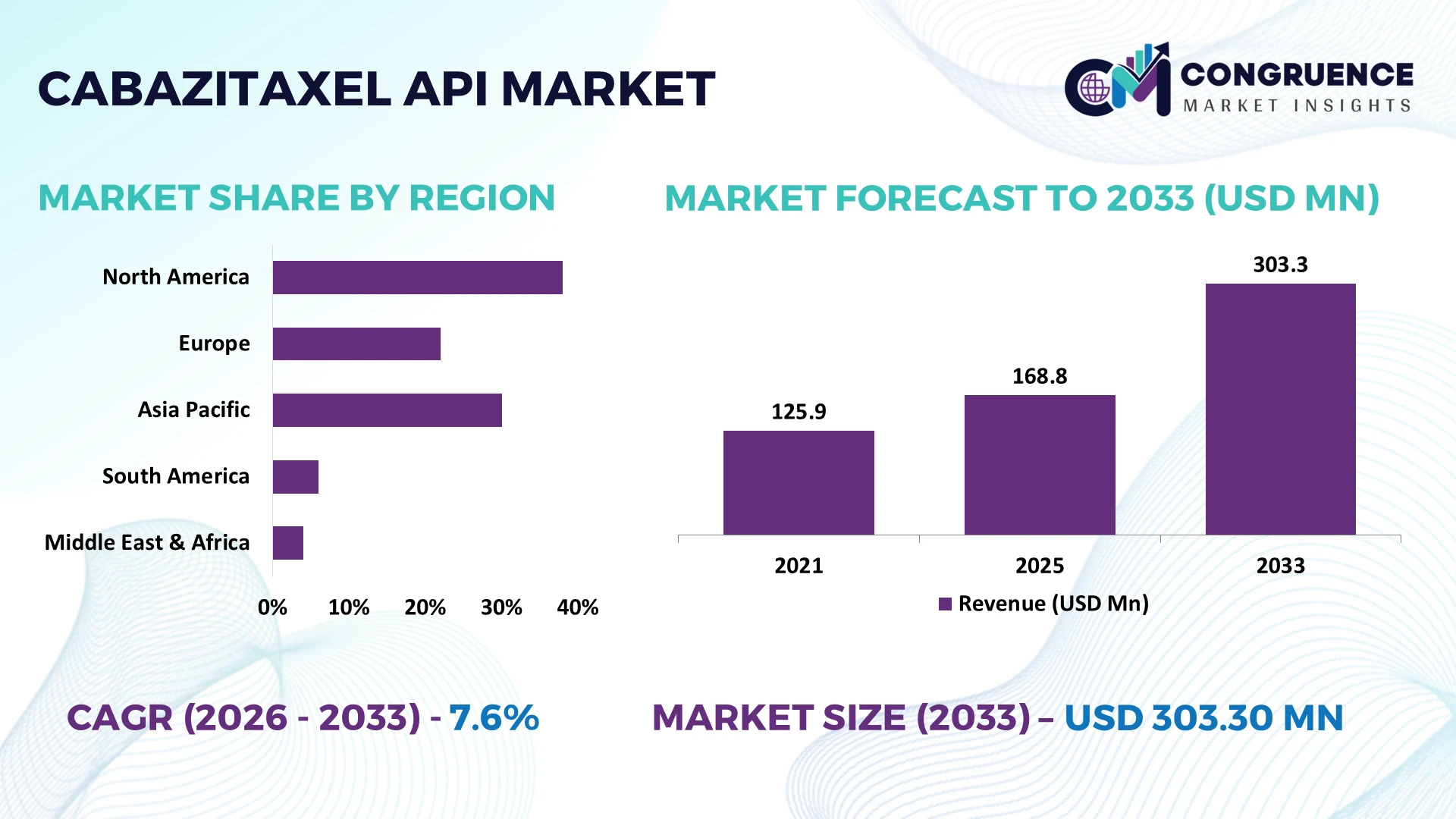
North America represents the largest consumption bloc, with the United States driving the overwhelming majority of regional demand through established generic injectable infrastructure and formulary penetration. The region's 38% share reflects not manufacturing dominance but downstream formulation concentration—major generic houses including Accord Healthcare and Dr. Reddy's have secured USFDA approvals for cabazitaxel injections, anchoring API procurement volumes. Structured procurement systems manage over 65% of regional purchases, ensuring supply continuity for oncology treatment protocols. The UPC's 2025 revocation of Sanofi's key European patent has accelerated generic entry momentum globally, indirectly reinforcing North American formulators' API sourcing scale . API qualification cycles remain lengthy, with dual-sourcing mandates now standard among generic injectable producers targeting US market entry.
United States Market Outlook: The US accounts for approximately 92% of North American API consumption, driven by five FDA-approved generic cabazitaxel injectable manufacturers requiring DMF-backed supply. The domestic manufacturing base for cytotoxic API remains minimal, creating structural import dependence that favors Indian DMF holders with NAI inspection outcomes.
Europe holds a 22% share of global API demand, with consumption concentrated in Germany, France, and Italy where generic cabazitaxel penetration accelerated following the Unified Patent Court's December 2025 revocation of Sanofi's EP 2 493 466 patent. This ruling opened nine European markets to generic competition, triggering API procurement expansion among Accord Healthcare, Zentiva, and Stada . The region's regulatory framework—centered on CEP certification and EU-GMP compliance—creates higher qualification barriers than North America, limiting qualified supplier pools. Indena's Italian CEP position provides a domestic EU-compliant source, though capacity remains constrained relative to demand. Sustainability requirements for cytotoxic waste handling add operational cost premiums of 12–18% versus Indian production environments.
Italy Market Outlook: Italy serves as the EU's primary API production node, anchored by Indena's botanical extraction integration and CEP-certified cabazitaxel capacity. The country benefits from proximity to European formulators and established GMP inspection mutual recognition, though scale remains limited compared to Asian export volumes.
Asia-Pacific commands a 30% share of global API consumption, but its strategic significance far exceeds this figure—India alone accounts for 80.33% of cabazitaxel API export transactions, with four active US DMF holders including Dr. Reddy's, Hetero Labs, Laurus Labs, and Shilpa Pharma. China follows with four DMF filings, leveraging upstream 10-DAB extraction integration to compete on precursor cost. The region's dominance rests on cytotoxic containment infrastructure investment and inspection track records, not merely cost advantages. Japan and South Korea represent smaller but quality-sensitive markets where domestic formulators require dual USFDA/EU-GMP qualified sources, creating premium pricing opportunities for Indian producers with NAI outcomes.
India Market Outlook: India's API export dominance is structural, supported by dedicated high-containment manufacturing suites and a 78% monograph compliance rate among qualified suppliers. The country's four DMF holders control the majority of global generic cabazitaxel injectable supply chains, positioning India as the indispensable node for formulators seeking USFDA-compliant sourcing.
South America holds a 6% share of global API consumption, with Brazil and Argentina representing the primary demand centers. The region lacks domestic cabazitaxel API manufacturing capacity, creating complete reliance on imported material from Indian and Chinese DMF holders. Brazil's ANVISA regulatory pathway requires separate registration procedures that add 8–12 months to qualification timelines compared to USFDA or EU-GMP reliance. Generic injectable formulators in the region typically source through distributors rather than direct API manufacturer relationships, introducing margin layers and reducing supply visibility. Currency volatility affecting Brazilian real and Argentine peso denominated contracts creates pricing instability that discourages long-term supply commitments from Indian exporters.
Brazil Market Outlook: Brazil accounts for approximately 58% of South American API demand, driven by public health system oncology procurement through SUS. The country's regulatory framework requires Portuguese-language dossier submissions and local GMP verification, creating barriers for smaller Indian suppliers and favoring established exporters with regional distribution partnerships.
The Middle East & Africa region holds a 4% share of global API consumption, with demand concentrated in Saudi Arabia, UAE, and South Africa. The region's strategic relevance lies less in current volume than in emerging pharmaceutical localization initiatives—Saudi Arabia's Vision 2030 pharmaceutical manufacturing targets and UAE's industrial diversification programs are creating incentives for domestic formulation capacity, which will require API import partnerships. Currently, no regional cabazitaxel API production exists, and all demand is met through imports from India and Europe. South Africa's regulatory reliance on WHO prequalification and stringent cytotoxic handling requirements limits qualified supplier pools to those already holding Stringent Regulatory Authority approvals.
Saudi Arabia Market Outlook: Saudi Arabia represents the region's most significant demand node, with SFDA-regulated oncology procurement requiring FDA or EMA reference approvals for imported APIs. The country's pharmaceutical localization strategy targets 40% domestic formulation capacity by 2030, creating future API partnership opportunities for DMF holders willing to transfer technology and establish regional distribution infrastructure.
The cabazitaxel API market is split between originator-anchored suppliers and generic-focused Indian/Chinese API producers. Teva API (Tapi Teva) and Dr. Reddy's compete for DMF-backed generic formulation supply, while Indena and Shilpa Medicare contest EU-GMP qualified niches. The top five players hold approximately 75–80% combined share, reflecting high concentration around inspection-cleared capacity rather than raw production volume. Competition centers on regulatory documentation depth and containment infrastructure—batch rejection rates run 15–20% lower on dedicated cytotoxic lines, translating to yield advantages of 8–12% for qualified producers. Players are pursuing USFDA inspection outcomes and dual US/EU DMF filings to lock in formulator contracts. The competitive shift favors vertical integration into taxane precursor capture, with Chinese producers leveraging upstream 10-DAB access to compress cost structures. Entry barriers are steep: containment validation cycles and inspection histories create multi-year qualification lead times. Winning requires NAI inspection records, dual-regulatory filings, and proven high-containment batch consistency—not price alone.
Dr. Reddy's Laboratories
Teva API (Tapi Teva)
Shilpa Medicare Limited
Indena
Hetero Labs
Laurus Labs
Synthland
Mac-Chem Products (India)
Shenzhen Haorui Industrial Development
Wuhan Hanways Chempharm
Fuan Pharmaceutical Group
Fujian Yewpark Biological
Suzhou Ryway Biotech
Current cabazitaxel API production relies on semi-synthetic routes from 10-DAB, with high-containment crystallization and impurity profiling as baseline requirements. Dedicated containment suites reduce batch rejection rates by 15–20% versus shared cytotoxic lines, directly improving yield economics and inspection outcomes. Approximately 70% of generic injectable formulators now mandate dual DMF-backed sourcing, forcing API producers to maintain parallel USFDA and EU-GMP documentation packages.
Emerging technologies center on Tween-80-free formulations and nanoparticle delivery systems. MegaPro's NanoMicelle™ platform achieved a maximum tolerated dose of 25 mg/m² with significantly reduced hematologic and gastrointestinal adverse events versus reference cabazitaxel, positioning 505(b)(2) bioequivalence pathways as a faster commercialization route . Starpharma's DEP® dendrimer cabazitaxel demonstrated 80% disease control rate in gastro-oesophageal cancers, with 50% longer progression-free survival than standard paclitaxel . These delivery innovations reduce reliance on conventional solubilizers, potentially reshaping API specification demand toward higher-purity, excipient-compatible grades.
Competitive advantage accrues to API producers that align with these formulation shifts early. Companies investing in ≥99% purity capability and acetone solvate specification compliance will capture premium pricing from formulators pursuing 505(b)(2) pathways. Between 2026 and 2028, expect API qualification packages to expand beyond pharmacopoeial compliance into delivery-system compatibility documentation. Producers unable to supply formulation-ready specification data will face exclusion from next-generation injectable supply chains.
January 2026 — Taiho Pharmaceutical Assumed sales and marketing responsibility for Jevtana in Japan from Sanofi effective April 1, 2026, while Sanofi retains marketing authorization and manufacturing. This transfer consolidates Japanese commercial access under Taiho's oncology infrastructure, affecting regional API procurement visibility for Sanofi's manufacturing operations. Source: taiho.co.jp
December 2025 — MegaPro Biomedical Taiwan FDA accepted the Phase 1/2a Clinical Study Report for MPB-1734, a Tween-80-free cabazitaxel formulation using NanoMicelle™ technology. Maximum tolerated dose reached 25 mg/m² with significant reductions in hematologic and gastrointestinal adverse events versus reference formulation, positioning a 505(b)(2) bioequivalence pathway. Source: megaprobio.com
June 2024 — Starpharma Presented final Phase 1/2 results for DEP® cabazitaxel at ASCO 2024, showing 80% disease control rate and 30% objective response rate in gastro-oesophageal cancers. Median progression-free survival reached 4.0 months versus published paclitaxel benchmarks, validating dendrimer-delivered cabazitaxel as a multi-indication candidate. Source: starpharma.com
January 2024 — Starpharma ASCO GI presentation reported DEP® cabazitaxel achieved 50% longer median progression-free survival and 29% longer overall survival than standard paclitaxel in advanced gastro-oesophageal cancers. The Tween-80-free dendrimer formulation eliminates steroid pre-medication requirements, signaling downstream API demand shifts toward excipient-compatible specifications. Source: starpharma.com
The report covers the global cabazitaxel API market across type, application, and end-user segments, with regional analysis spanning North America, Europe, Asia-Pacific, South America, and Middle East & Africa. Type segmentation addresses purity grades ≥98% and <98%, reflecting regulatory-driven demand concentration. Application coverage includes injectable formulations and research-grade uses. End-user analysis profiles generic injectable manufacturers, CDMOs, and research institutions. Approximately 70% of formulators now require dual DMF-backed sourcing, shaping qualification and procurement dynamics assessed throughout.
Strategic coverage includes competitive positioning among DMF holders, containment infrastructure requirements, inspection outcome impacts, and formulation technology shifts toward Tween-80-free delivery systems. The report supports investment planning by identifying capacity gaps in high-purity and ≥99% grade production, expansion priorities around USFDA-compliant containment suites, and partnership opportunities linked to 505(b)(2) formulation development. Regional granularity extends to country-level supply concentration metrics and regulatory pathway differences, enabling competitive benchmarking and sourcing strategy development for 2026–2033 planning cycles.
| Report Attribute / Metric | Details |
|---|---|
| Market Revenue (2025) | USD 168.8 Million |
| Market Revenue (2033) | USD 303.3 Million |
| CAGR (2026–2033) | 7.6% |
| Base Year | 2025 |
| Forecast Period | 2026–2033 |
| Historic Period | 2021–2025 |
| Segments Covered |
By Type
By Application
By End-User
|
| Key Deliverables | Revenue Forecast; Market Trends; Growth Drivers & Restraints; Technology Insights; Segmentation Analysis; Regional Insights; Competitive Landscape; Regulatory & ESG Overview; Recent Developments |
| Regions Covered | North America; Europe; Asia Pacific; South America; Middle East & Africa |
| Companies Profiled | Dr. Reddy's Laboratories; Teva API (Tapi Teva); Shilpa Medicare Limited; Indena; Hetero Labs; Laurus Labs; Synthland; Mac-Chem Products (India); Shenzhen Haorui Industrial Development; Wuhan Hanways Chempharm; Fuan Pharmaceutical Group; Fujian Yewpark Biological; Suzhou Ryway Biotech |
| Customization & Pricing | Available on Request (10% Customization Free) |




