
Reports
The Global Breath Biopsy Testing Market was valued at USD 1,498.3 Million in 2025 and is anticipated to reach a value of USD 2,613.1 Million by 2033 expanding at a CAGR of 7.2% between 2026 and 2033. Growth is being driven by clinical movement toward non-invasive biomarker detection, particularly for cancer, respiratory, infectious, and metabolic disease screening.
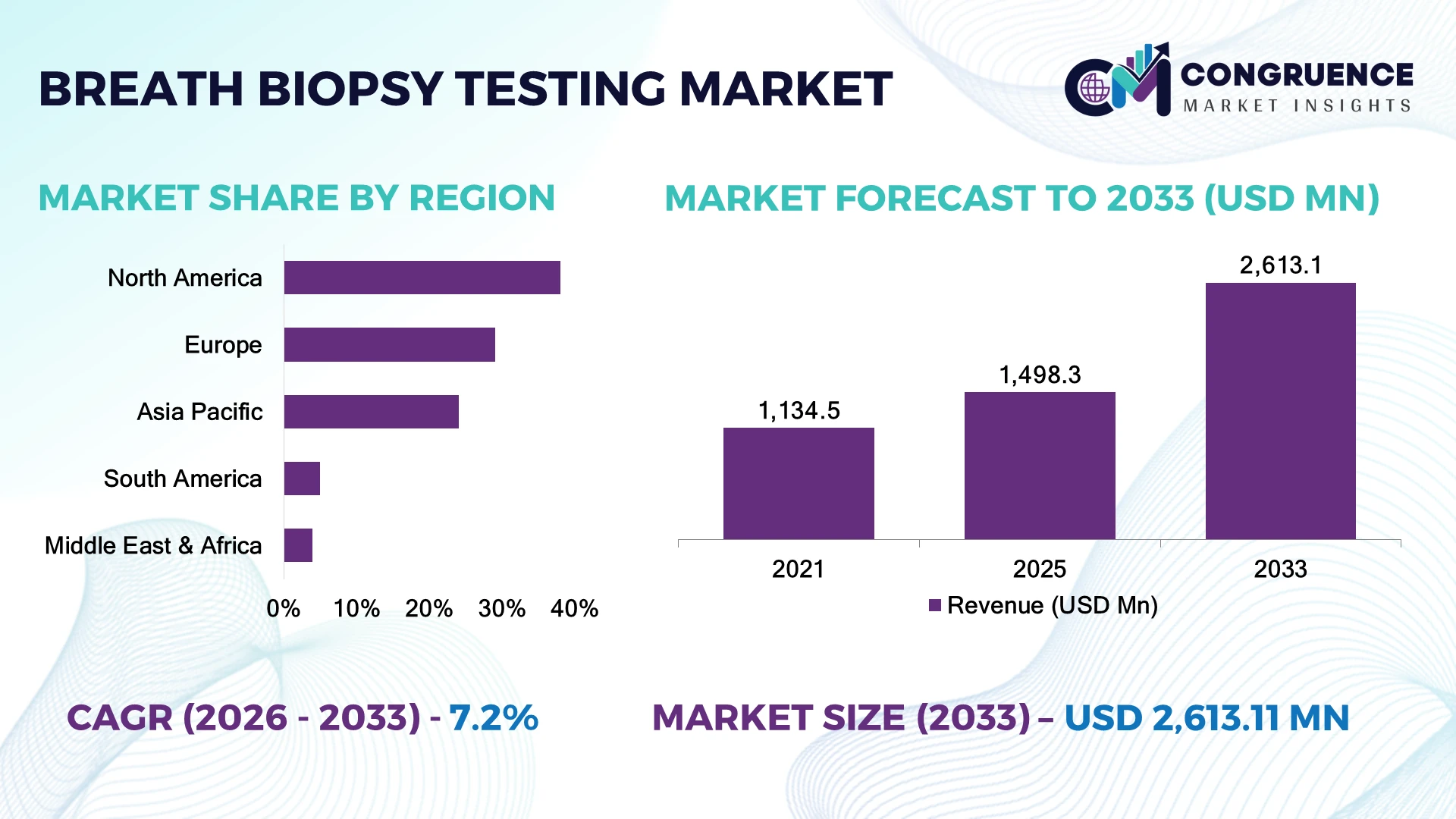
The United States remains the dominant commercial market, supported by advanced oncology infrastructure, established diagnostic reimbursement pathways, and investment in AI-enabled breathomics. North America accounts for approximately 38% of global demand, compared with about 29% for Europe, while Asia Pacific is accelerating clinical adoption through expanding diagnostic capacity. More than 1,000 volatile organic compounds have been identified in human breath, creating a broad biomarker-development base for next-generation testing.
The strategic priority is to convert high-volume biomarker discovery into clinically validated, reproducible tests that can move from specialist centers toward routine diagnostics.
Market Size & Growth: USD 1,498.3 million in 2025 to USD 2,613.1 million by 2033 at 7.2% CAGR, driven by non-invasive biomarker detection and precision diagnostics.
Top Growth Drivers: Cancer applications: 34%; respiratory diagnostics: 27%; North America: 38%.
Short-Term Forecast: By 2028, automated breath-sample processing can reduce laboratory handling time by approximately 20–30% versus highly manual workflows.
Emerging Technologies: Mass spectrometry, FAIMS, AI-assisted VOC classification, and portable electronic-nose platforms are expanding analytical capabilities.
Regional Leaders: North America: approximately USD 993 million; Europe: USD 757 million; Asia Pacific: USD 574 million based on current regional positioning.
Consumer/End-User Trends: Clinical research and pharmaceutical applications account for a substantial early-adopter base, with breath biomarker platforms deployed across more than 100 research sites by leading technology providers.
Pilot/Case Example: 2025 clinical development programs targeted infectious-disease detection through breath VOC signatures, aiming to provide non-invasive alternatives to conventional sampling workflows.
Competitive Landscape: Owlstone Medical, Breath Diagnostics, Smiths Detection, IMCS, and established analytical-instrument providers compete through sensitivity, biomarker libraries, AI analytics, and workflow integration.
Regulatory & ESG Impact: Non-invasive sampling reduces dependence on tissue collection and can lower consumable and patient-handling requirements compared with invasive diagnostic workflows.
Investment & Funding: At least USD 30 million in disclosed 2025 financing supported breath-diagnostic commercialization, clinical trials, and point-of-care development.
Innovation & Future Outlook: The technology shift is moving from laboratory VOC discovery toward portable, AI-enabled, multi-disease platforms capable of decentralized testing.
The Breath Biopsy Testing Market is moving beyond exploratory breathomics toward clinically actionable biomarker platforms. Cancer, respiratory disease, infectious disease, and precision-medicine programs are the principal demand areas, while AI-assisted VOC classification and portable mass-spectrometry technologies are improving analytical scalability. In 2026, clinical validation, standardized sample collection, and regulatory-grade reproducibility are becoming critical commercialization requirements, creating a transition from research-led adoption toward structured diagnostic deployment.
Breath biopsy testing is becoming strategically important because it can shift disease detection toward non-invasive sampling while supporting repeated monitoring and decentralized diagnostics. Unlike tissue biopsy, breath collection does not require invasive extraction, creating potential advantages for screening, longitudinal monitoring, and pharmaceutical biomarker studies. The commercial priority is therefore shifting from simply identifying VOC signatures toward proving that those signatures deliver reproducible clinical decisions.
Technology is advancing from laboratory-intensive analytical workflows toward integrated VOC collection, mass spectrometry, FAIMS, and AI classification. Automated processing can reduce sample-handling requirements by approximately 20–30%, while portable systems are shortening the pathway between collection and analysis. North America currently has stronger clinical infrastructure and commercialization activity, whereas Asia Pacific is building adoption through expanding diagnostic capacity and technology localization.
During 2026–2028, investment will increasingly target clinical validation, portable analyzers, standardized breath collection, and disease-specific biomarker libraries. Pharmaceutical companies are integrating breathomics into clinical-trial biomarker programs, while diagnostic developers are building partnerships with hospitals and research networks. The decisive competitive advantage will come from reproducible biomarker performance, regulatory readiness, and workflow integration rather than analytical sensitivity alone.
Clinical demand is moving toward non-invasive sampling as oncology and respiratory programs require repeatable biomarker assessment. Cancer applications account for approximately 34% of breath biopsy testing demand, while respiratory diagnostics represent about 27%, creating strong utilization across hospitals and research networks. In the United States, AI-assisted VOC analysis is increasingly being paired with mass spectrometry and chromatographic workflows to improve biomarker classification. Automated sample processing can reduce handling time by approximately 20–30%, improving laboratory throughput. Diagnostic companies are responding through hospital partnerships, disease-specific biomarker libraries, and integrated analyzers. The strategic shift is from exploratory breathomics toward repeatable clinical workflows where faster sampling and lower patient burden improve testing frequency and laboratory productivity.
Breath biomarker variability remains a major constraint because VOC profiles change with diet, medication, smoking exposure, environment, and sampling conditions. Differences in collection protocols can introduce approximately 10–20% analytical variation across testing workflows, complicating cross-site validation. Mass-spectrometry platforms also require specialized instrumentation and trained personnel, limiting deployment outside advanced laboratories. In the United States and Europe, developers face additional pressure to demonstrate reproducibility before clinical adoption. Companies are addressing these constraints through standardized breath-collection cartridges, calibration protocols, controlled sampling environments, and centralized reference databases. The critical operational issue is not detecting VOCs but generating consistent measurements across patients and facilities; platforms that control pre-analytical variability gain a substantial commercialization advantage.
Portable breath analyzers create an opportunity to shift testing from centralized laboratories toward outpatient and point-of-care environments. Miniaturized mass spectrometry, FAIMS, electronic-nose sensors, and AI classification can reduce analytical turnaround time by approximately 30–50% compared with conventional laboratory workflows. Respiratory and infectious-disease applications are particularly suited to decentralized deployment because repeated sampling can occur without invasive procedures. In India and Southeast Asia, compact systems can address uneven access to advanced laboratory infrastructure while supporting regional diagnostic networks. Developers are investing in sensor miniaturization, cloud-based analytics, and hospital partnerships. A less obvious opportunity is longitudinal monitoring: frequent breath measurements can generate patient-specific VOC baselines, creating a recurring diagnostic workflow rather than a one-time test.
Commercial deployment depends on demonstrating that breath biomarkers remain reliable across populations, instruments, laboratories, and disease stages. Studies using AI-based VOC classification frequently report accuracy above 80%, but performance can decline when algorithms encounter external patient cohorts or different sampling environments. This creates a substantial validation burden for diagnostic developers. Hospitals also require interoperability with laboratory information systems and electronic health records before integrating new breath-testing platforms into routine workflows. Companies must therefore invest in multicenter trials, standardized metadata, algorithm recalibration, cybersecurity controls, and interoperable software. The long-term challenge is scaling analytical intelligence without sacrificing clinical reproducibility; developers that build diverse validation datasets and locked-down quality systems can reduce deployment friction and strengthen regulatory readiness.
AI Classification Enters Routine Workflows: Breathomics platforms are increasingly combining VOC fingerprints with machine-learning classifiers to distinguish disease signatures. Reported model accuracy frequently exceeds 80% in controlled studies, while automated interpretation reduces analyst intervention. Developers are responding by expanding reference datasets, retraining algorithms across populations, and integrating analytical software directly into diagnostic workflows.
Sampling Standardization Gains Priority: Developers are shifting attention toward collection hardware, environmental controls, and metadata capture because pre-analytical variation can contribute approximately 10–20% measurement differences. Standardized cartridges and controlled sampling protocols are becoming important for multicenter validation. Companies are redesigning workflows to make sample collection reproducible before increasing analyzer deployment.
Portable Platforms Expand Clinical Access: Compact FAIMS, sensor-array, and miniaturized mass-spectrometry systems are moving breath analysis closer to outpatient settings. Portable workflows can reduce turnaround time by approximately 30–50% compared with centralized laboratory processing. Diagnostic companies are pursuing hospital pilots and decentralized testing partnerships, particularly where advanced analytical infrastructure remains concentrated in major cities.
Longitudinal Monitoring Gains Traction: Breath testing is increasingly positioned for repeated monitoring rather than single diagnostic events. Serial sampling can establish patient-specific VOC baselines, with repeated measurements potentially improving trend interpretation by approximately 10–15% compared with isolated readings. Developers are connecting analyzers with cloud analytics and electronic records, creating recurring monitoring workflows for oncology and chronic respiratory care.
Mass spectrometry-based breath biopsy testing is estimated to represent approximately 45% of demand, supported by high molecular resolution, broad VOC coverage, and established compatibility with clinical research workflows. Gas chromatography-based systems account for roughly 18%, retaining importance for biomarker discovery and reference-library development, while electronic-nose platforms represent about 27% and are gaining adoption where rapid, lower-complexity screening is prioritized. Other technologies, including FAIMS, ion-mobility, and electrochemical sensing, contribute approximately 10% but remain strategically important for miniaturization. Companies are increasingly combining high-resolution analytical platforms with AI interpretation rather than relying on standalone instrumentation.
Electronic-nose and portable sensor technologies are the fastest-growing type, supported by outpatient deployment and shorter analytical workflows. A 2025 multicenter study involving 5,292 participants used TD-GC-MS for model development and portable micro-GC for validation, demonstrating the industry's shift toward combining laboratory-grade biomarker discovery with deployable analytical platforms. This is shifting investment toward portable systems, while mass-spectrometry developers emphasize standardized sampling and algorithmic classification.
A 2025 multicenter validation study demonstrated the feasibility of combining laboratory-grade VOC profiling with portable analytical platforms, reinforcing the shift toward deployable breath-testing workflows.
Cancer diagnostics represent approximately 34% of breath biopsy testing demand, making oncology the leading application because VOC signatures can support non-invasive screening, triage, and treatment monitoring. Respiratory disease applications account for about 27%, supported by recurring assessment requirements across lung cancer, COPD, asthma, and other pulmonary conditions. Infectious-disease testing represents roughly 18%, while metabolic and other applications account for approximately 12% and 9%, respectively. Companies are concentrating investment on disease-specific biomarker libraries, AI classification, and workflow integration rather than broad, undifferentiated breath screening.
Infectious and respiratory applications are showing stronger operational adoption because rapid breath collection can complement conventional diagnostic pathways without repeated invasive sampling. A 2025 systematic review covering 8,768 cancer patients reported pooled VOC breath-test sensitivity of approximately 87% and specificity of 81%, supporting continued oncology investment. The business implication is a shift toward validated disease-specific panels, with developers increasingly partnering with hospitals and clinical research networks.
A 2025 systematic review covering 8,768 cancer patients reported pooled breath-VOC diagnostic sensitivity of approximately 87% and specificity of 81%, strengthening the case for clinically focused oncology applications.
Hospitals and specialty clinics represent an estimated 38% of breath biopsy testing demand, reflecting their concentration of oncology, pulmonology, infectious-disease, and clinical research workflows. Diagnostic laboratories account for approximately 27%, supported by centralized analytical infrastructure and specialist testing capabilities. Research institutes contribute around 20%, remaining critical for biomarker discovery and validation, while pharmaceutical and biotechnology companies represent approximately 15% through clinical-trial biomarker programs and translational research. Companies are therefore tailoring platforms differently by buyer: hospitals prioritize rapid workflows and interoperability, laboratories emphasize analytical reproducibility, and pharmaceutical users prioritize longitudinal biomarker datasets.
Pharmaceutical and biotechnology demand is expanding as breathomics becomes more relevant to pharmacodynamic monitoring and patient stratification. Research institutions remain influential because multicenter datasets are needed to validate disease-specific algorithms before clinical deployment. A 2025 smart mass-spectrometry study analyzed breath from 509 subjects and achieved AUROC values of approximately 0.98–0.99 across several cancer models, illustrating the value of integrated research platforms. Companies are responding through hospital collaborations, CRO partnerships, customized analytics, and modular instrument configurations.
A 2025 prospective clinical study demonstrated consistent eNose performance across multiple thoracic-oncology outpatient settings, supporting hospitals and specialty clinics as an important commercialization pathway for standardized breath diagnostics.
North America accounted for the largest market share at 38% in 2025 however, Asia-Pacific is expected to register the fastest growth, expanding at a CAGR of 8.1% between 2026 and 2033.

Clinical validation is shifting breathomics from research platforms toward hospital-based diagnostic workflows
North America represents approximately 38% of global breath biopsy testing demand, led by the United States, where oncology centers, pulmonary networks, academic hospitals, and diagnostic laboratories provide concentrated deployment infrastructure. Demand is increasingly moving toward AI-assisted VOC classification, mass-spectrometry workflows, and portable analyzers. A 2025 prospective multicenter study involving 5,292 participants demonstrated the feasibility of combining TD-GC-MS model development with portable micro-GC validation, reinforcing the region's transition toward deployable breath diagnostics. Companies are responding through hospital collaborations, clinical validation programs, and integration of analytical software with existing laboratory workflows. The strategic advantage is concentrated clinical infrastructure: developers can validate new platforms across established networks before expanding into decentralized settings.
United States Market Outlook: The United States remains the principal commercial and research hub, supported by advanced oncology infrastructure, high laboratory automation, and extensive clinical-trial activity. More than 5,000 participants were enrolled in a major 2025 multicenter breathomics study, demonstrating the country's broader ecosystem relevance for large-scale validation and clinical translation.
Standardization and clinical evidence are strengthening adoption across specialist diagnostic networks
Europe accounts for approximately 29% of global breath biopsy testing demand, supported by advanced respiratory medicine, university hospitals, and established clinical-research infrastructure in Germany, the United Kingdom, France, Italy, and Spain. Adoption is increasingly centered on standardized sampling, biomarker validation, and integration with pulmonary and oncology workflows rather than standalone experimental testing. European research programs are also expanding metabolomic analysis of exhaled breath condensate, strengthening applications in asthma and chronic respiratory disease. Companies are responding with interoperable analyzers, standardized collection protocols, and partnerships with academic medical centers. The region's fragmented healthcare systems make cross-site validation particularly important, increasing the strategic value of platforms capable of maintaining analytical consistency across multiple laboratories.
United Kingdom Market Outlook: The United Kingdom has a strong position through its concentration of university hospitals, respiratory research centers, and clinical-trial infrastructure. Multicenter respiratory research networks provide access to diverse patient cohorts, while established laboratory standards support development of reproducible breath-sampling protocols. This infrastructure makes the country an important validation market for pulmonary and oncology-focused breath diagnostics.
China-led clinical research is accelerating portable and AI-enabled breath diagnostics
Asia-Pacific represents approximately 24% of global demand and is the fastest-expanding regional market, driven by China, Japan, South Korea, and India. China is particularly active in clinical breathomics research, combining mass spectrometry, machine learning, and disease-specific VOC profiling. A 2025 study from Shanghai developed a targeted MS-based colorectal-cancer breath assay with a detection limit below 0.25 ng/L and measured accuracy ranging from 88.2% to 105.2%, illustrating increasing analytical sophistication. Companies are positioning through local clinical partnerships, portable instrumentation, and AI-enabled interpretation. The region's key advantage is the ability to combine large patient populations with rapidly expanding diagnostic infrastructure, supporting faster algorithm development and broader validation.
China Market Outlook: China is the leading Asia-Pacific market because of its large hospital network, expanding cancer-screening infrastructure, and active integration of AI with analytical diagnostics. A 2025 thoracic-cancer study enrolled 132 participants and combined machine learning with TD-GC-MS breath analysis. Domestic technology developers are increasingly collaborating with major hospitals to translate laboratory VOC research into clinical screening workflows.
Brazil is building demand through centralized diagnostic networks and non-invasive testing
South America accounts for approximately 5% of global breath biopsy testing demand, with Brazil representing the principal commercial and clinical hub. Adoption remains concentrated in major hospitals, university medical centers, and specialized laboratories, where access to mass spectrometry and metabolomics expertise is stronger. Brazil's established use of non-invasive breath diagnostics in gastroenterology provides a practical foundation for broader breath-analysis adoption, although sophisticated VOC platforms remain less widely deployed. Companies are therefore emphasizing lower-complexity sensors, partnerships with diagnostic laboratories, and centralized analytical services. The strategic opportunity is to use hub-and-spoke models: advanced analysis can remain concentrated in major cities while portable collection systems expand patient access beyond metropolitan centers.
Brazil Market Outlook: Brazil offers the largest addressable clinical infrastructure in South America, supported by major university hospitals and a broad diagnostic laboratory network. Its gastroenterology sector already uses breath-based testing, creating familiarity with non-invasive sampling. Developers can leverage this installed clinical workflow to introduce more advanced VOC analytics, particularly for respiratory and gastrointestinal applications.
Healthcare modernization is concentrating advanced breath diagnostics in major medical hubs
Middle East & Africa represents approximately 4% of global breath biopsy testing demand, with deployment concentrated in the United Arab Emirates, Saudi Arabia, Israel, and South Africa. Hospital modernization, precision-medicine programs, and investment in advanced laboratory infrastructure are creating selective demand for mass spectrometry, biomarker analysis, and AI-assisted diagnostics. Adoption remains uneven because specialized analytical equipment and trained personnel are concentrated in leading medical centers. Companies are consequently favoring partnerships with tertiary hospitals, centralized testing models, and technology-transfer arrangements rather than broad equipment deployment. The non-obvious opportunity is centralized regional testing: sophisticated breath analysis can be performed at high-capability hubs while standardized sample collection expands the geographic reach of diagnostic programs.
United Arab Emirates Market Outlook: The UAE has a strategically strong position because of concentrated investment in digitally enabled hospitals, advanced laboratory infrastructure, and precision-medicine programs. Major healthcare institutions increasingly use centralized diagnostic platforms and AI-enabled clinical technologies, creating an appropriate environment for portable breath collection linked to high-capability analytical laboratories.
The competitive field is led by Owlstone Medical, Breathomix, Breath Diagnostics, Breathe BioMedical, and analytical-platform suppliers such as Thermo Fisher Scientific, with diagnostic developers competing against instrument OEMs for clinical and research workflows. The top five specialist players are estimated to represent about 55% of breath-biopsy platform activity, reflecting concentration around validated datasets and analytical infrastructure. Competition centers on biomarker performance, workflow speed, portability, and customization; portable eNose and sensor systems can reduce testing time by 30–50%, while high-resolution MS platforms retain advantages in compound identification. Players are expanding through hospital studies, pharma collaborations, clinical-trial programs, and vertically integrated sample-to-analysis platforms. The competitive shift is toward AI-enabled interpretation and proprietary biomarker databases rather than standalone hardware. Entry barriers remain high because clinical validation, regulatory evidence, reference datasets, and reproducible sampling require substantial investment. Winning requires validated biomarkers, scalable collection, interoperable analytics, and partnerships that convert research adoption into deployment.
Owlstone Medical
Breathomix B.V.
Breath Diagnostics, Inc.
Breathe BioMedical Inc.
Thermo Fisher Scientific Inc.
Agilent Technologies, Inc.
Bruker Corporation
Shimadzu Corporation
PerkinElmer, Inc.
The eNose Company
E-Nose Pty Ltd
Scentsible Health
Biodesix, Inc.
Breath biopsy technology is moving from laboratory-only VOC discovery toward sample-to-answer platforms. High-resolution GC-MS and LC-MS remain reference technologies for compound identification, while FAIMS and electronic-nose systems enable faster pattern recognition. Targeted GC-MS workflows can reduce compound-identification ambiguity by roughly 15–25% versus untargeted screening, improving biomarker reproducibility. Breathomix’s cloud-connected eNose model illustrates integration between sensor acquisition and AI interpretation. Portable systems are increasingly attractive for outpatient deployment because they reduce handling and support real-time classification.
AI-driven VOC classification is becoming the disruptive layer. Machine-learning models can improve classification performance by about 5–15% after dataset expansion and calibration, although gains depend on population diversity. Breath Diagnostics reports 94% sensitivity and 85% specificity in studies involving more than 800 patients, demonstrating the competitive value of combining molecular analysis with AI interpretation. Companies are also integrating standardized breath collection, metadata capture, cloud analytics, and electronic health-record connectivity.
Between 2026 and 2028, miniaturized MS, FAIMS, sensor arrays, and multimodal AI are expected to move closer to point-of-care workflows. Automated preprocessing can reduce manual laboratory steps by about 20–30%. Technology leaders with biomarker databases gain an advantage because algorithms improve as datasets expand. Companies should prioritize interoperable platforms, standardized sampling, cybersecurity, and clinical validation now.
January 2025 Owlstone Medical closed the first $27 million of Series E financing, funding clinical trials and commercialization of Breath Biopsy tests and point-of-care devices for lung, liver, and digestive diseases. The investment strengthened clinical translation and product development capacity. Source: owlstonemedical.com
March 2025 Owlstone Medical received up to $2.3 million from the Cystic Fibrosis Foundation to develop breath testing for Pseudomonas aeruginosa detection and monitoring. The program targets an alternative to sputum culture, supporting broader infectious-disease applications and pediatric testing workflows. Source: owlstonemedical.com
February 2025 Breathe BioMedical launched its first large multicenter observational breath-collection study for breast-cancer detection at George Washington University Breast Center. The program expands clinical validation for women with dense breasts and establishes a pathway toward adjunctive screening alongside mammography. Source: breathebiomedical.com
February 2026 Breath Diagnostics received FDA Breakthrough Device Designation for OneBreath to support pre-operative pneumonia risk assessment. Its platform reports 94% sensitivity and 85% specificity in studies involving more than 800 patients, strengthening regulatory momentum for molecular breath diagnostics technology. Source: breathdiagnostics.com
The report covers the Breath Biopsy Testing Market across analytical types including mass spectrometry, gas chromatography, electronic-nose systems, FAIMS, and emerging sensor technologies. Application coverage spans cancer diagnostics, respiratory disease, infectious disease, metabolic conditions, and other biomarker applications, while end-user analysis includes hospitals and specialty clinics, diagnostic laboratories, research institutes, and pharmaceutical and biotechnology companies. Regional assessment covers North America, Europe, Asia-Pacific, South America, and Middle East & Africa, with country-level insights for major adoption hubs.
The analysis evaluates clinical validation, VOC biomarker development, AI-assisted classification, portable analyzers, standardized sampling, and point-of-care deployment. It also examines specialist companies, instrument suppliers, partnership activity, infrastructure concentration, and emerging decentralized testing models. The report supports investment planning, geographic expansion, technology selection, partnership strategy, competitive positioning, and commercialization decisions through 2026–2033.
| Report Attribute/Metric | Report Details |
|---|---|
|
Market Revenue in 2025 |
USD 1,498.3 Million |
|
Market Revenue in 2033 |
USD 2,613.1 Million |
|
CAGR (2026 - 2033) |
7.2% |
|
Base Year |
2025 |
|
Forecast Period |
2026 - 2033 |
|
Historic Period |
2021 - 2025 |
|
Segments Covered |
By Type
By Application
By End-User
Companies Profiled
|
|
Key Report Deliverable |
Revenue Forecast, Growth Trends, Market Dynamics, Segmental Overview, Regional and Country-wise Analysis, Competition Landscape |
|
Region Covered |
North America, Europe, Asia-Pacific, South America, Middle East, Africa |
|
Key Players Analyzed |
Owlstone Medical, Breathomix B.V., Breath Diagnostics, Inc., Breathe BioMedical Inc., Thermo Fisher Scientific Inc., Agilent Technologies, Inc., Bruker Corporation, Shimadzu Corporation, PerkinElmer, Inc., The eNose Company, E-Nose Pty Ltd, Scentsible Health, Biodesix, Inc. |
|
Customization & Pricing |
Available on Request (10% Customization is Free) |




