
Reports
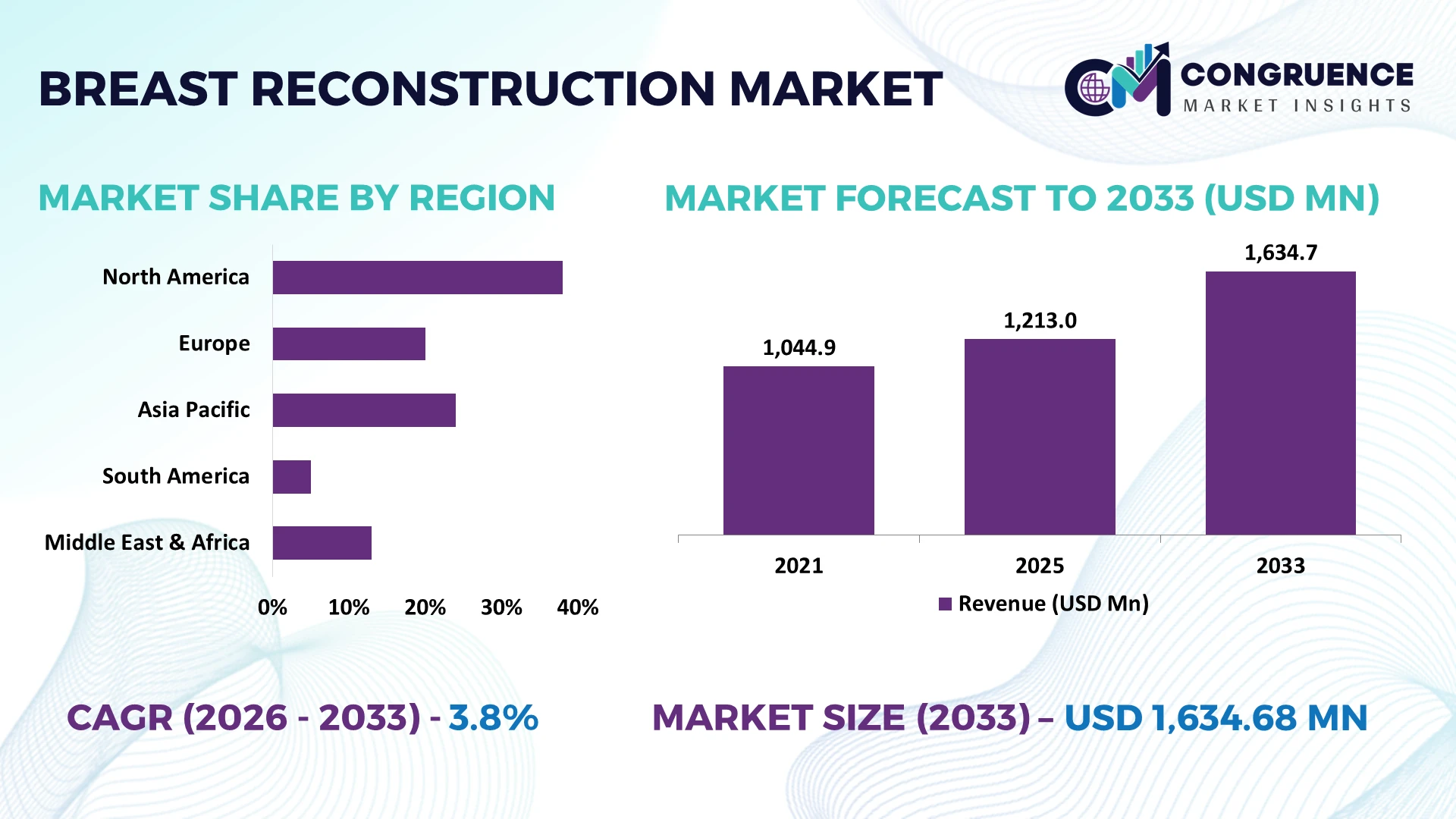
The Global Breast Reconstruction Market was valued at USD 1212.98 Million in 2025 and is anticipated to reach a value of USD 1634.68 Million by 2033 expanding at a CAGR of 3.8% between 2026 and 2033. Growth is driven by increasing immediate post-mastectomy reconstruction, wider prepectoral implant use, acellular dermal matrix adoption, and expansion of anatomy-specific breast implants and tissue expanders.
The U.S. anchors North America’s 61% global market position, supported by 162,579 breast reconstruction procedures in 2024, up 3%, with 74% performed immediately. Hospitals, oncology centers, implant manufacturers, and ADM suppliers drive adoption. Tiger Aesthetics’ USD 42.5 million Sientra acquisition strengthened domestic supply, while FDA boxed-warning requirements tightened implant oversight. Canada remains smaller but is positioned for faster regional expansion.
Strategically, suppliers should prioritize U.S. hospital and oncology channels while building differentiated implant, tissue-expander, ADM, and evidence-backed reconstruction portfolios for faster-expanding international markets.
Market Size & Growth: USD 1,212.98 million in 2025 reaches USD 1,634.68 million by 2033 at 3.8%, driven by immediate reconstruction and advanced implant adoption.
Top Growth Drivers: 74% immediate reconstruction, 54% tissue-expander-to-implant use, and 60.4% implant share concentrate demand in implant-led pathways.
Short-Term Forecast: By 2027, direct-to-implant workflows cut planned reconstructive stages from 2 procedures to 1 for eligible patients, a 50% reduction.
Emerging Technologies: MRI-conditional expanders, robotic microsurgery, and 930–1,445 cc implants strengthen precision, radiation compatibility, and anatomy-specific reconstruction.
Regional Leaders: 2033 normalized values are approximately USD 1,019 million North America, USD 250 million Europe, and USD 231 million Asia-Pacific.
Consumer/End-User Trends: 74% of U.S. procedures are immediate and 25% direct-to-implant, favoring fewer-stage reconstruction when clinically appropriate.
Pilot/Case Example: The ATHENA program evaluated 400 reconstruction patients; 95.6% said they would undergo the surgery again.
Competitive Landscape: AbbVie leads near 23%; Johnson & Johnson, Sientra/Tiger, Establishment Labs, and GC Aesthetics bring the top-five group near 65%.
Regulatory & ESG Impact: FDA requirements impose 3 key communication elements—boxed warning, decision checklist, and device card—raising compliance intensity.
Investment & Funding: Tiger Aesthetics committed USD 42.5 million for Sientra breast-implant assets in 2024, strengthening reconstructive-device consolidation.
Innovation & Future Outlook: Six MENTOR sizes spanning 930–1,445 cc plus MRI-compatible expanders shift competition toward personalized, evidence-backed reconstruction.
The Breast Reconstruction Market is increasingly centered on immediate implant-based procedures, tissue expanders, acellular dermal matrices, and autologous reconstruction. U.S. immediate procedures account for 74% of reconstruction volume, while MRI-conditional expanders and larger-volume implants are widening treatment choice. FDA risk-communication requirements and global oncology capacity expansion are pushing suppliers toward safer, evidence-backed, patient-specific portfolios, setting up the strategic discussion.
Breast reconstruction is becoming strategically important as breast-cancer care shifts from isolated tumor treatment toward integrated survivorship, creating stronger competition across implants, tissue expanders, acellular dermal matrices, microsurgical systems, and regenerative technologies. In the U.S., 74% of breast reconstructions are now performed immediately, while tissue-expander-to-implant procedures account for about 54% of cases. Regulatory emphasis on implant-risk disclosure and long-term surveillance is simultaneously shifting competition toward clinically documented product portfolios.
Technology is also changing reconstructive economics. Direct-to-implant reconstruction reduces the typical two-stage expander pathway to one primary reconstructive operation for eligible patients, eliminating one planned surgical stage and associated operating-room utilization. The U.S. leads in immediate and implant-based reconstruction, whereas European centers retain stronger autologous reconstruction capabilities and China is expanding specialist oncology infrastructure. Over the next 2–3 years, prepectoral placement, MRI-compatible expanders, robotic microsurgery, and patient-specific implant selection will gain greater institutional deployment.
A practical example is adoption of MRI-compatible tissue expanders that allow patients requiring postoperative imaging to avoid traditional magnetic-port restrictions. Manufacturers are consequently directing R&D toward safer expanders, anatomical implant ranges, ADM integration, and evidence generation while partnering with specialist surgeons. Competitive advantage will increasingly depend on controlling the complete reconstruction pathway rather than supplying an isolated implant.
Immediate post-mastectomy reconstruction is the strongest structural demand driver because it consolidates oncologic and reconstructive treatment while reducing additional operative episodes. In the U.S., approximately 74% of breast reconstructions are immediate, tissue-expander-to-implant procedures represent about 54%, and direct-to-implant techniques account for roughly 25%. The shift toward nipple-sparing mastectomy and prepectoral placement has increased demand for implants, expanders, acellular dermal matrices, and surgical support products within a single procedure pathway. FDA-mandated implant decision checklists have simultaneously strengthened informed product selection. Manufacturers are responding with broader anatomical sizing, improved shell technologies, MRI-compatible expanders, and surgeon-training programs. Strategically, companies capable of bundling implants, expanders, biologic matrices, and clinical education gain greater influence over hospital procurement than single-product suppliers.
Access remains structurally constrained by surgical expense, specialist availability, and substantial variation in post-mastectomy reconstruction utilization. Although immediate reconstruction represents about 74% of U.S. procedures, direct-to-implant reconstruction accounts for only around 25%, while approximately 21% involve autologous tissue techniques requiring specialized microsurgical capability. DIEP-flap procedures can require operating times exceeding 6 hours, creating materially higher theatre and staffing requirements than implant-based pathways. Outside major U.S. cancer centers, shortages of reconstructive microsurgeons restrict procedure scalability; similar capacity gaps are more pronounced across India and other emerging healthcare systems. Manufacturers cannot resolve these bottlenecks through product pricing alone. Companies are therefore supporting surgeon education, standardized procedural workflows, hospital partnerships, and expanded implant portfolios. Operationally, specialist capacity—not underlying patient need—remains a critical constraint on addressable procedure volume.
The strongest opportunity lies in technologies that reduce procedural stages while expanding reconstruction eligibility. Direct-to-implant procedures already represent roughly 25% of U.S. reconstruction, while immediate reconstruction has reached 74%, providing a substantial installed clinical base for prepectoral implants, biologic matrices, and advanced tissue-management products. MRI-compatible expanders remove a significant imaging limitation associated with conventional magnetic-port devices, while robotic microsurgery can enable smaller access incisions and more precise vessel preparation in autologous procedures. India presents an additional opportunity as oncology infrastructure and specialist breast-care networks expand from metropolitan hospitals into tier-one and tier-two cities. Manufacturers are investing in anatomical implant ranges, regenerative matrices, digital surgical planning, and surgeon partnerships. A non-obvious opportunity is reconstruction-compatible diagnostic imaging: products designed around continuing cancer surveillance can capture value beyond the initial surgical episode.
Long-term competitiveness depends on maintaining consistent outcomes across products, surgeons, and increasingly complex reconstruction pathways. Autologous reconstruction represents about 21% of U.S. procedures and can require microsurgical vascular anastomosis, while approximately 25% of cases use direct-to-implant techniques where patient selection and soft-tissue viability directly determine success. Implant reconstruction also requires continuing surveillance for capsular contracture, rupture, infection, and rare implant-associated malignancies. FDA boxed warnings and patient decision requirements have increased the evidence burden for manufacturers operating in the U.S. Unlike the cost-access restraint, this challenge centers on execution quality after adoption. Companies must strengthen post-market surveillance, surgeon credentialing, implant traceability, real-world evidence systems, and complication-management protocols. The strategic differentiator will be reproducible lifetime clinical performance, because expanding procedure availability without corresponding outcome consistency increases regulatory exposure and hospital procurement risk.
Prepectoral Workflows Reshape Implant Placement: Prepectoral reconstruction is replacing subpectoral positioning in selected U.S. centers, eliminating pectoralis-major elevation and reducing animation deformity exposure. Immediate reconstruction represents 74% of U.S. procedures, while direct-to-implant accounts for 25%. Manufacturers are refining implant surfaces, anatomical sizing, and ADM compatibility as surgeons standardize less-invasive workflows, shifting product competition toward soft-tissue support and predictable positioning.
Reconstruction Becomes More Immediate: Surgical coordination between breast and plastic surgeons is moving reconstruction into the same operative episode as mastectomy. With 162,579 U.S. procedures recorded in 2024 and immediate cases representing 74%, multidisciplinary scheduling is becoming operationally important. Hospitals are consolidating oncology and reconstruction pathways, while suppliers are aligning tissue expanders, implants, and surgical accessories around procedure-specific inventory requirements.
Implant Surveillance Changes Product Design: FDA-mandated boxed warnings, patient decision checklists, and implant identification cards have made traceability and long-term monitoring integral to U.S. workflows. Implant-based pathways represent more than 60% of reconstruction activity. Companies are strengthening patient registries, post-market evidence, and device documentation, making regulatory-data infrastructure an increasingly important competitive capability alongside implant performance.
Autologous Surgery Gains Digital Precision: DIEP and other flap procedures are incorporating CT angiography, perforator mapping, fluorescence perfusion assessment, and microsurgical planning. Autologous approaches represent about 21% of U.S. reconstruction procedures, while DIEP surgery can preserve abdominal muscle compared with TRAM-based techniques. Academic centers are expanding microsurgical teams and imaging integration, improving case selection while manufacturers target vascular assessment and operative-planning workflows.
Implant-Based Reconstruction leads with approximately 60–65% of market activity, supported by shorter procedures, standardized device availability, and easier scaling across hospital networks than microsurgical alternatives. Within the broader prosthetic pathway, Tissue Expander Reconstruction remains operationally important, with expander-to-implant procedures representing roughly 54% of U.S. reconstruction procedures. Its staged approach provides greater control over soft-tissue preparation, particularly after mastectomy, while manufacturers are introducing MRI-compatible expanders and broader implant geometries to improve treatment flexibility.
Flap Reconstruction represents the principal autologous alternative, accounting for approximately 20–25% of procedure activity and gaining relevance among patients seeking durable tissue-based outcomes. DIEP Flap Reconstruction is the fastest-growing provided type as muscle-preserving microsurgery and perforator imaging improve surgical planning. Latissimus Dorsi Flap remains strategically relevant where abdominal donor tissue is unsuitable or additional implant coverage is required. Suppliers are consequently balancing scalable prosthetic portfolios with microsurgical technologies, perfusion assessment, and specialist partnerships as investment moves toward more individualized reconstruction pathways.
Post-Mastectomy Reconstruction leads with an estimated 55–60% share, reflecting its direct integration into surgical breast-cancer pathways and increasing coordination between oncologic and reconstructive teams. Breast Cancer Reconstruction forms the broader clinical demand base, supported by more than 300,000 new invasive breast-cancer diagnoses annually in the U.S. and growing survivorship-focused care. Immediate reconstruction now represents approximately 74% of U.S. procedures, concentrating implant, expander, ADM, and surgical-support purchasing around mastectomy episodes.
Revision Reconstruction is the fastest-growing provided application as the installed population of reconstructed patients generates continuing requirements for implant exchange, asymmetry correction, capsular-contracture management, and conversion to autologous tissue. Congenital Breast Correction remains lower-volume but clinically specialized, requiring individualized implants or tissue rearrangement, while Cosmetic Reconstruction addresses restoration of breast form following previous procedures or structural changes. Manufacturers are responding with expanded implant dimensions, tissue-support products, revision-focused systems, and surgeon education. Strategically, recurring revision demand extends supplier relationships beyond the initial cancer-treatment episode and increases lifetime value per reconstructed patient.
Hospitals lead with approximately 55–60% of market demand because mastectomy, anesthesia, pathology, inpatient support, implant inventory, and microsurgical capability frequently converge within hospital infrastructure. Their position is reinforced by the 74% immediate-reconstruction rate in U.S. practice, which requires synchronized breast and reconstructive surgical teams. Academic Medical Centers command a smaller volume share but remain disproportionately important for DIEP flaps, complex revisions, microsurgery training, clinical studies, and adoption of advanced perfusion-assessment technologies.
Breast Centers are the fastest-growing provided end-user as integrated cancer programs consolidate diagnosis, mastectomy, reconstruction consultation, and survivorship management. Plastic Surgery Clinics remain influential in delayed and Revision Reconstruction, while Specialty Surgical Centers are expanding selected lower-complexity procedures where outpatient pathways support faster turnover. With more than 162,000 U.S. reconstructions performed annually, suppliers are segmenting commercial strategies by procedural complexity rather than facility size alone. Companies are building hospital contracts, surgeon-training partnerships, procedure-specific implant inventories, and specialist-center relationships. This favors vendors capable of supporting both high-throughput prosthetic reconstruction and technically demanding autologous workflows.
North America accounted for the largest market share at approximately 46% in 2025 however, Asia-Pacific is expected to register the fastest growth, expanding at a CAGR of approximately 5.2% between 2026 and 2033.
Immediate Reconstruction and Integrated Oncology Leadership
North America represents approximately 46% of global breast reconstruction demand, with the U.S. concentrating procedure volumes, implant procurement, specialist plastic surgeons, and advanced oncology infrastructure. Immediate reconstruction has become operationally embedded in mastectomy pathways, while tissue-expander-to-implant and direct-to-implant techniques account for approximately 54% and 25% of U.S. procedures, respectively. Academic hospitals increasingly deploy prepectoral reconstruction, perforator imaging, microsurgery, and acellular dermal matrices to improve treatment selection. FDA boxed warnings, patient decision checklists, and implant identification requirements have simultaneously raised post-market surveillance expectations. The region also remains central to portfolio consolidation; the USD 42.5 million acquisition of Sientra’s breast implant assets demonstrated continued investment in reconstructive product platforms. Suppliers are responding with MRI-compatible expanders, expanded implant dimensions, clinical evidence programs, and integrated surgeon education.
United States Market Outlook: The U.S. recorded 162,579 breast reconstruction procedures in 2024, reinforcing its position as the primary commercial and clinical deployment market. Its advantage extends beyond procedure scale to FDA-regulated implant surveillance, specialized microsurgical centers, and coordinated breast-cancer programs. Manufacturers therefore use U.S. clinical networks to introduce advanced expanders, implants, tissue-support technologies, and reconstruction protocols before broader international deployment.
Autologous Expertise Reshapes Reconstruction Pathways
Europe accounts for approximately 24% of global breast reconstruction activity, supported by universal or broadly accessible cancer-care systems, established plastic-surgery networks, and strong microsurgical expertise. Germany, the UK, France, Italy, and Spain concentrate advanced reconstructive capacity, with increasing use of DIEP flaps, nipple-sparing mastectomy, prepectoral implants, and patient-specific surgical planning. Unlike the more implant-intensive U.S. pathway, European specialist centers maintain a comparatively strong emphasis on autologous tissue reconstruction and multidisciplinary decision-making. EU Medical Device Regulation requirements have increased clinical-evidence, traceability, and post-market surveillance obligations, placing additional operational pressure on implant suppliers. Hospitals are consequently concentrating procurement around manufacturers capable of maintaining MDR-compliant portfolios and long-term clinical documentation. Digital perforator mapping and fluorescence perfusion assessment are also becoming important tools for reducing uncertainty in complex flap procedures and improving operating-room planning.
Germany Market Outlook: Germany combines high breast-cancer treatment capacity with more than 300 certified breast centers, creating a structured referral environment for reconstruction. Its certified oncology infrastructure supports coordinated mastectomy, implant reconstruction, microsurgery, pathology, and follow-up. Manufacturers benefit from concentrated institutional procurement but face rigorous clinical-evidence requirements, making surgeon education, device traceability, and documented outcomes central to competitive positioning.
Oncology Expansion Broadens Reconstruction Access
Asia-Pacific represents approximately 19% of global demand but exhibits the strongest structural expansion as breast-cancer treatment capacity, private hospital networks, reconstructive surgery training, and medical-device access improve. China, Japan, South Korea, India, and Australia anchor deployment, although reconstruction penetration remains uneven compared with mastectomy volumes. China’s large oncology system provides substantial procedure potential, while South Korea combines advanced plastic-surgery capability with sophisticated implant techniques. India is expanding multidisciplinary breast-care programs across major private hospital groups, progressively moving reconstruction beyond a limited number of metropolitan centers. Implant-based procedures remain operationally easier to scale than microsurgical flaps because they require less operating time and fewer specialized vascular resources. Suppliers are expanding surgeon education, local distribution, implant sizing portfolios, and hospital partnerships, while advanced centers adopt 3D planning, perforator imaging, and microsurgical techniques to broaden eligible patient populations.
China Market Outlook: China records more than 350,000 new female breast-cancer cases annually, creating one of the world’s largest underlying reconstruction pools. Reconstruction penetration remains below mature Western markets, leaving significant untreated procedural potential. Expanding tertiary hospitals, domestic surgical training, and improving implant availability make China strategically important for suppliers pursuing scale through clinical education and localized distribution.
Brazil Anchors Specialist Surgical Demand
South America represents approximately 6% of global breast reconstruction activity, with Brazil accounting for the largest concentration of plastic surgeons, oncology facilities, and implant-based procedures. Brazil’s established aesthetic and reconstructive surgery ecosystem provides technical expertise transferable to post-mastectomy reconstruction, while Argentina, Colombia, and Chile contribute specialist urban demand. Public-private access differences remain a defining operational constraint: complex autologous procedures are concentrated in tertiary hospitals, whereas implant reconstruction is more scalable across private facilities. Brazil records more than 70,000 new breast-cancer cases annually, maintaining a substantial clinical requirement for post-mastectomy care. Suppliers are strengthening distributor networks, surgeon education, and hospital relationships rather than relying solely on direct commercial infrastructure. Currency volatility and imported-device dependence continue to influence procurement, encouraging inventory optimization and greater interest in locally accessible surgical products.
Brazil Market Outlook: Brazil combines a breast-cancer burden exceeding 70,000 new cases annually with one of the world’s deepest plastic-surgery talent pools. This creates favorable conditions for implant, flap, and revision reconstruction. However, unequal access between SUS facilities and private hospitals makes reimbursement navigation, dependable inventory, and specialist partnerships decisive for manufacturers seeking sustained procedural penetration.
Specialist Healthcare Investment Expands Capacity
Middle East & Africa accounts for approximately 5% of global breast reconstruction demand, with activity concentrated in the UAE, Saudi Arabia, Israel, South Africa, and selected tertiary oncology centers. Gulf countries are expanding specialist cancer infrastructure through government-backed healthcare modernization, creating new procurement channels for implants, tissue expanders, surgical imaging, and reconstructive technologies. Saudi Arabia’s healthcare transformation is increasing oncology capacity and multidisciplinary breast-care integration, while the UAE combines private hospital expansion with internationally trained reconstructive surgeons. In Africa, limited microsurgical expertise and uneven insurance coverage keep complex reconstruction concentrated in major urban centers, making implant-based workflows more operationally scalable. Manufacturers are addressing fragmented demand through distributor partnerships, surgeon-training programs, and relationships with flagship hospitals. The key commercial transition is from isolated specialist procedures toward reconstruction embedded within organized breast-cancer treatment pathways.
Saudi Arabia Market Outlook: Saudi Arabia is building oncology and specialist surgical capacity under Vision 2030, with healthcare transformation emphasizing integrated cancer treatment and private-sector participation. Breast cancer represents roughly 30% of newly diagnosed cancers among Saudi women, creating a substantial reconstructive-care requirement. Suppliers positioned with hospital partnerships, surgeon training, and reliable implant availability gain an operational advantage as multidisciplinary breast services expand.
AbbVie’s Allergan Aesthetics, Johnson & Johnson’s Mentor, Establishment Labs, GC Aesthetics, and POLYTECH compete for implant-led reconstruction, while Integra LifeSciences and regenerative-matrix specialists target tissue-support workflows. The top five implant-focused suppliers control approximately 65% of commercial demand, creating a moderately concentrated structure. Competition increasingly centers on clinical differentiation: premium implant platforms command roughly 10–20% pricing advantages, direct-to-implant workflows eliminate one planned surgical stage, and advanced anatomical portfolios can expand usable sizing options by more than 20%. Leaders are widening implant ranges, developing MRI-compatible expanders, investing in post-market evidence, and partnering with reconstructive surgeons to influence hospital protocols. Consolidation of Sientra’s assets into Tiger Aesthetics illustrates the shift toward portfolio control, while MDR and FDA evidence requirements raise entry barriers through surveillance costs and clinical documentation. Regional suppliers compete through pricing and distribution, but global leaders defend institutional accounts through integrated implants, expanders, biologics, training, and evidence. Winning requires clinical credibility, dependable supply, surgeon adoption, and complete pathway coverage.
AbbVie Inc. (Allergan Aesthetics)
Johnson & Johnson
Establishment Labs Holdings Inc.
GC Aesthetics
POLYTECH Health & Aesthetics GmbH
Tiger Aesthetics Medical, LLC
Integra LifeSciences Holdings Corporation
Stryker Corporation
RTI Surgical, Inc.
AirXpanders
Sebbin
Laboratoires Arion
HansBiomed Corporation
Silimed Industria de Implantes Ltda.
Current reconstruction technology is shifting toward prepectoral implants, acellular dermal matrices, fluorescence perfusion imaging, and MRI-conditional tissue expanders. MRI-conditional expanders eliminate magnetic-port restrictions during imaging, while direct-to-implant workflows reduce planned reconstructive stages from two to one, a 50% procedural reduction for eligible patients. U.S. direct-to-implant deployment remains about 5% of reconstruction procedures, indicating room for workflow conversion and demand for implant, imaging, and tissue-support systems.
Emerging platforms combine radio-frequency identification, non-magnetic ports, 3D surgical planning, robotic microsurgery, and advanced implant geometries. Motiva Flora is deployed across more than 200 U.S. cancer centers, demonstrating institutional acceptance of MRI-compatible expansion technology. Free-flap reconstruction increased 6% in 2025, while conventional TRAM procedures declined 23%, signaling movement toward muscle-preserving microsurgery and precise perforator-based reconstruction with lower donor-site disruption, shorter recovery pathways, and suitability for complex oncologic reconstruction.
Disruptive development is moving toward regenerative adipose tissue, personalized 3D bioprinting, and digitally planned autologous reconstruction. Between 2026 and 2028, integration of perfusion analytics, imaging-compatible devices, and patient-specific implants will increasingly influence hospital purchasing and surgeon preference. Manufacturers controlling implants, expanders, biologic matrices, planning tools, and clinical evidence gain an operational advantage; legacy suppliers dependent on standalone implants face pressure as reconstruction becomes an integrated technology pathway.
May 2025 Johnson & Johnson MedTech launched MENTOR MemoryGel Enhance implants in the U.S., offering six sizes from 930 cc to 1,445 cc. The expanded range addresses larger-breasted reconstruction patients previously underserved by available implant dimensions, strengthening personalized post-mastectomy treatment options. Source: jnjmedtech.com
September 2024 Tata Memorial Centre’s ACTREC introduced Western India’s first whole-breast reconstruction using Braxon biological mesh. The technique requires approximately 2–3 operating hours and enables recovery within 3–4 weeks, expanding access to faster implant-based post-mastectomy reconstruction workflows. Source: pib.gov.in
November 2024 RTI Surgical enrolled the first patient in its ADMIRE study evaluating Cortiva Allograft Dermis for implant-based breast reconstruction. The prospective, multicenter, dual-arm study supports a premarket approval application, potentially strengthening regulated acellular dermal matrix adoption in reconstructive procedures. Source: globenewswire.com
March 2026 GC Aesthetics introduced Luna XT and PERLE implants in Mexico during the 56th AMCPER International Congress. Luna XT targets precision breast reconstruction, while direct-market entry strengthens surgeon access, clinical education, and portfolio deployment across Mexico’s reconstructive-surgery ecosystem. Source: gcaesthetics.com
The Breast Reconstruction Market Report evaluates Implant-Based Reconstruction, Tissue Expander Reconstruction, Flap Reconstruction, DIEP Flap Reconstruction, and Latissimus Dorsi Flap across Post-Mastectomy Reconstruction, Breast Cancer Reconstruction, Congenital Breast Correction, Revision Reconstruction, and Cosmetic Reconstruction. End-user coverage spans hospitals, plastic surgery clinics, breast centers, specialty surgical centers, and academic medical centers, with U.S. breast reconstruction procedures reaching 159,140 in 2025.
Geographic assessment covers North America, Europe, Asia-Pacific, South America, and Middle East & Africa alongside country-level deployment patterns. Technology coverage includes MRI-conditional expanders, prepectoral reconstruction, acellular dermal matrices, robotic microsurgery, perfusion imaging, regenerative tissue, and personalized implants. With free-flap procedures increasing 6% and tissue-expander-to-implant procedures rising 13% in 2025, the report identifies changing clinical pathways and supports 2026–2033 investment planning, geographic expansion, portfolio prioritization, partnership strategy, and competitive positioning.
| Report Attribute/Metric | Report Details |
|---|---|
Market Revenue in 2025 | USD 1212.98 Million |
Market Revenue in 2033 | USD 1634.68 Million |
CAGR (2026 - 2033) | 3.8% |
Base Year | 2025 |
Forecast Period | 2026 - 2033 |
Historic Period | 2021 - 2025 |
Segments Covered | By Type
By Application
By End-User
|
Key Report Deliverable | Revenue Forecast, Growth Trends, Market Dynamics, Segmental Overview, Regional and Country-wise Analysis, Competition Landscape |
Region Covered | North America, Europe, Asia-Pacific, South America, Middle East, Africa |
Key Players Analyzed | AbbVie Inc. (Allergan Aesthetics), Johnson & Johnson, Establishment Labs Holdings Inc., GC Aesthetics, POLYTECH Health & Aesthetics GmbH, Tiger Aesthetics Medical, LLC, Integra LifeSciences Holdings Corporation, Stryker Corporation, RTI Surgical, Inc., AirXpanders, Sebbin, Laboratoires Arion, HansBiomed Corporation, Silimed Industria de Implantes Ltda. |
Customization & Pricing | Available on Request (10% Customization is Free) |




