
Reports
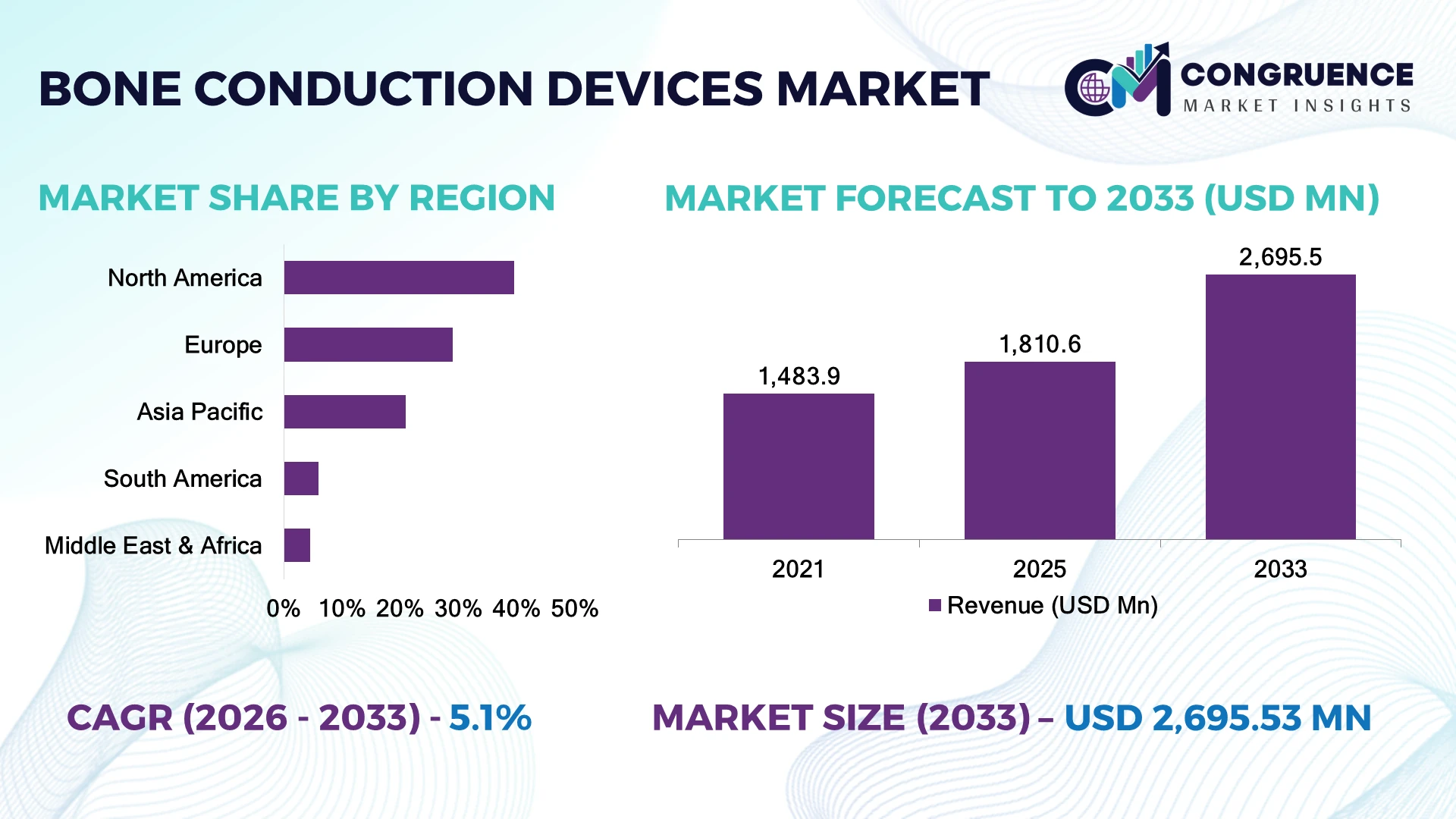
The Global Bone Conduction Devices Market was valued at USD 1,810.6 Million in 2025 and is anticipated to reach a value of USD 2,695.5 Million by 2033 expanding at a CAGR of 5.1% between 2026 and 2033. Growth is driven by wider adoption of implantable and non-implantable bone-conduction hearing solutions, increasing treatment of conductive and mixed hearing loss, and integration of wireless connectivity into assistive hearing devices.
The U.S. accounts for approximately 34% of global bone conduction device demand, supported by advanced audiology networks, implant centers, and established reimbursement pathways. The country also hosts major hearing-technology developers, while Germany and the U.K. maintain strong European clinical adoption. Approximately 25–30% of newer premium devices incorporate advanced wireless connectivity, reflecting the shift toward smartphone-linked hearing ecosystems. Ongoing healthcare localization and semiconductor supply-chain restructuring are further influencing component sourcing.
Strategically, manufacturers should prioritize miniaturized wireless platforms, clinical partnerships, and scalable implantable-device infrastructure in high-adoption markets.
Market Size & Growth: USD 1.81 billion in 2025 to USD 2.70 billion by 2033 at 5.1% CAGR, supported by implantable hearing solutions and wireless connectivity.
Top Growth Drivers: Conductive hearing loss treatment, pediatric hearing rehabilitation, and wireless-enabled devices account for approximately 20%, 15%, and 12% of growth influence.
Short-Term Forecast: By 2028, digital fitting and wireless programming can reduce selected clinical adjustment time by 15–25% and improve follow-up efficiency by 10–15%.
Emerging Technologies: Active transcutaneous implants, magnetic coupling, Bluetooth-enabled processors, remote programming, and improved piezoelectric transducers are reshaping device performance.
Regional Leaders: North America is projected near USD 1.0 billion, Europe around USD 0.75 billion, and Asia Pacific approximately USD 0.60 billion by 2033, with Asia Pacific showing faster pediatric and clinical adoption.
Consumer/End-User Trends: Approximately 25–30% of premium non-implantable devices increasingly incorporate wireless smartphone connectivity, strengthening demand for digitally integrated hearing ecosystems.
Pilot/Case Example: In 2025–2026, clinical adoption of active transcutaneous systems demonstrated the value of lower-profile implant architectures, with selected workflows reducing visible external hardware and improving patient acceptance.
Competitive Landscape: Cochlear leads the advanced implantable segment, competing with MED-EL, Oticon Medical, Medtronic, and specialized wireless bone-conduction manufacturers.
Regulatory & ESG Impact: Greater emphasis on biocompatibility, MRI compatibility, battery safety, and long-term implant reliability is increasing validation requirements while supporting longer device lifecycles.
Investment & Funding: More than USD 100 million in recent industry investment and strategic development activity is directed toward implantable hearing technology, wireless processors, clinical infrastructure, and next-generation auditory interfaces.
Innovation & Future Outlook: 2026–2028 competition will shift toward smaller implants, improved magnetic coupling, AI-assisted fitting, remote clinical support, and seamless smartphone integration.
Bone conduction devices are gaining traction across conductive hearing loss, mixed hearing loss, single-sided deafness, pediatric rehabilitation, and users unable to tolerate conventional ear-canal devices. Wireless connectivity now appears across roughly 25–30% of premium product offerings, while magnetic coupling and slimmer processors improve usability. In 2026, manufacturers are also strengthening component localization and clinical-service networks as semiconductor and medical-device supply chains become more regionally diversified.
Bone conduction technology is becoming strategically important because it expands hearing rehabilitation beyond conventional air-conduction devices and creates specialized treatment pathways for patients with conductive, mixed, or single-sided hearing loss. Competition is shifting from basic vibration transmission toward discreet implant architectures, wireless connectivity, digital fitting, and patient-centered device design. Pediatric audiology and implant centers remain particularly important adoption channels.
Active transcutaneous systems provide a meaningful technology advantage over older percutaneous configurations by eliminating a permanent skin-penetrating abutment, reducing selected maintenance requirements and improving cosmetic integration. Wireless processors further connect hearing rehabilitation with smartphones and remote clinical workflows. North America remains the strongest commercial market, while Germany, the U.K., Japan, South Korea, and Australia maintain sophisticated clinical adoption and specialist infrastructure.
Between 2026 and 2028, manufacturers will prioritize smaller implant profiles, improved magnetic coupling, remote programming, rechargeable processors, and AI-assisted fitting. Companies are expanding clinical partnerships and audiology training while developing integrated hardware-software platforms. The strategic advantage will favor manufacturers that combine implant reliability, comfortable sound transmission, wireless interoperability, and strong clinical support rather than competing solely on processor specifications.
Wireless connectivity is becoming a core differentiator as approximately 25–30% of premium bone conduction devices incorporate smartphone connectivity, Bluetooth streaming, or app-based controls. Digital fitting and remote adjustment can reduce selected follow-up workload by 15–25%, improving audiology-clinic efficiency. In the U.S., established implant centers and pediatric hearing programs are accelerating adoption of digitally configurable processors. Manufacturers are responding through Bluetooth-enabled processors, rechargeable architectures, remote-care platforms, and partnerships with audiology networks. The non-obvious advantage is ecosystem retention: smartphone compatibility increases daily device interaction and gives manufacturers a pathway to software-supported services rather than relying solely on hardware replacement cycles.
Implantable bone conduction systems face substantial cost and infrastructure barriers, with total treatment pathways typically requiring surgery, specialist fitting, follow-up, and device programming. Surgical and clinical components can represent 40–60% of the overall treatment pathway in less-developed healthcare systems, while specialist audiology capacity remains concentrated in major cities. In India and parts of Southeast Asia, limited implant-center availability can extend patient referral and treatment timelines by 20–30%. Manufacturers are addressing access constraints through distributor networks, clinician training, regional service centers, and lower-complexity non-implantable alternatives. The key commercial pressure is that superior device performance does not automatically translate into adoption where reimbursement, specialist capacity, and surgical infrastructure remain limited.
Pediatric hearing rehabilitation and single-sided deafness represent important expansion opportunities because bone conduction bypasses dysfunctional outer or middle-ear pathways. Children can account for approximately 15–25% of selected implant-program volumes, while single-sided hearing loss is creating demand for discreet wireless processors. Magnetic coupling and smaller implant profiles can reduce visible external hardware by approximately 20–30%, improving user acceptance. Companies are investing in pediatric clinical partnerships, remote programming, and processor miniaturization, particularly in the U.S., Germany, Japan, and Australia. The non-obvious opportunity is lifecycle management: pediatric patients generate recurring requirements for processor upgrades, fitting adjustments, accessories, and rehabilitation support, making clinical ecosystem development as important as initial implant placement.
Scaling bone conduction technologies requires coordinated surgical, audiological, rehabilitation, and software capabilities, creating execution complexity beyond conventional consumer audio products. Specialist fitting and post-operative programming can account for 15–25% of clinical workflow requirements, while inadequate calibration can materially reduce perceived sound quality and patient satisfaction. Increasing wireless functionality also introduces interoperability and cybersecurity requirements, particularly for smartphone-connected processors and remote-care platforms. Companies must standardize clinical protocols, expand audiologist training, strengthen software validation, and establish regional service infrastructure. In the U.S., Germany, and Japan, established specialist networks provide an advantage; emerging markets require deeper distributor and hospital partnerships. The long-term competitive risk is inconsistent patient outcomes across markets, not merely manufacturing scalability.
Processors Become More Connected: Bluetooth streaming and smartphone controls are increasingly standard in premium products, with approximately 25–30% of higher-end devices incorporating advanced wireless functionality. Remote fitting can reduce selected clinic follow-up workload by 15–25%. Manufacturers are integrating mobile applications and rechargeable processors, transforming bone conduction devices from standalone hearing hardware into connected assistive platforms.
Magnetic Designs Improve Acceptance: Active transcutaneous systems are gaining attention because magnetic coupling removes the permanent skin-penetrating abutment used by traditional percutaneous architectures. Newer configurations can reduce visible external hardware by approximately 20–30% and simplify selected maintenance routines. Manufacturers are refining magnet strength, implant profiles, and processor ergonomics to improve comfort without sacrificing acoustic performance.
Pediatric Programs Get Specialized: Pediatric patients represent approximately 15–25% of selected implant-program volumes, encouraging manufacturers to redesign processors around smaller form factors, secure retention, and simplified fitting. U.S. and European audiology centers are expanding multidisciplinary rehabilitation pathways. Companies are strengthening clinical training and family-support programs because long-term patient engagement influences processor upgrades, accessory demand, and treatment continuity.
Supply Chains Move Local: Medical-device manufacturers are increasing regional sourcing of electronics, batteries, magnets, and precision components as semiconductor and logistics disruptions continue influencing procurement. Localized or dual-source strategies can reduce single-supplier exposure by approximately 15–25%. Companies are qualifying alternative component suppliers and building regional inventories, making supply resilience increasingly important for maintaining implant and processor availability.
Implantable bone conduction devices account for approximately 58% of market value, supported by stronger clinical performance, direct or transcutaneous coupling, and suitability for patients who cannot benefit adequately from conventional hearing aids. Non-implantable devices retain roughly 42% of demand because they offer lower upfront costs, simpler fitting, and easier use for temporary or pediatric rehabilitation. Implantable systems command a higher value contribution despite lower unit volumes because surgical placement, specialized processors, and clinical follow-up increase system value. Companies are therefore expanding implant portfolios while improving magnetic coupling, processor miniaturization, and wireless connectivity.
Active transcutaneous systems represent the fastest-growing type, with adoption supported by improved cosmetic integration and reduced skin-management requirements. Their share within implantable deployments is estimated at approximately 30–35%, while newer processors can reduce visible external hardware by around 20–30%. Non-implantable manufacturers are responding with lighter processors and improved retention systems, but investment is increasingly shifting toward clinically integrated implant platforms.
Conductive and mixed hearing loss represents approximately 55% of bone conduction device applications, making it the dominant clinical indication because bone-conduction systems bypass dysfunctional outer- or middle-ear pathways. Single-sided deafness accounts for roughly 25%, while other specialized indications represent the remaining demand. Conductive and mixed-loss patients typically require clinically established rehabilitation pathways, whereas single-sided deafness increasingly attracts demand for discreet, wireless solutions. Companies are expanding processor options and clinical fitting programs to address different anatomical and hearing profiles.
Single-sided deafness is the fastest-growing application, supported by improved wireless processors, directional signal processing, and greater awareness of rehabilitation options. Approximately 25–30% of newer premium product development increasingly targets enhanced spatial-awareness and connectivity features relevant to these users. Pediatric applications remain strategically important because early intervention can require longer-term processor upgrades and rehabilitation support. Manufacturers are therefore building partnerships with audiology centers and expanding application-specific fitting protocols.
Hospitals and specialized implant centers account for approximately 48% of bone conduction device demand, reflecting their role in surgical implantation, multidisciplinary assessment, fitting, and post-operative rehabilitation. Audiology clinics contribute roughly 32%, particularly for device selection, programming, and non-implantable systems, while individual and home-based users represent approximately 20%. Hospital procurement prioritizes clinical evidence, device reliability, surgical compatibility, and long-term service support, whereas clinics place greater emphasis on fitting flexibility and processor connectivity. Companies are responding with clinician-training programs, hospital partnerships, and integrated surgical-to-audiology support.
Audiology clinics are the fastest-growing end-user channel as wireless programming and remote-support capabilities expand the role of outpatient providers. Digital fitting can reduce selected adjustment and follow-up workloads by approximately 15–25%, allowing clinics to manage more patients without proportional increases in staffing. Home-based use is also expanding through smartphone-connected processors and remote assistance. Manufacturers increasingly target clinics with training, software platforms, and bundled service programs, while hospital partnerships remain essential for implant adoption and referral generation.
North America accounted for the largest market share at approximately 39.5% in 2025 however, Asia-Pacific is expected to register the fastest growth, expanding at a CAGR of approximately 7.0% between 2026 and 2033.
Clinical infrastructure strengthens implantable-device adoption
North America represents approximately 39.5% of global bone conduction device demand, supported by established cochlear-implant centers, audiology networks, pediatric rehabilitation programs, and strong reimbursement infrastructure. The U.S. accounts for the majority of regional consumption and hosts extensive clinical infrastructure for conductive and mixed hearing loss. Implantable systems represent approximately 58% of market value, reflecting the region's preference for clinically integrated solutions. Manufacturers are strengthening hospital partnerships, surgeon training, remote fitting capabilities, and wireless processor portfolios. Active transcutaneous systems are gaining attention because they improve cosmetic integration and reduce skin-management requirements. The region also benefits from mature medical-device regulation and high specialist density, allowing manufacturers to introduce advanced processors and implant platforms faster than in less-developed healthcare systems.
U.S. Market Outlook: The U.S. remains the principal commercial and clinical market, supported by a large network of implant centers, audiologists, ENT specialists, and pediatric hearing programs. Approximately 25–30% of premium processor offerings now emphasize advanced wireless connectivity, strengthening smartphone-based hearing management. Manufacturers are expanding clinician education, remote programming, and reimbursement support to accelerate adoption beyond major metropolitan implant centers.
Specialist audiology networks support premium device adoption
Europe accounts for approximately 29% of global bone conduction device demand, with Germany, the U.K., France, Italy, and the Nordic countries providing strong clinical adoption. Established public healthcare systems and specialist audiology services support both pediatric and adult rehabilitation. Germany and the U.K. are particularly important for implantable technologies, while Nordic markets demonstrate strong adoption of digitally connected hearing solutions. Approximately 25–30% of premium devices increasingly incorporate wireless connectivity and smartphone integration. Manufacturers are strengthening hospital relationships, clinician training, and digital fitting capabilities. European regulatory requirements also favor established manufacturers with robust clinical documentation, biocompatibility validation, cybersecurity controls, and long-term post-market support.
Germany Market Outlook: Germany is a leading European market because of its sophisticated ENT, audiology, and medical-device infrastructure. Specialist implant centers support complex patient assessment and post-operative rehabilitation, while established reimbursement pathways facilitate access to advanced hearing technologies. Active transcutaneous systems are gaining clinical attention, and approximately 25% of premium device configurations increasingly emphasize wireless connectivity, digital fitting, and smartphone-linked functionality.
Healthcare modernization accelerates specialist hearing adoption
Asia-Pacific accounts for approximately 21% of global bone conduction device demand, with Japan, China, Australia, and South Korea representing the strongest markets. Japan combines advanced audiology infrastructure with domestic medical-device expertise, while Australia has mature implant and pediatric hearing programs. China is expanding specialist ENT and audiology capacity as healthcare infrastructure modernizes. Implantable systems remain concentrated in major metropolitan hospitals, while non-implantable devices provide broader access where surgical infrastructure is limited. Approximately 20–25% of premium processor offerings increasingly incorporate wireless connectivity. Manufacturers are responding through local distribution partnerships, clinician training, localized service centers, and competitively priced processor configurations.
Japan Market Outlook: Japan is strategically important because of its advanced medical-device manufacturing base, aging population, and sophisticated ENT and audiology infrastructure. Domestic technology capabilities support precision components, miniaturized electronics, and hearing-device development. Approximately 20–25% of premium hearing-device configurations increasingly incorporate wireless connectivity and digital controls. Manufacturers are emphasizing compact processors, clinical partnerships, and technology integration suited to Japan's highly developed healthcare environment.
Specialist-center concentration shapes market access
South America represents approximately 6% of global bone conduction device demand, with Brazil accounting for roughly 55–60% of regional consumption. Demand is concentrated in major urban hospitals, ENT centers, pediatric audiology programs, and private healthcare networks. Implantable devices remain concentrated in specialist facilities because surgical capability and reimbursement access vary substantially between urban and secondary markets. Non-implantable systems therefore maintain an important role in broader patient access. Approximately 15–20% of premium product offerings increasingly emphasize wireless connectivity, creating differentiation in private audiology channels. Manufacturers are strengthening distributor networks, clinician training, and local technical support to reduce service gaps. Brazil provides the strongest expansion platform because of its larger specialist infrastructure and established hearing-care ecosystem.
Brazil Market Outlook: Brazil is the region's most significant market due to its concentration of hospitals, ENT specialists, audiology clinics, and pediatric rehabilitation services. Major metropolitan areas account for a substantial share of implant procedures and specialist fittings. Approximately 15–20% of premium devices increasingly feature wireless connectivity, supporting demand for digitally integrated hearing care. Manufacturers are expanding distributor coverage and clinician partnerships to reach secondary cities and improve post-fitting support.
Premium healthcare investment expands specialist capacity
Middle East & Africa accounts for approximately 4.5% of global bone conduction device demand, with Saudi Arabia, the UAE, Israel, and South Africa representing the most significant markets. Gulf countries are expanding advanced hospital infrastructure, ENT departments, and pediatric hearing services, creating demand for implantable and digitally connected hearing technologies. Saudi Arabia and the UAE increasingly prioritize specialist medical equipment within premium hospital developments. Approximately 15–20% of new premium hearing-device procurement increasingly emphasizes wireless connectivity and remote-care functionality. Israel contributes specialized medical-device and hearing-technology capabilities, while South Africa provides an important gateway for sub-Saharan distribution. Manufacturers are establishing hospital partnerships, specialist training programs, and regional technical-service networks.
Saudi Arabia Market Outlook: Saudi Arabia is the region's strongest investment market because healthcare modernization is expanding specialist ENT, audiology, and pediatric rehabilitation infrastructure. New premium hospital facilities increasingly incorporate advanced hearing diagnostics and implant-support capabilities. Approximately 15–20% of premium procurement priorities increasingly include digitally connected hearing technologies. Manufacturers are targeting the market through distributor partnerships, clinical training, local technical support, and hospital-level collaborations that improve access to specialized bone conduction solutions.
Cochlear, MED-EL, and Oticon Medical compete as global implant leaders, while regional distributors and audiology specialists compete for access and service contracts. The top five players hold approximately 70% of market value, creating a concentrated technology-led structure. Premium systems command roughly 25–30% positioning premiums through wireless connectivity, while vertical supply integration can reduce procurement exposure by 10–20%. Players compete through implant innovation, surgeon training, hospital partnerships, processor upgrades, and localized technical support. The competitive shift is moving from percutaneous hardware toward active transcutaneous systems, rechargeable processors, and software-enabled remote fitting. Entry barriers remain high because clinical evidence, regulatory clearance, specialist networks, reimbursement, and long-term service capability must be established simultaneously. Smaller entrants face pressure from installed clinical ecosystems and switching costs. Winning requires superior implant reliability, differentiated signal processing, strong connectivity, efficient fitting workflows, and scalable after-sales infrastructure that converts clinical performance into broader specialist adoption and durable customer relationships.
Active transcutaneous implants are becoming the key technology shift, using piezoelectric stimulation and magnetic coupling to transmit sound without a permanent skin-penetrating abutment. These architectures can reduce visible hardware exposure by roughly 20–30% versus older percutaneous configurations while lowering skin-management demands by about 15–25%. Adoption is strongest in premium implant programs, where approximately 30–35% of implant-focused development increasingly targets active transcutaneous platforms. Wireless processors, Bluetooth, smartphone streaming, LE Audio, and Auracast are becoming core integration features, with connectivity present in roughly 25–30% of premium configurations. This improves fitting flexibility and user engagement while enabling selected remote-care workflows to reduce follow-up workload by 15–25%. Rechargeable lithium-ion processors add another efficiency layer, reducing battery replacement requirements and supporting compact industrial designs.
Compared with legacy disposable-battery processors, rechargeable platforms can deliver up to 30 hours of operation per charge in newer systems. Between 2026 and 2028, remote fitting, digital logging, automated personalization, and interoperability will shift competition toward software-enabled ecosystems. Cochlear and other established implant leaders benefit most because installed clinical networks accelerate adoption, while smaller entrants face higher validation, integration, and clinician-training costs across markets materially through 2028. The winning technology stack combines reliable implants, compact processors, connectivity, and efficient clinical workflows.
April 2024 Cochlear received FDA clearance to lower Osia eligibility from 12 to 5 years, expanding pediatric indications for conductive, mixed, and single-sided deafness. The change broadens addressable patients and strengthens pediatric implant adoption across specialist hearing centers. Source: cochlear.com
June 2025 Oticon Medical received Australian TGA clearance for Sentio, its active transcutaneous bone conduction system. The company described Sentio 1 Mini as the smallest transcutaneous system available, strengthening its competitive position in skin-intact implantation and specialist adoption. Source: oticonmedical.com
September 2025 MED-EL secured Belgian reimbursement for BONEBRIDGE, covering unilateral and bilateral implantation from September 1. The approval makes BONEBRIDGE the first active bone conduction implant reimbursed nationally, improving patient access and supporting implant-center adoption across Belgium immediately. Source: medel.com
July 2026 Cochlear introduced the Osia 3 processor following FDA clearance, adding up to 30 hours of battery life and expanded Bluetooth LE Audio and Auracast connectivity. The launch strengthens rechargeable, connected processor competition and premium differentiation globally. Source: fda.gov Access Data
The report covers implantable and non-implantable bone conduction devices across conductive and mixed hearing loss, single-sided deafness, pediatric hearing rehabilitation, and related clinical applications. End-user coverage includes hospitals, specialized implant centers, audiology clinics, rehabilitation facilities, and individual users. Implantable systems account for approximately 58% of market value, while wireless connectivity is increasingly concentrated in premium processor configurations.
Geographic coverage spans North America, Europe, Asia-Pacific, South America, and Middle East & Africa, with detailed country-level analysis of major adoption and infrastructure markets. Key technology coverage includes active transcutaneous systems, magnetic coupling, piezoelectric stimulation, wireless processors, Bluetooth connectivity, rechargeable platforms, remote fitting, and digital personalization. The report supports investment planning, market-entry decisions, manufacturing and distribution expansion, competitive positioning, clinical-partnership strategy, and technology prioritization through 2026–2033.
| Report Attribute/Metric | Report Details |
|---|---|
|
Market Revenue in 2025 |
USD 1,810.6 Million |
|
Market Revenue in 2033 |
USD 2,695.5 Million |
|
CAGR (2026 - 2033) |
5.1% |
|
Base Year |
2025 |
|
Forecast Period |
2026 - 2033 |
|
Historic Period |
2021 - 2025 |
|
Segments Covered |
By Type
By Application
By End-User
|
|
Key Report Deliverable |
Revenue Forecast, Growth Trends, Market Dynamics, Segmental Overview, Regional and Country-wise Analysis, Competition Landscape |
|
Region Covered |
North America, Europe, Asia-Pacific, South America, Middle East, Africa |
|
Key Players Analyzed |
Cochlear Limited, MED-EL GmbH, Oticon Medical, Sonova Group, WS Audiology, Demant A/S, Starkey, Zounds Hearing, Sophono, BHM-Tech Produktionsgesellschaft, Sentient Medical, Ear Technology Corporation |
|
Customization & Pricing |
Available on Request (10% Customization is Free) |




