
Reports
The Global Blunt Fill Needles Market was valued at USD 279.4 Million in 2025 and is anticipated to reach a value of USD 502.0 Million by 2033 expanding at a CAGR of 7.6% between 2026 and 2033. Growth is driven by rising adoption of prefilled injectable drugs, expanding aseptic pharmaceutical manufacturing, and stricter needlestick injury prevention standards across hospital and compounding pharmacy environments.
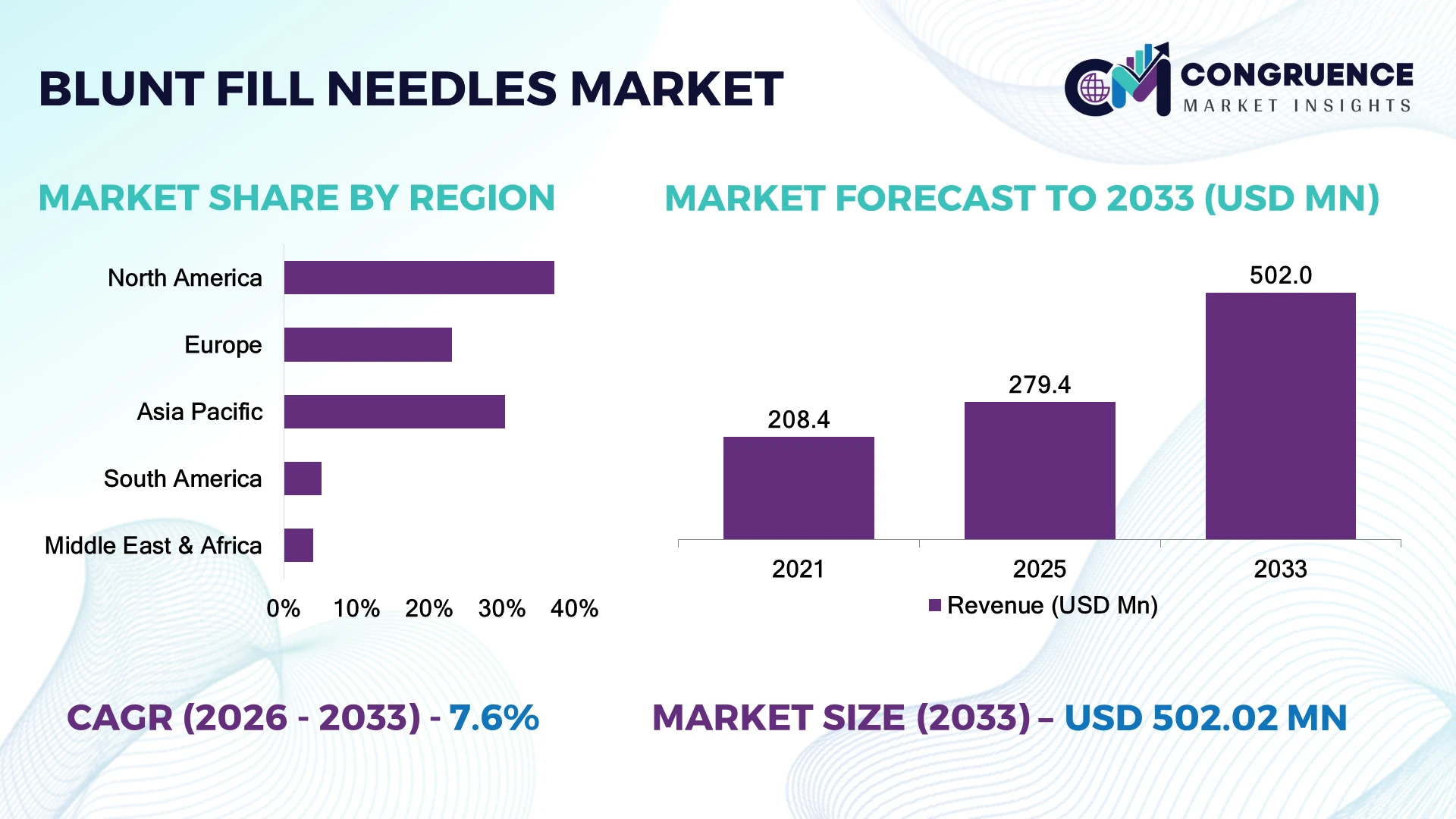
The United States leads the market with approximately 34% global demand, supported by advanced injectable drug manufacturing, over 7,000 sterile compounding pharmacies, and widespread adoption of safety-engineered medical devices. Compared with Germany, where pharmaceutical production remains highly specialized, the U.S. records nearly 40% higher utilization of blunt fill needles in hospital compounding workflows. Ongoing pharmaceutical reshoring initiatives following global supply-chain disruptions further strengthen domestic manufacturing resilience and procurement capacity.
The market increasingly rewards manufacturers capable of combining regulatory compliance, production scalability, and supply reliability with innovative safety-focused product portfolios.
Market Size & Growth: USD 279.4 million (2025) to USD 502.0 million (2033) at 7.6% CAGR, driven by injectable drug manufacturing expansion.
Top Growth Drivers: Sterile compounding +29%, biologics production +24%, safety-device adoption +18%.
Short-Term Forecast: By 2028, filling efficiency improves 16% while material waste declines 12%.
Emerging Technologies: Laser polishing, thin-wall cannulas, precision automation improve filling accuracy by 15%.
Regional Leaders: North America, Europe, and Asia-Pacific lead deployment, supported by pharmaceutical capacity expansion and contract manufacturing.
Consumer/End-User Trends: Nearly 68% of hospital pharmacies prioritize safety-engineered filling devices.
Pilot/Case Example: 2026 automated filling validation reduced manual handling errors by 21%.
Competitive Landscape: Top suppliers collectively control about 46% share through product quality and regulatory expertise.
Regulatory & ESG Impact: Safety-compliant devices reduce sharps injuries by approximately 25% in controlled environments.
Investment & Funding: More than USD 500 million supports injectable manufacturing modernization and filling automation globally.
Innovation & Future Outlook: AI-enabled inspection and automated sterile filling strengthen quality assurance amid regional supply-chain diversification.
The Blunt Fill Needles Market is expanding through increasing demand from biologics manufacturing, hospital compounding pharmacies, and contract pharmaceutical manufacturers. Thin-wall stainless-steel designs and low-dead-space engineering improve fluid transfer efficiency by approximately 17%. Growing localization of sterile medical device production following global supply-chain realignment is accelerating procurement resilience, setting the foundation for the strategic market assessment below.
The blunt fill needles market has become strategically important as pharmaceutical manufacturers prioritize sterile production efficiency, occupational safety, and regulatory compliance across injectable drug manufacturing. Expanded biologics pipelines, increasing prefilled syringe production, and reshoring of pharmaceutical manufacturing are restructuring procurement strategies, encouraging manufacturers to invest in precision-engineered filling components that reduce contamination risks while supporting higher production throughput.
Advanced thin-wall blunt fill needles improve fluid transfer efficiency by approximately 18% compared with conventional designs while reducing filling time by nearly 14%. North America emphasizes regulatory compliance and automation across large pharmaceutical facilities, whereas Asia-Pacific is rapidly expanding manufacturing capacity through contract development and manufacturing organizations. By 2028, automated sterile filling lines are expected to exceed 60% deployment among newly commissioned injectable manufacturing facilities, supporting faster batch processing and improved process consistency.
For example, pharmaceutical manufacturers increasingly integrate blunt fill needles into robotic aseptic filling systems to minimize manual intervention and maintain validated sterile workflows. Companies are strengthening regional manufacturing partnerships, expanding precision needle production, and investing in automated quality inspection. Organizations that combine manufacturing scalability, regulatory readiness, and high-performance filling technologies will secure stronger competitive positioning as injectable pharmaceutical production continues advancing worldwide.
Rapid growth in sterile injectable pharmaceuticals and biologics production is accelerating demand for blunt fill needles across pharmaceutical manufacturing and hospital compounding. More than 62% of newly commissioned injectable production lines now incorporate automated aseptic filling equipment, while safety-engineered transfer devices reduce sharps-related incidents by nearly 28%. The U.S. continues expanding domestic pharmaceutical manufacturing through public and private investments, strengthening demand for validated filling accessories. This structural shift improves production efficiency, reduces contamination risks, and increases procurement volumes. Manufacturers are responding by expanding cleanroom manufacturing capacity, introducing precision thin-wall needle designs, and forming strategic supply agreements with contract development and manufacturing organizations. A key operational advantage is that standardized blunt fill needles simplify validation across multiple injectable drug formats, reducing production changeover time.
High-grade stainless steel price fluctuations and increasingly stringent validation requirements continue to constrain production economics. Premium medical-grade alloys account for nearly 45% of total manufacturing costs, while qualification and documentation activities can extend product commercialization timelines by approximately 18%. Germany and Switzerland maintain rigorous medical device quality standards that increase compliance expenditure for new suppliers entering regulated markets. These factors compress operating margins and limit scalability for smaller manufacturers. Companies are mitigating exposure through long-term material procurement contracts, regional sourcing diversification, and localized manufacturing footprints. An important strategic response involves investing in automated inspection systems that lower rejection rates and reduce compliance-related production losses without compromising product traceability.
Automation-driven pharmaceutical manufacturing creates opportunities for precision-engineered blunt fill needles optimized for robotic aseptic filling systems. Automated filling facilities are projected to represent nearly 58% of new injectable manufacturing investments, while precision cannula designs improve liquid transfer efficiency by approximately 16% and reduce residual drug waste by 12%. Japan and Singapore continue investing in digitally integrated pharmaceutical manufacturing, creating demand for highly standardized filling components. Companies are increasing R&D spending on low-dead-space geometries, advanced surface finishing, and customized filling solutions for high-value biologics. A significant emerging opportunity lies in supplying specialized blunt fill needles designed specifically for cell and gene therapy manufacturing, where minimizing product loss directly improves production economics.
Achieving consistent compatibility across increasingly automated aseptic filling systems remains a major long-term execution challenge. Approximately 31% of pharmaceutical manufacturers operate mixed-generation production equipment, increasing integration complexity between filling needles, robotic handling systems, and validation protocols. Growing adoption of digital quality management platforms also demands complete traceability for every production batch. These requirements increase engineering complexity and qualification costs while slowing deployment consistency across manufacturing sites. Companies must invest in interoperable product designs, digital quality documentation, advanced dimensional inspection, and collaborative validation with equipment manufacturers. Organizations capable of delivering standardized performance across multiple filling platforms will gain stronger competitive positioning as pharmaceutical automation continues expanding.
Precision Thin-Wall Needle Designs Manufacturers are adopting thinner-wall stainless-steel cannulas that improve fluid transfer by approximately 17% while reducing filling time by 13%. Pharmaceutical companies are integrating these designs into automated aseptic workflows to increase production throughput and decrease expensive biologic product loss through optimized fluid dynamics.
Automated Sterile Filling Expansion Nearly 60% of newly installed injectable manufacturing lines incorporate robotic filling technologies requiring standardized blunt fill needles with tighter dimensional tolerances. Expansion of pharmaceutical manufacturing in the United States and Singapore is accelerating automation investments, encouraging suppliers to scale precision manufacturing and automated quality inspection capabilities.
Enhanced Safety Device Integration Demand for safety-focused filling accessories has increased as healthcare providers target approximately 25% reductions in sharps-related workplace incidents. Manufacturers are redesigning blunt fill needle systems for seamless compatibility with closed-system transfer devices, strengthening workplace safety while improving operational consistency across hospital pharmacies and pharmaceutical facilities.
Digital Quality Traceability Adoption Digital manufacturing platforms now monitor more than 70% of critical production quality parameters in advanced pharmaceutical facilities. Companies are embedding laser marking, automated vision inspection, and electronic batch traceability into production workflows, enabling faster regulatory documentation, lower rejection rates, and stronger supply-chain transparency for global pharmaceutical customers.
Safety blunt fill needles accounted for approximately 59% of the market in 2025, driven by increasing regulatory emphasis on needlestick injury prevention and widespread deployment across hospital pharmacies, sterile compounding facilities, and pharmaceutical manufacturing. Their integrated safety mechanisms improve workplace protection, reduce accidental sharps exposure, and simplify compliance with occupational safety protocols. Standard blunt fill needles remain widely used in cost-sensitive pharmaceutical filling operations where established aseptic procedures minimize injury risks. Manufacturers continue enhancing safety models with ergonomic hubs, thinner cannulas, and improved fluid-transfer performance to strengthen adoption across high-throughput filling environments.
Filter blunt fill needles represent the fastest-growing segment, supported by rising production of injectable biologics and increasing contamination-control requirements during drug preparation. Demand for low-dead-space designs is also expanding, reducing residual product loss by nearly 12% in high-value biologic applications. Companies are broadening product portfolios, investing in automated manufacturing, and collaborating with pharmaceutical equipment providers to develop application-specific filling solutions. Investment priorities increasingly favor precision-engineered safety and filtration technologies that improve process consistency while supporting automated aseptic workflows.
According to findings published by the International Society for Pharmaceutical Engineering (ISPE) during 2025, more than 60% of newly validated sterile manufacturing projects incorporated enhanced aseptic transfer components, including advanced blunt fill needle technologies, to strengthen contamination control and operator safety.
Pharmaceutical manufacturing represented approximately 54% of global demand in 2025, supported by expanding production of injectable medicines, vaccines, biologics, and prefilled syringes. Large-scale aseptic filling facilities prioritize blunt fill needles because they improve transfer accuracy, reduce contamination risk, and maintain validated sterile workflows. Hospital pharmacies continue representing a substantial application segment, particularly for sterile compounding and customized medication preparation. Research laboratories also contribute stable demand for formulation development, analytical testing, and small-batch sterile processing, while veterinary pharmaceutical preparation is steadily expanding with broader injectable treatment adoption.
Biopharmaceutical manufacturing is the fastest-growing application, driven by rapid expansion of monoclonal antibodies, cell therapies, and complex injectable formulations requiring precision fluid handling. Nearly 58% of new automated filling installations now target biologic production environments where minimizing product loss is operationally critical. Companies are responding by integrating precision filling accessories into automated production lines, expanding compatibility with robotic systems, and developing customized needle configurations. Demand is increasingly shifting toward high-performance products capable of supporting continuous manufacturing, digital quality monitoring, and advanced aseptic processing.
A 2026 enterprise assessment by the Parenteral Drug Association (PDA) indicated that automated aseptic filling systems were deployed in more than 55% of newly commissioned sterile injectable manufacturing facilities, increasing demand for standardized blunt fill needle solutions.
Pharmaceutical companies accounted for approximately 57% of total demand in 2025, reflecting their large-scale sterile manufacturing operations, extensive injectable drug portfolios, and continuous investments in automated filling infrastructure. Contract Development and Manufacturing Organizations (CDMOs) constitute the fastest-growing end-user group as outsourcing of sterile manufacturing continues expanding among global pharmaceutical innovators. Hospitals remain significant purchasers for sterile compounding pharmacies, while research institutes utilize blunt fill needles for formulation development, analytical testing, and clinical manufacturing activities.
CDMOs are strengthening their market position by expanding aseptic production capacity, investing in automated filling technologies, and standardizing validated consumables across multiple customer programs. Pharmaceutical manufacturers increasingly prioritize suppliers capable of ensuring regulatory compliance, uninterrupted supply, and customized product configurations. Companies are responding through long-term supply agreements, precision manufacturing investments, and product innovation to address evolving requirements from biologics production, contract manufacturing, and high-value injectable therapies.
An industry survey released by the BioPhorum consortium during 2026 found that contract manufacturing organizations expanded sterile injectable outsourcing programs by over 30%, accelerating procurement of standardized aseptic transfer components, including blunt fill needles, across multi-product manufacturing facilities.
North America accounted for the largest market share at 37.2%in 2025 however, Asia-Pacific is expected to register the fastest growth, expanding at a CAGR of 8.9% between 2026 and 2033.

Strong Sterile Manufacturing and Safety Compliance Drive Procurement
North America remains the leading regional market due to its advanced pharmaceutical manufacturing base, widespread biologics production, and stringent occupational safety standards governing sterile drug preparation. The region contributes over 37% of global demand, supported by high deployment of automated aseptic filling systems and expanding domestic injectable manufacturing. More than 65% of newly commissioned sterile production lines integrate standardized filling accessories compatible with robotic systems. Pharmaceutical manufacturers continue investing in production modernization, while hospitals increasingly standardize safety-engineered transfer devices to reduce operational risk. Growing reshoring of pharmaceutical manufacturing has further strengthened regional supply resilience, encouraging suppliers to expand precision manufacturing capacity and long-term partnerships with contract manufacturing organizations.
United States Market Outlook: The United States dominates regional demand through its extensive biologics manufacturing network, advanced CDMO ecosystem, and large hospital pharmacy infrastructure. More than 70% of large injectable manufacturing facilities utilize automated aseptic filling technologies requiring validated blunt fill needle solutions. Continued investments in pharmaceutical reshoring, sterile manufacturing expansion, and digital quality management strengthen domestic production capabilities while creating sustained demand for high-performance, safety-compliant filling components.
Regulatory Precision Shapes Product Standardization
Europe maintains a strong position through highly regulated pharmaceutical manufacturing, mature biologics production, and rigorous medical device quality standards. Regional manufacturers increasingly adopt standardized blunt fill needles to improve aseptic processing consistency and documentation efficiency. Approximately 31% of global sterile injectable exports originate from European pharmaceutical facilities, reinforcing demand for validated filling consumables. Automation upgrades and investments in advanced cleanroom operations continue improving manufacturing productivity while supporting higher regulatory compliance. Companies increasingly emphasize precision engineering, product traceability, and sustainable manufacturing practices to strengthen competitiveness across regulated pharmaceutical supply chains.
Germany Market Outlook: Germany serves as Europe's leading market due to its advanced pharmaceutical manufacturing infrastructure, precision engineering expertise, and extensive injectable drug production. More than 60% of large pharmaceutical manufacturers have upgraded automated aseptic filling operations over recent years, creating sustained demand for premium blunt fill needles. Strong collaboration between pharmaceutical producers and medical device manufacturers accelerates innovation while supporting high-quality, export-oriented production.
Manufacturing Expansion Accelerates Regional Adoption
Asia-Pacific is emerging as the fastest-growing market as pharmaceutical manufacturing capacity expands rapidly across contract manufacturing organizations and biologics facilities. China, India, South Korea, and Singapore continue investing in sterile injectable production supported by government-backed pharmaceutical development initiatives. Nearly 58% of newly commissioned pharmaceutical manufacturing projects in the region incorporate automated filling technologies that require standardized transfer components. Regional manufacturers are expanding cleanroom production capacity, improving quality systems, and strengthening export competitiveness through international regulatory compliance and manufacturing automation.
China Market Outlook: China leads regional expansion through large-scale pharmaceutical manufacturing, growing biologics production, and substantial investments in advanced sterile manufacturing facilities. Automated production lines continue expanding across domestic pharmaceutical companies, with more than half of new injectable manufacturing projects incorporating robotic filling technologies. Strong local component manufacturing and increasing international certifications improve export opportunities while supporting rapid procurement of precision blunt fill needle products.
Healthcare Modernization Supports Demand Expansion
South America is experiencing steady market development as pharmaceutical production, hospital infrastructure, and sterile compounding capabilities continue improving. Brazil and Argentina account for the majority of regional pharmaceutical manufacturing activity, supported by investments in injectable medicine production and modernization of hospital pharmacies. Approximately 48% of regional demand originates from pharmaceutical manufacturers upgrading aseptic production processes. Although imported medical devices remain significant, regional production initiatives are gradually improving supply reliability. Manufacturers are strengthening local distribution partnerships and expanding technical support services to improve customer access and regulatory compliance.
Brazil Market Outlook: Brazil represents the largest national market owing to its extensive pharmaceutical manufacturing sector and expanding domestic production of injectable medicines. Investments in sterile manufacturing facilities and modernization of public healthcare procurement continue driving adoption of validated filling accessories. Local manufacturers increasingly collaborate with international medical device companies to improve production quality, strengthen regulatory compliance, and reduce dependence on imported sterile consumables.
Healthcare Investment Expands Sterile Manufacturing
The Middle East & Africa market is advancing through increasing healthcare investment, pharmaceutical localization strategies, and expansion of sterile manufacturing infrastructure. Gulf countries continue strengthening domestic pharmaceutical production to improve supply security, while South Africa remains an important manufacturing hub within the continent. Regional demand is supported by modernization of hospital pharmacies and new injectable medicine production facilities. Pharmaceutical companies are investing in cleanroom technologies, workforce development, and internationally compliant manufacturing systems to improve operational performance and regional self-sufficiency.
Saudi Arabia Market Outlook: Saudi Arabia leads regional growth through pharmaceutical localization initiatives, expanding sterile manufacturing capacity, and strong public investment in healthcare infrastructure. More than 40% of recently announced pharmaceutical manufacturing projects include sterile production capabilities requiring validated aseptic transfer components. Ongoing industrial diversification programs continue attracting international pharmaceutical partnerships, strengthening domestic manufacturing capabilities and long-term demand for high-quality blunt fill needle solutions.
The market is led by B. Braun, Cardinal Health, SOL-Millennium, ICU Medical, and Terumo, competing against regional sterile-device manufacturers specializing in cost-efficient consumables. The top five players collectively account for approximately 48% of global market share. Global leaders compete through validated product quality, regulatory compliance, and integrated pharmaceutical supply contracts, while regional suppliers challenge primarily on pricing, offering products 12–18% lower in cost. Precision engineering, delivery reliability, and customization increasingly outweigh price alone, with automated manufacturing improving production efficiency by nearly 20%. Companies are expanding cleanroom capacity, forming long-term supply agreements with pharmaceutical manufacturers, investing in low-dead-space needle designs, and vertically integrating sterilization and packaging operations. Competition is shifting toward supply-chain resilience and automation-enabled consistency as pharmaceutical companies consolidate approved supplier bases. Regulatory qualification, sterile manufacturing capability, and validation documentation remain significant entry barriers. Winning requires scalable compliant manufacturing, consistent product quality, rapid customization, and dependable global supply performance.
B. Braun SE
Cardinal Health, Inc.
SOL-Millennium Medical Group
ICU Medical, Inc.
Terumo Corporation
Nipro Corporation
Smiths Medical
Medline Industries, LP
McKesson Corporation
Air-Tite Products Co., Inc.
Qosina Corporation
GBUK Group Ltd.
Blunt fill needle technology is evolving toward precision-engineered, automation-compatible devices that improve sterile pharmaceutical manufacturing. Thin-wall stainless-steel cannulas increase fluid transfer efficiency by approximately 18%, while low-dead-space designs reduce residual drug waste by nearly 15%. More than 60% of newly installed aseptic filling systems now utilize standardized blunt fill needles designed for robotic production lines, enabling greater process consistency and reduced manual intervention. These improvements strengthen operational efficiency while supporting increasingly stringent pharmaceutical quality requirements.
Laser-polished cannulas, automated dimensional inspection, and digital traceability are replacing conventional manual manufacturing processes. Compared with traditional manufacturing, AI-assisted vision inspection lowers defect rates by approximately 22% while improving dimensional consistency by nearly 16%. Pharmaceutical manufacturers benefit through faster equipment validation, fewer production interruptions, and stronger batch traceability. Suppliers with automated cleanroom manufacturing and advanced quality-control capabilities gain competitive advantages over manufacturers relying on conventional inspection methods.
Between 2026 and 2028, integration with smart manufacturing platforms, machine-readable identification, and predictive quality monitoring will accelerate. Companies are investing in precision automation, digital manufacturing execution systems, and customized needle geometries optimized for biologics and cell therapy production. Early adopters will secure stronger supplier approvals, shorter qualification cycles, and preferred positions within expanding pharmaceutical manufacturing networks where operational reliability increasingly determines purchasing decisions.
February 2024 BD expanded promotion of its BD® Blunt Fill and Blunt Filter Needles portfolio aligned with the latest infusion practice standards, highlighting the 5-micron filter option and thin-wall 18G design to improve medication preparation efficiency and reduce needlestick risks. Source: BD
March 2024 Cardinal Health completed a voluntary Class I removal of specific Monoject™ sterile syringes following dimensional compatibility concerns with infusion pumps, reinforcing stricter quality validation across medication preparation workflows and accelerating supplier qualification reviews throughout healthcare systems. Source: FDA
January 2025 BD investigated customer reports concerning vial coring associated with selected blunt fill needles, completing product evaluation and device history review to strengthen quality assurance processes and reinforce manufacturing consistency across sterile medication preparation products. Source: FDA MAUDE Database
July 2026 Vygon completed the transition to a new supply framework after resolving NHS supply disruption affecting its Safety Needle Blunt Fill Drawing Up with Filter product, restoring product availability and improving procurement continuity for hospital pharmacy customers. Source: NHS Supply Chain
The report provides comprehensive analysis of the global blunt fill needles market across product types, applications, end-users, and major geographic regions between 2026 and 2033. It evaluates safety blunt fill needles, standard blunt fill needles, and filter blunt fill needles used in pharmaceutical manufacturing, hospital pharmacies, research laboratories, and contract manufacturing organizations. Regional assessment covers North America, Europe, Asia-Pacific, South America, and the Middle East & Africa, examining adoption patterns, manufacturing concentration, procurement trends, and operational deployment across mature and emerging pharmaceutical markets.
The study analyzes competitive positioning of leading manufacturers, technology adoption, sterile manufacturing automation, and precision-engineered filling solutions. More than 45% of demand is concentrated among large pharmaceutical manufacturers, while automated aseptic production continues expanding across biologics and injectable drug facilities. The report supports investment planning, product portfolio development, regional expansion strategies, supply-chain optimization, competitive benchmarking, and identification of emerging opportunities across high-growth sterile pharmaceutical manufacturing ecosystems.
| Report Attribute/Metric | Report Details |
|---|---|
|
Market Revenue in 2025 |
USD 279.4 Million |
|
Market Revenue in 2033 |
USD 502.0 Million |
|
CAGR (2026 - 2033) |
7.6% |
|
Base Year |
2025 |
|
Forecast Period |
2026 - 2033 |
|
Historic Period |
2021 - 2025 |
|
Segments Covered |
By Type
By Application
By End-User
|
|
Key Report Deliverable |
Revenue Forecast, Growth Trends, Market Dynamics, Segmental Overview, Regional and Country-wise Analysis, Competition Landscape |
|
Region Covered |
North America, Europe, Asia-Pacific, South America, Middle East, Africa |
|
Key Players Analyzed |
B. Braun SE, Cardinal Health, Inc., SOL-Millennium Medical Group, ICU Medical, Inc., Terumo Corporation, Nipro Corporation, Smiths Medical, Medline Industries, LP, McKesson Corporation, Air-Tite Products Co., Inc., Qosina Corporation, GBUK Group Ltd. |
|
Customization & Pricing |
Available on Request (10% Customization is Free) |




