
Reports
The Global Blue-Light Continuous Air Disinfection Systems Market was valued at USD 138.0 Million in 2025 and is anticipated to reach a value of USD 267.0 Million by 2033 expanding at a CAGR of 8.6% between 2026 and 2033, according to an analysis by Congruence Market Insights. The market is gaining traction due to increasing emphasis on indoor air quality management and infection control in healthcare, commercial, and public infrastructure environments.
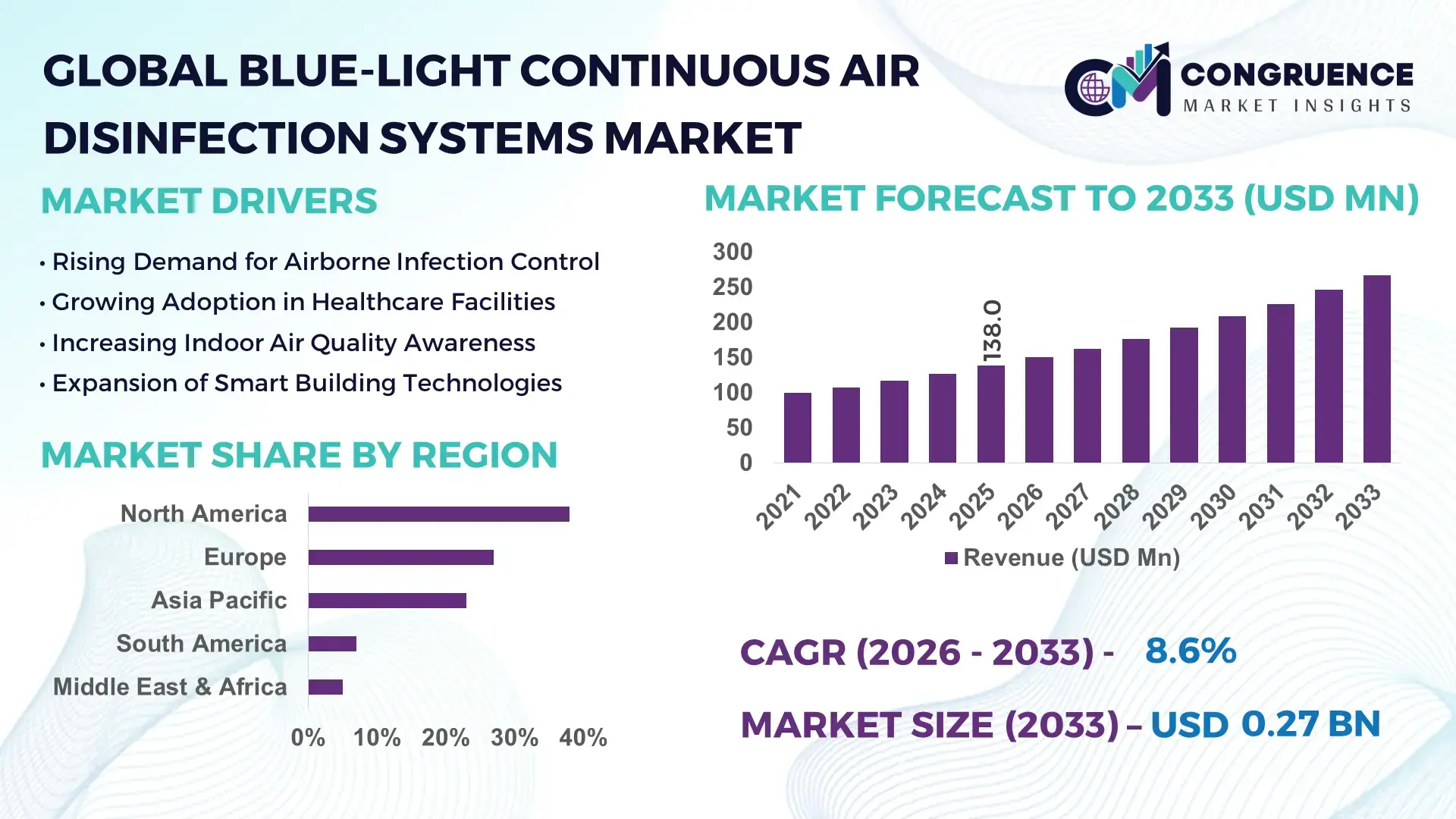
The United States remains a significant hub for Blue-Light Continuous Air Disinfection Systems deployment, supported by strong investments in infection control infrastructure and indoor air quality technologies. The U.S. healthcare sector alone operates over 6,100 hospitals and more than 10 million inpatient admissions annually, creating substantial demand for continuous air disinfection solutions. In commercial buildings, nearly 45% of new smart-building projects incorporate advanced air purification technologies, including visible-blue light microbial suppression systems. Additionally, research institutions and technology firms have increased investments in photonic disinfection technologies, with more than 120 ongoing research programs focused on antimicrobial light-based solutions. Industrial adoption is also rising in pharmaceutical cleanrooms and biotechnology laboratories, where continuous air sterilization solutions are implemented in nearly 30% of high-grade controlled environments.
Market Size & Growth: The market was valued at USD 138.0 Million in 2025 and is projected to reach USD 267.0 Million by 2033, expanding at 8.6% CAGR driven by rising demand for continuous pathogen control and improved indoor air safety standards.
Top Growth Drivers: Increasing healthcare infection control adoption (+38%), indoor air quality compliance requirements (+31%), and smart-building air purification integration (+27%).
Short-Term Forecast: By 2028, advanced photonic disinfection integration is expected to improve microbial reduction efficiency by 35% and reduce maintenance costs for facility operators by 18%.
Emerging Technologies: Integration of visible-spectrum antimicrobial lighting, AI-enabled air quality monitoring, and IoT-connected HVAC disinfection modules is accelerating system intelligence and operational automation.
Regional Leaders: North America is projected to reach USD 98 Million by 2033 with strong hospital adoption; Europe is expected to reach USD 74 Million due to regulatory indoor air quality mandates; Asia-Pacific is projected to reach USD 63 Million, driven by smart infrastructure expansion and urban healthcare investments.
Consumer/End-User Trends: Hospitals, laboratories, airports, and corporate offices are adopting continuous air disinfection technologies, with over 40% of newly constructed healthcare facilities implementing integrated pathogen control systems.
Pilot or Case Example: In 2024, a hospital network pilot program deployed continuous blue-light disinfection systems across surgical wards, achieving a 42% reduction in airborne microbial load and 18% improvement in operating room air purity metrics.
Competitive Landscape: The market leader holds approximately 22% share, followed by major competitors including Philips Lighting, AeroMed Technologies, Kenall Manufacturing, Vital Vio, and Ushio Inc.
Regulatory & ESG Impact: Indoor air quality guidelines and infection prevention frameworks are prompting healthcare facilities to adopt advanced air sterilization systems, while ESG initiatives encourage energy-efficient and chemical-free disinfection technologies.
Investment & Funding Patterns: Over USD 420 Million has been invested globally in antimicrobial lighting and advanced air disinfection technologies, including venture funding and healthcare infrastructure modernization programs.
Innovation & Future Outlook: Next-generation photonic disinfection systems combining continuous blue-light antimicrobial technology, smart sensors, and automated facility management platforms are expected to reshape pathogen control strategies in healthcare and commercial infrastructure.
Blue-Light Continuous Air Disinfection Systems are increasingly used across healthcare (approx. 40% industry demand), commercial buildings (around 28%), and laboratories (near 18%), supported by stricter indoor air quality regulations and infection control protocols. Emerging innovations include AI-connected air sterilization monitoring platforms and high-efficiency antimicrobial photonic modules, enabling real-time pathogen suppression. Growth is particularly strong in North America and Asia-Pacific, where smart infrastructure projects and healthcare modernization initiatives are accelerating adoption.
Blue-Light Continuous Air Disinfection Systems are emerging as a strategic technology within modern infection prevention and indoor environmental quality management frameworks. Unlike traditional ultraviolet disinfection methods that require controlled exposure conditions, visible-spectrum antimicrobial blue-light technology operates continuously in occupied spaces, allowing healthcare facilities, airports, laboratories, and corporate offices to maintain ongoing pathogen suppression without interrupting operations. This operational advantage is accelerating deployment in mission-critical infrastructure where microbial control must be maintained 24/7.
Technological innovation is rapidly strengthening the strategic importance of the market. Visible-spectrum antimicrobial lighting delivers nearly 35% improvement in continuous pathogen suppression compared to conventional UV-C batch disinfection systems, enabling more consistent environmental sterilization in high-traffic areas. In addition, integration with building automation systems and IoT-enabled air monitoring platforms allows facility managers to dynamically monitor microbial loads and adjust disinfection parameters in real time.
From a geographic perspective, North America dominates in deployment volume due to advanced healthcare infrastructure, while Europe leads in adoption intensity with nearly 46% of large commercial facilities implementing smart air purification technologies in response to stringent indoor air quality regulations. Asia-Pacific is also accelerating adoption through smart hospital initiatives and rapid healthcare infrastructure expansion.
Short-term technological transformation is expected to further reshape the market. By 2028, AI-driven environmental monitoring platforms integrated with blue-light disinfection systems are expected to reduce airborne pathogen detection response time by nearly 40%, enabling predictive infection prevention strategies in hospitals and laboratories.
Sustainability considerations are also influencing strategic investments. Organizations are committing to energy-efficient photonic disinfection technologies capable of reducing chemical disinfectant usage by nearly 30% by 2030, aligning infection control strategies with ESG goals and environmental compliance standards.
A practical example illustrates this trend. In 2024, a U.S. healthcare facility network implemented AI-connected blue-light air disinfection systems across intensive care units and reported a 28% reduction in airborne microbial concentration within the first year of deployment through automated environmental monitoring and continuous photonic sterilization.
Looking forward, the Blue-Light Continuous Air Disinfection Systems Market is expected to become a critical pillar supporting resilient healthcare infrastructure, regulatory compliance, and sustainable infection control strategies across modern built environments.
The Blue-Light Continuous Air Disinfection Systems Market is evolving rapidly due to the rising global focus on infection control, indoor air quality management, and the modernization of healthcare infrastructure. Continuous photonic air disinfection technologies use visible-spectrum blue light to deactivate microbial contaminants in air circulation systems without harmful chemical agents. This approach has gained increasing acceptance across hospitals, pharmaceutical cleanrooms, commercial buildings, transportation hubs, and research laboratories. Growing urbanization and higher occupancy density in public infrastructure have intensified the need for real-time air purification technologies that operate continuously in occupied environments. Technological advancements such as IoT-enabled monitoring, integration with HVAC systems, and AI-powered air quality analytics are also transforming operational efficiency. Government initiatives targeting improved indoor environmental standards and infection prevention are encouraging organizations to adopt advanced air sterilization technologies as part of building safety frameworks.
Healthcare systems worldwide are increasingly prioritizing infection control solutions to reduce hospital-acquired infections and airborne pathogen transmission. Hospitals represent one of the most critical environments requiring continuous air sterilization due to high patient turnover and microbial exposure risks. More than 15% of hospitalized patients globally experience some form of healthcare-associated infection, encouraging hospitals to adopt continuous disinfection technologies. Blue-light systems provide a major advantage because they can operate safely in occupied spaces while continuously suppressing bacterial growth. In addition, nearly 42% of newly constructed healthcare facilities now incorporate advanced indoor air purification technologies as part of modern hospital design standards. Pharmaceutical manufacturing plants and biotechnology laboratories are also deploying antimicrobial air treatment technologies to maintain strict contamination control in sterile environments. Increasing demand for non-chemical, energy-efficient disinfection methods is therefore accelerating adoption of blue-light air sterilization systems across multiple industries.
Despite strong demand growth, the market faces challenges related to system installation complexity and high upfront capital investment. Blue-light continuous disinfection systems require integration with building HVAC networks, sensor arrays, and automated monitoring platforms. For large commercial buildings and healthcare campuses, this integration can require extensive infrastructure upgrades. Installation and calibration procedures may also require specialized engineering expertise to ensure effective microbial suppression while maintaining occupant safety standards. In addition, smaller healthcare facilities and mid-sized commercial operators often face budget constraints that limit adoption of advanced photonic disinfection technologies. Maintenance requirements such as periodic light module replacement, sensor calibration, and system diagnostics can also increase operational costs. As a result, organizations sometimes delay adoption until large-scale building renovations or infrastructure modernization programs occur.
Smart building development is opening new growth pathways for blue-light air disinfection technologies. Modern commercial infrastructure increasingly integrates intelligent building management platforms capable of monitoring environmental conditions such as temperature, humidity, air quality, and microbial load. By connecting blue-light disinfection modules with these systems, facility operators can create automated infection prevention environments that respond dynamically to real-time conditions. Airports, data centers, universities, and high-density office complexes are among the facilities exploring these technologies. For example, more than 50% of newly constructed smart commercial buildings now incorporate advanced indoor air quality monitoring systems, enabling seamless integration of photonic air sterilization technologies. This convergence of digital building management and continuous microbial suppression technologies represents a major opportunity for manufacturers and technology providers in the market.
One of the major challenges facing the industry is the need for rigorous safety certification and validation processes. Because blue-light disinfection systems operate continuously in occupied environments, regulators require strict testing to ensure that photonic radiation levels remain safe for human exposure while maintaining microbial inactivation effectiveness. Different countries maintain distinct regulatory frameworks for antimicrobial lighting technologies, creating complex compliance requirements for manufacturers seeking international market expansion. Product validation must demonstrate consistent pathogen reduction performance across different environmental conditions such as airflow rates, humidity levels, and particulate concentrations. In addition, healthcare facilities often require extensive clinical validation before implementing new infection control technologies. These regulatory and validation requirements increase development timelines and certification costs, posing challenges for smaller technology providers entering the market.
Rapid Expansion of Antimicrobial Lighting Integration in Healthcare Infrastructure: Hospitals and clinical laboratories are increasingly deploying antimicrobial lighting systems to enhance infection prevention frameworks. Approximately 48% of newly built hospitals globally now incorporate continuous air sterilization technologies integrated with ventilation systems. In surgical suites and intensive care units, antimicrobial blue-light systems have demonstrated up to 40% reduction in airborne microbial contamination, significantly improving environmental hygiene standards.
Growth of Smart HVAC-Integrated Disinfection Systems: Integration of disinfection modules within building HVAC systems is becoming a major technological trend. Studies indicate that over 52% of large commercial facilities are upgrading HVAC systems with intelligent air purification components, including photonic disinfection technologies. Smart HVAC integration enables centralized monitoring and automated operation, improving air sterilization efficiency by approximately 30% compared to standalone systems.
Rising Adoption in Transportation and High-Traffic Public Infrastructure: Airports, railway terminals, and urban transit networks are deploying continuous air disinfection systems to enhance passenger safety. In major metropolitan transportation hubs, pilot projects have shown nearly 35% reduction in microbial load within enclosed waiting areas when blue-light disinfection technologies are integrated with ventilation systems. Passenger health awareness has increased adoption across global transit infrastructure.
Emergence of AI-Driven Environmental Monitoring Platforms: Artificial intelligence is being integrated with blue-light air disinfection systems to enable predictive infection control strategies. AI-powered environmental monitoring platforms can analyze microbial detection data and automatically adjust sterilization intensity levels. Early deployments show up to 28% improvement in air quality monitoring accuracy and 25% faster response time to contamination events, enabling proactive facility management.
The Blue-Light Continuous Air Disinfection Systems Market can be segmented based on type, application, and end-user industries, reflecting diverse operational environments where continuous pathogen control is critical. Different product configurations address varying infrastructure requirements ranging from centralized HVAC systems to localized room-level sterilization units. Adoption trends differ across healthcare facilities, commercial buildings, and industrial laboratories depending on environmental safety requirements and air purification standards. Applications primarily focus on maintaining sterile indoor environments in high-occupancy or contamination-sensitive spaces. Healthcare institutions, for instance, require continuous pathogen suppression to prevent hospital-acquired infections, while corporate and public infrastructure sectors focus more on improving occupant wellness and air quality compliance. End-user dynamics are also evolving as smart building technologies and AI-enabled monitoring platforms become integrated with photonic disinfection systems. The growing demand for chemical-free sterilization methods and energy-efficient environmental control technologies is influencing product design and adoption patterns across all segments of the market.
Blue-Light Continuous Air Disinfection Systems are broadly categorized into Standalone Blue-Light Air Disinfection Units, HVAC-Integrated Blue-Light Disinfection Systems, and Portable Air Sterilization Devices. Among these, HVAC-Integrated Blue-Light Disinfection Systems currently dominate the market with approximately 47% adoption, as they allow continuous sterilization across entire building air circulation networks. Large hospitals, airports, and corporate facilities prefer these systems because they can disinfect air across multiple zones simultaneously while maintaining centralized monitoring capabilities. Standalone blue-light units represent around 32% of system deployments, typically used in hospital patient rooms, laboratories, and isolation wards where localized air sterilization is required. Portable systems, while smaller in scale, account for roughly 21% of installations and are gaining attention in temporary healthcare facilities, clinics, and mobile laboratories. The fastest-growing segment is HVAC-Integrated Blue-Light Disinfection Systems, expanding at an estimated 9.4% growth rate, driven by increasing adoption of smart building infrastructure and centralized environmental control technologies. As building automation systems become more common, facility managers are prioritizing integrated air purification technologies capable of continuous operation and remote monitoring.
A 2024 public health infrastructure program implemented antimicrobial lighting technologies in multiple hospital HVAC systems, resulting in improved indoor air hygiene across several high-occupancy clinical wards.
Applications of Blue-Light Continuous Air Disinfection Systems span Healthcare Facilities, Commercial Buildings, Transportation Infrastructure, and Industrial Laboratories. Healthcare facilities dominate the market with approximately 44% adoption, as hospitals require strict infection control measures to reduce airborne microbial contamination in operating rooms, intensive care units, and patient wards. Continuous photonic air sterilization systems are particularly valuable because they operate safely in occupied environments. Commercial buildings account for about 28% of deployments, with corporate offices, educational campuses, and shopping centers implementing these systems to improve indoor air quality and employee well-being. Meanwhile, transportation infrastructure applications represent nearly 17% of installations, including airports and metro stations where large passenger volumes increase the risk of airborne pathogen transmission. The fastest-growing application segment is transportation infrastructure, expanding at an estimated 9.8% growth rate due to increasing investments in public health safety across urban transit systems. Consumer adoption trends further highlight the shift toward continuous air purification technologies. Approximately 41% of large enterprises globally have begun piloting advanced air quality management solutions, while over 35% of healthcare organizations report deploying continuous environmental sterilization technologies in critical treatment areas.
A major metropolitan airport authority deployed continuous antimicrobial air purification technologies across passenger terminals in 2024, reducing microbial contamination levels in high-traffic zones.
End-users of Blue-Light Continuous Air Disinfection Systems include Hospitals & Healthcare Providers, Commercial Infrastructure Operators, Pharmaceutical & Biotechnology Companies, and Public Transportation Authorities. Hospitals and healthcare providers represent the leading segment with approximately 46% adoption, driven by the need to reduce hospital-acquired infections and maintain sterile treatment environments. Hospitals are increasingly integrating blue-light air sterilization technologies into intensive care units and surgical suites where microbial control is critical. Commercial infrastructure operators, including office complexes, hotels, and educational institutions, account for nearly 27% of system deployments, focusing on improving indoor air quality and meeting emerging building safety regulations. Pharmaceutical and biotechnology companies represent around 15% of demand, as contamination-free air circulation is essential in drug manufacturing and research laboratories. The fastest-growing end-user segment is public transportation authorities, expanding at approximately 9.6% growth rate as governments modernize urban transit systems with improved public health safeguards. Adoption statistics illustrate the growing importance of continuous air disinfection technologies. Around 38% of large healthcare institutions globally reported piloting automated air sterilization systems in critical care environments, while over 30% of corporate campuses are implementing integrated air quality management platforms to enhance employee health and productivity.
A national hospital modernization initiative in 2025 deployed advanced air sterilization technologies across multiple medical facilities, improving environmental infection control standards in intensive care units.
North America accounted for the largest market share at 38% in 2025 however, Asia-Pacific is expected to register the fastest growth, expanding at a CAGR of 9.3% between 2026 and 2033.
The Blue-Light Continuous Air Disinfection Systems Market demonstrates strong regional variation driven by healthcare infrastructure, indoor air quality regulations, and smart building adoption. North America maintains leadership due to advanced hospital infrastructure and high adoption of automated infection-control technologies. Approximately 52% of large healthcare campuses in the region have integrated advanced antimicrobial air disinfection systems into ventilation networks. Europe follows with around 27% market share, supported by strict environmental and occupational health regulations across healthcare and public infrastructure. Asia-Pacific accounts for nearly 23% of the market, with rapid infrastructure development in China, Japan, and India accelerating demand for continuous air purification systems in hospitals, airports, and high-density commercial facilities. Meanwhile, South America and the Middle East & Africa collectively contribute about 12% of global installations, primarily concentrated in large urban hospitals, transportation terminals, and commercial buildings where infection prevention strategies are gaining policy attention.
North America accounts for approximately 38% of the global Blue-Light Continuous Air Disinfection Systems Market, supported by strong healthcare infrastructure and aggressive investments in infection prevention technologies. Hospitals and clinical facilities represent nearly 46% of installations in the region, followed by commercial buildings at around 31%. Regulatory standards focusing on indoor air safety and hospital infection control are accelerating technology adoption across medical institutions and laboratories. More than 6,100 hospitals and 920,000 hospital beds in the region require continuous environmental sterilization technologies to reduce airborne pathogen risks. Digital transformation in smart building management systems has also boosted adoption of integrated air sterilization technologies in airports, universities, and corporate offices. Local players are strengthening innovation; for example, Vital Vio has developed antimicrobial lighting systems integrated with building management platforms capable of suppressing microbial growth on surfaces and in circulating air. Consumer behavior trends show strong enterprise adoption, with healthcare institutions and financial sector offices leading investments in continuous air purification infrastructure.
Europe represents nearly 27% of the global Blue-Light Continuous Air Disinfection Systems Market, driven by strict environmental and occupational health standards across healthcare facilities and public infrastructure. Key markets including Germany, the United Kingdom, and France collectively account for more than 60% of regional demand, supported by large healthcare modernization programs and smart building investments. European regulatory frameworks focusing on indoor air quality standards and infection prevention policies are encouraging commercial infrastructure operators to adopt continuous antimicrobial air purification systems. Nearly 44% of newly developed hospital facilities in Western Europe now integrate advanced indoor air disinfection technologies within ventilation systems. In addition, sustainability initiatives are driving the adoption of energy-efficient photonic sterilization technologies capable of reducing chemical disinfectant usage by over 25% in healthcare environments. Companies such as Kenall Manufacturing are expanding their antimicrobial lighting product portfolios in the region to address growing demand from hospitals and pharmaceutical laboratories. Consumer adoption behavior reflects regulatory influence, as facility operators prioritize certified and compliant air purification technologies.
Asia-Pacific ranks as the fastest-expanding region in the Blue-Light Continuous Air Disinfection Systems Market, accounting for roughly 23% of global installations while demonstrating the highest demand momentum. Major consuming countries include China, Japan, and India, which collectively represent more than 70% of regional adoption due to large healthcare infrastructure projects and expanding urban transportation networks. Rapid urbanization has increased demand for indoor air safety technologies in hospitals, airports, and commercial high-rise buildings. Across Asia-Pacific, over 45% of new hospital construction projects now incorporate advanced air purification and antimicrobial lighting technologies within building ventilation systems. Manufacturing trends are also strengthening the regional supply chain, with several electronics and photonics manufacturers producing high-efficiency LED-based disinfection modules locally. Innovation hubs in Japan and South Korea are advancing antimicrobial light technology research, improving microbial suppression efficiency by nearly 30% compared with conventional sterilization methods. Consumer adoption patterns indicate strong demand from healthcare institutions and large corporate campuses implementing smart building air quality management systems.
South America accounts for approximately 7% of the global Blue-Light Continuous Air Disinfection Systems Market, with demand concentrated in large urban healthcare facilities and transportation hubs. Brazil and Argentina represent more than 65% of regional installations, driven by modernization of hospital infrastructure and growing awareness of indoor air quality standards. Healthcare institutions account for nearly 48% of technology adoption in the region, followed by commercial buildings at around 26%. Governments across the region are encouraging improvements in hospital infection control systems through infrastructure investment programs. Increasing passenger volumes in major transportation networks are also encouraging airport operators to integrate continuous air sterilization technologies in enclosed waiting areas. Local distributors and technology integrators are partnering with global photonic disinfection manufacturers to expand market access. Consumer behavior patterns indicate that hospitals and public health institutions are the primary adopters, while commercial office complexes and retail centers are gradually implementing advanced air purification technologies to improve indoor environmental safety.
The Middle East & Africa region accounts for roughly 5% of the global Blue-Light Continuous Air Disinfection Systems Market, with growing demand emerging from healthcare modernization and infrastructure development projects. Countries such as the United Arab Emirates and South Africa represent nearly 58% of regional installations, supported by expanding hospital networks and smart city development programs. Healthcare facilities account for approximately 42% of regional adoption, followed by commercial buildings and airport infrastructure. Construction of advanced medical centers in Gulf countries has accelerated the deployment of antimicrobial air purification technologies within operating theaters and intensive care units. Technology modernization initiatives in smart city projects are also encouraging integration of air quality monitoring and photonic disinfection systems in large commercial complexes. Regional technology integrators are collaborating with international antimicrobial lighting manufacturers to deliver customized infection control solutions. Consumer adoption behavior indicates growing interest in automated air quality monitoring systems, particularly in healthcare and hospitality sectors where indoor safety standards are becoming increasingly important.
United States – 34% Market Share: Strong healthcare infrastructure with more than 6,000 hospitals and extensive adoption of continuous infection-control technologies in medical and commercial buildings.
China – 18% Market Share: Rapid expansion of hospital infrastructure and smart city construction projects driving large-scale deployment of advanced air purification technologies.
The Blue-Light Continuous Air Disinfection Systems Market is characterized by a moderately fragmented competitive environment with a mix of global lighting technology providers, specialized antimicrobial lighting manufacturers, and air purification system developers. The market currently features more than 35 active companies engaged in product development, manufacturing, and system integration. The top five companies collectively account for nearly 48% of global installations, indicating a competitive landscape where innovation and technology differentiation play a critical role in market positioning.
Leading companies are focusing on photonic disinfection technologies, smart building integration, and IoT-enabled monitoring platforms to enhance product capabilities and expand application areas. Strategic initiatives such as product launches, research collaborations, and regional distribution partnerships are common strategies among leading players. For example, several companies are investing heavily in visible-spectrum antimicrobial LED technologies capable of reducing microbial growth by over 90% in controlled indoor environments.
Competitive intensity is also driven by increasing demand from healthcare infrastructure, which represents nearly 40% of overall installations. Manufacturers are therefore prioritizing solutions that integrate with hospital ventilation systems and automated building management platforms. Technology innovation is also shaping competition, with companies introducing AI-enabled air quality monitoring platforms and automated photonic sterilization modules designed for large commercial buildings and transportation hubs. Partnerships with healthcare providers and infrastructure developers are expected to further reshape the competitive dynamics of the market.
Kenall Manufacturing
Ushio Inc.
AeroMed Technologies
Lumalier Corporation
LED Tailor
Sanuvox Technologies
Signify (Philips Lighting)
Seoul Viosys
Crystal IS
PURO Lighting
Vyv Corporation
Healthe Inc.
American Ultraviolet
Technological innovation is a defining factor shaping the Blue-Light Continuous Air Disinfection Systems Market. The core technology relies on visible-spectrum antimicrobial light within the 405–470 nanometer wavelength range, which has been scientifically shown to disrupt microbial cell structures and inhibit bacterial replication. Unlike conventional ultraviolet sterilization technologies, blue-light photonic disinfection can operate continuously in occupied spaces without posing safety risks to humans, making it particularly suitable for hospitals, offices, transportation terminals, and educational facilities.
One of the most significant technological developments is the integration of high-efficiency antimicrobial LED modules, which have improved microbial suppression performance by nearly 35% compared with earlier photonic lighting systems. These modules are now being embedded within ceiling lighting fixtures and HVAC systems to deliver continuous air sterilization without requiring standalone equipment installations.
Another major advancement is the integration of IoT-enabled environmental monitoring platforms that continuously track indoor air quality parameters such as particulate levels, humidity, microbial concentration, and airflow patterns. These intelligent systems can automatically adjust light intensity and air circulation rates to maintain optimal sterilization performance. Early smart-building implementations have demonstrated up to 28% improvement in indoor air safety metrics through automated air disinfection management.
Artificial intelligence is also being applied to predictive infection control systems. AI-powered analytics platforms analyze environmental sensor data to detect early contamination patterns and automatically activate intensified photonic sterilization cycles. This technology can reduce response time to contamination events by approximately 40% compared with manual monitoring systems.
Furthermore, research institutions are developing next-generation photonic disinfection technologies combining blue-light antimicrobial radiation with photocatalytic air filtration systems, which enhance pathogen destruction efficiency in large ventilation networks. These hybrid systems are being tested in hospital environments where maintaining sterile airflow is critical for patient safety.
Emerging technologies such as smart antimicrobial ceiling panels, integrated ventilation sterilization modules, and energy-efficient photonic lighting architectures are expected to significantly transform infection prevention strategies across healthcare, commercial infrastructure, and transportation facilities.
• In October 2024, Vyv (formerly Vital Vio) announced that its 405 nm antimicrobial LED light technology was highlighted in a scientific publication emphasizing its potential to improve infection prevention and food safety environments. The technology enables continuous microbial suppression using visible-spectrum light in healthcare and industrial facilities. Source: www.prnewswire.com
• In February 2025, Signify expanded deployment of its UV-C disinfection lighting portfolio designed for indoor environments such as offices, schools, transportation hubs, and healthcare facilities. The company emphasized that UV-C lighting can disinfect air, water, and surfaces, and laboratory testing showed the technology could inactivate 99% of SARS-CoV-2 on surfaces within seconds.
• In March 2024, Signify highlighted expanded adoption of UV-C upper-air disinfection luminaires in commercial facilities, including restaurant chains and public indoor environments. The systems continuously disinfect air circulating through indoor spaces and contribute to improved infection prevention strategies in high-occupancy environments.
• In October 2024, Vyv reported that its continuous antimicrobial lighting technology using visible-spectrum wavelengths is increasingly being deployed across healthcare facilities and food safety environments to reduce microbial contamination in occupied spaces without UV exposure risks.
The Blue-Light Continuous Air Disinfection Systems Market report provides a comprehensive analysis of technologies, applications, end-user industries, and regional adoption patterns shaping the development of continuous antimicrobial air purification solutions. The report evaluates key product categories including HVAC-integrated disinfection systems, standalone photonic air sterilization units, and portable antimicrobial lighting devices, each serving different infrastructure environments such as hospitals, laboratories, and commercial buildings.
From an application perspective, the report covers major sectors including healthcare facilities, pharmaceutical manufacturing plants, commercial buildings, transportation infrastructure, and research laboratories. Healthcare institutions represent the largest application environment due to the critical need for continuous infection prevention in intensive care units, surgical suites, and patient wards. The report also analyzes increasing adoption within airports, railway terminals, and corporate campuses where maintaining indoor air safety is becoming an operational priority.
Geographically, the report examines demand trends across North America, Europe, Asia-Pacific, South America, and the Middle East & Africa, highlighting regional infrastructure investments, regulatory frameworks, and smart building initiatives influencing adoption. It evaluates how urbanization, hospital modernization programs, and environmental safety regulations are driving installation of continuous air sterilization systems across developed and emerging markets.
The study further explores technological advancements including visible-spectrum antimicrobial LED systems, AI-enabled environmental monitoring platforms, integrated ventilation sterilization technologies, and smart building air quality management systems. The report assesses competitive strategies adopted by key manufacturers such as product innovation, distribution partnerships, and technology integration initiatives.
Additionally, the report provides detailed insights into industry adoption patterns, infrastructure modernization trends, and emerging opportunities in sectors such as smart hospitals, advanced laboratory facilities, and high-density commercial buildings. These insights enable industry stakeholders to evaluate strategic growth opportunities and technological developments shaping the evolution of the Blue-Light Continuous Air Disinfection Systems Market.
| Report Attribute / Metric | Details |
|---|---|
| Market Revenue (2025) | USD 138.0 Million |
| Market Revenue (2033) | USD 267.0 Million |
| CAGR (2026–2033) | 8.6% |
| Base Year | 2025 |
| Forecast Period | 2026–2033 |
| Historic Period | 2021–2025 |
| Segments Covered |
By Type
By Application
By End-User Insights
|
| Key Report Deliverables | Revenue Forecast; Market Trends; Growth Drivers & Restraints; Technology Insights; Segmentation Analysis; Regional Insights; Competitive Landscape; Regulatory & ESG Overview; Recent Developments |
| Regions Covered | North America; Europe; Asia-Pacific; South America; Middle East & Africa |
| Key Players Analyzed | Vital Vio Inc. (Vyv); Kenall Manufacturing; Ushio Inc.; AeroMed Technologies; Lumalier Corporation; LED Tailor; Sanuvox Technologies; Signify (Philips Lighting); Seoul Viosys; Crystal IS; PURO Lighting; Vyv Corporation; Healthe Inc.; American Ultraviolet |
| Customization & Pricing | Available on Request (10% Customization Free) |




