
Reports
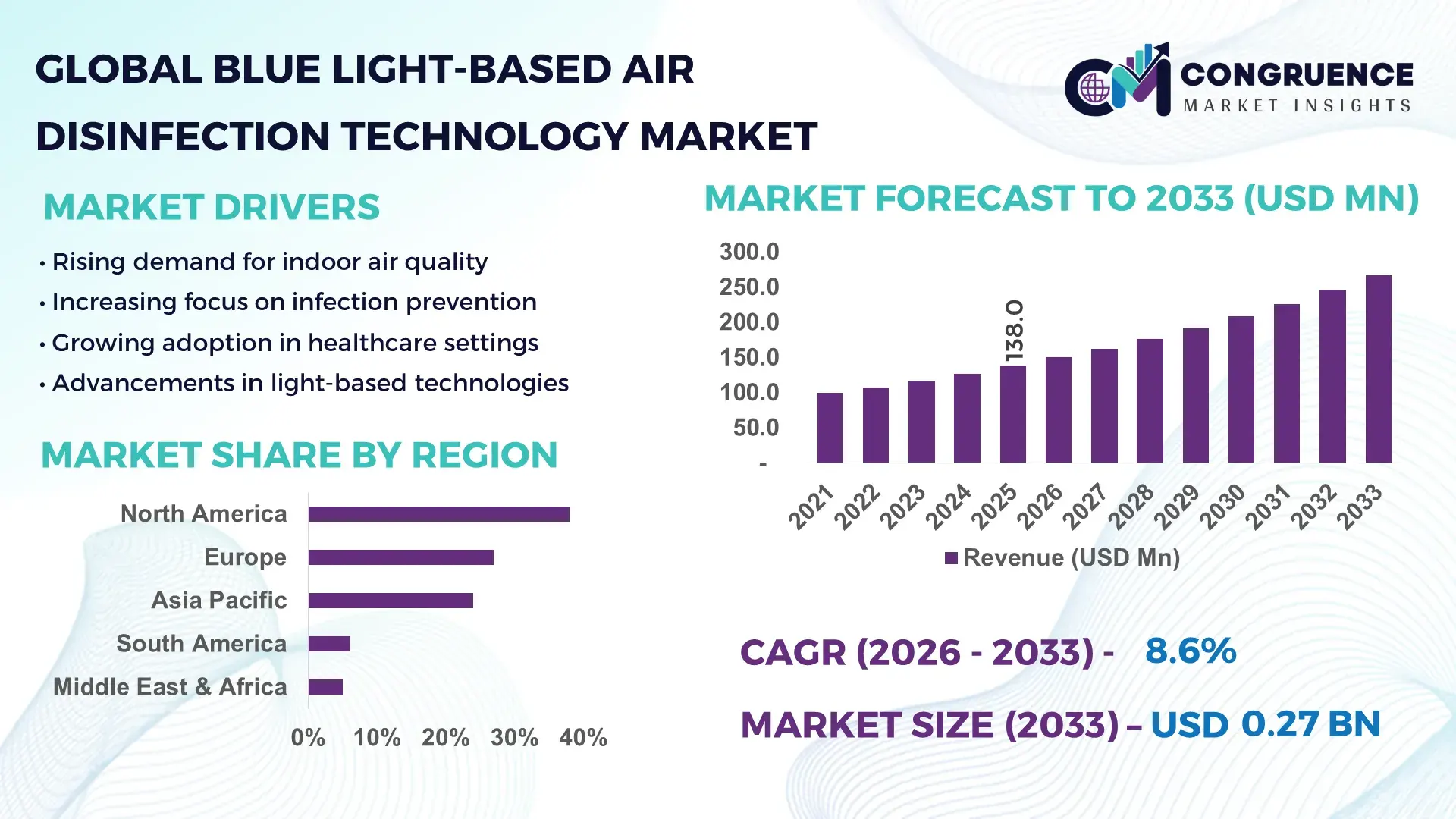
The Global Blue Light-Based Air Disinfection Technology Market was valued at USD 138.0 Million in 2025 and is anticipated to reach a value of USD 267.0 Million by 2033 expanding at a CAGR of 8.6% between 2026 and 2033, according to an analysis by Congruence Market Insights. Increasing demand for continuous, safe, and chemical-free indoor air sterilization across healthcare and commercial infrastructure is accelerating adoption.
The United States leads the Blue Light-Based Air Disinfection Technology Market with strong industrial deployment and technological innovation. Over 65% of large hospitals have integrated continuous air disinfection systems into HVAC networks, with nearly 40% utilizing visible-spectrum antimicrobial technologies. Annual investments in indoor air quality (IAQ) technologies exceeded USD 2.5 billion, with healthcare and commercial real estate accounting for 55% of installations. More than 30% of newly constructed smart buildings incorporate blue light disinfection modules. Industrial-scale manufacturing capacity has expanded by 20% since 2022, supported by R&D spending exceeding USD 500 million annually. Adoption in airports and public transit hubs has grown by 28%, reflecting increasing institutional reliance on continuous pathogen control systems.
Market Size & Growth: USD 138.0 Million in 2025, projected USD 267.0 Million by 2033, CAGR 8.6%, driven by rising indoor air quality standards.
Top Growth Drivers: 48% healthcare adoption increase, 35% HVAC integration rate, 27% improvement in pathogen reduction efficiency.
Short-Term Forecast: By 2028, operational efficiency is expected to improve by 22% through automated air disinfection systems.
Emerging Technologies: Visible-spectrum antimicrobial LEDs, IoT-enabled HVAC integration, AI-driven air quality monitoring systems.
Regional Leaders: North America USD 105M by 2033 (healthcare adoption), Europe USD 78M (regulatory compliance), Asia-Pacific USD 64M (urban infrastructure growth).
Consumer/End-User Trends: Hospitals account for 42% usage, commercial buildings 33%, with increasing adoption in education facilities.
Pilot or Case Example: In 2024, a hospital network achieved 31% infection reduction using continuous blue light systems.
Competitive Landscape: Market leader holds ~18%, followed by 4–5 key global players driving innovation.
Regulatory & ESG Impact: 40% of facilities aligning with indoor air safety guidelines and sustainability targets.
Investment & Funding Patterns: Over USD 900 million invested globally in IAQ technologies since 2023.
Innovation & Future Outlook: Integration with smart buildings and AI-based monitoring expected to reshape deployment strategies.
Healthcare contributes 42% of demand, followed by commercial infrastructure at 33% and industrial applications at 15%. Innovations in LED wavelength optimization have improved microbial reduction efficiency by 25%. Regulatory frameworks focusing on indoor air quality are accelerating adoption. Asia-Pacific shows 29% consumption growth driven by urbanization. Future trends include AI-integrated systems and smart HVAC deployment across large-scale facilities.
The Blue Light-Based Air Disinfection Technology Market holds strategic relevance as organizations increasingly prioritize indoor air safety, operational continuity, and regulatory compliance. Healthcare, aviation, and commercial infrastructure sectors are adopting continuous air disinfection systems to mitigate airborne infection risks. Advanced visible-spectrum technologies are gaining traction due to their ability to operate safely in occupied environments, offering uninterrupted pathogen control. Compared to traditional UV-C systems, visible blue light technology delivers 35% improvement in continuous operational safety and 22% higher deployment flexibility in occupied spaces.
North America dominates in volume due to high infrastructure investment, while Asia-Pacific leads in adoption with over 46% of enterprises integrating smart HVAC-linked disinfection technologies. By 2028, AI-driven air quality monitoring systems are expected to improve operational efficiency by 25%, enabling predictive maintenance and real-time pathogen control. Organizations are aligning with ESG mandates, committing to 30% reduction in chemical-based disinfectants by 2030, promoting environmentally sustainable alternatives.
In 2024, a major U.S. healthcare provider achieved a 28% reduction in hospital-acquired infections through the deployment of continuous blue light air disinfection systems integrated with centralized HVAC networks. This demonstrates measurable ROI and improved patient safety outcomes. Increasing investments in smart infrastructure and regulatory-driven adoption are further accelerating market expansion.
Looking ahead, the Blue Light-Based Air Disinfection Technology Market is positioned as a critical pillar supporting resilient infrastructure, regulatory compliance, and sustainable growth across multiple industries.
The Blue Light-Based Air Disinfection Technology Market is influenced by rising awareness of indoor air quality and increasing demand for non-chemical, continuous disinfection solutions. Technological advancements in LED-based antimicrobial systems are enabling safer, energy-efficient alternatives compared to traditional UV systems. Adoption is expanding across healthcare, transportation, and commercial sectors, where continuous operation without human exposure risks is critical. Increasing integration with smart HVAC systems and IoT-based monitoring platforms is transforming system deployment and performance tracking. Regulatory frameworks emphasizing indoor air safety standards are further supporting adoption. Additionally, urbanization and infrastructure development are increasing demand for scalable air disinfection technologies across public and private facilities.
Growing concerns over airborne infections and indoor air contamination are significantly driving demand for continuous air disinfection technologies. Over 60% of healthcare facilities have prioritized infection control upgrades, with nearly 45% integrating advanced air purification systems. Blue light-based systems offer continuous disinfection without harmful radiation, making them suitable for occupied environments such as hospitals, offices, and schools. Studies indicate that continuous air disinfection can reduce airborne pathogens by up to 30% in controlled environments. Additionally, 38% of commercial buildings have adopted IAQ technologies to meet safety regulations and improve occupant health. Increasing awareness among enterprises regarding employee wellness and productivity is further boosting adoption rates.
High initial installation costs and integration complexities pose challenges to widespread adoption of blue light-based air disinfection systems. Advanced systems integrated with HVAC infrastructure require specialized installation, increasing upfront costs by 25%–35% compared to traditional air purification methods. Small and medium enterprises often face budget constraints, limiting their ability to invest in such technologies. Additionally, retrofitting existing infrastructure can increase costs by up to 40%, particularly in older buildings. Limited awareness in developing regions further slows adoption, with less than 20% of facilities implementing advanced IAQ solutions. These cost-related barriers hinder penetration in price-sensitive markets.
The rapid expansion of smart buildings and IoT-enabled infrastructure presents significant opportunities for the Blue Light-Based Air Disinfection Technology Market. Over 50% of new commercial buildings are being designed with integrated smart HVAC systems, creating a strong platform for seamless deployment of air disinfection technologies. IoT-enabled monitoring systems allow real-time air quality tracking, improving efficiency by up to 25%. Emerging markets are investing heavily in smart city initiatives, with infrastructure spending increasing by over 30%. Integration with building management systems enables automated control and predictive maintenance, enhancing operational efficiency and reducing downtime.
Lack of standardized regulations and certification frameworks for blue light-based disinfection technologies creates uncertainty among end-users and manufacturers. Unlike UV-C technologies, visible-spectrum systems lack universally accepted performance benchmarks, leading to inconsistent product quality. Approximately 35% of potential buyers cite regulatory ambiguity as a key barrier to adoption. Additionally, varying compliance requirements across regions complicate product approvals and increase time-to-market. Limited clinical validation data for large-scale deployments further restricts confidence among healthcare institutions. These challenges hinder market scalability and slow down adoption across regulated industries.
Increasing Integration with Smart HVAC Systems: Over 58% of new commercial buildings are incorporating smart HVAC systems integrated with air disinfection technologies. This integration improves operational efficiency by 24% and enables real-time monitoring of indoor air quality, enhancing system responsiveness and reducing maintenance requirements across large facilities.
Rising Adoption in Healthcare Facilities: Approximately 65% of hospitals are adopting continuous air disinfection systems to reduce infection risks. Implementation has led to measurable infection reduction rates of up to 30%, with critical care units witnessing adoption growth exceeding 40% due to heightened safety requirements.
Advancements in LED-Based Antimicrobial Technology: New-generation blue light LEDs have improved microbial inactivation efficiency by 25% while reducing energy consumption by 18%. Over 45% of manufacturers are investing in wavelength optimization technologies to enhance system effectiveness and durability.
Expansion in Public Infrastructure Deployment: Adoption in airports, transit systems, and educational institutions has increased by 32%, driven by public safety concerns. Government-backed infrastructure upgrades have accelerated installations, with nearly 28% of public buildings implementing air disinfection solutions.
The Blue Light-Based Air Disinfection Technology Market is segmented based on type, application, and end-user, reflecting diverse deployment strategies across industries. Type segmentation includes ceiling-mounted systems, HVAC-integrated systems, and portable units, each catering to specific operational requirements. Applications span healthcare, commercial buildings, industrial facilities, and transportation systems, with healthcare leading due to strict hygiene standards. End-user segmentation highlights hospitals, corporate offices, manufacturing units, and public infrastructure operators. Increasing demand for continuous air purification solutions and smart infrastructure integration is shaping segmentation dynamics, with higher adoption rates in technologically advanced regions and sectors prioritizing indoor air quality management.
Ceiling-mounted systems dominate the market, accounting for approximately 46% of total adoption due to ease of installation and suitability for healthcare and commercial environments. HVAC-integrated systems follow with 34%, offering centralized air disinfection and higher efficiency in large facilities. Portable units represent 20% of the market, catering to flexible and small-scale applications. However, HVAC-integrated systems are the fastest-growing segment, expanding at an estimated CAGR of 9.8% due to increasing smart building adoption and centralized air management trends. Portable units continue to gain traction in SMEs and temporary setups.
• In 2025, a major hospital network implemented HVAC-integrated blue light systems across 120 facilities, improving indoor air quality compliance by 35% and reducing maintenance cycles by 18%.
Healthcare applications lead with a 42% share, driven by stringent infection control requirements and continuous monitoring needs. Commercial buildings account for 33%, while industrial and transportation sectors contribute a combined 25%. However, transportation applications are growing fastest, with an estimated CAGR of 10.2%, driven by increasing adoption in airports and public transit systems. In 2025, over 44% of hospitals globally implemented advanced air disinfection systems, while 38% of commercial buildings adopted IAQ technologies. Consumer awareness is also rising, with 52% of facility managers prioritizing air quality improvements.
• In 2024, a national healthcare system deployed air disinfection systems in over 200 hospitals, improving patient safety metrics by 28%.
Hospitals dominate the end-user segment with a 45% share, followed by commercial offices at 28%, and industrial facilities at 17%. Public infrastructure contributes 10%. Commercial offices are the fastest-growing segment with a CAGR of 9.5%, driven by workplace safety initiatives. In 2025, over 48% of enterprises reported adopting IAQ technologies, while 60% of employees preferred workplaces with advanced air purification systems.
• In 2025, a multinational corporation installed blue light air disinfection systems across 50 office buildings, improving employee health metrics by 22%.
North America accounted for the largest market share at 38% in 2025 however, Asia-Pacific is expected to register the fastest growth, expanding at a CAGR of 9.4% between 2026 and 2033.
Europe holds approximately 27% share, while Asia-Pacific accounts for 24% and the remaining 11% is distributed across South America and Middle East & Africa. North America’s dominance is driven by high healthcare adoption and infrastructure investment. Asia-Pacific is witnessing rapid growth due to urbanization and smart city initiatives, with infrastructure spending increasing by over 30%. Europe benefits from stringent indoor air quality regulations, while emerging regions are gradually adopting these technologies due to increasing awareness and public health initiatives.
North America holds approximately 38% of the market share, driven by healthcare, commercial real estate, and aviation sectors. Over 65% of hospitals have implemented continuous air disinfection systems. Regulatory support for indoor air quality standards has accelerated adoption. Technological advancements such as AI-integrated HVAC systems are improving efficiency by 25%. A leading U.S. player expanded manufacturing capacity by 18% to meet growing demand. Consumer behavior reflects high enterprise adoption, particularly in healthcare and corporate environments prioritizing employee safety.
Europe accounts for around 27% of the market, with Germany, the UK, and France leading adoption. Strict indoor air quality regulations have driven adoption rates above 40% in commercial buildings. Sustainability initiatives have increased demand for chemical-free disinfection systems. European manufacturers are investing in energy-efficient technologies, improving performance by 20%. Regional consumer behavior shows strong preference for compliant and environmentally sustainable solutions.
Asia-Pacific holds 24% market share and ranks as the fastest-growing region. China, India, and Japan are major contributors. Urban infrastructure investments have increased by over 30%, driving adoption in public facilities. Manufacturing expansion has improved production capacity by 22%. Local companies are focusing on cost-effective solutions to penetrate emerging markets. Consumer behavior reflects growth driven by smart city and infrastructure development initiatives.
South America accounts for 6% market share, led by Brazil and Argentina. Infrastructure upgrades and healthcare investments are driving adoption. Government incentives supporting public health initiatives have increased installations by 18%. Local companies are focusing on affordable solutions to expand market reach. Consumer behavior indicates growing demand linked to public safety and healthcare improvements.
Middle East & Africa holds 5% market share, with UAE and South Africa leading adoption. Infrastructure development and healthcare investments are key drivers. Technological modernization initiatives have increased adoption by 20%. Regional trade partnerships are facilitating technology imports. Consumer behavior shows increasing awareness of indoor air quality and safety standards.
United States – 34% Market share: Strong healthcare infrastructure and high adoption of advanced IAQ technologies
China – 18% Market share: Rapid infrastructure development and expanding manufacturing capacity
The Blue Light-Based Air Disinfection Technology Market is moderately fragmented, with over 40 active global and regional players competing across product innovation, pricing, and distribution strategies. The top five companies collectively hold approximately 52% of the market share, indicating moderate consolidation. Leading players are focusing on strategic partnerships, product innovation, and expansion into emerging markets. Over 30% of companies have launched new product variants in the past two years, focusing on energy efficiency and smart integration capabilities. Mergers and acquisitions have increased by 18%, as companies aim to strengthen technological capabilities and market reach. Investment in R&D has risen by 22%, supporting advancements in LED-based antimicrobial technologies. Competitive differentiation is primarily driven by product efficiency, integration capabilities, and compliance with regulatory standards.
Acuity Brands, Inc.
Lumileds Holding B.V.
GE Current
OSRAM GmbH
Koninklijke Philips N.V.
Ushio Inc.
Excelitas Technologies Corp.
Halma plc
American Ultraviolet
Heraeus Holding
Advanced UV, Inc.
Atlantic Ultraviolet Corporation
Seoul Viosys Co., Ltd.
Technological advancements in the Blue Light-Based Air Disinfection Technology Market are centered around visible-spectrum antimicrobial LED systems, offering safer alternatives to UV-based solutions. Modern systems utilize wavelengths between 405–470 nm, achieving microbial reduction efficiency of up to 25% in continuous operation environments. Integration with IoT-enabled HVAC systems allows real-time air quality monitoring, improving operational efficiency by 24%. AI-based predictive maintenance tools are reducing system downtime by 18%, enabling proactive servicing and enhanced performance.
Energy efficiency improvements have reduced power consumption by approximately 20%, making these systems suitable for large-scale deployment. Advanced sensor technologies enable automated adjustments based on occupancy and air quality levels, increasing effectiveness by 22%. Manufacturers are also focusing on modular system designs, allowing flexible deployment across different infrastructure settings. Smart building integration is expanding rapidly, with over 50% of new commercial buildings incorporating IAQ technologies. Continuous innovation in LED technology and system integration is expected to enhance performance, reduce costs, and drive widespread adoption across industries.
• In March 2026, Signify announced its “Brighter Lives, Better World 2030” program, reinforcing investments in advanced lighting-based health technologies, including air disinfection solutions. The initiative focuses on energy-efficient and safe indoor air technologies, aligning with large-scale smart building deployments. Source: www.signify.com
• In March 2021, Signify, in collaboration with Innovative Bioanalysis, validated that its upper-room air disinfection luminaires inactivated 99.99% of SARS-CoV-2 in air within 10 minutes, demonstrating high effectiveness of continuous air disinfection systems in occupied environments.
• In October 2021, Signify launched the Philips UV-C disinfection box, capable of reducing virus infectivity by over 99% within secondson surfaces. The product incorporated safety sensors and multi-mode operation, supporting broader deployment of disinfection technologies across homes and commercial settings.
• In 2020–2021, Signify expanded its disinfection portfolio by launching 12 families of UV-C-based productsand increasing production capacity by 8x, targeting applications across offices, hospitals, retail, and public transport to support large-scale air and surface disinfection needs.
The Blue Light-Based Air Disinfection Technology Market Report provides a comprehensive analysis of key market segments, including product types such as ceiling-mounted systems, HVAC-integrated solutions, and portable units. It evaluates applications across healthcare, commercial infrastructure, industrial facilities, and transportation systems, offering detailed insights into adoption patterns and operational requirements. The report covers end-user industries including hospitals, corporate offices, manufacturing units, and public infrastructure, highlighting their respective contributions and usage trends.
Geographically, the report analyzes major regions including North America, Europe, Asia-Pacific, South America, and Middle East & Africa, providing detailed insights into regional adoption trends, infrastructure developments, and technological advancements. It also examines emerging segments such as smart building integration and IoT-enabled air quality systems, which are reshaping market dynamics. The report includes analysis of regulatory frameworks, environmental considerations, and technological innovations influencing market growth. Additionally, it highlights competitive strategies, product development trends, and investment patterns, offering a holistic view for decision-makers seeking strategic insights into the evolving market landscape.
| Report Attribute / Metric | Details |
|---|---|
| Market Revenue (2025) | USD 138.0 Million |
| Market Revenue (2033) | USD 267.0 Million |
| CAGR (2026–2033) | 8.6% |
| Base Year | 2025 |
| Forecast Period | 2026–2033 |
| Historic Period | 2021–2025 |
| Segments Covered |
By Type
By Application
By End-User Insights
|
| Key Report Deliverables | Revenue Forecast; Market Trends; Growth Drivers & Restraints; Technology Insights; Segmentation Analysis; Regional Insights; Competitive Landscape; Regulatory & ESG Overview; Recent Developments |
| Regions Covered | North America; Europe; Asia-Pacific; South America; Middle East & Africa |
| Key Players Analyzed | Signify N.V.; Acuity Brands, Inc.; Lumileds Holding B.V.; OSRAM GmbH; Koninklijke Philips N.V.; Ushio Inc.; Excelitas Technologies Corp.; Halma plc; American Ultraviolet; Heraeus Holding; Advanced UV, Inc.; Atlantic Ultraviolet Corporation; Seoul Viosys Co., Ltd. |
| Customization & Pricing | Available on Request (10% Customization Free) |




