
Reports
The Global Blood Viscosity Analyzer Market was valued at USD 177.0 Million in 2025 and is anticipated to reach a value of USD 261.5 Million by 2033 expanding at a CAGR of 5.0% between 2026 and 2033. Growth is anchored in the accelerating integration of automated viscometry into hematology and stroke-care pathways, where the 2025 American Society of Hematology protocols for hypoxic whole-blood measurement widened the clinical mandate for precision rheology beyond legacy rotational platforms .
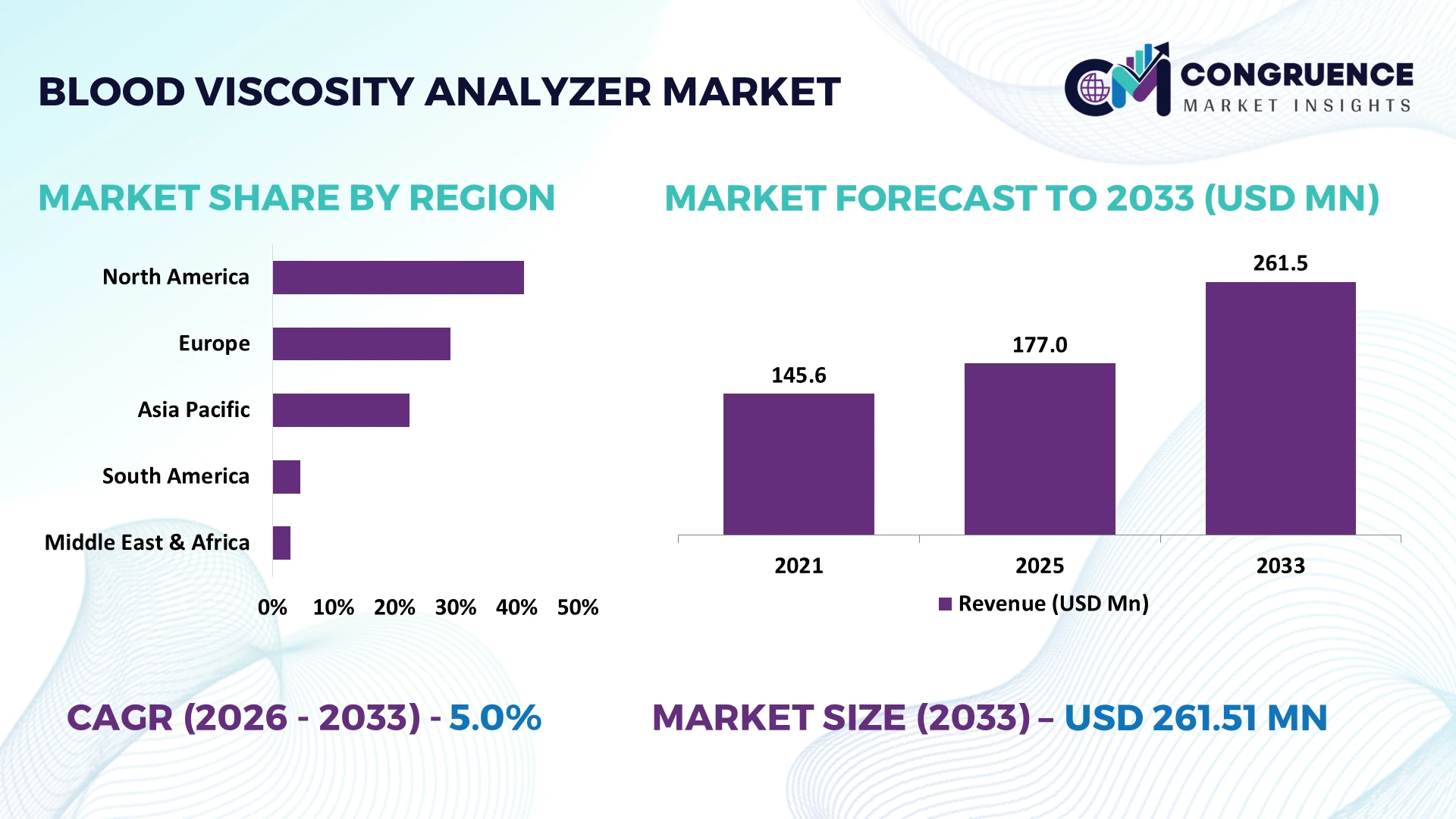
North America commands 35.73% of global revenue, underpinned by a U.S. installed base exceeding 200,000 clinical laboratories and hospital systems standardizing multi-site viscometry contracts . Germany and the U.K. collectively represent approximately 12.4% of global revenue, yet China’s public hospital modernization and national stroke-care programs are compressing adoption cycles at a pace exceeding Western procurement timelines .
The strategic implication is clear: vendors that couple high-shear accuracy with laboratory information system interoperability will capture switching costs in consolidated health networks, while price-sensitive county hospitals in Asia-Pacific will reward localized calibration and service models over premium instrumentation alone.
Market Size & Growth: Valued at USD 177.0 Million in 2025 and projected to reach USD 261.5 Million by 2033, with automated capillary platforms driving repeat-testing demand across specialty hematology centers .
Top Growth Drivers: Sickle cell monitoring protocols (63-patient longitudinal evidence linking viscosity to vaso-occlusive crises), stroke research adoption (6.24% capillary segment expansion), and point-of-care decentralization (Asia-Pacific hospital infrastructure investment).
Short-Term Forecast: By 2027, automated capillary systems reduce operator hands-on time by approximately 40% versus manual rotational workflows, enabling smaller laboratories to maintain ISO 13485-compliant quality controls without dedicated rheology technicians .
Emerging Technologies: Microfluidic sample reduction to 15 μL (RheoSense m-VROC II), AI-assisted diagnostic dashboards in South Korean and Japanese hemostasis analyzers, and dual-mode surface acoustic wave sensors targeting real-time coagulation-phase monitoring .
Regional Leaders: North America at USD 0.69 Billion (multi-site hospital standardization), Europe at USD 0.50 Billion (ISO 13485 procurement filters), and Asia-Pacific at USD 0.38 Billion (Chinese county hospital expansion) .
Consumer/End-User Trends: Rotational viscometers retain 38.94% revenue share as hospitals prioritize staff familiarity and existing quality procedures over novel formats, creating switching friction for new entrants .
Pilot/Case Example: 2025 sickle cell anemia study of 63 patients confirmed steady-state blood viscosity as the sole independent multivariate predictor of vaso-occlusive crisis rates, strengthening the case for routine viscosity monitoring in specialty care .
Competitive Landscape: Top five players—Anton Paar, Thermo Fisher Scientific, Brookfield, RheoSense, and Health Onvector—hold approximately 64% combined share, with incumbent contract lock-in reinforcing their hospital procurement advantage .
Regulatory & ESG Impact: ISO 13485 quality management requirements direct European procurement toward documented manufacturing controls, effectively excluding approximately 30% of lower-tier suppliers from public tender eligibility .
Investment & Funding: National Science Foundation-supported wearable ultrasound viscosity prototypes target a 4–6 year FDA clinical pathway, signaling venture interest in continuous monitoring beyond benchtop analyzers .
Innovation & Future Outlook: The strategic shift moves from episodic laboratory testing toward continuous hemodynamic dashboards integrating viscosity and blood pressure, with wearable validation in animal models already distinguishing viscosity trends independent of pressure changes .
The blood viscosity analyzer market’s clinical demand centers on sickle cell disease monitoring, stroke risk stratification, and hyperviscosity syndrome management, where 2025 evidence linking steady-state viscosity to vaso-occlusive crisis rates strengthened the case for routine testing . Product innovation is compressing sample volumes to 15 μL and shortening measurement cycles, with capillary platforms gaining traction in smaller laboratories and point-of-care settings. An emerging operational trend is the integration of viscosity data into AI-assisted diagnostic dashboards, particularly in South Korean and Japanese hemostasis workflows . Regulatory pressure under ISO 13485 continues to filter supplier eligibility in European tenders, shaping procurement toward documented quality systems rather than lowest-cost instrumentation. These dynamics set the stage for a strategic discussion on competitive positioning and deployment economics.
The blood viscosity analyzer market is shifting from a niche hematology tool to a strategic asset in stroke-care pathways and chronic disease management, driven by health-system consolidation and the demand for standardized, interoperable diagnostic data across multi-site networks. Supply-chain restructuring in Asia-Pacific is accelerating this transition: Chinese public hospital modernization programs and domestic instrument suppliers are compressing import dependency, while India’s private multispecialty chains embed viscometry into nephrology and oncology care protocols . Automated capillary platforms now deliver measurable operational gains over legacy rotational systems—reduced operator hands-on time and smaller laboratory footprint enable smaller facilities to maintain quality controls that previously required dedicated rheology technicians, effectively lowering the barrier to entry for county-level hospitals in China and tier-2 diagnostic centers in India.
Regional contrasts sharpen the strategic picture. North America’s installed base and academic medical center partnerships sustain premium rotational system demand and multi-year service contracts, while Asia-Pacific’s 8.27% projected expansion rate reflects greenfield hospital capacity rather than replacement cycles . The next two to three years will see adoption indicators hinge on reimbursement clarity for point-of-care viscometry and the pace at which laboratory information system vendors integrate viscosity data streams. A practical deployment example is the embedding of automated viscometers into stroke-unit workflows, where rapid whole-blood analysis informs plasmapheresis or cytoreductive decisions within the treatment window. Companies are responding by prioritizing service-network density over unit price in emerging markets and by pursuing partnerships with hematology analyzers to bundle viscosity measurement into existing diagnostic panels. The competitive advantage will accrue to suppliers that solve the calibration and consumable logistics challenge in distributed hospital networks, converting instrument placements into recurring revenue streams while positioning viscosity as a standard component of cardiovascular risk assessment.
Clinical protocol expansion into sickle cell disease and stroke research is structurally widening the addressable testing base, with the 2025 American Society of Hematology hypoxic measurement protocols creating repeat-testing demand at specialty hematology centers . Automated capillary platforms reduce operator requirements and footprint, enabling smaller laboratories to adopt viscometry without dedicated rheology staff—a shift particularly consequential in China, where national stroke-care programs are modernizing blood-rheology testing across county and tertiary hospitals . Companies are responding by localizing calibration kits and service contracts to align with public hospital procurement cycles, while device manufacturers prioritize laboratory information system connectivity to embed viscosity data into existing hematology workflows. The strategic insight is that repeat-testing economics, not initial instrument sales, will determine which vendors build durable positions in consolidated health networks.
The purchase price of clinical-grade viscometers represents only a fraction of total ownership, with service contracts, calibration kits, operator training, and quality-control materials adding continuing expense that disproportionately burdens smaller hospitals . This cost structure creates a bifurcated market: premium automated systems concentrate in well-equipped urban hospitals, while price-sensitive procurement in Asia-Pacific, the Middle East, and South America faces limited local application support outside major centers. The direct business impact is slower replacement cycles and reduced willingness to adopt newer capillary or microfluidic formats when incumbent rotational platforms already satisfy staff familiarity and ISO 13485 documentation requirements. Companies are mitigating risk through distributor partnerships and regional service hubs, but the fundamental constraint remains that calibration logistics, not instrument capability, limit deployment depth in underserved geographies.
Microfluidic viscometers requiring as little as 15 μL of sample open pediatric, rare-disease, and pharmaceutical screening applications previously excluded by blood-volume constraints, while wearable ultrasound-based sensors under development target continuous hemodynamic monitoring beyond episodic laboratory testing . The National Science Foundation-supported wearable prototype distinguishes viscosity trends independent of blood pressure changes in animal models, suggesting a future pathway toward real-time sepsis and trauma triage . Companies are positioning through R&D partnerships with academic medical centers and patent filings around surface acoustic wave and ultrasonic sensing formats . The non-obvious opportunity lies in clinical trial applications: drug developers working on hydroxyurea alternatives and gene therapies for sickle cell disease require viscosity as an outcome measure, creating demand that is decoupled from hospital capital budgets and responsive to precision and sample-volume advantages rather than brand incumbency.
Execution complexity persists in the absence of universally accepted viscosity measurement protocols, compromising result comparability across sites and complicating reimbursement decisions in decentralized health systems . The shortage of trained operators capable of maintaining temperature-controlled high-shear testing quality is acute in Asia-Pacific, the Middle East, and Africa, where service coverage concentrates in urban centers . This workforce gap threatens deployment consistency as hospital networks expand into county-level facilities in China and tier-2 cities in India, where staff turnover and limited application support erode quality-control adherence. Companies must solve this through simulation-based training platforms, remote calibration verification, and simplified user interfaces that reduce dependence on specialized personnel. The strategic insight is that scalability without workforce enablement produces instrument placements without recurring testing volume, undermining the repeat-revenue model that sustains long-term market relevance.
Capillary Platforms Reshape Lab Footprint Automated capillary systems are displacing manual rotational workflows in smaller hospital laboratories across South Korea and Japan, with validation studies confirming stable whole-blood readings across shear rates of 1 to 1,000 s⁻¹ over 20-day testing periods . Compact U-tube configurations reduce operator hands-on requirements and bench space, enabling tier-2 diagnostic centers to maintain quality controls that previously demanded dedicated rheology staff. Vendors are responding by localizing calibration kits and shortening service-response windows in high-volume Asian hospital networks.
AI Integration Moves Beyond Instrumentation Machine learning interpretation layers are being embedded directly into viscometer software, with computational fluid dynamics tools now capable of processing blood rheology data at nearly 90% recovery efficiency in microfluidic formats . This shift converts raw viscosity readings into actionable risk scores for stroke and hyperviscosity screening, reducing clinician interpretation time. Device developers targeting point-of-care settings are prioritizing integrated result interpretation over raw measurement precision as a competitive differentiator.
Supply Chain Localization Accelerates in Asia-Pacific U.S. tariff escalations on precision rheology components and microcapillary systems have prompted manufacturers to pursue dual-sourcing and domestic production of standardized items, with medical device re-certification timelines delaying supplier switches by months . Chinese and Indian hospital procurement increasingly favors suppliers with regional calibration and spare-parts inventory. Companies are restructuring distribution agreements to maintain margin stability while ensuring uninterrupted consumable supply to county-level facilities.
Wearable Sensing Enters Validation Phase Ultrasound-based continuous viscosity monitoring prototypes have demonstrated the ability to distinguish viscosity trends independent of blood pressure fluctuations in animal models, targeting sepsis and trauma triage applications beyond episodic laboratory testing. National Science Foundation-supported research pathways suggest a 4–6 year clinical validation horizon. Early-stage companies are pursuing academic medical center partnerships and patent portfolios around surface acoustic wave formats, positioning for a future where viscosity becomes a continuous hemodynamic parameter rather than a batch-tested laboratory value.
Rotational viscometers held 38.94% of product revenue in 2025, sustained by clinical familiarity and broad shear-rate coverage from 0.1 to 1,000 s⁻¹ that aligns with established hospital quality procedures and ISO 13485 documentation requirements . Hospitals favor these platforms because staff training, calibration routines, and result review workflows are already embedded, creating switching friction that protects incumbent suppliers in U.S. and German hospital contracts.
Capillary viscometers represent the fastest-growing format, with adoption accelerating in stroke research and smaller laboratory settings where automated platforms reduce footprint and operator dependency . Microfluidic systems occupy a precision niche, with RheoSense's m-VROC II requiring samples as small as 15 μL for pediatric and pharmaceutical screening applications . Companies are prioritizing capillary automation and microfluidic sample reduction over rotational platform refreshes, redirecting R&D toward formats that lower deployment barriers in space-constrained facilities.
Clinical diagnostics and patient monitoring accounted for approximately 72.0% of application demand in 2025, driven by rising hospital admissions for chronic diseases requiring cardiovascular risk assessment, diabetes monitoring, and inflammatory disease evaluation . This concentration reflects the operational reality that viscosity testing remains embedded in inpatient and outpatient diagnostic workflows where laboratory infrastructure and trained personnel are readily available.
Point-of-care testing represents the fastest-expanding application segment, supported by the shift toward decentralized diagnostics in ICUs and outpatient clinics where compact, user-friendly viscometers deliver instant results . Hematology and blood research applications maintain steady demand from academic medical centers and specialty sickle cell centers, where 2025 evidence linking steady-state viscosity to vaso-occlusive crisis rates strengthened the clinical case for repeat testing . Companies are adapting by developing dual-purpose platforms that serve both central laboratory throughput and point-of-care portability, rather than treating these as separate product lines.
Hospitals and diagnostic laboratories represented 50.1% of end-user demand in 2026, reflecting higher testing volumes, superior resource availability, and access to trained personnel capable of operating clinical-grade viscometers under temperature-controlled conditions . The U.S. alone maintains approximately 6,100 registered hospitals, providing a dense installed base for multi-site standardization contracts that reinforce incumbent vendor positions.
Academic and research institutes constitute the fastest-growing end-user segment, with expanding biomedical research funding and clinical study requirements driving adoption of research-grade viscometers for blood rheology and pharmaceutical formulation work . Pharmaceutical and biotechnology companies represent a specialized but strategically important buyer group, particularly for drug developers evaluating hydroxyurea alternatives and gene therapies where viscosity serves as a clinical outcome measure . Companies are targeting hospitals through bundled service contracts and calibration logistics, while pursuing research institutions with precision-focused product variants and academic partnership programs that generate publication-driven credibility.
North America accounted for the largest market share at 41.1% in 2025 however, Asia-Pacific is expected to register the fastest growth, expanding at a CAGR of 8.27% between 2026 and 2033.

North America's dominance rests on an installed clinical laboratory base exceeding 200,000 testing facilities across the United States, creating dense procurement networks for multi-site viscometry standardization . Hospital systems in the U.S. and Canada favor rotational platforms for their established quality-control documentation, reinforcing incumbent supplier contracts and service agreements. The region's research institutions actively publish blood rheology findings in stroke and vascular disease contexts, sustaining demand for research-grade instruments alongside clinical deployments. North America held 41.1% of global market share in 2025, anchored by replacement-cycle economics and payer infrastructure that accommodates viscosity testing within cardiovascular risk panels .
United States Market Outlook: The U.S. represents approximately 35.0% of global market value, with an installed base concentrated in academic medical centers and large integrated delivery networks . Its advantage lies in early technology adoption and payer infrastructure that accommodates viscosity testing within cardiovascular risk panels, positioning American hospitals as the primary validation market for next-generation capillary and microfluidic formats.
Europe's market is shaped by ISO 13485 procurement requirements that direct hospital tenders toward documented manufacturing controls, effectively excluding lower-tier suppliers from public health contracts. German and U.K. research institutions actively investigate blood rheology in stroke and vascular disease, influencing product expansion strategies among key players . The region's chronic disease burden—35.3% of EU residents aged 16 and over reported long-term illness or chronic conditions in 2024—sustains clinical demand for viscosity monitoring in cardiovascular and metabolic care pathways. Europe held 29.1% of global market share in 2025, with regional research collaborations adapting petroleum-industry viscosity measurement technology for low-cost clinical viscometer prototypes .
Germany Market Outlook: Germany accounts for approximately 6.5% of global revenue, supported by a dense network of university hospitals and medical technology clusters . Its operational advantage lies in precision engineering supply chains and strong biomedical research funding, positioning German facilities as early adopters of automated capillary systems with integrated quality documentation.
Asia-Pacific's expansion is anchored in government-led hospital upgrades and laboratory automation investments across China, Japan, and India, creating greenfield demand rather than replacement cycles . China's county-level hospital modernization programs and national stroke-care initiatives compress procurement timelines, while Japanese and South Korean hospitals prioritize integrated diagnostic dashboards that embed viscosity data into existing hemostasis workflows. Asia-Pacific held 22.4% of global market share in 2025, with Anton Paar's regional service center expansion covering over 25 countries and supporting more than 1,200 viscometer installations signaling long-term infrastructure commitment .
China Market Outlook: China contributes approximately 7.5% of global revenue, driven by public hospital expansion and domestic instrument manufacturing . Its advantage lies in scale procurement and local production capabilities, with Chinese suppliers targeting county-level facilities through price-competitive capillary systems and localized calibration support.
South America's demand is concentrated in Brazil and Argentina, where private hospital networks and rising healthcare investments drive moderate adoption of clinical-grade viscometers. Public laboratory infrastructure remains uneven, limiting deployment depth outside major metropolitan centers. South America held 4.5% of global market share in 2025, with growth trajectory dependent on private-sector procurement and distributor-led service models that compensate for limited manufacturer presence. Companies are responding through distributor partnerships and regional service hubs, prioritizing Brazil as the anchor market for clinical validation and reference-site development.
Brazil Market Outlook: Brazil represents the region's primary revenue concentration, supported by private hospital chains and diagnostic laboratory networks in São Paulo and Rio de Janeiro. Its operational advantage lies in established private healthcare infrastructure and growing cardiovascular disease burden, positioning Brazilian facilities as the region's reference market for viscometry adoption and clinical protocol development.
The Middle East & Africa market is concentrated in GCC countries, where healthcare infrastructure investment and hospital modernization programs drive adoption of advanced diagnostic instruments. Saudi Arabia and the UAE account for the majority of regional demand, with government-backed hospital projects specifying imported clinical-grade viscometers. Middle East & Africa held 2.9% of global market share in 2025, with the GCC sub-region alone representing 2.3% of global revenues . Outside the GCC, deployment remains limited by laboratory infrastructure gaps and workforce training constraints. Companies are targeting GCC hospital groups through bundled service contracts and calibration support agreements, leveraging Dubai and Riyadh as regional distribution hubs.
Saudi Arabia Market Outlook: Saudi Arabia anchors GCC demand, supported by Vision 2030 healthcare infrastructure commitments and hospital expansion projects in Riyadh and Jeddah. Its operational advantage lies in centralized procurement through government health ministries, enabling large-scale instrument deployments that smaller regional markets cannot support.
Competition pits global rheology incumbents Anton Paar, Thermo Fisher, and AMETEK Brookfield against specialized innovators RheoSense and Health Onvector, with regional clinical-viscometry players such as Benson Viscometers and Biorheologics contesting hospital accounts on price and localized service. The top five hold approximately 64% combined share . Technology precision, calibration logistics, and ISO 13485 documentation anchor competition more than unit price, with rotational platforms retaining 38.94% revenue share through workflow familiarity while capillary formats target 6.24% segment expansion . Players compete through distributor agreements—Benson’s 2025 partnerships with Sanollo and MedBridge for North American coverage—and through microfluidic sample reduction, where RheoSense’s 15 μL capability differentiates . The competitive shift favors capillary automation and point-of-care integration, pressuring incumbents to defend installed rotational bases. The decisive barrier is service-network density in tier-2 hospital markets. Winning requires pairing validated shear-rate performance with calibration infrastructure that smaller laboratories cannot replicate internally.
Anton Paar GmbH
Thermo Fisher Scientific Inc.
AMETEK Brookfield
RheoSense, Inc.
Health Onvector
Benson Viscometers
Biorheologics Co., Ltd.
Lamy Rheology
proRheo GmbH
A&D Company, Limited
BioFluid Technology
LAUDA
Fann Instrument Company
CANNON Instrument Company
Current clinical workflows remain anchored in rotational viscometry, which holds 38.94% of product revenue because its shear-rate coverage from 0.1 to 1,000 s⁻¹ aligns with established hospital quality procedures . Automated capillary systems are displacing semi-manual platforms by reducing operator hands-on time and bench footprint, with curved-capillary U-tube configurations demonstrating benchmark-comparable accuracy in 2026 evaluations .
Emerging microfluidic viscometers compress sample requirements to 15 μL, enabling pediatric and pharmaceutical screening applications that full-volume instruments cannot serve; RheoSense’s m-VROC II achieves this with 2% accuracy and 0.5% repeatability . Disruptive ultrasound-based wearable sensing targets continuous hemodynamic monitoring, distinguishing viscosity trends independent of blood pressure changes in animal models and pursuing a 4–6 year FDA clinical pathway .
Competitive advantage accrues to suppliers integrating viscosity output into laboratory information systems and point-of-care dashboards, not to instrument precision alone. Between 2026 and 2028, expect capillary automation to penetrate smaller hospital laboratories while wearable validation progresses in research settings; vendors acting now on calibration logistics and software interoperability will lock in switching costs before consolidation narrows procurement options.
November 2025 — Benson Viscometers Exhibited semi-automated BV1 and automated BV200 clinical viscometers at MEDICA 2025 in Düsseldorf, generating initial partnership talks with Sanollo and MedBridge for global and North American sales support. Business impact: expands distribution reach into U.S. and Canadian hospital procurement channels without direct sales infrastructure.
March 2025 — Youngin Scientific / Ubiosis Hosted a blood viscosity testing seminar in Seoul introducing the Hemovister A2.0 automated platform, which measures systolic and diastolic viscosity simultaneously to overcome semi-automated equipment limitations. Business impact: accelerates clinical adoption in South Korean health-screening and cardiovascular prevention markets. Source: rapportian.com
April 2025 — Biorheologics Received U.S. FDA approval for Rheovis 2000A multi-channel and Rheovis 200 automated blood viscosity measurement devices, following Japanese patent registration for multi-channel viscosity measurement. Business impact: opens U.S. clinical laboratory and hospital deployment pathways for automated multi-sample workflows. Source: biorheologics.com
February 2025 — RheoSense Launched microVISC PRO high-performance viscometer requiring 100 µL samples with built-in temperature control, extending the company’s microfluidic portfolio beyond m-VROC II. Business impact: broadens addressable precision-screening demand in pharmaceutical formulation and low-volume clinical research.
The report covers the global blood viscosity analyzer market across product types—rotational, capillary, and microfluidic viscometers—with rotational platforms retaining 38.94% revenue share while capillary formats expand fastest in stroke research and decentralized laboratory settings . Application coverage spans clinical diagnostics and patient monitoring (72.0% share), hematology and blood research, point-of-care testing, and pharmaceutical applications, segmented across hospitals and diagnostic laboratories (50.1%), academic research institutes, and biotechnology companies .
Regional analysis addresses North America, Europe, Asia-Pacific, South America, and Middle East & Africa, with country-level deployment patterns and infrastructure constraints. The report supports investment planning through competitive positioning of the top five players holding approximately 64% combined share, adoption trend mapping for automated and microfluidic platforms, and identification of niche opportunities in wearable continuous monitoring and pediatric low-volume testing between 2026 and 2033.
| Report Attribute / Metric | Details |
|---|---|
| Market Revenue (2025) | USD 177.0 Million |
| Market Revenue (2033) | USD 261.5 Million |
| CAGR (2026–2033) | 5.0% |
| Base Year | 2025 |
| Forecast Period | 2026–2033 |
| Historic Period | 2021–2025 |
| Segments Covered |
By Type
By Application
By End-User
|
| Key Deliverables | Revenue Forecast; Market Trends; Growth Drivers & Restraints; Technology Insights; Segmentation Analysis; Regional Insights; Competitive Landscape; Regulatory & ESG Overview; Recent Developments |
| Regions Covered | North America; Europe; Asia-Pacific; South America; Middle East & Africa |
| Companies Profiled | Anton Paar GmbH; Thermo Fisher Scientific Inc.; AMETEK Brookfield; RheoSense, Inc.; Health Onvector; Benson Viscometers; Biorheologics Co., Ltd.; Lamy Rheology; proRheo GmbH; A&D Company, Limited; BioFluid Technology; LAUDA; Fann Instrument Company; CANNON Instrument Company |
| Customization & Pricing | Available on Request (10% Customization Free) |




