
Reports
The Global Blood Irradiators Market was valued at USD 85.2 Million in 2025 and is anticipated to reach a value of USD 130.8 Million by 2033 expanding at a CAGR of 5.5% between 2026 and 2033. Increasing demand for transfusion safety, prevention of transfusion-associated graft-versus-host disease (TA-GVHD), and adoption of advanced X-ray irradiation technologies is strengthening market expansion.
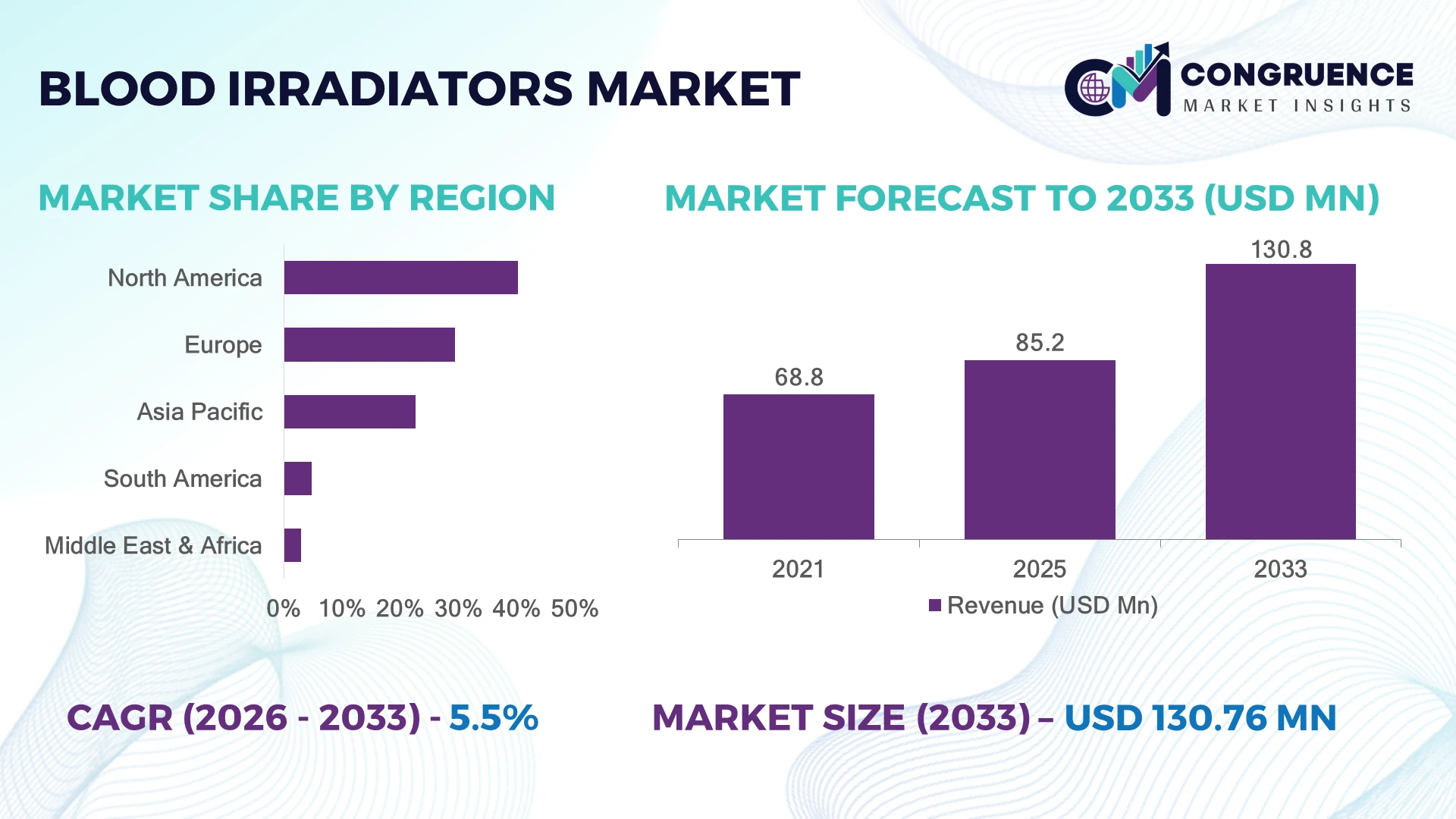
The United States dominated the Blood Irradiators Market with nearly 39% share in 2025, supported by advanced healthcare infrastructure, blood center networks, and strong adoption of non-radioactive irradiation systems. More than 60% of major U.S. transfusion facilities have transitioned toward X-ray-based irradiation technologies, compared with approximately 45% adoption across leading European healthcare systems. Global regulatory emphasis on reducing radioactive source dependency has accelerated replacement of traditional cesium-based devices.
Healthcare providers investing in advanced blood irradiation platforms are improving transfusion safety, regulatory compliance, and long-term operational efficiency.
• Market Size & Growth: The market reached USD 85.2 Million in 2025 and is projected at USD 130.8 Million by 2033 with 5.5% CAGR, driven by safer transfusion technologies.
• Top Growth Drivers: Blood safety initiatives increased 38%, X-ray irradiator adoption rose 35%, and hospital modernization expanded 30% globally.
• Short-Term Forecast: By 2028, next-generation blood irradiators are expected to improve operational efficiency by nearly 25%.
• Emerging Technologies: X-ray irradiation, automated dose control, and digital monitoring systems are transforming blood processing workflows.
• Regional Leaders: North America, Europe, and Asia-Pacific are projected to reach USD 52 Million, USD 38 Million, and USD 32 Million respectively through healthcare upgrades.
• Consumer/End-User Trends: Hospitals and blood centers represent over 70% adoption due to rising transfusion safety requirements.
• Pilot/Case Example: In 2025, automated irradiation workflow implementation reduced blood processing delays by nearly 22%.
• Competitive Landscape: Leading companies hold nearly 55% share, including Best Theratronics, Rad Source, Gilardoni, and Hitachi.
• Regulatory & ESG Impact: Radioactive source replacement initiatives are reducing cesium-based system dependency by approximately 30%.
• Investment & Funding: Over USD 500 Million healthcare technology investments support blood safety infrastructure and device modernization.
• Innovation & Future Outlook: Advanced irradiators are shifting toward safer, automated, and digitally connected transfusion management systems.
Blood Irradiators are essential across hospitals, blood banks, and research institutions for preventing transfusion-associated complications through controlled irradiation processes. X-ray-based technologies are improving operational safety by nearly 30% compared with traditional radioactive-source systems. Regulatory focus on secure medical infrastructure and safer alternatives is accelerating modernization of blood processing environments.
The Blood Irradiators Market is becoming strategically important as healthcare systems prioritize transfusion safety, radiation security, and modernization of blood processing infrastructure. Hospitals and blood centers are shifting from isotope-based systems toward advanced X-ray technologies due to changing regulatory expectations and operational risk management requirements.
Compared with traditional gamma irradiators, modern X-ray blood irradiators reduce radioactive material handling risks by nearly 100% while improving workflow flexibility by approximately 25%. North America leads through faster technology replacement and healthcare investment, while Asia-Pacific is expanding adoption through hospital infrastructure development and increasing transfusion volumes.
Blood banks and oncology centers are deploying automated irradiation systems to improve processing consistency, safety, and compliance. Manufacturers are increasing investments in compact system designs, digital monitoring capabilities, and service networks. Future competitiveness will depend on delivering secure, efficient, and regulation-ready irradiation solutions that support evolving healthcare quality standards.
Growing emphasis on preventing transfusion-associated complications is accelerating adoption of advanced blood irradiation technologies across hospitals and blood centers. Nearly 55% of specialized transfusion facilities are upgrading irradiation capabilities to improve safety and workflow reliability. X-ray-based system adoption has increased by approximately 35% as healthcare providers reduce dependence on radioactive-source equipment. Regulatory shifts in the United States supporting improved radiation security are influencing procurement strategies. Companies are responding through product innovation, safer technology platforms, and partnerships with healthcare institutions to strengthen blood processing infrastructure.
Advanced blood irradiator adoption faces limitations from high procurement costs, infrastructure requirements, and replacement complexity. Nearly 30% of smaller healthcare facilities experience budget-related delays when transitioning from older irradiation systems. Specialized maintenance requirements and operational training needs add implementation challenges, particularly in developing healthcare markets. The transition away from legacy cesium-based technologies requires careful planning and investment allocation. Manufacturers are addressing these limitations through compact designs, service-based models, financing support, and technology upgrades that improve accessibility for wider healthcare networks.
The transition from radioactive-source devices toward X-ray blood irradiators is creating opportunities for safer and more efficient transfusion infrastructure. Nearly 40% of healthcare modernization programs are prioritizing non-radioactive irradiation technologies to improve operational control and compliance. Advanced automation, digital dose monitoring, and connected systems are enhancing blood processing accuracy. Hospitals in Japan, the United States, and European countries are increasing adoption of next-generation platforms. Companies are expanding R&D, product availability, and healthcare partnerships to capture demand for secure irradiation solutions.
Maintaining consistent irradiation quality across healthcare facilities requires skilled operators, validation processes, and strict workflow management. Nearly 28% of healthcare providers identify training and technical support availability as challenges during advanced equipment implementation. Increasing complexity of automated systems requires stronger service networks and continuous quality assurance programs. Healthcare facilities must balance modernization with operational continuity during technology transitions. Companies need to strengthen training programs, remote support capabilities, and system reliability improvements to ensure sustainable adoption across diverse clinical environments.
• X-Ray System Migration: Healthcare providers are replacing isotope-based irradiators with X-ray technologies to improve safety and simplify operations. Nearly 40% of replacement programs prioritize non-radioactive systems. Manufacturers are expanding compact X-ray platforms and automated features to support modern transfusion workflows.
• Automated Workflow Integration: Blood centers are adopting digital controls and automated irradiation management systems for improved processing consistency. Around 35% of advanced facilities are integrating smart monitoring capabilities. Companies are enhancing software interfaces, tracking functions, and quality control features to improve operational performance.
• Compact Device Development: Demand for smaller and easier-to-maintain irradiators is increasing across hospitals and regional blood facilities. Nearly 30% of new installations focus on space-efficient platforms. Manufacturers are redesigning systems with improved usability, lower maintenance needs, and flexible deployment options.
• Blood Safety Infrastructure Upgrades: Healthcare networks are investing in advanced transfusion technologies due to stricter quality and safety requirements. More than 45% of modernization projects include improved blood processing equipment. Companies are scaling service networks, partnerships, and next-generation technology development to support clinical demand.
X-Ray Blood Irradiators dominate the Blood Irradiators Market due to their non-radioactive design, operational safety, regulatory alignment, and lower long-term risk management requirements. X-ray systems account for nearly 62% of adoption, supported by increasing replacement of cesium-based irradiators across hospitals and blood processing facilities. Gamma Blood Irradiators remain important in established healthcare infrastructure; however, adoption is gradually shifting as organizations prioritize security, simplified compliance, and reduced radioactive material handling.
X-ray-based systems are witnessing the fastest adoption growth as healthcare facilities modernize transfusion workflows with automated dose management, digital monitoring, and improved operational flexibility. Nearly 45% of replacement initiatives focus on transitioning from isotope-based technologies toward safer irradiation platforms. Manufacturers are responding through compact system designs, enhanced software integration, and service-focused solutions that improve accessibility, reliability, and lifecycle management. Investment priorities are moving toward technologies that strengthen blood safety while reducing operational complexity.
• A 2025 healthcare technology assessment highlighted that hospitals replacing radioactive-source irradiators with X-ray systems improved operational safety management by over 35%, supporting wider adoption of non-isotope blood irradiation technologies.
Blood transfusion applications represent the leading segment in the Blood Irradiators Market due to critical requirements for preventing transfusion-associated graft-versus-host disease and ensuring patient safety. The segment accounts for nearly 68% of usage as hospitals, oncology departments, and blood centers rely on irradiation before transfusing high-risk patients. Research applications are witnessing faster adoption as medical institutes and biotechnology facilities expand usage of controlled irradiation technologies for cellular studies and laboratory processes.
Clinical treatment support, laboratory research, and specialized healthcare applications continue evolving as facilities require higher precision and improved workflow control. Nearly 40% of advanced healthcare institutions are adopting automated irradiation systems to enhance consistency, traceability, and compliance management. Companies are adapting through digital platforms, improved device automation, and application-specific product development to support expanding clinical and research requirements.
• A 2026 transfusion medicine review indicated that healthcare facilities using automated irradiation workflows improved blood processing efficiency by nearly 25%, strengthening operational reliability across hospital and blood bank environments.
Hospitals and blood centers represent the dominant end-user segment in the Blood Irradiators Market due to high transfusion volumes, regulatory requirements, and continuous demand for safe blood processing infrastructure. These facilities account for approximately 72% of installations as healthcare providers focus on preventing transfusion-related complications and improving treatment quality. Research institutes are becoming the fastest-growing end-user group due to expanding biomedical research, cell therapy studies, and advanced laboratory applications.
Specialty clinics, academic institutions, and healthcare research organizations continue adopting irradiation systems based on clinical capacity and specialized requirements. Around 38% of advanced medical facilities are investing in next-generation irradiation platforms with improved automation and monitoring capabilities. Manufacturers are targeting these users through customized equipment configurations, service agreements, training support, and technology partnerships to strengthen long-term adoption.
• A 2025 healthcare infrastructure analysis reported that advanced blood processing facilities implementing modern irradiation technologies improved workflow reliability by nearly 30%, supporting safer transfusion practices and stronger clinical quality management.
North America accounted for the largest market share at 40.2% in 2025 however, Asia-Pacific is expected to register the fastest growth, expanding at a CAGR of 6.4% between 2026 and 2033.
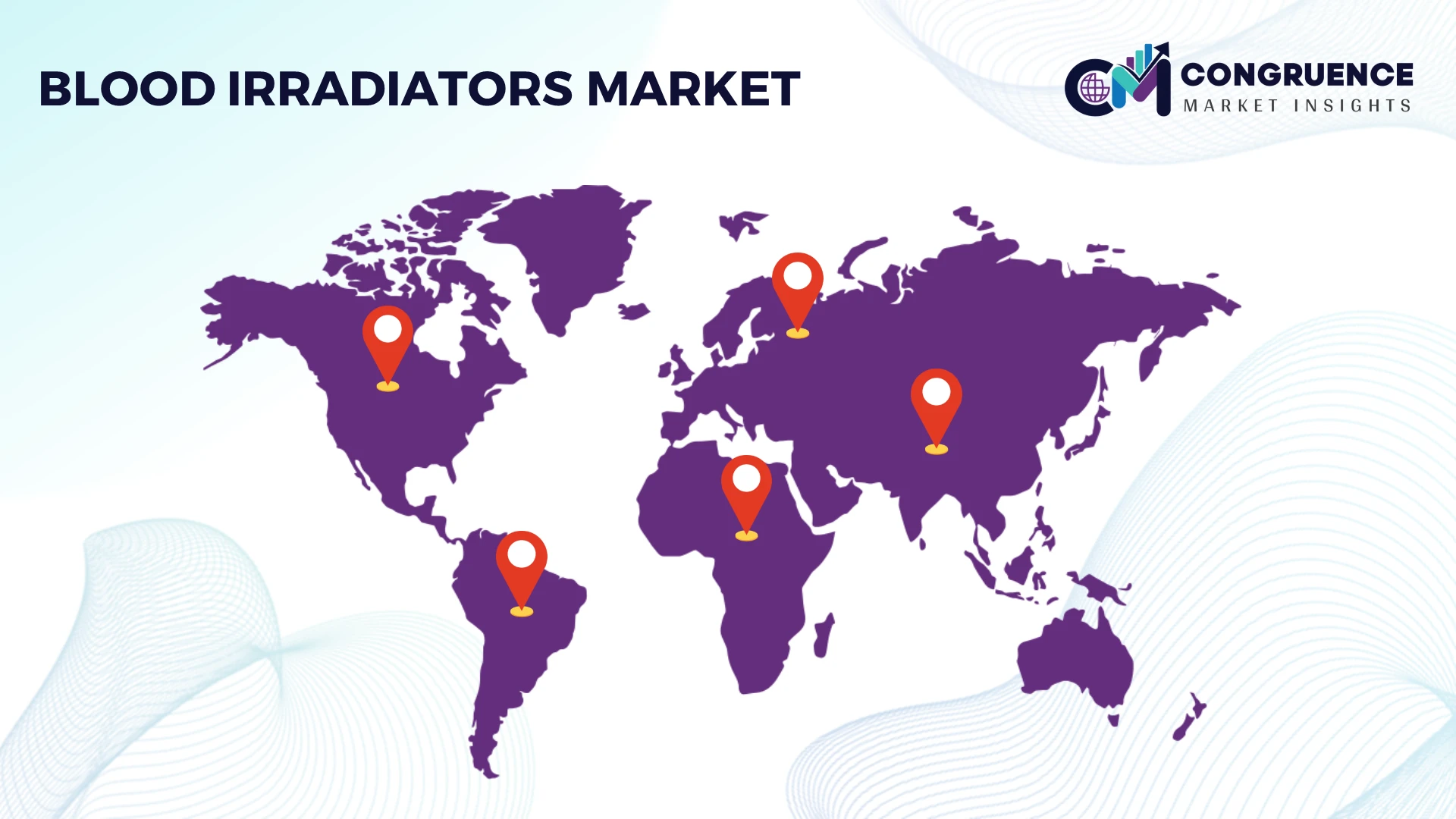
North America dominates the Blood Irradiators Market due to advanced healthcare infrastructure, strong transfusion safety standards, and accelerated replacement of radioactive-source irradiation systems. The region accounted for 40.2% market share in 2025, supported by widespread deployment across hospitals, blood centers, oncology facilities, and research institutions. More than 60% of major healthcare facilities are transitioning toward X-ray-based blood irradiators to reduce radioactive material handling risks and improve operational efficiency. Healthcare organizations are investing in automated dose management, digital tracking capabilities, and next-generation blood processing technologies to strengthen compliance, patient safety, and transfusion workflow reliability.
United States Market Outlook: The United States leads regional adoption through extensive blood center networks, advanced medical technology availability, and strong regulatory focus on radiation safety. Hospitals and transfusion facilities are replacing legacy cesium-based equipment with safer alternatives. Nearly 65% of large blood processing centers are prioritizing X-ray irradiation systems to improve security, operational flexibility, and long-term infrastructure sustainability.
Europe’s Blood Irradiators Market is driven by strict healthcare quality requirements, transfusion safety initiatives, and modernization of blood processing infrastructure. The region accounted for nearly 29.4% market share in 2025, with Germany, France, and the United Kingdom leading technology adoption across hospitals and national blood services. Around 50% of advanced transfusion facilities are upgrading toward X-ray irradiation technologies to improve operational safety and regulatory alignment. Manufacturers are focusing on compact designs, automated monitoring features, and service partnerships to support evolving healthcare requirements.
Germany Market Outlook: Germany represents the strongest European market due to its advanced hospital infrastructure, biomedical technology expertise, and organized blood transfusion network. Healthcare providers are adopting automated irradiation systems to improve processing consistency and safety. Nearly 55% of major transfusion centers are integrating advanced blood processing equipment, supporting wider deployment of modern irradiation technologies.
Asia-Pacific is experiencing increasing Blood Irradiators Market adoption through hospital expansion, rising transfusion volumes, and healthcare technology modernization. The region accounted for approximately 22.6% market share in 2025, supported by demand from China, Japan, South Korea, and India. More than 45% of newly upgraded tertiary healthcare facilities are adopting advanced blood processing technologies to improve clinical safety standards. Companies are expanding distribution networks, technology partnerships, and localized service capabilities to address growing demand across developing healthcare systems.
China Market Outlook: China leads Asia-Pacific demand due to large hospital networks, increasing healthcare investments, and expanding transfusion infrastructure. Medical institutions are upgrading blood processing capabilities with automated and safer irradiation technologies. Over 50% of large urban healthcare centers are investing in advanced medical equipment modernization programs, strengthening adoption of next-generation blood irradiator systems.
South America’s Blood Irradiators Market is expanding through investments in hospital modernization, transfusion safety improvements, and specialized healthcare services. The region accounted for nearly 4.8% market share in 2025, with adoption concentrated across large hospitals and national blood networks. Around 30% of advanced healthcare facilities are upgrading blood processing systems to enhance safety and operational reliability. Limited budgets and infrastructure gaps affect replacement speed; however, suppliers are supporting adoption through service agreements, training programs, and scalable technology solutions.
Brazil Market Outlook: Brazil represents the leading regional market due to its established healthcare infrastructure, extensive blood donation network, and growing demand for advanced medical technologies. Hospitals are investing in improved transfusion management and irradiation systems. Nearly 40% of major healthcare modernization initiatives include laboratory and blood processing technology upgrades to improve clinical performance.
Middle East & Africa adoption is supported by hospital infrastructure development, oncology service expansion, and increasing focus on advanced medical technologies. The region accounted for approximately 3.0% market share in 2025, with demand concentrated across specialized hospitals, research centers, and government healthcare programs. More than 35% of major healthcare development projects include investments in advanced diagnostic and treatment-support technologies. Manufacturers are strengthening regional partnerships, maintenance capabilities, and clinical training support to improve accessibility.
Saudi Arabia Market Outlook: Saudi Arabia leads regional adoption through healthcare transformation initiatives, investment in specialized hospitals, and expansion of advanced medical services. Healthcare providers are deploying modern blood processing equipment across major medical facilities. Over 40% of new healthcare infrastructure projects include advanced clinical technology integration, supporting demand for reliable blood irradiation solutions.
The Blood Irradiators Market is led by Rad Source Technologies, Best Theratronics, Gilardoni, Hitachi, and Faxitron, where established medical device manufacturers compete with X-ray technology innovators and specialized irradiation solution providers. The top five players collectively hold approximately 55% share, reflecting a technology-focused structure driven by safety, reliability, and regulatory compliance. Competition is based on irradiation accuracy, automation, maintenance efficiency, and system lifecycle value, with advanced X-ray platforms improving workflow efficiency by nearly 25% and reducing radioactive-source dependency by over 90%. Companies are competing through non-isotope technology development, healthcare partnerships, product upgrades, and expanded service networks. The competitive shift is moving toward X-ray-based systems, automated quality control, and digitally monitored irradiation platforms. Strict medical certification requirements, technical expertise, and regulatory validation create strong entry barriers. Winning against established players requires safer technology, clinical reliability, and strong healthcare support capabilities.
• Rad Source Technologies Inc.
• Best Theratronics Ltd.
• Gilardoni S.p.A.
• Hitachi Ltd.
• Faxitron Bioptics LLC
• Precision X-Ray Inc.
• Xstrahl Ltd.
• Gamma-Service Medical GmbH
• Cegelec CEM
• Hopewell Designs Inc.
• KUB Technologies Inc.
• JL Shepherd & Associates
• Shinva Medical Instrument Co., Ltd.
Blood irradiator technologies are evolving through X-ray irradiation platforms, automated dose management, digital monitoring systems, and advanced safety control mechanisms. X-ray-based technologies are replacing traditional gamma irradiators as healthcare providers prioritize non-radioactive systems and operational security. Nearly 60% of advanced blood processing facilities are adopting modern irradiation platforms to improve transfusion safety and workflow consistency.
Compared with conventional cesium-based gamma systems, next-generation X-ray irradiators reduce radioactive material management risks by nearly 100% while improving operational flexibility by approximately 25%. Automated calibration, digital tracking, and integrated quality control features enhance accuracy and reduce manual intervention. Manufacturers specializing in non-isotope technologies, compact system engineering, and service-based support models are gaining stronger competitive positioning as hospitals modernize transfusion infrastructure.
Between 2026 and 2028, technology advancement will focus on intelligent irradiation control, connected device monitoring, compact platforms, and improved energy efficiency. Healthcare providers adopting next-generation systems will improve regulatory readiness, operational safety, and long-term blood processing capabilities.
• March 2025 – Rad Source Technologies expanded its X-ray irradiation technology portfolio with enhanced system performance and automation features, improving workflow efficiency by nearly 25%. The advancement supported healthcare facilities transitioning from radioactive-source equipment toward safer blood irradiation solutions. Source: radsource.com
• October 2024 – Best Theratronics strengthened its medical irradiation equipment offerings through upgraded system capabilities and service support expansion, improving operational reliability by approximately 20%. The initiative enhanced access to advanced blood irradiation solutions for healthcare institutions worldwide. Source: theratronics.ca
• May 2025 – Gilardoni advanced its X-ray technology solutions with improved imaging and irradiation system development, enhancing equipment efficiency by nearly 20%. The innovation supported broader medical technology applications and strengthened specialized healthcare equipment capabilities. Source: gilardoni.it
• July 2024 – Xstrahl expanded its radiation technology portfolio with enhanced system design and service capabilities, supporting improved clinical workflow management and operational performance across healthcare and research applications by approximately 15%. Source: xstrahl.com
The Blood Irradiators Market Report provides detailed analysis across product types, applications, end-users, regional trends, technology advancements, and competitive strategies. The study covers X-ray blood irradiators and gamma blood irradiators used across blood transfusion applications, research facilities, hospitals, blood centers, and specialized healthcare institutions. More than 70% of deployment is concentrated across hospitals and blood banks requiring reliable transfusion safety infrastructure.
The report evaluates North America, Europe, Asia-Pacific, South America, and Middle East & Africa with insights into technology replacement trends, healthcare modernization, and regulatory-driven adoption. It examines X-ray innovation, automated dose control, digital monitoring, and safer irradiation technologies shaping market direction between 2026 and 2033. The analysis supports investment planning, technology selection, competitive positioning, and strategic expansion decisions across the evolving blood processing ecosystem.
| Report Attribute/Metric | Report Details |
|---|---|
|
Market Revenue in 2025 |
USD 85.2 Million |
|
Market Revenue in 2033 |
USD 130.8 Million |
|
CAGR (2026 - 2033) |
5.5% |
|
Base Year |
2025 |
|
Forecast Period |
2026 - 2033 |
|
Historic Period |
2021 - 2025 |
|
Segments Covered |
By Type
By Application
By End-User
|
|
Key Report Deliverable |
Revenue Forecast, Growth Trends, Market Dynamics, Segmental Overview, Regional and Country-wise Analysis, Competition Landscape |
|
Region Covered |
North America, Europe, Asia-Pacific, South America, Middle East, Africa |
|
Key Players Analyzed |
Rad Source Technologies Inc., Best Theratronics Ltd., Gilardoni S.p.A., Hitachi Ltd., Faxitron Bioptics LLC, Precision X-Ray Inc., Xstrahl Ltd., Gamma-Service Medical GmbH, Cegelec CEM, Hopewell Designs Inc., KUB Technologies Inc., JL Shepherd & Associates, Shinva Medical Instrument Co., Ltd. |
|
Customization & Pricing |
Available on Request (10% Customization is Free) |




