
Reports
The Global Blood Filtration and Purification Market was valued at USD 19046.87 Million in 2025 and is anticipated to reach a value of USD 33717.7 Million by 2033 expanding at a CAGR of 7.4% between 2026 and 2033. Growth is driven by rising dialysis volumes, expanding therapeutic plasma exchange, continuous renal replacement therapy deployment, pathogen-reduction technologies, and higher utilization of leukocyte-reduced blood components.
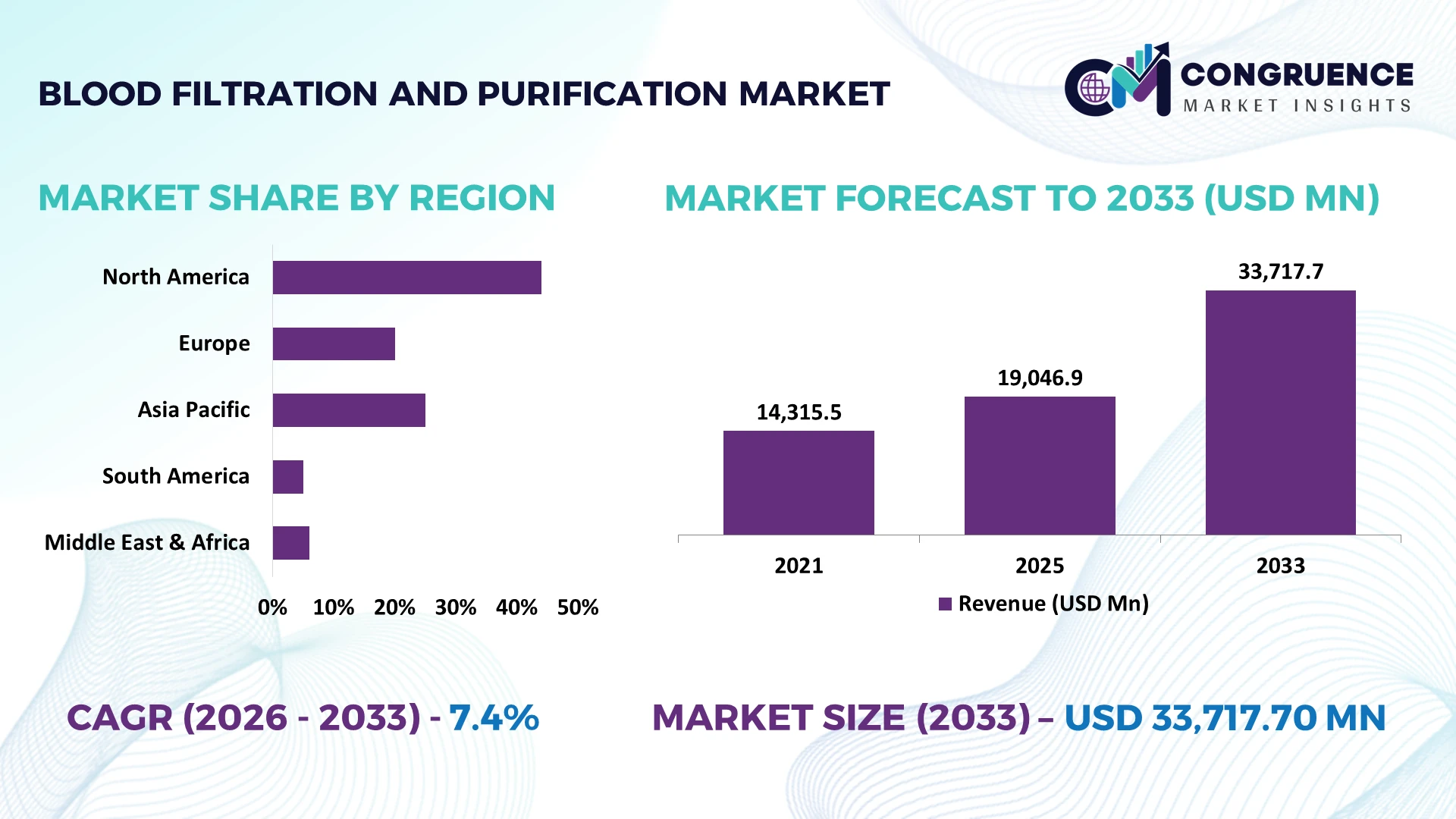
The United States leads the global blood filtration and purification market with an estimated 35% share, supported by more than 550,000 dialysis-dependent kidney-failure patients and extensive hospital, blood-center, and outpatient dialysis infrastructure. Universal leukoreduction is widely implemented across U.S. blood services, strengthening demand for high-efficiency filters. Japan, despite a smaller population, manages more than 340,000 chronic dialysis patients, demonstrating exceptionally high treatment intensity. Post-pandemic medical-supply localization and U.S.–China trade tensions continue pushing manufacturers toward geographically diversified membrane and disposable-component sourcing.
Strategically, suppliers combining high-selectivity membranes, automated extracorporeal platforms, dependable disposables, and localized manufacturing hold the strongest position as treatment volumes and blood-safety requirements intensify.
Market Size & Growth: USD 19,046.87 million in 2025 reaches USD 33,717.7 million by 2033 at 7.4%, driven by dialysis expansion and advanced extracorporeal purification.
Top Growth Drivers: Dialysis demand contributes approximately 45%, blood-component filtration 25%, and critical-care purification around 15% of equipment and consumables utilization.
Short-Term Forecast: By 2028, automated monitoring and optimized membrane systems are positioned to reduce extracorporeal workflow intervention by approximately 15%.
Emerging Technologies: High-flux membranes, adsorption cartridges, AI-supported dialysis monitoring, and hemoperfusion systems are advancing selective toxin and cytokine removal.
Regional Leaders: By 2033, North America approaches USD 11.8 billion, Europe USD 9.1 billion, and Asia-Pacific USD 9.8 billion as automated treatment adoption expands.
Consumer/End-User Trends: Hospitals and dialysis centers account for approximately 70% of system utilization, reinforcing recurring demand for filters, cartridges, and tubing sets.
Pilot/Case Example: Expanded hemodiafiltration deployment can increase middle-molecule clearance by more than 20% versus conventional high-flux hemodialysis under appropriate treatment conditions.
Competitive Landscape: Fresenius Medical Care holds an estimated 30%+ dialysis-products position, competing with Baxter, Nipro, Asahi Kasei, and Toray.
Regulatory & ESG Impact: Single-use extracorporeal circuits can generate several kilograms of waste per treatment, accelerating material-reduction and recycling initiatives across dialysis operations.
Investment & Funding: Fresenius Medical Care committed approximately EUR 1 billion to innovation through 2025, emphasizing digital platforms, next-generation dialysis, and operational modernization.
Innovation & Future Outlook: High-volume hemodiafiltration exceeding 23 liters convection per session is strengthening the shift toward higher-clearance, precision-controlled blood purification.
The Blood Filtration and Purification Market is shifting toward high-selectivity membranes, automated extracorporeal systems, adsorption technologies, and digitally monitored dialysis workflows. Demand remains concentrated across chronic kidney failure, critical-care renal support, therapeutic plasma exchange, and blood-component processing. Hospitals and dialysis centers represent approximately 70% of system utilization, making recurring consumables and treatment reliability commercially critical. High-volume hemodiafiltration and advanced adsorption cartridges are expanding purification capability, while post-pandemic supply-chain localization is strengthening regional manufacturing of membranes and disposable circuits, setting up the market’s strategic competitive discussion.
Blood filtration and purification is becoming strategically important as health systems shift from conventional diffusion-based dialysis toward higher-clearance, digitally monitored extracorporeal therapies. More than 550,000 U.S. patients depend on dialysis, while Japan treats over 340,000 chronic dialysis patients, sustaining recurring demand for dialyzers, adsorption cartridges, plasma filters, and circuits. Manufacturers are simultaneously regionalizing critical disposable supply chains following pandemic-era shortages.
High-volume hemodiafiltration combines diffusion with convection and can increase middle-molecule clearance by more than 20% versus conventional high-flux hemodialysis under appropriate treatment conditions. Europe has established broader hemodiafiltration deployment, while U.S. adoption is accelerating following regulatory clearance of compatible systems. Digital monitoring, automated ultrafiltration control, and connected treatment platforms are reducing manual intervention and supporting standardized clinical workflows.
Through 2026–2028, investment will concentrate on high-flux membranes, adsorption cartridges, connected dialysis systems, and locally manufactured disposables. A practical example is deployment of high-volume hemodiafiltration above 23 liters convection per session, requiring coordinated machines, dialyzers, and ultrapure fluid infrastructure. Fresenius Medical Care, Baxter, Nipro, Toray, and Asahi Kasei are advancing platform and membrane technologies. Competitive advantage will increasingly depend on combining clinical clearance performance with consumable reliability, digital integration, and scalable treatment infrastructure.
Chronic kidney failure creates the strongest recurring utilization base for blood purification equipment and consumables. More than 550,000 U.S. patients receive dialysis, while Japan manages over 340,000 dialysis patients and maintains prevalence above 0.25% of its population. Hemodialysis represents roughly 85–90% of dialysis treatment in major facility-based markets, generating repeated demand for dialyzers, tubing, filters, and concentrates. The operational shift toward high-flux dialysis and hemodiafiltration increases membrane-performance requirements beyond conventional low-flux systems. Providers are upgrading treatment platforms while manufacturers expand high-permeability dialyzers and integrated monitoring capabilities. Fresenius Medical Care, Nipro, Toray, and Asahi Kasei are strengthening membrane and system portfolios. The strategic insight is recurring consumable intensity: every installed machine creates sustained demand for single-use purification components throughout its operating life.
Blood purification scalability remains constrained by infrastructure requirements spanning machines, purified water, trained staff, electricity, consumables, and maintenance. Hemodialysis typically requires three treatment sessions weekly, creating approximately 156 facility visits annually per patient and substantial operational intensity. Water-intensive conventional dialysis can consume roughly 120–500 liters per treatment depending on system design and facility processes, increasing utility exposure. These requirements are particularly restrictive in lower-resource countries where reliable water treatment and nephrology capacity remain uneven. Supply disruptions affecting membranes, tubing, and sterile disposables can immediately restrict treatment throughput because substitution requires validated compatibility. Providers are responding with longer-term consumable contracts, localized inventory, preventive maintenance, and peritoneal or home-based alternatives where clinically suitable. Operationally, infrastructure utilization—not machine availability alone—determines whether additional purification capacity translates into deliverable treatments.
High-volume hemodiafiltration is creating a strategically valuable upgrade cycle for dialysis systems, high-flux dialyzers, ultrapure fluid infrastructure, and treatment software. Convection volumes above 23 liters per session characterize high-volume delivery, while randomized clinical evidence has demonstrated a 23% reduction in all-cause mortality compared with conventional high-flux hemodialysis in appropriately treated patients. Europe already has substantial online hemodiafiltration experience, creating a deployment template for countries expanding advanced renal replacement therapy. Through 2026–2028, adoption will favor machines capable of automated substitution-fluid management, real-time treatment monitoring, and integrated data capture. Manufacturers are investing in compatible membrane platforms and provider training. The non-obvious opportunity extends beyond machine replacement: every hemodiafiltration conversion increases requirements for ultrapure-water infrastructure, higher-performance consumables, clinical workflow integration, and technical service contracts.
Connected blood purification systems introduce execution requirements extending beyond membrane performance into cybersecurity, interoperability, data quality, and workforce capability. A dialysis patient undergoing three weekly sessions generates approximately 156 treatment records annually, making automated data exchange increasingly valuable but also multiplying integration points across machines, electronic health records, remote monitoring, and clinical decision systems. Healthcare remains heavily targeted by cyberattacks, while network-connected medical devices require continuous software maintenance and access control. Japan’s aging dialysis population also increases pressure to automate workflows as clinical staffing capacity tightens. Manufacturers must therefore invest in secure architectures, standardized interfaces, remote diagnostics, technician training, and lifecycle software support. The strategic challenge is platform consistency: advanced purification technology loses operational value when device data cannot move reliably into provider workflows, limiting fleet-level optimization and increasing manual documentation burdens.
Home Dialysis Reshapes Treatment Delivery: U.S. providers are shifting selected renal treatments away from facility-only workflows as home modalities reduce dependence on three weekly center visits. Home dialysis represents roughly 14% of U.S. dialysis patients, while treatment schedules can exceed five sessions weekly. Fresenius Medical Care and DaVita are expanding patient training, remote monitoring, and home-support infrastructure, increasing demand for compact purification systems and simplified consumables.
Connected Platforms Automate Clinical Workflows: Dialysis equipment increasingly integrates treatment data, remote diagnostics, automated ultrafiltration control, and electronic clinical records. A conventional patient generates approximately 156 treatment sessions annually, making automated documentation operationally significant. Connected platforms can remove several manual data-entry steps per session. Manufacturers are integrating cloud-enabled fleet monitoring and predictive servicing, helping providers reduce administrative workload while improving machine utilization and maintenance scheduling.
Adsorption Technologies Expand Critical Care: Hemoperfusion and adsorption cartridges are moving beyond conventional renal toxin removal toward sepsis, intoxication, liver-support, and inflammatory-mediator management. Intensive-care acute kidney injury affects approximately 30–50% of critically ill patients, creating demand for configurable extracorporeal circuits. Suppliers are combining adsorption cartridges with CRRT platforms and clinical protocols, allowing hospitals to broaden purification capability without establishing completely separate extracorporeal infrastructure.
Dialysis Sustainability Moves Operational: Water, plastics, and energy consumption are becoming procurement considerations as providers confront utility costs and environmental targets. Conventional hemodialysis can require roughly 120–500 liters of water per treatment, while patients commonly receive 156 sessions annually. Providers are deploying heat recovery, water-reuse systems, optimized dialysate flows, and recyclable packaging; equipment manufacturers are redesigning consumables and machines around lower resource intensity.
Hemodialysis Filters lead the type segment with an estimated 48% share, supported by the global installed base of facility-based hemodialysis machines and recurring dialyzer replacement at every treatment. Their scale advantage comes from standardized extracorporeal circuits, mature polysulfone and related membrane technologies, and established procurement contracts. Hemodiafiltration Filters represent approximately 18% and are the fastest-growing type as high-volume convective therapy expands. Compared with conventional hemodialysis filters, these products require higher permeability and controlled middle-molecule removal, increasing technical differentiation and supplier value.
Hemofiltration Filters remain important in continuous and acute renal support, while Plasma Filters serve plasma separation workflows and Therapeutic Apheresis-related processing. Leukocyte Reduction Filters maintain established demand in blood-component preparation, where filtration can remove more than 99.9% of leukocytes under validated conditions. Manufacturers including Fresenius Medical Care, Nipro, Toray, and Asahi Kasei are prioritizing membrane selectivity, biocompatibility, higher ultrafiltration performance, and integrated disposables. Investment is therefore moving toward technically differentiated filtration rather than commodity membrane capacity alone.
Renal Failure Treatment dominates applications with an estimated 62% share because chronic kidney failure requires repeated extracorporeal filtration, typically three sessions weekly for facility-based hemodialysis. More than 550,000 U.S. patients depend on dialysis, creating predictable utilization of filters, circuits, and purification equipment. Acute Kidney Injury represents approximately 15% and is the fastest-growing operational application as hospitals expand continuous renal replacement capability in intensive care. AKI affects roughly 30–50% of critically ill patients, concentrating demand in high-acuity environments requiring continuous fluid and solute control.
Fluid Management overlaps with complex renal and critical-care workflows but increasingly benefits from automated ultrafiltration and monitoring. Blood Component Processing remains filtration-intensive through leukocyte reduction, while Therapeutic Apheresis supports plasma exchange and selective component removal. Manufacturers are responding with modular extracorporeal platforms, integrated monitoring, high-selectivity membranes, and ICU-compatible disposables. The strategic shift favors platforms capable of supporting multiple purification workflows, enabling hospitals to improve equipment utilization while limiting separate infrastructure requirements.
Dialysis Centers represent the leading end-user segment with an estimated 52% share, reflecting concentrated machine fleets, high patient throughput, and recurring filter consumption. A facility-based patient typically undergoes approximately 156 treatments annually, making procurement reliability and cost per treatment critical operating metrics. Hospitals account for approximately 30%, purchasing broader purification portfolios covering acute kidney injury, therapeutic filtration, and complex fluid management. Their buying criteria emphasize platform versatility and rapid treatment initiation rather than the standardized high-volume workflows characteristic of dedicated dialysis centers.
Hospitals represent the fastest-growing end-user group as critical-care purification becomes more technologically integrated. Blood Banks maintain specialized demand for Leukocyte Reduction Filters, while Specialty Clinics serve lower-volume renal and apheresis workflows. Diagnostic Laboratories remain the smallest operational users because blood purification is treatment-intensive rather than diagnostic-led. Manufacturers are targeting dialysis networks with volume-based consumable contracts while supplying hospitals with modular systems, clinical training, connectivity, and service agreements. Competitive positioning increasingly depends on supporting both high-throughput chronic care and flexible acute-care deployment.
North America accounted for the largest market share at 35% in 2025 however, Asia-Pacific is expected to register the fastest growth, expanding at a CAGR of 9.0% between 2026 and 2033.
High-Throughput Dialysis Infrastructure Drives Utilization
North America represents approximately 35% of global blood filtration and purification demand, anchored by extensive dialysis-center networks, hospital critical-care infrastructure, and recurring single-use filtration requirements. The United States has more than 550,000 patients receiving dialysis, creating high utilization of dialyzers, extracorporeal circuits, adsorption cartridges, and treatment monitoring systems. Home dialysis also accounts for roughly 14% of U.S. dialysis patients, shifting investment toward compact equipment, remote monitoring, and simplified disposables. Providers are integrating treatment data with electronic clinical workflows and expanding high-flux membrane deployment. Fresenius Medical Care, DaVita, Baxter, and hospital systems increasingly prioritize equipment standardization and supply continuity. The operational shift toward connected platforms enables remote diagnostics and fleet-level maintenance, while domestic inventory strategies reduce exposure to disruptions affecting sterile disposables and membrane components.
United States Market Outlook: The United States combines large dialysis networks with advanced critical-care, blood-processing, and apheresis infrastructure. Facility-based hemodialysis patients commonly receive approximately 156 treatments annually, creating exceptional recurring consumable intensity. Regulatory clearance of advanced dialysis platforms and increasing home-treatment adoption support investment in connected machines, high-performance dialyzers, remote patient management, and automated treatment documentation.
Hemodiafiltration Reshapes Advanced Renal Care
Europe holds approximately 27% of global demand and maintains a technologically advanced renal replacement infrastructure, particularly in Germany, France, Italy, Spain, and the United Kingdom. High-volume hemodiafiltration has deeper clinical deployment than in many international markets, increasing requirements for high-flux membranes, ultrapure dialysis fluid, and automated substitution-fluid management. Convection volumes exceeding 23 liters per session define high-volume treatment and raise the technical specification of machines and disposables. Sustainability is also entering procurement decisions because conventional hemodialysis can consume 120–500 liters of water per session. Providers are implementing optimized dialysate flows, heat recovery, water-management systems, and lower-material consumables. European manufacturers and dialysis operators are consequently competing through clinical performance, digital treatment integration, resource efficiency, and lifecycle service rather than equipment price alone.
Germany Market Outlook: Germany represents one of Europe’s largest dialysis environments and combines dense nephrology infrastructure with strong medical-device engineering. More than 80,000 patients require chronic dialysis, supporting substantial recurring filter utilization. German operators are positioned strongly for high-volume hemodiafiltration, digitally coordinated treatment workflows, ultrapure-water systems, and sustainability-focused facility modernization, reinforcing demand for technically differentiated purification platforms.
Patient Scale Accelerates Capacity Expansion
Asia-Pacific accounts for approximately 25% of global demand, combining Japan’s mature dialysis infrastructure with rapidly expanding treatment capacity in China and India. Japan maintains more than 340,000 chronic dialysis patients and exceptionally high facility-based treatment intensity, supporting sophisticated dialyzers and membrane technologies from Nipro, Toray, and Asahi Kasei. China continues expanding hospital and dialysis-center capacity as chronic kidney disease detection improves, while India is increasing access through public and private dialysis programs. Regional manufacturing provides a strategic advantage in membranes, hollow fibers, tubing, and finished dialyzers, reducing dependence on transcontinental supply. Manufacturers are scaling localized production and service networks while adapting systems to different reimbursement and infrastructure conditions. The key operational shift is localization: high patient volumes increasingly justify domestic manufacturing rather than import-dependent equipment and consumable models.
Japan Market Outlook: Japan combines more than 340,000 dialysis patients with domestic expertise in hollow-fiber membranes, dialyzers, adsorption technologies, and extracorporeal systems. Its mature clinical infrastructure supports extensive high-performance membrane utilization and rigorous quality requirements. Nipro, Toray, and Asahi Kasei provide Japan with an integrated manufacturing advantage spanning membrane science, filtration components, and international distribution.
Public Dialysis Networks Concentrate Demand
South America represents approximately 7% of global blood filtration and purification demand, with Brazil accounting for the majority of regional treatment activity. Chronic dialysis is concentrated in contracted clinics and hospital networks supported heavily through public healthcare reimbursement. Brazil has more than 150,000 chronic dialysis patients, creating substantial recurring requirements for dialyzers, bloodlines, water-treatment infrastructure, and dialysis machines. Argentina, Colombia, and Chile maintain smaller but established nephrology systems, while access remains less uniform outside major urban centers. Currency volatility and imported-device dependence increase procurement pressure, encouraging distributors to maintain larger consumable inventories and manufacturers to pursue localized service capabilities. Expansion increasingly centers on treatment capacity and equipment uptime rather than premium technology alone. Suppliers offering dependable maintenance, compatible consumables, and predictable procurement economics hold a stronger operating position.
Brazil Market Outlook: Brazil is the region’s operational center because its dialysis population exceeds 150,000 and treatment is delivered through an extensive network of specialized clinics. High treatment frequency creates dependable consumable demand, while geographic scale raises service requirements. Suppliers combining local distribution, technical maintenance, inventory availability, and cost-efficient dialyzer portfolios gain an advantage in public and private procurement.
Healthcare Modernization Expands Treatment Infrastructure
Middle East & Africa represents approximately 6% of global demand, with investment concentrated in Gulf healthcare systems and major African urban centers. Saudi Arabia and the United Arab Emirates are modernizing hospital infrastructure, expanding specialist renal services, and adopting connected medical technologies, while South Africa maintains one of sub-Saharan Africa’s more developed private dialysis ecosystems. Renal replacement access remains uneven across lower-income countries because reliable electricity, purified water, trained nephrology personnel, and recurring consumable funding are prerequisites for conventional hemodialysis. Gulf providers increasingly procure integrated equipment-service-consumable packages to improve fleet reliability and standardization. Suppliers are responding through local distributors, clinical training, service centers, and long-term procurement partnerships. Infrastructure quality therefore determines addressable demand: installed dialysis machines deliver limited value without dependable water treatment, maintenance, and sterile supply continuity.
Saudi Arabia Market Outlook: Saudi Arabia offers a strategically important combination of government-backed healthcare modernization, large hospital systems, and expanding renal-care capacity. National transformation programs are accelerating digital-health infrastructure and specialized treatment investment. Providers increasingly prioritize integrated dialysis platforms, centralized monitoring, dependable technical support, and high-performance consumables, creating opportunities for manufacturers with established local service and distribution capabilities.
Fresenius Medical Care, Baxter, Nipro, Asahi Kasei, and Toray compete across dialysis machines, dialyzers, membranes, extracorporeal circuits, and purification technologies, while specialized suppliers challenge them in adsorption and apheresis. The top five hold approximately 55–60% of organized global demand, reflecting manufacturing scale and recurring consumable contracts. Fresenius competes through integrated equipment, clinics, digital platforms, and disposables; Japanese manufacturers differentiate through hollow-fiber membrane engineering and biocompatibility. High-performance membranes can improve middle-molecule clearance by over 20%, while optimized dialysate workflows reduce resource consumption by approximately 10–20%. Players are expanding localized manufacturing, provider partnerships, connected monitoring, and vertically integrated consumable supply. Competition is shifting from standalone filtration products toward integrated treatment ecosystems combining machines, membranes, software, service, and supply assurance. Regulatory validation, membrane intellectual property, sterile manufacturing, and installed clinical infrastructure create substantial entry barriers. Winning requires demonstrable clinical performance, dependable consumable availability, digital interoperability, competitive treatment economics, and responsive technical service across major dialysis networks.
Fresenius Medical Care
Baxter International
Nipro Corporation
Asahi Kasei Corporation
Toray Industries
B. Braun
Medtronic
Terumo Corporation
Cytosorbents Corporation
Kaneka Corporation
Kawasumi Laboratories
Infomed
Jafron Biomedical
Haemonetics Corporation
Current blood filtration technology centers on high-flux hollow-fiber membranes, online hemodiafiltration, automated ultrafiltration control, and connected dialysis platforms. High-volume hemodiafiltration delivering at least 23 liters convection per session achieved 23% lower all-cause mortality than high-flux hemodialysis in the CONVINCE trial. Automated substitution-fluid control also reduces manual adjustment, improving workflow consistency. Adoption is established across Europe and expanding in U.S. clinics following 5008X deployment.
Emerging systems combine medium-cutoff membranes, adsorption cartridges, intelligent treatment monitoring, and resource-efficient reverse-osmosis water platforms. Toray’s newer dialyzer designs are 60% lighter than previous wet-type products, lowering material and logistics burden, while Nipro’s LiniXia architecture targets optimized dialysis-water production. Compared with legacy diffusion-only hemodialysis, high-volume hemodiafiltration adds convection, improving removal of larger middle molecules while maintaining routine in-center workflows. Integrated platforms benefit large dialysis networks through standardized treatment, servicing, and consumable procurement.
Through 2026–2028, disruptive development will center on AI-supported prescription optimization, predictive machine maintenance, selective adsorption, and digitally connected extracorporeal therapy. Fresenius Medical Care is transitioning about 36,000 U.S. patients across 28 states to 5008X while training more than 7,200 clinicians. Scale favors vertically integrated manufacturers controlling machines, membranes, software, and disposables. Investment now secures installed-base access, clinical data integration, and recurring consumable demand at scale.
August 2024 Baxter agreed to sell its Vantive kidney-care business to Carlyle for $3.8 billion, separating dialysis operations employing more than 23,000 people. The transaction created an independent renal-care platform focused on dialysis equipment, consumables, and purification innovation. Source: Reuters
October 2024 Asahi Kasei Medical launched Planova FG1, its next-generation virus-removal filter, initially offering 0.0003-square-meter and 0.3-square-meter formats. Higher-flux hollow-fiber technology strengthens purification productivity for biotherapeutics and plasma derivatives while supporting subsequent manufacturing scale-up into larger filter configurations. Source: Asahi Kasei
June 2025 Nipro unveiled LiniXia at ERA 2025 in Vienna, held June 4–7, adding next-generation reverse-osmosis water treatment to its dialysis portfolio. LiniXia PRO introduces full heat disinfection, strengthening Nipro’s integrated infrastructure offering for hemodialysis clinics. Source: Nipro
May 2026 Fresenius Medical Care confirmed full U.S. commercialization of 5008X CAREsystem was underway, targeting transition of about 36,000 patients across 28 states and training 7,200-plus nurses and technicians, establishing high-volume hemodiafiltration infrastructure across its clinic network. Source: Fresenius Medical Care
The Blood Filtration and Purification Market Report evaluates Hemodialysis Filters, Hemofiltration Filters, Hemodiafiltration Filters, Plasma Filters, and Leukocyte Reduction Filters across Renal Failure Treatment, Acute Kidney Injury, Fluid Management, Blood Component Processing, and Therapeutic Apheresis. End-user coverage includes Hospitals, Dialysis Centers, Blood Banks, Specialty Clinics, and Diagnostic Laboratories across North America, Europe, Asia-Pacific, South America, and Middle East & Africa.
Technology analysis covers high-flux hollow-fiber membranes, high-volume hemodiafiltration, selective adsorption, automated ultrafiltration, connected dialysis platforms, and advanced water purification. Hemodialysis Filters represent an estimated 48% of type demand, while Dialysis Centers contribute approximately 52% of end-user utilization. The report assesses regulatory transitions, localized manufacturing, recurring consumable economics, infrastructure modernization, and emerging critical-care purification, supporting 2026–2033 investment planning, geographic expansion, technology positioning, procurement strategy, and competitive differentiation.
| Report Attribute/Metric | Report Details |
|---|---|
Market Revenue in 2025 | USD 19046.87 Million |
Market Revenue in 2033 | USD 33717.7 Million |
CAGR (2026 - 2033) | 7.4% |
Base Year | 2025 |
Forecast Period | 2026 - 2033 |
Historic Period | 2021 - 2025 |
Segments Covered | By Type
By Application
By End-User
|
Key Report Deliverable | Revenue Forecast, Growth Trends, Market Dynamics, Segmental Overview, Regional and Country-wise Analysis, Competition Landscape |
Region Covered | North America, Europe, Asia-Pacific, South America, Middle East, Africa |
Key Players Analyzed | Fresenius Medical Care, Baxter International, Nipro Corporation, Asahi Kasei Corporation, Toray Industries, B. Braun, Medtronic, Terumo Corporation, Cytosorbents Corporation, Kaneka Corporation, Kawasumi Laboratories, Infomed, Jafron Biomedical, Haemonetics Corporation |
Customization & Pricing | Available on Request (10% Customization is Free) |




