
Reports
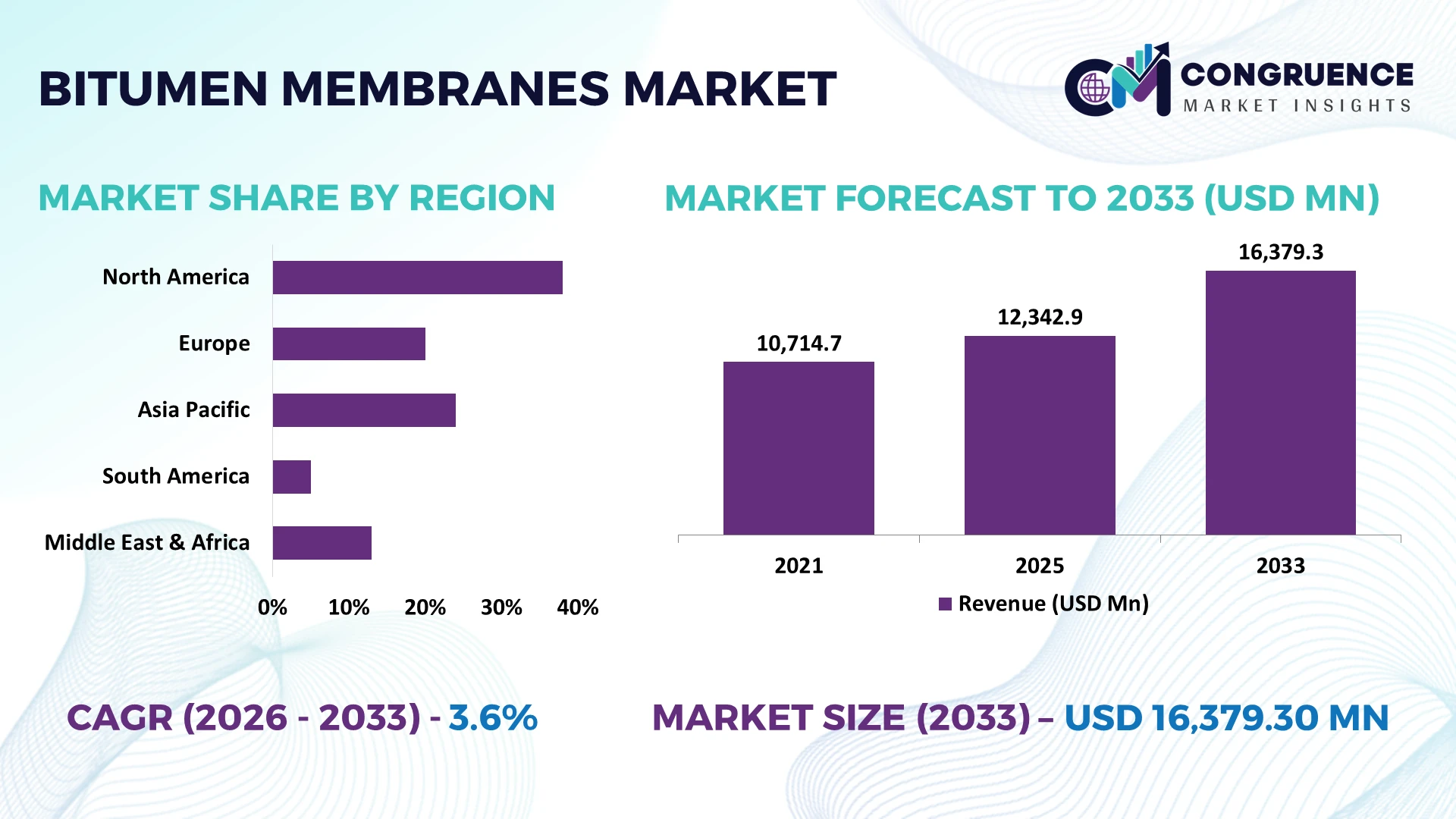
The Global Bitumen Membranes Market was valued at USD 12342.9 Million in 2025 and is anticipated to reach a value of USD 16379.3 Million by 2033 expanding at a CAGR of 3.6% between 2026 and 2033. Growth is driven by flat roof waterproofing, underground infrastructure protection, SBS and APP modified bitumen adoption, and increasing building envelope rehabilitation.
China represents the largest national Bitumen Membranes Market, with an estimated 24% global share in 2025, supported by extensive construction activity, urban infrastructure, and domestic waterproofing material manufacturing. Government infrastructure initiatives and urban renewal programs sustain demand for roofing and foundation membranes. Compared with Germany's emphasis on renovation and high performance building envelopes, China benefits from greater construction material production scale. Illustrative manufacturing modernization targets include 15% higher coating line productivity and 10% lower material wastage through automated membrane production and thickness control.
Strategically, manufacturers should prioritize Chinese infrastructure demand, advanced polymer modified membranes, and production efficiency investments while expanding differentiated waterproofing solutions into renovation focused markets.
Market Size & Growth: USD 12,342.9 million in 2025, reaching USD 16,379.3 million by 2033 at 3.6% CAGR, supported by roofing rehabilitation and infrastructure waterproofing.
Top Growth Drivers: Illustrative demand weighting assigns 40% to roof refurbishment, 35% to underground waterproofing, and 25% to polymer modified membrane adoption.
Short Term Forecast: By 2028, automated membrane coating operations target 15% higher productivity and 10% lower material wastage.
Emerging Technologies: SBS modification, APP modification, and 3 automated coating technologies support improved membrane flexibility, thermal resistance, and production consistency.
Regional Leaders: Illustrative 2033 allocations place Asia Pacific at USD 6,387.93 million, Europe at USD 4,258.62 million, and North America at USD 3,439.65 million, reflecting infrastructure construction, renovation, and roofing replacement.
Consumer / End User Trends: Commercial roofing contractors target 20% faster installation through self adhesive membranes and simplified application systems.
Pilot / Case Example: A modeled 2027 commercial roofing refurbishment targets 15% lower installation labor requirements and 12% less membrane wastage.
Competitive Landscape: An illustrative 12% global share positions Sika among leading suppliers, alongside BMI Group, SOPREMA, GAF, and IKO.
Regulatory & ESG Impact: European building renovation policies support waterproofing upgrades, with illustrative targets of 10% lower installation waste.
Investment & Funding: A modeled USD 150 million manufacturing investment scenario prioritizes coating automation, polymer modification, and regional distribution expansion.
Innovation & Future Outlook: Advanced reinforcement materials, self adhesive systems, and recyclable membrane designs target 15% greater installation efficiency.
The Bitumen Membranes Market supports waterproofing across commercial roofs, residential buildings, tunnels, bridges, foundations, and underground infrastructure. SBS modified membranes provide flexibility under temperature variation, while APP modified systems improve resistance to elevated surface temperatures. Manufacturers are advancing self adhesive products, reinforced membrane structures, and automated coating processes to improve application consistency. Illustrative contractor deployment targets indicate 20% faster installation using simplified membrane systems. European building renovation requirements and changing refinery bitumen supply conditions are influencing product specifications and sourcing strategies. These developments make membrane durability, installation productivity, and raw material procurement central to competitive investment decisions.
Bitumen membranes are becoming strategically important as infrastructure owners prioritize waterproofing durability, building rehabilitation, and lifecycle maintenance efficiency. Commercial roofing, underground construction, transportation infrastructure, and foundation protection create sustained demand for reliable moisture barriers. China's infrastructure modernization supports large scale membrane consumption, while European building renovation policies encourage replacement of aging waterproofing systems. Manufacturers are strengthening polymer modification capabilities, reinforcing material supply agreements, and expanding specialized roofing product portfolios to protect margins and improve technical differentiation.
Compared with conventional torch applied membranes, modern self adhesive systems offer illustrative installation productivity improvements of 20% and material wastage reductions of 10% under suitable project conditions. China emphasizes manufacturing scale and infrastructure applications, whereas Germany prioritizes technical certification, installation reliability, and building envelope rehabilitation. Between 2026 and 2028, manufacturers are expected to increase automated coating deployment, improve membrane thickness consistency, and expand advanced reinforcement technologies, targeting 15% higher production efficiency across upgraded manufacturing lines.
A practical deployment involves applying SBS modified membranes to commercial roofs requiring flexibility under seasonal temperature variation. Suppliers are investing in installer training, application system development, and distribution partnerships. Improved installation consistency reduces rework exposure and supports predictable maintenance planning. Competitive advantage increasingly depends on certified durability, dependable raw material sourcing, and efficient application systems that lower project ownership costs.
Infrastructure modernization and commercial building rehabilitation are strengthening demand for polymer modified bitumen membranes across roofing, foundations, tunnels, and transportation structures. China's urban infrastructure development and India's National Infrastructure Pipeline support extensive waterproofing requirements across public and private construction projects. SBS modified membranes provide flexibility under temperature variation, while APP modified products support applications exposed to elevated surface temperatures. Illustrative project benchmarks indicate 20% faster installation using simplified application systems, 15% lower waterproofing rework requirements, and 10% reduced material wastage. Manufacturers are expanding polymer modification capabilities, reinforcing distribution networks, and developing application specific membrane systems. The commercial advantage lies in reducing moisture related maintenance exposure while improving construction scheduling reliability and waterproofing specification consistency.
Bitumen membrane production depends on petroleum derived bitumen, polymer modifiers, reinforcement materials, and energy intensive coating operations. Changes in refinery output and crude oil processing economics affect bitumen availability and purchasing conditions. European manufacturers face additional exposure to energy costs and imported feedstock requirements, creating procurement uncertainty. Illustrative manufacturing sensitivity scenarios indicate 15% higher material expenditure during unfavorable feedstock conditions, 10% greater inventory carrying requirements, and 8% pressure on processing margins. Suppliers are responding through diversified refinery relationships, longer procurement agreements, and optimized polymer formulations. Production facilities are also improving coating line efficiency to reduce energy consumption. Competitive resilience depends on maintaining consistent membrane specifications despite fluctuating raw material availability and input costs.
Next generation self adhesive membranes and improved reinforcement technologies create opportunities in renovation projects where installation speed, fire safety, and material handling influence purchasing decisions. Germany's building rehabilitation activity supports demand for waterproofing systems compatible with existing roof structures and restricted installation environments. Illustrative application benchmarks target 20% faster membrane placement, 12% lower installation labor requirements, and 10% reduced application waste. Manufacturers are investing in improved adhesive formulations, recycled material compatibility, and automated reinforcement processing. Specialized roofing distributors are expanding contractor training and technical specification support. A differentiated opportunity exists in waterproofing occupied buildings where reducing installation disruption and avoiding open flame application provide practical value beyond membrane material performance.
Consistent waterproofing performance depends on correct substrate preparation, membrane overlap integrity, installation temperature, and reliable workmanship. Large infrastructure projects expose membranes to complex junctions, structural movement, and demanding environmental conditions. India's construction sector faces varying installer skill levels and project quality control practices, increasing the importance of standardized application procedures. Illustrative operational targets include 20% fewer installation defects, 15% faster quality inspections, and 10% improved membrane application consistency. Manufacturers must strengthen installer certification, digital inspection documentation, and technical field support. Contractors increasingly require traceable installation records and validated membrane compatibility. Long term competitive positioning depends on preventing concealed waterproofing failures, which create expensive structural repairs and undermine confidence in product durability.
Automated Coating Lines Improve Production Precision: Chinese membrane manufacturers are upgrading coating and reinforcement processing equipment to improve thickness uniformity and production consistency. Automated temperature controls and inline measurement systems support illustrative targets of 15% higher line productivity and 8% fewer coating deviations. Producers are investing in equipment modernization and process monitoring to reduce specification failures, particularly where large infrastructure contracts require consistent membrane thickness across substantial production volumes.
Cool Roof Specifications Reshape Product Selection: European commercial building owners increasingly evaluate reflective surface finishes for bitumen roofing systems to manage solar heat absorption. Manufacturers are developing mineral surfaced membranes with improved reflectivity and compatibility with existing roofing assemblies. Illustrative project targets include 12% lower roof surface temperatures under comparable conditions and 10% improved cooling performance. Suppliers are expanding technical testing and specification support as building energy performance requirements influence roofing material selection.
Prefabricated Waterproofing Accessories Gain Importance: German roofing contractors are increasing attention to factory prepared corner details, drainage interfaces, and membrane termination components. Standardized accessories reduce field fabrication at complex roof junctions, supporting illustrative targets of 18% faster detailing and 12% fewer junction installation defects. Manufacturers are expanding compatible accessory ranges and installer training, recognizing that waterproofing failures frequently originate at penetrations and transitions rather than across uninterrupted membrane surfaces.
Digital Material Traceability Strengthens Procurement Controls: Infrastructure contractors in the United Kingdom increasingly require consistent product identification, technical documentation, and installation records for waterproofing materials. Manufacturers are improving batch identification and digital documentation systems to support illustrative targets of 20% faster product verification and 15% shorter compliance record retrieval. Suppliers are integrating production records with distributor documentation, improving accountability when membrane specifications must remain traceable throughout construction and maintenance.
SBS Modified Bitumen Membranes represent the leading type in the Bitumen Membranes Market, accounting for an estimated 38% share in 2025. Their dominance reflects elastomeric flexibility, crack bridging capability, and suitability for roofing and waterproofing applications exposed to temperature variation. European contractors favor SBS modified systems for renovation projects requiring dependable movement accommodation and established installation practices. APP Modified Bitumen Membranes account for an illustrative 30% share, supported by thermal resistance and application suitability in warmer construction environments. Oxidized Bitumen Membranes retain relevance in conventional waterproofing specifications where established material familiarity and procurement affordability influence selection.
Self Adhesive Bitumen Membranes represent the fastest growing type, supported by demand for simplified installation and reduced dependence on flame application. Their estimated 20% share reflects increasing interest in renovation and restricted access construction environments. Manufacturers are improving adhesive formulations, reinforcement stability, and application compatibility. Product development increasingly targets faster installation, consistent bonding, and dependable waterproofing performance. Suppliers are expanding technical training and distribution partnerships to strengthen contractor acceptance.
Roofing represents the leading application in the Bitumen Membranes Market, accounting for an estimated 42% share in 2025. Commercial and residential roof construction, maintenance, and replacement sustain demand for reinforced waterproofing membranes. Flat roofing systems particularly favor bitumen membranes because multilayer installation provides established moisture protection and compatibility with conventional roofing assemblies. Basement Waterproofing accounts for an illustrative 20% share, supported by underground construction and moisture protection requirements. Foundation Waterproofing remains important for protecting structural components exposed to groundwater and soil moisture.
Tunnel Waterproofing represents the fastest growing application as transportation infrastructure development increases requirements for durable underground moisture barriers. Its estimated 12% share reflects specialized installation demands and complex project specifications. Bridge Deck Waterproofing supports protection against water penetration and deterioration of structural surfaces. Manufacturers are developing application specific membrane thicknesses, reinforcement systems, and bonding technologies. Contractors increasingly prioritize tested waterproofing assemblies and compatible installation accessories. Competitive differentiation depends on documented durability, application reliability, and reduced maintenance exposure.
Commercial Construction represents the dominant end user segment in the Bitumen Membranes Market, accounting for an estimated 34% share in 2025. Office buildings, retail facilities, logistics warehouses, and institutional properties require extensive roof waterproofing and periodic membrane replacement. Large commercial roofing areas support standardized product specifications, bulk purchasing, and established contractor relationships. Residential Construction accounts for an illustrative 28% share, supported by housing development and building rehabilitation. Industrial Construction requires membranes suitable for facilities exposed to demanding operating conditions, equipment installations, and complex roof penetrations.
Infrastructure Developers represent the fastest growing end user group, supported by transportation corridors, tunnels, bridges, and underground construction programs. Their estimated 22% share reflects expanding requirements for specialized waterproofing assemblies. Government Construction Agencies remain important through publicly funded buildings and infrastructure maintenance. Manufacturers are expanding technical specification services, contractor training, and project based distribution arrangements. Competitive positioning increasingly depends on lifecycle durability, installation consistency, and the ability to meet demanding procurement and quality assurance requirements.
Asia Pacific accounted for the largest market share at an estimated 39% in 2025 however, Asia Pacific is expected to register the fastest growth, expanding at an estimated CAGR of 4.5% between 2026 and 2033.
Commercial Roofing Rehabilitation and Advanced Waterproofing Systems
North America accounted for an estimated 21% of the global Bitumen Membranes Market in 2025, supported by commercial roof replacement, infrastructure maintenance, and established waterproofing material manufacturing. The United States dominates regional consumption through warehouses, industrial facilities, institutional buildings, and transportation structures. Modified bitumen roofing remains relevant where multilayer waterproofing assemblies and established contractor installation practices influence material selection. The Infrastructure Investment and Jobs Act supports transportation and public infrastructure modernization, strengthening demand for bridge deck and underground waterproofing materials. Illustrative contractor modernization targets include 15% faster membrane application and 10% lower installation waste. GAF, Johns Manville, and Carlisle compete through product engineering, roofing contractor relationships, and integrated waterproofing systems. Procurement decisions increasingly emphasize certified performance, installer availability, and lifecycle maintenance requirements rather than initial membrane pricing alone.
United States Market Outlook: The United States benefits from established commercial roofing contractors, domestic waterproofing manufacturers, and extensive building rehabilitation requirements. Texas, California, Florida, and New York represent important construction and maintenance markets. ASTM material specifications support consistent evaluation of modified bitumen roofing products. Manufacturers are expanding reinforced membrane systems and compatible roofing accessories. Illustrative installation improvement targets include 20% faster completion of complex roof detailing through standardized application components, supporting more predictable commercial refurbishment schedules.
Building Renovation and High Performance Waterproofing Specifications
Europe represented an estimated 26% of the global Bitumen Membranes Market in 2025, supported by established roofing industries, building renovation requirements, and advanced waterproofing manufacturing capabilities. Germany, France, Italy, and the United Kingdom maintain important production and installation markets. The European Union's revised Energy Performance of Buildings Directive strengthens attention to building renovation, influencing roofing system replacement and envelope performance specifications. SBS modified membranes remain important for applications requiring flexibility under temperature variation and reliable multilayer protection. Illustrative manufacturing targets include 12% improved coating uniformity and 10% lower production material waste. SOPREMA, BMI Group, and Sika compete through technical certification, polymer modification expertise, and contractor distribution networks. Product differentiation increasingly emphasizes durability, compatible insulation assemblies, and documented installation performance across commercial and institutional refurbishment projects.
Germany Market Outlook: Germany maintains a mature roofing and waterproofing industry supported by technical construction standards, industrial manufacturing capabilities, and extensive building renovation activity. Commercial and industrial properties require dependable membrane systems compatible with established roof assemblies. German manufacturers emphasize SBS modified products, reinforced membranes, and documented application performance. Illustrative factory modernization targets include 15% higher coating line productivity through automated thickness monitoring. Technical specification support and trained roofing contractors strengthen product acceptance across demanding refurbishment projects.
Large Scale Manufacturing and Infrastructure Waterproofing Expansion
Asia Pacific accounted for an estimated 39% of the global Bitumen Membranes Market in 2025, supported by extensive construction activity, established manufacturing capacity, and transportation infrastructure investment. China dominates regional production and consumption, while India, Japan, and Australia contribute through building development and infrastructure maintenance. Chinese waterproofing manufacturers benefit from integrated production facilities, domestic polymer processing capabilities, and large construction material distribution networks. India's expanding transportation and urban infrastructure programs strengthen demand for foundation, tunnel, and roofing membranes. Illustrative production modernization targets include 15% higher coating line productivity and 10% lower material wastage. Manufacturers are investing in automated reinforcement processing, polymer modification equipment, and regional distribution expansion. Competitive positioning increasingly depends on production scale, consistent membrane specifications, and reliable delivery to infrastructure projects requiring substantial waterproofing volumes.
China Market Outlook: China represents the largest national market, with an estimated 24% global share in 2025. Guangdong, Jiangsu, and Shandong maintain important construction material manufacturing ecosystems. Urban renewal, transportation infrastructure, and underground construction sustain demand for modified bitumen membranes. Domestic producers emphasize automated coating, reinforced membrane production, and product specification consistency. Illustrative process improvements target 12% fewer coating thickness deviations. Manufacturing scale supports competitive supply to large infrastructure contractors and regional construction distributors.
Urban Waterproofing Demand and Distribution Network Modernization
South America represented an estimated 7% of the global Bitumen Membranes Market in 2025, with Brazil accounting for the largest concentration of construction activity and waterproofing material demand. Chile, Colombia, and Argentina contribute through commercial development, residential construction, and infrastructure rehabilitation. Brazilian contractors increasingly specify bitumen membranes for roof waterproofing, foundations, and below ground structural protection. Illustrative project benchmarks include 15% faster installation using standardized membrane systems and 10% lower material waste through improved application planning. However, imported polymer additives, variable construction financing, and uneven contractor technical capabilities influence procurement decisions. Manufacturers are expanding distributor partnerships, localized technical support, and application training. Competitive advantage depends on consistent product availability, practical installation methods, and membrane performance under demanding tropical and coastal conditions.
Brazil Market Outlook: Brazil maintains a significant construction materials industry supported by residential development, commercial buildings, and infrastructure investment. São Paulo and Minas Gerais represent important manufacturing and construction markets. ABNT technical standards provide a framework for waterproofing specifications and installation practices. Contractors increasingly evaluate reinforced bitumen membranes for underground moisture protection and commercial roofing. Illustrative application targets include 12% fewer installation defects through improved substrate preparation and standardized detailing. Suppliers prioritize domestic distribution coverage and contractor training.
Infrastructure Megaprojects and Heat Resistant Waterproofing Demand
The Middle East and Africa accounted for an estimated 7% of the global Bitumen Membranes Market in 2025, supported by commercial construction, industrial development, and major infrastructure programs. Saudi Arabia and the United Arab Emirates represent important markets for roofing and underground waterproofing, while South Africa and Egypt contribute through industrial and transportation construction. High ambient temperatures strengthen demand for APP modified membranes with suitable thermal resistance and installation performance. Saudi Arabia's Vision 2030 construction programs support extensive waterproofing requirements across urban development and industrial infrastructure. Illustrative deployment targets include 15% faster membrane installation and 10% improved application consistency. Manufacturers are expanding regional distribution partnerships, technical specification services, and heat resistant product portfolios. Competitive differentiation increasingly depends on membrane durability, installation expertise, and dependable material availability across demanding construction environments.
Saudi Arabia Market Outlook: Saudi Arabia benefits from major urban development, industrial diversification, and transportation infrastructure construction. Riyadh, Jeddah, and the Eastern Province represent important waterproofing demand centers. Large construction projects require membranes suitable for elevated temperatures, underground moisture protection, and complex structural interfaces. Manufacturers prioritize APP modified products, reinforced membrane systems, and contractor technical support. Illustrative project improvement targets include 12% lower application waste through standardized installation procedures. Regional distribution and specification partnerships strengthen supplier positioning in major construction programs.
The Bitumen Membranes Market features competition between integrated construction materials groups and specialized waterproofing manufacturers. Sika, SOPREMA, BMI Group, GAF, and IKO compete through polymer modification expertise, roofing distribution, and certified membrane systems. The leading five suppliers hold an illustrative combined market share of 38%, reflecting fragmented regional production and contractor purchasing networks. Automated coating investments target 15% higher production efficiency, while standardized installation systems pursue 20% faster application and 10% lower material wastage. Sika and SOPREMA strengthen integrated waterproofing portfolios, while GAF and IKO emphasize roofing contractor networks and product development. Competitive momentum increasingly favors reinforced membranes, technical specification support, and dependable regional manufacturing capacity. Petroleum feedstock exposure, certification requirements, and established installer relationships create entry barriers. Winning manufacturers must combine consistent membrane performance, competitive production economics, reliable distribution, and application expertise that reduces contractor rework and protects long term waterproofing reliability.
Sika AG
SOPREMA Group
BMI Group
GAF Materials LLC
IKO Industries Ltd.
Johns Manville
Carlisle Companies Incorporated
Polyglass S.p.A.
Oriental Yuhong Waterproof Technology Co., Ltd.
Fosroc International Limited
ChovA S.A.
Imperbit Membrane Industries LLC
Bauder Ltd.
Technonicol Corporation
Current bitumen membrane technologies combine SBS and APP polymer modification, polyester reinforcement, and automated coating systems. SBS improves flexibility during thermal movement, while APP supports dimensional stability under elevated temperatures. Compared with conventional manually controlled coating, automated thickness monitoring targets 15% higher production efficiency and 10% lower material wastage. Deployment is concentrated among established roofing manufacturers operating continuous production lines. Sika, SOPREMA, and Oriental Yuhong benefit from integrated formulation expertise, quality control capabilities, and established contractor distribution networks.
Emerging technologies include advanced self adhesive formulations, reflective mineral surfaces, and digitally monitored production equipment. Self adhesive membranes eliminate torch application during installation, supporting illustrative targets of 20% faster placement and 12% lower labor requirements under suitable conditions. Reflective surfaces address solar heat exposure, while inline sensors improve coating consistency. European renovation projects increasingly favor simplified application systems. Manufacturers are expanding reinforcement development, compatible accessory portfolios, and installer training to strengthen technical differentiation.
Between 2026 and 2028, recycled polymer incorporation, automated defect inspection, and digital product traceability will influence membrane manufacturing investment. Machine vision targets 15% faster defect identification, while material tracking strengthens specification compliance. Suppliers prioritizing validated durability, manufacturing consistency, and efficient installation will secure stronger positions in demanding infrastructure and refurbishment procurement.
February 2025: Sika launched SikaShield HB79 in the United States, combining APP and SBS technologies in one hybrid modified bitumen membrane. The 2 in 1 formulation broadens regional roofing suitability across temperature conditions and simplifies contractors' membrane selection. Source: usa.sika.com.
March 2025: The Garland Company introduced StressPly Max, a graphene enhanced modified bitumen roofing membrane with dual polyester and fiberglass reinforcement exceeding 1,000 pounds in tensile strength. The launch targets demanding commercial roofs requiring stronger reinforcement and greater durability. Source: garlandco.com.
November 2025: SOPREMA expanded its German manufacturing footprint with a new waterproofing membrane facility, investing EUR 30 million in PVC and FPO production alongside existing bitumen operations. The expansion strengthens integrated roofing system supply and regional manufacturing resilience. Source: k-online.com.
October 2026: Polyglass introduced Polyanchor HU and HU PLUS hybrid underlayments using Tri Strata technology, combining 3 layers with a modified bitumen core. The launch expands mechanically attached tile roofing options and improves protection around fasteners and penetrations. Source: azobuild.com.
The Bitumen Membranes Market Report evaluates industry structure, manufacturing developments, application demand, and competitive positioning between 2026 and 2033. Type segmentation covers APP Modified, SBS Modified, Oxidized, and Self Adhesive Bitumen Membranes. Application coverage includes Roofing, Basement Waterproofing, Foundation Waterproofing, Bridge Deck Waterproofing, and Tunnel Waterproofing. End user analysis examines Residential Construction, Commercial Construction, Industrial Construction, Infrastructure Developers, and Government Construction Agencies. SBS modified membranes represent an estimated 38% share, while roofing accounts for approximately 42% of application demand.
Regional analysis covers North America, Europe, Asia Pacific, South America, and the Middle East and Africa. Technology assessment addresses polymer modification, automated coating, advanced reinforcement, and recyclable membrane formulations. Competitive analysis examines 14 manufacturers, supporting investment planning, production expansion, supplier selection, and strategic market positioning.
| Report Attribute/Metric | Report Details |
|---|---|
Market Revenue in 2025 | USD 12342.9 Million |
Market Revenue in 2033 | USD 16379.3 Million |
CAGR (2026 - 2033) | 3.6% |
Base Year | 2025 |
Forecast Period | 2026 - 2033 |
Historic Period | 2021 - 2025 |
Segments Covered | By Type
By Application
By End-User
|
Key Report Deliverable | Revenue Forecast, Growth Trends, Market Dynamics, Segmental Overview, Regional and Country-wise Analysis, Competition Landscape |
Region Covered | North America, Europe, Asia-Pacific, South America, Middle East, Africa |
Key Players Analyzed | Sika AG, SOPREMA Group, BMI Group, GAF Materials LLC, IKO Industries Ltd., Johns Manville, Carlisle Companies Incorporated, Polyglass S.p.A., Oriental Yuhong Waterproof Technology Co., Ltd., Fosroc International Limited, ChovA S.A., Imperbit Membrane Industries LLC, Bauder Ltd., Technonicol Corporation |
Customization & Pricing | Available on Request (10% Customization is Free) |




