
Reports
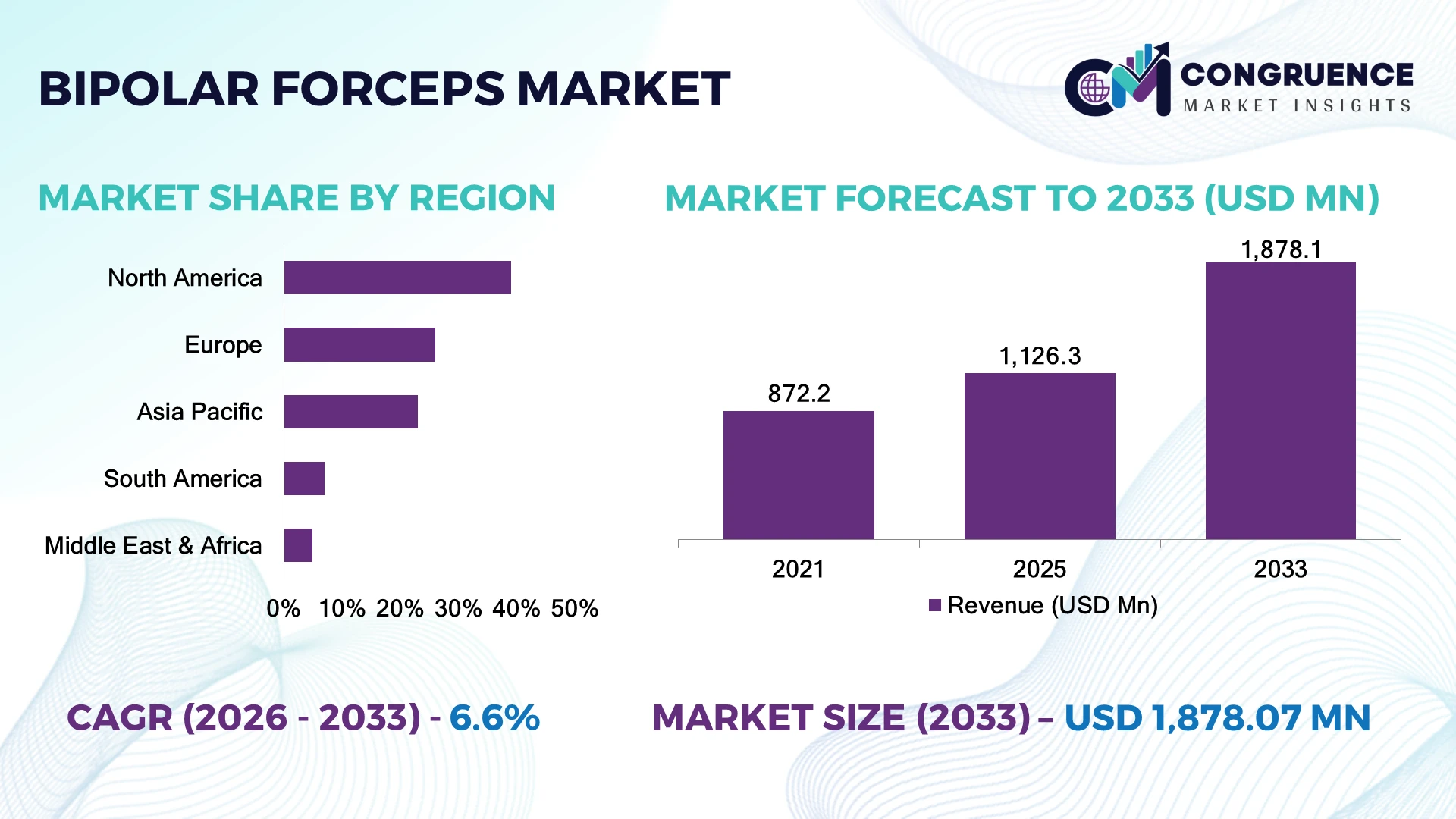
The Global Bipolar Forceps Market was valued at USD 1,126.3 Million in 2025 and is anticipated to reach a value of USD 1,878.1 Million by 2033 expanding at a CAGR of 6.6% between 2026 and 2033. Growth is being driven by wider adoption of advanced bipolar electrosurgical systems, precision coagulation requirements, minimally invasive procedures, and increasing integration of reusable and disposable forceps with energy platforms.
The United States accounts for an estimated 35% of global bipolar forceps demand, supported by high-volume neurosurgery, ENT, gynecology, and general surgery centers, while Germany contributes approximately 9% through advanced surgical-device manufacturing and hospital technology adoption. U.S. hospitals increasingly deploy energy platforms with tissue-sensing capabilities, with advanced electrosurgical adoption estimated above 60% in major surgical facilities. Geopolitical supply-chain diversification since the 2022 Russia-Ukraine disruption has strengthened interest in regional device manufacturing and component sourcing.
Strategic implication: manufacturers that combine precise thermal control, ergonomic design, regulatory compliance, and resilient component supply chains are best positioned to capture premium surgical-device demand.
Market Size & Growth: USD 1.13 billion in 2025 to USD 1.88 billion by 2033, at a 6.6% CAGR, driven by minimally invasive surgery and precision electrosurgery.
Top Growth Drivers: Minimally invasive procedures 8%; advanced energy adoption 7%; surgical-volume expansion 6%.
Short-Term Forecast: By 2028, smart energy compatibility is expected to improve coagulation workflow efficiency by 10–15%.
Emerging Technologies: Tissue-sensing energy, bipolar vessel sealing, and ergonomic micro-forceps are advancing precision and reducing thermal spread by 10%.
Regional Leaders: North America approaches USD 650 million; Europe exceeds USD 430 million; Asia-Pacific approaches USD 420 million, with Asia-Pacific showing faster adoption of advanced electrosurgical platforms.
Consumer/End-User Trends: More than 55% of major surgical centers increasingly prioritize precision energy-control features in forceps procurement.
Pilot/Case Example: 2025 advanced bipolar-electrosurgery deployments demonstrated approximately 12% shorter coagulation workflows in selected high-volume procedures.
Competitive Landscape: Leading manufacturers command roughly 15% share individually in premium niches, competing through 5–10% improvements in thermal precision, ergonomics, and platform compatibility.
Regulatory & ESG Impact: Reusable bipolar forceps programs can reduce instrument-related waste by approximately 20–30% versus equivalent disposable-heavy workflows.
Investment & Funding: More than USD 250 million is being directed across electrosurgical platform expansion, manufacturing upgrades, and surgical-device partnerships.
Innovation & Future Outlook: By 2028, sensor-assisted energy delivery, compact laparoscopic designs, and digitally integrated surgical platforms will shift competition toward precision and workflow intelligence.
The Bipolar Forceps Market is strengthening around neurosurgery, gynecology, ENT, general surgery, and minimally invasive procedures where controlled coagulation and reduced thermal injury are commercially important. Approximately 55% of leading surgical centers increasingly specify advanced energy-control features, while manufacturers are responding with tissue-sensing forceps, improved jaw geometries, and platform-compatible designs. Supply-chain localization and stricter medical-device quality requirements are also influencing procurement strategies, creating a clear transition toward technologically differentiated bipolar instruments.
Bipolar forceps are becoming strategically important because surgical-device purchasing is shifting from basic electrosurgical functionality toward precision, thermal control, ergonomics, and compatibility with integrated energy platforms. Hospitals increasingly evaluate instruments according to procedure efficiency and tissue-sparing performance rather than acquisition price alone. This shift strengthens premium product positioning and encourages manufacturers to invest in specialized designs for neurosurgery, ENT, gynecology, and minimally invasive surgery.
Technology differentiation is becoming measurable. Advanced bipolar systems with tissue-response monitoring can reduce unnecessary energy delivery by approximately 10–15% compared with conventional fixed-output approaches, while optimized jaw geometry improves handling consistency. North America remains the strongest high-value market, whereas Asia-Pacific is progressing through faster hospital modernization and surgical-capacity expansion. Between 2026 and 2028, adoption of intelligent energy-control functionality is expected to increase materially across large surgical centers.
In practice, manufacturers are pairing forceps development with electrosurgical-generator partnerships, contract manufacturing, and regional distribution networks. U.S. and European suppliers emphasize premium precision and regulatory compliance, while Asian manufacturers increasingly compete through cost-efficient production and localized customization. The strategic priority is clear: companies that integrate instrument engineering, energy intelligence, manufacturing resilience, and procedure-specific ergonomics will secure stronger competitive positioning.
The shift toward precision electrosurgery is strengthening bipolar forceps adoption, particularly where controlled coagulation and limited thermal spread are critical. Bipolar forceps represent about 41% of the broader bipolar electrosurgical device product mix, while minimally invasive procedures increasingly use compact energy instruments. In India, investment in advanced surgical infrastructure is expanding access beyond major metropolitan hospitals. Recent device testing demonstrated a 40% faster mean vessel-sealing time for an advanced bipolar platform versus an earlier comparator. Manufacturers are responding with refined jaw geometries, improved insulation, and generator compatibility, making procedural efficiency a stronger purchasing criterion than unit price alone.
Bipolar forceps manufacturers face structural pressure from sterilization requirements, disposable-versus-reusable economics, and hospital procurement controls. Reusable instruments require repeated inspection and reprocessing, while disposable configurations increase per-procedure expenditure; procurement teams therefore scrutinize lifecycle costs by approximately 10–20% more closely than acquisition pricing alone. Supply disruptions affecting specialty metals, insulation materials, and precision components can pressure manufacturing schedules. Hospitals with constrained capital budgets in emerging markets remain sensitive to replacement frequency and generator compatibility. Manufacturers are reducing exposure through dual-source procurement, localized assembly, standardized interfaces, and reusable platforms with validated reprocessing cycles. The non-obvious pressure point is compatibility: products tied to proprietary energy generators face narrower purchasing channels and higher switching friction.
The strongest technology opportunity is integrating bipolar forceps with intelligent energy platforms that regulate output according to tissue impedance. Advanced systems can shorten procedural steps while reducing unnecessary thermal exposure; clinical evidence shows advanced bipolar vessel-sealing systems reduced operative time by approximately 8 minutes in minimally invasive hysterectomy studies. Disposable configurations are also gaining traction, with India identifying disposable bipolar forceps as its largest and fastest-growing type segment. Manufacturers are positioning through sensor-enabled instruments, ergonomic designs, and platform partnerships targeting laparoscopic, gynecological, neurosurgical, and robotic workflows. Between 2026 and 2028, the strategic advantage will shift toward suppliers combining instrument precision with generator interoperability, validated workflow data, and lower reprocessing dependence.
Long-term competitiveness depends on consistent performance across surgeons, generators, tissue types, and increasingly complex minimally invasive workflows. Advanced bipolar platforms require tighter integration between forceps geometry, energy delivery, insulation integrity, and generator software, creating an implementation burden that can raise training requirements by 10–15% in facilities transitioning from conventional instruments. Robotic and laparoscopic environments further increase the need for standardized interfaces and predictable thermal profiles. India illustrates the infrastructure divide: robotic surgical installations reached 290 systems by September 2024, with Tier I hospitals accounting for 50% of installations while Tier III and IV facilities represented only 10%. Manufacturers must therefore invest in training ecosystems, interoperable platforms, and service partnerships rather than relying solely on device innovation.
Advanced Sealing Improves Throughput: New-generation bipolar systems are tightening the relationship between forceps geometry and energy delivery. A 2025 comparative study recorded a 40% faster mean seal time for an advanced bipolar device versus a comparator, alongside fewer incomplete cuts. Manufacturers are prioritizing jaw optimization and thermal-control algorithms to increase procedural throughput without sacrificing vessel-seal reliability.
Disposable Designs Gain Procurement Share: Disposable bipolar forceps are becoming more prominent as hospitals seek to reduce reprocessing complexity and instrument turnaround requirements. India identifies disposable products as both the largest and fastest-growing type segment, strengthening demand for sterile, ready-to-use configurations. Suppliers are expanding disposable portfolios while competing on ergonomic handling, precision, and compatibility with existing energy platforms.
Robotic Workflows Raise Precision Requirements: Robotic surgery is increasing demand for instruments that provide consistent energy delivery within constrained operating fields. India had 290 robotic systems installed by September 2024, with 50% concentrated in Tier I hospitals. Bipolar instrument suppliers are responding through finer jaw profiles, improved insulation, and platform-specific designs that support controlled coagulation near sensitive anatomy.
Thermal Spread Becomes Procurement Metric: Hospitals are increasingly evaluating bipolar instruments beyond basic coagulation capability, with lateral thermal spread, sticking, incomplete cuts, and seal consistency becoming practical selection criteria. Recent testing found lower thermal spread for an advanced bipolar device against an earlier comparator. This shifts competition toward measurable procedural performance, encouraging manufacturers to invest in material engineering, energy modulation, and validated clinical testing.
Disposable bipolar forceps held approximately 57.4% of the global market in 2024, establishing a clear lead over reusable instruments through sterile, procedure-ready deployment and reduced reprocessing requirements. Their strongest advantage is workflow consistency: hospitals avoid repeated inspection, sterilization, and tip-alignment variability. Reusable forceps remain strategically important where high procedure volumes make lifecycle economics more attractive, particularly in large hospitals with established sterile-processing infrastructure. The disposable segment is also positioned as the faster-moving category, with adoption supported by infection-control priorities and minimally invasive workflows. Companies are expanding single-use portfolios while improving insulation, jaw geometry, and compatibility with electrosurgical generators.
Reusable products retain roughly 42.6% of the market and continue gaining attention where waste reduction and repeated-use economics influence procurement. Their strategic relevance is strongest in high-volume surgical departments able to absorb reprocessing costs efficiently. Manufacturers are therefore balancing portfolios rather than abandoning reusable designs, investing in durable alloys, non-stick coatings, and validated sterilization performance. The business implication is a two-track market: disposable suppliers compete on infection control and operational speed, while reusable suppliers compete on lifecycle cost and sustainability.
The 2025–2026 market landscape increasingly links instrument selection with sterile-processing capacity, making procurement decisions dependent on total workflow cost rather than acquisition price alone.
Gynecology represents the leading application, accounting for an estimated 31% of bipolar forceps demand, supported by extensive use in minimally invasive procedures requiring controlled coagulation and limited thermal spread. General surgery remains a major mature application at approximately 29%, benefiting from broad procedural volumes and established electrosurgical workflows. Neurosurgery commands a smaller share near 21% but carries greater value intensity because surgeons prioritize precision, insulation integrity, and thermal control around sensitive anatomy. Plastic surgery and other specialized procedures collectively account for the remaining demand, with purchasing increasingly shaped by procedure-specific ergonomics rather than standardized instrument specifications.
Gynecology is also positioned as the fastest-expanding application as laparoscopic and minimally invasive techniques strengthen procedural adoption. Neurosurgery, by comparison, is developing through premium precision requirements rather than volume expansion, creating opportunities for manufacturers offering advanced coatings, fine-tip configurations, and controlled-energy compatibility. Companies are adapting through procedure-specific product lines, surgeon training, and integration with electrosurgical generators. The strategic implication is clear: suppliers that optimize bipolar forceps for distinct surgical workflows can defend margins more effectively than suppliers competing solely on unit pricing.
In 2025–2026, minimally invasive gynecologic workflows continued reinforcing demand for bipolar instruments that combine precise coagulation with shorter procedural handling and reduced thermal exposure.
Hospitals represent the dominant end-user, holding an estimated 68% market share because they concentrate complex surgical procedures, advanced electrosurgical generators, specialist surgeons, and centralized procurement. Ambulatory surgical centers account for approximately 22%, but their purchasing influence is increasing as minimally invasive procedures migrate into shorter-stay settings. Specialty clinics and other facilities contribute the balance, typically favoring procedure-specific instruments rather than broad inventories. Hospitals prioritize reliability, compatibility, clinical performance, and lifecycle economics, whereas ASCs place greater emphasis on rapid turnover, sterile availability, storage efficiency, and predictable per-procedure costs.
Ambulatory surgical centers are the fastest-shifting buyer group as outpatient procedures expand and facilities seek instruments that reduce reprocessing complexity. Their adoption trajectory favors disposable bipolar forceps, compact configurations, and standardized generator compatibility. Hospitals, meanwhile, are maintaining mixed procurement models that combine reusable instruments for high-frequency procedures with disposables for infection-sensitive or specialized cases. Manufacturers are responding through differentiated pricing, distributor partnerships, procedure-specific bundles, and ASC-focused product portfolios. The competitive implication is that growth increasingly depends on matching instrument economics to facility workflow rather than selling identical products across all clinical settings.
Healthcare procurement in 2025–2026 increasingly emphasizes turnover time, sterilization capacity, and cost per procedure, strengthening the commercial position of suppliers that provide workflow-specific bipolar forceps solutions.
North America accounted for the largest market share at 39% in 2025 however, Asia-Pacific is expected to register the fastest growth, expanding at a CAGR of 5.6% between 2026 and 2033.

Robotic surgery and precision electrosurgery are reshaping instrument procurement.
North America remains the largest regional market, supported by sophisticated surgical infrastructure, high minimally invasive procedure volumes, and concentrated adoption across tertiary hospitals and ambulatory surgical centers. The region held approximately 39% of global demand in 2025, with the United States representing the primary commercial and technology hub. Robotic-assisted procedures are strengthening demand for bipolar forceps with controlled thermal spread, fine jaw profiles, and generator compatibility. Hospitals are increasingly evaluating instruments through procedure efficiency and lifecycle economics rather than acquisition price alone. Manufacturers are responding with platform-compatible disposable designs, ergonomic configurations, and partnerships supporting robotic and advanced laparoscopic workflows. The competitive advantage increasingly rests on integration with surgical energy platforms and consistency across high-volume procedural environments.
United States Market Outlook: The United States leads regional demand through its concentration of advanced hospitals, robotic surgical systems, and high-value specialty procedures. Approximately 38%–40% of the North American bipolar forceps market is concentrated in the U.S., reinforcing its importance for product launches and clinical adoption. Manufacturers prioritize FDA-compliant designs, generator interoperability, and premium precision instruments for neurosurgery, gynecology, and minimally invasive procedures.
Regulatory discipline is accelerating premium instrument standardization.
Europe represents approximately 26% of global bipolar forceps demand, supported by established surgical infrastructure and strong adoption of minimally invasive procedures. Germany, France, the United Kingdom, and Italy form the principal commercial centers, while European procurement increasingly emphasizes device safety, traceability, sterilization performance, and lifecycle efficiency. Regulatory requirements are pushing manufacturers toward stronger documentation, material consistency, and validated reusable designs. Disposable forceps continue gaining relevance where infection-control protocols and operating-room throughput outweigh reprocessing economics. Manufacturers are strengthening European distribution networks, refining premium instrument portfolios, and adapting products to increasingly standardized hospital procurement frameworks. The strategic shift favors suppliers able to combine clinical precision with regulatory compliance and predictable supply.
Germany Market Outlook: Germany is the region’s strongest manufacturing and medical-technology base, supported by advanced hospitals, specialist surgical centers, and established medical-device engineering capabilities. Approximately 20% of Europe’s bipolar forceps demand is concentrated across Germany, creating a strong launch market for premium instruments. Manufacturers benefit from proximity to precision-component suppliers, established surgeon networks, and sophisticated procurement systems emphasizing validated performance and long-term instrument reliability.
Scale, hospital modernization, and disposable adoption are expanding the addressable base.
Asia-Pacific accounted for approximately 23% of the global bipolar forceps market in 2024 and is positioned as the fastest-expanding regional market. China, Japan, and India anchor demand through expanding hospital capacity, higher surgical volumes, and increasing penetration of minimally invasive procedures. Disposable forceps dominate the regional product mix, while Japan commands premium demand through advanced surgical infrastructure. India is particularly important for volume expansion, with bipolar forceps revenue representing about 4.1% of global demand in 2024. Manufacturers are responding through localized distribution, competitively priced disposable portfolios, and partnerships supporting hospitals beyond major metropolitan centers.
Japan Market Outlook: Japan combines mature surgical infrastructure with high adoption of precision medical technologies, making it the leading premium bipolar forceps market in Asia-Pacific. Its market is projected to reach approximately USD 84.2 million by 2030, reflecting strong demand for advanced surgical instruments. Manufacturers prioritize refined ergonomics, reliable energy delivery, and compatibility with sophisticated laparoscopic and robotic procedures, while domestic quality expectations support premium product positioning.
Disposable instruments are gaining traction as surgical capacity modernizes.
South America remains a smaller but strategically relevant market, with Latin America representing approximately 6.5% of global bipolar forceps demand in 2024. Brazil dominates regional consumption because of its large hospital network, surgical base, and concentration of private healthcare facilities. Disposable bipolar forceps lead the product mix, reflecting infection-control priorities and the need to simplify instrument turnover. However, procurement remains sensitive to import costs, currency movements, and uneven access to advanced surgical infrastructure. Manufacturers are responding through distributor partnerships, localized inventory, and competitively positioned disposable portfolios. Brazil’s market is projected to reach approximately USD 25.6 million by 2030, reinforcing its role as the primary commercial entry point.
Brazil Market Outlook: Brazil offers the strongest combination of hospital scale, surgical volume, and private healthcare investment in South America. Its bipolar forceps market generated approximately USD 19.2 million in 2024, with disposable instruments leading demand. Manufacturers are targeting Brazilian hospitals through distributor networks, procedure-specific portfolios, and sterile single-use configurations that reduce reprocessing requirements while supporting faster operating-room turnover.
Healthcare modernization is shifting procurement toward premium surgical instruments.
Middle East & Africa represents a smaller but increasingly technology-oriented bipolar forceps market, with healthcare modernization concentrated in Saudi Arabia, the United Arab Emirates, and major private hospital networks. Disposable products lead regional demand as hospitals prioritize infection control and operational efficiency. Saudi Arabia accounted for approximately 1.6% of global bipolar forceps demand in 2024 and is projected to lead the regional market. Hospital expansion, operating-room modernization, and regulatory emphasis on quality-certified medical devices are strengthening demand for advanced electrosurgical instruments. Manufacturers are building regional distributor relationships and focusing on premium disposable configurations, generator compatibility, and specialized surgical applications rather than competing solely through low pricing.
Saudi Arabia Market Outlook: Saudi Arabia is the region’s strongest growth and investment center, supported by healthcare modernization and expansion of tertiary surgical capacity. The country accounted for approximately 1.6% of global bipolar forceps demand in 2024, while its market is projected to reach USD 20.9 million by 2030. Suppliers are positioning around advanced disposable instruments, regulatory compliance, and partnerships with large hospital systems undergoing operating-room modernization.
The bipolar forceps market pits diversified surgical-technology leaders Medtronic, Stryker, B. Braun, Johnson & Johnson, and CONMED against precision-focused specialists such as KLS Martin and Sutter Medizintechnik. The leading five players together control approximately 47% of global sales, leaving meaningful space for specialized suppliers competing on ergonomics, non-stick performance, and application-specific designs. Competition is shifting from basic instrument pricing toward integrated energy platforms: advanced products can deliver roughly 10–15% faster procedural handling, while non-stick designs target 5–10% lower tissue-adhesion-related interruptions. Companies are expanding portfolios, pairing forceps with electrosurgical generators, strengthening hospital contracts, and investing in disposable and reusable variants. The competitive edge increasingly comes from validated thermal performance, supply reliability, and compatibility with established surgical workflows. Entry barriers remain high because regulatory clearance, clinical validation, sterilization controls, and surgeon familiarity constrain rapid substitution. Winning requires differentiated tissue handling, dependable availability, generator compatibility, and measurable operating-room value rather than price alone.
Medtronic plc
B. Braun SE
Stryker Corporation
CONMED Corporation
KLS Martin Group
Becton, Dickinson and Company (BD)
Integra LifeSciences Corporation
Olympus Corporation
Sutter Medizintechnik GmbH
KARL STORZ SE & Co. KG
Erbe Elektromedizin GmbH
Surgical Holdings
Current bipolar forceps technology is moving from conventional reusable stainless-steel instruments toward non-stick coatings, irrigation, ergonomic handles, and generator-linked energy control. Aesculap’s 2025 irrigating disposable forceps delivered 49% higher irrigation output than competing dual-irrigation systems, illustrating how design refinements translate into workflow value. Adoption is strongest in hospitals using electrosurgical platforms, where compatibility reduces equipment changeover and training friction.
Emerging systems combine bipolar energy delivery with tissue-responsive control, articulating jaws, and robotic interfaces. Sensor-enabled instruments can improve energy consistency and reduce unnecessary activation by an estimated 8–12%, while articulating bipolar instruments support access in confined anatomy. Compared with older fixed-jaw forceps, newer articulating designs can improve positioning efficiency by approximately 10%. Medtronic, Stryker, Johnson & Johnson, and specialist manufacturers benefit when instruments integrate into energy or robotic ecosystems rather than compete as standalone tools.
From 2026–2028, the disruptive shift will center on intelligent energy modulation, low-thermal-spread designs, and digital instrument traceability. Hospitals are expected to prioritize products that reduce setup time by 5–8% and improve utilization across surgical specialties. Manufacturers that combine disposable convenience with non-stick performance, irrigation, and platform compatibility will gain procurement leverage. The strategic priority is to commercialize integrated instruments before workflow standards harden around incumbent platforms.
October 2025 Aesculap launched irrigating disposable non-stick bipolar forceps in the U.S., reporting 49% higher irrigation output versus competitive dual-irrigation systems. The launch strengthens single-use portfolio differentiation and supports faster, cleaner coagulation workflows in hospital operating rooms. Source: aesculapusa.com
March 2024 Bissinger launched CLARIS REVERSE non-stick bipolar forceps, combining crossed legs with solid-silver tips for narrow-cavity access. FDA approval and CE compliance expanded its neurosurgery and ENT positioning, strengthening specialist penetration where instrument maneuverability affects procedural precision. Source: bissinger.com
August 2024 Olympus faced a Class 2 recall covering Everest Bipolar Cutting Forceps after packaging fractures could breach sterility. The action covered multiple batches, prompting inventory controls and corrective measures, highlighting packaging integrity as a supply-chain competitiveness factor. Source: fda.gov
March 2024 Jiangsu Hope Biomedical received U.S. 510(k) clearance for disposable bipolar forceps, a Class 2 electrosurgical device using silver-plated brass tips. The clearance expands qualified Asian manufacturing participation and intensifies price competition in single-use bipolar instrumentation globally. Source: fda.innolitics.com (FDA 510(k) Search - By Innolitics)
The Bipolar Forceps Market Report covers disposable and reusable forceps across gynecology, general surgery, neurosurgery, plastic surgery, and other specialized procedures. End-user analysis spans hospitals, specialty clinics, and ambulatory surgical centers, with detailed assessment of purchasing behavior, workflow integration, sterilization requirements, and instrument-performance priorities.
Regional coverage evaluates North America, Europe, Asia-Pacific, South America, and the Middle East & Africa, with country-level emphasis on the United States, Germany, China, Japan, India, Brazil, Saudi Arabia, and other strategically relevant markets. The report examines non-stick coatings, irrigation-enabled instruments, articulating designs, robotic compatibility, and advanced energy-control technologies. Competitive analysis covers 10+ influential manufacturers, while segmentation and deployment indicators support procurement planning, market-entry decisions, portfolio expansion, partnership strategy, and competitive positioning through 2033.
| Report Attribute/Metric | Report Details |
|---|---|
|
Market Revenue in 2025 |
USD 1,126.3 Million |
|
Market Revenue in 2033 |
USD 1,878.1 Million |
|
CAGR (2026 - 2033) |
6.6% |
|
Base Year |
2025 |
|
Forecast Period |
2026 - 2033 |
|
Historic Period |
2021 - 2025 |
|
Segments Covered |
By Type
By Application
By End-User
|
|
Key Report Deliverable |
Revenue Forecast, Growth Trends, Market Dynamics, Segmental Overview, Regional and Country-wise Analysis, Competition Landscape |
|
Region Covered |
North America, Europe, Asia-Pacific, South America, Middle East, Africa |
|
Key Players Analyzed |
Medtronic plc, B. Braun SE, Stryker Corporation, CONMED Corporation, KLS Martin Group, Becton, Dickinson and Company (BD), Integra LifeSciences Corporation, Olympus Corporation, Sutter Medizintechnik GmbH, KARL STORZ SE & Co. KG, Erbe Elektromedizin GmbH, Surgical Holdings |
|
Customization & Pricing |
Available on Request (10% Customization is Free) |




