
Reports
The Global Biophotonics Market was valued at USD 70,145.1 Million in 2025 and is anticipated to reach a value of USD 132,747.1 Million by 2033 expanding at a CAGR of 8.3% between 2026 and 2033. Growth is driven by AI-integrated imaging, molecular diagnostics, biosensors, minimally invasive optical diagnostics, and expanding use of photonic technologies across precision medicine and life-science research.
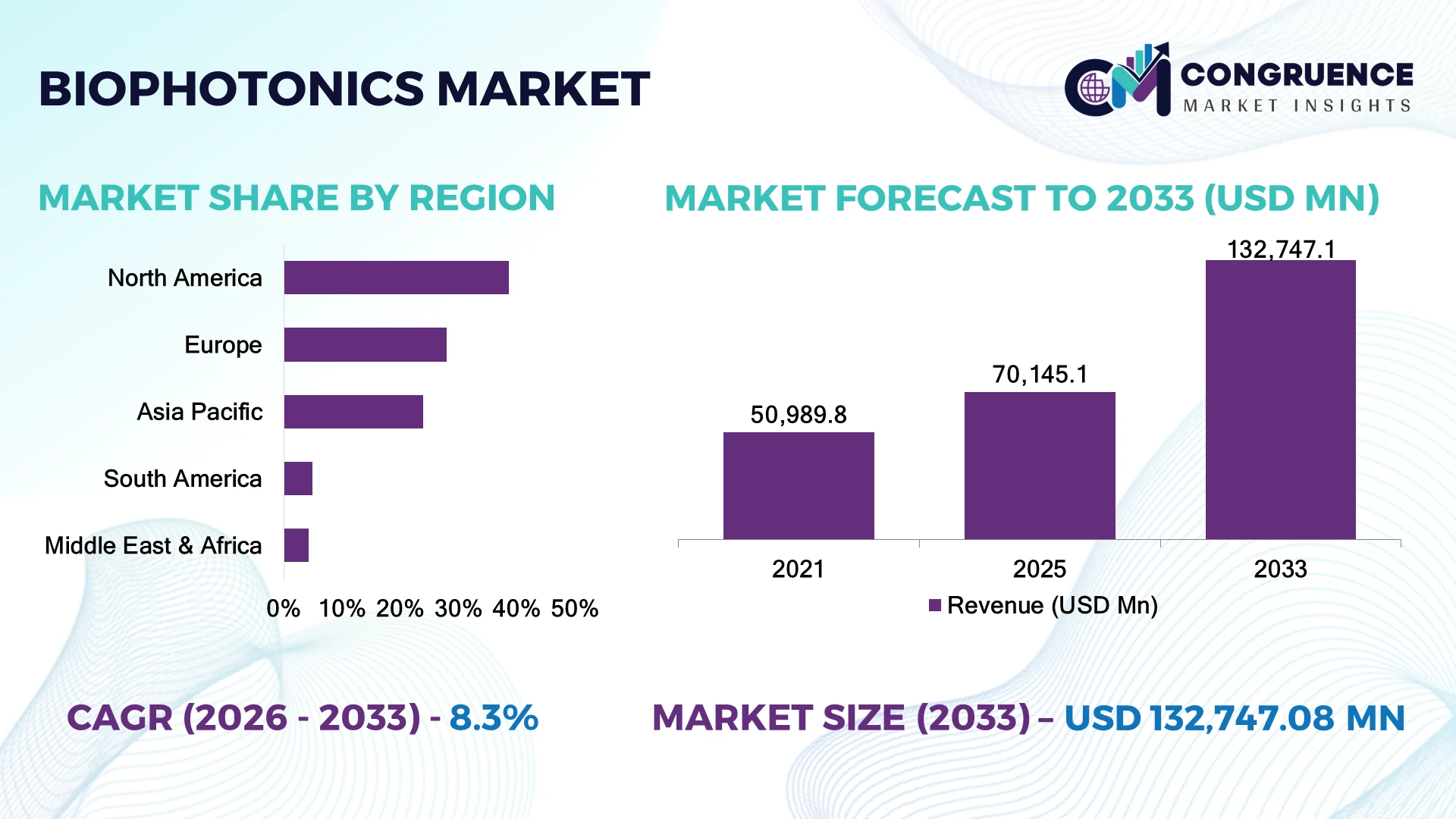
North America holds approximately 38.7% of global biophotonics demand, led by U.S. hospitals, pharmaceutical companies, biotechnology firms, and advanced imaging centers. U.S.-based Eikon Therapeutics raised USD 350.7 million for super-resolution microscopy and drug discovery. India is scaling rapidly, while China strengthens domestic biomanufacturing capabilities amid ongoing U.S.–China supply-chain restructuring.
Strategically, investment should prioritize AI-enabled imaging, localized photonic components, and clinically validated platforms where technology adoption is accelerating fastest.
Market Size & Growth: USD 70.15 billion in 2025 rising to USD 132.75 billion by 2033 at 8.3% CAGR, supported by AI-enabled imaging and precision diagnostics.
Top Growth Drivers: AI-integrated imaging, molecular diagnostics, and biosensors collectively represent approximately 25–30% of current technology-led demand expansion.
Short-Term Forecast: By 2028, automated image analysis is positioned to reduce selected diagnostic workflow time by 15–25% and improve laboratory throughput by 10–20%.
Emerging Technologies: AI microscopy, super-resolution imaging, photoacoustic systems, SPAD sensors, and advanced biosensors are reshaping high-resolution detection and quantitative analysis.
Regional Leaders: North America is projected at approximately USD 51 billion, Europe near USD 33 billion, and Asia Pacific around USD 35 billion by 2033, with Asia Pacific showing the strongest technology adoption momentum.
Consumer/End-User Trends: Hospitals and diagnostic laboratories represent more than 50% of established biophotonics utilization, while research institutions increasingly adopt automated and AI-assisted platforms.
Pilot/Case Example: In 2025, Eikon Therapeutics secured USD 350.7 million for super-resolution microscopy, automation, and high-performance computing, strengthening real-time cellular analysis and drug-development capabilities.
Competitive Landscape: North America leads with approximately 38.7% regional share; key participants include Thermo Fisher Scientific, ZEISS, Olympus/Evident, Hamamatsu Photonics, and Carl Zeiss Meditec.
Regulatory & ESG Impact: EU medical-device modernization is targeting faster digital procedures, while optical diagnostics reduce selected invasive procedures and support lower-material laboratory workflows.
Investment & Funding: At least USD 350.7 million flowed into a major 2025 super-resolution microscopy platform, reinforcing investor preference for AI-photonics and drug-discovery convergence.
Innovation & Future Outlook: 2026–2028 competition shifts toward multimodal imaging, edge AI, SPAD detection, portable diagnostics, and integrated optical platforms that combine hardware, software, and analytics.
Biophotonics demand is concentrated in optical imaging, microscopy, spectroscopy, biosensing, diagnostics, and light-based therapeutics, with medical diagnostics representing more than 50% of application demand in several industry estimates. AI-assisted image analysis, SPAD sensors, and portable optical systems are expanding functionality. In 2026, supply-chain localization and tighter medical-device requirements are accelerating investment in validated, scalable photonic platforms, creating a clear transition toward integrated diagnostics and research ecosystems.
Biophotonics is becoming strategically important because optical technologies increasingly determine diagnostic speed, image quality, analytical sensitivity, and the economics of laboratory workflows. The competitive focus is shifting from standalone lasers and imaging hardware toward integrated systems combining photonics, AI, automation, and quantitative analytics. This shift is reinforced by healthcare modernization and the EU's ongoing effort to streamline medical-device procedures.
AI-assisted image analysis can cut selected manual interpretation and workflow steps by roughly 15–25% compared with conventional image-review processes, while automated microscopy improves repeatability and throughput. North America remains the largest commercial base at approximately 38.7%, whereas Asia Pacific is building the strongest expansion platform through healthcare infrastructure, research investment, and local manufacturing.
The next 2–3 years will prioritize multimodal imaging, SPAD-based detection, portable diagnostics, and AI-enabled microscopy. Eikon Therapeutics' USD 350.7 million 2025 financing demonstrates how capital is moving toward high-performance imaging integrated with drug discovery. ZEISS's acquisition of SPAD specialist Pi Imaging Technology similarly signals vertical technology integration. Companies that secure photonic components, software capabilities, clinical validation, and regional partnerships early will gain the strongest competitive position.
AI integration is accelerating biophotonics adoption as automated image interpretation reduces selected manual analysis time by 15–25% and improves laboratory throughput by 10–20%. Hospitals and pharmaceutical laboratories are increasingly combining microscopy, spectroscopy, and machine-learning models to identify cellular and molecular signatures faster. In the U.S., precision-oncology workflows are strengthening demand for high-resolution imaging, while China is expanding automated laboratory infrastructure. Companies are responding through AI-photonics partnerships, embedded analytics, and acquisitions of specialized imaging technologies. The non-obvious advantage is data reuse: integrated imaging platforms convert repeated diagnostic scans into structured datasets, increasing instrument utilization and strengthening software differentiation.
Specialized lasers, detectors, optical coatings, and precision components can represent 25–40% of system manufacturing costs, while imported photonic components expose manufacturers to 10–20% procurement-price variability during supply disruptions. Japan and the U.S. remain important sources for advanced detectors and photonic components, creating qualification dependencies for smaller instrument manufacturers. Medical-device validation further increases redesign costs when component specifications change. Companies are responding through dual sourcing, longer-term procurement contracts, localized assembly, and standardized optical modules. A key operational pressure is that substituting a detector or laser is not equivalent to changing an ordinary electronic component; optical recalibration can extend validation cycles by 15–25%, directly constraining product scalability.
Miniaturized spectroscopy, silicon photomultipliers, and portable fluorescence systems are opening decentralized diagnostic applications beyond conventional laboratories. Compact platforms can reduce selected instrument footprints by 40–60% and shorten sample-to-result workflows by 20–30%, creating opportunities in India, Southeast Asia, and underserved U.S. healthcare settings. SPAD-based detection is particularly attractive for low-light molecular measurements and high-speed imaging. Companies are investing in semiconductor-photonics integration, university partnerships, and cartridge-based diagnostic platforms. The strategic opportunity extends beyond hardware: recurring consumables, cloud analytics, and instrument-as-a-service models can increase utilization while lowering upfront barriers for smaller laboratories. Manufacturers that combine portability with clinical-grade sensitivity can capture applications previously constrained by centralized infrastructure.
Scaling biophotonics from laboratory prototypes to standardized commercial systems remains difficult because optical alignment, calibration, thermal stability, and software integration require tightly controlled manufacturing. Automated calibration can reduce selected alignment labor by 20–30%, but complex multimodal instruments can still require 10–15% longer validation cycles than conventional imaging platforms. Workforce shortages in photonics engineering further pressure deployment consistency, particularly in emerging manufacturing hubs. Companies must invest in machine-vision inspection, automated calibration, modular architectures, and specialized workforce training. The critical long-term issue is reproducibility: a platform that performs exceptionally in a research laboratory but varies across production batches cannot achieve clinical-scale adoption, making manufacturing engineering as strategically important as optical innovation.
AI Moves Into Microscopy: AI-assisted microscopy is reducing selected image-review workloads by 15–25%, while automated segmentation improves analytical throughput by 10–20%. U.S. pharmaceutical laboratories are integrating machine learning directly into imaging workflows rather than treating analytics as a separate software layer. Companies are responding with embedded AI, cloud-enabled analysis, and proprietary image libraries. The non-obvious shift is toward instruments that continuously generate reusable biological datasets, increasing software-driven differentiation.
SPAD Detection Gains Ground: Single-photon avalanche diode adoption is expanding in low-light imaging, fluorescence analysis, and time-resolved measurements, with detection-speed improvements of approximately 20–40% over conventional detector configurations in selected applications. Japanese and U.S. photonics manufacturers are increasing semiconductor-photonics integration. The shift reduces dependence on bulky detector architectures and supports smaller instruments, creating a practical pathway toward portable research and diagnostic systems.
Portable Systems Expand: Compact spectroscopy and fluorescence platforms are reducing selected instrument footprints by 40–60% and shortening workflows by 20–30%. India and Southeast Asia are becoming important deployment markets as decentralized testing and laboratory modernization expand. Manufacturers are shifting from standalone instruments toward cartridge-based systems, integrated optics, and cloud analytics. This creates a non-obvious advantage: portability increases utilization by moving testing closer to sample collection rather than simply reducing equipment size.
Supply Chains Become Modular: Photonics manufacturers are increasingly standardizing optical modules, detectors, and electronic interfaces to reduce component-change exposure. Modular architectures can lower selected redesign requirements by 10–20% and shorten qualification activity by approximately 15%. U.S.–China technology restrictions and semiconductor supply-chain restructuring are accelerating dual-source strategies. Companies are responding through localized assembly, alternative detector qualification, and longer procurement agreements, making component interchangeability an increasingly important competitive capability.
In-vivo biophotonics accounts for approximately 56% of the market, supported by real-time tissue visualization, minimally invasive diagnostics, optical coherence tomography, endoscopy, and image-guided procedures. Its ability to generate physiological information without repeated tissue extraction gives hospitals and device manufacturers a strong workflow advantage. In-vitro platforms remain structurally important for spectroscopy, fluorescence microscopy, biosensing, and laboratory diagnostics, representing roughly 44% of demand. However, in-vivo systems are gaining share as clinicians prioritize real-time measurement and intervention guidance. Companies are directing 15–20% of new platform-development activity toward higher-resolution imaging, miniaturized optics, and multimodal sensing.
The fastest-growing shift is toward compact in-vivo systems combining photonic sensors with AI-based interpretation. Adoption of automated image analysis is approaching 50% across surveyed healthcare organizations outside the U.S., strengthening demand for AI-ready optical platforms. In-vitro manufacturers are responding with multiplexing and automation, while in-vivo specialists prioritize miniaturization and clinical integration. The strategic priority is moving from standalone optical hardware toward complete imaging-and-analytics platforms.
Imaging represents approximately 55–60% of biophotonics application demand, reflecting broad deployment across microscopy, see-through imaging, inside imaging, optical coherence tomography, and surface imaging. See-through imaging and microscopy remain mature, while biosensors and advanced molecular analysis are gaining strategic importance. Imaging platforms benefit from established clinical workflows and high instrument utilization, whereas emerging sensing applications increasingly target decentralized testing and continuous biological monitoring. Companies are expanding multimodal platforms that combine optical imaging with spectroscopy and computational analysis, with automation reducing selected image-processing workloads by 15–25%.
Biosensors represent the fastest-growing application shift as miniaturized optical detection moves closer to point-of-care environments. Portable photonic systems can reduce selected workflow times by approximately 20–30%, strengthening their relevance in India and other infrastructure-constrained markets. Light therapy remains commercially established, particularly in dermatology and therapeutic applications, while spectromolecular systems support higher-value molecular analysis. The competitive implication is clear: manufacturers increasingly prioritize integrated imaging-plus-sensing architectures rather than single-modality instruments.
Medical diagnostics represents approximately 55–68% of biophotonics end-use demand, depending on market definition, supported by hospitals, diagnostic laboratories, imaging centers, and medical-device manufacturers. Diagnostic buyers prioritize accuracy, throughput, interoperability, and clinical validation, while research institutions emphasize resolution, flexibility, and experimental configurability. Hospitals and clinics account for roughly 50–52% of usage in broader deployment estimates, making them the primary commercial anchor. Companies are responding with modular systems, AI-enabled workflows, service contracts, and application-specific configurations.
Academic and research institutes are the fastest-moving emerging buyer group, particularly in the U.S., Germany, Japan, and South Korea, where photonics research increasingly intersects with drug discovery, cell biology, and advanced microscopy. Research-oriented deployments can require 15–25% greater configuration flexibility than routine clinical systems, encouraging suppliers to offer modular optics and software. Pharmaceutical and biotechnology companies are also increasing demand for high-content imaging and molecular analysis, shifting competition toward application expertise, automation, and integrated data workflows.
North America accounted for the largest market share at approximately 38.7% in 2025 however, Asia-Pacific is expected to register the fastest growth, expanding at a CAGR of 10.1% between 2026 and 2033.

Advanced imaging and AI integration reinforce technology leadership
North America contributes approximately 38.7% of global biophotonics demand, supported by concentrated pharmaceutical R&D, advanced hospitals, biotechnology clusters, and high-value microscopy infrastructure. The U.S. dominates regional deployment, particularly in precision oncology, drug discovery, ophthalmic imaging, and molecular diagnostics. AI-enabled imaging is being incorporated into an estimated 45–50% of advanced diagnostic and research workflows, strengthening demand for computationally integrated optical systems. Pharmaceutical and biotechnology companies are also increasing investment in high-content imaging and super-resolution platforms. Manufacturers are responding through software integration, photonics partnerships, and acquisitions targeting detectors, microscopy, and analytical platforms. The region's key advantage is not only installed equipment but the concentration of clinical validation, venture capital, and specialized photonics engineering capabilities.
U.S. Market Outlook: The U.S. represents the region's primary commercial and innovation center, with pharmaceutical, biotechnology, academic, and clinical users accounting for the majority of advanced biophotonics deployments. More than 40% of high-end research imaging workflows increasingly incorporate automated image analysis. Strong demand for real-time cellular imaging is encouraging companies to combine optical hardware with AI analytics, cloud processing, and application-specific software.
Clinical modernization strengthens integrated optical platforms
Europe represents approximately 28% of global biophotonics demand, supported by Germany, France, the U.K., Switzerland, and the Netherlands. Germany has particular strength in optical engineering, microscopy, medical devices, and precision manufacturing. Approximately 30–35% of advanced European biophotonics development activity is concentrated around imaging, microscopy, spectroscopy, and biosensing applications. EU medical-device modernization is increasing emphasis on software validation, cybersecurity, and clinical evidence, encouraging manufacturers to develop integrated hardware-software platforms rather than isolated optical instruments. Sustainability requirements are also influencing equipment design through modular components, longer service cycles, and reduced material waste. Companies are strengthening partnerships between photonics manufacturers, hospitals, universities, and pharmaceutical laboratories to accelerate clinical translation.
Germany Market Outlook: Germany remains Europe's strongest industrial base for precision photonics, supported by established optical-engineering expertise and dense research infrastructure. Approximately one-third of European advanced microscopy and optical-instrument development activity is associated with German industrial and research ecosystems. Manufacturers are emphasizing automated inspection, high-resolution microscopy, spectroscopy, and modular optical architectures to improve instrument reliability while meeting increasingly demanding medical-device and sustainability requirements.
Manufacturing scale converges with rapidly modernizing healthcare
Asia-Pacific accounts for approximately 24% of global biophotonics demand and represents the fastest-expanding deployment base, driven by China, Japan, South Korea, and India. Japan remains influential in optical components, detectors, lasers, and precision instrumentation, while China combines manufacturing scale with expanding pharmaceutical and clinical infrastructure. India is strengthening demand through diagnostic modernization and biotechnology investment. Advanced photonics manufacturing increasingly incorporates automated alignment and inspection, improving selected production consistency by 10–15%. Companies are diversifying component sourcing across China, Japan, South Korea, and India while establishing local application-support networks. The region's strategic advantage is the combination of component manufacturing, electronics expertise, expanding healthcare capacity, and a large pool of research institutions.
China Market Outlook: China is the region's largest manufacturing and deployment hub, spanning optical components, medical imaging, laboratory instrumentation, and biotechnology research. Domestic manufacturers increasingly integrate photonic components with AI-enabled analytics and automated laboratory systems. Automated optical inspection can improve selected manufacturing consistency by approximately 10–15%, while localized component production reduces dependence on imported modules. Companies are prioritizing domestic supply chains, research partnerships, and clinical application development.
Diagnostic modernization creates concentrated deployment opportunities
South America represents approximately 5% of global biophotonics demand, with Brazil accounting for roughly 60–65% of regional consumption. Demand is concentrated in hospitals, diagnostic laboratories, universities, pharmaceutical research, and ophthalmic applications. Brazil's expansion of private diagnostic networks is supporting investment in optical imaging and automated laboratory equipment, while Argentina and Chile maintain specialized research demand. Approximately 20–25% of new institutional deployments increasingly prioritize automated image acquisition or digital analysis. Import dependence remains significant for advanced lasers, detectors, and precision imaging components, creating longer procurement cycles. Companies are therefore emphasizing local distributor partnerships, service networks, and modular systems that simplify maintenance. The strongest commercial opportunity lies in diagnostic platforms that improve throughput without requiring major laboratory reconstruction.
Brazil Market Outlook: Brazil provides the region's largest installed healthcare and research base, with São Paulo and Rio de Janeiro serving as important pharmaceutical, biotechnology, university, and diagnostic clusters. Private diagnostic networks are increasingly adopting automated imaging and digital pathology workflows. Approximately 20% of advanced laboratory equipment procurement increasingly incorporates automation or digital analytics, creating opportunities for suppliers offering localized technical support, service contracts, and application-specific optical systems.
Healthcare infrastructure investment accelerates advanced diagnostics
Middle East & Africa accounts for approximately 4.3% of global biophotonics demand, with Saudi Arabia, the UAE, Israel, and South Africa representing the most commercially significant deployment centers. Saudi Arabia and the UAE are investing heavily in advanced hospitals, diagnostic infrastructure, genomics, and research facilities. Premium hospitals increasingly prioritize automated imaging and minimally invasive diagnostic technologies, with advanced optical systems representing approximately 15–20% of new high-end diagnostic technology deployments in leading facilities. Israel contributes specialized photonics, medical-device, and biotechnology capabilities, while South Africa anchors sub-Saharan research and diagnostic demand. Companies are responding through distributor partnerships, localized technical support, and hospital collaborations. The region's key opportunity is infrastructure-led adoption rather than broad consumer deployment.
Saudi Arabia Market Outlook: Saudi Arabia is emerging as the region's strongest investment market because healthcare modernization is increasingly linked with biotechnology, genomics, and advanced diagnostics. Major hospital developments are creating demand for high-resolution imaging, optical diagnostics, and laboratory automation. Advanced diagnostic technology represents an estimated 15–20% of equipment priorities in premium new facilities, encouraging global suppliers to establish local partnerships, technical-service capabilities, and application-training programs.
ZEISS, Leica Microsystems, Evident, Bruker, and Hamamatsu compete as global technology leaders, while regional optical-component manufacturers and specialized photonics suppliers challenge them on cost and customization. The top five players collectively account for approximately 32% of the global market, leaving room for specialists. Competition centers on imaging performance, automation, AI integration, component security, and application support. Premium systems typically command 15–25% higher pricing, while automated workflows can improve laboratory throughput by 10–20%. Hamamatsu benefits from detector and sensor integration; ZEISS and Leica emphasize advanced microscopy plus software; Bruker competes through specialized molecular and neural imaging. Players are expanding through partnerships, acquisitions, AI integration, and vertical control of optics, detectors, software, and sample preparation. The shift is toward integrated photonics-data ecosystems rather than standalone instruments. Entry barriers include optical engineering, clinical validation, proprietary software, and service infrastructure. Winning requires measurable performance, interoperable analytics, dependable components, and application-specific solutions that shorten research workflows.
AI-enabled microscopy is becoming the integration layer, with automated segmentation, denoising, and classification reducing selected image-analysis workloads by 15–25%. Around 45–50% of advanced research imaging workflows incorporate computational analysis, pushing ZEISS, Leica Microsystems, and Evident toward software-integrated platforms. Light-field and light-sheet imaging are also expanding volumetric acquisition, increasing throughput for live-cell studies.
SPAD detectors, back-illuminated sCMOS, quantum-dot sensors, and miniaturized spectroscopy are improving sensitivity while reducing instrument size by approximately 20–40% in configurations. Modern sCMOS platforms deliver substantially higher acquisition speed than legacy EMCCD architectures, with 10–30% workflow-efficiency gains in high-speed imaging. Hamamatsu and specialist component suppliers benefit as OEMs prioritize detector integration, low-light performance, and modular optical architectures. Portable fluorescence and spectroscopy platforms are extending biophotonics beyond centralized laboratories.
Between 2026 and 2028, multimodal imaging, edge AI, and automated sample handling will shift competition toward workflow platforms. AI-assisted analysis can reduce selected manual interpretation steps by 15–25%, while automated acquisition improves utilization by 10–20%. Companies controlling optics, detectors, software, and application partnerships will gain the advantage because interoperability reduces integration friction and accelerates deployment. Early investment matters now: standardized hardware-software architectures enable faster product upgrades, reusable datasets, and stronger customer retention.
April 2026 ZEISS partnered with EDGE Biotechnologies to integrate quantitative assays, scalable imaging hardware, and AI analytics for biopharma. The collaboration targets high-throughput screening, reducing reliance on animal testing and strengthening quantitative bioimaging workflows for drug-development decisions globally. Source: zeiss.comZeiss
May 2025 Leica Microsystems acquired ATTO-TEC, adding fluorescent dyes and reagents to its microscopy portfolio. The transaction expanded Leica’s workflow coverage from sample preparation through AI-based analysis, strengthening high-plex 3D imaging capabilities and improving control across cancer-research workflows. Source: leica-microsystems.comLeica Microsystems
April 2025 Bruker launched the nVista 2P miniature two-photon microscope, weighing approximately 2 grams and imaging to 300 microns depth. The system expands high-resolution neural-circuit research into freely behaving animals, strengthening Bruker’s position in compact functional imaging globally. Source: bruker.comBruker Corporation
October 2025 Evident launched the FLUOVIEW FV5000 confocal and multiphoton platform with photon-level quantitation, high-density scanning, and AI workflow tools. The platform targets neuroscience, cell biology, and drug development, improving imaging capability and broadening adoption of automated research microscopy. Source: evidentscientific.com Evident Scientific
The Biophotonics Market Report evaluates in-vivo and in-vitro platforms across imaging, spectroscopy, biosensing, light therapy, and spectromolecular applications. Coverage spans medical diagnostics, research, pharmaceuticals, biotechnology, and other specialized users, with detailed assessment of hospitals, diagnostic laboratories, academic institutions, pharmaceutical companies, and biotechnology firms. Regional analysis covers North America, Europe, Asia Pacific, South America, and Middle East & Africa, with country-level evaluation of manufacturing, deployment, infrastructure, and technology adoption.
The report assesses AI-enabled microscopy, light-field and light-sheet imaging, SPAD and sCMOS detectors, spectroscopy, optical coherence technologies, multimodal imaging, automation, and portable photonic diagnostics. It incorporates approximately 45–50% adoption of computational analysis across advanced research imaging workflows and evaluates supplier positioning across major technology categories. Strategic analysis supports investment planning, technology prioritization, geographic expansion, partnerships, product development, competitive positioning, and market-entry decisions through 2026–2033.
| Report Attribute/Metric | Report Details |
|---|---|
|
Market Revenue in 2025 |
USD 70,145.1 Million |
|
Market Revenue in 2033 |
USD 132,747.1 Million |
|
CAGR (2026 - 2033) |
8.3% |
|
Base Year |
2025 |
|
Forecast Period |
2026 - 2033 |
|
Historic Period |
2021 - 2025 |
|
Segments Covered |
By Type
By Application
By End-User
|
|
Key Report Deliverable |
Revenue Forecast, Growth Trends, Market Dynamics, Segmental Overview, Regional and Country-wise Analysis, Competition Landscape |
|
Region Covered |
North America, Europe, Asia-Pacific, South America, Middle East, Africa |
|
Key Players Analyzed |
ZEISS, Leica Microsystems, Evident, Bruker, Hamamatsu Photonics, Nikon, Thermo Fisher Scientific, Carl Zeiss Meditec, Coherent, Lumentum, Wasatch Photonics, Photonis, Newport, HORIBA |
|
Customization & Pricing |
Available on Request (10% Customization is Free) |




