
Reports
The Global Bifurcation Lesions Treatment Market was valued at USD 2570 Million in 2025 and is anticipated to reach a value of USD 4127.2 Million by 2033 expanding at a CAGR of 6.1% between 2026 and 2033. Growth is driven by increasing complex coronary interventions, adoption of drug eluting stents, intravascular imaging guided procedures, and improved techniques for treating coronary artery bifurcation lesions.
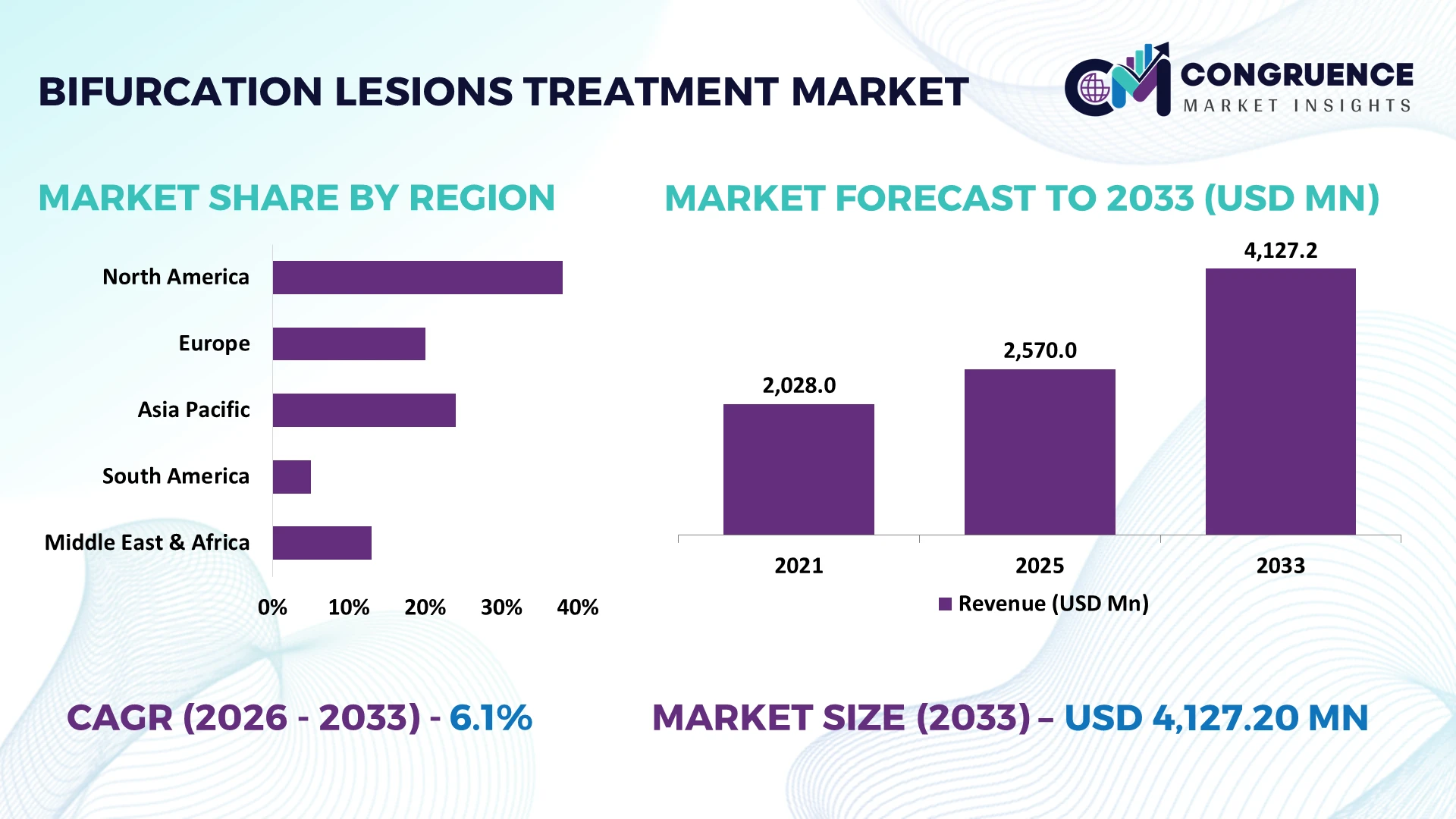
The United States dominates the Bifurcation Lesions Treatment Market, with an illustrative 38% global share, supported by advanced interventional cardiology infrastructure, medical device investment, and extensive catheterization laboratory networks. Coronary bifurcation lesions account for approximately 15% to 20% of percutaneous coronary interventions. Compared with India, where catheterization laboratory expansion supports advanced coronary treatment, the United States maintains broader access to intravascular ultrasound and optical coherence tomography. FDA oversight and investments in cardiovascular device innovation strengthen adoption of specialized coronary stents, guidewires, and balloon catheters.
Strategically, manufacturers should prioritize the estimated 38% United States market concentration and the 15% to 20% bifurcation intervention burden, emphasizing imaging compatibility, procedural precision, and specialized device portfolios.
Market Size & Growth: USD 2,570 million in 2025, reaching USD 4,127.2 million by 2033 at 6.1% CAGR, supported by advanced coronary stenting.
Top Growth Drivers: Bifurcation lesions represent 15% to 20% of coronary interventions; imaging guidance and complex PCI capabilities strengthen procedural demand.
Short Term Forecast: By 2028, integrated imaging workflows target 15% faster lesion assessment and 10% lower procedural inefficiency.
Emerging Technologies: Intravascular ultrasound, optical coherence tomography, and dedicated bifurcation stent designs represent 3 important innovation areas.
Regional Leaders: Illustrative 2033 allocations place North America at USD 1,568.34 million, Europe at USD 1,114.34 million, and Asia Pacific at USD 1,031.80 million, supporting imaging, stenting, and catheterization expansion.
Consumer/End User Trends: Approximately 15% to 20% of PCI procedures involve bifurcation lesions, reinforcing specialized device procurement.
Pilot/Case Example: In 2024, an illustrative imaging guided PCI deployment model targeted 15% improved procedural planning efficiency.
Competitive Landscape: Abbott competes with Boston Scientific, Medtronic, Terumo, and BIOTRONIK across advanced coronary intervention devices.
Regulatory & ESG Impact: FDA quality requirements cover 100% of applicable regulated device manufacturing operations, strengthening validation and traceability.
Investment & Funding: An illustrative USD 100 million investment scenario prioritizes imaging compatible stents, catheter technology, and clinical training.
Innovation & Future Outlook: Drug coated balloons, computational vessel assessment, and advanced stent optimization define 3 strategic development priorities.
The Bifurcation Lesions Treatment Market is shifting toward imaging guided intervention, optimized stent deployment, and individualized coronary treatment strategies. Complex lesions involving major coronary branches require precise vessel sizing, side branch protection, and careful assessment of procedural outcomes. Approximately 15% to 20% of coronary interventions involve bifurcation anatomy, making specialized guidewires, balloons, and drug eluting stents essential components of interventional cardiology portfolios. Advances in intravascular ultrasound, optical coherence tomography, and drug coated balloon technologies are influencing treatment selection. Hospital investments in advanced catheterization laboratories and regulatory expectations for device performance establish the foundation for strategic competitive positioning.
The Bifurcation Lesions Treatment Market is becoming strategically important as interventional cardiology shifts toward imaging guided coronary reconstruction and anatomically optimized device selection. Bifurcation lesions account for approximately 15% to 20% of percutaneous coronary interventions, creating specialized demand for drug eluting stents, guidewires, and balloon catheters. Digital catheterization laboratory modernization is strengthening procedural planning, while regulatory scrutiny encourages manufacturers to demonstrate clinical performance across complex coronary anatomies.
Intravascular ultrasound guided intervention offers measurable advantages over angiography alone. The RENOVATE COMPLEX PCI trial reported target vessel failure rates of 7.7% with intravascular imaging guidance versus 12.3% with angiography guidance in complex coronary interventions. United States hospitals benefit from established imaging infrastructure, while India is expanding advanced catheterization capabilities. Between 2026 and 2028, procurement priorities will increasingly emphasize imaging compatibility, operator training, and procedural outcome monitoring.
A practical deployment combines intravascular imaging, proximal optimization, and selective side branch treatment within standardized bifurcation intervention protocols. Abbott, Boston Scientific, and Medtronic are strengthening device portfolios, clinical education, and hospital partnerships. Competitive positioning increasingly depends on translating anatomical precision into consistent clinical outcomes, efficient device utilization, and dependable procedural support.
Complex coronary intervention is strengthening demand for specialized bifurcation treatment devices as clinicians prioritize accurate vessel assessment and optimized stent deployment. Bifurcation lesions account for approximately 15% to 20% of percutaneous coronary interventions. In the RENOVATE COMPLEX PCI trial, intravascular imaging guidance reduced target vessel failure from 12.3% to 7.7%, demonstrating the clinical importance of improved procedural visualization. United States catheterization laboratories increasingly incorporate intravascular ultrasound and optical coherence tomography into complex lesion assessment. Abbott, Boston Scientific, and other manufacturers are expanding imaging compatible device portfolios and physician education programs. Suppliers integrating coronary imaging, stent optimization, and procedural training gain stronger hospital procurement positioning while supporting consistent treatment outcomes.
High acquisition costs for intravascular imaging systems and specialized coronary intervention devices constrain adoption in facilities with limited capital budgets. Bifurcation lesions represent approximately 15% to 20% of coronary interventions, yet advanced imaging equipment requires dedicated consoles, disposable catheters, and trained operators. The RENOVATE COMPLEX PCI trial demonstrated target vessel failure rates of 7.7% with imaging guidance versus 12.3% with angiography guidance, highlighting the clinical tradeoff associated with restricted technology access. Indian hospitals outside major metropolitan centers face uneven availability of advanced imaging infrastructure. Manufacturers are addressing procurement barriers through equipment placement agreements, distributor partnerships, and integrated device packages. Competitive advantage depends on reducing total procedural costs without compromising treatment precision.
Drug coated balloons and advanced vessel assessment technologies are creating opportunities for more individualized bifurcation intervention strategies. Bifurcation lesions account for approximately 15% to 20% of coronary procedures, supporting demand for devices capable of treating complex vessel anatomy. In selected clinical settings, provisional stenting avoids routine placement of a second stent, reducing permanent implant burden while preserving side branch treatment options. Imaging guided complex PCI has demonstrated target vessel failure of 7.7%, compared with 12.3% under angiographic guidance. China and India are expanding advanced coronary treatment capabilities, creating opportunities for imaging compatible balloons and specialized guidewires. Manufacturers are investing in clinical evaluation, catheter design, and physician training to strengthen treatment flexibility and procedural efficiency.
Maintaining consistent outcomes across complex bifurcation anatomies remains a major execution challenge for interventional cardiology providers. Bifurcation lesions account for approximately 15% to 20% of percutaneous coronary interventions, requiring careful assessment of vessel diameter, side branch significance, and lesion complexity. In the RENOVATE COMPLEX PCI trial, target vessel failure occurred in 7.7% of imaging guided procedures versus 12.3% of angiography guided procedures, emphasizing the importance of operator expertise and imaging interpretation. Hospitals must standardize proximal optimization, guidewire management, and selective side branch intervention while maintaining efficient catheterization laboratory workflows. Manufacturers are strengthening simulation training, procedural guidance, and imaging integration. Long term competitiveness depends on reproducible clinical performance across different operators and hospital environments.
Provisional Stenting Protocols Gain Clinical Preference: European catheterization laboratories increasingly standardize provisional stenting for suitable coronary bifurcations. The strategy begins with 1 main vessel stent, reserving a second implant for compromised side branches. Since bifurcations account for approximately 15% to 20% of coronary interventions, this approach improves inventory predictability. Manufacturers are refining stent deliverability and procedural education to support selective treatment.
Physiology Assessment Refines Side Branch Decisions: Interventional teams increasingly incorporate fractional flow reserve measurements after bifurcation treatment. An FFR threshold of 0.80 helps identify functionally significant residual narrowing, reducing reliance on angiographic appearance alone. Hospitals are integrating pressure wire assessment into procedural protocols, while device suppliers expand compatible measurement platforms and training programs to improve treatment selection.
Calcified Lesion Preparation Becomes More Specialized: Coronary intervention teams are refining plaque modification strategies before stent implantation in heavily calcified bifurcations. Intravascular lithotripsy systems commonly deliver pulses at approximately 1 per second, with catheter specific treatment limits. Manufacturers are improving balloon deliverability and calcium modification capabilities, enabling operators to address inadequate lesion expansion and reduce complications associated with complex coronary anatomy.
Clinical Evidence Reshapes Device Evaluation Standards: Hospital procurement committees increasingly assess long term clinical outcomes alongside immediate procedural success. The RENOVATE COMPLEX PCI trial reported target vessel failure of 7.7% with intravascular imaging guidance versus 12.3% with angiography guidance. Device manufacturers are strengthening clinical evidence programs, procedural registries, and physician education, shifting purchasing discussions toward treatment durability and documented performance.
Drug-Eluting Stents represent the leading segment of the Bifurcation Lesions Treatment Market, with an illustrative share of approximately 45%, supported by their established role in preventing restenosis following coronary intervention. Contemporary drug eluting platforms combine thin struts, antiproliferative coatings, and improved deliverability, supporting treatment across varied bifurcation anatomies. Balloon Catheters account for an estimated 22% share, reflecting their importance in lesion preparation, stent expansion, and side branch treatment. Guidewires remain essential for accessing complex vessel branches, while Bare-Metal Stents occupy a limited position because drug eluting alternatives provide stronger restenosis prevention.
Bifurcation-Specific Stents represent the fastest advancing specialized category, supported by demand for improved side branch access and anatomically tailored deployment. Atherectomy Devices remain relevant for selected heavily calcified lesions requiring plaque modification before stenting. Abbott, Boston Scientific, Medtronic, and specialized manufacturers are refining device geometry, coating technologies, and catheter compatibility. Investment priorities increasingly emphasize procedural adaptability, clinical evidence, and reliable treatment outcomes rather than standalone implant specifications.
Coronary Bifurcation Lesions represent the leading application, with an illustrative market share of approximately 40%, reflecting their substantial contribution to complex percutaneous coronary interventions. Bifurcation anatomy is encountered in approximately 15% to 20% of coronary interventions, requiring specialized guidewires, balloon catheters, and stent optimization techniques. Left Main Bifurcation Lesions account for an estimated 20% share within the illustrative application allocation, supported by their clinical complexity and need for precise treatment planning. Side-Branch Lesions require careful evaluation of vessel significance and selective intervention, influencing procedural device consumption and treatment strategy.
Calcified Bifurcation Lesions represent the fastest advancing application category as improved calcium modification technologies expand treatment capabilities. Complex Coronary Lesions require advanced lesion assessment and coordinated device selection. United States and Japanese hospitals are strengthening specialized interventional cardiology programs, while manufacturers develop more deliverable catheters, advanced stent platforms, and procedural training resources. Competitive positioning increasingly depends on successful treatment of anatomically demanding lesions and consistent procedural outcomes.
Hospitals represent the leading end user segment, with an illustrative market share of approximately 60%, reflecting their concentration of catheterization laboratories, specialist interventional cardiologists, and advanced cardiovascular imaging infrastructure. Complex bifurcation interventions require coordinated access to drug eluting stents, guidewires, balloon catheters, and lesion preparation technologies. Cardiac Catheterization Centers account for an estimated 25% share, supported by dedicated coronary intervention workflows and specialized procedural teams. Hospitals prioritize comprehensive device portfolios, clinical support, and emergency treatment capabilities, while catheterization centers emphasize efficient scheduling, inventory management, and procedural consistency.
Cardiac Catheterization Centers represent the fastest advancing end user category as dedicated facilities expand advanced coronary intervention capabilities. Specialty Cardiology Clinics contribute through patient evaluation and selected procedural services, while Ambulatory Surgical Centers remain comparatively limited by complex intervention requirements. United States providers increasingly evaluate catheterization workflow integration and procedural outcomes when selecting suppliers. Abbott, Boston Scientific, and other manufacturers are strengthening clinical education, device compatibility, and institutional partnerships. Future procurement competition will center on dependable equipment availability, specialist training, and evidence supported procedural performance.
North America accounted for the largest market share at an estimated 38% in 2025 however, Asia Pacific is expected to register the fastest growth, expanding at an estimated CAGR of 7.4% between 2026 and 2033.

Advanced Coronary Imaging Strengthens Complex Intervention Leadership
North America represents an estimated 38% of the global Bifurcation Lesions Treatment Market, supported by extensive catheterization laboratory infrastructure, advanced coronary imaging capabilities, and established cardiovascular device manufacturing networks. The United States dominates regional demand through specialized interventional cardiology programs and widespread access to contemporary drug eluting stents. Coronary bifurcation lesions account for approximately 15% to 20% of percutaneous coronary interventions, supporting specialized device procurement. Canadian hospitals contribute through advanced cardiovascular centers and publicly funded coronary treatment programs. In the RENOVATE COMPLEX PCI trial, imaging guidance reduced target vessel failure from 12.3% to 7.7%, reinforcing investment in intravascular imaging. Abbott, Boston Scientific, and Medtronic compete through device innovation, procedural training, and integrated cardiovascular portfolios. Hospital purchasing decisions increasingly emphasize documented clinical outcomes and procedural efficiency.
United States Market Outlook: The United States benefits from advanced cardiovascular research institutions, extensive catheterization laboratory networks, and FDA regulated medical device development. Specialized hospitals increasingly incorporate intravascular ultrasound and optical coherence tomography into complex coronary procedures. The RENOVATE COMPLEX PCI findings demonstrated a 4.6 percentage point absolute reduction in target vessel failure with imaging guidance. Manufacturers are strengthening physician education, clinical evidence generation, and device compatibility to support advanced intervention programs.
Clinical Standardization Strengthens Evidence Based Coronary Treatment
Europe accounts for an estimated 27% of global bifurcation lesions treatment activity, supported by established cardiovascular treatment networks in Germany, France, the United Kingdom, Italy, and Spain. European interventional cardiology practice emphasizes evidence based procedural selection, provisional stenting, and optimized side branch management. The European Bifurcation Club promotes standardized treatment principles, supporting consistent adoption of contemporary coronary intervention techniques. Bifurcation lesions represent approximately 15% to 20% of percutaneous coronary interventions, maintaining demand for specialized stents, guidewires, and balloon catheters. European Union Medical Device Regulation requirements influence device certification, clinical evidence, and postmarket surveillance. Manufacturers are strengthening regulatory documentation and specialist training programs. Competitive differentiation increasingly depends on clinical validation, anatomical adaptability, and reliable access to advanced coronary intervention equipment.
Germany Market Outlook: Germany maintains advanced cardiac catheterization infrastructure, specialized cardiovascular research institutions, and established medical technology capabilities. Hospitals in Berlin, Munich, and Hamburg support complex coronary intervention programs involving intravascular imaging and specialized stenting techniques. Germany's medical device regulatory environment follows European Union requirements, encouraging comprehensive clinical evaluation and product traceability. Suppliers prioritize physician training, validated device performance, and hospital procurement partnerships to strengthen market positioning.
Catheterization Infrastructure Expansion Accelerates Advanced Device Adoption
Asia Pacific represents an estimated 25% of the global Bifurcation Lesions Treatment Market, supported by expanding cardiovascular intervention infrastructure in China, India, Japan, South Korea, and Australia. China combines extensive hospital networks with growing domestic coronary device manufacturing capabilities, strengthening competition between international suppliers and local manufacturers. Japan maintains advanced interventional cardiology expertise and established intravascular imaging adoption. India is expanding catheterization laboratory capacity through private hospital investment and specialized cardiac care development. Bifurcation lesions account for approximately 15% to 20% of coronary interventions, supporting demand for specialized stents, guidewires, and balloon catheters. Manufacturers are strengthening local production, distributor partnerships, and clinical training initiatives. Competitive positioning increasingly depends on affordability, procedural support, and compatibility with existing catheterization infrastructure.
China Market Outlook: China benefits from extensive cardiovascular treatment networks, expanding domestic medical device manufacturing, and government initiatives supporting healthcare technology localization. Hospitals in Beijing, Shanghai, and Guangzhou maintain advanced coronary intervention capabilities. Domestic manufacturers are strengthening drug eluting stent production and catheter technology development, while international companies compete through advanced imaging compatibility and clinical evidence. Procurement increasingly emphasizes reliable distribution, regulatory approval, and specialized physician training.
Specialized Cardiac Care Expansion Strengthens Device Procurement
South America represents an estimated 6% of global bifurcation lesions treatment activity, with Brazil maintaining the largest concentration of specialized cardiovascular treatment infrastructure. Argentina, Chile, and Colombia contribute through tertiary hospitals and private interventional cardiology centers. Brazil's public healthcare system supports coronary intervention delivery, although advanced intravascular imaging access remains concentrated in major metropolitan hospitals. Coronary bifurcation lesions account for approximately 15% to 20% of percutaneous coronary interventions internationally, creating demand for specialized coronary stents and procedural accessories. Medical device procurement is influenced by imported equipment costs, regulatory requirements, and technical service availability. Manufacturers are strengthening distributor relationships and clinical training partnerships. Competitive advantage depends on dependable device supply, procedural compatibility, and cost effective access to advanced coronary intervention technologies.
Brazil Market Outlook: Brazil maintains established interventional cardiology programs in São Paulo, Rio de Janeiro, and other major healthcare centers. ANVISA oversees medical device registration and regulatory compliance, influencing market entry and procurement. Public hospitals prioritize reliable coronary intervention equipment, while private cardiovascular centers support adoption of advanced imaging and specialized stenting platforms. Suppliers strengthen distribution agreements, technical support, and physician education to improve access across different healthcare settings.
Healthcare Modernization Expands Advanced Coronary Intervention Capacity
The Middle East and Africa represent an estimated 4% of global bifurcation lesions treatment activity, supported by cardiovascular infrastructure development in Saudi Arabia, the United Arab Emirates, Israel, and South Africa. Saudi Arabia is expanding specialized cardiac services through healthcare transformation initiatives, while the United Arab Emirates is strengthening private hospital capabilities. Israel contributes advanced cardiovascular research and medical technology innovation. South Africa maintains established academic cardiac centers, although specialized imaging availability varies across healthcare facilities. Hospitals increasingly prioritize reliable coronary stents, balloon catheters, and intravascular imaging systems for complex intervention programs. Manufacturers are expanding distributor partnerships and specialist training initiatives. Competitive differentiation depends on equipment availability, clinical support, regulatory compliance, and the ability to maintain advanced catheterization services across geographically dispersed healthcare networks.
Saudi Arabia Market Outlook: Saudi Arabia is strengthening cardiovascular treatment infrastructure through Vision 2030 healthcare modernization programs. Major hospitals in Riyadh and Jeddah are expanding advanced catheterization capabilities and specialist cardiac services. The Saudi Food and Drug Authority regulates medical device market access, supporting structured procurement and quality oversight. International manufacturers are strengthening distribution partnerships, clinical education, and integrated coronary intervention portfolios to support complex lesion treatment.
The Bifurcation Lesions Treatment Market features competition between diversified cardiovascular device manufacturers and specialized coronary intervention suppliers. Abbott competes with Boston Scientific and Medtronic through drug eluting stents, imaging integration, and clinical evidence. Terumo emphasizes catheter deliverability, while BIOTRONIK differentiates through coronary implant engineering. An illustrative concentration model assigns approximately 55% combined market share to these leading suppliers, reflecting established hospital relationships and broad procedural portfolios.
Competition increasingly centers on anatomical precision, device compatibility, and treatment durability. Bifurcation lesions account for 15% to 20% of coronary interventions, while imaging guided complex PCI demonstrated target vessel failure of 7.7% versus 12.3% with angiography guidance.
Manufacturers are strengthening clinical partnerships, expanding specialized catheter portfolios, and investing in physician training. Regulatory approval requirements, clinical validation costs, and hospital procurement contracts restrict market entry. Competitive success requires validated clinical performance, reliable device availability, and integrated procedural support across complex coronary treatment environments.
Abbott Laboratories
Boston Scientific Corporation
Medtronic plc
Terumo Corporation
BIOTRONIK SE & Co. KG
B. Braun SE
Cook Medical LLC
Cordis Corporation
MicroPort Scientific Corporation
OrbusNeich Medical Group Holdings Limited
Meril Life Sciences Pvt. Ltd.
Sahajanand Medical Technologies Limited
Lepu Medical Technology (Beijing) Co., Ltd.
Asahi Intecc Co., Ltd.
Contemporary bifurcation treatment combines drug eluting stents, provisional stenting, intravascular ultrasound, and optical coherence tomography. Bifurcation anatomy occurs in approximately 15% to 20% of coronary interventions, requiring precise vessel assessment and side branch protection. Compared with conventional angiography guidance, intravascular imaging reduced target vessel failure from 12.3% to 7.7% in complex coronary interventions, representing approximately 37% relative improvement. Hospitals investing in imaging integration gain measurable clinical advantages and stronger procedural standardization.
Emerging technologies include dedicated bifurcation stents, intravascular lithotripsy, and drug coated balloons for selected side branch treatment. Calcium modification improves preparation of resistant lesions, while specialized stent geometries preserve branch access. Fractional flow reserve measurements use a threshold of 0.80 to assess physiological significance. Abbott, Boston Scientific, and Terumo compete through catheter deliverability, imaging compatibility, and clinical validation. Specialized manufacturers benefit from anatomically adaptable devices and targeted physician education.
Between 2026 and 2028, artificial intelligence assisted vessel assessment and computational stent planning will strengthen personalized intervention workflows. Hospitals are evaluating digital imaging integration and standardized optimization protocols. Manufacturers must demonstrate reproducible clinical outcomes, reliable device availability, and procedural compatibility. Competitive advantage increasingly depends on translating imaging precision into durable treatment results while reducing unnecessary implants and repeat interventions across complex coronary anatomies.
March 2024: Boston Scientific announced FDA approval of its AGENT drug coated balloon. The AGENT IDE trial reported 17.9% target lesion failure versus 28.7% with conventional balloons, expanding coronary treatment options for restenosis without additional permanent metallic implants. Source: bostonscientific.com.
October 2024: DCB BIF investigators reported randomized results involving 784 patients with true coronary bifurcation lesions. Drug coated side branch balloons reduced one year composite events to 7.2% versus 12.5%, strengthening evidence for selective treatment strategies. Source: jacc.org.
March 2025: European Bifurcation Club investigators published EBC MAIN findings comparing provisional and systematic dual stenting across 467 patients at 35 hospitals. The research strengthened clinical evaluation of left main bifurcation strategies, supporting evidence based procedural selection. Source: cerc-europe.org.
April 2026: REC CAGEFREE I investigators published a coronary bifurcation subgroup analysis involving 2,257 patients with angiographic assessments. The study evaluated drug coated balloons against drug eluting stents, strengthening evidence for device selection in noncomplex lesions. Source: sciencedirect.com.
The Bifurcation Lesions Treatment Market Report evaluates coronary intervention technologies, procedural demand, competitive positioning, and investment priorities between 2026 and 2033. Type segmentation includes Drug-Eluting Stents, Bare-Metal Stents, Bifurcation-Specific Stents, Balloon Catheters, Guidewires, and Atherectomy Devices. Application coverage examines Left Main Bifurcation Lesions, Coronary Bifurcation Lesions, Side-Branch Lesions, Complex Coronary Lesions, and Calcified Bifurcation Lesions. End user assessment covers Hospitals, Cardiac Catheterization Centers, Specialty Cardiology Clinics, and Ambulatory Surgical Centers.
Regional analysis evaluates North America, Europe, Asia Pacific, South America, and the Middle East and Africa. Technology coverage includes intravascular imaging, drug coated balloons, calcium modification, and advanced stent optimization. Illustrative segment allocations identify Drug-Eluting Stents at 45% and Hospitals at 60%. The report supports supplier evaluation, clinical infrastructure investment, geographic expansion, and evidence driven competitive strategy.
| Report Attribute/Metric | Report Details |
|---|---|
Market Revenue in 2025 | USD 2570 Million |
Market Revenue in 2033 | USD 4127.2 Million |
CAGR (2026 - 2033) | 6.1% |
Base Year | 2025 |
Forecast Period | 2026 - 2033 |
Historic Period | 2021 - 2025 |
Segments Covered | By Type
By Application
By End-User
|
Key Report Deliverable | Revenue Forecast, Growth Trends, Market Dynamics, Segmental Overview, Regional and Country-wise Analysis, Competition Landscape |
Region Covered | North America, Europe, Asia-Pacific, South America, Middle East, Africa |
Key Players Analyzed | Abbott Laboratories, Boston Scientific Corporation, Medtronic plc, Terumo Corporation, BIOTRONIK SE & Co. KG, B. Braun SE, Cook Medical LLC, Cordis Corporation, MicroPort Scientific Corporation, OrbusNeich Medical Group Holdings Limited, Meril Life Sciences Pvt. Ltd., Sahajanand Medical Technologies Limited, Lepu Medical Technology (Beijing) Co., Ltd., Asahi Intecc Co., Ltd. |
Customization & Pricing | Available on Request (10% Customization is Free) |




