
Reports
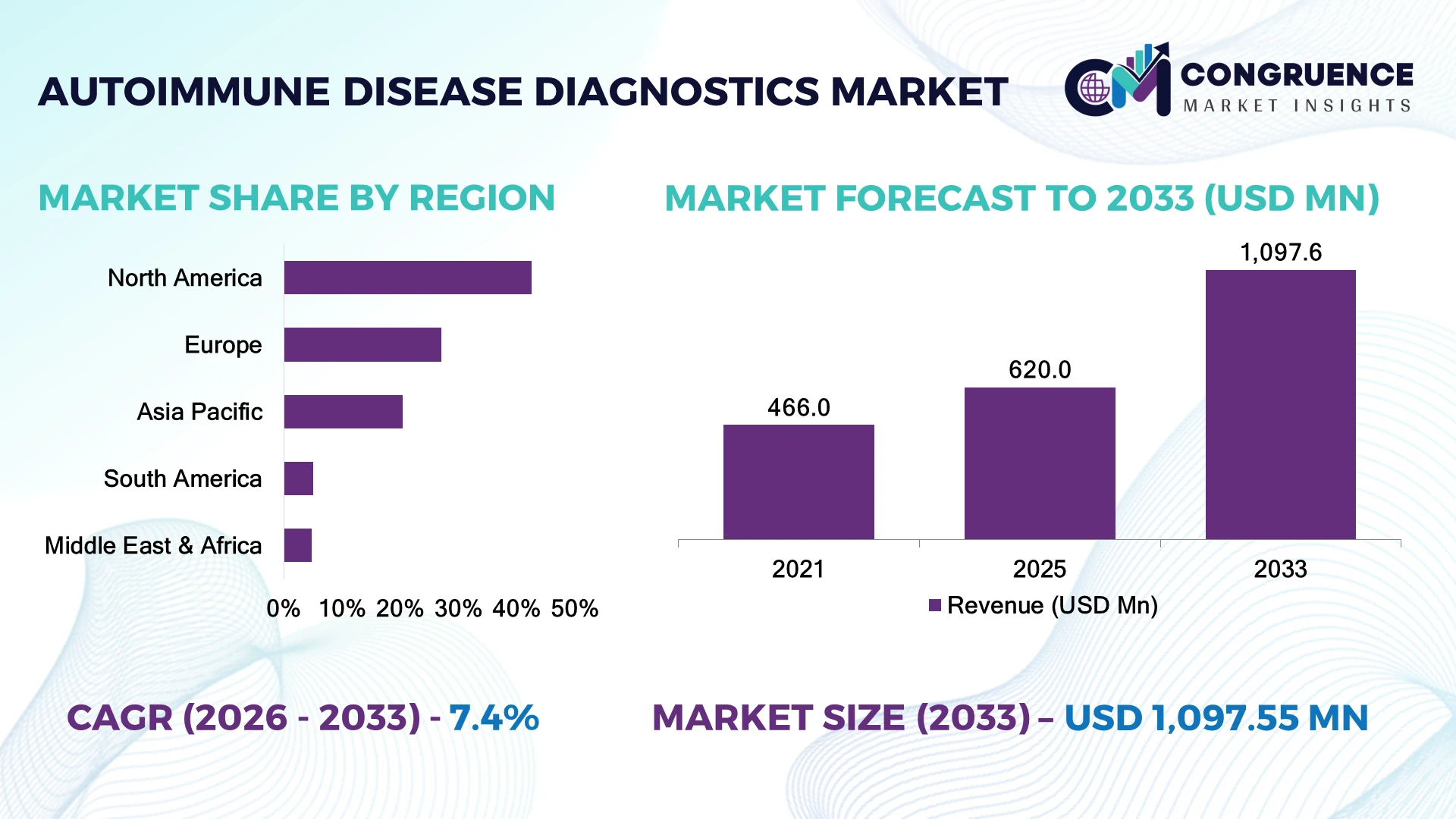
The Global Autoimmune Disease Diagnostics Market was valued at USD 620.0 Million in 2025 and is anticipated to reach a value of USD 1,097.6 Million by 2033 expanding at a CAGR of 7.4% between 2026 and 2033. Growth is driven by automated autoantibody testing, multiplex immunoassays, AI-assisted interpretation, precision biomarkers, and modernization of high-throughput diagnostic laboratories.
The United States remains the dominant country, holding approximately 39.0% of global market activity, supported by advanced IVD infrastructure, specialized laboratories, and strong investment in diagnostic automation. Around 59.1% of U.S. laboratories report AI use in digital image analysis. India is expanding automated pathology capacity from a lower adoption base, while U.S. healthcare investment is accelerating amid tariff pressures and global supply-chain restructuring.
Strategic implication companies should prioritize AI-enabled automation, validated multiplex platforms, localized manufacturing, and resilient reagent networks to strengthen U.S. leadership while capturing emerging opportunities in India and other high-growth markets.
Market Size & Growth: USD 620.0 million in 2025 to USD 1,097.6 million by 2033 at 7.4% CAGR, driven by automated immunoassays and AI-assisted diagnostics.
Top Growth Drivers: AI-assisted interpretation 59.1%, localized diagnostics 63.8%, and ANA testing 42.8% strengthen high-growth diagnostic workflows.
Short-Term Forecast: By 2028, automated laboratory workflows are targeted to improve throughput 15–25% and reduce repetitive manual processing.
Emerging Technologies: AI image analysis, multiplex autoantibody testing, and immune-repertoire sequencing are advancing precision autoimmune diagnostics.
Regional Leaders: North America reaches approximately USD 467.6 million, Europe USD 296.4 million, and Asia-Pacific USD 230.5 million by 2033, with automation expanding fastest across Asia-Pacific.
Consumer/End-User Trends: Hospitals remain the leading end-user segment at 53.2%, while laboratories increasingly adopt automated testing and digital interpretation.
Pilot/Case Example: In 2025, AI-based immune-repertoire analysis achieved 98.95% AUC for SLE and 97.76% for rheumatoid arthritis, demonstrating advanced biomarker potential.
Competitive Landscape: Roche leads at approximately 17%, followed by Abbott at 14%, with Siemens Healthineers, Bio-Rad Laboratories, and Thermo Fisher Scientific competing through automation and assay breadth.
Regulatory & ESG Impact: U.S. laboratory-developed-test oversight through 2028 is increasing validation requirements while encouraging standardized workflows and more reproducible diagnostic processes.
Investment & Funding: Roche’s USD 50 billion U.S. investment program strengthens domestic healthcare and life-science capacity, with capital shifting toward AI, diagnostics, manufacturing, and supply-chain resilience.
Innovation & Future Outlook: Multiplex diagnostics, AI interpretation, digital pathology, and immune profiling are shifting competition toward integrated precision-diagnostic ecosystems.
Autoimmune Disease Diagnostics Market is increasingly shaped by specialized hospital laboratories, reference testing centers, rheumatology services, and precision-medicine programs. ANA testing accounted for 42.8% of the test segment in 2025, while AI-assisted interpretation and multiplex platforms are expanding diagnostic capabilities. Supply-chain localization and regulatory modernization are encouraging manufacturers to strengthen validated, automated platforms and regional production capacity.
The autoimmune disease diagnostics market is becoming strategically important as diagnostic precision increasingly influences treatment selection, patient monitoring, laboratory utilization, and healthcare costs. The transition from conventional single-marker testing toward multiplex assays, automated immunoassays, and AI-supported interpretation is reshaping competitive requirements. Regulatory modernization is simultaneously increasing the importance of validated platforms, standardized workflows, and stronger quality systems.
Technology is creating measurable operational advantages over legacy processes. Automated immunoassay systems can improve laboratory throughput by approximately 15–25% while reducing repetitive manual handling, whereas AI-supported image interpretation strengthens consistency in microscopy-based testing. The United States maintains greater diagnostic scale and technology penetration, while India and China are expanding through laboratory modernization and automated testing infrastructure.
Over the next 2–3 years, providers will prioritize automated ANA processing, multiplex panels, digital pathology, and cloud-connected laboratory systems. A practical deployment model combines automated sample preparation with digital image interpretation in high-volume reference laboratories. Companies are adjusting capital allocation toward AI partnerships, assay development, platform acquisitions, and regional manufacturing. Competitive advantage will increasingly depend on workflow integration, validated clinical data, regulatory readiness, and resilient diagnostic supply networks.
Laboratory automation is the principal structural driver as autoimmune testing shifts toward higher-throughput and reproducible workflows. Localized autoimmune disease diagnostics represented 63.8% of the market in 2025, while ANA testing accounted for 42.8%, creating substantial demand for automated platforms capable of processing complex testing volumes. AI adoption in digital image analysis has reached 59.1% in U.S. laboratory settings, accelerating computerized interpretation. Healthcare systems are also increasing investment in integrated diagnostic infrastructure amid supply-chain restructuring. Companies are responding through automated analyzer upgrades, multiplex assay development, software integration, and technology partnerships. The key strategic advantage is workflow consolidation: reducing manual handoffs improves consistency while allowing laboratories to process broader autoimmune profiles without equivalent increases in staffing requirements.
Specialized reagents, assay complexity, infrastructure disparities, and regulatory requirements continue to constrain scalable deployment. Consumables and assays represented approximately 70.7% of the market in 2025, highlighting the industry's dependence on reliable reagent availability. Regulatory requirements for laboratory-developed tests are also increasing validation and quality-system workloads through 2028. Global trade tensions and supply-chain restructuring are encouraging laboratories to reduce dependence on concentrated sourcing networks. These pressures can increase operating costs, delay installations, and reduce utilization of diagnostic instruments. Companies are responding through dual sourcing, regional manufacturing, longer supplier contracts, and standardized assay portfolios. The critical operational insight is that analyzer capacity alone does not guarantee diagnostic continuity; uninterrupted reagent availability remains essential for maintaining laboratory throughput and customer service levels.
Next-generation biomarker platforms represent a significant opportunity as autoimmune diagnostics move beyond conventional single-analyte testing. AI-based immune-repertoire analysis has demonstrated 98.95% AUC for SLE and 97.76% for rheumatoid arthritis, highlighting the potential of advanced computational diagnostics. Asia-Pacific is also positioned for accelerated adoption as healthcare infrastructure and automated laboratory capacity expand, particularly across China and India. Companies are increasing R&D activity around multiplex assays, AI interpretation, molecular profiling, and cloud-connected diagnostics. The most distinctive opportunity lies in compact multiplex platforms for secondary hospitals, enabling specialist autoimmune testing without requiring full reference-laboratory infrastructure. Partnerships between diagnostic manufacturers, hospitals, software developers, and biotechnology companies will strengthen commercialization while expanding access to precision diagnostic capabilities.
Integrating AI into autoimmune diagnostics remains a complex execution challenge involving validation, interoperability, cybersecurity, workforce adaptation, and clinical accountability. Approximately 81% of pathology professionals express concern about AI accuracy, while 63% identify data security as a significant concern, demonstrating the implementation gap between technological capability and routine clinical use. Laboratories also face inconsistent digital infrastructure across countries and healthcare systems. These limitations can increase deployment costs, delay adoption, and create variable diagnostic performance between sites. Companies must invest in explainable AI, multi-site validation, cybersecurity architecture, interoperable laboratory systems, and continuous model monitoring. The strategic challenge is not algorithm availability but dependable clinical integration. Vendors that demonstrate consistent performance across instruments, laboratories, and patient populations will secure stronger long-term competitive positioning.
AI-Assisted Interpretation Expands: Automated ANA pattern recognition is moving from pilot programs into routine laboratory workflows, with AI incorporation in U.S. digital image analysis reaching 59.1% and advanced models improving pattern-classification performance by more than 7%. Laboratories are reducing manual microscopy workloads and investing in digital pathology integration, creating faster review cycles and more consistent reporting.
Multiplex Testing Gains Ground: Laboratories are consolidating autoimmune panels as testing workflows shift from single-analyte assays toward broader immune profiling. Modern platforms can evaluate 20 or more autoantibody targets per sample, while instrument installations across European laboratories have increased approximately 30%. Companies are expanding multiplex portfolios and integrating automated sample handling to improve throughput, reduce repeat testing, and strengthen laboratory utilization.
Regulatory Workflows Tighten: U.S. laboratory-developed-test oversight is increasing validation, documentation, and quality-control requirements, with implementation extending through 2028. Compliance workloads are prompting laboratories to standardize assay documentation and strengthen analytical verification. Diagnostic manufacturers are responding with validated IVD platforms, software-enabled quality controls, and regulatory partnerships, while supply-chain localization is becoming an important operational response to geopolitical trade pressure.
Specialist Centers Scale Digitally: Diagnostic centers are increasing investment in biomarker testing, digital pathology, and automated immunoassays as decentralized testing expands. Clinical laboratories are projected to record approximately 12.7% annual expansion in adoption activity, while AI-enabled workflows increasingly connect laboratory information systems with clinical records. Companies are targeting specialist centers through modular platforms and service partnerships, revealing a non-obvious shift from hospital-led purchasing toward distributed diagnostic networks.
Systemic autoimmune disease diagnostics lead the market with approximately 63% share, supported by complex conditions such as rheumatoid arthritis, systemic lupus erythematosus, and multiple sclerosis that require repeated antibody profiling and disease monitoring. Rheumatoid arthritis represents about 36.7% within systemic diagnostics, reinforcing demand for RF, anti-CCP, ANA, and complementary immunologic testing. Localized autoimmune disease diagnostics remain strategically important across type 1 diabetes, thyroiditis, and inflammatory disorders, with their broader screening requirements supporting steady laboratory volumes. Companies are strengthening systemic-disease portfolios through broader antibody panels and automated immunoassay platforms.
Localized diagnostics are emerging as a faster-adoption category as biomarker-based testing becomes more accessible across specialist and community laboratories. Multiple sclerosis diagnostics are particularly benefiting from advances in molecular and imaging-supported assessment, while localized conditions increasingly use disease-specific biomarkers. Approximately 68% of autoimmune diagnostic demand is associated with recurring reagents and consumables, making scalable assay availability critical for both mature and emerging types. Companies are therefore shifting investment toward multiplex kits, automated analyzers, and specialized biomarker partnerships, with localized testing creating opportunities for decentralized diagnostic deployment.
Systemic autoimmune disease diagnostics account for approximately 63% of application demand, reflecting the intensive testing requirements of rheumatoid arthritis, systemic lupus erythematosus, and ankylosing spondylitis. These applications require multiple biomarkers, repeat monitoring, and multidisciplinary interpretation, concentrating demand within hospitals and specialized laboratories. Rheumatoid arthritis diagnostics represent roughly 36.7% of systemic disease applications, supported by established RF and anti-CCP testing pathways. Companies are expanding automated immunoassay menus and integrated interpretation tools to reduce turnaround pressure and improve consistency across high-volume workflows.
Localized autoimmune disease diagnostics are gaining adoption as screening and disease-specific biomarker testing expand beyond tertiary hospitals. Type 1 diabetes, multiple sclerosis, idiopathic thrombocytopenic purpura, and Hashimoto’s thyroiditis increasingly benefit from specialized assays and digital diagnostic workflows. Autoantibody and immunologic testing is expanding at approximately 7.8%, reflecting greater use of targeted biomarkers and multiplex panels. Companies are responding with decentralized testing partnerships, broader assay menus, and automated platforms that support smaller laboratories. The operational shift is significant: application growth is moving from complex hospital diagnosis toward distributed disease monitoring and specialist testing networks.
Hospitals remain the leading end-user, accounting for approximately 53.6% of market demand, because they combine rheumatology services, specialized laboratories, inpatient care, and multidisciplinary diagnostic infrastructure. Their procurement advantage comes from high testing volumes and the ability to integrate ANA, autoantibody panels, inflammatory markers, and advanced immunologic testing into centralized workflows. Clinical laboratories are the fastest-expanding buyer group, supported by approximately 12.7% annual adoption growth as reference facilities consolidate complex testing and operate high-throughput platforms. Companies are responding with scalable analyzers, integrated laboratory software, and volume-based procurement programs.
Diagnostic centers are strengthening their position as autoimmune testing becomes more decentralized and specialist-focused. Their expansion is supported by demand for rapid turnaround, broader biomarker menus, and access to advanced testing without hospital admission. Hospitals continue prioritizing integrated systems, while diagnostic centers increasingly favor modular platforms and partnership-based laboratory services. Other end-users, including research and specialized healthcare facilities, remain smaller but important for biomarker validation and next-generation assay development. Companies are therefore using differentiated pricing, workflow customization, and laboratory partnerships to capture decentralized demand while protecting hospital-based contracts.
North America accounted for the largest market share at 42.6% in 2025 however, Asia-Pacific is expected to register the fastest growth, expanding at a CAGR of 8.2% between 2026 and 2033.

North America commands 42.6% of the global autoimmune disease diagnostics market, supported by concentrated reference laboratories, advanced IVD infrastructure, and strong adoption of automated immunoassay platforms. The United States represents approximately 91.5% of regional activity, making it the principal center for diagnostic technology deployment, clinical research, and enterprise investment. Around 59.1% of U.S. laboratories report AI incorporation in digital image analysis, strengthening demand for digitally integrated workflows. Roche’s USD 50 billion U.S. investment program further reinforces domestic life-science and diagnostics infrastructure amid ongoing tariff and supply-chain restructuring. Hospitals and reference laboratories are prioritizing high-throughput platforms, digital pathology, and multiplex testing to address specialist workforce constraints. Companies are responding through platform expansion, AI partnerships, localized production, and integrated laboratory solutions, positioning North America as the technology benchmark for advanced autoimmune diagnostics.
United States Market Outlook: The United States remains the region’s dominant diagnostic technology hub, supported by extensive reference-laboratory networks, high IVD penetration, and strong clinical research infrastructure. Approximately 59.1% of laboratories report AI use in digital image analysis, demonstrating substantial enterprise readiness for computational diagnostics. Large healthcare systems are increasingly integrating automated immunoassay systems with laboratory information platforms, while domestic investment is strengthening manufacturing and supply resilience. The country’s regulatory transition for laboratory-developed tests is also encouraging greater standardization, validation, and quality-system investment across diagnostic providers.
Europe represents approximately 27.1% of the global autoimmune disease diagnostics market, supported by established hospital laboratories, sophisticated healthcare systems, and strong regulatory harmonization. Germany, the United Kingdom, France, and Italy account for a substantial portion of regional diagnostic activity, with Germany maintaining a leading position through advanced laboratory infrastructure and strong medical-device capabilities. Digital pathology, automated immunofluorescence, and multiplex testing are increasingly integrated into specialist laboratories, while tighter diagnostic-quality requirements are accelerating platform standardization. European laboratories are also emphasizing resource efficiency through automated workflows that reduce repetitive manual processing and improve reagent utilization. Approximately 30% growth in automated laboratory technology deployments across major European facilities reflects this modernization trend. Companies are responding through interoperable platforms, strategic laboratory partnerships, localized service networks, and expanded automated assay portfolios.
Germany Market Outlook: Germany remains Europe’s leading strategic market because of its dense hospital network, advanced laboratory infrastructure, and established medical-technology manufacturing base. Approximately 18% of European autoimmune diagnostics activity is concentrated in Germany, supported by specialized immunology services and strong adoption of automated laboratory systems. Diagnostic providers are increasingly integrating digital interpretation with laboratory information systems to improve traceability and workflow consistency. Germany’s emphasis on standardized clinical processes also supports demand for validated diagnostic platforms, creating favorable conditions for manufacturers offering automation, interoperability, and high-quality assay performance.
Asia-Pacific accounts for approximately 20.4% of the global autoimmune disease diagnostics market and represents the fastest-expanding regional opportunity as China, Japan, India, and South Korea modernize diagnostic infrastructure. China combines large-scale healthcare demand with expanding domestic IVD manufacturing, while India is increasing automated pathology capacity across major hospital and diagnostic networks. Japan maintains strong adoption of advanced laboratory technologies through highly developed healthcare infrastructure. Automated diagnostic facilities in India are increasingly designed for processing more than 4,000 tests per hour, demonstrating the scale of infrastructure modernization. Companies are responding through local manufacturing, hospital partnerships, technology licensing, and lower-footprint automated systems. The region’s strategic advantage is the ability to combine expanding diagnostic volumes with rapidly improving digital infrastructure, enabling suppliers to establish scalable platforms before automation penetration reaches mature-market levels.
China Market Outlook: China is the most strategically significant Asia-Pacific market because of its large patient base, expanding hospital laboratory networks, and growing domestic diagnostic manufacturing capacity. Local sourcing is becoming increasingly important as healthcare companies seek shorter supply chains and greater control over reagent availability. Major diagnostic enterprises are increasing investment in automated immunoassays, molecular testing, and digital laboratory infrastructure. Domestic production of diagnostic components is strengthening supply resilience, while large tertiary hospitals provide strong deployment environments for high-throughput autoimmune testing and advanced biomarker platforms.
South America represents approximately 5.1% of the global autoimmune disease diagnostics market, with Brazil accounting for the largest share of regional activity through its extensive private laboratory networks and concentrated specialist healthcare infrastructure. Argentina, Colombia, and Chile provide additional demand as diagnostic centers expand autoimmune testing capabilities. Brazil is increasingly adopting automated immunoassay systems to reduce turnaround times and improve consistency across high-volume laboratories, although imported equipment and specialized reagents remain exposed to currency and logistics pressures. Diagnostic providers are responding through centralized testing, distributor partnerships, regional service agreements, and selective automation investment. Approximately 35% of advanced diagnostic capacity is concentrated in major metropolitan healthcare centers, creating both deployment efficiency and geographic-access limitations. Companies that combine centralized high-throughput testing with distributed sample collection can capture demand without replicating expensive laboratory infrastructure across every location.
Brazil Market Outlook: Brazil leads South America's autoimmune diagnostics landscape because of its large healthcare system, extensive private laboratory networks, and concentration of specialist medical services in São Paulo and other major metropolitan centers. Private diagnostic chains are increasingly deploying automated immunoassay platforms to improve throughput and standardize reporting. Approximately 40% of advanced diagnostic infrastructure is concentrated in the country’s largest urban healthcare markets, creating strong economies of scale. Companies are prioritizing partnerships with laboratory networks, localized technical support, and centralized testing models to overcome geographic infrastructure disparities.
Middle East & Africa accounts for approximately 4.8% of the global autoimmune disease diagnostics market, with demand concentrated in Saudi Arabia, the United Arab Emirates, South Africa, and major Gulf healthcare centers. Saudi Arabia and the UAE are investing heavily in hospital modernization, centralized laboratories, digital health infrastructure, and advanced diagnostic capabilities. Large tertiary hospitals are increasingly adopting automated immunoassay systems and integrated laboratory information platforms, while private healthcare groups are expanding specialist diagnostic services. Approximately 25% of advanced diagnostic deployments are concentrated within major Gulf healthcare hubs, reflecting strong infrastructure concentration. Companies are responding through hospital partnerships, distributor networks, technology localization, and laboratory modernization projects. Supply-chain resilience remains important because specialized reagents and instruments often depend on international procurement. The region therefore favors vendors capable of combining advanced technology with reliable service, training, and regional inventory support.
Saudi Arabia Market Outlook: Saudi Arabia represents the most strategically significant Middle Eastern market due to sustained healthcare infrastructure modernization, large tertiary hospitals, and continued investment in advanced diagnostic services. The country is expanding centralized laboratory capabilities and integrating digital systems into major healthcare facilities, creating stronger demand for automated immunoassays and specialized autoimmune testing. Large healthcare transformation programs are supporting deployment of advanced laboratory equipment across major medical centers. Companies are positioning through hospital partnerships, localized technical support, regional distribution, and integrated laboratory platforms that align with the country's broader healthcare modernization agenda.
Roche, Abbott, Siemens Healthineers, Bio-Rad Laboratories, and Thermo Fisher Scientific compete as global diagnostic leaders, while specialized immunodiagnostic suppliers challenge them through focused assay portfolios and regional laboratory relationships. The top five players collectively account for approximately 29.4% of the market, leaving substantial share to regional and specialist providers. Competition centers on technology, assay breadth, automation, supply reliability, speed, and workflow integration, with automated platforms improving laboratory throughput by 15–25% and digital interpretation adoption reaching 59.1% in U.S. laboratory workflows. Roche and Abbott emphasize integrated diagnostic ecosystems, while Thermo Fisher differentiates through high-throughput autoimmune testing and broad immunoassay menus. Bio-Rad is strengthening molecular capabilities, while Siemens expands integrated laboratory solutions. The competitive shift is moving from standalone assays toward connected platforms, automation, and data-enabled diagnostics. High validation requirements, installed equipment bases, and reagent ecosystems create significant entry barriers. Winning requires scalable automation, validated accuracy, resilient supply chains, and integrated clinical workflows.
Abbott Laboratories
Siemens Healthineers AG
Bio-Rad Laboratories, Inc.
Thermo Fisher Scientific Inc.
Danaher Corporation
Quest Diagnostics Incorporated
bioMérieux SA
Beckman Coulter, Inc.
Inova Diagnostics, Inc.
EUROIMMUN Medizinische Labordiagnostika AG
AESKU.Diagnostics GmbH & Co. KG
Automated immunoassay platforms are becoming the operational backbone of high-volume autoimmune testing. Modern systems deliver substantially higher throughput than manual workflows, with advanced platforms processing up to 960 results per hour compared with considerably slower batch-based testing. Automation can reduce hands-on laboratory time by approximately 50–70%, while digital laboratory connectivity improves traceability and reagent management. Thermo Fisher’s Phadia platforms demonstrate this transition through automated autoimmune testing and LIS connectivity.
AI-assisted image interpretation is emerging alongside multiplex immunoassays, enabling laboratories to standardize complex ANA and autoantibody workflows. Digital interpretation can reduce manual review requirements by approximately 20–30% in suitable workflows, while multiplex platforms consolidate numerous biomarkers into fewer analytical runs. U.S. laboratory AI incorporation in digital image analysis has reached 59.1%, giving technology-focused providers a competitive advantage in high-volume reference laboratories.
Between 2026 and 2028, connected laboratory systems, AI interpretation, multiplex biomarker panels, and automated quality control will increasingly converge into integrated diagnostic ecosystems. Companies with established analyzer installations benefit from easier software upgrades and recurring assay demand, while regional specialists can compete through targeted biomarkers and customization. The strategic priority is shifting from purchasing individual instruments toward connected platforms that improve throughput, data consistency, and laboratory utilization.
February 2026 — Roche reported positive Phase III results for Gazyva/Gazyvaro in primary membranous nephropathy, an autoimmune disease, with the study showing a statistically significant reduction in disease activity. The development strengthens Roche’s immunology pipeline and expands its autoimmune-disease clinical strategy. Roche
October 2025 — Gazyva/Gazyvaro received U.S. approval for adults with active lupus nephritis receiving standard therapy, based on Phase III REGENCY and Phase II NOBILITY data. The approval expands Roche’s autoimmune portfolio and strengthens its position in immune-mediated kidney disease. Roche
June 2024 — Siemens Healthineers and Novartis developed a neurofilament light-chain blood test for multiple sclerosis that achieved CE Mark approval. The blood-based biomarker supports earlier assessment of neuronal injury and strengthens biomarker-led monitoring alongside established MS diagnostic workflows. Siemens Healthineers
September 2025 — Thermo Fisher highlighted its Phadia Laboratory Systems and EliA autoimmune testing at the 17th Dresden Symposium on Autoantibodies, reinforcing automated autoimmune diagnostics and standardized testing workflows. Phadia systems support both EliA and ImmunoCAP testing, strengthening integrated laboratory deployment. Thermo Fisher Scientific
The Autoimmune Disease Diagnostics Market Report covers systemic and localized autoimmune disease diagnostics, including rheumatoid arthritis, systemic lupus erythematosus, multiple sclerosis, type 1 diabetes, thyroid autoimmune diseases, inflammatory bowel disease, and related diagnostic categories. Coverage extends across hospitals, clinical laboratories, specialized diagnostic centers, research institutions, and other healthcare facilities, with analysis of ANA testing, autoantibody assays, immunoassays, molecular diagnostics, digital pathology, and AI-assisted interpretation.
The report evaluates North America, Europe, Asia-Pacific, South America, and Middle East & Africa, emphasizing country-level deployment, laboratory modernization, infrastructure concentration, regulatory developments, and technology adoption. Approximately 59.1% AI incorporation in U.S. digital image analysis and growing automation across high-volume laboratories highlight important technology shifts. The analysis supports investment planning, geographic expansion, partnership decisions, competitive positioning, technology prioritization, and strategic planning through 2033.
| Report Attribute / Metric | Details |
|---|---|
| Market Revenue (2025) | USD 620.0 Million |
| Market Revenue (2033) | USD 1,097.6 Million |
| CAGR (2026–2033) | 7.4% |
| Base Year | 2025 |
| Forecast Period | 2026–2033 |
| Historic Period | 2021–2025 |
| Segments Covered |
By Type
By Application
By End-User
|
| Key Deliverables | Revenue Forecast; Market Trends; Growth Drivers & Restraints; Technology Insights; Segmentation Analysis; Regional Insights; Competitive Landscape; Regulatory & ESG Overview; Recent Developments |
| Regions Covered | North America; Europe; Asia-Pacific; South America; Middle East & Africa |
| Companies Profiled | F. Hoffmann-La Roche Ltd; Abbott Laboratories; Siemens Healthineers AG; Bio-Rad Laboratories, Inc.; Thermo Fisher Scientific Inc.; Danaher Corporation; Quest Diagnostics Incorporated; bioMérieux SA; Beckman Coulter, Inc.; Inova Diagnostics, Inc.; EUROIMMUN Medizinische Labordiagnostika AG; AESKU.Diagnostics GmbH & Co. KG |
| Customization & Pricing | Available on Request (10% Customization Free) |




