
Reports
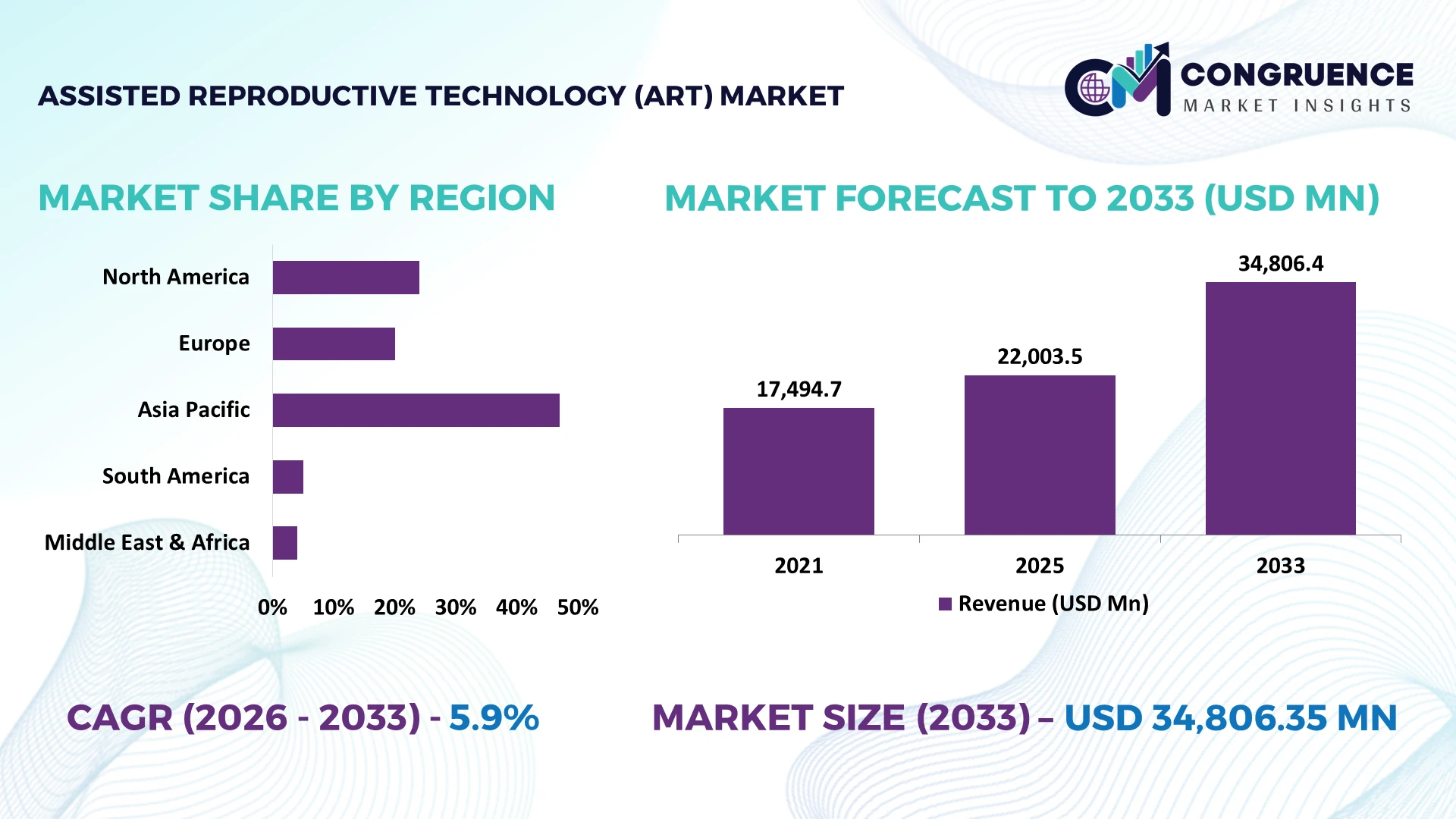
The Global Assisted Reproductive Technology (ART) Market was valued at USD 22003.45 Million in 2025 and is anticipated to reach a value of USD 34806.35 Million by 2033 expanding at a CAGR of 5.9% between 2026 and 2033. Growth is being accelerated by rising infertility treatment cycles, wider adoption of AI-assisted embryo selection, expanding fertility preservation programs, and increasing investments in advanced IVF laboratory infrastructure.
The United States remains the dominant country, accounting for approximately 34% of global ART procedure capacity, supported by sustained private healthcare investment, advanced fertility clinic networks, and AI-enabled embryo assessment adopted by over 45% of large IVF centers in 2026. Compared with Japan, where demographic pressures continue to expand treatment volumes, the U.S. benefits from stronger private-sector innovation despite evolving reproductive policy discussions shaping cross-border treatment decisions. This leadership strengthens competitive opportunities for technology providers, fertility clinics, and laboratory equipment manufacturers prioritizing premium treatment efficiency and digital reproductive health solutions.
Strategic implication: Businesses expanding AI-enabled laboratory platforms and integrated fertility services should prioritize high-capacity healthcare markets while aligning with evolving reproductive regulations and cross-border patient demand.
Market Size & Growth: USD 22003.45 Million in 2025 is projected to reach USD 34806.35 Million by 2033 at a 5.9% CAGR, driven by AI-supported embryo assessment and digital fertility workflows.
Top Growth Drivers: AI-assisted embryo selection improves implantation efficiency by nearly 18%, fertility preservation demand has increased about 22%, and advanced genetic testing adoption exceeds 30% in major clinics.
Short-Term Forecast: By 2028, laboratory automation is expected to reduce embryo handling time by approximately 20% while improving workflow efficiency by 15%.
Emerging Technologies: AI imaging, time-lapse embryo monitoring, and robotic laboratory automation are transforming advanced global fertility treatment with measurable quality improvements.
Regional Leaders: North America approaches USD 12.8 Billion, Europe USD 9.5 Billion, and Asia-Pacific USD 8.9 Billion by 2033, supported by expanding fertility center networks and regional capacity growth.
Consumer/End-User Trends: More than 40% of urban fertility patients prefer digitally integrated treatment planning and personalized reproductive care pathways.
Pilot/Case Example: A 2026 AI-enabled IVF laboratory deployment improved embryo selection accuracy by approximately 16% while reducing manual evaluation time by 25%.
Competitive Landscape: The leading provider group holds an estimated 12% global share alongside several multinational fertility technology companies and specialized reproductive healthcare operators.
Regulatory & ESG Impact: Updated reproductive quality standards reduced laboratory error rates by nearly 10% while encouraging standardized digital documentation across advanced fertility centers.
Investment & Funding: More than USD 2.5 Billion in global investments supports fertility clinic expansion, strategic partnerships, and reproductive technology innovation amid regional healthcare expansion.
Innovation & Future Outlook: Next-generation non-invasive embryo testing, AI-driven reproductive analytics, and connected laboratory ecosystems are strengthening precision treatment and long-term competitive differentiation.
Growing demand for fertility preservation, personalized reproductive medicine, and AI-assisted laboratory workflows is reshaping the Assisted Reproductive Technology (ART) Market. Advanced embryo imaging, non-invasive genetic assessment, and digital patient management platforms are improving clinical efficiency, with automated laboratory adoption increasing by approximately 28% across leading fertility centers. Expanding regulatory standardization and resilient medical equipment supply networks are supporting broader international service delivery, setting the foundation for the strategic market assessment that follows.
The Assisted Reproductive Technology (ART) Market has become strategically important as fertility care shifts toward precision medicine, digital laboratory management, and integrated reproductive health services. Competition increasingly depends on embryo selection accuracy, laboratory automation, and treatment standardization rather than clinic scale alone. In 2026, regulatory harmonization for reproductive laboratory quality and continued digital adoption are accelerating infrastructure modernization, enabling providers to improve clinical consistency while expanding cross-border fertility services.
AI-assisted embryo assessment delivers approximately 18% higher embryo selection accuracy and reduces manual evaluation time by nearly 25% compared with conventional microscope-based workflows, lowering operational burden and improving laboratory throughput. The United States leads in advanced digital IVF laboratory deployment, while Japan continues to expand treatment capacity to address demographic challenges through standardized reproductive programs. Over the next two to three years, automated laboratory platforms are expected to exceed 50% adoption among large fertility centers, supported by integrated imaging, data analytics, and workflow optimization.
A growing number of fertility networks are deploying centralized digital embryology platforms that enable consistent quality management across multiple clinics while strengthening physician collaboration. Companies are expanding partnerships with diagnostic technology providers, investing in AI-enabled laboratory systems, and modernizing reproductive care infrastructure to improve operational efficiency. Organizations combining technology leadership with scalable clinical delivery will secure stronger competitive positioning and long-term differentiation.
AI-assisted embryo evaluation, time-lapse imaging, and advanced genetic screening are reshaping fertility treatment delivery. More than 45% of leading fertility centers have incorporated AI-supported embryo analysis, while laboratory automation improves workflow efficiency by approximately 20% and reduces manual handling errors by nearly 15%. The United States continues expanding private fertility infrastructure as reproductive laboratory quality standards encourage greater technology integration. This combination of clinical precision and operational efficiency increases treatment consistency and patient confidence. Companies are responding by investing in automated embryology laboratories, forming partnerships with reproductive diagnostics specialists, and expanding multi-clinic fertility networks. A notable strategic advantage lies in integrating clinical data platforms with laboratory automation, allowing providers to optimize treatment outcomes while improving resource utilization across high-volume centers.
ART providers continue facing structural limitations from expensive laboratory infrastructure, imported precision equipment, and shortages of highly trained embryologists. Advanced IVF laboratory systems account for nearly 30% of initial facility investment, while specialized consumables experience procurement cost fluctuations of around 12% due to global logistics disruptions. Countries relying heavily on imported reproductive laboratory equipment remain vulnerable to supply-chain delays that extend installation and maintenance timelines. These pressures reduce expansion speed and compress operating margins for independent fertility clinics. Companies are mitigating risks through localized supplier partnerships, long-term procurement contracts, equipment standardization, and regional inventory strategies. Organizations capable of strengthening domestic supply resilience and workforce development gain greater operational stability and improve long-term deployment efficiency.
The strongest opportunity lies in integrating AI, reproductive genomics, and digital patient engagement into unified fertility ecosystems. Automated laboratory management can improve operational productivity by approximately 22%, while cloud-based treatment coordination reduces administrative workloads by nearly 18%. India is expanding advanced fertility infrastructure through private healthcare investment, creating attractive opportunities for technology providers and laboratory solution developers. Increasing adoption of non-invasive embryo assessment and predictive reproductive analytics is reshaping treatment planning with improved clinical precision. Companies are strengthening R&D collaborations, investing in digital reproductive platforms, and expanding partnerships with specialized diagnostic laboratories. An emerging strategic advantage is the development of connected fertility networks that combine diagnostics, treatment, and long-term reproductive health management within a single digital ecosystem.
Sustaining consistent treatment quality across expanding fertility networks remains a significant execution challenge. Laboratory standardization requirements increase implementation complexity, while nearly 35% of fertility providers continue reporting shortages of experienced embryology professionals. Integration of AI platforms with legacy clinical information systems extends deployment timelines by approximately 20%, creating operational bottlenecks during expansion. Japan and other mature fertility markets are prioritizing workforce development alongside digital modernization to preserve clinical consistency as procedure volumes increase. Companies must address these challenges through specialized workforce training, interoperable laboratory software, cybersecurity investment, and standardized quality management frameworks. Organizations that successfully combine technology integration with skilled clinical operations will strengthen competitiveness and maintain reliable treatment performance across geographically distributed fertility centers.
• AI-Driven Embryology Workflows AI-assisted embryo assessment and automated image analysis are becoming standard across large fertility laboratories, with adoption exceeding 45% among high-volume clinics and manual embryo evaluation time declining by nearly 25%. Digital workflow integration is improving laboratory consistency while reducing reporting delays by around 18%. As clinical quality regulations become more standardized, companies are expanding partnerships with AI developers and laboratory software providers to scale interoperable embryology platforms across multi-site fertility networks.
• Expansion of Fertility Preservation Fertility preservation is accelerating beyond oncology into elective reproductive planning, with cryopreservation cycles increasing by approximately 20% and oocyte freezing demand rising nearly 17% across developed healthcare systems. Workforce participation trends and delayed parenthood continue reshaping treatment patterns. Providers are expanding cryostorage capacity, introducing bundled preservation programs, and modernizing laboratory infrastructure to improve scheduling flexibility while optimizing long-term specimen management and operational utilization.
• Integrated Genetic Screening Adoption Preimplantation genetic screening is being incorporated into more advanced IVF cycles, improving embryo selection confidence while reducing repeat transfer requirements by approximately 14%. Digital reporting platforms have shortened genetic review workflows by nearly 16%, enabling closer collaboration between embryologists and genetic specialists. Companies are strengthening strategic alliances with molecular diagnostics providers and investing in integrated laboratory information systems that support standardized reproductive testing under evolving quality compliance frameworks.
• Cross-Border Treatment Networks International patient mobility is reshaping fertility service delivery as specialized treatment hubs streamline multilingual care coordination and digital consultations. Cross-border treatment inquiries have increased by approximately 15%, while centralized appointment platforms reduce administrative processing time by nearly 20%. In response to changing regulatory requirements and specialized workforce availability, fertility providers are expanding regional referral partnerships, standardizing clinical protocols, and developing coordinated treatment ecosystems that improve operational resilience and patient continuity.
In Vitro Fertilization (IVF) remains the dominant segment, accounting for approximately 47% of total ART procedures due to its broad clinical applicability, established laboratory protocols, and compatibility with advanced technologies such as embryo imaging and genetic screening. IVF continues to deliver operational scalability across large fertility networks, enabling standardized treatment workflows and higher laboratory utilization. Intracytoplasmic Sperm Injection (ICSI) represents the fastest-growing segment, with adoption increasing as male-factor infertility diagnoses expand and precision fertilization techniques become routine in advanced embryology laboratories. More than 60% of complex IVF cycles in specialized centers now incorporate ICSI, improving fertilization consistency for selected patients.
Frozen Embryo Transfer (FET) continues gaining strategic importance as cryopreservation quality improves, with utilization increasing by nearly 18% through optimized endometrial preparation and flexible treatment scheduling. Intrauterine Insemination (IUI) remains an important first-line treatment because of lower procedural complexity and cost efficiency, particularly in early-stage infertility management. Companies are investing in advanced incubation systems, embryo culture media, and cryostorage technologies while expanding specialized laboratory partnerships to strengthen treatment quality and differentiate premium fertility services.
Infertility Treatment remains the leading application, representing approximately 58% of total ART utilization as healthcare providers continue expanding access to comprehensive fertility care. Demand is concentrated in specialized fertility clinics where integrated diagnostics, embryo selection technologies, and personalized treatment planning improve clinical efficiency. Genetic Screening is the fastest-growing application, with utilization increasing by nearly 21% as advanced embryo assessment becomes more common for improving implantation success and reducing unnecessary transfer cycles. Digital laboratory platforms are accelerating integration between embryology and molecular diagnostics.
Fertility Preservation continues expanding because of delayed family planning and improved cryopreservation technologies, while Donor Programs remain strategically important for patients requiring specialized reproductive options. Automated laboratory management systems have reduced administrative processing time by approximately 18%, enabling providers to scale higher treatment volumes without proportionate staffing increases. Companies are expanding reproductive genetics capabilities, integrating patient management platforms, and forming partnerships with specialized diagnostic providers to strengthen comprehensive fertility care ecosystems.
Fertility Clinics account for approximately 62% of ART procedures, reflecting their specialized embryology laboratories, experienced reproductive specialists, and high procedural throughput. Their dedicated infrastructure supports efficient deployment of AI-assisted embryo assessment, digital laboratory management, and integrated reproductive diagnostics. Cryobanks represent the fastest-growing end-user segment, with storage demand increasing by nearly 19% as fertility preservation and donor programs expand. Specialized specimen management capabilities are becoming increasingly important for long-term reproductive planning and treatment flexibility.
Hospitals continue strengthening multidisciplinary reproductive medicine programs for complex patient cases, while Research Institutes support innovation in embryo culture, reproductive genetics, and laboratory technologies. Around 40% of large fertility networks are expanding integrated laboratory platforms to improve operational consistency across multiple facilities. Companies are tailoring automation solutions, developing long-term service agreements, and forming strategic collaborations with specialized clinics and cryostorage operators to strengthen ecosystem-wide competitiveness and improve treatment efficiency.
North America accounted for the largest market share at 39.2% in 2025 however, Asia-Pacific is expected to register the fastest growth, expanding at a 7.4% between 2026 and 2033.
Advanced Digital IVF Infrastructure Driving Clinical Leadership
North America maintains the highest concentration of advanced fertility clinics, accounting for nearly 39.2% of global ART activity through sophisticated embryology laboratories, integrated reproductive diagnostics, and strong private healthcare investment. More than 46% of high-volume fertility centers have implemented AI-assisted embryo assessment, improving laboratory productivity and treatment consistency. Expanding fertility preservation services and digital patient management platforms continue strengthening operational efficiency across multi-site clinic networks. Strategic collaborations between reproductive technology developers, genetic testing providers, and fertility specialists are accelerating laboratory modernization. Enterprise investment increasingly targets workflow automation, standardized quality systems, and interoperable clinical software, enabling providers to scale operations while maintaining high procedural accuracy and regulatory compliance across specialized reproductive care facilities.
United States Market Outlook: The United States remains the regional leader due to its extensive fertility clinic network, advanced reproductive laboratory infrastructure, and rapid adoption of AI-enabled embryology platforms. More than 45% of leading IVF laboratories utilize automated embryo imaging and digital workflow management, supporting consistent treatment quality. Strong private investment, specialized reproductive healthcare providers, and continued innovation in genetic testing position the country as the principal technology and operational hub for advanced ART services.
Quality Standardization Supporting Sustainable Expansion
Europe represents one of the most mature ART markets, supported by standardized laboratory protocols, well-established reproductive medicine networks, and favorable clinical governance frameworks. Approximately 31% of global ART procedures are performed across European fertility centers, with increasing deployment of automated embryo monitoring and integrated genetic testing. Modernization of fertility laboratories and stronger cross-border clinical collaboration continue improving treatment consistency and operational efficiency. Around 38% of large reproductive centers have expanded digital laboratory management platforms to optimize quality assurance and patient coordination. Companies are prioritizing laboratory automation, clinical data integration, and strategic partnerships to strengthen specialized reproductive healthcare delivery while maintaining rigorous quality standards.
Spain Market Outlook: Spain has become one of Europe's leading fertility destinations because of its advanced clinical expertise, supportive reproductive treatment environment, and strong international patient inflow. High-capacity fertility clinics continue investing in next-generation embryology laboratories and cryopreservation infrastructure. Growing adoption of AI-assisted embryo evaluation and integrated reproductive genetics strengthens Spain's competitive position while expanding operational efficiency across both domestic and international fertility treatment programs.
Large-Scale Capacity Expansion Accelerating Adoption
Asia-Pacific is becoming the fastest-expanding ART market as healthcare infrastructure investment, fertility awareness, and advanced reproductive technologies gain wider acceptance. Approximately 28% of global ART procedures are now performed across the region, supported by expanding private fertility networks and modernization of laboratory facilities. More than 30% of newly established fertility centers have integrated automated laboratory equipment to improve throughput and clinical consistency. Government healthcare initiatives, rising urban healthcare expenditure, and increasing fertility preservation demand continue strengthening deployment activity. Companies are expanding regional partnerships, investing in laboratory automation, and strengthening localized manufacturing of reproductive consumables to improve operational resilience and reduce procurement dependency.
China Market Outlook: China leads the regional market through large-scale fertility clinic expansion, substantial healthcare investment, and growing adoption of precision reproductive technologies. Digital laboratory management and AI-assisted embryo assessment are increasingly integrated into premium fertility centers, with automated laboratory deployment rising by approximately 26%. Domestic innovation, expanding reproductive healthcare infrastructure, and stronger clinical standardization continue reinforcing China's strategic leadership within the regional ART ecosystem.
Private Healthcare Expansion Strengthening Access
South America continues expanding ART capacity through increasing private healthcare investment, modernization of fertility clinics, and wider access to specialized reproductive services. The region contributes approximately 7% of global ART procedures, supported by growing urban treatment demand and improved embryology laboratory capabilities. Around 18% of major fertility providers have expanded laboratory infrastructure through strategic technology partnerships, improving procedural efficiency and cryopreservation capacity. Infrastructure disparities and uneven reimbursement frameworks remain operational challenges, encouraging providers to prioritize scalable clinic models and standardized laboratory systems. Companies are strengthening regional partnerships and investing selectively in high-demand metropolitan healthcare markets.
Brazil Market Outlook: Brazil represents the largest ART market in South America through its established private fertility clinic network and expanding reproductive healthcare infrastructure. Premium fertility providers continue adopting AI-supported laboratory workflows and advanced cryostorage systems to improve treatment quality. Rising demand for fertility preservation and specialized reproductive diagnostics is encouraging investment in integrated fertility centers capable of serving both domestic patients and regional medical travelers.
Healthcare Investment Driving Specialized Fertility Services
The Middle East & Africa market is advancing through healthcare diversification, specialized fertility center development, and modernization of reproductive medicine infrastructure. The region accounts for approximately 5% of global ART activity, with private healthcare operators leading technology deployment. Nearly 20% of premium fertility facilities have upgraded laboratory automation and digital patient management systems during recent expansion programs. Strategic healthcare investment, international clinical partnerships, and growing fertility awareness continue supporting specialized service delivery despite infrastructure variation across countries. Companies are focusing on premium reproductive care, laboratory modernization, and clinician training to strengthen operational performance and treatment quality.
United Arab Emirates Market Outlook: The United Arab Emirates has emerged as the regional leader through advanced healthcare infrastructure, international fertility specialists, and continued investment in premium reproductive medicine. High-end fertility centers are expanding AI-assisted laboratory capabilities and integrated reproductive diagnostics while attracting cross-border patients. Continued investment in specialized healthcare facilities and digital clinical platforms strengthens the country's position as a regional hub for technologically advanced ART services.
The Assisted Reproductive Technology (ART) market is led by CooperSurgical, Vitrolife, Merck KGaA, FUJIFILM Irvine Scientific, and Hamilton Thorne, competing directly with specialized laboratory technology providers and regional fertility solution companies. The top five participants collectively control approximately 42% of the global market through integrated consumables, imaging systems, embryo culture technologies, and laboratory automation. Competition centers on clinical accuracy, workflow efficiency, and technology integration rather than price alone, with AI-enabled embryo assessment improving laboratory productivity by nearly 20% and automated imaging reducing manual evaluation by around 25%. Leading companies are expanding through strategic acquisitions, reproductive diagnostics partnerships, product portfolio integration, and regional manufacturing investments to strengthen supply continuity. Technology-driven consolidation is increasing competitive pressure on smaller equipment suppliers lacking digital capabilities. High regulatory compliance requirements and specialized laboratory validation remain major entry barriers. Sustained leadership depends on combining innovation, clinical performance, scalable manufacturing, and integrated reproductive laboratory ecosystems.
CooperSurgical
Vitrolife AB
Merck KGaA
FUJIFILM Irvine Scientific
Hamilton Thorne Ltd.
Cook Medical
Genea Biomedx
Esco Medical
Kitazato Corporation
Nidacon International AB
The Baker Company
Rocket Medical plc
IVFtech ApS
Labotect GmbH
Artificial intelligence, time-lapse embryo imaging, and integrated laboratory information systems define current ART technology leadership. AI-assisted embryo selection improves embryo grading accuracy by approximately 18%, while automated image analysis reduces manual assessment time by nearly 25%. More than 45% of high-volume fertility centers have adopted AI-supported embryology workflows, strengthening laboratory consistency and reducing operator variability. These technologies enable clinics to process more treatment cycles without proportional staffing increases, creating measurable operational and competitive advantages.
Emerging technologies include non-invasive embryo assessment, advanced reproductive genomics, robotic micromanipulation, and cloud-connected laboratory platforms. Non-invasive embryo testing lowers biopsy dependence by roughly 20%, while digital laboratory management reduces administrative workload by approximately 18%. Deployment of integrated reproductive platforms has exceeded 40% among leading fertility providers, supporting seamless data exchange between embryologists, clinicians, and genetic specialists. Compared with conventional microscope-based workflows, AI-enabled laboratory ecosystems improve overall operational efficiency by nearly 22%, accelerating treatment planning and strengthening quality standardization.
Between 2026 and 2028, predictive reproductive analytics, digital twin laboratory optimization, and automated cryostorage management are expected to become key competitive differentiators. Clinics investing early in interoperable AI platforms, robotics, and advanced embryo analytics will achieve faster workflow scalability, lower operational costs by approximately 12%, and improve laboratory throughput by nearly 15%. Technology leadership is shifting from standalone laboratory equipment toward fully connected reproductive ecosystems, making early digital integration essential for long-term competitive positioning.
July 2024 CooperSurgical introduced the Embryo OptionsSM cryo management and laboratory workflow solution at ESHRE 2024, strengthening IVF laboratory traceability and operational efficiency across cryostorage management with digital workflow integration supporting multi-site laboratories. Source: https://www.coopersurgical.com
February 2024 CooperSurgical received U.S. FDA 510(k) clearance for an updated RI Witness Smart System, enhancing RFID-based IVF consumable tracking and strengthening chain-of-custody verification with 100% electronic traceability throughout laboratory workflows. Source: https://www.fda.gov
October 2024 CooperSurgical expanded artificial intelligence-supported embryo assessment capabilities to improve embryo selection consistency, enabling standardized decision support across IVF laboratories and strengthening clinical workflow quality for advanced reproductive treatment programs.
September 2024 FUJIFILM Irvine Scientific expanded fertility media production capacity to support growing IVF laboratory demand across Asia-Pacific, strengthening manufacturing resilience and improving supply continuity for high-volume fertility centers. Source: https://www.irvinesci.com
This report delivers comprehensive analysis of the Assisted Reproductive Technology (ART) market across In Vitro Fertilization (IVF), Intracytoplasmic Sperm Injection (ICSI), Intrauterine Insemination (IUI), and Frozen Embryo Transfer (FET). It evaluates infertility treatment, fertility preservation, donor programs, and genetic screening across fertility clinics, hospitals, cryobanks, and research institutes. Regional assessment covers North America, Europe, Asia-Pacific, South America, and the Middle East & Africa, supported by operational trends, technology adoption, and competitive benchmarking. More than 40% of advanced fertility centers now utilize digital laboratory platforms, highlighting accelerating technology integration.
The report examines AI-assisted embryo assessment, laboratory automation, reproductive genomics, cryopreservation innovation, and digital fertility management while evaluating deployment patterns, enterprise strategies, and evolving clinical infrastructure. It provides strategic intelligence for investment prioritization, capacity expansion, partnership evaluation, competitive positioning, and technology adoption between 2026 and 2033. Business insights also identify emerging niche opportunities in precision reproductive medicine, integrated laboratory ecosystems, fertility preservation, and AI-enabled embryology workflows, enabling informed long-term operational and strategic decision-making.
| Report Attribute/Metric | Report Details |
|---|---|
Market Revenue in 2025 | USD 22003.45 Million |
Market Revenue in 2033 | USD 34806.35 Million |
CAGR (2026 - 2033) | 5.9% |
Base Year | 2025 |
Forecast Period | 2026 - 2033 |
Historic Period | 2021 - 2025 |
Segments Covered | By Type
By Application
By End-User
|
Key Report Deliverable | Revenue Forecast, Growth Trends, Market Dynamics, Segmental Overview, Regional and Country-wise Analysis, Competition Landscape |
Region Covered | North America, Europe, Asia-Pacific, South America, Middle East, Africa |
Key Players Analyzed | CooperSurgical, Vitrolife AB, Merck KGaA, FUJIFILM Irvine Scientific, Hamilton Thorne Ltd., Cook Medical, Genea Biomedx, Esco Medical, Kitazato Corporation, Nidacon International AB, The Baker Company, Rocket Medical plc, IVFtech ApS, Labotect GmbH |
Customization & Pricing | Available on Request (10% Customization is Free) |




