
Reports
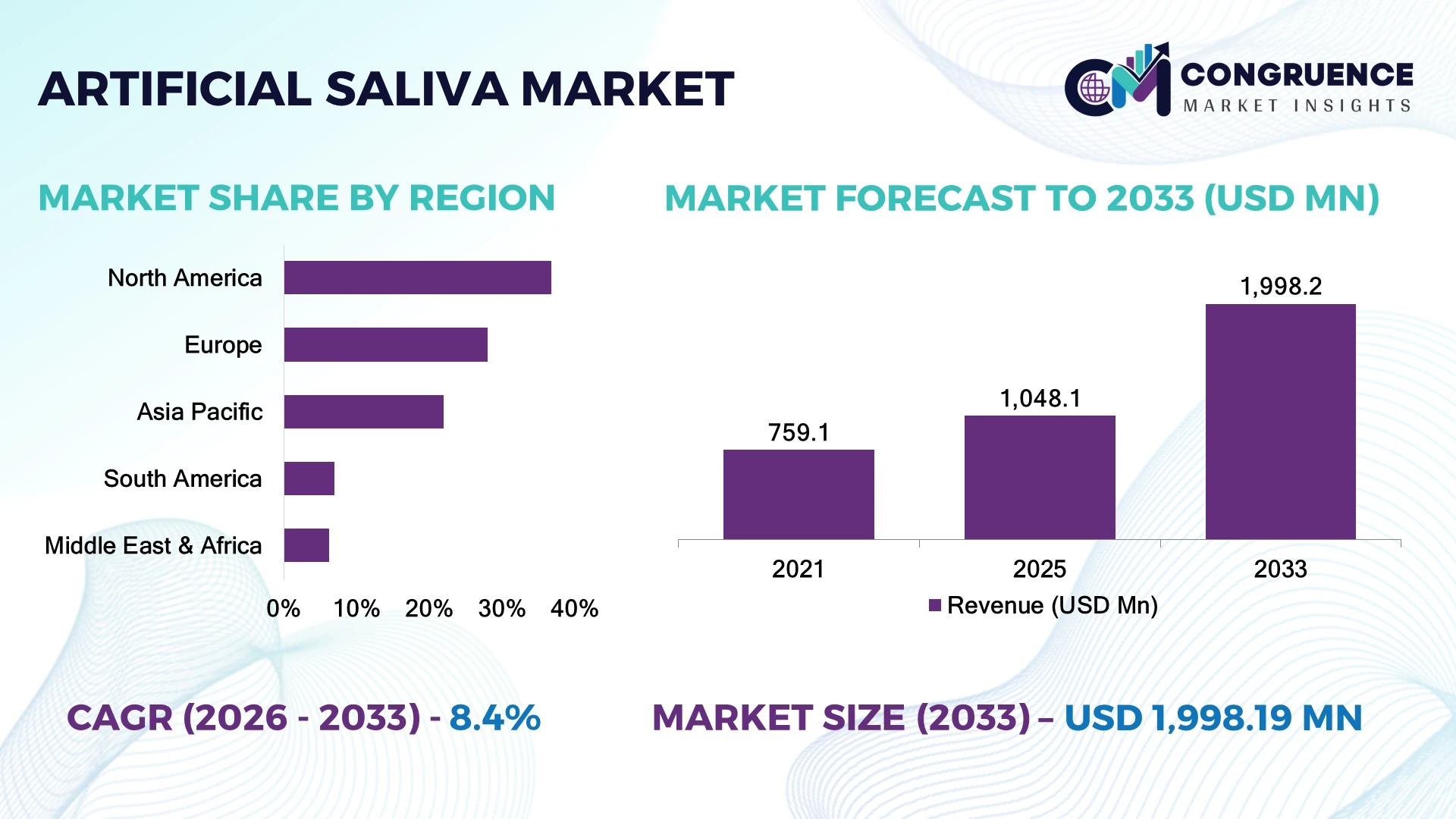
The Global Artificial Saliva Market was valued at USD 1,048.1 Million in 2025 and is anticipated to reach a value of USD 1,998.2 Million by 2033 expanding at a CAGR of 8.4% between 2026 and 2033. Growth is being driven by rising xerostomia associated with cancer therapies, polypharmacy, autoimmune disorders, and aging populations, alongside greater clinical preference for longer-lasting saliva-substitute formulations.
The United States represents the dominant national market, supported by advanced oncology and dental-care infrastructure, while Japan and Germany show strong adoption among aging populations. Approximately 38% of adults globally experience xerostomia symptoms in pooled estimates, reinforcing a substantial treatment pool. U.S. demand is more concentrated in oncology and specialty dentistry, whereas India is expanding through lower-cost OTC formulations and pharmacy distribution.
Strategically, manufacturers should prioritize clinically differentiated formulations, longer moisture retention, and scalable OTC distribution rather than competing solely on formulation price.
Market Size & Growth: USD 1,048.1 Million in 2025 to USD 1,998.2 Million by 2033 at a 8.4% CAGR, driven by xerostomia treatment demand and formulation innovation.
Top Growth Drivers: Xerostomia prevalence 38%; medication-related dry mouth 30%+; oncology-linked demand 20%+.
Short-Term Forecast: By 2028, advanced gel and sustained-release formats target 15–20% longer moisture retention than conventional sprays.
Emerging Technologies: Mucin-based systems, polymer hydrogels, and bioadhesive formulations are improving residence time by approximately 20–30%.
Regional Leaders: North America leads; Europe emphasizes clinical formulations; Asia-Pacific records 10–15% stronger adoption momentum through aging and dental-care expansion.
Consumer/End-User Trends: OTC purchasing represents an increasingly important channel, with convenience-oriented formats accounting for approximately 45% of routine-use demand.
Pilot/Case Example: 2025 hydrogel research demonstrated sustained moisture-release potential, targeting approximately 20% longer oral residence than conventional liquid substitutes.
Competitive Landscape: Leading suppliers compete through formulation performance, with established oral-care and specialty pharmaceutical companies targeting approximately 10–15% differentiation through gels, sprays, and bioadhesive products.
Regulatory & ESG Impact: Approximately 20% of product-development priorities increasingly emphasize preservative optimization, biocompatibility, packaging reduction, and clinically acceptable excipients.
Investment & Funding: Private and institutional R&D programs increasingly target polymer science, mucin mimetics, and sustained-release platforms, shifting investment toward higher-value therapeutic formulations.
Innovation & Future Outlook: 2026–2030 development is moving toward biomimetic saliva, multifunctional lubrication, remineralization, and antimicrobial functionality, strengthening product differentiation beyond basic moisture replacement.
The Artificial Saliva Market is increasingly centered on xerostomia management across oncology, dentistry, autoimmune disease, and medication-associated dry mouth. Spray and liquid products retain strong convenience advantages, while gels and bioadhesive systems are gaining attention for longer oral residence. Approximately 38% prevalence of xerostomia in pooled adult estimates underscores the size of the addressable patient population. In 2026, manufacturers are increasingly positioning products around moisture retention, mucosal comfort, and formulation tolerability rather than basic lubrication alone. This shift is strengthening the commercial relevance of clinically differentiated saliva substitutes and setting up a broader strategic transition toward sustained-release oral-care technologies.
Artificial saliva is becoming strategically important because xerostomia increasingly intersects with oncology survivorship, aging, chronic medication use, autoimmune disorders, and dental-care management. The commercial opportunity is shifting from basic symptom relief toward formulations that replicate selected physical and protective properties of natural saliva. This is increasing the importance of polymer engineering, mucosal adhesion, buffering, and mineral-support functionality in product development.
Technology differentiation is becoming measurable. Conventional aqueous sprays provide rapid but short-duration lubrication, whereas gel and bioadhesive systems can extend oral residence by approximately 20–30%, reducing the frequency of reapplication and improving convenience. North America maintains stronger specialty-care infrastructure, while Asia-Pacific combines expanding healthcare access with a large aging population and rising OTC availability. These differences are influencing product positioning and channel strategy.
Over the next 2–3 years, manufacturers are expected to prioritize sustained-release formulations, mucin-mimetic ingredients, and multifunctional products combining lubrication with oral-health support. Companies are redirecting R&D toward differentiated formulations and partnering with dental and pharmaceutical channels. The strongest competitive position will come from products that deliver longer-lasting relief, clinically credible performance, manufacturing scalability, and convenient distribution.
Rising treatment-related xerostomia is shifting artificial saliva demand toward formulations providing sustained mucosal lubrication rather than short-duration wetting. Xerostomia affects approximately 20–30% of adults in many clinical populations, while prevalence among patients receiving head-and-neck radiotherapy can exceed 70%. Gel and bioadhesive formats increasingly target 20–30% longer oral residence than conventional aqueous sprays. In the United States, oncology survivorship and dental-care networks are expanding demand for clinically differentiated saliva substitutes. Manufacturers are responding with mucin-mimetic polymers, buffered formulations, and multi-channel distribution. The non-obvious opportunity is moving from symptom replacement toward products supporting mucosal protection and oral comfort, allowing companies to defend premium positioning through measurable formulation performance rather than volume-based pricing.
Artificial saliva manufacturers face formulation constraints involving preservative compatibility, viscosity control, ingredient stability, and short shelf-life requirements. Approximately 15–20% of product-development effort can be directed toward stability and packaging optimization, particularly for polymer-rich gels and bioadhesive systems. Refrigeration-sensitive or moisture-sensitive ingredients can add 5–10% to logistics and inventory costs compared with conventional liquid formulations. In India and other price-sensitive markets, these cost differences pressure margins and restrict premium-product penetration. Regulatory requirements for excipient safety and therapeutic positioning further complicate formulation changes. Companies are mitigating exposure through standardized excipient platforms, dual-source procurement, regional contract manufacturing, and simplified packaging. The strategic pressure point is achieving longer residence time without creating manufacturing complexity that erodes commercial scalability.
Biomimetic artificial saliva represents the strongest product-development opportunity as manufacturers move beyond basic lubrication toward multifunctional oral protection. Mucin-mimetic polymers, hydrogel matrices, and mineral-support formulations can target 20–30% improvements in residence time or moisture retention versus conventional aqueous products. Approximately 25% of emerging formulation research is increasingly oriented toward sustained-release or bioadhesive delivery concepts. Japan's aging population and expanding geriatric dental-care infrastructure create a particularly attractive environment for convenient, long-duration formulations. Companies are investing in polymer R&D, university collaborations, and dental-channel partnerships to establish differentiated clinical positioning. A non-obvious opportunity lies in multifunctional products combining lubrication, buffering, remineralization, and mucosal protection, allowing manufacturers to expand artificial saliva from a symptom-management product into a broader oral-care platform.
The principal long-term challenge is translating laboratory formulation performance into consistent clinical outcomes across diverse xerostomia populations. Patient response can vary substantially according to medication exposure, radiation history, autoimmune disease, hydration status, and baseline salivary function, creating approximately 15–25% variability in perceived duration of relief across product formats. Sustained-release systems also face viscosity, dispensing, and sensory challenges that can reduce adherence by an estimated 10–15% when formulations become unpleasant or difficult to administer. Digital patient monitoring and personalized treatment protocols are emerging responses, particularly within specialist dental and oncology settings. Manufacturers must strengthen clinical validation, formulation standardization, human-factors testing, and practitioner partnerships. The competitive advantage will increasingly depend on proving reproducible real-world performance rather than relying solely on ingredient claims.
Bioadhesive Formulations Gain Traction Artificial saliva development is shifting toward polymer-based gels and mucosal adhesives capable of extending oral residence by approximately 20–30% compared with conventional liquid products. Adoption is particularly relevant in oncology and specialist dental care, where repeated dosing creates workflow and adherence burdens. Manufacturers are refining viscosity and sensory properties to capture premium demand without compromising patient usability.
Mucin Mimicry Drives Formulation Innovation Developers are increasingly replicating selected lubrication characteristics of natural mucins rather than relying solely on water-based hydration. Experimental formulations targeting 15–25% stronger surface retention are gaining attention, while approximately 20% of emerging product concepts emphasize biomimetic polymers. Companies are investing in material-science partnerships because superior lubrication performance offers stronger differentiation than conventional flavor or packaging changes.
OTC Channels Expand Patient Access Retail pharmacy and e-commerce channels are becoming more important for routine xerostomia management, particularly in the United States and Japan. Convenience-oriented sprays and ready-to-use gels account for an estimated 40–45% of consumer-oriented purchases, encouraging manufacturers to simplify dosing and packaging. Supply-chain normalization after recent pharmaceutical and healthcare disruptions is also enabling broader regional distribution and inventory localization.
Multifunctional Oral Care Accelerates Artificial saliva products are increasingly incorporating buffering, mineral-support, and mucosal-protection functions, moving beyond moisture replacement alone. Approximately 15–20% of newer formulation concepts target more than one oral-health benefit. This shift is creating new positioning opportunities across aging, medication-associated xerostomia, and cancer survivorship. Companies are responding with differentiated formulations, practitioner education, and partnerships across dental and specialty-care channels.
Gels Lead Through Longer Moisture Retention
Gel formulations represent the leading artificial saliva type, accounting for approximately 42% of product-market demand, supported by higher viscosity, stronger mucosal adhesion, and longer-lasting relief. Their positioning is particularly strong for severe xerostomia, nighttime use, oncology recovery, and geriatric patients requiring sustained lubrication. Oral sprays remain a mature, highly scalable format, while oral solutions and liquids retain relevance where rapid oral coverage and flexible dosing are prioritized. Dissolving tablets and powders occupy narrower niches but offer portability and formulation flexibility.
Oral sprays are emerging as the fastest-growing type, with demand shifting toward convenient, portable administration and frequent daytime use. Their share is estimated near 30–35%, while formulation improvements targeting longer hydration are increasing competitive differentiation. Approximately 15–20% of product development is shifting toward bioadhesive polymers, hydrogel matrices, and sustained-release approaches. Companies are consequently balancing high-volume spray portfolios with premium gel and advanced polymer platforms, directing investment toward longer residence time, improved sensory characteristics, and differentiated clinical performance.
A 2026 systematic review and meta-analysis covering 174,698 participants found a pooled xerostomia prevalence of 32.4% among adults aged 60 years and older, reinforcing the importance of longer-duration formulations for an expanding geriatric treatment population.
Geriatric Xerostomia Anchors Routine Demand
Geriatric xerostomia represents the leading application, estimated at approximately 35% of artificial saliva demand, reflecting high exposure to polypharmacy, age-related salivary dysfunction, and chronic oral-health conditions. Oncology supportive care follows as a major clinical application, particularly for patients receiving head-and-neck radiotherapy, while dental and oral-health management remains important for maintaining mucosal comfort and reducing complications associated with persistent dryness. Post-surgical recovery and autoimmune-related xerostomia represent more specialized applications with stronger clinical rather than routine retail purchasing patterns.
Oncology supportive care is the fastest-growing application, with demand increasingly linked to survivorship programs and long-term management of treatment-related oral complications. Approximately 20–25% of specialized clinical demand is associated with oncology-related xerostomia management, while autoimmune and chronic-disease applications are also expanding as diagnosis and long-term symptom management improve. Companies are responding with alcohol-free sprays, higher-viscosity gels, calcium-phosphate formulations, and clinician-focused distribution. The strategic shift is toward application-specific formulations rather than one product serving every xerostomia profile.
A 2026 clinical study of post-radiotherapy head-and-neck cancer patients reported xerostomia in 90% of respondents, with 53.1% describing the daily burden as strong or very strong, highlighting sustained clinical demand for effective saliva substitutes in oncology care.
Adults Dominate Through Chronic Usage Intensity
Adult users account for approximately 72% of artificial saliva demand, reflecting the higher prevalence of xerostomia among older adults, chronic-disease patients, medication users, and oncology populations. Pediatric users represent a smaller but strategically relevant segment, requiring stricter formulation considerations around ingredients, taste, dosing convenience, and safety. Adult purchasing is more diversified across OTC pharmacies, dental practices, hospitals, and online channels, whereas pediatric demand is more dependent on clinician or caregiver recommendations.
The pediatric segment is positioned for comparatively faster expansion as awareness of medication-associated dry mouth and specialized oral-care needs increases. Approximately 25–30% of pediatric-oriented product development is increasingly focused on palatability, mild formulations, and simplified administration. Adult-focused suppliers are therefore expanding differentiated gels, sprays, and moisturizing systems, while pediatric positioning favors lower-complexity formulations and caregiver-friendly packaging. Companies targeting future demand are prioritizing clinical credibility, formulation safety, and channel partnerships rather than relying solely on broad OTC distribution.
A 2026 meta-analysis covering 128 publications and more than 174,000 participants estimated xerostomia prevalence at 32.4% among adults aged 60 years and older, demonstrating the substantial adult treatment pool supporting sustained demand for artificial saliva products.
North America accounted for the largest market share at 36.8% in 2025 however, Asia-Pacific is expected to register the fastest growth, expanding at a CAGR of 9.1% between 2026 and 2033.

Clinical Integration Is Shifting Toward Long-Duration Relief
North America holds the strongest artificial saliva market position, supported by established dental-care infrastructure, high OTC product penetration, and extensive management of medication-induced xerostomia. The region represents approximately 36.8% of global demand, with the United States accounting for the majority of regional consumption. Hospitals, oncology centers, dental practices, and long-term-care facilities are increasingly incorporating saliva substitutes into supportive oral-care protocols. Product differentiation is shifting toward alcohol-free sprays, bioadhesive gels, and formulations designed for prolonged mucosal hydration. Approximately 31.9% of xerostomia prevalence among older adults in North America underscores a substantial addressable population. Manufacturers are expanding pharmacy and clinical distribution while investing in higher-retention formulations and clinician-oriented product positioning.
United States Market Outlook: The United States remains the principal commercial and innovation hub, supported by a large aging population, sophisticated dental-care networks, and strong OTC healthcare distribution. Demand is increasingly concentrated in geriatric care, oncology supportive treatment, and medication-associated xerostomia. Institutionalized older adults show particularly high need, with xerostomia prevalence estimated at 43.6% globally among institutionalized populations, reinforcing opportunities for hospital and long-term-care contracts.
Aging Demographics Are Increasing Clinical Product Intensity
Europe maintains a strong artificial saliva market position through its aging population, mature pharmaceutical distribution, and established dental-care systems. Approximately 33.2% of older adults across Europe report xerostomia, creating substantial recurring demand for saliva substitutes. Germany represents an important national market, with particularly elevated reported xerostomia prevalence among older populations. European manufacturers are increasingly emphasizing alcohol-free formulations, clinically differentiated gels, and products compatible with long-term medication use. Regulatory scrutiny around product claims and formulation safety is pushing companies toward stronger clinical substantiation and standardized quality control. The market is also shifting from basic symptomatic relief toward condition-specific formulations addressing nighttime dryness, denture-related discomfort, and oncology-associated oral complications.
Germany Market Outlook: Germany is strategically important because of its high reported xerostomia burden and extensive healthcare infrastructure. A pooled analysis identified xerostomia prevalence among older German populations at 81.4%, substantially above the European average. This creates strong potential for pharmacy, dental-clinic, and institutional-care channels. Companies are prioritizing clinically differentiated formulations and professional recommendation pathways rather than competing solely through mass-market pricing.
Scale and Aging Are Reshaping Product Distribution
Asia-Pacific combines a rapidly expanding older population with uneven access to specialized oral-care products, creating a two-speed artificial saliva market. Japan represents the region's most mature opportunity, while China, India, South Korea, and Australia are strengthening demand through expanding healthcare infrastructure and pharmacy penetration. Asia records approximately 28.7% xerostomia prevalence among older adults, below Europe's 33.2% but across a much larger demographic base. Manufacturers are therefore emphasizing affordable sprays, compact packaging, and localized distribution. Digital pharmacy channels are becoming increasingly relevant, while partnerships with dental clinics and hospitals are improving product visibility. Companies that combine cost-efficient formulations with local regulatory and distribution expertise are best positioned to capture fragmented demand.
Japan Market Outlook: Japan offers the strongest strategic platform in Asia-Pacific because of its advanced healthcare infrastructure, large elderly population, and established oral-care culture. Demand is concentrated around geriatric patients, medication-associated xerostomia, and long-term oral-health management. Manufacturers are positioned to benefit from premium formulations offering longer residence time and convenient administration, while partnerships with pharmacies, dental clinics, and elder-care providers can strengthen recurring product utilization.
High Xerostomia Burden Creates a Clinically Driven Opportunity
South America presents a comparatively high underlying xerostomia burden, with prevalence among older adults estimated at 38.9%, the highest among major continental groupings in a recent meta-analysis. Brazil anchors regional demand through its large healthcare market, dental infrastructure, pharmaceutical manufacturing base, and growing clinical attention to oral-health complications. A 2025 Brazilian population study involving 1,052 participants reported xerostomia in 60.64%, illustrating substantial localized symptom burden. Distribution remains more concentrated in major urban centers, creating a clear divide between established metropolitan channels and underserved secondary markets. Companies are responding through pharmacy partnerships, locally adapted pricing, and wider availability of sprays and gels rather than relying exclusively on premium clinical formulations.
Brazil Market Outlook: Brazil is the region's most strategically significant market because of its population scale, established dental sector, and substantial xerostomia burden. A 2025 clinical population assessment recorded xerostomia among 60.64% of participants, reinforcing the commercial relevance of symptomatic oral-care products. Manufacturers are strengthening pharmacy and dental distribution while positioning artificial saliva as part of broader chronic oral-care management.
Healthcare Modernization Is Expanding Specialist Access
Middle East & Africa remains a developing artificial saliva market characterized by concentrated demand in advanced healthcare systems and major metropolitan centers. Saudi Arabia and the United Arab Emirates are emerging as priority markets because of hospital modernization, private healthcare expansion, dental-service development, and increasing access to specialist oral-care products. Demand is particularly relevant across oncology, geriatric care, autoimmune disorders, and medication-associated xerostomia. Approximately one-third of adults aged 60 years and older globally experience xerostomia, providing a clear clinical rationale for broader product availability as regional healthcare capacity improves. Companies are strengthening distributor networks, hospital partnerships, and premium product portfolios while adapting pack sizes and pricing to local purchasing structures.
Saudi Arabia Market Outlook: Saudi Arabia offers the strongest strategic opportunity in the region through its expanding hospital infrastructure, private healthcare investment, and increasing specialization in oncology and dental services. The market favors products supported by clinical positioning, reliable cold-chain-independent distribution, and professional recommendation. Suppliers are increasingly targeting hospitals, pharmacies, and specialist clinics, while distributor partnerships provide an efficient route into a geographically dispersed healthcare system.
Haleon’s Biotene competes directly with GC Corporation, Forward Science, Xlear, and Oasis, while specialist brands such as OraCoat, Dentiva, and Hager Pharma challenge established players through niche formulations and channel specialization. The market is moderately concentrated, with the top five players estimated to command approximately 64% combined share. Competition centers on formulation performance, clinical positioning, distribution reach, and price: premium products typically command 20–35% higher pricing, while long-acting formulations can reduce application frequency by 25–40%. Haleon and GC emphasize broad portfolios and professional channels; specialist players compete through customization, adherence technologies, and targeted xerostomia indications. Current competition is shifting toward clinically validated, longer-lasting, sugar-free, and lower-cost formulations, reinforced by digital pharmacy distribution. Entry barriers remain substantial because regulatory compliance, clinical evidence, established pharmacy access, and formulation credibility constrain rapid scaling. Winning requires differentiated efficacy, reliable supply, strong clinical relationships, and efficient omnichannel distribution.
Haleon
GC Corporation
Xlear, Inc.
Oasis Consumer Healthcare
Forward Science
OraCoat
Lubricity Labs
Dentiva
Hager Pharma
Colgate-Palmolive
Oxyfresh
SmartMouth
Entod Research Cell
TheraBreath
Artificial saliva technology is shifting from basic aqueous moisturizers toward long-residence gels, polymer-based mucin mimetics, enzyme-enhanced systems, and bioadhesive formulations. Sugar-free and pH-balanced formulations are increasingly integrated with xylitol, glycerin, cellulose derivatives, and mineral systems. Long-acting gels can extend perceived moisture retention by approximately 20–30% versus conventional liquid sprays, improving adherence and reducing repeated applications. Professional dental and pharmacy channels are accelerating adoption of differentiated formulations.
Emerging formulation engineering is focusing on controlled-release matrices and mucosal adhesion. Bioadhesive systems can improve residence performance by approximately 15–25%, while optimized polymer networks reduce formulation waste by around 10–15%. Clinical assessment is also becoming more objective through oral-moisture measurement and standardized xerostomia scoring. These technologies favor specialist manufacturers capable of translating laboratory performance into clinically validated products rather than competing solely through retail pricing.
Between 2026 and 2028, the strongest competitive advantage will come from formulations combining prolonged hydration, oral protection, and patient convenience. New-generation gels already demonstrate comparable short-term wetness to established commercial products, creating pressure on incumbents to improve performance without increasing cost. Companies investing in bioadhesion, controlled release, and clinically validated formulations will gain stronger differentiation across oncology, geriatric, dental, and chronic-care channels.
June 2025 Recordati Rare Diseases recalled Caphosol artificial saliva after stability testing found an out-of-specification result in Solution B, affecting 3,754 boxes or 120,128 doses. The action tightened quality controls and temporarily disrupted international supply in multiple countries. Source: FDA
April 2025 NHS Specialist Pharmacy Service expanded dental prescribing guidance for artificial saliva, distinguishing gel, spray, and protective formulations and specifying formulation attributes. The guidance strengthened clinician selection and supported more standardized product positioning across UK dental-care channels. Source: NHS
May 2024 Mucosamin artificial saliva spray was evaluated in 80 ventilated COVID-19 patients, with intervention participants showing lower oral-assessment scores after four days, 9.23 versus 12.05. The evidence strengthened hospital-use positioning for artificial saliva in critical-care oral management. Source: PubMed
January 2026 Rangsit University’s trial compared its artificial saliva gel with GC Dry Mouth Gel in 37 xerostomia patients; both improved oral wetness without significant differences at 60 minutes. The result supports lower-cost formulation competition against established products. Source: MDPI
The Artificial Saliva Market Report evaluates the industry across sprays, gels, rinses, lozenges, and emerging long-acting formulations, with analysis of humectant-based, polymer/mucin-mimicking, enzyme-enhanced, and protective-film technologies. Coverage spans dental clinics, hospitals, pharmacies, specialty stores, online channels, oncology care, geriatric care, and chronic xerostomia management. Regional analysis includes North America, Europe, Asia-Pacific, South America, and Middle East & Africa, with country-level assessment of adoption, distribution, regulatory positioning, and clinical utilization.
The report examines competitive positioning across leading global manufacturers and specialist formulation developers, highlighting product differentiation, clinical validation, pricing, channel reach, and formulation innovation. Adoption patterns, professional prescribing, product formats, and emerging bioadhesive technologies are evaluated to identify high-potential niches. The analysis supports investment planning, portfolio expansion, market-entry decisions, partnership development, competitive benchmarking, and strategic positioning through 2026–2033.
| Report Attribute/Metric | Report Details |
|---|---|
|
Market Revenue in 2025 |
USD 1,048.1 Million |
|
Market Revenue in 2033 |
USD 1,998.2 Million |
|
CAGR (2026 - 2033) |
8.4% |
|
Base Year |
2025 |
|
Forecast Period |
2026 - 2033 |
|
Historic Period |
2021 - 2025 |
|
Segments Covered |
By Type
By Application
By End-User
|
|
Key Report Deliverable |
Revenue Forecast, Growth Trends, Market Dynamics, Segmental Overview, Regional and Country-wise Analysis, Competition Landscape |
|
Region Covered |
North America, Europe, Asia-Pacific, South America, Middle East, Africa |
|
Key Players Analyzed |
Haleon, GC Corporation, Xlear, Inc., Oasis Consumer Healthcare, Forward Science, OraCoat, Lubricity Labs, Dentiva, Hager Pharma, Colgate-Palmolive, Oxyfresh, SmartMouth, Entod Research Cell, TheraBreath |
|
Customization & Pricing |
Available on Request (10% Customization is Free) |




