
Reports
The Global Animal Diagnostics Market was valued at USD 8,405.1 Million in 2025 and is anticipated to reach a value of USD 18,682.8 Million by 2033 expanding at a CAGR of 10.5% between 2026 and 2033. Growth is being driven by wider molecular testing, point-of-care diagnostics, preventive companion-animal screening, and intensified livestock surveillance following H5N1 outbreaks.
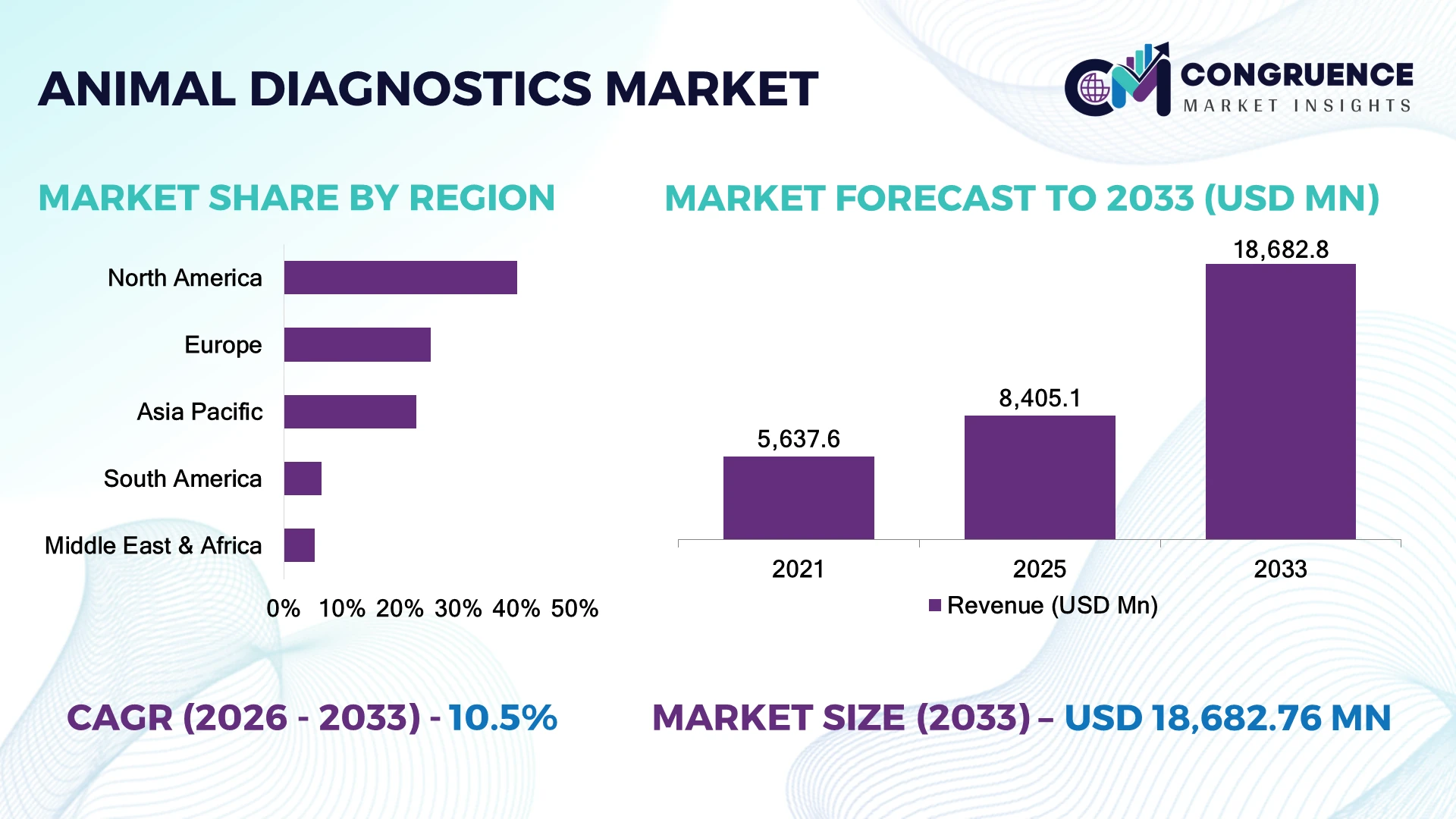
The U.S. accounts for roughly 40% of global animal diagnostics demand, supported by advanced veterinary laboratories, companion-animal care, livestock surveillance, and high diagnostic utilization. Approximately 45.5% of households own dogs and 32.1% own cats, while molecular testing is gaining importance amid H5N1 surveillance. The U.S. market remains materially larger than individual European markets.
The strategic priority is to combine rapid testing, connected diagnostics, and recurring consumables with disease-surveillance infrastructure.
Market Size & Growth: USD 8,405.1 million in 2025 to USD 18,682.8 million by 2033 at 10.5% CAGR, driven by molecular diagnostics and preventive testing.
Top Growth Drivers: Preventive diagnostics 34%; point-of-care adoption 29%; livestock surveillance 24%.
Short-Term Forecast: By 2028, automated testing can reduce turnaround time 20–30% and improve workflow efficiency 15–20%.
Emerging Technologies: AI-assisted imaging, molecular assays, multiplex testing, and connected point-of-care analyzers are advancing diagnostic workflows.
Regional Leaders: North America leads at about 46.5%; Europe follows with mature laboratory networks; Asia-Pacific records the strongest infrastructure expansion.
Consumer/End-User Trends: Companion animals represent more than 65% of U.S. point-of-care diagnostic demand, reinforcing preventive and chronic-care testing.
Pilot/Case Example: 2025 livestock surveillance programs expanded molecular screening, enabling faster outbreak identification and reducing reliance on centralized testing workflows.
Competitive Landscape: IDEXX leads premium veterinary diagnostics, competing with Zoetis, Antech, Thermo Fisher Scientific, Virbac, and regional laboratory networks.
Regulatory & ESG Impact: H5N1 surveillance has increased molecular-testing requirements, while early diagnosis reduces unnecessary treatment and improves antimicrobial stewardship.
Investment & Funding: Veterinary diagnostics investment is shifting toward integrated analyzers, reference laboratories, AI-enabled interpretation, and recurring consumables.
Innovation & Future Outlook: By 2028, connected diagnostics, multiplex assays, AI interpretation, and decentralized testing will strengthen speed, data integration, and clinical decision-making.
Animal diagnostics is becoming increasingly centered on rapid, actionable testing across companion animals, livestock, and poultry. Point-of-care platforms, molecular assays, AI-supported imaging, and multiplex panels are expanding the addressable testing workflow, with U.S. livestock surveillance providing a real-world catalyst. Approximately 42.8% of U.S. diagnostic demand is linked to infectious-disease applications, reinforcing the strategic importance of faster detection and integrated surveillance.
Animal diagnostics is becoming a strategic control point for veterinary networks, livestock producers, pharmaceutical companies, and animal-health technology providers because testing increasingly determines treatment timing, outbreak containment, herd productivity, and preventive-care economics. The 2026 market environment is particularly shaped by tighter disease surveillance, H5N1 testing requirements, and greater migration toward decentralized point-of-care workflows.
Technology is changing the economics of testing. Modern point-of-care systems can deliver results within minutes to hours compared with centralized workflows that often require longer transport and laboratory processing, while automation can reduce manual handling by approximately 20–30%. In the United States, companion animals account for more than 65% of point-of-care demand, whereas livestock diagnostics is expanding faster as producers adopt herd-level surveillance and precision health programs. Europe remains laboratory-intensive, while Asia-Pacific is strengthening decentralized infrastructure.
During 2026–2028, diagnostic providers are prioritizing connected analyzers, molecular multiplexing, AI-assisted interpretation, and integrated laboratory software. A practical example is livestock H5N1 surveillance, where rapid molecular testing supports earlier intervention across affected herds. Companies are responding through instrument-reagent ecosystems, laboratory partnerships, localized distribution, and recurring-service models. Competitive advantage will increasingly depend on diagnostic speed, assay breadth, interoperability, and the ability to convert test results into actionable animal-health decisions.
Molecular diagnostics, multiplex PCR, and rapid immunoassays are shifting animal testing from centralized laboratories toward faster clinical workflows. In advanced veterinary markets, point-of-care testing adoption is approaching 30–35% across high-throughput practices, while digital result integration can reduce reporting delays by 20–25%. Rising antimicrobial-resistance surveillance is reinforcing demand for pathogen-specific testing rather than empirical treatment. In the United States, veterinary networks are expanding in-clinic diagnostic capacity to shorten treatment decisions and improve utilization of laboratory infrastructure. Companies are responding through compact analyzers, assay menus, cloud connectivity, and reference-laboratory partnerships. The non-obvious advantage is recurring consumables revenue: installed diagnostic platforms create predictable demand for cartridges, reagents, and calibration materials.
Uneven veterinary laboratory infrastructure remains a direct constraint, particularly across emerging markets where advanced diagnostic availability can remain 30–40% below mature-market levels. Skilled laboratory staffing shortages can extend turnaround times by 15–25%, while cold-chain requirements increase operating complexity for temperature-sensitive reagents. India and parts of Southeast Asia also face fragmented clinic networks, making standardized instrument deployment harder than in consolidated U.S. veterinary groups. These conditions pressure utilization rates and increase per-test economics, particularly for low-volume practices. Manufacturers are reducing exposure through ambient-stable reagents, decentralized analyzers, distributor partnerships, and tiered instrument pricing. The strategic pressure point is not assay availability but achieving sufficient testing volume per installed system to sustain profitable service models.
AI-assisted image interpretation, multiplex molecular panels, and cloud-connected veterinary diagnostics create opportunities to extend advanced testing beyond specialist hospitals. Automated interpretation can reduce manual review requirements by roughly 20–30%, while multiplex assays consolidate several pathogen targets into one workflow and improve laboratory throughput by 15–25%. Japan and South Korea are particularly attractive for digitally integrated veterinary networks combining diagnostics, electronic records, and remote consultation. Companies are positioning through software-enabled analyzers, API integration, and partnerships with veterinary hospital groups. A less obvious opportunity lies in livestock surveillance: connected testing platforms can aggregate geographically distributed disease signals, creating operational value for herd managers and biosecurity programs beyond individual clinical diagnosis.
Scaling animal diagnostics increasingly requires interoperability across analyzers, laboratory information systems, electronic veterinary records, and cloud platforms. Integration projects can increase deployment timelines by 10–20%, while inconsistent data standards still create manual reconciliation across multi-site veterinary networks. Cybersecurity exposure also rises as connected diagnostic instruments transmit patient and laboratory data across distributed systems. In the United States, large veterinary groups therefore face greater complexity when standardizing equipment acquired through multiple procurement cycles. Manufacturers must invest in open APIs, standardized data formats, remote diagnostics, and workforce training rather than treating instruments as standalone hardware. The strongest long-term differentiator will be deployment reliability: companies that combine analytical performance with seamless multi-site integration can protect utilization, service contracts, and customer retention.
Point-of-Care Testing Accelerates: Veterinary clinics are increasing decentralized testing, with point-of-care adoption reaching roughly 30–35% in advanced practice settings. Compact analyzers shorten diagnostic workflows by 20–25%, shifting purchasing toward cartridge-based systems. Manufacturers are expanding assay menus and partnering with clinic networks to capture recurring consumables demand rather than relying solely on instrument sales.
Multiplex Panels Gain Traction: Multiplex molecular testing is consolidating several pathogen targets into fewer workflows, improving laboratory throughput by approximately 15–25% and reducing repeat sample handling. U.S. veterinary laboratories are prioritizing broader respiratory, gastrointestinal, and antimicrobial-resistance panels. Suppliers are responding with expanded assay portfolios and automated sample preparation, strengthening differentiation through menu breadth and workflow compatibility.
Digital Connectivity Becomes Standard: Cloud-connected analyzers and electronic veterinary records are increasingly integrated across multi-site practices, reducing manual result entry by about 20–30%. This transition is changing procurement criteria from analytical accuracy alone toward interoperability, remote monitoring, and centralized quality control. Vendors are developing APIs and software ecosystems to lock in enterprise accounts through operational integration.
Biosecurity Testing Broadens Demand: Disease surveillance is becoming more data-intensive as livestock producers strengthen biosecurity and antimicrobial-resistance monitoring. Connected testing programs can increase surveillance frequency by 15–20% compared with periodic centralized testing. Supply-chain disruptions and regional disease events are reinforcing localized testing capacity, while diagnostic companies are combining field instruments, reference laboratories, and digital reporting to support faster intervention.
Molecular Diagnostics Lead as Precision Testing Expands
Molecular diagnostics is estimated to lead the Animal Diagnostics Market with approximately 34% share, supported by high analytical sensitivity, pathogen specificity, and expanding multiplex testing. Its ability to identify infectious agents before clinical deterioration makes it particularly valuable for livestock surveillance and companion-animal care. Immunodiagnostics follows at roughly 27%, benefiting from established workflows, broad assay availability, and comparatively lower equipment requirements. Companies are strengthening molecular portfolios through multiplex panels, automated sample preparation, and decentralized platforms, while maintaining immunoassay capacity for high-volume routine testing.
The fastest-growing shift is toward point-of-care molecular and digital diagnostic formats, with adoption increasing roughly 18–22% in advanced veterinary practices as clinics prioritize faster treatment decisions. Conventional laboratory diagnostics remain strategically important for complex confirmatory testing, while imaging and pathology retain specialist value. Investment is therefore moving toward integrated platforms combining molecular testing, AI interpretation, and cloud connectivity, allowing manufacturers to compete on workflow speed rather than assay accuracy alone.
HealthforAnimals reported that 28 new diagnostics tools had been introduced through its animal-health innovation roadmap by 2023, reinforcing the industry's shift toward earlier, technology-enabled disease detection.
Companion-Animal Testing Drives Clinical Intensification
Companion-animal diagnostics represents the leading application, accounting for approximately 48% of market demand, driven by preventive wellness testing, chronic-disease monitoring, oncology screening, and higher diagnostic utilization in organized veterinary practices. Livestock diagnostics follows at about 32%, where pathogen surveillance and herd-level disease control create larger-volume testing requirements. Companies are expanding clinic-integrated analyzers, rapid assays, and subscription-based consumables to increase testing frequency and strengthen recurring revenue.
The fastest-growing application is livestock disease surveillance, with deployment intensity estimated to rise 15–20% as producers prioritize early detection, biosecurity, and antimicrobial stewardship. Research and laboratory applications remain important for specialized pathogen characterization and validation, while food-animal testing increasingly links diagnostics with traceability systems. In the United States, integrated veterinary networks are investing in standardized testing workflows, while manufacturers are adapting platforms for decentralized farms and multi-site clinics. This shift makes interoperability and rapid turnaround increasingly critical purchasing criteria.
The American Animal Hospital Association's 2025 research involving more than 300 veterinary professionals highlighted persistent diagnostic challenges in veterinary oncology, underscoring the commercial and clinical opportunity for faster diagnostic workflows in companion-animal practice.
Veterinary Hospitals Anchor High-Value Adoption
Veterinary hospitals and clinics account for an estimated 52% of Animal Diagnostics Market demand, reflecting their high testing frequency, broader diagnostic menus, and ability to justify in-house analyzers. Diagnostic laboratories hold approximately 24%, concentrating on specialized molecular, pathology, and confirmatory testing. Livestock producers and research institutions represent smaller but strategically important segments, with purchasing increasingly tied to herd surveillance, disease-control programs, and advanced biological research.
Livestock producers constitute the fastest-expanding end-user group, supported by connected monitoring, portable testing, and disease-surveillance requirements; adoption of digital diagnostic workflows is estimated to increase 18–22% across technology-oriented operations. Hospitals prioritize integrated analyzers and comprehensive test menus, whereas laboratories emphasize throughput and analytical depth. Manufacturers are responding with tiered platforms, reagent contracts, cloud-based reporting, and distributor partnerships. The competitive opportunity is shifting toward modular systems that can serve both high-throughput clinical environments and decentralized testing networks without requiring equivalent infrastructure investment.
A 2025 American Animal Hospital Association survey covering 557 U.S. veterinary professionals found that 8 in 10 respondents had difficult financial conversations with clients weekly, reinforcing the importance of efficient diagnostic workflows that support clearer treatment decisions and cost management.
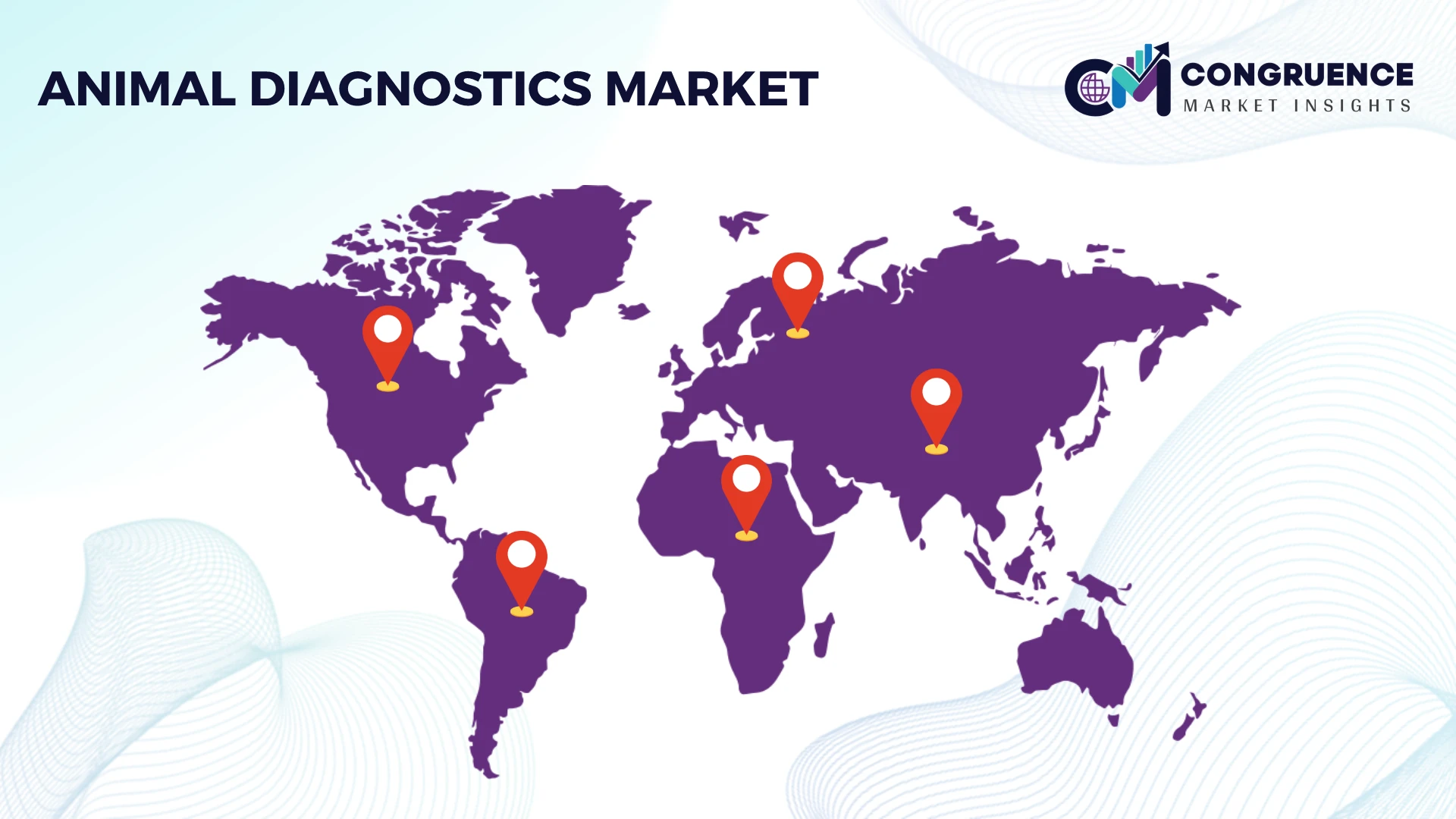
North America accounted for the largest market share at 40.1% in 2025 however, Asia-Pacific is expected to register the fastest growth, expanding at a CAGR of 12.7% between 2026 and 2033.
Consolidated Veterinary Networks Accelerate Diagnostic Intensification
North America retains market leadership through high veterinary healthcare expenditure, consolidated hospital networks, advanced reference laboratories, and rapid adoption of molecular and point-of-care diagnostics. The region represented approximately 40% of global veterinary diagnostics activity in 2025, with the United States accounting for the overwhelming majority of regional demand. Large veterinary groups increasingly standardize analyzers, laboratory information systems, and recurring reagent contracts across multi-site operations. Companion-animal testing remains particularly intensive, while livestock surveillance supports specialized molecular testing. Deployment of cloud-connected diagnostic platforms is strengthening centralized quality control and remote interpretation. U.S. laboratories and veterinary networks are also expanding multiplex testing to improve pathogen identification and antimicrobial stewardship. The strategic advantage lies in high instrument utilization and recurring consumables demand, encouraging suppliers to prioritize enterprise contracts, integrated platforms, and workflow automation.
United States Market Outlook: The United States remains the region's strongest operational market because of its dense veterinary hospital infrastructure, advanced reference laboratories, and high diagnostic intensity in companion-animal care. Veterinary hospitals and clinics account for roughly two-thirds of companion-animal diagnostic end-use, creating a strong installed base for analyzers and consumables. National livestock surveillance additionally supports specialized molecular testing for economically important diseases. Companies are prioritizing U.S. expansion through clinic-network partnerships, decentralized testing platforms, and integrated digital reporting.
Regulatory Surveillance Strengthens Precision Veterinary Testing
Europe is characterized by strong veterinary laboratory infrastructure, stringent animal-health controls, and sophisticated livestock surveillance systems. Germany, France, the United Kingdom, and the Netherlands form important diagnostic hubs, combining companion-animal medicine with intensive dairy, swine, and poultry production. Regulatory emphasis on antimicrobial stewardship is increasing the value of pathogen-specific diagnostics and susceptibility testing. Molecular platforms, multiplex assays, and automated laboratory workflows are gaining traction as laboratories seek higher throughput with tighter quality controls. The region also benefits from cross-border disease surveillance, which increases demand for standardized testing protocols. Companies are responding through reference-laboratory partnerships, assay localization, and interoperable diagnostic systems. Europe’s competitive advantage increasingly rests on regulatory-grade data quality rather than equipment volume alone.
Germany Market Outlook: Germany provides a strong operating base because of its advanced veterinary laboratories, extensive livestock production infrastructure, and highly standardized diagnostic practices. Its large swine, cattle, and poultry sectors support recurring testing requirements for infectious disease surveillance and food-chain biosecurity. Diagnostic suppliers benefit from established laboratory networks capable of supporting molecular and immunological workflows at scale. Increasing emphasis on antimicrobial stewardship is also shifting purchasing toward more targeted assays, encouraging companies to expand multiplex panels and automated laboratory solutions.
Livestock Intensification Drives Decentralized Testing
Asia-Pacific is becoming the strongest expansion zone as China, India, Japan, South Korea, and Australia combine large animal populations with improving veterinary infrastructure. The region is estimated to represent more than 20% of global animal diagnostics demand, while adoption of decentralized testing is advancing particularly quickly in livestock-intensive markets. China is expanding laboratory and disease-surveillance capabilities, while India is strengthening veterinary testing capacity around dairy, poultry, and animal disease-control programs. Japan and South Korea emphasize automated, digitally connected diagnostics. Companies are adapting through lower-cost analyzers, portable molecular systems, distributor networks, and localized reagent manufacturing. The key commercial opportunity is converting fragmented testing environments into scalable platform ecosystems rather than simply selling standalone instruments.
China Market Outlook: China offers the strongest industrial opportunity in Asia-Pacific because of its large livestock production base, expanding veterinary laboratory infrastructure, and growing emphasis on animal-disease surveillance. Large-scale poultry and swine operations support high-volume pathogen testing, while urban veterinary networks are increasing demand for companion-animal diagnostics. Deployment of automated and molecular systems is concentrated around major agricultural and metropolitan hubs. Companies are strengthening local distribution, reagent availability, and application-specific assay portfolios to improve accessibility and reduce dependence on imported diagnostic workflows.
Livestock Biosecurity Shifts Diagnostics Toward Surveillance
South America’s animal diagnostics demand is closely tied to cattle, poultry, swine, and export-oriented food production, with Brazil serving as the principal commercial and laboratory hub. Large-scale livestock operations increasingly require testing for disease control, traceability, breeding performance, and export compliance. Molecular diagnostics and rapid immunoassays are gaining relevance as producers seek earlier identification of infectious diseases. Brazil’s extensive accredited laboratory network supports standardized testing, although access remains more concentrated around major agricultural and metropolitan centers. Investment is increasingly directed toward decentralized testing, laboratory automation, and disease-surveillance capacity. Companies are balancing premium molecular platforms with lower-cost rapid tests to address uneven infrastructure. Export-sensitive livestock producers represent the strongest customer group because diagnostic compliance directly influences market access and operational continuity.
Brazil Market Outlook: Brazil offers the strongest South American opportunity because of its globally significant cattle and poultry industries, sophisticated agribusiness infrastructure, and established veterinary laboratory ecosystem. Federal diagnostic frameworks cover diseases including brucellosis and equine infectious diseases, supporting standardized laboratory procedures. Large export-oriented producers increasingly require rapid, traceable testing to protect supply-chain continuity. Companies are targeting Brazil through regional laboratory partnerships, livestock-focused molecular assays, portable testing platforms, and distribution networks positioned close to major agricultural production corridors.
Biosecurity Investment Accelerates Digital Surveillance
Middle East & Africa remains a comparatively underpenetrated but strategically important animal diagnostics market, supported by livestock disease-control programs, food-security initiatives, and modernization of veterinary infrastructure. Saudi Arabia, the United Arab Emirates, and South Africa are emerging as important technology and laboratory hubs. Saudi Arabia launched an AI-powered animal-health platform in 2025 to visualize veterinary disease data and generate forecasts, demonstrating the region’s shift toward digital epidemiological surveillance. Livestock and zoonotic-disease monitoring are particularly important across arid production systems, where disease outbreaks can materially affect food-security planning. Companies are responding with portable molecular diagnostics, cloud-connected surveillance tools, and laboratory partnerships. Infrastructure localization and government-backed programs are becoming more important competitive differentiators than broad product availability.
Saudi Arabia Market Outlook: Saudi Arabia is the region’s strongest strategic market because veterinary diagnostics is increasingly integrated with national livestock protection, food-security, and disease-control programs. The country’s animal-health authorities maintain dedicated laboratory and regulatory infrastructure, while an AI-powered animal-health platform launched in 2025 provides real-time disease mapping and forecasting capabilities. The Kingdom’s 2025 recognition as free of glanders also demonstrates the commercial importance of systematic surveillance and internationally aligned diagnostic controls. Companies are positioning around epidemiological analytics, laboratory modernization, and field-based testing.
IDEXX, Zoetis, bioMérieux, Virbac, and regional veterinary laboratories compete across premium in-clinic platforms, reference testing, molecular assays, and rapid diagnostics. The top five are estimated to control about 55% of global value, leaving providers competing mainly on price and localized service.
Technology accounts for roughly 35% of purchasing differentiation, while turnaround speed influences about 25% of enterprise decisions and supply reliability about 20%. IDEXX emphasizes integrated analyzers, software, and consumables; Zoetis combines reference laboratories with point-of-care systems; bioMérieux competes through automated microbiology and multiplex PCR; Virbac targets practical clinic and farm testing.
Competition is shifting toward platform ecosystems, AI-assisted interpretation, and vertically integrated laboratory networks. Zoetis is expanding reference capacity, while IDEXX is broadening installed-base menus and software integration. Entry barriers remain high because regulatory validation, laboratory infrastructure, reagent availability, and clinical trust require sustained investment. Winning requires superior workflow economics, dependable supply, broad assay menus, and embedded digital integration.
IDEXX Laboratories, Inc.
Zoetis Inc.
bioMérieux SA
Virbac
Neogen Corporation
QIAGEN N.V.
Randox Laboratories Ltd.
Thermo Fisher Scientific Inc.
Shenzhen Mindray Bio-Medical Electronics Co., Ltd.
Zomedica Corp.
MiDOG Animal Diagnostics
FUJIFILM Wako Pure Chemical Corporation
Animal diagnostics technology is moving from standalone analyzers toward connected, automated workflows. AI-assisted hematology, digital cytology, multiplex PCR, and cloud reporting are becoming commercially important; automated interpretation can reduce manual review by roughly 20%, while digital workflows can cut result-handling time by about 15%. Adoption is strongest in large veterinary networks and reference laboratories, where integration improves utilization and standardization.
Point-of-care molecular systems are disrupting conventional centralized testing by delivering actionable results within minutes rather than days. Modern multiplex PCR platforms can process several pathogen targets in one workflow, improving testing efficiency by around 15–25%. Slide-free cellular analysis also reduces preparation steps and supports more consistent interpretation. Premium suppliers benefit most because proprietary cartridges, software, and installed instruments create recurring consumables demand.
Between 2026 and 2028, AI-enabled interpretation, cloud-connected analyzers, automated sample preparation, and sequencing-based pathogen identification will shift purchasing toward complete diagnostic ecosystems. New slide-free and AI-assisted systems can improve workflow efficiency by approximately 20% versus manual microscopy-heavy processes. Competitive advantage will increasingly favor companies combining assay breadth with interoperability, cybersecurity, remote service, and rapid deployment rather than instrument performance alone. These changes also improve technician productivity and support higher testing volumes across multi-site veterinary networks with fewer interruptions.
June 2025 IDEXX launched Catalyst Cortisol Test, its third Catalyst menu expansion within a year, enabling real-time endocrine testing. Global rollout targeted more than 75,000 installed analyzers, strengthening consumables utilization and expanding point-of-care diagnostic depth across veterinary practices nationwide. Source: idexx.com (IDEXX)
May 2025 Zoetis opened a 32,000-square-foot reference laboratory in Louisville, co-located with UPS Worldport. The facility strengthens high-throughput testing, specimen logistics, and turnaround across the U.S., expanding centralized capacity while integrating logistics infrastructure into veterinary diagnostics nationally. Source: zoetis.com (Zoetis News)
June 2025 bioMérieux launched VETFIRE, its first veterinary PCR panel, detecting seven equine respiratory pathogens in less than 20 minutes. The ready-to-use assay expands rapid syndromic testing and strengthens automated molecular diagnostics beyond traditional centralized laboratory workflows globally today. Source: biomerieux.com (bioMérieux Website)
April 2025 University of Missouri opened Phase I of a new veterinary diagnostic laboratory building backed by a $73 million investment. The expansion strengthens regional disease surveillance, research, and diagnostic capacity, connecting veterinary research with livestock and companion-animal programs. Source: missouri.edu (College of Veterinary Medicine)
The Animal Diagnostics Market Report evaluates diagnostic demand across molecular diagnostics, immunodiagnostics, hematology, clinical biochemistry, diagnostic imaging, pathology, and rapid testing formats. Application coverage spans companion-animal care, livestock disease surveillance, food-animal testing, and research-oriented diagnostics, with analysis of veterinary hospitals and clinics, reference laboratories, research institutions, and production enterprises.
The report examines North America, Europe, Asia-Pacific, South America, and the Middle East & Africa, while identifying country-level deployment differences and emerging opportunities in decentralized testing, multiplex assays, AI-assisted interpretation, sequencing, and cloud-connected diagnostic platforms. Market analysis incorporates adoption patterns, testing intensity, installed-base expansion, workflow automation, and competitive participation. These insights support investment planning, regional expansion, technology prioritization, partnership strategy, and competitive positioning through 2026–2033, with particular attention to high-growth molecular and point-of-care diagnostic ecosystems.
| Report Attribute/Metric | Report Details |
|---|---|
|
Market Revenue in 2025 |
USD 8,405.1 Million |
|
Market Revenue in 2033 |
USD 18,682.8 Million |
|
CAGR (2026 - 2033) |
10.5% |
|
Base Year |
2025 |
|
Forecast Period |
2026 - 2033 |
|
Historic Period |
2021 - 2025 |
|
Segments Covered |
By Type
By Application
By End-User
|
|
Key Report Deliverable |
Revenue Forecast, Growth Trends, Market Dynamics, Segmental Overview, Regional and Country-wise Analysis, Competition Landscape |
|
Region Covered |
North America, Europe, Asia-Pacific, South America, Middle East, Africa |
|
Key Players Analyzed |
IDEXX Laboratories, Inc., Zoetis Inc., bioMérieux SA, Virbac, Neogen Corporation, QIAGEN N.V., Randox Laboratories Ltd., Thermo Fisher Scientific Inc., Shenzhen Mindray Bio-Medical Electronics Co., Ltd., Zomedica Corp., MiDOG Animal Diagnostics, FUJIFILM Wako Pure Chemical Corporation |
|
Customization & Pricing |
Available on Request (10% Customization is Free) |




