
Reports
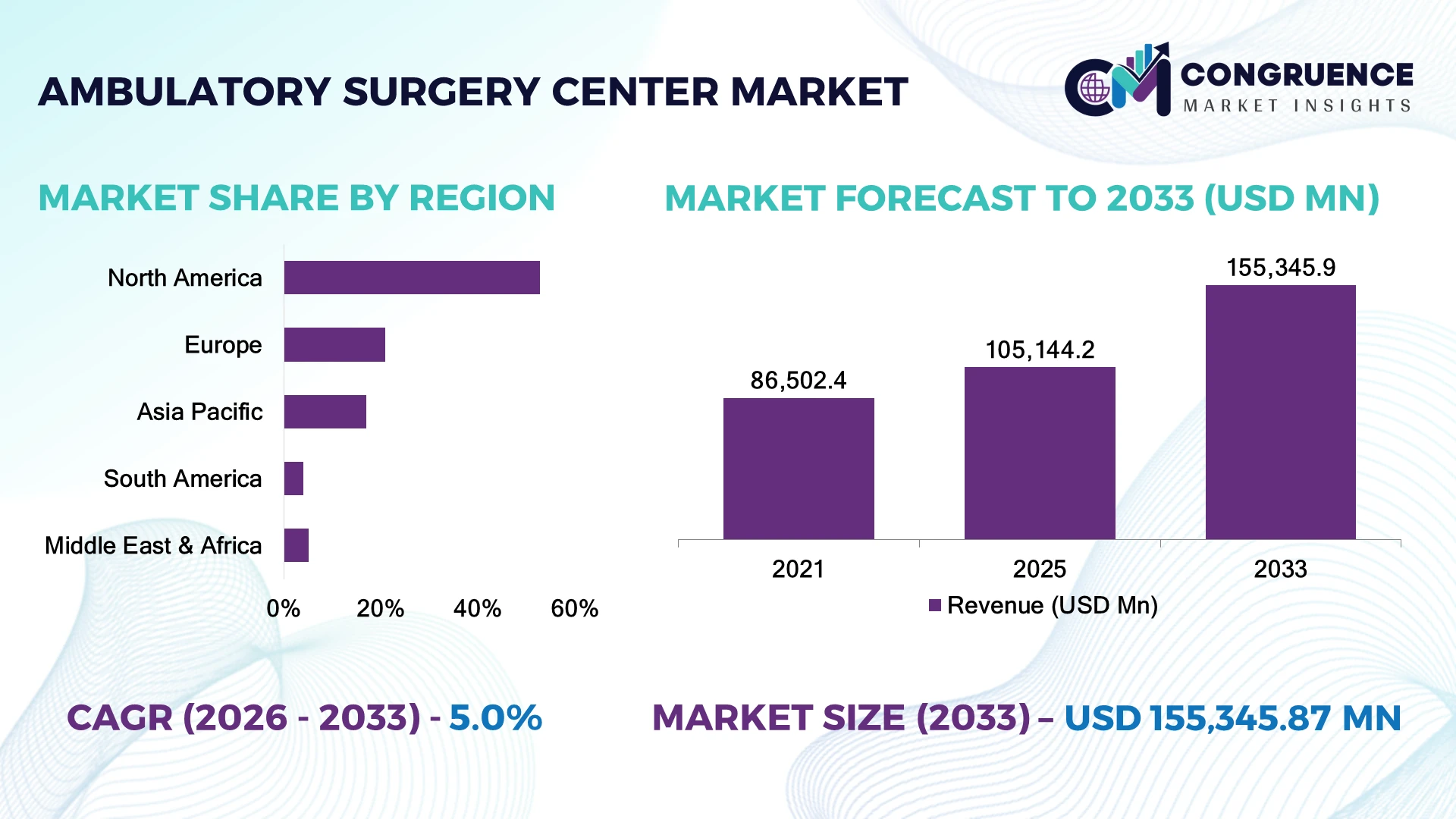
The Global Ambulatory Surgery Center Market was valued at USD 105,144.2 Million in 2025 and is anticipated to reach a value of USD 155,345.9 Million by 2033 expanding at a CAGR of 5.0% between 2026 and 2033. Growth is driven by hospital-to-ASC migration, minimally invasive procedures, shorter recovery pathways, and payer pressure to shift eligible surgeries toward lower-cost outpatient settings.
The U.S. remains the dominant country, accounting for an estimated 70%+ of global ASC capacity, supported by more than 6,000 Medicare-certified centers and sustained investment in orthopedic, ophthalmic, gastrointestinal, and cardiovascular outpatient infrastructure. India has a much smaller organized base but is expanding faster through private hospital networks and day-care surgery models, with minimally invasive procedures increasingly reducing inpatient utilization by 20–30%. Post-pandemic healthcare restructuring and persistent hospital capacity constraints are accelerating this shift.
Strategic decisions increasingly favor scalable ASC networks, specialized procedure centers, digital scheduling, and high-throughput operating models over generalized inpatient expansion.
The Ambulatory Surgery Center Market is expanding across orthopedic, ophthalmic, gastrointestinal, pain-management, and minimally invasive procedures, supported by robotic surgery, AI scheduling, digital pre-operative assessment, and remote monitoring. Specialty-focused centers increasingly represent 30%+ of new outpatient capacity in developed markets. In 2026, staffing shortages and tighter hospital capacity are accelerating investment in standardized day-surgery pathways and integrated ASC networks, setting the foundation for broader strategic transformation.
Ambulatory surgery centers are becoming strategically important because healthcare systems are moving suitable procedures away from high-cost inpatient environments while demanding greater throughput, predictable outcomes, and shorter patient recovery. For operators, the competitive advantage increasingly comes from procedure specialization, physician alignment, asset utilization, and standardized clinical pathways rather than simply adding operating rooms.
A major market shift is the modernization of ASC infrastructure around digital patient flow and minimally invasive surgery. Automated scheduling and electronic pre-operative workflows can reduce administrative workload by roughly 10–15%, while optimized operating-room utilization can improve throughput by 8–12% versus less integrated legacy processes. North America remains the scale leader, whereas India and Southeast Asia are building capacity through private hospital groups and specialized day-care facilities.
Over the next 2–3 years, investment will increasingly target orthopedic, ophthalmic, GI, and cardiovascular procedures that combine high case volumes with predictable recovery. A practical deployment model is a multi-specialty ASC using centralized scheduling, standardized instrument sets, and same-day discharge protocols to increase room utilization while controlling staffing costs. Strategic partnerships between healthcare systems, physicians, technology providers, and ASC operators will therefore become increasingly important, making operational efficiency a core determinant of long-term competitive positioning.
Hospital capacity constraints and payer pressure are accelerating migration of eligible procedures toward ambulatory surgery centers, particularly in the U.S. Orthopedic, ophthalmic, gastrointestinal, and pain procedures are increasingly shifting to same-day pathways, with ASC utilization for suitable elective procedures rising approximately 8–12% in mature markets. Minimally invasive techniques can reduce inpatient resource utilization by 20–30%, strengthening the economic case for outpatient care. U.S. operators are responding by expanding specialty-focused facilities, acquiring physician-led centers, and investing in robotic-assisted surgery. A non-obvious advantage is higher asset productivity: standardized procedure rooms can support multiple specialties across extended operating schedules, allowing operators to increase case throughput without proportional infrastructure expansion.
ASC scalability is increasingly constrained by shortages of perioperative nurses, anesthesiologists, surgical technologists, and specialized clinical staff. Labor can represent 25–35% of operating costs at high-throughput centers, while staffing gaps can reduce operating-room utilization by 10–15%. Smaller Indian and U.S. facilities also face uneven access to advanced anesthesia, sterilization, imaging, and emergency-transfer infrastructure. Supply-chain volatility for surgical instruments and specialized devices adds further scheduling pressure, particularly where facilities depend on imported equipment. Operators are mitigating exposure through centralized procurement, multi-year supplier contracts, cross-training, and standardized instrument inventories. The key operational insight is that workforce productivity, rather than physical operating-room capacity alone, increasingly determines whether new ASC capacity becomes commercially productive.
Specialty-focused ASC networks present an attractive expansion pathway as orthopedic, ophthalmic, endoscopic, and cardiovascular procedures become increasingly suitable for same-day treatment. AI-enabled scheduling and predictive capacity management can improve operating-room utilization by 8–15%, while digital pre-admission workflows can reduce administrative processing time by 15–20%. India offers a particularly significant opportunity as private hospital groups develop dedicated day-care surgery infrastructure in Mumbai, Bengaluru, Delhi, and Hyderabad. Robotic-assisted surgery and remote postoperative monitoring further support higher-acuity outpatient procedures. Companies are positioning through physician partnerships, specialty acquisitions, and technology integration. A less obvious opportunity lies in centralized back-office platforms: shared scheduling, billing, procurement, and analytics can generate scale economics without duplicating administrative teams across every facility.
Moving higher-acuity procedures into outpatient settings creates execution challenges around patient selection, anesthesia protocols, emergency escalation, and interoperable clinical data. Inadequate interoperability can increase manual documentation and coordination workloads by 10–15%, while cybersecurity incidents can disrupt digitally dependent scheduling and clinical workflows for days rather than hours. U.S. centers are also adapting to evolving reimbursement and quality-reporting requirements, requiring stronger outcome tracking and risk stratification. Companies must invest in integrated electronic health records, redundant connectivity, standardized clinical pathways, and real-time patient monitoring. The strategic challenge is maintaining same-day economics without compromising clinical resilience: operators that successfully combine digital orchestration with robust transfer protocols can expand procedure complexity while preserving safety and utilization.
AI Scheduling Improves Room Utilization: U.S. ASC operators are deploying predictive scheduling, automated cancellations management, and real-time capacity dashboards, improving operating-room utilization by approximately 8–15% and reducing unused slots by 10–12%. Companies are integrating these tools with patient intake and staffing systems to increase daily case density without expanding physical capacity.
Robotic Surgery Enters More ASCs: Robotic-assisted procedures are moving beyond major hospitals into specialized outpatient facilities, particularly orthopedic and gynecological centers. Procedure standardization can reduce selected operating times by 10–20%, while improved visualization supports increasingly complex same-day interventions. Operators are responding through capital partnerships, physician training, and dedicated robotic procedure rooms.
Specialty Centers Reshape Facility Design: New facilities increasingly emphasize orthopedic, ophthalmic, GI, and pain-management specialization, with specialty-focused models accounting for more than 30% of new outpatient capacity in several developed markets. Smaller footprints and standardized room configurations can reduce infrastructure requirements by 15–25%, encouraging operators to expand into secondary U.S. cities and Indian metropolitan hubs.
Digital Pre-Op Gains Operational Priority: Labor shortages and tighter scheduling are accelerating digital consent, medication reconciliation, pre-anesthesia screening, and postoperative follow-up. Automated workflows can reduce administrative handling by 15–20% and shorten patient processing times by 10–15%. Operators are consolidating these functions into centralized platforms, creating measurable scale advantages across multi-site ASC networks.
Freestanding Centers Lead, Specialty Models Gain Ground
Freestanding ambulatory surgery centers represent the leading type, accounting for approximately 58–62% of global ASC capacity, supported by dedicated infrastructure, streamlined governance, and higher flexibility in physician scheduling and procedure-room utilization. Hospital-affiliated centers remain strategically important, particularly for higher-acuity procedures requiring integrated diagnostics, specialist referrals, or rapid escalation pathways. Physician-owned and joint-venture models are also gaining traction, with corporate participation in U.S. ASCs increasing as operators seek scale and standardized procurement. The fastest-growing type is specialty-focused ASC networks, expanding approximately 10–14% as orthopedic, ophthalmic, GI, and spine procedures migrate toward outpatient settings. Companies are increasingly using joint ventures and acquisitions to combine physician alignment with centralized technology, procurement, and revenue-cycle infrastructure.
The competitive implication is a shift from standalone facilities toward scalable networks. Standardized specialty centers can improve room utilization by 8–12%, while centralized administrative functions can reduce duplicated operating costs by 10–15%. Hospital-affiliated centers retain an advantage where complex patient pathways require broader clinical integration.
Orthopedic Procedures Accelerate Outpatient Complexity
Orthopedic surgery is the leading application, representing approximately 24–28% of ASC procedure activity, supported by high-volume joint, sports-medicine, and spine procedures increasingly performed through minimally invasive techniques. Ophthalmology and gastrointestinal procedures remain mature, high-throughput applications, together accounting for roughly 30–35% of activity in established markets. Cardiovascular procedures are the fastest-growing application, expanding approximately 12–16% as improved imaging, anesthesia, vascular-access technologies, and CMS policy changes make selected interventions increasingly suitable for outpatient settings. Pain management, ENT, gynecology, and other specialties remain important contributors, particularly in physician-led centers.
Companies are responding by developing procedure-specific operating rooms, investing in robotic and image-guided technologies, and forming specialist physician partnerships. Orthopedic-focused facilities can achieve 10–15% higher room utilization through standardized instrumentation and predictable patient pathways. The strategic shift is toward higher-acuity outpatient procedures rather than simply increasing low-complexity case volumes.
Health Systems Dominate, Physician Networks Expand
Hospitals and integrated health systems represent the leading end-user group, accounting for approximately 40–45% of ASC-related capacity and investment, reflecting their referral networks, capital resources, payer relationships, and ability to shift procedures from inpatient settings. Independent physician groups and physician-led centers represent approximately 25–30%, while corporate ASC operators and joint ventures capture a growing share through acquisitions and multi-site platforms. Physician groups are the fastest-growing end-user category, expanding approximately 10–13% as surgeons seek greater scheduling control, specialized facilities, and participation in facility economics.
Established health systems increasingly prioritize outpatient migration to improve capacity management, whereas physician-led operators emphasize specialty concentration and faster decision-making. Companies are responding through joint ventures, acquisition platforms, and shared-service models that combine clinical autonomy with centralized procurement and digital infrastructure. Corporate ownership across major U.S. ASC operators increased 15.7% from 2018 to 2023, demonstrating the shift toward scaled operating platforms.
North America accounted for the largest market share at 52.8% in 2025 however, Asia-Pacific is expected to register the fastest growth, expanding at a CAGR of 6.3% between 2026 and 2033.
ASC consolidation and higher-acuity outpatient procedures strengthen U.S. dominance
North America represents the largest concentration of ambulatory surgery infrastructure, with the U.S. accounting for the overwhelming majority of regional capacity. More than 6,000 Medicare-certified ASCs support extensive orthopedic, ophthalmic, gastrointestinal, pain-management, and cardiovascular activity. Hospital-to-ASC migration is strengthening as operators target higher operating-room utilization and lower facility costs. Robotic-assisted surgery, centralized scheduling, and physician joint ventures are becoming important investment priorities, while corporate operators increasingly consolidate independent facilities into multi-site networks. Standardized clinical pathways can improve room utilization by approximately 8–12%, strengthening the economics of specialty-focused centers. Canada is expanding outpatient infrastructure more selectively, with capacity concentrated around major metropolitan health systems.
United States Market Outlook:
The U.S. remains the global operational benchmark because of its mature reimbursement infrastructure, extensive physician ownership participation, and established ASC regulatory framework. Orthopedic and ophthalmic procedures represent particularly strong outpatient volumes, while cardiovascular interventions are expanding the addressable case mix. Major operators are investing in acquisitions, robotic platforms, digital patient-flow systems, and specialty centers. Physician alignment remains a critical differentiator because it directly influences scheduling density, referral capture, and facility utilization.
Outpatient modernization aligns capacity management with healthcare efficiency
Europe is increasingly shifting appropriate elective procedures toward day-surgery pathways as healthcare systems address hospital waiting lists, workforce constraints, and infrastructure pressure. The region represented approximately 20–22% of global ASC activity in 2025, with the U.K., Germany, France, Italy, and Spain providing the strongest institutional base. Mature markets increasingly prioritize standardized pathways, digital pre-operative assessment, and minimally invasive techniques. Selected outpatient models can reduce inpatient bed requirements by approximately 15–25%, strengthening the investment case. Cross-border healthcare integration and sustainability targets are also encouraging facilities to improve asset utilization rather than expand conventional inpatient capacity.
United Kingdom Market Outlook:
The U.K. has strong strategic relevance because national efforts to reduce elective-care backlogs continue to favor independent-sector capacity and high-throughput surgical pathways. Elective hubs and dedicated surgical facilities are increasingly designed around standardized procedures, digital scheduling, and rapid discharge. Operators are targeting ophthalmology, orthopedics, endoscopy, and general surgery, where predictable patient pathways support efficient utilization. The combination of waiting-list pressure and constrained hospital capacity creates a strong operating environment for specialized ASC models.
Private healthcare investment accelerates specialized outpatient capacity
Asia-Pacific is transitioning from hospital-centric surgical delivery toward specialized day-care infrastructure, led by China, India, Japan, South Korea, Australia, and Southeast Asia. The region accounted for approximately 16–18% of global ASC activity in 2025, while private healthcare investment is increasing capacity in major metropolitan markets. India is particularly active in orthopedic, ophthalmic, fertility, and minimally invasive procedures, with specialized centers increasingly using digital registration and automated patient-flow systems. Standardized outpatient pathways can reduce facility resource requirements by approximately 15–20%. Hospital groups and private operators are increasingly using partnerships and satellite facilities to reach secondary cities without replicating full tertiary-hospital infrastructure.
India Market Outlook:
India offers substantial expansion potential through private hospital chains, specialty clinics, and organized day-care networks concentrated in Mumbai, Delhi, Bengaluru, Hyderabad, Chennai, and Pune. Ophthalmology, orthopedics, gastroenterology, and minimally invasive procedures are particularly compatible with outpatient models. Digital pre-admission, teleconsultation, electronic records, and centralized scheduling are improving operational coordination. Operators are increasingly establishing smaller specialty facilities closer to residential and commercial clusters, allowing higher patient throughput while avoiding the capital intensity associated with full-service hospitals.
Private hospital networks drive selective outpatient expansion
South America's ASC market is concentrated in Brazil, followed by Argentina, Colombia, and Chile, with Brazil representing more than half of organized private outpatient surgical capacity. Private healthcare operators are expanding day-surgery capabilities for ophthalmology, orthopedics, gastroenterology, and elective general procedures. Digital scheduling and standardized operating-room workflows can improve facility utilization by approximately 8–12%, but uneven insurance coverage and infrastructure availability limit uniform deployment. Operators are therefore favoring metropolitan locations with strong specialist density and established private healthcare demand. Partnership models between hospitals and physician groups are becoming more attractive as providers seek to increase surgical throughput without building large inpatient campuses.
Brazil Market Outlook:
Brazil is the region's principal market because of its large private healthcare sector, extensive specialist base, and concentration of advanced surgical infrastructure in São Paulo, Rio de Janeiro, Brasília, and other major cities. Private hospitals increasingly use dedicated outpatient units for high-volume procedures, while specialty clinics are adopting minimally invasive technologies and digital patient-management systems. Brazil's scale also supports centralized procurement and equipment-sharing models, helping operators control capital costs and improve utilization across multi-site networks.
Healthcare modernization shifts investment toward specialized day-care infrastructure
Middle East & Africa is developing ASC capacity through hospital modernization, private healthcare investment, medical-tourism infrastructure, and government-backed healthcare transformation programs. Saudi Arabia and the UAE lead regional deployment, while South Africa provides a more established private surgical ecosystem. The region represented approximately 5–7% of global activity in 2025, with demand concentrated in metropolitan healthcare hubs. New facilities increasingly incorporate digital scheduling, minimally invasive surgery, advanced imaging, and standardized discharge protocols. Specialized outpatient pathways can reduce inpatient bed utilization by approximately 15–20%, making ASC development strategically relevant where governments are seeking higher healthcare capacity without proportional hospital expansion.
Saudi Arabia Market Outlook:
Saudi Arabia is emerging as a major investment market because healthcare transformation programs are encouraging private-sector participation, specialized facilities, and technology-enabled clinical delivery. Riyadh and Jeddah are leading locations for advanced private healthcare infrastructure, including orthopedic, ophthalmic, and elective surgical services. Operators are integrating digital patient journeys, robotic-assisted procedures, and centralized clinical support. The strategic advantage lies in developing specialized outpatient capacity alongside large hospital campuses, enabling providers to shift suitable cases into lower-intensity settings while preserving tertiary resources for complex care.
HCA Healthcare, Tenet’s United Surgical Partners International, SCA Health, AmSurg, and Surgery Partners compete directly with physician-led and regional platforms. The top five corporate operators hold approximately 21.3% combined share of freestanding ASC ownership. Competition centers on acquisition price, physician alignment, technology, specialty mix, and operating efficiency: centralized procurement can reduce costs 8–12%, digital workflows improve throughput 10–15%, and specialty standardization can lift room utilization 8–12%. USPI competes through joint ventures and acquisitions, while SCA Health emphasizes specialty operating models and physician partnerships. AmSurg and Surgery Partners are expanding through targeted acquisitions and de novo centers, while HCA leverages hospital referral networks. The competitive shift is toward higher-acuity procedures, cardiovascular expansion, robotics, and platform consolidation rather than simple facility-count growth. Entry barriers include physician relationships, regulatory approvals, capital requirements, payer contracts, and clinical infrastructure. Winning requires scale without sacrificing physician autonomy, superior utilization, reliable quality metrics, and rapid specialty expansion.
ASC technology is shifting from standalone clinical equipment toward integrated digital operating platforms. AI scheduling, predictive staffing, electronic pre-registration, and automated patient-flow tools can improve room utilization by 8–15% and reduce administrative handling by 10–20%. Adoption is strongest among multi-site U.S. operators, where centralized dashboards connect scheduling, staffing, inventory, and discharge workflows. These systems create an advantage for networks managing high-volume specialty centers.
Robotic-assisted surgery, advanced imaging, and minimally invasive instrumentation are expanding the addressable procedure mix. Compared with conventional manual workflows, robotic and image-guided platforms can reduce selected procedure times by 10–20% while improving standardization. Cardiovascular ASCs are an emerging technology-led segment as smaller devices, improved anesthesia, and monitoring enable same-day treatment. Operators investing in standardized robotic rooms and interoperable clinical systems gain stronger physician recruitment and higher case complexity.
Between 2026 and 2028, predictive analytics, remote postoperative monitoring, cybersecurity automation, and connected medical devices will become core infrastructure rather than optional upgrades. New digital workflows can outperform paper-heavy processes by approximately 15–20% in administrative speed. The competitive beneficiaries will be scaled operators able to integrate technology across facilities, negotiate procurement, and convert clinical data into utilization gains. Technology investment now directly influences throughput, specialty expansion, and operating resilience.
The Ambulatory Surgery Center Market Report covers freestanding, hospital-affiliated, physician-owned, and specialty-focused centers across orthopedic, ophthalmic, gastrointestinal, cardiovascular, pain-management, ENT, gynecological, and other outpatient procedures. End-user analysis encompasses hospitals and health systems, physician groups, corporate ASC operators, and joint ventures across North America, Europe, Asia-Pacific, South America, and Middle East & Africa. More than 6,300 Medicare-certified ASCs operate in the U.S., providing a significant benchmark for infrastructure and adoption analysis.
The report evaluates robotic-assisted surgery, AI scheduling, digital patient-flow management, minimally invasive instrumentation, remote monitoring, interoperable clinical systems, and automated administrative workflows. It examines specialty migration, physician partnerships, consolidation, facility utilization, and higher-acuity outpatient expansion, with technology-enabled workflows targeting 8–15% utilization improvements. The analysis supports investment planning, network expansion, partnership selection, competitive positioning, technology deployment, and strategic market direction from 2026 through 2033.
| Report Attribute/Metric | Report Details |
|---|---|
|
Market Revenue in 2025 |
USD 105,144.2 Million |
|
Market Revenue in 2033 |
USD 155,345.9 Million |
|
CAGR (2026 - 2033) |
5% |
|
Base Year |
2025 |
|
Forecast Period |
2026 - 2033 |
|
Historic Period |
2021 - 2025 |
|
Segments Covered |
By Type
By Application
By End-User
|
|
Key Report Deliverable |
Revenue Forecast, Growth Trends, Market Dynamics, Segmental Overview, Regional and Country-wise Analysis, Competition Landscape |
|
Region Covered |
North America, Europe, Asia-Pacific, South America, Middle East, Africa |
|
Key Players Analyzed |
Tenet Healthcare Corporation, HCA Healthcare, Inc., Surgery Partners, Inc., SCA Health, AmSurg, Regent Surgical Health, Covenant Physician Partners, Surgical Care Affiliates, AMSURG, Physicians Endoscopy, United Surgical Partners International, Surgery Center Services of America, ValueHealth, Community Health Systems |
|
Customization & Pricing |
Available on Request (10% Customization is Free) |




