
Reports
The Global Ambulatory Cardiac Monitoring Devices Market was valued at USD 6,810.4 Million in 2025 and is anticipated to reach a value of USD 13,670.1 Million by 2033 expanding at a CAGR of 9.1% between 2026 and 2033. Growth is driven by wider use of extended-wear ECG patches, AI-assisted arrhythmia detection, and remote diagnostic workflows that capture intermittent cardiac abnormalities beyond short in-clinic examinations.
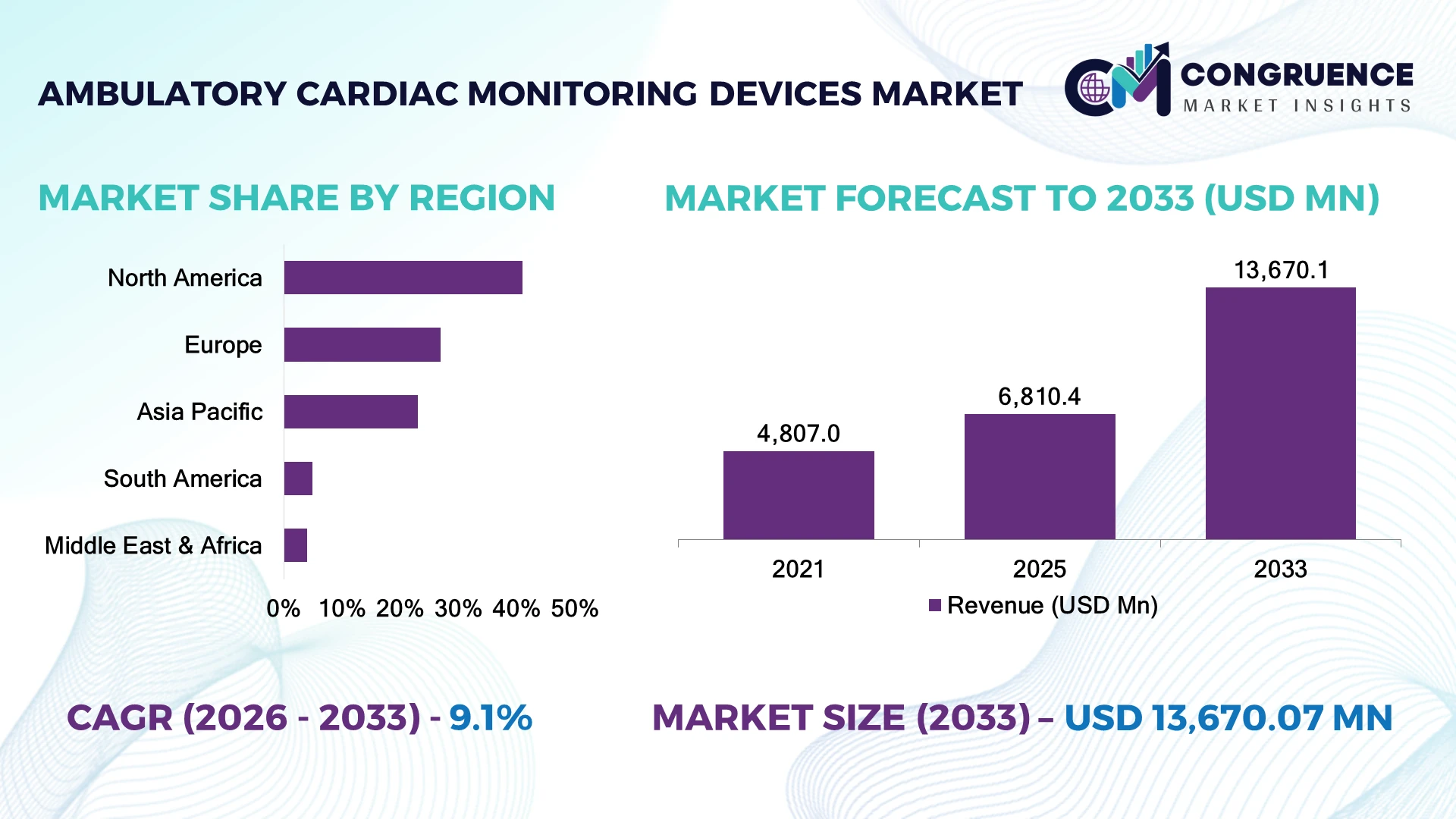
North America represents an estimated 41% of the global market, with the United States accounting for the region’s largest share through established cardiology networks, outpatient diagnostics, and remote-monitoring reimbursement pathways. The country’s clinical ecosystem is investing in connected ECG devices and automated analysis as atrial fibrillation prevalence rises; approximately 12.1 million Americans are projected to have the condition by 2050. Japan, meanwhile, is a major ambulatory monitoring market, with around 1.6 million tests prescribed annually.
Suppliers should prioritize clinically validated algorithms, longer recording duration, reliable reporting workflows, and reimbursement-compatible service models rather than competing on device price alone.
Market Size & Growth: The market is projected to expand from USD 6,810.4 million in 2025 to USD 13,670.1 million by 2033, supported by extended ECG monitoring and AI-enabled analysis.
Top Growth Drivers: Arrhythmia detection, outpatient diagnostics, and remote monitoring are reshaping care pathways; the United States is projected to have 12.1 million people with atrial fibrillation by 2050.
Short-Term Forecast: By 2028, providers should target a 5–10% reduction in avoidable reporting and workflow delays through integrated data review; this is an operational target, not an industry-wide forecast.
Emerging Technologies: AI-assisted ECG interpretation, adhesive patches, and cloud-connected reporting are extending monitoring beyond conventional 24–48-hour Holter examinations.
Regional Leaders: North America leads with an estimated 41% share; Europe benefits from established clinical pathways, while Asia-Pacific gains traction through Japan’s advanced monitoring market and expanding digital health capabilities.
Consumer/End-User Trends: Long-term patches can record continuously for up to 14 days, reducing dependence on short-duration monitoring when symptoms occur intermittently.
Pilot/Case Example: In 2025, iRhythm introduced its Zio monitoring service in Japan with up to 14 days of continuous ECG recording and AI-assisted analysis.
Competitive Landscape: iRhythm, Philips, GE HealthCare, Baxter, and BioTelemetry-related offerings compete across extended-wear patches, Holter systems, telemetry, analytics, and clinical reporting.
Regulatory & ESG Impact: Remote monitoring depends on medical-device compliance, appropriate clinical use, and secure data transmission; reusable components and lower-visit workflows can reduce material and transport requirements.
Investment & Funding: VitalConnect secured USD 100 million in 2025 to accelerate commercialization of its wearable cardiac-monitoring technology, underscoring investor interest in connected diagnostics.
Innovation & Future Outlook: Competition is moving toward integrated services that combine signal capture, automated analysis, clinician review, and actionable reporting, with clinical validation and reimbursement access determining scalability.
The ambulatory cardiac monitoring devices market is evolving from episodic ECG recording toward longer-duration, data-rich diagnostics. Demand is concentrated in arrhythmia evaluation, post-procedure follow-up, and outpatient cardiology. As providers address capacity constraints and intermittent symptoms, extended-wear patches and automated reporting are becoming more relevant. Reimbursement requirements and clinical validation remain central to deployment, creating a competitive advantage for companies that combine dependable signals with efficient interpretation workflows.
Ambulatory cardiac monitoring is becoming strategically important because diagnostic value increasingly depends on capturing abnormalities that short clinic-based tests can miss. Extended-wear patches, mobile cardiac telemetry, and cloud-based interpretation are changing how cardiology providers allocate testing capacity and follow patients after treatment. In the United States, Medicare’s remote-monitoring framework requires appropriate medical-device use and documented data transmission, making clinical workflow and reimbursement alignment central to commercialization.
Technology differentiation is moving beyond recording duration toward signal quality, algorithm validation, and report turnaround. Traditional Holter monitors commonly capture 24–48 hours, while some patch-based services support up to 14 days, providing a longer window for intermittent arrhythmias. North America benefits from established diagnostic networks and reimbursement pathways; Japan combines an ageing population with substantial use of ambulatory monitoring. Between 2026 and 2028, providers should focus on improving analyzable data, reducing manual review bottlenecks, and integrating reports into electronic health records.
A practical deployment model links patch distribution, patient instructions, automated signal review, technician validation, and clinician reporting in one workflow. Manufacturers are responding through software investment, clinical partnerships, local market launches, and expanded distribution agreements. The strategic priority is not simply to collect more ECG data, but to convert high-quality recordings into timely, clinically actionable decisions. Companies that demonstrate dependable diagnostic performance and predictable service economics will be better positioned to secure long-term provider contracts.
Longer recording windows address a key limitation of conventional short-duration ECG testing: symptoms and arrhythmias do not always occur during a 24–48-hour examination. Patch-based systems that monitor for up to 14 days provide a broader capture window and support outpatient diagnosis without requiring continuous hospital observation. In Japan, approximately 1.6 million ambulatory monitoring tests are prescribed annually, demonstrating a substantial clinical use case for longer-duration monitoring. Providers are expanding patch-based pathways and automated analysis to manage test volumes more efficiently. A practical operational target is to reduce avoidable repeat testing by 5–10% through better patient selection and recording quality; this requires local validation. Companies that combine comfortable wearables with reliable data interpretation can improve workflow consistency and differentiate beyond hardware specifications.
Ambulatory cardiac monitoring economics depend on more than device acquisition: patch replacement, patient onboarding, data transmission, technician review, physician interpretation, and payer authorization all influence total service cost. Reimbursement rules differ by country and monitoring modality, creating uncertainty for providers introducing newer systems. In the United States, remote monitoring requires qualifying connected medical devices and appropriate clinical documentation; device use alone does not guarantee payment. Even a 5% increase in unplanned rework or rejected claims can materially erode service margins, making this a planning sensitivity rather than a measured industry average. Providers are responding with standardized patient instructions, automated eligibility checks, and integrated billing documentation. Vendors that offer transparent service costs and validated clinical workflows are better positioned to expand across hospitals and independent diagnostic centers.
AI-assisted ECG analysis creates an opportunity to process high-volume recordings while directing clinician attention toward potentially significant events. Longer-wear patches can generate several days of data, making automated signal classification and artifact handling important for operational scalability. Some commercially deployed systems analyze recordings lasting up to 14 days, while new sensor designs improve comfort and signal quality. Vivalink reported in 2025 that its new wearable ECG adhesive improved P-wave detection by up to 160% in its reported testing, highlighting how electrode-interface design can influence diagnostic information. Companies can capture value by combining validated algorithms, better adhesives, and streamlined reporting rather than selling devices in isolation. Investment should prioritize clinical validation, interoperability, and measurable reductions in manual review time before expanding into additional indications.
Scaling ambulatory cardiac monitoring requires reliable performance across patient populations, skin types, activity levels, and real-world recording conditions. Signal artifacts, poor electrode contact, connectivity interruptions, and inconsistent patient adherence can reduce analyzable data and trigger repeat tests. A 1–2 percentage-point decline in usable recordings can create meaningful extra work when diagnostic services process thousands of studies; this is an operational sensitivity, not a universal measured outcome. AI systems also require ongoing validation as algorithms encounter new populations and clinical settings. Providers must integrate reports securely into electronic health records while protecting patient data and maintaining clinician oversight. Companies should invest in diverse clinical evidence, cybersecurity controls, technician training, and interoperability testing. Sustainable advantage depends on proving performance across routine care, not solely in controlled product demonstrations.
Longer Wear Windows Gain Ground — Patch-based monitoring increasingly extends beyond conventional 24–48-hour Holter testing, with systems offering up to 14 days of continuous recording. Longer observation can improve the opportunity to capture intermittent events and reduce repeat testing when appropriately prescribed. Providers are standardizing patient education and return logistics to protect recording quality; a 5–10% reduction in repeat tests is a potential workflow target that requires local validation.
AI Moves Into Routine Interpretation — Deep-learning algorithms classify ECG signals and prioritize events for technician review, helping services manage growing data volumes. Commercial systems now pair automated analysis with human validation rather than relying on unattended AI decisions. Providers are evaluating report turnaround and false-alert rates; a 10% reduction in manual review time is a reasonable pilot objective, not a verified sector-wide outcome.
Wearable Design Targets Signal Quality — Adhesive formulation, sensor placement, water resistance, and skin comfort are becoming important product differentiators. In 2025, Vivalink reported up to 160% improved P-wave detection with a new ECG adhesive in its testing. Manufacturers are investing in wearability and signal fidelity because better raw data can reduce artifact-related rework and support more dependable downstream interpretation.
Market Access Becomes More Localized — Device makers are tailoring commercialization to local regulatory approvals, reimbursement pathways, and clinical practice. iRhythm launched its Zio monitoring service in Japan in 2025, pairing up to 14-day monitoring with local distribution. Companies are building regional partnerships and clinical evidence to reduce adoption friction; the non-obvious advantage is that localization of reporting and support can matter as much as sensor specifications.
Holter monitors are estimated to account for approximately 30% of the ambulatory cardiac monitoring devices market, supported by established diagnostic protocols, broad clinician familiarity, and relatively straightforward deployment. Mobile cardiac telemetry, event monitors, patch-based continuous monitors, and implantable loop recorders serve complementary clinical requirements. Holter systems remain relevant for short-duration continuous ECG recording, while event monitors support intermittent symptom capture. Mobile cardiac telemetry provides connected monitoring and time-sensitive event transmission, whereas implantable loop recorders address selected patients requiring long-term rhythm surveillance. These indicative shares and rankings should be treated as directional because published estimates vary by market definition.
Patch-based continuous monitors represent an important adoption shift, particularly where symptoms occur infrequently and longer observation improves the opportunity to capture arrhythmias. Devices offering up to 14 days of recording extend monitoring beyond conventional 24–48-hour Holter testing. Providers are investing in thinner wearable designs, AI-assisted analysis, and integrated reporting to improve patient adherence and processing efficiency. A 5–10% reduction in avoidable repeat testing is a potential operational target, subject to clinical validation. Manufacturers that combine recording quality with dependable interpretation services are positioned to gain preference over suppliers competing primarily on hardware cost.
Arrhythmia detection and monitoring is estimated to represent approximately 50–60% of application demand, reflecting the clinical need to identify intermittent rhythm abnormalities, including atrial fibrillation, bradycardia, and tachyarrhythmias. Syncope and unexplained palpitation evaluation form another important application, as short clinical ECG examinations can fail to capture sporadic events. Post-stroke rhythm surveillance, post-procedure follow-up, and broader outpatient cardiac assessment extend usage into more targeted diagnostic pathways. These indicative shares are directional estimates rather than audited measurements, and application classifications vary across market studies.
Long-duration monitoring for suspected intermittent arrhythmias and post-stroke atrial fibrillation represents a strategic adoption opportunity because diagnostic decisions often depend on detecting events outside the clinic. Compared with conventional 24–48-hour Holter examinations, selected patch systems provide up to 14 days of continuous recording. Providers are integrating automated classification, technician validation, and electronic reporting to handle longer recordings without proportionate increases in manual review. A 5–10% reduction in report-processing delays is a potential operational target, not an established industry average. Suppliers that align monitoring duration with clinical indication can improve resource utilization while avoiding unnecessary use of higher-intensity telemetry or implantable systems.
Hospitals and clinics are estimated to account for approximately 47–50% of ambulatory cardiac monitoring device demand, supported by cardiology departments, diagnostic pathways, specialist interpretation, and established patient-referral networks. Ambulatory care centers and independent diagnostic testing facilities provide additional demand through outpatient testing and outsourced monitoring services. Home healthcare and remote-monitoring providers are becoming increasingly relevant as wearable devices enable data collection without requiring patients to remain near clinical facilities. These directional estimates vary according to whether market studies classify monitoring services, device procurement, or clinical testing separately.
Home-based monitoring and independent diagnostic services represent important expansion opportunities because connected patches and remote reporting can extend testing capacity beyond hospital infrastructure. However, adoption depends on reimbursement, patient onboarding, data security, clinician oversight, and reliable report delivery. Providers are developing integrated service models that combine device supply, analysis, and clinical reporting, while manufacturers are tailoring contracts to testing volume and workflow requirements. A 5–10% reduction in avoidable administrative handling is a potential efficiency target for integrated deployments, subject to local validation. Competitive positioning will increasingly depend on dependable clinical workflows, interoperability, and predictable service costs rather than device availability alone.
North America accounted for the largest market share at an estimated 41% in 2025; however, Asia-Pacific is expected to register the fastest growth at a CAGR of 9.7% between 2026 and 2033.
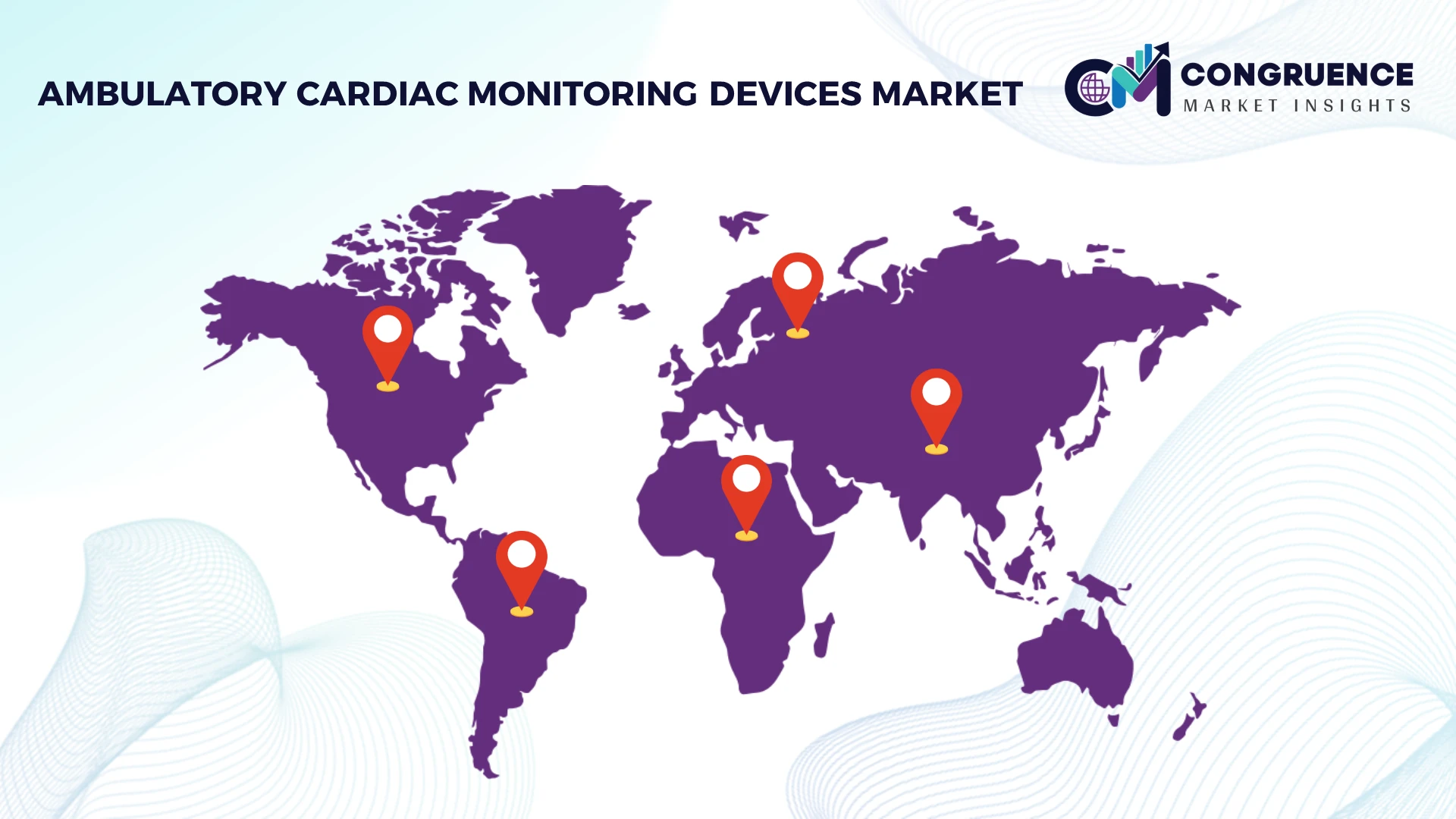
North America leads through established outpatient cardiology networks, advanced diagnostic infrastructure, and widespread use of Holter monitors, mobile cardiac telemetry, and extended-wear ECG patches. The United States anchors regional demand through specialist clinics, independent diagnostic providers, and reimbursement-supported monitoring services. Providers are integrating automated ECG analysis and cloud-based reporting to manage longer recordings without proportionate increases in manual review. Competition increasingly centers on clinical validation, report turnaround, and reimbursement-compatible workflows rather than device pricing alone. Canada's publicly funded healthcare system presents opportunities for remote diagnostics, although provincial procurement and access arrangements differ. Suppliers with established clinical evidence, reliable distribution, and integrated reporting capabilities are well positioned to maintain regional penetration.
United States Market Outlook: The United States is the principal commercial center for ambulatory cardiac monitoring, supported by established medical-device regulation, specialized diagnostic providers, and reimbursement pathways for eligible monitoring services. The projected 12.1 million Americans living with atrial fibrillation by 2050 underscores the need for effective rhythm detection and follow-up. Manufacturers are expanding patch-based monitoring, AI-assisted interpretation, and clinical-service integration to address intermittent arrhythmias. Competitive success depends on demonstrating diagnostic reliability, fitting payer requirements, and helping providers manage testing volumes without compromising clinician oversight.
Europe represents an estimated 25–29% of global market demand, supported by established cardiology services, ageing populations, and increasing integration of digital health into outpatient care. Germany, the United Kingdom, France, and Italy are important national markets, although reimbursement and procurement arrangements differ. A 2025 European review of ambulatory cardiac monitoring found substantial variation in access and reimbursement across countries, making commercialization strategy highly market-specific. Providers are expanding remote monitoring and longer-duration ECG assessment while emphasizing secure data handling and integration with clinical records. Suppliers need country-specific reimbursement evidence, regulatory compliance, and local service partnerships to convert technical capability into sustained adoption.
Germany Market Outlook: Germany combines a large healthcare system with established cardiology practices, medical-device expertise, and a developing digital health infrastructure. A 2025 survey of physicians found that 45.9% of respondents used telemonitoring and 26.2% used wearable devices, indicating practical adoption alongside continuing interoperability and cost barriers. For ambulatory ECG suppliers, opportunities lie in connecting monitoring outputs with clinical workflows, improving report exchange, and supporting reimbursement documentation. Providers that demonstrate reliable data integration and manageable operating costs are better positioned to scale across outpatient cardiology networks.
Asia-Pacific is the fastest-expanding regional market, supported by ageing populations, rising cardiovascular diagnostic needs, and uneven but improving access to digital healthcare. Japan is an established ambulatory monitoring market, while China, India, South Korea, and Australia provide opportunities through large patient populations and expanding clinical infrastructure. In May 2025, iRhythm launched its Zio ECG Recording and Analysis System in Japan, offering up to 14 days of continuous monitoring through a local distribution partnership. The launch illustrates how longer recording windows and localized commercial support can expand access. Adoption nevertheless varies with reimbursement, clinical awareness, and the availability of trained personnel.
Japan Market Outlook: Japan benefits from an ageing population, advanced clinical infrastructure, and established demand for ambulatory rhythm diagnostics. Approximately 1.6 million ambulatory cardiac monitoring tests are prescribed annually, creating a substantial base for extended-wear ECG technologies. The 2025 launch of iRhythm's Zio service through Senko Medical Instrument introduced up to 14 days of continuous recording with AI-assisted analysis. Suppliers that align product design with patient comfort, clinical evidence, and local distribution arrangements are positioned to serve Japan's sophisticated diagnostic market.
South America remains a smaller market, with demand concentrated in Brazil and other major urban healthcare centers. Public healthcare systems, private hospitals, and specialist cardiology clinics create demand for ECG diagnostics, while uneven specialist distribution increases the value of remote interpretation. Brazil's National Telediagnosis Platform had processed more than 1.74 million ECG examinations across over 1,300 municipalities by the end of 2023, demonstrating the potential of distributed diagnostic infrastructure. This service is not limited to ambulatory monitoring, but illustrates the reach of remote ECG workflows. Device suppliers face affordability, connectivity, and procurement constraints, making scalable service models and local partnerships important for market development.
Brazil Market Outlook: Brazil offers the region's strongest combination of healthcare scale, cardiology demand, and established digital diagnostic infrastructure. Its National Telediagnosis Platform has supported ECG access across 11 states, enabling recordings to be reviewed remotely by cardiologists. This model provides a foundation for expanding access to connected cardiac diagnostics, although ambulatory monitoring requires additional capabilities for prolonged recording, patient adherence, and event interpretation. Suppliers can strengthen their position through partnerships with hospitals, diagnostic networks, and telehealth providers, supported by pricing models suited to public and private healthcare settings.
The Middle East and Africa market is shaped by uneven healthcare infrastructure, rising demand for cardiovascular diagnostics, and investment in digital health services. Saudi Arabia and the United Arab Emirates are important Gulf markets because of healthcare modernization, specialist hospital capacity, and expanding technology adoption. Across Africa, access to cardiologists and diagnostic facilities remains less consistent, creating opportunities for portable ECG systems and remote interpretation. Brazil-style centralized telediagnosis models demonstrate a possible approach, but local connectivity, clinical capacity, and procurement conditions determine transferability. Suppliers are prioritizing hospital partnerships, distributor networks, and service support that can accommodate different levels of infrastructure readiness.
Saudi Arabia Market Outlook: Saudi Arabia is strategically positioned through healthcare transformation under Vision 2030, investment in digital health, and the development of integrated care networks. These changes support opportunities for ambulatory ECG devices that help clinicians evaluate intermittent arrhythmias outside conventional hospital settings. Adoption will depend on clinical procurement, regulatory compliance, reimbursement arrangements, and integration with electronic health records. Suppliers can differentiate through Arabic-language patient support, clinician training, secure data exchange, and partnerships with hospitals and local distributors. Scalable deployment requires demonstrating clinical value while fitting the operational requirements of the country's evolving healthcare system.
The market pits established platforms from Philips, GE HealthCare and Nihon Kohden against specialized innovators iRhythm, AliveCor and Vivalink. Philips competes through connected monitoring services and hospital integration, while iRhythm differentiates through extended-wear patches and AI-supported analysis. The market remains diversified; available estimates do not establish an audited top-five share, so a 45–55% combined share should be treated only as a directional planning range. Buyers prioritize clinical accuracy, recording duration, reporting speed, reimbursement fit and total service cost. A 5–10% reduction in avoidable workflow delays and a 3–5% improvement in analyzable recordings are potential operational targets, not universal measured outcomes. Philips is expanding payer and EHR partnerships; iRhythm is localizing commercial access; AliveCor is broadening AI-based diagnostic capabilities. Competition is shifting from hardware specifications toward validated algorithms, interoperability and integrated service delivery. Regulatory clearance, clinical evidence, cybersecurity and payer access constrain entry. Winning requires demonstrable diagnostic value, scalable reporting and dependable market access.
Extended-wear ECG patches, wireless telemetry and compact event monitors are shifting monitoring beyond conventional 24–48-hour Holter tests. Some patch systems record continuously for up to 14 days, increasing the observation window for intermittent arrhythmias. AI-supported classification helps prioritize abnormal signals, while technician review remains important for clinical validation. A 5–10% reduction in avoidable repeat testing is a potential workflow target, not a universal measured result. Adoption is strongest in established outpatient cardiology and specialist diagnostic services.
Interoperability is becoming a differentiator as monitoring results move into electronic health records and referral workflows. Philips’ 2025 collaboration with Epic enables clinicians to order and review cardiac monitoring results within Epic, reducing manual data entry. Integrated workflows can target a 3–5% improvement in administrative processing efficiency, subject to local validation. Meanwhile, improved electrode placement and adhesive design support signal quality and patient comfort; Vivalink reported up to 160% greater P-wave detection with its new adhesive in company testing. Such findings are product-specific, not comparable across all devices.
During 2026–2028, competitive advantage will increasingly depend on validated algorithms, secure cloud connectivity and scalable interpretation services. AliveCor’s Kardia 12L expanded to 39 FDA-cleared cardiac determinations in January 2026, illustrating how software can broaden device utility. Large platform providers benefit from EHR integration and distribution reach; specialists compete through focused innovation and faster iteration. Companies should prioritize clinical evidence, cybersecurity, reimbursement readiness and workflow integration rather than treating AI adoption alone as a commercial advantage.
The report evaluates ambulatory cardiac monitoring devices across Holter monitors, extended-wear ECG patches, mobile cardiac telemetry, event monitors and implantable loop recorders. Application coverage includes arrhythmia detection, syncope and palpitation assessment, post-stroke rhythm surveillance, and post-procedure follow-up. End-users include hospitals, clinics, ambulatory care centers, independent diagnostic providers, and home-based monitoring services. Geographic analysis covers North America, Europe, Asia-Pacific, South America, and the Middle East and Africa, with country-level emphasis on healthcare infrastructure, reimbursement, and clinical adoption.
Technology coverage includes AI-assisted ECG interpretation, wireless telemetry, wearable sensors, cloud reporting, EHR integration, and remote diagnostic workflows. Competitive analysis compares diversified medical-device companies with specialized monitoring and software providers, assessing clinical validation, recording duration, interoperability, regulatory clearance, and service delivery. The report supports investment planning, geographic expansion, partnership selection, and competitive positioning by identifying where extended-wear monitoring, automated interpretation, and integrated clinical workflows address operational gaps. Its 2026–2033 outlook helps businesses prioritize product development, market access, and scalable deployment models across established and emerging healthcare systems.
| Report Attribute/Metric | Report Details |
|---|---|
|
Market Revenue in 2025 |
USD 6,810.4 Million |
|
Market Revenue in 2033 |
USD 13,670.1 Million |
|
CAGR (2026 - 2033) |
9.1% |
|
Base Year |
2025 |
|
Forecast Period |
2026 - 2033 |
|
Historic Period |
2021 - 2025 |
|
Segments Covered |
By Type
By Application
By End-User
|
|
Key Report Deliverable |
Revenue Forecast, Growth Trends, Market Dynamics, Segmental Overview, Regional and Country-wise Analysis, Competition Landscape |
|
Region Covered |
North America, Europe, Asia-Pacific, South America, Middle East, Africa |
|
Key Players Analyzed |
Koninklijke Philips N.V., GE HealthCare Technologies Inc., iRhythm Technologies, Inc., Abbott Laboratories, Medtronic plc, Boston Scientific Corporation, Nihon Kohden Corporation, Fukuda Denshi Co., Ltd., Shenzhen Mindray Bio-Medical Electronics Co., Ltd., ZOLL Medical Corporation, AliveCor, Inc., Vivalink, Inc., BIOTRONIK SE & Co. KG, Bittium Corporation |
|
Customization & Pricing |
Available on Request (10% Customization is Free) |




