
Reports
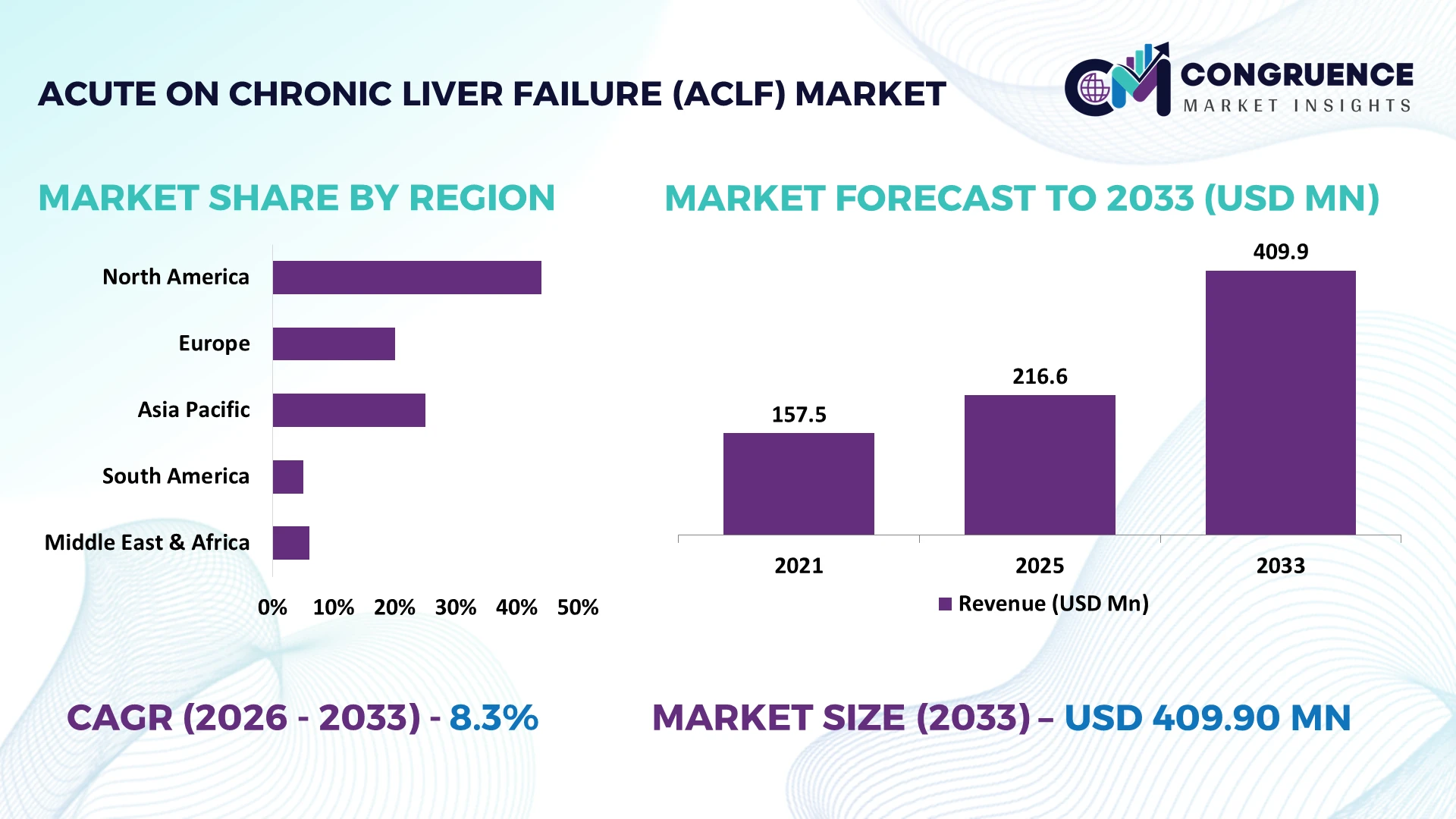
The Global Acute On Chronic Liver Failure (ACLF) Market was valued at USD 216.6 Million in 2025 and is anticipated to reach a value of USD 409.9 Million by 2033 expanding at a CAGR of 8.3% between 2026 and 2033. Increasing incidence of alcohol associated cirrhosis, hepatitis B reactivation, bacterial infections, and multi organ failure is accelerating demand for advanced ACLF diagnosis, therapeutic plasma exchange, intensive care interventions, and liver transplantation.
India represents a strategically important market within South Asia, where ACLF prevalence reaches 65% among patients hospitalized with decompensated cirrhosis. India's clinical infrastructure recorded 3,920 liver transplants across 183 registered centres in 2022, compared with 6,053 in China and 9,528 in the United States. Alcohol accounts for 43.2% of adult cirrhosis cases in India, strengthening demand for specialized hepatology services. Government supported transplant infrastructure and expanding tertiary care capabilities are improving treatment access, while China's 2025 Viral Hepatitis Action Plan prioritizes earlier diagnosis and treatment.
Healthcare investors and manufacturers should prioritize Asia Pacific partnerships, plasma exchange infrastructure, and AI enabled clinical decision systems to capture high burden hospital demand.
Market Size & Growth: USD 216.6 million in 2025 to USD 409.9 million by 2033, at 8.3% CAGR, driven by advanced plasma exchange and critical care adoption.
Top Growth Drivers: Alcohol related cirrhosis 47.4%, systemic infection 49%, and hepatitis B related chronic liver disease 34.9% in respective clinical cohorts.
Short Term Forecast: By 2028, wider therapeutic plasma exchange adoption targets improved early survival, supported by clinical evidence demonstrating a 19.6 percentage point reduction in 28 day mortality.
Emerging Technologies: AI based mortality prediction, therapeutic plasma exchange, and extracorporeal liver support are transforming clinical risk assessment and treatment.
Regional Leaders: Asia Pacific USD 180.4 million, North America USD 102.5 million, and Europe USD 82 million by 2033, representing analytical regional allocation estimates. Asia Pacific benefits from HBV management, North American hospitals from advanced critical care, and Europe from standardized EASL protocols.
Consumer/End User Trends: Hospitals and transplant centres prioritize multidisciplinary treatment, with 65% ACLF prevalence among South Asian decompensated cirrhosis admissions.
Pilot/Case Example: A 2026 Indian randomized trial involving 194 patients demonstrated 19.6 percentage points lower 28 day mortality with therapeutic plasma exchange.
Competitive Landscape: The market remains fragmented, with no reliably established global vendor market share. Key participants include Baxter International, Fresenius Medical Care, Terumo, B. Braun, and Asahi Kasei.
Regulatory & ESG Impact: EASL guideline recommendations received 97% expert consensus for using organ failure assessment to determine ACLF severity and mortality risk, supporting standardized clinical protocols.
Investment & Funding: A consolidated global ACLF specific investment total is not publicly established. Investment priorities include transplant infrastructure, plasma exchange equipment, critical care expansion, and clinical AI partnerships.
Innovation & Future Outlook: Next generation liver support, regenerative medicine, precision risk stratification, and integrated organ monitoring are shifting competition toward measurable survival improvements and transplant bridging capabilities.
The Acute On Chronic Liver Failure (ACLF) Market is witnessing increasing demand for therapeutic plasma exchange, advanced liver support systems, transplant bridging interventions, and AI enabled mortality prediction. Clinical evidence demonstrates a 19.6 percentage point reduction in 28 day mortality with plasma exchange in an Indian randomized trial, strengthening interest in evidence based treatment protocols. AI driven risk assessment is also improving patient stratification through continuous evaluation of creatinine, bilirubin, infection, and organ dysfunction. China's 2025 Viral Hepatitis Action Plan further reinforces the importance of early intervention. These developments position precision hepatology and advanced critical care as important strategic priorities for future market expansion.
The Acute On Chronic Liver Failure (ACLF) Market is becoming strategically important as hospitals shift from conventional cirrhosis management toward integrated organ support, rapid infection control, and transplant bridging therapies. With global 30 day mortality reaching 47.9% under EASL criteria, treatment effectiveness increasingly determines hospital investment priorities, technology procurement, and competitive differentiation. The growing emphasis on standardized critical care pathways is also reshaping clinical infrastructure and therapeutic development.
Therapeutic plasma exchange (TPE) is strengthening its position against standard medical therapy, with an Indian randomized trial reporting 44.3% mortality compared with 63.9% under standard treatment, representing a 19.6 percentage point improvement. However, similar 90 day mortality highlights the need for integrated long term treatment strategies. India offers significant clinical deployment opportunities through its 183 registered liver transplant centres, while the United States maintains stronger established critical care infrastructure and standardized clinical guidance.
During 2027–2029, investment priorities will increasingly favour automated plasma exchange, AI supported prognostic assessment, and multidisciplinary treatment networks. Hospitals are integrating hepatology, transfusion medicine, and intensive care capabilities to improve treatment coordination. Companies prioritizing clinical partnerships, equipment accessibility, and evidence based treatment protocols will establish stronger competitive positioning in advanced liver failure management.
Systemic infections account for a major proportion of ACLF precipitating events, while infection contributes to 49% of cases in reported global clinical evidence. South Asia records approximately 65% prevalence among hospitalized patients with decompensated cirrhosis, creating concentrated demand for advanced hepatology and intensive care. Therapeutic plasma exchange demonstrated a 19.6 percentage point reduction in 28 day mortality in an Indian randomized trial involving 194 patients. This clinical evidence strengthens investment in extracorporeal treatment infrastructure. Hospitals are expanding transfusion medicine capabilities and multidisciplinary critical care partnerships, while equipment manufacturers are prioritizing plasma separation technologies and hospital based service integration.
ACLF treatment faces substantial financial constraints because simultaneous organ support, prolonged intensive care, and specialist interventions increase hospital expenditure. US hospitalization costs reach USD 53,570 per ACLF admission, compared with USD 15,193 for cirrhosis, creating a 3.5 times cost differential. Diagnostic fragmentation further complicates treatment standardization, with reported overlap between APASL and EASL diagnostic classifications ranging from 7.7% to 80.2%. These differences affect patient identification, clinical trial comparability, and procurement planning. Healthcare providers are prioritizing standardized diagnostic protocols, bundled treatment arrangements, and locally sourced consumables to improve cost control and purchasing efficiency.
AI enabled prognostic assessment, automated plasma exchange, and integrated organ monitoring offer opportunities to improve ACLF treatment coordination. India recorded 3,920 liver transplants across 183 registered centres in 2022, demonstrating an established specialist infrastructure for expanding advanced liver failure services. Living donor procedures accounted for 3,183 transplants, highlighting the importance of transplant bridging interventions. Furthermore, a 19.6 percentage point improvement in 28 day survival with therapeutic plasma exchange creates a stronger clinical case for expanding treatment access. Companies can capitalize through AI partnerships, equipment leasing, clinical training, and regional service networks. An important opportunity lies in connecting secondary hospitals with specialist transplant centres through digital referral and remote monitoring platforms.
Scaling advanced ACLF therapies requires consistent clinical execution, trained transfusion specialists, and continuous monitoring of unstable patients. In an Indian randomized plasma exchange trial, only 57.7% of treated patients completed all five planned sessions, while hemodynamic instability accounted for 43.9% of treatment discontinuations. This exposes an operational limitation: equipment availability alone does not guarantee successful treatment delivery. India's concentration of transplant facilities also creates geographical disparities in specialist access, particularly outside established medical hubs. Companies must invest in workforce training, automated monitoring, standardized treatment protocols, and hospital partnerships. Long term competitiveness will depend on delivering reproducible clinical outcomes across facilities rather than simply increasing equipment installations.
Global Diagnostic Standardization Accelerates: The October 2026 multisociety consensus involving EASL, AASLD, APASL, ALEH, and SOLDA establishes a harmonized ACLF framework. Its emphasis on organ failure classification and standardized clinical endpoints addresses differences between existing diagnostic systems. This transition improves clinical trial comparability and supports multinational therapeutic development. Pharmaceutical companies and diagnostic technology providers are aligning research protocols and patient stratification systems with the harmonized framework.
Extracorporeal Treatment Gains Attention: Therapeutic plasma exchange is receiving stronger clinical attention following a 2026 randomized trial involving 194 patients, which demonstrated a 19.6 percentage point improvement in 28 day survival. Treatment completion and patient selection remain operational considerations. Equipment manufacturers are strengthening hospital partnerships, improving treatment monitoring, and developing integrated extracorporeal support capabilities.
Transplant Networks Expand Digitally: India's National Organ and Tissue Transplant Organization reported 20,138 organ transplants during 2025, representing 6.5% growth over 2024. Its national network connects more than 1,000 hospitals, strengthening digital registry coverage and referral coordination. This infrastructure development supports transplant evaluation and specialist connectivity. Companies are targeting transplant centres with integrated monitoring, equipment support, and clinical coordination solutions.
Multidisciplinary Critical Care Intensifies: The 2026 APASL Beijing Position Paper introduced 104 consensus statements covering infection control, organ support, prognostic scoring, and transplantation. Standardized assessment increasingly connects hepatology, nephrology, neurology, and intensive care workflows. This shift improves treatment coordination and creates demand for interoperable monitoring systems. Healthcare technology companies are prioritizing integrated clinical platforms, decision support, and specialist training rather than isolated equipment installations.
Type A ACLF, Type B ACLF, Type C ACLF, Type D ACLF, and Type E ACLF represent the specified commercial segmentation categories. However, these five categories do not constitute a recognized global clinical classification, making defensible individual market share percentages unavailable. The 2026 international consensus instead distinguishes Type A and Type B according to previous decompensation history. This distinction makes Type A and Type B the clinically relevant categories for standardized patient stratification. Type C, Type D, and Type E require clearly defined commercial or clinical criteria before meaningful comparisons of adoption, treatment requirements, or purchasing demand can be established.
For manufacturers, the immediate investment priority is developing diagnostic and therapeutic platforms compatible with internationally recognized ACLF classifications. Type A and Type B applications offer clearer opportunities for clinical validation and multicentre research, while the remaining supplied categories require standardized definitions before dedicated product positioning. Companies that establish consistent patient identification and interoperable clinical evidence will strengthen hospital procurement relationships and reduce classification related research fragmentation.
Infection Management represents a major application area because bacterial infections frequently precipitate systemic inflammation and accelerate multiple organ dysfunction in ACLF patients. Renal Dysfunction is an increasingly important treatment priority as acute kidney injury and hepatorenal syndrome complicate critical care and increase mortality risk. Organ Failure Management remains central to hospital protocols through continuous assessment of hepatic, renal, respiratory, and circulatory functions. Hepatic Encephalopathy requires specialized neurological monitoring, while Liver Transplantation provides a definitive treatment pathway for eligible patients. A reliable market share allocation across these five applications is not established in published clinical classifications.
Renal Dysfunction is a strategically important emerging application because early kidney support, fluid management, and continuous renal replacement therapy require coordinated specialist infrastructure. Companies are strengthening integrated monitoring, extracorporeal treatment compatibility, and hospital partnerships. Infection Management retains established clinical importance, whereas transplantation demand is increasingly connected to donor availability and referral infrastructure. Investment priorities are shifting toward integrated organ support rather than isolated liver treatment technologies.
Hospitals represent the leading end-user category because ACLF treatment requires intensive care beds, continuous organ monitoring, blood component support, specialist hepatologists, and emergency intervention capabilities. Their procurement requirements span diagnostic platforms, therapeutic plasma exchange equipment, renal replacement systems, and critical care infrastructure. Liver Specialty Centers maintain specialized demand through advanced hepatology assessment and multidisciplinary treatment, while Transplant Centers concentrate on recipient evaluation, donor coordination, and perioperative management. Gastroenterology Clinics primarily contribute through chronic liver disease identification and early referral, whereas Research Institutes support clinical validation and next-generation therapeutic development. Publicly established end-user market shares are unavailable for these five categories.
Transplant Centers represent a strategically expanding specialized buyer group as India's transplantation infrastructure develops. India performed 20,138 organ transplants during 2025, recording 6.5% growth over the preceding year. The national registry network connects more than 1,000 hospitals, strengthening institutional coordination. Companies are responding through customized equipment packages, specialist training, maintenance partnerships, and integrated hospital solutions. Hospitals retain procurement scale, while specialist and transplant centres offer opportunities for higher-value clinical technology deployment and research collaborations.
South Asia recorded the highest documented ACLF prevalence, at 65% among patients hospitalized with decompensated cirrhosis, positioning Asia Pacific as a major clinical demand centre. However, regional ACLF market shares and comparable 2026–2033 growth rates are not established in published market datasets. Clinical prevalence should not be interpreted as commercial market share.
Advanced Critical Care Infrastructure and Transplant Technology Integration
North America benefits from established hepatology departments, advanced intensive care infrastructure, specialized transplant hospitals, and access to extracorporeal blood purification technologies. The United States represents the principal commercial market because hospitals operate sophisticated organ support systems and multidisciplinary liver failure programs. ACLF hospitalizations have increased substantially, while hospitalization costs are 3.5 times those associated with cirrhosis, strengthening institutional interest in early diagnosis and resource optimization. Adoption of artificial liver support remains clinically selective because established EASL recommendations do not support routine use outside investigative trials. Equipment suppliers are therefore prioritizing validated applications, hospital collaborations, and integrated critical care platforms rather than broad installations.
United States Market Outlook: The United States leads regional technology development through advanced transplant infrastructure, clinical research networks, and specialized liver disease centres. Its healthcare providers prioritize MELD based assessment, continuous renal replacement therapy, and multidisciplinary organ failure management. The substantial financial burden of ACLF admissions encourages investment in earlier patient identification, clinical decision support, and treatment pathways that reduce avoidable intensive care utilization.
Clinical Standardization and Evidence Based Treatment Deployment
Europe maintains a strong position through the European Association for the Study of the Liver and the CLIF Consortium, which have established influential clinical assessment frameworks. The EASL ACLF guidelines strengthen consistency in organ failure grading, prognostic evaluation, and treatment selection across specialist hospitals. European clinical research also supports the evaluation of albumin dialysis, plasma exchange, and artificial liver support systems. However, the recommendation against routine extracorporeal liver support outside investigative trials limits immediate commercial deployment. Manufacturers are responding by prioritizing clinical validation, research partnerships, and device optimization. Differences in national reimbursement arrangements and hospital procurement systems make country specific commercialization strategies more effective than uniform European distribution.
Germany Market Outlook: Germany offers a strategically important market through its university hospitals, advanced extracorporeal treatment capabilities, and established medical technology manufacturing ecosystem. Its specialist centres provide opportunities for clinical evaluation of liver support systems and integrated blood purification equipment. Manufacturers benefit from collaboration with hepatology research institutions, while procurement decisions increasingly emphasize demonstrated clinical effectiveness, device reliability, and compatibility with intensive care infrastructure.
High Disease Burden and Expanding Specialist Infrastructure
Asia Pacific represents the most important clinical demand centre because South Asia records the highest documented ACLF prevalence among hospitalized patients with decompensated cirrhosis. India, China, Japan, and South Korea demonstrate distinct treatment requirements shaped by alcohol related liver disease, hepatitis B, and metabolic liver disorders. An APASL Research Consortium analysis covering 6,319 patients across 15 countries identified substantial differences in disease triggers and mortality. India recorded 47% 30 day mortality, compared with 24% in Bangladesh and 65% in Pakistan. These variations strengthen demand for country specific diagnostic protocols, intensive care integration, and transplant referral networks. Companies are expanding clinical partnerships and improving access to extracorporeal treatment equipment.
India Market Outlook: India offers substantial commercial opportunities through its expanding liver transplant infrastructure, specialist hepatology hospitals, and high clinical burden. The country's 3,920 liver transplants across 183 registered centres in 2022 demonstrate established treatment capacity. Equipment manufacturers can strengthen their presence through partnerships with tertiary hospitals, training programs, affordable plasma exchange systems, and integrated critical care solutions.
Transplant Centre Concentration and Critical Care Modernization
South America demonstrates significant clinical need, although specialized ACLF treatment remains concentrated in major transplant hospitals. Brazil represents the principal commercial opportunity because of its established liver transplantation infrastructure and specialist hepatology services. A Brazilian retrospective study covering 381 patients treated between 2017 and 2022 identified ACLF in 10.49% of the cohort. Bacterial infections triggered 45% of identified cases, while kidney failure affected 65%, reinforcing demand for integrated infection control and renal support. Limited specialist distribution and differences in hospital financing constrain deployment outside major medical centres. Suppliers are prioritizing partnerships with transplantation hospitals, specialist training, and equipment servicing to improve treatment accessibility.
Brazil Market Outlook: Brazil offers the strongest strategic positioning through established transplantation centres, university hospitals, and specialist intensive care services. Its clinical experience with ACLF provides opportunities for pharmaceutical research, extracorporeal treatment evaluation, and multidisciplinary treatment protocols. Companies entering the market should prioritize partnerships with major transplant institutions and local clinical research organizations to establish evidence based adoption.
Specialist Hospital Investment and Transplant Infrastructure Expansion
The Middle East and Africa market is shaped by uneven specialist healthcare distribution, hepatitis related liver disease, and investment in advanced hospital infrastructure. Saudi Arabia and the United Arab Emirates are important technology adoption centres, while several African countries face shortages of transplant facilities and specialized intensive care capacity. Saudi Arabian transplant research covering 1,419 adult recipients between 2011 and 2023 identified living donor transplantation in 79.8% of procedures, demonstrating the importance of organized donor networks. Healthcare modernization programs are supporting advanced diagnostics, blood purification systems, and specialist hospital development. Manufacturers are targeting tertiary hospitals through clinical partnerships, equipment servicing, and tailored procurement arrangements rather than relying on broad distribution networks.
Saudi Arabia Market Outlook: Saudi Arabia offers a strong commercial opportunity through specialized transplantation infrastructure, government supported healthcare modernization, and investment in advanced tertiary care. Its growing focus on metabolic liver disease and transplant capacity creates demand for integrated organ support, diagnostic technologies, and specialist treatment platforms. Companies can strengthen market access through hospital partnerships, clinical training, and locally supported equipment deployment.
The ACLF competitive landscape spans extracorporeal equipment manufacturers, blood purification specialists, and investigational liver support developers. Baxter, Fresenius Medical Care, Terumo, B. Braun, and Asahi Kasei compete through dialysis platforms, plasma separation, apheresis systems, and hospital supply relationships; Cytosorbents and specialist developers target adjunctive blood purification and emerging liver support. A defensible combined share for the five largest ACLF suppliers is not publicly established because vendors report broader portfolios rather than ACLF specific sales. Competition centres on clinical validation, treatment reliability, consumable availability, service coverage, and intensive care compatibility across major hospitals. EASL guidance does not recommend routine extracorporeal liver support outside investigative trials, making evidence generation a decisive purchasing factor. Suppliers are responding through clinical collaborations, device refinement, local servicing, and renal replacement integration. Entry barriers include regulatory evaluation, specialist training, procurement cycles, and outcome evidence. Winning requires validated performance, dependable consumables, and practical integration into multidisciplinary care pathways.
Baxter International Inc.
Fresenius Medical Care AG
Terumo Corporation
B. Braun Melsungen AG
Asahi Kasei Corporation
Nikkiso Co., Ltd.
CytoSorbents Corporation
Grifols S.A.
Kaneka Corporation
Haemonetics Corporation
Toray Industries, Inc.
Medica S.p.A.
Therapeutic plasma exchange, continuous renal replacement therapy, and molecular adsorbent recirculating systems represent important current technologies. Plasma exchange demonstrated a 19.6 percentage point improvement in 28 day survival in an Indian randomized trial involving 194 patients. Automated monitoring and integrated extracorporeal platforms improve treatment coordination, while standardized workflows target 1–2% reductions in processing inefficiencies. Deployment remains concentrated in specialist hospitals because treatment requires trained personnel and intensive monitoring.
Emerging technologies include AI based mortality prediction, automated organ dysfunction assessment, and connected patient monitoring. Integration of bilirubin, creatinine, coagulation, and inflammatory markers supports faster clinical risk stratification, targeting 1–2% improvements in assessment efficiency. Machine learning tools also strengthen patient selection for transplantation and extracorporeal interventions. Specialist hospitals and clinical technology developers benefit through more consistent decision making and improved utilization of intensive care resources.
Between 2026 and 2028, bioartificial liver support, advanced hemoperfusion membranes, and precision monitoring will shape disruptive innovation. Compared with fragmented manual assessment, integrated digital workflows target 1–2% faster clinical processing. Established equipment manufacturers benefit from hospital integration, while AI developers gain opportunities through clinical partnerships. Investment should prioritize validated treatment outcomes, interoperability, and scalable extracorporeal platforms.
August 2026: Instituto Grifols' APACHE Phase 3 results showed albumin plasma exchange reduced 90 day death without transplantation by 35% among 274 ACLF patients, strengthening the clinical case for extracorporeal support in early stage patients and transplant bridging. Source: efclif.com
October 2026: Fresenius Medical Care launched multiFiltratePRO in the United States after FDA clearance, integrating continuous kidney replacement therapy and citrate anticoagulation while eliminating separate citrate and calcium pumps, simplifying complex ICU workflows for acute kidney injury patients. Source: freseniusmedicalcare.com
December 2025: The Chinese Society of Hepatology issued China's first ACLF diagnosis and treatment guideline, recommending dynamic reassessment every 3–7 days and multiple prognostic scores, strengthening standardized patient stratification and transplant timing across specialist hospitals and transplantation services. Source: pmc.ncbi.nlm.nih.gov
October 2026: EASL, AASLD, APASL, ALEH, and SOLDA published a global ACLF definition consensus, aligning diagnosis, grading, organ failure assessment, and trial endpoints across five societies to improve research comparability and multinational therapeutic development and regulatory trial alignment. Source: sciencedirect.com
The Acute On Chronic Liver Failure (ACLF) Market Report assesses five supplied types: Type A ACLF, Type B ACLF, Type C ACLF, Type D ACLF, and Type E ACLF. Applications cover Infection Management, Organ Failure Management, Hepatic Encephalopathy, Renal Dysfunction, and Liver Transplantation. End users include Hospitals, Liver Specialty Centers, Transplant Centers, Gastroenterology Clinics, and Research Institutes, with analysis of procurement priorities and treatment requirements.
Regional coverage spans North America, Europe, Asia Pacific, South America, and the Middle East and Africa, including country level assessment of clinical infrastructure and transplant capacity. Technologies include plasma exchange, renal replacement therapy, albumin dialysis, hemoperfusion, AI prognostic tools, and integrated monitoring. The report assesses 2024–2026 clinical and regulatory developments, 12 profiled companies, and deployment barriers to inform investment, market entry, partnerships, product priorities, and expansion strategy through 2033.
| Report Attribute/Metric | Report Details |
|---|---|
Market Revenue in 2025 | USD 216.6 Million |
Market Revenue in 2033 | USD 409.9 Million |
CAGR (2026 - 2033) | 8.3% |
Base Year | 2025 |
Forecast Period | 2026 - 2033 |
Historic Period | 2021 - 2025 |
Segments Covered | By Type
By Application
By End-User
|
Key Report Deliverable | Revenue Forecast, Growth Trends, Market Dynamics, Segmental Overview, Regional and Country-wise Analysis, Competition Landscape |
Region Covered | North America, Europe, Asia-Pacific, South America, Middle East, Africa |
Key Players Analyzed | Baxter International Inc., Fresenius Medical Care AG, Terumo Corporation, B. Braun Melsungen AG, Asahi Kasei Corporation, Nikkiso Co., Ltd., CytoSorbents Corporation, Grifols S.A., Kaneka Corporation, Haemonetics Corporation, Toray Industries, Inc., Medica S.p.A. |
Customization & Pricing | Available on Request (10% Customization is Free) |




