
Reports
The Global Abdominal Surgery Retractor Market was valued at USD 246.0 Million in 2025 and is anticipated to reach a value of USD 672.7 Million by 2033 expanding at a CAGR of 13.4% between 2026 and 2033. Growth is driven by the adoption of minimally invasive surgical procedures, demand for self-retaining retractors, and integration of ergonomic designs that improve surgeon precision and reduce operative complexity.
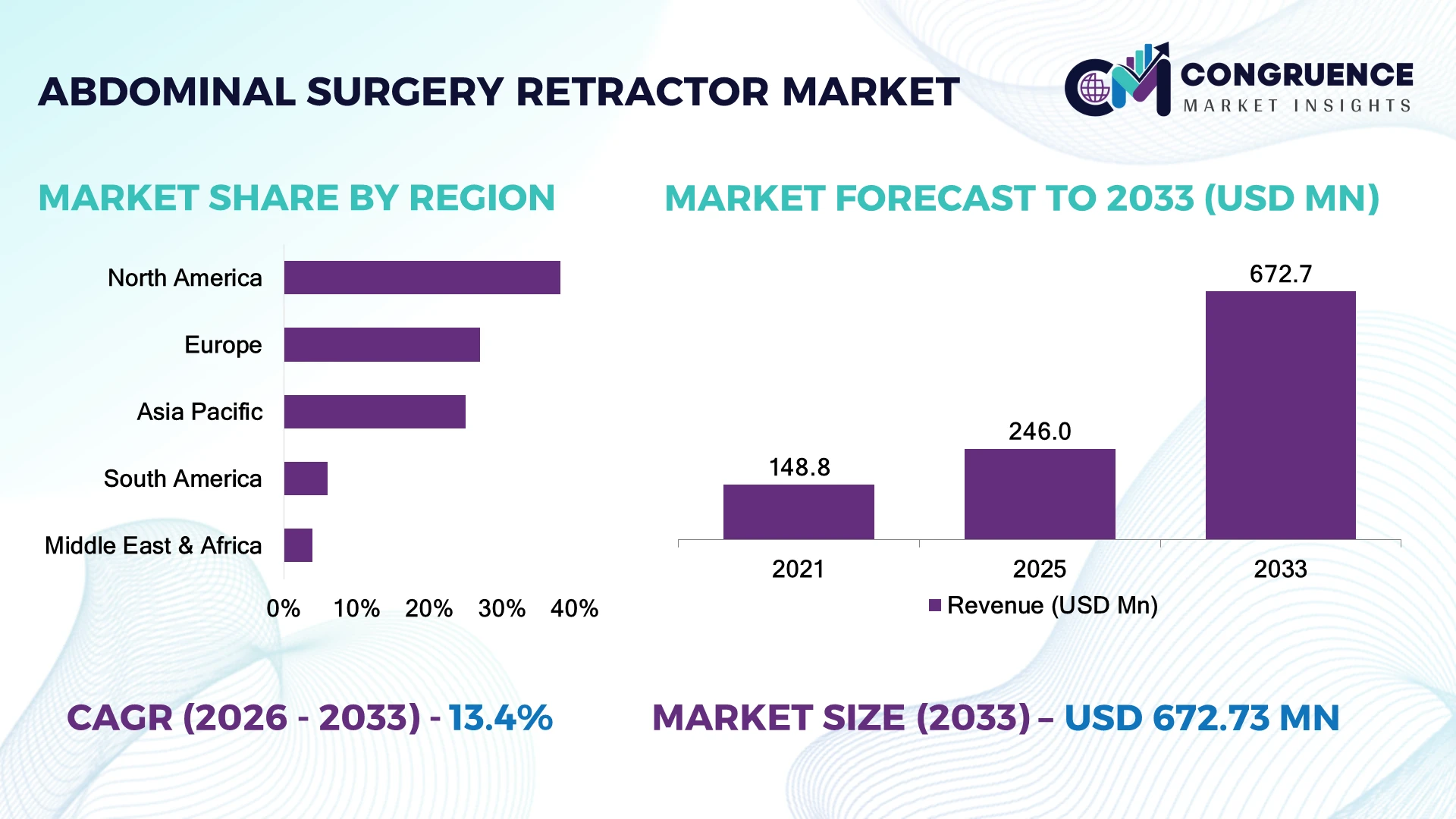
The United States dominates the market with approximately 38% share, supported by advanced surgical infrastructure, over 6,000 hospitals, and strong adoption of robotic-assisted and minimally invasive procedures. Germany follows with nearly 12% share, driven by investments in modern operating rooms and surgical technology upgrades. The U.S. healthcare system records higher adoption of advanced retractors compared with emerging markets due to greater procedural volumes and technology spending.
Strategic investments in precision surgical devices and localized manufacturing will determine future competitive advantage.
Market Size & Growth: The market reaches USD 246.0 Million in 2025 and USD 672.7 Million by 2033 at a 13.4% CAGR, supported by minimally invasive surgery adoption and advanced surgical instrument innovation.
Top Growth Drivers: Minimally invasive procedures contribute 42%, robotic-assisted surgery adoption accounts for 28%, and hospital infrastructure modernization represents 22% of market expansion.
Short-Term Forecast: By 2028, hospitals adopting advanced retractors achieve approximately 15% improvement in surgical workflow efficiency and 10% reduction in procedure-related delays.
Emerging Technologies: AI-assisted surgical planning, automation-enabled operating rooms, and lightweight titanium or polymer-based retractors are reshaping surgical precision and usability.
Regional Leaders: North America is projected at USD 260 Million with robotic surgery adoption, Europe at USD 170 Million with advanced healthcare systems, and Asia-Pacific at USD 150 Million with expanding hospital networks.
Consumer/End-User Trends: More than 55% of tertiary hospitals are shifting toward reusable and ergonomic retractors to improve operational efficiency and cost management.
Pilot/Case Example: In 2024, hospitals implementing digitally integrated surgical workflows reported up to 18% reduction in operating room preparation time.
Competitive Landscape: Leading manufacturers hold approximately 45% combined share, with major players including B. Braun, Medtronic, Integra LifeSciences, Johnson & Johnson, and CooperSurgical.
Regulatory & ESG Impact: Sustainability-focused procurement policies are increasing demand for reusable surgical devices, reducing single-use instrument waste by nearly 20% in selected healthcare systems.
Investment & Funding: More than USD 500 Million in surgical technology investments are supporting partnerships, automation development, and advanced device manufacturing expansion.
Innovation & Future Outlook: Next-generation retractors featuring smart sensing, improved ergonomics, and digital surgical integration are driving a shift toward precision-based operating environments.
The Abdominal Surgery Retractor Market is witnessing rising demand from hospitals seeking improved surgical visibility, reduced procedural fatigue, and enhanced operating room efficiency. Advanced materials, modular instrument systems, and ergonomic innovations are gaining adoption, with approximately 30% of manufacturers prioritizing product redesign initiatives. Supply-chain localization in countries such as the United States and India is strengthening availability of critical surgical devices and supporting market resilience.
The Abdominal Surgery Retractor Market is becoming strategically important as healthcare providers prioritize surgical efficiency, precision, and cost-controlled operating environments. Increasing investments in minimally invasive procedures and modernization of surgical facilities are transforming demand patterns. Supply-chain restructuring after global medical device disruptions has encouraged manufacturers to expand regional production networks and strengthen supplier partnerships.
Advanced self-retaining retractors with ergonomic mechanisms reduce surgeon adjustment requirements by nearly 20% compared with traditional manual retractors, improving workflow consistency and reducing operating room pressure. Digital-assisted surgical environments are also accelerating adoption, particularly in the United States and Japan, where technology-enabled procedures are more established, while emerging markets focus on affordable and scalable surgical solutions.
Hospitals in India and Southeast Asia are expanding access through new surgical centers and public healthcare investments, creating deployment opportunities for cost-efficient devices. Companies are responding through product innovation, manufacturing expansion, and collaborations with healthcare institutions. Over the next 2–3 years, competitive positioning will depend on improving device usability, strengthening supply reliability, and delivering measurable operational value across diverse healthcare systems.
The growing shift toward minimally invasive abdominal procedures is the primary driver accelerating adoption of advanced retractors. Hospitals are increasing investments in ergonomic and self-retaining systems as surgical efficiency becomes a priority. Minimally invasive techniques represent more than 50% of abdominal procedures in developed healthcare markets, while robotic-assisted surgery adoption continues rising. The United States and Germany are expanding surgical technology programs, encouraging manufacturers to develop lightweight, adjustable retractors. Companies are responding through R&D partnerships, product launches, and precision-engineered designs that improve visualization and reduce surgeon fatigue. The strategic advantage lies in devices that combine functionality with compatibility across modern surgical platforms.
High acquisition costs and procurement limitations remain key barriers, particularly for smaller hospitals and developing healthcare systems. Premium surgical retractors using advanced materials can increase equipment expenses by 15–25% compared with conventional alternatives. Healthcare providers in countries such as India and Brazil often face budget constraints and limited access to advanced operating room infrastructure. Regulatory compliance requirements and dependence on specialized medical-grade materials add supply complexity. Companies are reducing these challenges through localized manufacturing, diversified supplier networks, and cost-optimized product portfolios. Effective pricing strategies and regional partnerships are becoming essential for expanding adoption beyond premium healthcare facilities.
Integration of smart technologies presents significant opportunities as hospitals move toward connected operating environments. Sensor-enabled surgical instruments and digitally assisted procedures are gaining attention, with more than 35% of advanced healthcare facilities evaluating smart surgical solutions. Countries including Japan and South Korea are investing in automation and precision healthcare infrastructure, creating demand for next-generation retractors. Manufacturers are focusing on modular designs, advanced polymers, and AI-supported surgical ecosystems to improve efficiency. The strongest opportunity lies in combining traditional surgical reliability with digital capabilities that provide better procedural control, data insights, and long-term operational savings.
Scaling advanced abdominal retractors across diverse healthcare systems remains challenging due to workforce training gaps, technology integration issues, and infrastructure differences. Nearly 40% of hospitals in emerging markets still operate with limited access to advanced surgical technologies, affecting consistent deployment. Cybersecurity considerations are also emerging as operating rooms become increasingly connected. Companies must address these challenges through training programs, regional support networks, and simplified device integration. Long-term competitiveness depends on ensuring reliable performance across different clinical environments while maintaining regulatory compliance and sustainable manufacturing practices.
Ergonomic Design Transformation: Hospitals are shifting toward lightweight, self-retaining abdominal retractors that improve surgical handling and reduce physical strain. Adoption of ergonomic systems has increased by nearly 25% in advanced surgical centers, while adjustable designs improve workflow efficiency by around 15%. Companies are responding by developing modular retractors using titanium alloys and advanced polymers to support longer procedures and improve surgeon comfort.
Smart Surgical Integration: Connected operating room technologies are influencing retractor development as hospitals integrate digital surgical platforms. Approximately 30% of technology-focused hospitals are evaluating smart surgical instruments with tracking and automation capabilities. Companies are partnering with healthcare technology providers to improve device compatibility, while regulatory focus on digital healthcare transformation in countries such as the United States is accelerating adoption.
Localized Supply Chain Expansion: Medical device manufacturers are restructuring supply networks after global component shortages affected surgical equipment availability. Around 20% of companies are increasing regional manufacturing capacity, particularly in India and Southeast Asia, to reduce dependency on international suppliers. This shift is improving delivery reliability, lowering logistics exposure, and encouraging partnerships with local medical device manufacturers.
Sustainable Instrument Adoption: Healthcare providers are increasing demand for reusable surgical instruments as sustainability initiatives influence procurement decisions. Hospitals implementing waste-reduction programs have achieved approximately 15–20% reductions in disposable surgical equipment usage. Companies are responding with durable materials, sterilization-friendly designs, and lifecycle-focused product strategies to align with evolving ESG requirements.
Self-retaining abdominal retractors represent the leading segment, accounting for approximately 48% of market adoption due to their ability to maintain consistent exposure while reducing manual assistance during complex procedures. Their scalability across open abdominal surgeries, improved stability, and compatibility with modern operating environments support widespread hospital adoption. Hand-held retractors remain important, particularly in cost-sensitive healthcare systems, but face limitations related to continuous surgeon assistance and procedural fatigue.
The fastest-growing shift is toward advanced adjustable and modular retractors, supported by demand for customized surgical workflows. These systems are gaining nearly 20% higher preference among technology-focused hospitals due to improved flexibility and integration capabilities. Companies are increasing investment in lightweight materials, precision manufacturing, and surgeon-focused product development. Emerging designs using polymer composites and titanium structures are creating opportunities for improved durability and reduced operating room complexity.
General abdominal surgery remains the dominant application segment, representing approximately 55% of demand due to high procedure volumes across hospitals and surgical centers. Procedures including gastrointestinal surgeries, colorectal interventions, and exploratory abdominal operations continue driving consistent usage. Emergency abdominal procedures also maintain strong relevance because retractors provide essential visualization during time-sensitive interventions.
The fastest-growing application area is minimally invasive and technology-assisted abdominal procedures, expanding as hospitals modernize surgical infrastructure. Adoption of advanced surgical workflows has increased by nearly 30% in leading healthcare facilities, encouraging demand for adaptable retractors compatible with evolving techniques. Companies are responding through product customization, surgeon training programs, and partnerships with hospitals adopting advanced operating room systems. Traditional open surgery applications continue supporting market stability, while emerging precision-based procedures are reshaping future demand priorities.
Hospitals represent the leading end-user segment with approximately 65% market share, driven by higher surgical volumes, advanced infrastructure availability, and continuous demand for abdominal procedures. Large tertiary hospitals and academic medical centers are major adopters because they require reliable surgical exposure systems across multiple specialties. Ambulatory surgical centers are expanding steadily, supported by outpatient procedure growth and demand for efficient surgical workflows.
The fastest-growing end-user group is ambulatory surgical centers, with adoption increasing by nearly 25% as healthcare systems shift toward cost-efficient outpatient care models. These facilities prioritize compact, easy-to-use retractors that reduce setup time and improve operational efficiency. Companies are targeting this segment through affordable product lines, distribution partnerships, and simplified instrument designs. Emerging healthcare facilities in countries such as India are also increasing procurement of scalable surgical equipment to expand procedural capacity.
North America accounted for the largest market share at 38% in 2025 however, Asia-Pacific is expected to register the fastest growth, expanding at a CAGR of 15.1% between 2026 and 2033.

North America held the largest share of approximately 38% in 2025, supported by advanced hospital infrastructure, high surgical procedure volumes, and strong adoption of minimally invasive surgical technologies. The United States contributes the majority of regional demand due to its extensive network of tertiary hospitals, robotic surgery adoption, and established medical device ecosystem. More than 60% of leading hospitals in the region are upgrading operating room technologies to improve surgical efficiency and procedural consistency. Strong investment in surgical automation, ergonomic instrument development, and healthcare modernization programs is encouraging manufacturers to expand product portfolios and strengthen partnerships with hospitals and surgical technology providers.
United States Market Outlook: The United States remains the primary growth center due to its advanced healthcare infrastructure, medical device innovation capabilities, and high adoption of complex abdominal procedures. The country has more than 6,000 hospitals, creating a large installed base for surgical instruments. Increasing investments in robotic-assisted surgery platforms, outpatient surgical facilities, and precision-based operating room solutions are supporting demand for advanced abdominal retractors.
Europe accounted for approximately 27% of the global market in 2025, supported by mature healthcare systems, strong medical technology manufacturing, and strict surgical quality standards. Germany, France, and the United Kingdom represent major adoption centers due to advanced hospital infrastructure and strong clinical research capabilities. Around 30% of hospitals across major European markets are investing in operating room modernization programs focused on efficiency, ergonomics, and sustainable medical equipment adoption. The European Union’s emphasis on medical device compliance and environmental sustainability is encouraging manufacturers to develop reusable, durable, and resource-efficient surgical instruments. Companies are expanding through regional manufacturing, healthcare partnerships, and innovation-focused product strategies.
Germany Market Outlook: Germany leads Europe due to its strong medical engineering sector, advanced hospital network, and globally recognized surgical technology capabilities. The country operates more than 2,000 hospitals and maintains a strong medical device manufacturing ecosystem. Increasing investment in digital healthcare infrastructure and precision surgical solutions is strengthening Germany’s role as a key innovation hub for abdominal surgery instruments.
Asia-Pacific represented approximately 25% of the global market in 2025 and is positioned as the fastest-growing market due to expanding healthcare infrastructure, rising surgical volumes, and increasing domestic medical device production. China, India, Japan, and South Korea are leading regional adoption through hospital expansion and technology upgrades. Medical device manufacturing growth in China and India is reducing supply-chain dependency while improving availability of cost-effective surgical instruments. More than 20% growth in regional healthcare equipment distribution networks has been observed as manufacturers strengthen local partnerships. Companies are focusing on affordable, scalable retractors and localized production strategies to address diverse healthcare requirements.
China Market Outlook: China holds a leading position due to its large healthcare infrastructure, expanding domestic medical device industry, and government-supported healthcare modernization initiatives. The country has more than 35,000 hospitals, creating significant demand for surgical instruments. Increasing local manufacturing capabilities, research investments, and technology adoption programs are enabling Chinese companies to improve competitiveness in the surgical device sector.
South America accounted for approximately 6% of the global market in 2025, with Brazil and Argentina representing the largest demand centers due to concentrated healthcare infrastructure and growing private hospital networks. Adoption remains focused in urban medical facilities where advanced surgical procedures are increasingly performed. Healthcare modernization initiatives and investments in surgical capacity expansion are improving access to advanced instruments. Brazil’s private healthcare sector continues increasing equipment procurement, while regional distributors are expanding product availability. Companies are addressing market limitations through localized partnerships, flexible pricing models, and targeted distribution strategies to improve adoption beyond major metropolitan hospitals.
Brazil Market Outlook: Brazil represents the largest South American market due to its extensive healthcare network, private hospital expansion, and increasing surgical capacity. The country operates more than 6,000 hospitals, supporting consistent demand for surgical equipment. Growing investment in healthcare infrastructure and collaboration with international medical device manufacturers are improving access to advanced abdominal surgery retractors.
Middle East & Africa represented approximately 4% of the global market in 2025, driven by healthcare infrastructure investments, medical tourism expansion, and modernization of specialized hospitals. Adoption is concentrated in countries such as Saudi Arabia, the United Arab Emirates, and South Africa, where healthcare transformation programs are accelerating demand for advanced surgical technologies. New hospital developments and upgrades in operating room facilities are increasing requirements for reliable surgical instruments. More than 500 hospitals in Saudi Arabia alone support expanding demand for modern surgical equipment. Companies are strengthening regional distributor networks, forming healthcare partnerships, and introducing cost-optimized product solutions to address diverse clinical requirements.
Saudi Arabia Market Outlook: Saudi Arabia is the most strategically significant market in the region due to healthcare transformation initiatives, advanced hospital development, and investment in specialized surgical centers. The country’s healthcare system includes more than 500 hospitals, with increasing adoption of modern surgical technologies. Government-backed healthcare modernization and international partnerships are improving access to advanced abdominal surgery instruments and supporting long-term market development.
The Abdominal Surgery Retractor Market features competition between global medical device leaders such as Medtronic, Johnson & Johnson, B. Braun, and Integra LifeSciences against regional manufacturers focused on cost efficiency and localized supply. OEMs compete with specialized surgical instrument suppliers through ergonomic design, material innovation, and customization. The top five players collectively account for approximately 45% of the market, creating a moderately consolidated structure. Competition is driven by technology differentiation, with advanced retractors improving workflow efficiency by 15–20%, while cost-focused manufacturers compete through pricing advantages of nearly 10–15%. Leading companies are expanding through hospital partnerships, product innovation, regional manufacturing, and vertical integration of supply chains. The market is shifting toward smart surgical compatibility, reusable designs, and supply resilience after global equipment disruptions. High regulatory requirements, clinical validation needs, and surgeon adoption barriers remain key entry challenges. Winning players must combine innovation, reliability, cost control, and strong healthcare partnerships.
Johnson & Johnson MedTech
B. Braun Melsungen AG
Integra LifeSciences Holdings Corporation
CooperSurgical Inc.
Teleflex Incorporated
Stryker Corporation
Zimmer Biomet Holdings, Inc.
KLS Martin Group
Applied Medical Resources Corporation
Surgical Innovations Group plc
Thompson Surgical Instruments, Inc.
The abdominal surgery retractor market is evolving through ergonomic engineering, lightweight materials, and digitally integrated surgical systems. Advanced self-retaining retractors using titanium alloys and high-performance polymers improve handling efficiency by approximately 15% compared with traditional stainless-steel designs. Adoption is increasing in tertiary hospitals where more than 30% of operating rooms are upgrading surgical instrument portfolios.
Smart surgical integration is becoming a competitive differentiator as hospitals adopt connected operating environments. Sensor-enabled instruments, automation compatibility, and digital workflow systems improve procedural visibility and reduce manual adjustments by nearly 20%. Global medical device companies are investing in modular platforms that support customization across complex abdominal procedures.
Between 2026 and 2028, AI-assisted surgical planning, robotic surgery compatibility, and sustainable reusable instruments will influence product positioning. Technology leaders benefit through premium adoption, while cost-focused manufacturers are improving competitiveness through simplified designs and localized production. Companies that combine advanced functionality with affordability will gain stronger hospital partnerships and long-term market relevance.
June 2025 – Johnson & Johnson MedTech launched the Polyphonic™ AI Fund for Surgery with NVIDIA and AWS participation to accelerate AI-driven surgical innovation. The initiative targets data-based surgical solutions and strengthens digital ecosystem partnerships. Source: Johnson & Johnson MedTech Press Releases
April 2025 – Johnson & Johnson MedTech completed first clinical cases with the OTTAVA™ Robotic Surgical System for gastric bypass procedures at Memorial Hermann-Texas Medical Center. The milestone expanded minimally invasive surgery capabilities and supported future multi-procedure adoption. Source: Johnson & Johnson MedTech Press Releases
January 2025 – Integra LifeSciences launched the Integra Institute digital medical education platform for healthcare professionals across the U.S. and EMEA. The platform provides surgical training resources, webinars, and procedure-focused content to improve clinician engagement and technology adoption. Source: Integra LifeSciences Newsroom
September 2025 – B. Braun received ISO 27001 certification for information security, strengthening digital healthcare technology capabilities and cybersecurity practices. The certification supports secure connected healthcare solutions and reinforces operational resilience across medical technology platforms. Source: B. Braun Press Releases
The Abdominal Surgery Retractor Market Report provides comprehensive coverage across major product types, applications, and end-user categories, including hospitals, ambulatory surgical centers, and specialty healthcare facilities. The analysis evaluates self-retaining, handheld, and advanced modular retractors across general abdominal procedures and emerging minimally invasive surgical applications. Regional assessment covers North America, Europe, Asia-Pacific, South America, and Middle East & Africa, highlighting adoption patterns, manufacturing capabilities, and healthcare infrastructure trends.
The report examines technology developments, competitive positioning, supply-chain strategies, and innovation trends shaping market direction from 2026 to 2033. It evaluates approximately 10–14 major industry participants, product strategies, deployment trends, and investment opportunities. The insights support business decisions related to expansion planning, partnerships, product development, market entry strategies, and long-term competitive positioning within evolving surgical technology ecosystems.
| Report Attribute / Metric | Details |
|---|---|
| Market Revenue (2025) | USD 246.0 Million |
| Market Revenue (2033) | USD 672.7 Million |
| CAGR (2026–2033) | 13.4% |
| Base Year | 2025 |
| Forecast Period | 2026–2033 |
| Historic Period | 2021–2025 |
| Segments Covered |
By Type
By Application
By End-User
|
| Key Deliverables | Revenue Forecast; Market Trends; Growth Drivers & Restraints; Technology Insights; Segmentation Analysis; Regional Insights; Competitive Landscape; Regulatory & ESG Overview; Recent Developments |
| Regions Covered | North America; Europe; Asia-Pacific; South America; Middle East & Africa |
| Companies Profiled | Medtronic plc; Johnson & Johnson MedTech; B. Braun Melsungen AG; Integra LifeSciences Holdings Corporation; CooperSurgical Inc.; Teleflex Incorporated; Stryker Corporation; Zimmer Biomet Holdings, Inc.; KLS Martin Group; Applied Medical Resources Corporation; Surgical Innovations Group plc; Thompson Surgical Instruments, Inc. |
| Customization & Pricing | Available on Request (10% Customization Free) |




