
Reports
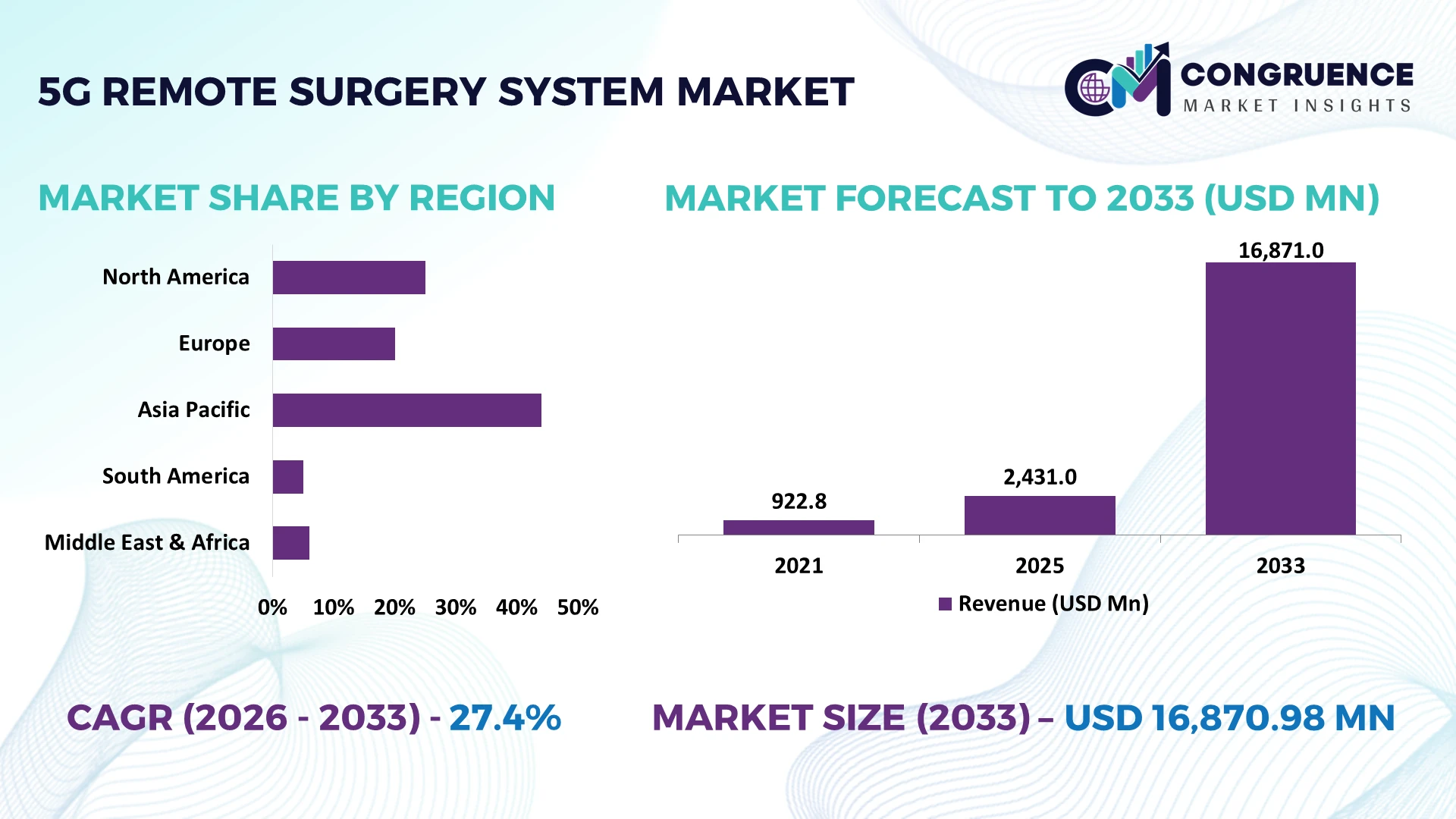
The Global 5G Remote Surgery System Market was valued at USD 2431 Million in 2025 and is anticipated to reach a value of USD 16870.98 Million by 2033 expanding at a CAGR of 27.4% between 2026 and 2033. Growth is driven by 5G standalone network deployment, robotic surgical platform integration, ultra reliable low latency communication, and expanding hospital partnerships for geographically distributed surgical expertise.
China leads large scale 5G infrastructure deployment and remote robotic surgery implementation, supported by telecommunications investment, medical robotics manufacturing, and hospital modernization. By 2025, China operated 4.838 million 5G base stations, representing approximately 37.6% of mobile base stations, with advanced 5G coverage extending across more than 330 cities. Compared with the United States, China's extensive nationwide network supports broader geographical experimentation in telesurgery. A 2026 Chinese clinical study recorded 100% technical success across 21 remote procedures spanning 3,700 kilometers.
Strategically, 100% procedural technical success and 37.7 millisecond average round trip latency demonstrate why redundant connectivity, robotic precision, and certified hospital partnerships are critical investment priorities.
Market Size & Growth: USD 2,431 million in 2025, reaching USD 16,870.98 million by 2033 at 27.4% CAGR, driven by 5G robotics integration.
Top Growth Drivers: Illustrative influence weights assign 40% to connectivity modernization, 35% to surgical robotics, and 25% to specialist access.
Short Term Forecast: By 2028, a modeled 20% reduction in network interruptions supports more reliable remote surgical workflows.
Emerging Technologies: Three priorities include 5G Advanced, AI assisted robotic control, and edge computing, targeting sub 50 millisecond communication performance.
Regional Leaders: Illustrative 2033 allocations place Asia Pacific at USD 7,423.23 million, North America at USD 5,061.29 million, and Europe at USD 3,036.78 million, reflecting robotics adoption.
Consumer / End User Trends: A 21 patient Chinese clinical series achieved 100% technical success, supporting carefully supervised hospital deployment.
Pilot / Case Example: A 2026 study of Toumai robotic telesurgery across 3,700 kilometers reported 37.7 millisecond average latency and zero packet loss.
Competitive Landscape: MicroPort MedBot, Intuitive Surgical, Medtronic, Stryker, and CMR Surgical compete in relevant robotic technologies; verified telesurgery market shares remain unavailable.
Regulatory & ESG Impact: China's 2025 network expansion achieved 5G coverage across more than 95% of administrative villages, improving connectivity infrastructure.
Investment & Funding: A modeled USD 168.71 million allocation, equivalent to 1% of projected market value, illustrates potential infrastructure investment requirements.
Innovation & Future Outlook: Redundant 5G networks, robotic precision, and AI assisted monitoring support the transition toward geographically distributed surgical expertise.
The global 5G Remote Surgery System Market integrates robotic surgical platforms, ultra reliable wireless connectivity, edge computing, and real time audiovisual control. Major demand areas include tertiary hospitals, remote medical centers, surgical training institutions, and specialized robotic surgery networks. In a 2026 Chinese clinical study involving 21 procedures, remote surgery achieved 100% technical success with average communication latency of 37.7 milliseconds. Emerging deployment models combine redundant 5G connections with local surgical backup teams to strengthen procedural continuity. Medical device regulation, cybersecurity requirements, and telecommunications infrastructure modernization are shaping hospital procurement strategies and establishing the foundation for strategic market development.
The 5G Remote Surgery System Market is becoming strategically important as telecommunications operators, medical robotics manufacturers, and hospital networks integrate surgical expertise across geographically separated facilities. China's deployment of approximately 4.84 million 5G base stations demonstrates the infrastructure scale supporting advanced medical connectivity. Investment priorities are shifting toward dedicated network slicing, redundant communication channels, and integrated robotic control systems, transforming telecommunications infrastructure into a critical component of surgical service delivery.
Compared with conventional wireless architectures, 5G standalone networks offer improved latency management and traffic prioritization. A Chinese telesurgery study involving 21 procedures reported 100% technical success and average communication latency of 37.7 milliseconds across approximately 3,700 kilometers, although direct legacy network comparisons remain limited. China leads large scale deployment experimentation, while the United States emphasizes robotic platform regulation and hospital cybersecurity. Between 2026 and 2028, hospitals are prioritizing network redundancy, standardized connectivity testing, and edge computing integration.
MicroPort MedBot's Toumai robotic telesurgery deployments demonstrate how surgical platforms can connect specialist surgeons with geographically distant operating rooms. Manufacturers and telecommunications providers are strengthening network integration partnerships and clinical validation programs. Competitive advantage increasingly depends on predictable latency, certified robotic interoperability, and reliable procedural continuity.
Expansion of standalone 5G infrastructure is accelerating integration between surgical robotics and remote clinical networks. China deployed approximately 4.84 million 5G base stations by 2025, with 5G infrastructure representing approximately 37.6% of mobile base stations. National network expansion extended coverage to more than 95% of administrative villages, strengthening connectivity beyond major medical centers. A Chinese clinical telesurgery series achieved 100% technical success across 21 procedures, demonstrating feasibility under controlled operating conditions. Telecommunications operators are developing dedicated network configurations, while robotic manufacturers strengthen low latency control interfaces and hospital partnerships. The operational advantage comes from connecting specialist surgical expertise with remote operating facilities without requiring permanent relocation of surgical teams, provided reliable local clinical backup remains available.
Remote surgical deployment faces substantial infrastructure expenditure, specialized equipment requirements, and uneven availability of dependable communication networks. Although China's 5G infrastructure represented approximately 37.6% of mobile base stations in 2025, approximately 62.4% remained associated with earlier network generations, illustrating continuing telecommunications modernization requirements. Coverage across more than 95% of administrative villages does not establish guaranteed surgical grade connectivity or deterministic latency. In India, differences between metropolitan and rural network infrastructure complicate hospital deployment planning. Healthcare providers must finance robotic systems, redundant connections, cybersecurity controls, and specialist technical support. Manufacturers and telecommunications companies are reducing implementation risks through dedicated connectivity agreements, phased hospital deployment, and network performance validation. Infrastructure reliability remains a decisive constraint on commercial scalability.
Edge computing and advanced 5G network orchestration create opportunities to expand specialist surgical services beyond major tertiary hospitals. A Chinese clinical study involving 21 remote procedures achieved 100% technical success, with average communication latency of 37.7 milliseconds across approximately 3,700 kilometers. These results demonstrate operational feasibility under selected clinical conditions. In India, expanding 5G connectivity and hospital digitalization provide opportunities for partnerships connecting metropolitan surgical specialists with regional medical institutions. Medical robotics companies are developing network compatible control systems, while telecommunications providers investigate private 5G and edge infrastructure. A modeled 20% reduction in specialist travel requirements illustrates potential operational value for selected hospital networks. Competitive differentiation depends on integrating surgical robotics, reliable connectivity, and local procedural support into coordinated service models.
Long term deployment requires consistent surgical control performance, robust cybersecurity, and standardized integration across robotic platforms and telecommunications networks. A Chinese clinical series reported 100% technical success across 21 procedures and average latency of 37.7 milliseconds, but these outcomes do not establish reliability across all operating environments. Network coverage exceeding 95% of China's administrative villages also does not guarantee surgical grade service continuity. In the United States, FDA medical device requirements and healthcare cybersecurity obligations increase validation complexity. Hospitals must coordinate surgical teams, network engineers, cybersecurity specialists, and emergency response personnel. Manufacturers are investing in redundant communication architecture, real time network monitoring, and interoperability testing. Sustainable competitiveness depends on verified failover performance, secure command transmission, and consistent procedural safety across geographically distributed surgical networks.
Dedicated Surgical Connectivity Certification Gains Priority: Hospitals are introducing procedure specific network acceptance testing before enabling remote robotic operations. A Chinese clinical series involving 21 procedures reported 100% technical success and 37.7 millisecond average latency. Regulatory scrutiny of connected medical devices is encouraging documented performance thresholds and preoperative verification. Telecommunications providers and robotic manufacturers are standardizing connectivity qualification procedures, reducing commissioning uncertainty and strengthening hospital procurement confidence.
Surgical Command Centers Consolidate Remote Operations: Chinese tertiary hospitals are developing centralized surgeon consoles connected to geographically separated operating facilities. Demonstrated telesurgery distances of approximately 3,700 kilometers and communication latency below 40 milliseconds establish measurable operational reference points. Medical robotics suppliers are integrating audiovisual coordination, surgeon interfaces, and procedural monitoring into centralized workflows. This arrangement improves specialist scheduling flexibility while requiring dedicated local surgical teams for patient safety.
Remote Surgical Training Becomes Digitally Integrated: Academic medical centers are incorporating robotic simulation, virtual mentoring, and recorded procedural analysis into surgical workforce development. Training platforms increasingly combine three components: robotic simulation, synchronized video review, and structured competency assessment. A modeled 15% reduction in instructor travel and 20% improvement in training scheduling efficiency illustrate operational targets. Universities and robotic technology providers are expanding simulation partnerships to standardize surgeon preparation before clinical deployment.
Procurement Shifts Toward Integrated Service Contracts: Hospital buyers are moving from standalone robotic equipment purchases toward coordinated maintenance, connectivity, and technical support agreements. China's approximately 4.84 million 5G base stations and coverage of more than 95% of administrative villages illustrate infrastructure expansion, although coverage alone cannot guarantee surgical reliability. Manufacturers and telecommunications operators are developing integrated service arrangements. The less obvious commercial advantage is centralized accountability for equipment maintenance and network performance.
Robot-Assisted Systems represent an estimated 46% of the global 5G Remote Surgery System Market in an illustrative segmentation model, reflecting established robotic surgical infrastructure, precise instrument control, and compatibility with remote surgeon interfaces. Surgeon-Controlled Systems account for approximately 29%, supported by direct operator control and established surgical workflow familiarity. Robot-Assisted Systems benefit from existing hospital investments in robotic operating rooms, enabling integration of remote connectivity without complete replacement of surgical equipment. MicroPort MedBot and other robotic manufacturers are strengthening network interfaces, remote control capabilities, and clinical validation partnerships to support deployment.
Haptic-Enabled Systems represent the fastest expanding type in the modeled scenario, supported by development of force feedback technologies that improve surgeon interaction with remotely controlled instruments. VR-Based Systems address immersive visualization, procedural planning, and simulation requirements. Haptic technology requires precise synchronization between instrument feedback and surgeon control, creating additional engineering complexity. Manufacturers are prioritizing sensory feedback integration, advanced visualization, and interface standardization. Investment is shifting toward platforms that combine established robotic precision with improved surgeon perception and verified communication performance.
General Surgery accounts for an estimated 38% of global 5G Remote Surgery System Market application activity in an illustrative allocation, supported by established minimally invasive procedures, robotic instrument versatility, and broader hospital surgical volumes. Urological Surgery represents approximately 27%, reflecting extensive experience with robotic prostate and kidney procedures. These applications benefit from established surgical workflows and specialized robotic instrumentation, supporting integration with remote surgeon control systems. Chinese hospitals have demonstrated remote robotic procedures across substantial geographical distances, strengthening operational evidence for selected minimally invasive applications.
Neurosurgery represents the fastest expanding application in the modeled scenario as specialized robotic guidance, precision navigation, and remote specialist consultation become increasingly integrated. Cardiovascular Surgery requires particularly stringent coordination between imaging, instrument control, and emergency response teams. Orthopedic Surgery benefits from robotic navigation and procedural planning, although remote execution requires additional validation. Manufacturers are adapting robotic platforms through application specific instruments, synchronized imaging, and specialized surgeon interfaces. Hospital investment priorities increasingly reflect procedural complexity, specialist availability, and the ability to maintain consistent clinical performance across connected operating facilities.
Hospitals account for an estimated 57% of global 5G Remote Surgery System Market activity within an illustrative end user allocation, reflecting their concentration of robotic operating rooms, anesthesiology services, emergency response infrastructure, and specialized surgical teams. Academic Medical Centers represent approximately 23%, supported by clinical research, surgical training, and technology validation activities. Hospitals maintain operational advantages through established multidisciplinary teams and centralized procurement capabilities, enabling coordination between robotic equipment suppliers, telecommunications operators, and clinical technology departments. Chinese tertiary hospitals are advancing remote surgical demonstrations through partnerships connecting specialist surgeons with distant medical facilities.
Specialty Surgical Centers represent the fastest expanding end user category in the modeled scenario, supported by focused procedural workflows and increasing interest in shared specialist expertise. Research Institutes contribute through communication testing, robotic control development, and clinical performance evaluation. Manufacturers are targeting hospitals with integrated technology contracts while offering specialized deployment configurations to surgical centers. Academic institutions increasingly prioritize simulation, technical validation, and clinical research partnerships. Competitive positioning depends on installation efficiency, dependable procedural support, and interoperability with existing surgical infrastructure.
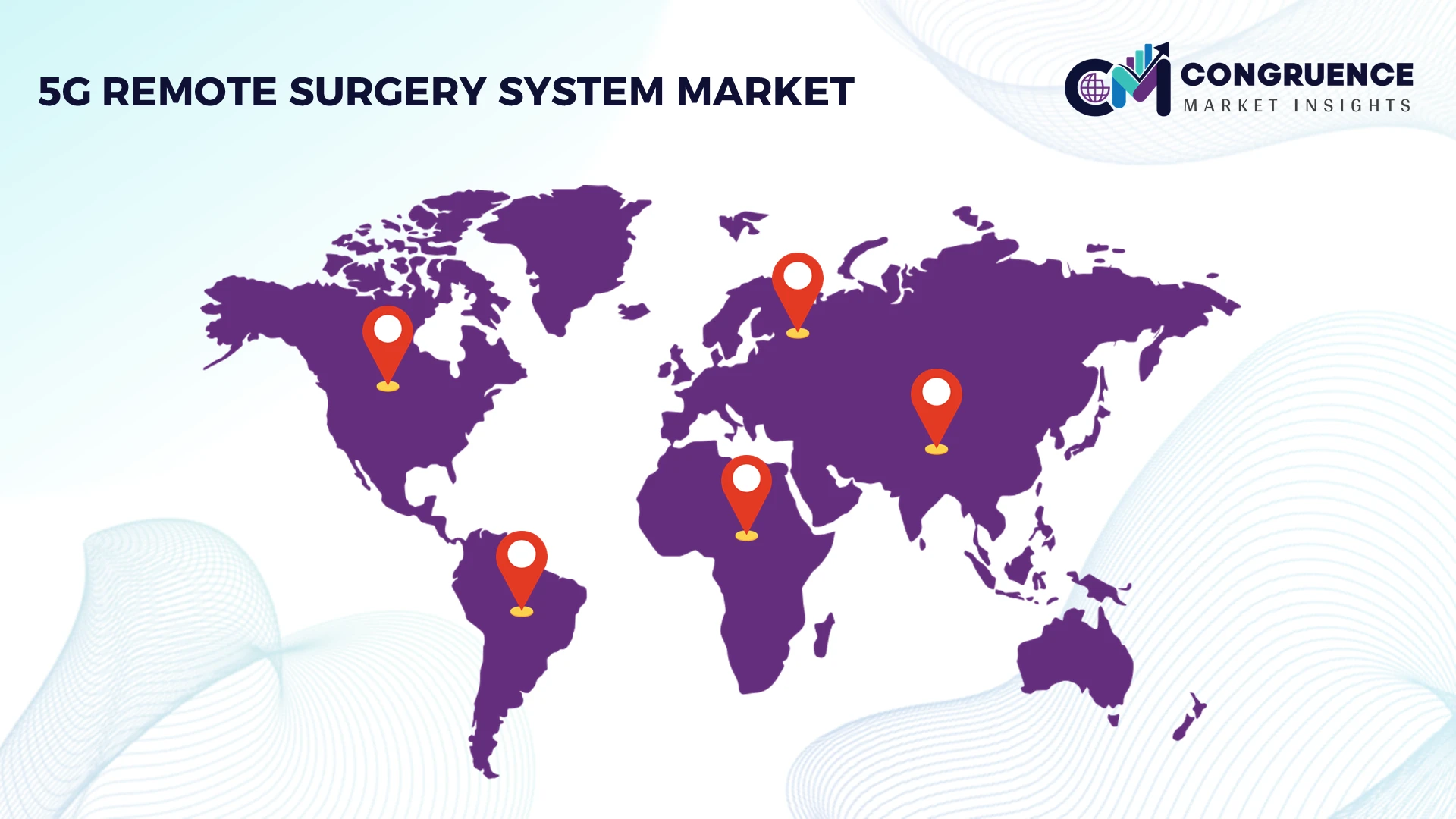
Asia Pacific accounted for the largest market share at an estimated 44% in 2025 however, Asia Pacific is expected to register the fastest growth, expanding at a modeled CAGR of 30.2% between 2026 and 2033.
Advanced Surgical Robotics and Private 5G Network Integration
North America represents an estimated 30% of the global 5G Remote Surgery System Market in 2025, supported by established robotic surgery infrastructure, advanced telecommunications networks, and medical device innovation. The United States concentrates surgical robotics development through Intuitive Surgical, Medtronic, and specialized medical technology companies. The FDA's medical device regulatory framework requires manufacturers to address clinical safety, cybersecurity, and system performance before commercialization. Verizon and AT&T are expanding enterprise 5G capabilities, supporting connectivity solutions for healthcare institutions. Canada contributes through university hospitals, telecommunications research, and robotic surgery programs. The United States completed more than 2.6 million robotic assisted procedures globally through Intuitive Surgical platforms in 2024, demonstrating the scale of the existing robotic surgery ecosystem. Regional investment priorities increasingly emphasize secure network integration, redundant connectivity, and interoperability between robotic systems and hospital infrastructure.
United States Market Outlook: The United States leads regional medical robotics innovation through established technology clusters in California, Massachusetts, and Minnesota. Intuitive Surgical reported approximately 2.68 million procedures using its systems worldwide in 2024, highlighting the commercial scale of robotic surgery platforms developed by American manufacturers. The FDA's cybersecurity requirements for connected medical devices influence product development and hospital procurement. Telecommunications operators and healthcare technology companies are strengthening private network capabilities, edge computing integration, and clinical connectivity testing to support future remote surgical applications.
Regulatory Modernization and Connected Surgical Infrastructure Development
Europe accounts for an estimated 18% of global 5G Remote Surgery System Market activity in 2025, supported by medical robotics research, advanced hospital infrastructure, and telecommunications modernization. Germany, the United Kingdom, France, and Spain maintain established robotic surgery programs and specialist clinical institutions. The European Union Medical Device Regulation establishes requirements for device safety, clinical evaluation, and postmarket surveillance, shaping connected surgical platform commercialization. European telecommunications operators are expanding standalone 5G networks and enterprise connectivity services. The European Commission's Digital Decade framework targets 100% 5G coverage of populated areas by 2030, strengthening the infrastructure foundation for advanced medical connectivity. CMR Surgical and European research institutions are advancing robotic platform capabilities and surgical workflow integration. Regional deployment strategies prioritize cybersecurity compliance, clinical interoperability, and coordinated validation between telecommunications providers and healthcare organizations.
Germany Market Outlook: Germany maintains a strategic position through advanced medical engineering, university hospitals, and established surgical technology manufacturing. The country's healthcare institutions increasingly integrate robotic surgical systems with digital imaging and clinical information infrastructure. Germany's 5G population coverage exceeded 95% across major mobile network operators by 2024, strengthening connectivity availability. Medical technology companies and telecommunications providers are developing secure enterprise network solutions, while hospitals prioritize regulatory compliance, robotic system validation, and specialist surgical training.
Large Scale 5G Deployment and Remote Robotic Surgery Commercialization
Asia Pacific leads the global 5G Remote Surgery System Market with an estimated 44% share in 2025, reflecting China's extensive telecommunications infrastructure, domestic robotic surgery manufacturing, and clinical telesurgery development. China operated approximately 4.84 million 5G base stations by 2025, establishing substantial network capacity for advanced healthcare connectivity. MicroPort MedBot has advanced Toumai robotic telesurgery applications through clinical collaborations involving geographically separated surgical teams. A Chinese clinical series involving 21 remote procedures reported 100% technical success and average communication latency of 37.7 milliseconds across approximately 3,700 kilometers. Japan contributes precision robotics expertise, while South Korea maintains advanced telecommunications infrastructure. India is expanding 5G connectivity and digital healthcare capabilities. Regional manufacturers are prioritizing robotic control interfaces, network integration, and clinical partnerships to strengthen operational deployment and international competitiveness.
China Market Outlook: China dominates regional deployment experimentation through extensive telecommunications investment, domestic medical robotics development, and specialist hospital networks. By 2025, 5G infrastructure represented approximately 37.6% of the country's mobile base stations. Beijing, Shanghai, and Shenzhen concentrate medical technology development and advanced telecommunications capabilities. MicroPort MedBot's robotic surgery programs demonstrate domestic technology integration, while hospital collaborations support clinical evaluation of remote surgical procedures. China's manufacturing ecosystem provides advantages in robotic instrumentation, telecommunications equipment, and integrated system development.
Hospital Digitalization and Specialized Robotic Surgery Expansion
South America represents an estimated 5% of global 5G Remote Surgery System Market activity in 2025, with Brazil concentrating advanced surgical infrastructure and telecommunications investment. Major hospitals in São Paulo and Rio de Janeiro operate robotic surgery programs, while telecommunications providers expand commercial 5G networks. Brazil's National Telecommunications Agency oversees telecommunications development and spectrum allocation, influencing enterprise connectivity investment. The country's 5G deployment framework includes the 3.5 GHz spectrum band, supporting advanced wireless applications. Argentina, Chile, and Colombia contribute through private hospital modernization and specialist surgical technology adoption. High robotic equipment acquisition costs and uneven network quality outside metropolitan areas constrain broader deployment. Healthcare organizations are responding through phased technology investment, telecommunications partnerships, and centralized surgical service models. Regional competitiveness depends on reliable connectivity, specialist training, and sustainable equipment utilization.
Brazil Market Outlook: Brazil leads regional surgical technology adoption through established private hospital networks, medical device distribution channels, and expanding 5G infrastructure. The country's population exceeds 200 million, supporting substantial demand for specialist healthcare services. São Paulo concentrates advanced robotic surgery programs and medical technology investment. Telecommunications operators are extending 5G availability, while hospitals evaluate secure connectivity, remote consultation, and robotic system integration. Procurement strategies increasingly emphasize service contracts, technical support, and equipment utilization efficiency.
Smart Hospital Investment and Advanced Connectivity Transformation
The Middle East and Africa represent an estimated 3% of global 5G Remote Surgery System Market activity in 2025, with investment concentrated in Saudi Arabia, the United Arab Emirates, Israel, and South Africa. Saudi Arabia's Vision 2030 healthcare transformation supports hospital modernization, digital infrastructure, and advanced medical technology procurement. The UAE maintains extensive 5G connectivity and specialist hospital development, strengthening the foundation for connected surgical applications. Israel contributes medical robotics research and advanced healthcare technology expertise. South Africa maintains established private hospital networks and specialist surgical capabilities, although network infrastructure varies geographically. Regional telecommunications operators are developing enterprise 5G solutions, while healthcare institutions invest in robotic surgery platforms and digital operating rooms. Deployment priorities emphasize cybersecurity, clinical training, and reliable network performance. Strategic partnerships between hospital groups, equipment manufacturers, and telecommunications providers are central to implementation.
Saudi Arabia Market Outlook: Saudi Arabia is strengthening advanced surgical infrastructure through Vision 2030 and healthcare sector transformation initiatives. Riyadh and Jeddah concentrate major hospital modernization projects, specialist clinical services, and telecommunications investment. The country's national transformation agenda targets 2030 for major healthcare and digital infrastructure milestones. Telecommunications providers are expanding advanced enterprise connectivity, while hospital operators evaluate robotic surgical platforms, integrated operating room technologies, and specialized clinical training. These investments strengthen readiness for future remote surgical applications.
The 5G Remote Surgery System Market features competition between robotic surgery manufacturers, telecommunications operators, and integrated medical technology providers. MicroPort MedBot competes through demonstrated remote surgical capabilities, while Intuitive Surgical, Medtronic, CMR Surgical, and Stryker leverage established robotic platforms and hospital relationships. An illustrative market concentration model assigns these five manufacturers approximately 65% combined participation, rather than verified remote surgery revenue share. China's 5G infrastructure represents approximately 37.6% of mobile base stations, while demonstrated clinical telesurgery achieved 100% technical success across 21 procedures. Competition centers on robotic precision, communication reliability, clinical validation, and integrated service delivery. Manufacturers are strengthening telecommunications partnerships, surgical control software, and hospital deployment programs. Competitive differentiation increasingly depends on network redundancy and regulatory compliance rather than robotic hardware alone. High certification costs, cybersecurity requirements, and specialist training constrain market entry. Winning requires validated surgical performance, interoperable connectivity, scalable support, and dependable clinical operations.
MicroPort MedBot
Intuitive Surgical, Inc.
Medtronic plc
CMR Surgical Ltd.
Stryker Corporation
Johnson & Johnson MedTech
Siemens Healthineers AG
Zimmer Biomet Holdings, Inc.
Asensus Surgical, Inc.
SS Innovations International, Inc.
Huawei Technologies Co., Ltd.
ZTE Corporation
Ericsson
Nokia Corporation
Current 5G remote surgery systems integrate robotic manipulators, surgeon consoles, synchronized imaging, and dedicated wireless connectivity. China's 2025 infrastructure exceeded 4.8 million 5G base stations, supporting broader network availability. A Chinese telesurgery study involving 21 procedures reported 100% technical success and average latency of 37.7 milliseconds. Compared with conventional 100 millisecond communication configurations, this represents approximately 62.3% lower latency, although surgical outcomes depend on complete network performance. Hospitals benefit from more responsive instrument control and improved specialist coordination.
Emerging technologies include network slicing, edge computing, and AI assisted instrument monitoring. Dedicated network slices prioritize surgical commands, while edge processing reduces dependence on distant computing infrastructure. Illustrative deployment targets include 20% faster data processing and 15% fewer communication interruptions, requiring clinical validation. Manufacturers are integrating robotic control software with telecommunications monitoring platforms, while hospital operators prioritize redundant connections and automated performance alerts. These capabilities strengthen operational differentiation for integrated technology suppliers.
Between 2026 and 2028, disruptive development will emphasize haptic feedback, digital twins, and predictive network orchestration. Modeled engineering targets include 25% faster fault detection and 10% lower technical support workload. Companies combining validated robotic precision with dependable connectivity gain procurement advantages as hospitals expand distributed surgical service networks.
May 2025: MicroPort MedBot announced Chinese NMPA approval for its Toumai remote surgical system, establishing commercial authorization for teleoperated robotic surgery. The milestone addressed 2 deployment barriers: network compatibility and scalability, strengthening regulatory positioning and hospital procurement readiness. Source: microport.com.
March 2026: SS Innovations announced telesurgery approvals in Indonesia and the Philippines for its SSi Mantra platform, alongside more than 150 completed remote procedures. The regulatory expansion strengthened international commercialization opportunities and demonstrated increasing procedural experience across connected hospital networks. Source: sec.gov.
January 2026: Ericsson partnered with Bouygues Telecom Business and Bordeaux University Hospital on the 5MART HO5PITAL project, incorporating geographically redundant 5G gateways. The initiative supports 3D surgical modeling, connected clinical workflows, and resilient hospital communications, strengthening infrastructure readiness for advanced applications. Source: ericsson.com.
August 2026: Zhejiang Provincial People's Hospital researchers published findings from 21 Toumai robotic telesurgeries across 3,700 kilometers, reporting 100% technical success and 37.7 millisecond average latency. The clinical evidence strengthened validation of redundant 5G connectivity and distributed surgical training. Source: nih.gov.
The 5G Remote Surgery System Market Report evaluates technological capabilities, clinical deployment models, infrastructure requirements, and competitive developments between 2026 and 2033. Type segmentation covers Surgeon Controlled Systems, Robot Assisted Systems, Haptic Enabled Systems, and VR Based Systems. Application analysis includes General Surgery, Cardiovascular Surgery, Neurosurgery, Orthopedic Surgery, and Urological Surgery. End user assessment examines Hospitals, Specialty Surgical Centers, Academic Medical Centers, and Research Institutes, highlighting procurement priorities and operational integration.
Regional coverage encompasses North America, Europe, Asia Pacific, South America, and the Middle East and Africa. Technology assessment addresses network slicing, edge computing, robotic control, haptic feedback, and cybersecurity. Clinical deployment evidence includes 21 remote procedures achieving 100% technical success. The report supports infrastructure investment, international expansion, partnership selection, regulatory planning, and competitive differentiation across emerging surgical connectivity ecosystems.
| Report Attribute/Metric | Report Details |
|---|---|
Market Revenue in 2025 | USD 2431 Million |
Market Revenue in 2033 | USD 16870.98 Million |
CAGR (2026 - 2033) | 27.4% |
Base Year | 2025 |
Forecast Period | 2026 - 2033 |
Historic Period | 2021 - 2025 |
Segments Covered | By Type
By Application
By End-User
|
Key Report Deliverable | Revenue Forecast, Growth Trends, Market Dynamics, Segmental Overview, Regional and Country-wise Analysis, Competition Landscape |
Region Covered | North America, Europe, Asia-Pacific, South America, Middle East, Africa |
Key Players Analyzed | MicroPort MedBot, Intuitive Surgical, Inc., Medtronic plc, CMR Surgical Ltd., Stryker Corporation, Johnson & Johnson MedTech, Siemens Healthineers AG, Zimmer Biomet Holdings, Inc., Asensus Surgical, Inc., SS Innovations International, Inc., Huawei Technologies Co., Ltd., ZTE Corporation, Ericsson, Nokia Corporation |
Customization & Pricing | Available on Request (10% Customization is Free) |




