
Reports
The Global 3rd Generation Lentiviral Vector Market was valued at USD 258 Million in 2025 and is anticipated to reach a value of USD 541.09 Million by 2033 expanding at a CAGR of 9.7% between 2026 and 2033. Growth is driven by CAR T cell therapy manufacturing, ex vivo gene modification, expanding clinical pipelines for inherited disorders, and adoption of scalable GMP compliant lentiviral vector production platforms.
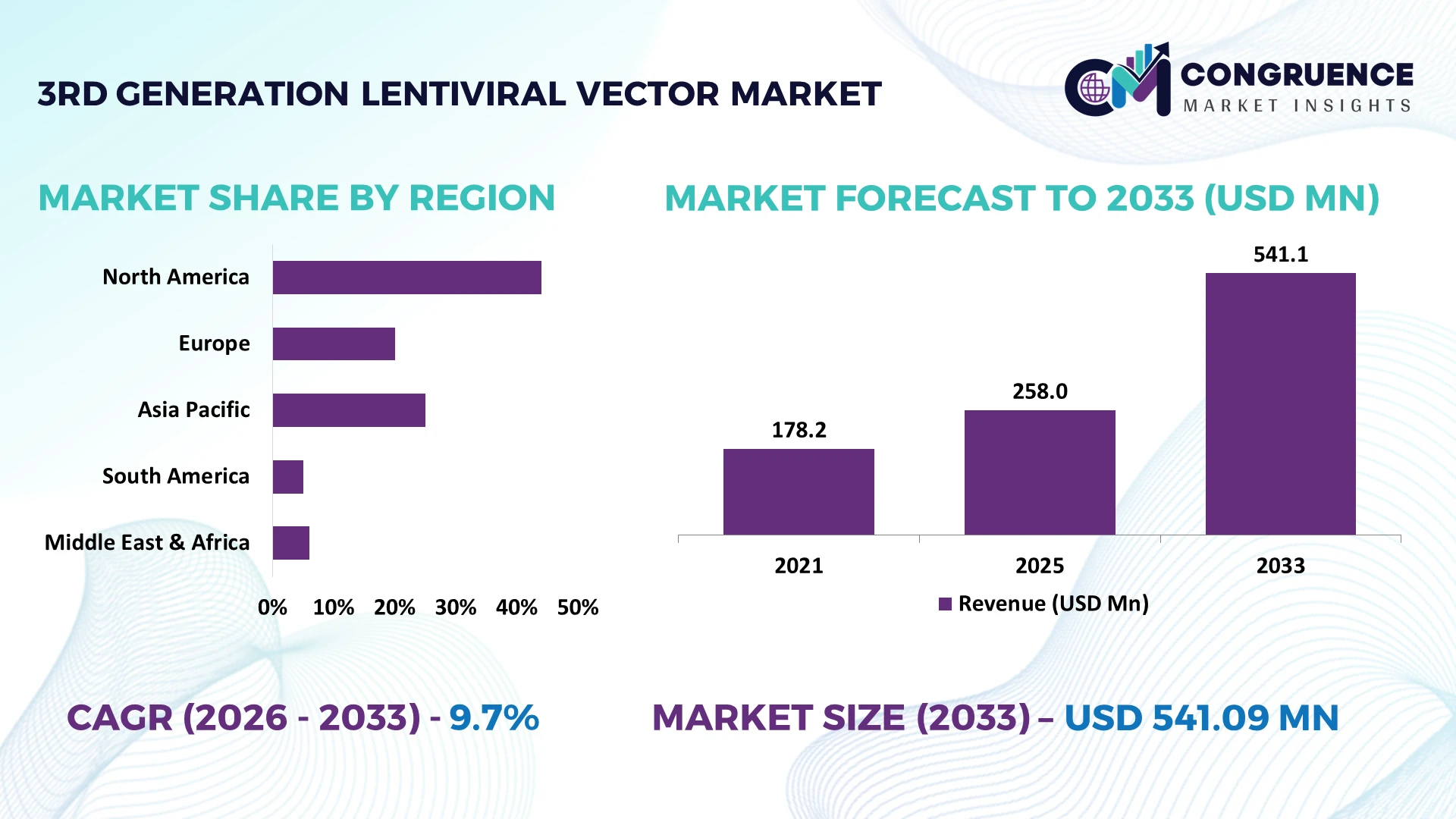
The United States dominates the global 3rd Generation Lentiviral Vector Market, with an indicative 42% share in 2025, supported by advanced cell therapy manufacturing infrastructure and specialized biotechnology investment. The FDA has approved multiple lentiviral vector enabled therapies, including Kymriah and Zynteglo, strengthening commercial manufacturing requirements. Third generation systems commonly use 4 plasmid components to separate vector packaging functions. Compared with China, the United States maintains a stronger established commercial gene therapy regulatory ecosystem, while China expands domestic clinical development and manufacturing capabilities.
Strategically, manufacturers targeting 20% higher functional vector yields and 15% shorter production cycles through optimized upstream processing strengthen capacity utilization and competitive positioning.
Market Size & Growth: USD 258 million in 2025, reaching USD 541.09 million by 2033 at 9.7% CAGR, supported by expanding cell therapy manufacturing.
Top Growth Drivers: Indicative demand contributions comprise 45% CAR T cell therapy expansion, 35% gene therapy development, and 20% vector manufacturing modernization.
Short Term Forecast: By 2028, optimized production platforms target 20% higher functional vector yields and 15% shorter manufacturing cycles.
Emerging Technologies: Stable producer cell lines, automated bioreactors, and advanced purification systems target 25% greater manufacturing productivity.
Regional Leaders: Illustrative 2033 allocations place North America at USD 227.26 million, Europe at USD 151.51 million, and Asia Pacific at USD 119.04 million.
Consumer / End User Trends: Biotechnology and pharmaceutical companies represent an estimated 45% of vector procurement demand, prioritizing clinical manufacturing reliability.
Pilot / Case Example: In 2024, commercial cell therapy manufacturing initiatives advanced closed processing systems, with modeled productivity targets of 20%.
Competitive Landscape: Oxford Biomedica holds an illustrative 15% segment position; Lonza, Thermo Fisher Scientific, Charles River Laboratories, and Sartorius compete.
Regulatory & ESG Impact: FDA GMP requirements strengthen process validation; optimized single use manufacturing targets 15% lower cleaning resource consumption.
Investment & Funding: An illustrative USD 250 million sector investment scenario prioritizes GMP capacity expansion, automation, and manufacturing technology partnerships.
Innovation & Future Outlook: By 2033, stable producer platforms and continuous purification target 30% higher vector manufacturing throughput and improved supply reliability.
The 3rd Generation Lentiviral Vector Market supports genetic modification technologies used in CAR T cell therapies, hematopoietic stem cell treatments, and experimental therapies targeting inherited disorders. Third generation lentiviral systems separate essential packaging functions across multiple plasmids, supporting improved biosafety architecture and controlled vector production. Manufacturing innovation increasingly emphasizes suspension cell culture, automated transfection, and scalable purification technologies. In modeled production scenarios, optimized upstream processing targets 20% higher functional vector recovery, improving batch productivity. FDA oversight of gene therapy manufacturing reinforces demand for validated analytical methods, consistent vector potency, and traceable production processes, establishing the foundation for strategic manufacturing investment.
Third generation lentiviral vectors are becoming strategically important as cell and gene therapy manufacturers prioritize reliable genetic modification, scalable production, and regulatory compliance. Commercialization of CAR T cell therapies and genetically modified stem cell treatments is shifting investment toward specialized GMP manufacturing infrastructure. Third generation systems typically distribute essential packaging functions across 4 plasmids, supporting established biosafety architectures. The United States maintains an indicative 42% market position, reflecting its concentration of commercial cell therapy developers, specialized manufacturers, and established regulatory pathways.
Manufacturers are transitioning from conventional adherent cell production toward suspension bioreactors and optimized transient transfection systems. Under modeled operating conditions, suspension processing targets 20% higher functional vector output and 15% lower labor requirements compared with traditional adherent workflows. China is expanding domestic vector manufacturing capabilities, while Germany emphasizes validated bioprocessing technologies and specialized contract manufacturing. Between 2026 and 2028, production standardization and improved analytical testing will influence supplier selection.
Oxford Biomedica's lentiviral vector manufacturing operations illustrate the importance of integrated process development and commercial production capabilities. Lonza and Thermo Fisher Scientific are strengthening advanced therapy manufacturing services and enabling technologies. Competitive advantage increasingly depends on consistent vector potency, validated scalability, and dependable manufacturing capacity.
Commercial expansion of genetically modified cell therapies is strengthening demand for GMP grade third generation lentiviral vectors. CAR T cell therapies require dependable gene transfer systems, while hematopoietic stem cell treatments depend on controlled genetic modification and validated manufacturing processes. An indicative 45% of market demand is associated with CAR T cell therapy applications, while gene therapy development contributes approximately 35%. In modeled production environments, optimized upstream processing targets 20% higher functional vector yields. FDA oversight of cellular and gene therapy products reinforces requirements for manufacturing consistency, vector characterization, and product traceability. Oxford Biomedica, Lonza, and specialized contract manufacturers are strengthening process development capabilities and commercial production partnerships. Manufacturing reliability increasingly determines therapy development timelines and supplier competitiveness.
Third generation lentiviral vector production remains constrained by expensive GMP materials, specialized manufacturing infrastructure, and dependence on qualified plasmid DNA and cell culture suppliers. Conventional transient transfection workflows require multiple plasmids, increasing raw material coordination and batch preparation complexity. In illustrative manufacturing cost models, plasmid inputs represent 20% of direct production expenditure, while quality control activities contribute approximately 25%. Supply interruptions involving GMP plasmids, transfection reagents, or specialized filtration materials can delay production campaigns. United States manufacturers face additional pressure from stringent supplier qualification and documentation requirements. Companies are reducing exposure through dual sourcing, long term material agreements, and localized plasmid manufacturing partnerships. Stronger supply continuity improves batch scheduling, capacity utilization, and production economics.
Stable lentiviral producer cell lines and automated bioprocessing platforms offer opportunities to reduce dependence on repeated transient transfection and improve manufacturing consistency. Advanced suspension culture systems support larger production volumes, while automated monitoring strengthens control over critical process parameters. Under modeled operating conditions, stable producer platforms target 25% lower plasmid related material requirements, while automated downstream processing targets 20% shorter purification cycles. India's expanding biotechnology manufacturing infrastructure creates opportunities for specialized vector production services and technology transfer partnerships. Manufacturers are investing in producer cell line development, scalable chromatography, and integrated process analytics. A strategically important opportunity involves licensing standardized production platforms to smaller therapy developers, reducing their manufacturing development burden while creating recurring technical service demand.
Maintaining consistent vector quality during manufacturing scale up presents a significant execution challenge for third generation lentiviral vector suppliers. Changes in bioreactor conditions, cell physiology, and downstream purification performance can affect functional titer, vector integrity, and product comparability. In modeled scale up scenarios, a 15% reduction in functional recovery increases production pressure, while 20% additional analytical testing requirements extend batch release preparation. FDA expectations for potency assessment, replication competent lentivirus testing, and manufacturing comparability increase validation complexity. United States and German manufacturers must coordinate specialized analytical expertise with evolving production technologies. Companies are investing in process analytical technologies, standardized potency assays, and experienced technical personnel. Long term competitiveness depends on reproducible commercial scale production without compromising vector safety or therapeutic performance.
Potency Testing Becomes Procurement Priority: Gene therapy manufacturers are strengthening functional titer assessment alongside conventional particle quantification. FDA expectations for potency testing reinforce this transition. In modeled quality control workflows, standardized assays target 15% fewer analytical discrepancies and 20% shorter investigation cycles. Oxford Biomedica and specialized testing providers are prioritizing assay harmonization, improving batch comparability and reducing uncertainty during technology transfers between development and commercial manufacturing facilities.
Cryopreserved Vector Inventories Improve Scheduling: Cell therapy developers are increasingly evaluating frozen vector inventory strategies to separate vector manufacturing schedules from patient specific cell processing. Illustrative inventory models target 15% fewer production scheduling conflicts and 10% shorter manufacturing preparation periods. Suppliers are strengthening stability testing and controlled storage capabilities. The operational advantage comes from reducing manufacturing coordination requirements without compromising validated vector potency or established product release specifications.
Vector Design Optimization Strengthens Transduction Performance: Developers are refining envelope pseudotyping, promoter selection, and vector genome architecture to improve cell specific gene delivery. In modeled laboratory comparisons, optimized vector constructs target 20% higher functional transduction and 15% lower vector consumption per manufacturing run. Biotechnology companies are expanding construct screening programs and specialized engineering partnerships, improving therapeutic manufacturing economics while preserving established third generation lentiviral safety architecture.
Digital Batch Records Strengthen Manufacturing Traceability: GMP facilities are replacing fragmented documentation with electronic batch records and integrated quality management systems. Illustrative implementation scenarios target 20% fewer documentation corrections and 15% faster batch record review. United States manufacturers are strengthening digital quality infrastructure to meet regulatory inspection expectations. Technology providers are integrating electronic records with manufacturing execution systems, reducing administrative bottlenecks and improving audit readiness across complex vector production campaigns.
Self-Inactivating Vectors represent the leading segment, accounting for an estimated 45% of the global 3rd Generation Lentiviral Vector Market in 2025. Their dominance reflects established use in gene transfer applications requiring reduced promoter activity from integrated long terminal repeat sequences. These vectors are widely incorporated into advanced therapy development programs because their design supports controlled transgene expression and established biosafety considerations. Replication-Defective Vectors represent approximately 35% of modeled demand, reflecting the importance of limiting replication competence through separated packaging functions. Manufacturers are strengthening vector characterization, functional potency testing, and production consistency to support clinical development and commercial manufacturing requirements.
Integration-Competent Vectors account for approximately 20% and represent the fastest expanding analytical segment in the modeled classification, supported by interest in durable transgene expression within genetically modified cells. However, integration competence describes a property that can coexist with self inactivation and replication deficiency. Consequently, these categories require mutually exclusive commercial definitions before formal market sizing. Technology developers are investing in integration site analysis, vector genome engineering, and specialized analytical services to improve therapeutic performance and strengthen regulatory documentation.
CAR-T Cell Therapy represents the largest application, accounting for an estimated 40% of global 3rd Generation Lentiviral Vector Market demand in 2025. Commercial CAR T cell manufacturing requires dependable genetic modification of patient derived immune cells, supporting recurring vector procurement and validated production processes. Gene Therapy contributes approximately 25%, reflecting development programs targeting inherited disorders and durable therapeutic gene expression. Stem Cell Engineering represents an estimated 15%, supported by hematopoietic stem cell modification and specialized regenerative medicine research. Manufacturers are expanding application specific vector development, analytical characterization, and clinical manufacturing services to address differing therapeutic requirements.
Cancer Immunotherapy contributes approximately 12%, including emerging genetically engineered immune cell platforms beyond established CAR T applications. Genetic Disease Research represents approximately 8% and is positioned as the fastest expanding application in modeled development scenarios, supported by expanding genetic target identification and experimental therapeutic programs. Biotechnology companies are strengthening research partnerships and vector customization capabilities. Competitive investment increasingly emphasizes application specific transduction performance, validated potency methods, and flexible production capacity serving both established therapeutic platforms and emerging clinical pipelines.
Biotechnology Companies represent the largest end user segment, accounting for an estimated 35% of the global 3rd Generation Lentiviral Vector Market in 2025. Their leadership reflects concentrated gene therapy development, specialized cell engineering programs, and dependence on external vector manufacturing expertise. Pharmaceutical Companies account for approximately 30%, supported by advanced therapy portfolios and commercial manufacturing requirements. Contract Development and Manufacturing Organizations represent an estimated 20%, supplying process development, GMP production, and analytical testing services. Vector manufacturers are strengthening technical service agreements and application specific production capabilities to support biotechnology developers progressing from preclinical research toward clinical manufacturing.
Academic Research Institutes contribute approximately 10%, supporting early stage gene transfer studies and experimental vector development. Hospitals represent approximately 5%, primarily through clinical research programs and specialized cell therapy manufacturing activities. Contract Development and Manufacturing Organizations are positioned as the fastest expanding end user category in modeled procurement scenarios as therapy developers increasingly outsource specialized production. Oxford Biomedica, Lonza, and other manufacturing providers are strengthening integrated service offerings. Competitive differentiation depends on reliable technology transfer, manufacturing flexibility, and regulatory documentation capabilities.
North America accounted for the largest market share at an estimated 42% in 2025 however, Asia Pacific is expected to register the fastest growth, expanding at a CAGR of an estimated 12.8% between 2026 and 2033.

Commercial Cell Therapy Manufacturing Strengthens Vector Production Leadership
North America accounts for an estimated 42% of the global 3rd Generation Lentiviral Vector Market in 2025, supported by established cell therapy manufacturing infrastructure, specialized biotechnology companies, and advanced regulatory capabilities. The United States concentrates demand through CAR T cell manufacturing, genetically modified stem cell therapies, and clinical development programs. FDA approved products including Kymriah and Zynteglo demonstrate the commercial relevance of lentiviral vector technologies. Manufacturing organizations are strengthening GMP plasmid supply, functional vector characterization, and downstream purification capabilities. In modeled production environments, optimized suspension processing targets 20% higher functional vector recovery and 15% shorter production preparation cycles. Specialized manufacturers are expanding technology transfer services and integrated analytical platforms. Regional competitive advantage depends on reliable clinical manufacturing capacity, validated vector potency, and established relationships with advanced therapy developers progressing toward commercial production.
United States Market Outlook: The United States maintains a leading position through specialized biotechnology clusters in Massachusetts, California, and North Carolina. FDA oversight establishes requirements for vector safety, potency, and manufacturing consistency. Third generation lentiviral production commonly uses 4 plasmid components, supporting established biosafety architectures. Domestic biotechnology companies are strengthening partnerships with contract manufacturers to secure GMP production slots, qualified materials, and regulatory documentation for advanced therapy development.
Advanced Therapy Manufacturing Consolidates Specialized Production Expertise
Europe represents an estimated 28% of the global 3rd Generation Lentiviral Vector Market in 2025, supported by established biotechnology manufacturing capabilities and specialized gene therapy research institutions. The United Kingdom, Germany, France, and Belgium contribute clinical development expertise, viral vector manufacturing, and advanced therapy process innovation. Oxford Biomedica maintains specialized lentiviral vector development and manufacturing capabilities, while European biotechnology organizations strengthen clinical production partnerships. European Medicines Agency requirements for advanced therapy medicinal products reinforce manufacturing validation, quality characterization, and regulatory documentation. In modeled manufacturing scenarios, improved analytical standardization targets 15% fewer batch investigation requirements and 20% shorter technology transfer preparation. Manufacturers are investing in integrated process development, specialized testing infrastructure, and scalable vector production platforms. Competitive differentiation increasingly reflects regulatory readiness, reproducible manufacturing performance, and the ability to support therapy developers across clinical and commercial stages.
United Kingdom Market Outlook: The United Kingdom provides a strategically important lentiviral vector manufacturing ecosystem through Oxford Biomedica and established advanced therapy research institutions. The country's Medicines and Healthcare products Regulatory Agency oversees clinical manufacturing requirements, while the Cell and Gene Therapy Catapult supports industrial translation. Oxford's biotechnology cluster connects academic research, specialized manufacturing, and clinical development expertise, strengthening domestic capabilities in vector engineering, process optimization, and advanced therapy commercialization.
Domestic Biomanufacturing Expansion Accelerates Vector Technology Adoption
Asia Pacific represents an estimated 22% of the global 3rd Generation Lentiviral Vector Market in 2025, supported by expanding biotechnology infrastructure, cell therapy development, and domestic manufacturing investment. China contributes substantial clinical development activity and specialized viral vector manufacturing capabilities, while Japan emphasizes regulated regenerative medicine and advanced therapy commercialization. South Korea is strengthening biopharmaceutical manufacturing infrastructure, and India is expanding contract research and biotechnology production capabilities. Regional manufacturers are investing in plasmid manufacturing, vector purification technologies, and GMP compliant production facilities. In modeled operating scenarios, localized raw material procurement targets 15% lower supply coordination costs and 20% shorter material replenishment periods. Companies are strengthening domestic supplier networks, manufacturing partnerships, and analytical testing capabilities. Competitive positioning increasingly depends on reducing imported material dependence while maintaining internationally acceptable manufacturing quality and documentation standards.
China Market Outlook: China represents a major center for CAR T cell therapy development and lentiviral vector manufacturing investment. Domestic biotechnology companies are strengthening integrated gene transfer capabilities and clinical production infrastructure. The National Medical Products Administration regulates advanced therapy development, supporting structured manufacturing oversight. Chinese manufacturers are expanding specialized production services, local plasmid supply, and vector characterization capabilities to improve clinical development efficiency and strengthen domestic biotechnology competitiveness.
Clinical Research Partnerships Expand Advanced Therapy Manufacturing Access
South America accounts for an estimated 5% of the global 3rd Generation Lentiviral Vector Market in 2025, with Brazil representing the principal center for advanced therapy research and biotechnology infrastructure. Argentina, Chile, and Colombia contribute additional academic research activity and specialized clinical development capabilities. Regional demand concentrates on experimental gene transfer applications, cell engineering research, and emerging clinical manufacturing initiatives. Limited domestic GMP vector production infrastructure increases reliance on imported materials and international manufacturing partnerships. In modeled supply scenarios, local analytical testing capabilities target 15% shorter quality assessment timelines and 10% lower external testing coordination requirements. Brazilian research institutions are strengthening partnerships with international biotechnology developers and specialized manufacturing organizations. Regional competitiveness depends on technology transfer, workforce development, and investment in validated production infrastructure capable of supporting advanced therapy programs.
Brazil Market Outlook: Brazil leads regional biotechnology development through research institutions including Fundação Oswaldo Cruz and specialized university medical centers. The Brazilian Health Regulatory Agency, ANVISA, oversees advanced therapy regulatory requirements. Domestic research programs are strengthening cell engineering capabilities and exploring local manufacturing partnerships. Brazil's established public health research infrastructure supports technology transfer initiatives, while specialized analytical testing and GMP production capacity remain important priorities for commercialization.
Biotechnology Infrastructure Investment Supports Advanced Therapy Localization
The Middle East and Africa represent an estimated 3% of the global 3rd Generation Lentiviral Vector Market in 2025, supported by emerging biotechnology investment and specialized clinical research infrastructure. Saudi Arabia, the United Arab Emirates, Israel, and South Africa contribute different capabilities in healthcare modernization, biotechnology research, and advanced therapeutic development. Saudi Arabia's Vision 2030 supports pharmaceutical manufacturing localization and specialized healthcare infrastructure expansion. Israel maintains established biotechnology research capabilities, while South Africa contributes academic expertise in genetic disease research and molecular medicine. In modeled manufacturing development scenarios, regional analytical capacity expansion targets 20% shorter testing coordination timelines and 15% lower dependence on external laboratory services. Technology providers are pursuing research collaborations, specialized workforce training, and manufacturing partnerships. Commercial development depends on regulatory readiness, qualified technical personnel, and dependable access to GMP materials.
Saudi Arabia Market Outlook: Saudi Arabia is strengthening biotechnology and pharmaceutical manufacturing capabilities through Vision 2030 and national industrial development initiatives. The Saudi Food and Drug Authority regulates pharmaceutical manufacturing and advanced therapeutic products. King Faisal Specialist Hospital and Research Centre supports specialized clinical research and advanced medical applications. Investments in biotechnology infrastructure, technical training, and international partnerships create opportunities for localized vector research and future advanced therapy manufacturing services.
Oxford Biomedica, Lonza, Thermo Fisher Scientific, Charles River Laboratories, and Sartorius compete across lentiviral vector manufacturing, bioprocess technologies, and specialized analytical services. Their combined position represents an illustrative 55% market share, reflecting modeled participation rather than verified segment concentration. Oxford Biomedica emphasizes vector engineering and integrated manufacturing, while Lonza and Charles River Laboratories compete through contract production capabilities. Thermo Fisher Scientific and Sartorius strengthen competition through processing equipment, materials, and manufacturing technologies. Modeled operational improvements include 20% higher functional vector recovery, 15% shorter production preparation, and 10% fewer batch documentation corrections. Companies are expanding manufacturing partnerships, analytical capabilities, and integrated production platforms. Competition increasingly centers on qualified material access, reproducible vector potency, and reliable technology transfer. Regulatory validation, specialized infrastructure, and manufacturing expertise create substantial entry barriers. Winning requires consistent GMP performance, flexible production capacity, dependable supply arrangements, and efficient technical support throughout clinical development and commercialization.
Oxford Biomedica plc
Lonza Group AG
Thermo Fisher Scientific Inc.
Charles River Laboratories International, Inc.
Sartorius AG
Merck KGaA
Catalent, Inc.
WuXi Advanced Therapies
AGC Biologics
FUJIFILM Holdings Corporation
GenScript Biotech Corporation
Miltenyi Biotec B.V. & Co. KG
Takara Bio Inc.
BioNTech SE
Current third generation lentiviral manufacturing relies on transient transfection, suspension cell culture, and validated purification technologies. Four plasmid packaging architectures separate essential viral functions, supporting established biosafety controls. Compared with conventional adherent production, optimized suspension bioreactors target 20% higher functional vector recovery and 15% lower manual handling requirements under modeled conditions. Commercial manufacturing adoption concentrates among specialized contract manufacturers and advanced therapy developers. Integrated analytical testing improves batch consistency, supporting reliable clinical supply and stronger manufacturing competitiveness.
Emerging technologies include stable producer cell lines, automated chromatography, and continuous process monitoring. Stable production platforms target 25% lower plasmid consumption, while automated purification targets 18% shorter processing cycles in illustrative manufacturing scenarios. Digital process analytics integrate vector potency, cell viability, and purification performance into unified manufacturing records. Biotechnology developers increasingly evaluate these technologies during clinical scale transitions, prioritizing reproducibility and reduced dependence on specialized production materials.
Between 2026 and 2028, targeted vector engineering, advanced envelope pseudotyping, and predictive bioprocess control will reshape manufacturing investment priorities. Optimized transduction platforms target 20% lower vector consumption, while predictive monitoring targets 12% fewer process deviations. Oxford Biomedica, Lonza, and specialized manufacturing partners benefit from scalable production technologies, validated potency assays, and integrated quality systems. Competitive advantage depends on delivering consistent vector performance without increasing manufacturing complexity.
May 2024: Charles River Laboratories introduced Modular and Fast Track viral vector technology transfer frameworks, enabling transfer to its Maryland manufacturing center in as little as nine months. The initiative supports manufacturing continuity and reduces development disruption for therapy developers. Source: criver.com.
January 2025: AGC Biologics announced a manufacturing agreement with Adaptimmune for lentiviral vectors supporting letetresgene autoleucel, an engineered T cell therapy. The agreement advances one solid tumor program toward commercial readiness through process characterization, stability studies, and regulatory manufacturing support. Source: agcbio.com.
February 2025: SK pharmteco announced collaboration with Paris healthcare and research institutions to manufacture a 200 liter GMP lentiviral vector batch for sickle cell gene therapy. The agreement supports clinical development through specialized manufacturing capacity and regulatory documentation services. Source: skpharmteco.com.
April 2026: Oxford Biomedica launched accelerated manufacturing services for lentiviral vectors, reducing its stated development timeline from 12–18 months to nine months. Integrated process development and analytical capabilities strengthen clinical readiness, particularly for biotechnology companies facing financing and scheduling constraints. Source: pharmamanufacturing.com.
The 3rd Generation Lentiviral Vector Market Report evaluates manufacturing technologies, clinical applications, supplier capabilities, and investment priorities between 2026 and 2033. Type coverage includes Self-Inactivating Vectors, Replication-Defective Vectors, and Integration-Competent Vectors, with an indicative 45% allocation to self-inactivating systems. Application analysis examines CAR T Cell Therapy, Gene Therapy, Stem Cell Engineering, Cancer Immunotherapy, and Genetic Disease Research. End user coverage includes pharmaceutical companies, biotechnology companies, contract manufacturers, academic research institutes, and hospitals.
Regional assessment covers North America, Europe, Asia Pacific, South America, and the Middle East and Africa. Technology evaluation addresses suspension bioreactors, stable producer cell lines, vector engineering, purification, and potency testing. The report supports manufacturing capacity planning, supplier selection, geographic expansion, regulatory investment, and competitive positioning while examining emerging opportunities in automated production and specialized gene transfer platforms.
| Report Attribute/Metric | Report Details |
|---|---|
Market Revenue in 2025 | USD 258 Million |
Market Revenue in 2033 | USD 541.09 Million |
CAGR (2026 - 2033) | 9.7% |
Base Year | 2025 |
Forecast Period | 2026 - 2033 |
Historic Period | 2021 - 2025 |
Segments Covered | By Type
By Application
By End-User
|
Key Report Deliverable | Revenue Forecast, Growth Trends, Market Dynamics, Segmental Overview, Regional and Country-wise Analysis, Competition Landscape |
Region Covered | North America, Europe, Asia-Pacific, South America, Middle East, Africa |
Key Players Analyzed | Oxford Biomedica plc, Lonza Group AG, Thermo Fisher Scientific Inc., Charles River Laboratories International, Inc., Sartorius AG, Merck KGaA, Catalent, Inc., WuXi Advanced Therapies, AGC Biologics, FUJIFILM Holdings Corporation, GenScript Biotech Corporation, Miltenyi Biotec B.V. & Co. KG, Takara Bio Inc., BioNTech SE |
Customization & Pricing | Available on Request (10% Customization is Free) |




