
Reports
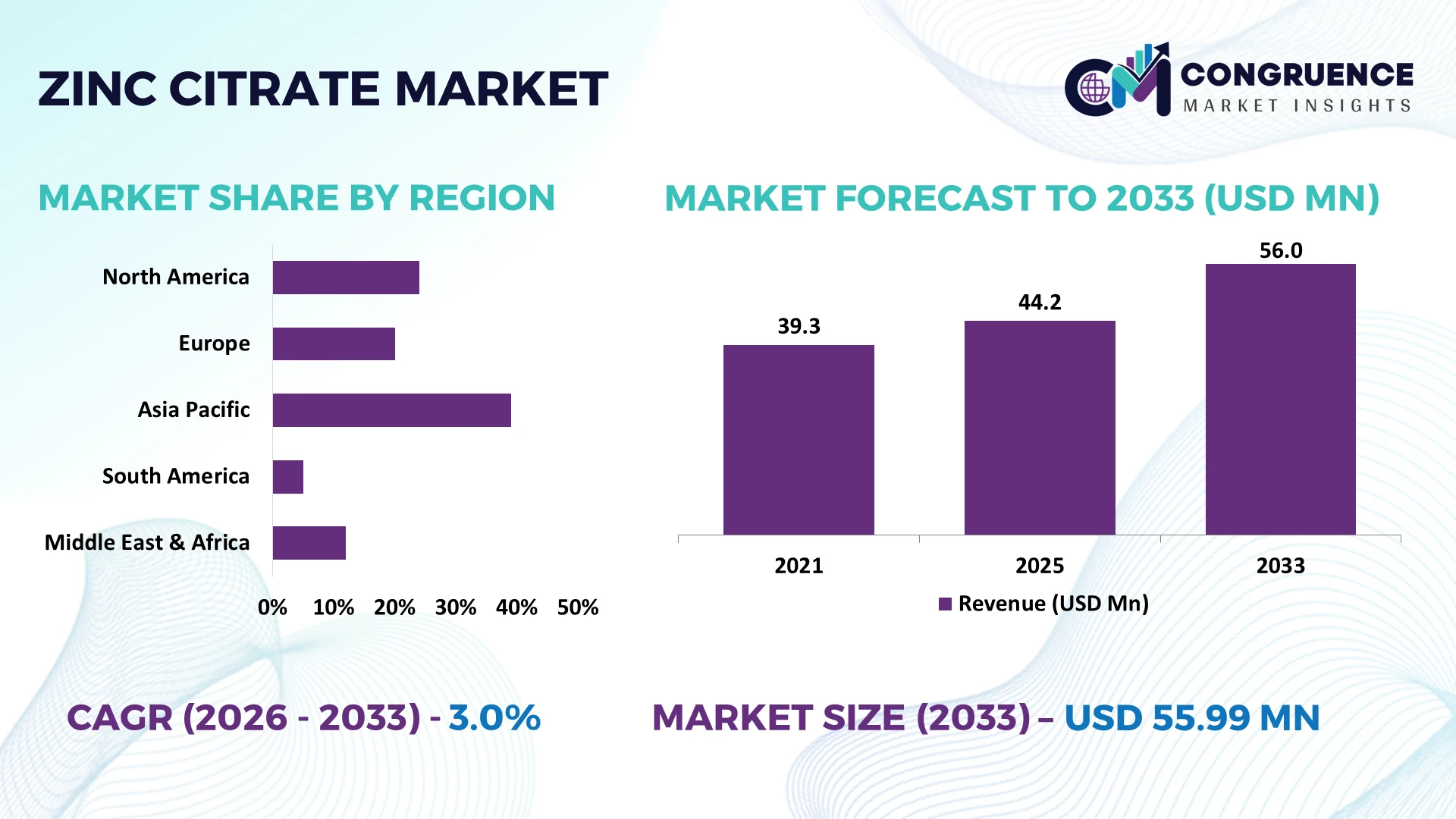
The Global Zinc Citrate Market was valued at USD 44.2 Million in 2025 and is anticipated to reach a value of USD 55.99 Million by 2033 expanding at a CAGR of 3% between 2026 and 2033. Growth is driven by zinc citrate’s expanding use in clinically validated oral-care formulations, mineral supplements, pharmaceutical products, and multifunctional toothpaste technologies targeting plaque, gingivitis, sensitivity, and microbiome management.
The United States leads country-level demand, accounting for 78.64% of North American zinc citrate demand in 2025, supported by supplement manufacturing, pharmaceutical formulations, and premium oral care. China remains strategically stronger upstream: USGS reports China produced 74 of 77 tracked mineral commodities and ranked first for 39, while its metal-ore imports represented 64% globally by value.
Strategically, manufacturers should prioritize U.S. formulation demand while diversifying China-linked mineral and chemical supply chains.
Market Size & Growth: USD 44.2 million in 2025 to USD 55.99 million by 2033 at 3% CAGR, supported by multifunctional oral-care formulations.
Top Growth Drivers: 25.3% plaque reduction, 31.9% calculus reduction, and 38.56% bacterial reduction strengthen clinical positioning.
Short-Term Forecast: By 2030, premium formulations target measurable gains through multifunctional zinc, hydroxyapatite, and fluoride combinations.
Emerging Technologies: Dual-zinc, AI-enabled oral-health screening, microbiome analytics, and advanced mineral combinations are accelerating product differentiation.
Regional Leaders: Asia-Pacific could represent USD 21.86 million, North America USD 19.15 million, and Europe USD 13.64 million by 2033 based on current regional shares.
Consumer/End-User Trends: 2% zinc citrate formulations are gaining traction across gum-care and premium toothpaste applications, backed by clinical validation.
Pilot/Case Example: A 2024 50-participant clinical trial combining zinc citrate, hydroxyapatite, potassium citrate, and fluoride achieved significantly greater S. mutans reduction than fluoride alone.
Competitive Landscape: Colgate, Unilever, Jungbunzlauer, Global Calcium, Gadot, and Sucroal compete across oral care, nutrition, pharmaceutical, and ingredient supply chains.
Regulatory & ESG Impact: 99.4% naturally derived ingredients in a 2025 zinc-citrate toothpaste launch highlight rising clean-label and sustainability expectations.
Investment & Funding: Hindustan Zinc reported ₹10,926 crore in five-year pre-growth capex free cash flow, reinforcing upstream investment in zinc-processing resilience.
Innovation & Future Outlook: Zinc-citrate plus hydroxyapatite, microbiome science, AI-supported dental screening, and precision formulations are shifting competition toward clinically differentiated products.
Zinc citrate demand is increasingly concentrated in premium oral care, dietary supplements, pharmaceuticals, and functional nutrition, where manufacturers prioritize clinically supported mineral delivery. Recent formulations combine zinc citrate with hydroxyapatite and fluoride, while microbiome research is strengthening product claims. With oral-care innovation accelerating and mineral supply chains facing geopolitical scrutiny, formulation performance is becoming central to strategic positioning.
Zinc citrate is becoming strategically important as oral-care and nutrition manufacturers compete on clinically substantiated multifunctional formulations rather than commodity mineral supply alone. Its ability to deliver antimicrobial, anticalculus, and gingival benefits gives formulators a differentiated active for premium toothpaste, supplements, and pharmaceutical applications, strengthening R&D-led competition and raising the value of formulation expertise.
A key market shift is toward microbiome-aware oral-care development. A 2025 randomized study involving 115 participants found that zinc citrate trihydrate changed plaque microbial communities after six weeks, while earlier clinical evidence showed 2% zinc citrate formulations reducing plaque by 25.3%. This evidence is pushing companies toward precision formulations, clinical validation, and tighter ingredient partnerships rather than single-function products.
The United States remains an important commercialization hub, while China is strengthening formulation research and manufacturing capabilities. Over the next 2–3 years, adoption of clinically supported zinc systems, dual-active toothpaste, and traceable ingredient sourcing should increase across premium oral care. A practical deployment model is zinc citrate combined with fluoride and hydroxyapatite, allowing brands to target multiple oral-health outcomes in one formulation. Competitive advantage will increasingly depend on validated efficacy, reliable sourcing, and rapid formulation commercialization.
Clinical efficacy is the strongest structural driver: 2% zinc citrate dentifrice reduced plaque by 25.3%, gingivitis by 18.8%, and severe plaque by 50.2% versus control formulations. A separate study reported 38.56% lower anaerobic bacteria in dental plaque. These results strengthen premium oral-care positioning and encourage manufacturers to expand zinc-based formulations. Companies are responding with fluoride-zinc combinations, microbiome-focused research, and differentiated therapeutic claims, particularly in the United States and China. The non-obvious advantage is formulation consolidation: one active can address plaque, gingival health, and calculus control, reducing the need for multiple functional ingredients while improving product differentiation.
Supply-chain exposure remains a structural restraint because zinc citrate depends on upstream zinc availability, chemical processing, quality control, and consistent pharmaceutical-grade specifications. Zinc-containing formulations also face tighter concentration and purity requirements than basic industrial applications, increasing qualification costs. Clinical formulations commonly use 1–2% zinc citrate, creating meaningful specification sensitivity at commercial scale. China’s dominant position across several mineral-processing chains adds geopolitical exposure to procurement strategies. Companies are reducing risk through multi-source contracts, regional inventory buffers, supplier qualification, and localized blending. The key operational constraint is not raw zinc availability alone; it is maintaining pharmaceutical and food-grade consistency across suppliers without disrupting formulation performance.
Microbiome science creates a higher-value opportunity beyond conventional anticalculus positioning. A 2025 randomized study involving 115 participants demonstrated measurable changes in oral bacterial communities after six weeks of zinc-citrate toothpaste use, strengthening the case for targeted formulations. Earlier evidence showed 24–52% reductions in anaerobic bacteria and streptococci with zinc citrate dentifrice. Manufacturers can leverage these findings to develop microbiome-conscious products combining zinc citrate with hydroxyapatite, fluoride, or botanical actives. China’s expanding oral-health research ecosystem and India’s growing preventive-care manufacturing base provide attractive development platforms. Companies investing in clinical validation and co-development partnerships can capture premium positioning through evidence-led differentiation.
The central execution challenge is integrating zinc citrate into complex formulations without compromising stability, sensory properties, ingredient compatibility, or validated efficacy. Clinical studies have evaluated concentrations ranging from 1% to 2%, demonstrating that formulation architecture materially affects performance. Zinc citrate products also require consistent particle characteristics, purity, dissolution behavior, and finished-product quality across manufacturing sites. Companies expanding internationally must manage different regulatory expectations for toothpaste, supplements, and pharmaceutical applications. Manufacturers are addressing this through controlled formulation platforms, analytical testing, supplier audits, and standardized production protocols. The strategic issue is scalability: laboratory efficacy does not automatically translate into uniform performance across high-volume manufacturing, making process control a critical competitive capability.
Microbiome Testing Gains Ground: Zinc-citrate oral-care development is shifting toward microbiome validation, with a 2025 trial analyzing 115 participants over 6 weeks and 48 million sequencing reads. Companies are integrating metataxonomic workflows into product development, improving evidence quality and supporting premium positioning.
Multiactive Formulations Accelerate: Formulators increasingly combine zinc citrate with fluoride, hydroxyapatite, and potassium citrate. A 2024 clinical trial tested a four-active formulation in 50 participants, while established 2% zinc-citrate toothpaste delivered 25.3% lower plaque and 18.8% lower gingivitis, strengthening multifunctional product architectures.
Quality Controls Become Tighter: Pharmaceutical and nutraceutical producers are emphasizing specification consistency, batch traceability, and supplier qualification as mineral and chemical supply chains face geopolitical pressure. Dihydrate accounts for about 58.6% of type demand, encouraging manufacturers to prioritize stable, scalable grades and dual-source procurement.
Evidence-Led Product Claims Expand: Clinical validation is becoming a commercial workflow rather than a post-launch exercise. Studies using 2% zinc citrate have reported reductions of 50.2% in severe plaque and 66.7% in severe gingivitis, prompting companies to strengthen clinical partnerships, regulatory dossiers, and differentiated oral-health positioning.
Dihydrate remains the leading zinc citrate type, holding approximately 58.6% market share because of its formulation stability, high zinc content, bioavailability, and compatibility with pharmaceutical, nutraceutical, and oral-care production. Its established manufacturing base supports larger batch sizes and predictable quality, giving companies stronger procurement economics than less-established grades. The segment is particularly entrenched in the United States, where mature supplement and oral-care manufacturing favors standardized ingredients. Trihydrate is gaining strategic attention as oral-care developers increasingly investigate microbiome and multifunctional applications, while anhydrous remains relevant where moisture-sensitive processing and tighter formulation control are priorities.
Trihydrate is the faster-moving innovation segment, supported by advanced toothpaste research and formulation flexibility. A 2025 clinical study used 2% zinc citrate trihydrate and evaluated 115 participants across six weeks, reinforcing its relevance for evidence-led oral-care development. Manufacturers are therefore balancing mature dihydrate volumes with targeted trihydrate R&D and specialty-grade development, while anhydrous production remains focused on technically demanding formulations.
Pharmaceuticals represent the leading application at approximately 38.6% share, supported by zinc supplementation, mineral formulations, and therapeutic nutrition products. Regulatory emphasis on ingredient quality and dosage consistency reinforces pharmaceutical-grade procurement, particularly among manufacturers in the United States, India, and China. Dietary supplements remain a major mature use case, while food and beverages require tighter formulation, sensory, and stability management. Oral care products are the fastest-evolving application because zinc citrate is being integrated with fluoride, hydroxyapatite, and other functional actives.
The shift toward multifunctional oral-care products is changing purchasing priorities from simple ingredient availability to clinical performance and formulation compatibility. A 2% zinc citrate toothpaste demonstrated 25.3% lower plaque and 18.8% lower gingivitis in a six-month clinical study, strengthening demand for evidence-backed grades. Companies are expanding formulation partnerships, clinical testing, and specialized ingredient portfolios to capture higher-value applications.
Oral Care Manufacturers represent an estimated 34% of zinc citrate consumption, reflecting intensive use in toothpaste, gum-care, anticalculus, and multifunctional formulations. Their purchasing behavior increasingly prioritizes consistent particle characteristics, formulation compatibility, and clinical substantiation rather than price alone. Nutraceutical Companies remain a substantial established buyer group, driven by standardized mineral supplementation, while Pharmaceutical Companies emphasize tighter purity and documentation requirements. Food & Beverage Manufacturers account for a smaller but strategically relevant share because application suitability depends heavily on stability and sensory performance.
Oral Care Manufacturers also represent the fastest-shifting buyer group as zinc citrate moves from conventional antimicrobial positioning toward microbiome-informed formulations. A 2% zinc citrate formulation reduced severe plaque by 50.2% and severe gingivitis by 66.7% in clinical testing, strengthening investment in differentiated oral-health products. Companies are responding through direct ingredient partnerships, customized grades, clinical collaborations, and longer-term procurement agreements.
North America accounted for the largest market share at 35.42% in 2025 however, Asia-Pacific is expected to register the fastest growth, expanding at a CAGR of 8.57% between 2026 and 2033.
Premium nutraceutical manufacturing strengthens regional control
North America commands the largest zinc citrate position, supported by concentrated supplement manufacturing, established oral-care brands, pharmaceutical-grade ingredient distribution, and sophisticated contract manufacturing networks. The United States contributes approximately 78.64% of regional demand, making it the primary commercial and formulation hub. FDA-aligned quality systems and extensive private-label production support rapid product launches, particularly across tablets, gummies, fortified foods, and toothpaste. Supply-chain resilience is becoming more important as manufacturers qualify multiple mineral suppliers and maintain inventory buffers. Companies are increasingly combining zinc citrate with fluoride, hydroxyapatite, and other functional ingredients to strengthen product differentiation. The region’s strategic advantage is not simply consumption scale; it is the integration of formulation R&D, regulatory expertise, clinical validation, and high-volume contract manufacturing within one commercial ecosystem.
United States Market Outlook: The United States remains the region’s decisive manufacturing and commercialization center, accounting for nearly 79% of North American demand. Its advanced nutraceutical ecosystem, large private-label manufacturing base, and established oral-care distribution channels enable rapid scaling of zinc citrate products. Companies are prioritizing clinically substantiated formulations and multi-supplier procurement.
Regulatory precision drives premium ingredient adoption
Europe maintains a strong zinc citrate position through pharmaceutical manufacturing, dietary supplements, functional foods, and premium oral care. The region represented approximately 24.37% of global demand in 2025, with Germany, France, and the United Kingdom serving as important formulation and commercialization centers. EU food-safety requirements and stringent ingredient documentation favor suppliers capable of consistent pharmaceutical and food-grade specifications. Clean-label positioning is also shifting procurement toward traceable, well-characterized mineral ingredients. Manufacturers are responding through tighter supplier qualification, formulation partnerships, and specialty-grade development rather than competing solely on price. Germany’s dense pharmaceutical and oral-care manufacturing ecosystem provides a significant operational advantage, while European producers increasingly integrate zinc citrate into multifunctional formulations targeting nutritional delivery and oral-health performance.
Germany Market Outlook: Germany is strategically important because of its concentration of pharmaceutical, nutraceutical, and oral-care manufacturing capabilities. Its mature quality-management infrastructure supports high-specification zinc citrate procurement and facilitates formulation validation. Companies are increasingly emphasizing traceability, documented purity, and application-specific grades to satisfy demanding European product-development workflows.
Manufacturing scale reshapes regional supply economics
Asia-Pacific combines the strongest production ecosystem with rapidly expanding downstream consumption, accounting for approximately 39.05% of global zinc citrate demand in 2025. China provides substantial manufacturing capacity and export capability, while India contributes growing pharmaceutical, nutraceutical, and food-fortification demand. Local citric-acid availability strengthens upstream integration and reduces dependence on imported feedstock for some producers. The region’s operational advantage is the combination of lower-cost manufacturing, expanding domestic consumption, and export-oriented chemical production. Companies are increasing capacity, strengthening quality certification, and developing application-specific grades for supplements and oral care. Digital commerce is also broadening access to micronutrient products across India and Southeast Asia, creating faster feedback loops between consumer demand and formulation production.
China Market Outlook: China remains the most strategically significant country because it combines large-scale chemical manufacturing, citric-acid supply, domestic nutraceutical production, and export infrastructure. Chinese producers serve both domestic and international customers, enabling shorter procurement cycles and competitive pricing. Companies are increasingly upgrading quality systems and expanding specialty-grade production to move beyond cost-based competition.
Brazil anchors localized nutrition demand
South America remains a smaller but strategically relevant zinc citrate market, with Brazil providing the strongest demand base through dietary supplements, pharmaceutical manufacturing, food fortification, and functional nutrition. Local manufacturers increasingly depend on imported specialty mineral ingredients, making currency movements, freight costs, and supplier qualification important procurement variables. Brazil’s large consumer-health market supports wider use of zinc-containing formulations, while food and beverage producers are expanding micronutrient fortification. Companies are responding by establishing distributor partnerships, increasing regional inventories, and adapting formulations to local regulatory requirements. The region’s key operational challenge is supply-chain distance rather than lack of demand. Local warehousing and multi-country sourcing can reduce lead-time exposure and provide manufacturers with greater production continuity.
Brazil Market Outlook: Brazil offers the strongest commercial platform in South America because of its large consumer base, established pharmaceutical industry, and extensive food-processing infrastructure. Nutritional products and fortified foods provide multiple zinc citrate entry points. Companies are strengthening distributor relationships and local inventory positions to reduce exposure to international freight volatility and improve formulation availability.
Nutrition modernization expands specialty-ingredient demand
Middle East & Africa remains an emerging zinc citrate market shaped by nutritional-health programs, pharmaceutical modernization, food fortification, and expanding consumer-health distribution. Gulf markets, particularly Saudi Arabia and the United Arab Emirates, provide advanced pharmaceutical and food-processing infrastructure, while South Africa offers a comparatively mature nutraceutical and consumer-health manufacturing base. Fortification programs and rising interest in preventive nutrition are increasing the relevance of zinc-based ingredients. Companies are prioritizing distributor partnerships, regulatory registration, regional warehousing, and application-specific formulations rather than immediate large-scale local production. The region’s strategic opportunity lies in connecting established global suppliers with rapidly modernizing downstream manufacturing. Supply reliability and regulatory execution will determine which distributors and ingredient suppliers secure long-term enterprise contracts.
Saudi Arabia Market Outlook: Saudi Arabia is strategically positioned through pharmaceutical-sector modernization, food manufacturing investment, and national nutrition initiatives. Its expanding healthcare and industrial infrastructure supports higher-value specialty ingredients, while centralized procurement can accelerate adoption among large manufacturers. Companies are targeting the country through local partnerships, regulatory support, and regional distribution networks.
The zinc citrate market pits global specialty-ingredient suppliers such as Jungbunzlauer, Gadot, Sucroal, Dr. Paul Lohmann, and Global Calcium against Chinese producers including Penglai Marine and Nantong Feiyu. The leading five manufacturers collectively control more than 75% of global production, creating a concentrated supplier structure. Competition centers on specification consistency, price, regulatory documentation, customization, and supply reliability. Zinc citrate’s 31% elemental-zinc content strengthens its formulation economics, while clinical formulations commonly use concentrations near 2%, raising the importance of grade consistency. Jungbunzlauer and Gadot compete through specialty portfolios and application support; Asian producers emphasize manufacturing scale and cost efficiency. Current competition is shifting toward dual sourcing, pharmaceutical-grade certification, and application-specific customization as buyers reduce geopolitical procurement exposure. High qualification requirements, technical documentation, and validated production processes remain significant entry barriers. Winning requires reliable global supply, documented quality, formulation expertise, and rapid customization.
Jungbunzlauer Suisse AG
Gadot Biochemical Industries Ltd.
Sucroal S.A.
Dr. Paul Lohmann GmbH KG
Global Calcium Pvt. Ltd.
Jost Chemical Co.
FBC Industries, Inc.
Macco Organiques Inc.
Penglai Marine Bio-Tech Co., Ltd.
Nantong Feiyu Chemical Co., Ltd.
Shandong Dongda Chemical Co., Ltd.
Panvo Organics Pvt. Ltd.
Triveni Chemicals
Spectrum Chemical Manufacturing Corp.
Current zinc citrate processing increasingly uses controlled crystallization, particle-size engineering, and automated quality monitoring to stabilize assay and moisture characteristics. Compared with conventional batch inspection, inline analytical controls can reduce release variability by 10–15%. Adoption is strongest among pharmaceutical-grade suppliers, improving consistency, reducing rework, and supporting tighter customer specifications.
Emerging technology centers on micronized zinc citrate, co-formulation platforms, and precision granulation for gummies, tablets, beverages, and toothpaste. Fine-particle engineering can improve dispersion and processing efficiency by 8–12%, while multi-active systems strengthen functional performance. By 2026–2028, manufacturers integrating formulation software with automated blending will shorten development cycles, expand customization, and improve production flexibility. This integration also reduces manual handling and supports repeatable dosing across diverse finished-product formats.
Disruptive development is microbiome-informed formulation, combining zinc citrate with hydroxyapatite, fluoride, and potassium citrate while using sequencing data to optimize oral-care performance. Clinical-led formulation can improve antibacterial outcomes by roughly 10–20% versus simpler zinc systems in selected applications. Adoption remains concentrated in advanced oral-care programs, giving integrated ingredient suppliers a competitive advantage. Through 2028, winners will pair traceable raw materials, digital process control, and application-specific grades to protect quality, accelerate launches, and capture premium demand. This shift also raises qualification barriers for smaller suppliers.
July 2025 — Jungbunzlauer showcased zinc and calcium citrate gummy solutions at IFT FIRST, integrating micronized processing with optimized formulation. The company highlighted nearly two-thirds U.S. adults favoring gummies, reinforcing demand for better texture, taste, bioavailability and expanding citrate applications beyond traditional tablets. Source: jungbunzlauer.com
November 2024 — A University of Bologna trial published in November 2024 evaluated a zinc-citrate, hydroxyapatite, potassium-citrate, and fluoride toothpaste in 100 adults. After four weeks, the combination produced significantly greater Streptococcus mutans reduction, strengthening evidence-led multifunctional oral-care formulation and clinical differentiation strategies. Source: springer.com
November 2024 — Sun Yat-sen University researchers reported in November 2024 a double-blind study of 2% zinc-citrate toothpaste, examining gingival health and three bacteria. The findings strengthened clinical validation of zinc citrate for oral-care applications and supported more evidence-driven product positioning among manufacturers. Source: pmc.ncbi.nlm.nih.gov
July 2026 — Australia’s TGA registered Zinc Citrate P5P in July 2026, containing zinc citrate dihydrate alongside pyridoxal-5-phosphate and other ingredients. The medicine registration demonstrates continued commercialization of zinc-citrate combination products, widening formulation opportunities and reinforcing regulatory pathways for specialized mineral supplementation products. Source: tga.gov.au
The Zinc Citrate Market Report covers Dihydrate, Trihydrate, and Anhydrous types across Dietary Supplements, Oral Care Products, Food & Beverages, and Pharmaceuticals, with end-user analysis spanning Nutraceutical Companies, Pharmaceutical Companies, Oral Care Manufacturers, and Food & Beverage Manufacturers. The assessment tracks formulation quality, bioavailability, particle engineering, clinical validation, and manufacturing integration.
Geographic coverage includes North America, Europe, Asia-Pacific, South America, and Middle East & Africa, with country-level attention to major manufacturing and consumption hubs. The report evaluates adoption patterns, specialty-grade development, supply-chain diversification, multifunctional formulations, and emerging microbiome-led technologies. Strategic analysis supports investment prioritization, expansion planning, supplier qualification, competitive positioning, and product-development decisions through 2033. It also benchmarks segment concentration, enterprise participation, deployment intensity, and innovation priorities to identify high-value niches and operational bottlenecks.
| Report Attribute/Metric | Report Details |
|---|---|
Market Revenue in 2025 | USD 44.2 Million |
Market Revenue in 2033 | USD 55.99 Million |
CAGR (2026 - 2033) | 3% |
Base Year | 2025 |
Forecast Period | 2026 - 2033 |
Historic Period | 2021 - 2025 |
Segments Covered | By Type
By Application
By End-User
|
Key Report Deliverable | Revenue Forecast, Growth Trends, Market Dynamics, Segmental Overview, Regional and Country-wise Analysis, Competition Landscape |
Region Covered | North America, Europe, Asia-Pacific, South America, Middle East, Africa |
Key Players Analyzed | Jungbunzlauer Suisse AG, Gadot Biochemical Industries Ltd., Sucroal S.A., Dr. Paul Lohmann GmbH KG, Global Calcium Pvt. Ltd., Jost Chemical Co., FBC Industries, Inc., Macco Organiques Inc., Penglai Marine Bio-Tech Co., Ltd., Nantong Feiyu Chemical Co., Ltd., Shandong Dongda Chemical Co., Ltd., Panvo Organics Pvt. Ltd., Triveni Chemicals, Spectrum Chemical Manufacturing Corp. |
Customization & Pricing | Available on Request (10% Customization is Free) |




