
Reports
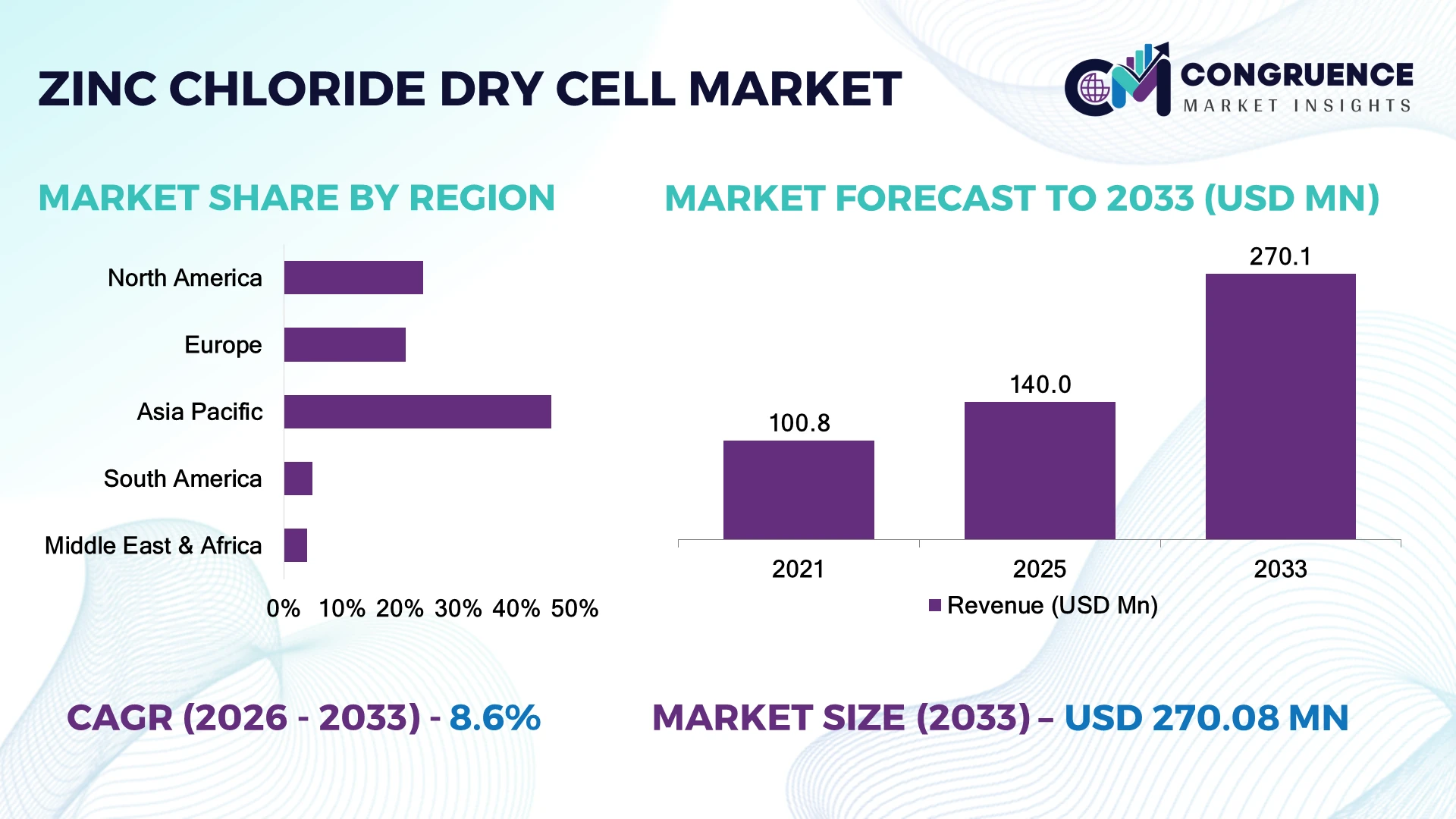
The Global Zinc Chloride Dry Cell Market was valued at USD 140.0 Million in 2025 and is anticipated to reach a value of USD 270.1 Million by 2033 expanding at a CAGR of 8.56% between 2026 and 2033. Growth is being propelled by sustained demand for long-shelf-life portable power solutions in flashlights, remote controls, emergency devices, and low-drain industrial electronics across cost-sensitive markets.
China dominates the global Zinc Chloride Dry Cell Market with an estimated 34% production share, supported by large-scale battery manufacturing clusters and over USD 1.2 billion in annual dry-cell production investments. The country produces more than 18 billion primary batteries annually, significantly exceeding India’s estimated 7 billion units. Rising demand from consumer electronics and emergency lighting applications, combined with supply-chain resilience initiatives following global trade disruptions, continues to strengthen China's leadership position.
Strategic implication Companies that secure localized zinc and electrolyte supply chains while expanding value-focused battery portfolios are best positioned to strengthen market share and operational resilience.
Market Size & Growth: USD 140.0 Million in 2025, reaching USD 270.1 Million by 2033, driven by expanding low-cost portable power demand and battery manufacturing modernization.
Top Growth Drivers: Consumer electronics demand (+18%), emergency lighting adoption (+22%), and rural electrification initiatives (+15%) are accelerating market expansion.
Short-Term Forecast: By 2028, production efficiency is expected to improve by 12% through automation and optimized electrode manufacturing.
Emerging Technologies: Advanced zinc formulations, automated cell assembly, and smart quality-control systems are reducing defect rates by nearly 10%.
Regional Leaders: Asia-Pacific (~USD 125 Million), North America (~USD 42 Million), and Europe (~USD 36 Million) lead adoption through consumer electronics, industrial backup devices, and retail battery replacement demand.
Consumer/End-User Trends: More than 60% of low-drain battery purchases remain concentrated in household electronics and portable lighting devices.
Pilot/Case Example: In 2024, a major Asian battery facility implemented automated inspection systems, reducing production defects by 14%.
Competitive Landscape: Leading manufacturers control roughly 40% of global supply; key players include Panasonic, GP Batteries, Energizer, Toshiba, and Fujitsu.
Regulatory & ESG Impact: Battery waste-management regulations increased collection program participation by approximately 20% across several developed markets.
Investment & Funding: Over USD 350 Million has been directed toward capacity upgrades, localization, and manufacturing optimization initiatives.
Innovation & Future Outlook: Next-generation electrolyte chemistry and lightweight cell design are improving performance while supporting supply-chain diversification strategies.
Zinc Chloride Dry Cell batteries continue to serve essential demand across flashlights, remote controls, portable radios, toys, and emergency backup applications. Manufacturers are introducing improved electrolyte formulations that extend shelf life by nearly 15% while enhancing leakage resistance. Growing localization of battery production and procurement diversification strategies are reshaping supply networks, particularly as manufacturers seek greater resilience against raw-material sourcing disruptions and international trade uncertainties, setting the stage for broader strategic market evolution.
The Zinc Chloride Dry Cell Market is becoming strategically important because it supports large-volume, cost-efficient power requirements across consumer electronics, emergency preparedness equipment, and industrial backup applications. As manufacturers restructure supply chains and governments emphasize localized manufacturing capacity, primary battery production has emerged as a critical component of industrial resilience and energy-access strategies. This shift is strengthening investment activity across Asia and selected emerging economies.
Modern zinc chloride cells provide approximately 10–20% longer operational life in low-drain applications compared with conventional zinc-carbon batteries, improving device reliability while maintaining affordability. China continues to dominate manufacturing scale, whereas India is rapidly expanding production capacity through domestic battery manufacturing initiatives and electronics-sector growth. Over the next two to three years, automated assembly technologies are expected to reduce manufacturing defects by more than 10%, improving operational consistency and product quality.
A practical example is the deployment of zinc chloride batteries in emergency lighting and disaster-response kits, where reliability and storage life remain critical. Companies are expanding supplier networks, investing in advanced quality-control systems, and forming strategic sourcing partnerships. Organizations that combine manufacturing efficiency, supply-chain security, and product performance optimization will strengthen competitive positioning and maintain long-term relevance in the evolving portable power ecosystem.
The increasing use of affordable portable electronic devices remains a core growth catalyst for zinc chloride dry cells. Household electronics account for more than 60% of battery consumption in several developing economies, while emergency lighting demand has increased by approximately 22% over recent years. The continued expansion of rural electrification programs and portable lighting adoption has created stable demand for primary batteries. Following global supply-chain disruptions, manufacturers in China and India have accelerated local production investments to reduce dependency on imported components. This shift is improving manufacturing stability and shortening delivery cycles. In response, leading battery producers are expanding automated production lines and enhancing electrolyte technologies to improve shelf life and leakage resistance. The key operational insight is that affordability combined with reliability remains a stronger purchasing driver than premium performance in many high-volume applications.
Zinc chloride battery manufacturers face persistent pressure from fluctuations in zinc and chemical feedstock prices. Zinc input costs have experienced periodic swings exceeding 15% during recent commodity cycles, directly affecting production economics. Additionally, over 50% of certain battery raw-material processing activities remain concentrated within a limited number of industrial hubs, creating procurement vulnerabilities. Transportation bottlenecks and trade-related restrictions have further increased sourcing complexity for battery producers. These pressures can compress margins and limit large-scale production planning, particularly for smaller manufacturers. To mitigate exposure, companies are diversifying supplier networks, negotiating long-term procurement agreements, and increasing localized sourcing. A notable strategic insight is that supply-chain resilience is becoming as important as manufacturing efficiency in maintaining competitiveness within the primary battery industry.
Emerging manufacturing ecosystems present significant opportunities for zinc chloride battery producers. India’s battery manufacturing ecosystem has expanded by more than 20% through electronics-sector investments, while Southeast Asian production capacity continues to strengthen. Automated production systems can reduce quality deviations by nearly 10–12%, improving throughput and consistency. New electrolyte optimization technologies are also extending battery shelf life by approximately 15%, enhancing product differentiation. Government initiatives supporting domestic manufacturing and industrial self-sufficiency are encouraging capacity expansion and technology transfer agreements. Companies are responding through facility modernization, regional partnerships, and expanded R&D programs focused on efficiency gains. A less obvious opportunity lies in supplying emergency preparedness equipment, public safety inventories, and disaster-response infrastructure where dependable low-cost power remains essential despite increasing rechargeable battery adoption.
The long-term challenge for zinc chloride dry cells is maintaining relevance as rechargeable and higher-performance battery technologies become increasingly accessible. Rechargeable battery adoption in selected consumer segments has increased by more than 25%, reducing replacement frequency for some traditional applications. At the same time, consumers increasingly expect longer device runtime and enhanced sustainability credentials. Manufacturers must balance cost competitiveness with product improvements while navigating evolving environmental regulations governing battery disposal and recycling. Operationally, upgrading production systems and workforce capabilities requires significant investment and technical expertise. Companies are addressing these pressures through product innovation, manufacturing automation, and strategic collaborations with recycling and materials-processing partners. The critical competitive insight is that future success will depend on operational efficiency and targeted application specialization rather than direct competition with advanced rechargeable technologies.
Localized Battery Manufacturing Expansion Production localization has accelerated as manufacturers reduce exposure to cross-border supply disruptions and logistics volatility. Domestic battery output capacity in India has expanded by nearly 18%, while localized component sourcing has increased by approximately 22% among major producers. Shorter procurement cycles and lower transportation dependency are improving inventory stability and operational responsiveness. Companies are restructuring supplier networks, expanding regional assembly operations, and increasing long-term procurement agreements to strengthen manufacturing continuity.
Automation-Driven Quality Optimization Battery manufacturers are deploying automated inspection, electrode preparation, and packaging systems to improve production consistency. Automated quality-control platforms have reduced defect rates by roughly 12%, while production throughput has improved by nearly 15% in modernized facilities. Labor availability challenges and rising quality requirements are accelerating technology adoption. Leading producers are scaling smart manufacturing initiatives, integrating machine-vision systems, and standardizing process controls to improve yield performance and reduce operational waste.
Enhanced Shelf-Life Product Development Manufacturers are increasingly focusing on advanced zinc chloride formulations that improve storage performance and leakage resistance. New battery designs have demonstrated shelf-life improvements of approximately 15% and leakage reductions exceeding 10% compared with conventional configurations. Demand from emergency lighting, safety equipment, and remote consumer applications is driving this shift. Companies are expanding electrolyte research programs and prioritizing product differentiation through performance-focused chemistry enhancements rather than competing solely on price.
Sustainability and Recycling Alignment Battery collection and recycling participation rates have increased by nearly 20% in several developed markets as waste-management regulations become more stringent. Enterprise procurement programs are increasingly incorporating environmental compliance requirements, influencing supplier selection decisions. A notable trend is the use of recycled zinc inputs in selected production streams, helping reduce raw-material exposure. Manufacturers are strengthening recycling partnerships, redesigning packaging materials, and integrating circular-economy objectives into long-term operational planning.
AA Zinc Chloride batteries represent the leading segment, accounting for approximately 38% of total market demand due to their broad compatibility with flashlights, remote controls, portable radios, and household electronics. Their dominance stems from standardized form factors, cost efficiency, and extensive retail availability. AAA batteries follow closely with nearly 27% market share, supported by growing use in compact consumer devices. Manufacturers continue to prioritize AA and AAA production lines because these formats deliver high-volume turnover and strong distribution efficiency across both developed and emerging economies. D batteries are emerging as the fastest-growing category, benefiting from increasing deployment in industrial lighting systems, emergency preparedness equipment, and heavy-duty portable devices. Adoption in these applications has increased by nearly 14% over the past two years. Meanwhile, C batteries maintain relevance in specialty industrial applications, while 9V batteries continue serving safety devices such as smoke detectors and testing equipment. Battery producers are expanding format-specific portfolios, improving shelf-life performance, and strengthening retail partnerships to capture replacement demand while balancing mature and specialty battery segments.
Consumer electronics constitute the largest application segment, representing approximately 46% of overall zinc chloride battery utilization. Demand remains concentrated in remote controls, portable audio devices, clocks, toys, and flashlights where low-drain performance and affordability remain decisive purchasing factors. High replacement frequency and extensive household penetration continue supporting sustained battery consumption. Companies are optimizing packaging configurations and retail distribution strategies to maintain competitiveness within this mature but highly resilient application base. Emergency lighting is the fastest-growing application segment, with deployment activity increasing by nearly 16% as governments, enterprises, and public facilities strengthen preparedness programs. Portable lighting systems and backup illumination equipment increasingly rely on zinc chloride batteries because of dependable storage characteristics and cost-effective replacement cycles. Industrial equipment, portable testing devices, and communication accessories also contribute steady demand. Manufacturers are responding by introducing longer-lasting formulations, strengthening distribution networks, and aligning production schedules with seasonal and institutional procurement patterns where battery reliability remains operationally critical.
Household consumers remain the dominant end-user segment, accounting for approximately 55% of total battery consumption. The concentration is driven by widespread use across remote controls, clocks, flashlights, toys, and portable entertainment devices. Consistent replacement cycles and broad product accessibility continue supporting high-volume purchasing behavior. Manufacturers target this segment through value-oriented packaging, retail promotions, and extended shelf-life offerings designed to improve convenience and customer retention in highly competitive consumer channels. Commercial and institutional users represent the fastest-growing end-user group, with demand expanding by nearly 15% through increased deployment of emergency lighting systems, safety equipment, and portable monitoring devices. Industrial users maintain stable purchasing volumes in inspection tools and maintenance equipment, while government and public-sector organizations continue procuring batteries for preparedness inventories and operational continuity programs. Companies are strengthening business-to-business distribution networks, offering customized procurement agreements, and developing application-specific battery solutions to improve penetration across professional and institutional customer segments.
Asia-Pacific accounted for the largest market share at 46% in 2025 however, North America is expected to register the fastest growth, expanding at a CAGR of 9.1% between 2026 and 2033.
North America represented approximately 24% of the global Zinc Chloride Dry Cell Market in 2025, supported by strong demand from emergency lighting systems, household electronics, safety equipment, and industrial maintenance applications. The region benefits from established distribution infrastructure, high replacement battery consumption, and widespread deployment of portable backup power devices. Facility operators, public institutions, and commercial enterprises continue expanding emergency preparedness inventories, creating stable procurement cycles. Battery suppliers are increasingly integrating automated packaging and inventory management systems to improve fulfillment efficiency. Additionally, retail battery replacement programs have expanded by nearly 12% across major distribution networks, improving product availability and replenishment speed. Strategic partnerships between battery distributors and facility management providers are strengthening market penetration across institutional and commercial sectors.
United States Market Outlook: The United States remains the largest market within North America due to its extensive retail network, large installed base of battery-powered devices, and strong emergency preparedness culture. More than 70% of portable emergency lighting systems deployed across commercial facilities utilize primary battery technologies. Manufacturers continue investing in advanced packaging formats, supply-chain optimization, and distribution automation. Growing procurement activity from healthcare facilities, schools, and public infrastructure operators is reinforcing long-term demand stability across both consumer and institutional channels.
Europe accounted for approximately 21% of global market demand, supported by strong regulatory oversight, mature retail distribution systems, and consistent consumption of low-drain battery products. Environmental compliance requirements are encouraging manufacturers to improve battery collection, recycling integration, and packaging sustainability. The region continues to maintain stable demand across household electronics, emergency devices, and industrial monitoring equipment. Battery collection participation has increased by nearly 20% in several European markets, influencing procurement and supplier qualification processes. Manufacturers are responding through localized packaging operations, recycling partnerships, and material efficiency initiatives. Operational modernization and regulatory alignment remain critical competitive factors for suppliers operating across the region.
Germany Market Outlook: Germany serves as the most influential market in Europe due to its industrial scale, advanced manufacturing ecosystem, and established battery distribution infrastructure. The country maintains strong demand from industrial maintenance equipment, safety devices, and household electronics. Automated warehousing and logistics systems now support a significant share of battery distribution operations, improving inventory visibility and delivery performance. German enterprises are also prioritizing environmentally compliant battery sourcing, encouraging suppliers to strengthen recycling capabilities and product stewardship programs.
Asia-Pacific dominates the global Zinc Chloride Dry Cell Market with approximately 46% market share, driven by extensive manufacturing capacity, strong consumer electronics demand, and highly integrated supply chains. The region serves as the primary production hub for zinc chloride batteries, supplying both domestic and export markets. Large-scale manufacturing clusters support cost-efficient production and rapid distribution capabilities. Battery production output has expanded by nearly 15% across several key manufacturing centers over recent years, supported by facility upgrades and automation investments. Strong demand from portable electronics, emergency lighting products, and household devices continues reinforcing production activity. Manufacturers are expanding production lines, improving quality-control systems, and increasing export-oriented capacity to strengthen global competitiveness.
China Market Outlook: China remains the strategic center of the global market due to its unmatched manufacturing scale, vertically integrated supply chain, and extensive battery production ecosystem. The country accounts for more than one-third of global zinc chloride battery manufacturing output and produces billions of primary batteries annually. Strong domestic electronics demand and export activity continue supporting production growth. Manufacturers are investing heavily in automation, process optimization, and advanced quality-control technologies to improve efficiency while maintaining cost leadership across international markets.
South America accounted for approximately 5% of global market demand, supported by growing consumption of affordable portable power products and increasing use of battery-operated devices in underserved areas. Household electronics, portable lighting products, and emergency-use equipment remain primary demand drivers. Distribution networks are expanding into secondary cities and rural markets, improving product accessibility and replacement battery availability. Battery imports continue to supply a substantial portion of regional demand, although localized assembly activities are gradually increasing. Several distribution and logistics investments have improved battery availability by nearly 10% across key urban markets. While infrastructure limitations remain a challenge, improving retail penetration is supporting market development.
Brazil Market Outlook: Brazil represents the largest market in South America due to its population scale, consumer electronics demand, and expanding retail infrastructure. Portable lighting, radios, and household devices continue driving battery consumption across both urban and rural regions. National distribution networks have improved market coverage substantially, enabling faster replenishment cycles and stronger product availability. Companies are strengthening partnerships with retailers and wholesalers while optimizing inventory management systems to support growing consumer demand and improve operational efficiency.
The Middle East & Africa region accounted for approximately 4% of global market demand and continues to benefit from expanding infrastructure projects, emergency preparedness programs, and increasing access to portable power solutions. Zinc chloride batteries remain widely used in flashlights, communication devices, and backup lighting equipment across residential and commercial environments. Government-led modernization initiatives and public infrastructure investments are supporting greater deployment of battery-powered safety systems. Procurement activity for emergency lighting and backup devices has increased by nearly 14% across several key markets. Companies are strengthening distribution partnerships and improving regional warehousing capabilities to ensure reliable product availability and supply continuity.
Saudi Arabia Market Outlook: Saudi Arabia serves as the most strategically significant market in the region due to ongoing infrastructure modernization, commercial development projects, and growing investment in public safety systems. Large-scale construction, transportation, and public facility projects continue increasing demand for emergency lighting and portable power devices. Procurement activity from government agencies and commercial operators remains strong, while improvements in logistics infrastructure are enhancing battery distribution efficiency. Suppliers are expanding regional partnerships and inventory capabilities to support long-term deployment requirements across critical infrastructure sectors.
The Zinc Chloride Dry Cell Market is led by Panasonic Energy, Energizer Holdings, GP Batteries, Toshiba, and Fujitsu, with the top five participants collectively controlling approximately 48% of global market activity. Competition is primarily between global battery brands and regional volume manufacturers, while cost-focused Asian producers increasingly challenge established premium brands in high-volume consumer segments. Price remains a decisive factor, yet shelf-life improvements of 10–15% and production-efficiency gains exceeding 12% are becoming important differentiators. Large manufacturers leverage vertically integrated supply chains and automated production systems to reduce unit costs and improve delivery reliability. Regional players compete through localized distribution, private-label manufacturing, and faster response to retail demand fluctuations. The competitive landscape is shifting toward supply-chain control, manufacturing automation, and product reliability rather than pure branding strength. Rising raw-material volatility and retailer pricing pressure create significant entry barriers for new participants. Winning requires manufacturing scale, resilient sourcing networks, consistent product quality, and strong retail distribution partnerships.
Energizer Holdings, Inc.
GP Batteries International Limited
Toshiba Corporation
Fujitsu Limited (FDK Corporation)
Duracell Inc.
Rayovac (Spectrum Brands Holdings)
Camelion Batterien GmbH
Nanfu Battery Co., Ltd.
Nippo Batteries Company Limited
Eveready Industries India Limited
Panasonic Energy India Co. Ltd.
VARTA AG
Fujian Huatai Battery Co., Ltd.
Manufacturers are increasingly deploying advanced zinc chloride electrolyte formulations to improve shelf life, leakage resistance, and discharge consistency. New-generation electrolyte systems deliver approximately 15% longer storage performance and reduce leakage incidents by more than 10% compared with conventional zinc-carbon chemistries. Adoption has expanded across consumer electronics, emergency lighting, and portable safety devices where reliability remains a critical purchasing criterion. Companies with established production scale benefit most because performance enhancements can be implemented without major changes to manufacturing infrastructure.
Automation is becoming a defining competitive technology across battery production facilities. Automated electrode preparation, filling, sealing, and inspection systems have reduced manufacturing defects by nearly 12% while increasing throughput by approximately 15%. Compared with traditional manual quality-control workflows, machine-vision inspection delivers faster defect detection and greater production consistency. More than 40% of large-scale battery manufacturing facilities now incorporate some form of automated quality management, improving operational efficiency and inventory reliability.
Between 2026 and 2028, smart manufacturing platforms, digital process monitoring, and predictive maintenance technologies are expected to reshape production economics. Manufacturers implementing integrated production analytics can reduce unplanned downtime by roughly 20%. The competitive advantage increasingly shifts toward companies capable of combining cost efficiency, production stability, and performance optimization. Early adopters of advanced manufacturing technologies are expected to strengthen supply-chain resilience, improve product consistency, and secure stronger positions in high-volume consumer and institutional battery markets.
April 2024 – Panasonic Energy announced discussions with IndianOil to establish a battery manufacturing joint venture in India, strengthening localized battery production capabilities. The initiative supports long-term capacity expansion and supply-chain diversification across rapidly growing battery markets. Source: www.news.panasonic.com
June 2025 – FDK Corporation developed the CR17500EX high-capacity primary battery and established a mass-production system. The new battery delivers 17% higher capacity than its predecessor, improving reliability for communications, security, and industrial monitoring applications. Source: www.fdk.com
July 2025 – Panasonic Energy commenced mass production at its Kansas battery facility with planned annual capacity reaching 32 GWh. The expansion strengthens localized manufacturing, improves supply security, and enhances operational scale across North American battery markets. Source: www.news.panasonic.com
May 2026 – Panasonic announced a strategic expansion into AI-related battery applications and projected significant growth in energy operations. The company targeted a 130-billion-yen profit contribution increase from its energy segment, reinforcing investment in next-generation battery infrastructure and supply-chain capabilities.
This report provides comprehensive analysis of the Zinc Chloride Dry Cell Market across key battery types, applications, end-user industries, and major geographic regions. Coverage includes AA, AAA, C, D, and 9V battery categories alongside consumer electronics, emergency lighting, industrial equipment, and portable power applications. The study evaluates manufacturing trends, supply-chain developments, battery performance improvements, distribution strategies, and adoption patterns influencing market evolution. More than 60% of market demand remains concentrated in household and portable electronic applications, highlighting the continued importance of replacement battery consumption.
The report further examines competitive positioning, technology adoption, production modernization, and regional manufacturing dynamics across North America, Europe, Asia-Pacific, South America, and the Middle East & Africa. Strategic insights include localization initiatives, automation deployment, procurement trends, sustainability priorities, and product innovation activities. The analysis supports investment evaluation, market-entry planning, capacity expansion decisions, partnership strategies, and long-term competitive positioning while identifying emerging opportunities across both mature and developing battery ecosystems through 2033.
| Report Attribute / Metric | Details |
|---|---|
| Market Revenue (2025) | USD 140.0 Million |
| Market Revenue (2033) | USD 270.1 Million |
| CAGR (2026–2033) | 8.56% |
| Base Year | 2025 |
| Forecast Period | 2026–2033 |
| Historic Period | 2021–2025 |
| Segments Covered |
By Type
By Application
By End-User
|
| Key Deliverables | Revenue Forecast; Market Trends; Growth Drivers & Restraints; Technology Insights; Segmentation Analysis; Regional Insights; Competitive Landscape; Regulatory & ESG Overview; Recent Developments |
| Regions Covered | North America; Europe; Asia-Pacific; South America; Middle East & Africa |
| Companies Profiled | Panasonic Energy Co., Ltd.; Energizer Holdings, Inc.; GP Batteries International Limited; Toshiba Corporation; Fujitsu Limited (FDK Corporation); Duracell Inc.; Rayovac (Spectrum Brands Holdings); Camelion Batterien GmbH; Nanfu Battery Co., Ltd.; Nippo Batteries Company Limited; Eveready Industries India Limited; Panasonic Energy India Co. Ltd.; VARTA AG; Fujian Huatai Battery Co., Ltd. |
| Customization & Pricing | Available on Request (10% Customization Free) |




