
Reports
The Global Zinc Borate Market was valued at USD 325.7 Million in 2025 and is anticipated to reach a value of USD 503.7 Million by 2033 expanding at a CAGR of 5.6% between 2026 and 2033. Growth is driven by halogen-free flame-retardant reformulation, electrical insulation demand, EV components, and stricter fire-safety requirements for polymers and construction materials.
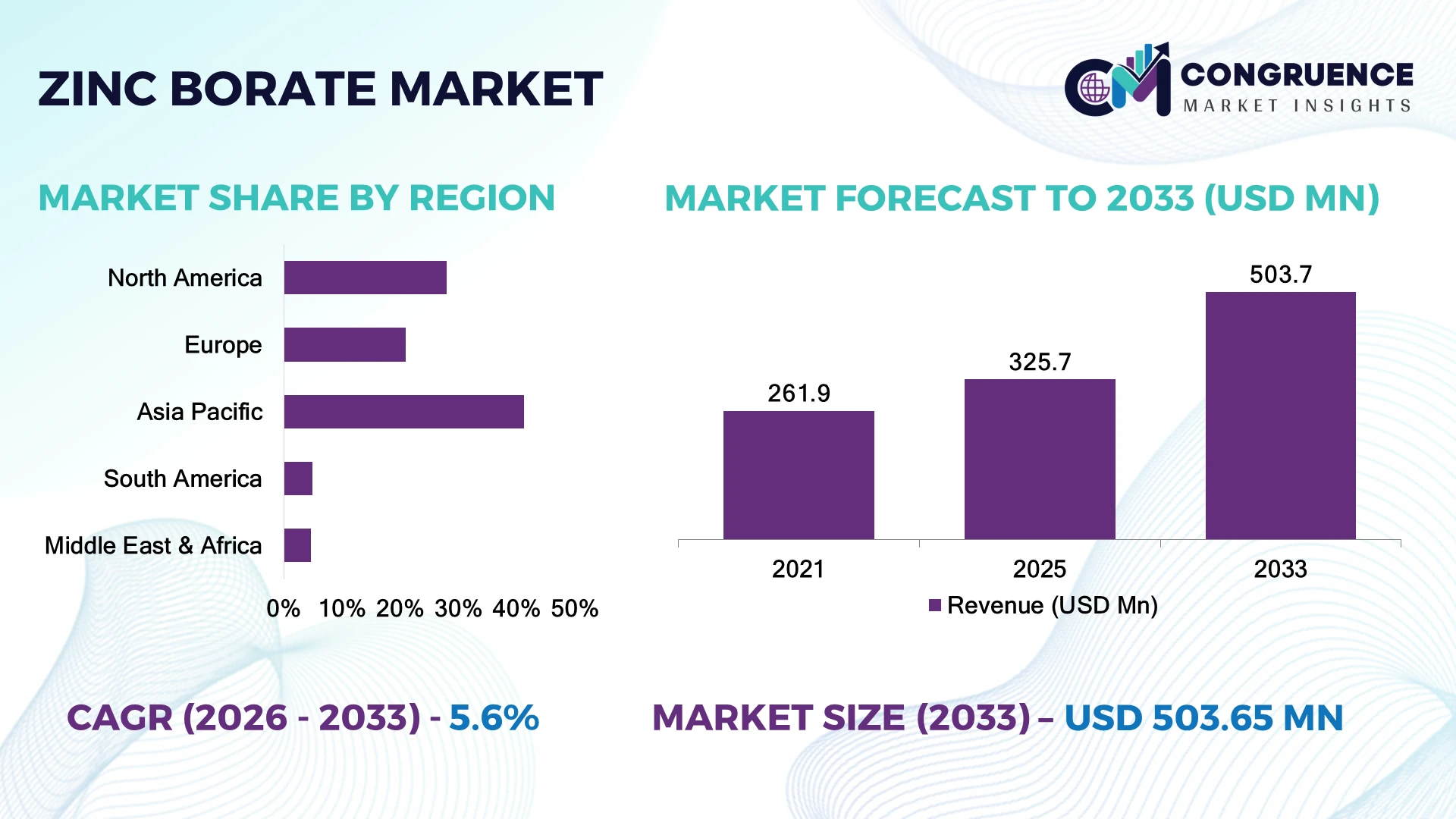
China dominates production and consumption, representing approximately 19.2% of global demand, while Asia-Pacific holds 41.34% of the market. China’s USD 111.6 million market contrasts with the U.S. USD 104.4 million market, where electrical insulation and EV manufacturing are key demand centers. China’s polymer manufacturing scale and proximity to zinc and boron inputs reinforce supply-chain advantages amid continuing U.S.-China trade tensions.
Strategic implication: suppliers should prioritize high-purity grades, localized production, and application-specific formulations to capture premium polymer demand.
Market Size & Growth: USD 325.7 million in 2025 to USD 503.7 million by 2033 at 5.6% CAGR, supported by halogen-free flame-retardant reformulation.
Top Growth Drivers: 41.34% Asia-Pacific share; 36% construction application; 7.6% electronics application growth.
Short-Term Forecast: By 2028, optimized zinc-borate formulations are positioned to reduce additive loading by approximately 10–20% while maintaining flame performance.
Emerging Technologies: Ultrafine particles, surface modification, nanostructured zinc borate, and AI-assisted formulation are improving dispersion and polymer compatibility.
Regional Leaders: Asia-Pacific USD 239.8 million in 2025; North America approximately USD 165 million by 2034; Europe approximately USD 130 million, reflecting manufacturing, electrical, and regulatory demand.
Consumer/End-User Trends: Plastics and polymers lead adoption, with approximately 48% type-share attributed to high-zinc-content formulations in one 2025 assessment.
Pilot/Case Example: 2026 EVA research using 2 wt% zinc borate increased melt-flow rate 70.59% and limiting oxygen index 11%, demonstrating improved processability and fire resistance.
Competitive Landscape: Borax, LANXESS, Sakai Chemical, Eti Maden, and Shandong-based producers compete through grade performance, capacity, customization, and supply reliability.
Regulatory & ESG Impact: Non-halogenated formulations are gaining preference as fire-safety and chemical-compliance requirements intensify, accelerating substitution toward mineral-based additives.
Investment & Funding: A 10,000-ton/year zinc-borate plant model requires approximately USD 22.78 million fixed investment, highlighting the capital intensity of integrated production.
Innovation & Future Outlook: 2026–2028 development is shifting toward ultrafine, hybrid, low-loading grades for EVs, electronics, cables, coatings, and advanced polymer systems.
The Zinc Borate Market is expanding across flame-retardant polymers, electrical insulation, rubber, coatings, textiles, and EV components. Recent formulations emphasize ultrafine particles and synergistic additive systems, while a 2026 study demonstrated 70.59% higher melt-flow rate using 2 wt% zinc borate. Supply-chain localization and non-halogenated formulation requirements are reshaping purchasing priorities, supporting the strategic analysis ahead.
Zinc borate is becoming strategically important because polymer producers increasingly require multifunctional flame retardancy without relying exclusively on conventional halogenated systems. Asia-Pacific already represents 41.34% of global demand, while China accounts for approximately 19.2%, creating a manufacturing-centered supply structure. Meanwhile, U.S. and European buyers increasingly prioritize fire performance, formulation compatibility, and chemical-compliance documentation.
Technology is changing the economics of formulation. A 2026 EVA study using only 2 wt% zinc borate increased melt-flow rate by 70.59% and limiting oxygen index by 11%, demonstrating how engineered particle dispersion can improve processing while strengthening fire resistance. Another 2026 polypropylene formulation reduced peak heat-release rate by 91% and smoke production by 93% through zinc-borate synergy. These results favor customized additive packages over commodity-grade supply.
During 2026–2028, compounders will increasingly qualify ultrafine, modified, and hybrid zinc borate grades for EV housings, electronics, cables, and construction polymers. Producers are responding through application laboratories, localized capacity, and partnerships with polymer processors. The strongest competitive position will come from combining consistent particle engineering, regulatory readiness, technical support, and secure raw-material access rather than competing solely on price.
Stricter fire-performance requirements and halogen-free formulation strategies are increasing zinc borate use in polymers, cables, coatings, and electrical components. Asia-Pacific represents approximately 41.3% of demand, while plastics and polymers account for roughly 48% of application consumption. EV thermal-management and electrical-insulation requirements are adding higher-value demand. China’s large polymer-processing base is reinforcing regional supply integration, while manufacturers increasingly combine zinc borate with synergistic flame retardants. Producers are responding through ultrafine grades, surface modification, and application-specific formulations that improve dispersion and reduce loading. The strategic shift is from commodity flame retardancy toward engineered additive systems, allowing suppliers to defend margins through performance differentiation rather than volume alone.
Zinc borate producers remain exposed to fluctuations in zinc, boron, energy, and transportation costs, with raw-material inputs typically representing more than 50% of manufacturing expenditure. China supplies a significant share of global zinc and borate processing capacity, increasing exposure to trade-policy changes and logistics disruptions. Fine-particle processing can add approximately 10–20% to production costs compared with conventional grades because of additional milling and surface-treatment requirements. These pressures compress margins for standardized products and complicate fixed-price contracts. Manufacturers are responding through multi-source procurement, localized processing, inventory buffering, and higher-value modified grades. The non-obvious constraint is that supply reliability increasingly influences purchasing decisions alongside purity and flame-retardant performance.
Ultrafine zinc borate creates a commercially attractive pathway to improve dispersion while reducing additive loading in high-performance polymers. Advanced formulations can target approximately 10–20% lower zinc-borate loading while maintaining required flame-retardant performance, improving polymer properties and material economics. EVs, electronics, photovoltaic components, and low-smoke cable systems provide high-value opportunities, particularly in China, South Korea, Germany, and the United States. Surface-functionalized particles and hybrid zinc-borate systems are becoming important formulation technologies. Companies are investing in particle engineering, application laboratories, and compounder partnerships to accelerate qualification. A non-obvious opportunity lies in replacing multiple additive packages with multifunctional zinc-borate systems, simplifying formulations while improving supplier integration and recurring demand.
Scaling high-performance zinc borate grades requires consistent particle size, morphology, moisture content, and dispersion behavior across production batches. Ultrafine formulations can experience agglomeration, with processing variability potentially increasing defect rates by 5–10% in sensitive polymer compounds. Automotive and electronics customers also impose tighter quality tolerances than general construction applications, increasing testing and qualification workloads. Manufacturers are addressing these pressures through automated particle-size monitoring, controlled drying, surface treatment, and statistical process control. The operational challenge extends beyond production: formulation changes can require renewed customer validation, slowing adoption of new grades. Suppliers with integrated laboratory-to-production capabilities therefore gain an advantage by shortening qualification cycles and maintaining batch consistency at commercial scale.
Ultrafine Particle Engineering Advances: Zinc borate producers are shifting toward finer particle distributions, with engineered grades targeting approximately 10–20% lower additive loading and improved polymer dispersion. Automated milling and surface-treatment systems are increasingly integrated into production. Companies are using these technologies to serve electronics, automotive, and cable applications where filler loading directly affects processing and finished-part performance.
Hybrid Flame-Retardant Systems Expand: Compounders are combining zinc borate with magnesium hydroxide, aluminum hydroxide, and phosphorus-based additives to improve flame suppression and smoke control. Optimized formulations can reduce peak heat-release rates by more than 50% in laboratory systems. Producers are consequently expanding formulation partnerships rather than selling zinc borate as a standalone commodity additive.
EV Materials Reshape Specifications: Electric-vehicle battery housings, charging components, connectors, and cable systems increasingly require flame retardancy alongside dimensional stability and electrical insulation. China’s expanding EV manufacturing base is accelerating qualification of mineral additives, while European and U.S. suppliers emphasize halogen-free formulations. Companies are developing application-specific grades with tighter moisture and particle-size controls.
Supply Localization Gains Momentum: Geopolitical trade friction and concentrated mineral-processing capacity are encouraging buyers to diversify zinc-borate procurement. Producers are increasing regional inventories and developing secondary supply routes, targeting approximately 15–25% greater supply-chain resilience through dual sourcing. The shift is changing purchasing criteria: documented continuity and consistent batch quality increasingly outweigh small price differences for critical electrical and automotive applications.
Hydrated zinc borate leads the Zinc Borate Market, representing approximately 54.2% of 2025 demand, supported by established production routes, broad compatibility with PVC, EVA, thermoplastics, and rubber, and balanced flame-retardant performance. Anhydrous zinc borate accounts for about 22.7% and is preferred for higher-temperature polymer processing because it avoids moisture release. Modified zinc borate remains smaller but is gaining strategic importance as compounders prioritize dispersion and lower loading. The mature hydrated segment therefore retains volume leadership, while emerging grades increasingly capture technically demanding applications.
Modified and ultrafine grades represent the fastest-moving shift, driven by electronics, automotive, and advanced polymer requirements. Ultrafine particles improve dispersion and can support approximately 10–20% lower additive loading in targeted formulations. Companies are expanding application laboratories, surface-treatment capabilities, and compounder partnerships to accelerate qualification. The investment priority is moving from commodity capacity toward engineered grades, where performance differentiation, formulation support, and application-specific customization provide stronger pricing power and customer retention.
Industry insight: A 2026 EVA/POE study found that only 2 wt% zinc borate increased melt-flow rate by 70.59% and elongation by 12.7%, demonstrating the commercial relevance of optimized low-loading formulations for process-sensitive polymer applications.
Plastics and polymers represent the leading Zinc Borate application, reflecting extensive use in PVC, polyolefins, EVA, engineering plastics, wire insulation, and flame-retardant construction materials. Construction accounts for approximately 36% of application demand in one 2025 assessment, while electronics is the fastest-growing application at about 7.6% growth, supported by tighter fire-performance requirements for compact electronic components. Rubber, paints and coatings, adhesives and sealants, and other applications provide diversification, but plastics remain the principal volume engine.
Electronics is shifting demand toward finer, better-dispersed grades because miniaturized components require flame protection without excessive filler loading or deterioration of electrical properties. Rubber applications are also expanding, with approximately 6.3% growth supported by conveyor belts, industrial seals, and transportation components. Producers are responding through masterbatch-compatible formulations, surface modification, and direct technical collaboration with compounders. The business implication is clear: application-specific formulation support is becoming as important as zinc-borate purity in securing higher-value contracts.
Industry insight: In 2026, researchers demonstrated that 2 wt% zinc borate increased EVA melt-flow rate by 70.59% while raising limiting oxygen index to 46.4%, showing how low-dose formulations can improve both processing and flame performance.
Building and construction is the leading Zinc Borate end-user industry, accounting for approximately 34% of 2025 demand. Fire-resistant insulation, polymer boards, coatings, and related building materials sustain high-volume consumption, particularly where fire-safety specifications influence material selection. Plastics and polymers remain the broader processing base, while electrical and electronics users demand tighter particle-size and purity controls. Textiles and paints and coatings remain specialized buyers. The established construction segment therefore prioritizes dependable supply and cost efficiency, whereas technical industries place greater emphasis on formulation performance.
Automotive is the fastest-growing end-user group, with approximately 7.2% growth, supported by lightweight polymer components and increasing EV material requirements. This contrasts with construction procurement, where standardized grades dominate, as automotive customers increasingly qualify customized formulations for thermal, mechanical, and fire-performance requirements. Companies are responding through OEM partnerships, application-specific technical support, and localized supply arrangements. Future purchasing power is shifting toward automotive and electronics customers capable of rewarding higher-performance grades, encouraging producers to prioritize modified particles and formulation development over undifferentiated capacity.
Industry insight: A 2025 research study demonstrated zinc borate incorporation into regenerated flame-resistant fibers without modifying existing spinning equipment, supporting practical adoption in textile manufacturing while strengthening the material’s application diversity.
Asia-Pacific accounted for the largest market share at 41.34% in 2025 moreover, Asia-Pacific is also expected to register the fastest growth, expanding at a CAGR of 7.5% between 2026 and 2033.
North America represents a mature, specification-driven market supported by stringent fire-safety requirements, electrical insulation, cable manufacturing, and automotive applications. The U.S. accounted for approximately 18.0% of regional demand in 2025, making it the principal consumption center. Procurement increasingly favors halogen-free and low-smoke additive systems, while domestic compounders prioritize consistent particle morphology and regulatory documentation. Renovation and infrastructure modernization sustain demand beyond new construction. Suppliers are responding with higher-purity grades, technical formulation support, and localized inventory strategies. The key operational shift is toward qualification-led purchasing, where suppliers that provide application validation and reliable batch consistency can defend positions even when imported alternatives offer lower nominal pricing.
U.S. Market Outlook: The U.S. is the region’s strategic anchor, supported by established polymer processing, electrical-component manufacturing, and expanding EV production. Electrical insulation remains an important application base, while increasingly demanding automotive specifications encourage customized flame-retardant formulations. Companies are strengthening domestic distribution and technical-service capabilities to shorten customer qualification cycles and reduce exposure to import disruptions.
Europe maintains a regulation-intensive demand environment shaped by REACH compliance, sustainable construction, automotive engineering, and tighter requirements for flame-retardant materials. Germany is the leading national market, while France, the U.K., Italy, and Spain provide substantial downstream demand. Surface-treated zinc borate adoption has increased by approximately 28% within European polymer-processing facilities, reflecting greater emphasis on dispersion and formulation efficiency. Suppliers are consequently shifting toward engineered grades that support halogen-free systems and improve processing consistency. The business implication is that regulatory compliance is becoming a product-selection differentiator rather than merely a documentation requirement, favoring manufacturers with established technical and compliance infrastructure.
Germany Market Outlook: Germany is Europe’s most strategically significant market, supported by advanced automotive manufacturing, industrial plastics, and construction-material production. Its 2025 market represented approximately 5.5% of European demand. Strong REACH compliance requirements and the automotive sector’s preference for high-performance, halogen-free materials encourage suppliers to develop technically differentiated grades and maintain rigorous quality documentation.
Asia-Pacific held 41.34% of global zinc borate demand in 2025, supported by China’s polymer-processing scale, infrastructure activity, automotive manufacturing, and electronics production. China accounted for approximately 19.2% of regional demand, while India and Japan provide important downstream growth through plastics, construction, automotive, and advanced electronics. Regional producers benefit from established chemical supply chains and cost-efficient manufacturing, while compounders increasingly require finer particles and application-specific grades. Companies are expanding product portfolios and technical partnerships to serve PVC cables, engineering plastics, rubber components, and EV materials. The major competitive advantage is supply-chain proximity: manufacturers can integrate additive production, compounding, and downstream conversion with shorter procurement cycles.
China Market Outlook: China is the region’s dominant national market, supported by extensive PVC, engineering-plastic, rubber, and automotive manufacturing. Its 2025 demand represented approximately 19.2% of Asia-Pacific consumption. The country’s large compounder ecosystem enables rapid qualification of customized zinc-borate formulations, while export-oriented production encourages suppliers to combine cost efficiency with increasingly stringent flame-performance specifications.
South America remains a smaller but increasingly diversified market, with demand concentrated in Brazil and Mexico. Construction materials, polymer processing, transportation, mining, and industrial rubber applications provide the principal consumption base. Brazil accounted for approximately 2.6% of global demand in 2025, reflecting its comparatively large industrial and construction footprint. Local specialty-additive production remains limited, leaving manufacturers dependent on imported materials and exposing buyers to freight, currency, and raw-material volatility. Suppliers are therefore strengthening distributor relationships and maintaining regional inventories to improve availability. The strategic opportunity is concentrated rather than broad-based: suppliers that combine reliable imports with formulation support can capture higher-value industrial accounts without requiring extensive local manufacturing infrastructure.
Brazil Market Outlook: Brazil is South America’s most significant zinc-borate market, supported by infrastructure construction, petrochemical-based polymer production, and fire-resistant building materials. Its 2025 market accounted for approximately 2.6% of Latin American demand. Industrial users also include rubber and transportation applications, creating opportunities for suppliers offering dependable imported grades and technical support.
Middle East & Africa demand is increasingly linked to construction, petrochemical-based polymers, cables, coatings, and industrial diversification. GCC countries are the principal demand centers, where large infrastructure programs require fire-resistant polymers and certified construction materials. Saudi Arabia’s broader flame-retardant market was led by building and construction, representing approximately 38% in 2026, highlighting the downstream importance of compliant additive systems. Suppliers are strengthening distributor networks and targeting localized technical support because specialty-additive manufacturing remains relatively limited. The non-obvious market shift is the growing connection between petrochemical integration and downstream additive demand: local polymer production can progressively create recurring zinc-borate consumption rather than project-only purchasing.
Saudi Arabia Market Outlook: Saudi Arabia is the most strategically significant market in the region, supported by Vision 2030 construction, industrial diversification, and expanding demand for certified fire-resistant materials. Riyadh, Jeddah, and Dammam concentrate major construction and industrial activity. Saudi building requirements reinforce demand for compliant flame-retardant materials, encouraging suppliers to strengthen local distribution, technical qualification, and project-based supply capabilities.
Global leaders such as Rio Tinto’s U.S. Borax, Eti Maden, and LANXESS compete with regional specialists including Akdeniz Chemson and Shandong Taixing Advanced Material. The structure combines vertically integrated borate suppliers, formulation-led specialty producers, and Chinese cost-focused manufacturers. The top five players are estimated to control about 45% of market value, leaving room for specialists. Competition centers on price, grade consistency, particle engineering, supply reliability, and customization; specialized grades can command premiums of roughly 10–20%, while ultrafine processing can improve dispersion by approximately 15–25% in targeted formulations. U.S. Borax leverages integrated borate processing and global logistics, whereas Chinese suppliers emphasize manufacturing scale and responsive pricing. Akdeniz Chemson has added downstream innovation, including zinc-borate fertilizer development in Brazil. The competitive shift is toward application-specific grades and supply security. Entry barriers include qualification requirements, process know-how, and raw-material integration. Winning requires dependable quality, localized inventory, technical formulation support, and scalable production economics.
Rio Tinto (U.S. Borax)
Eti Maden
LANXESS AG
Akdeniz Chemson
Shandong Taixing Advanced Material Co., Ltd.
Sakai Chemical Industry Co., Ltd.
Shandong Bio New Material Co., Ltd.
Jiangsu Shenlong Zinc Industry Co., Ltd.
Shandong Wuwei Flame Retardant Technology Co., Ltd.
Royce Global
Wallace FR
C-Tech Corporation
Societa Chimica Larderello S.p.A.
Akrochem Corporation
Zinc borate production is shifting from conventional batch precipitation toward tighter particle engineering, automated drying, and continuous process control. Filtration and flash-drying systems can reduce process variability by roughly 10–15%. Automated particle-size monitoring strengthens batch qualification for electrical and automotive compounds, where dispersion is critical. Companies with integrated reaction, filtration, drying, and milling capabilities gain an advantage because they can stabilize specifications while reducing rework and customer qualification friction.
Emerging surface modification and ultrafine-particle technologies are enabling lower additive loading without sacrificing flame performance. Targeted formulations can reduce zinc-borate loading by approximately 10–20%, while improved dispersion can raise processing consistency by around 15%. Research into zinc-borate nanoparticles and hybrid systems is expanding for engineering plastics, cables, coatings, and EV components. Shandong Taixing and other specialty suppliers benefit because formulation support becomes a competitive differentiator rather than a simple product sale.
From 2026–2028, the most disruptive opportunity is closed-loop process analytics combined with application-specific formulation databases. Digital monitoring can improve production efficiency by an estimated 5–10% and reduce batch deviations. This favors producers connecting laboratory formulation, production control, and qualification. Companies acting now can shorten development cycles, protect margins, and capture higher-specification applications before customized grades become standard procurement requirements.
April 2026: Shandong Taixing Advanced Material reported zinc borate production operating at full capacity, with feeding, synthesis, pressure filtration, and flash drying integrated. The operating shift supports domestic and export orders while strengthening throughput consistency and supply reliability. Source: taixingfrchem.com
April 2025: Shandong Taixing Advanced Material showcased zinc borate, flame-retardant masterbatch, and low-dielectric products at CHINAPLAS 2025. Its battery-pack solution had passed multiple national and international certifications for customers, strengthening qualification opportunities across construction, electronics, and new-energy vehicles. Source: taixingflameretardant.com
December 2025: Research published in the Journal of Applied Polymer Science evaluated zinc borate in cross-linked polyolefin cable sheaths for new-energy vehicle charging piles. The work targeted flame retardancy alongside mechanical and insulation properties, supporting higher-performance cable formulations.
April 2024: Akdeniz Chemson completed a Brazil R&D project and launched ZNB 35 zinc-borate-based fertilizer. The diversification extends zinc borate beyond conventional flame-retardant applications, creating an additional demand pathway while demonstrating localized product development around Brazilian agricultural requirements. Source: akdenizchemson.com
The Zinc Borate Market Report covers hydrated, anhydrous, and modified zinc borate across plastics and polymers, rubber, paints and coatings, adhesives and sealants, and other applications. End-user analysis spans construction, electrical and electronics, automotive, textiles, and specialized industrial uses, with country-level assessment across North America, Europe, Asia-Pacific, South America, and Middle East & Africa.
The study evaluates conventional and engineered grades, particle-size optimization, surface modification, automated processing, and emerging hybrid flame-retardant systems. With plastics and polymers representing the leading application and Asia-Pacific accounting for 41.34% of 2025 demand, the report identifies priority markets, supply-chain positioning, technology adoption, and competitive gaps. Findings support capacity planning, market-entry decisions, expansion strategy, supplier selection, investment prioritization, and competitive positioning through 2026–2033 now.
| Report Attribute/Metric | Report Details |
|---|---|
|
Market Revenue in 2025 |
USD 325.7 Million |
|
Market Revenue in 2033 |
USD 503.7 Million |
|
CAGR (2026 - 2033) |
5.6% |
|
Base Year |
2025 |
|
Forecast Period |
2026 - 2033 |
|
Historic Period |
2021 - 2025 |
|
Segments Covered |
By Type
By Application
By End-User
|
|
Key Report Deliverable |
Revenue Forecast, Growth Trends, Market Dynamics, Segmental Overview, Regional and Country-wise Analysis, Competition Landscape |
|
Region Covered |
North America, Europe, Asia-Pacific, South America, Middle East, Africa |
|
Key Players Analyzed |
Rio Tinto (U.S. Borax), Eti Maden, LANXESS AG, Akdeniz Chemson, Shandong Taixing Advanced Material Co., Ltd., Sakai Chemical Industry Co., Ltd., Shandong Bio New Material Co., Ltd., Jiangsu Shenlong Zinc Industry Co., Ltd., Shandong Wuwei Flame Retardant Technology Co., Ltd., Royce Global, Wallace FR, C-Tech Corporation, Societa Chimica Larderello S.p.A., Akrochem Corporation |
|
Customization & Pricing |
Available on Request (10% Customization is Free) |




