
Reports
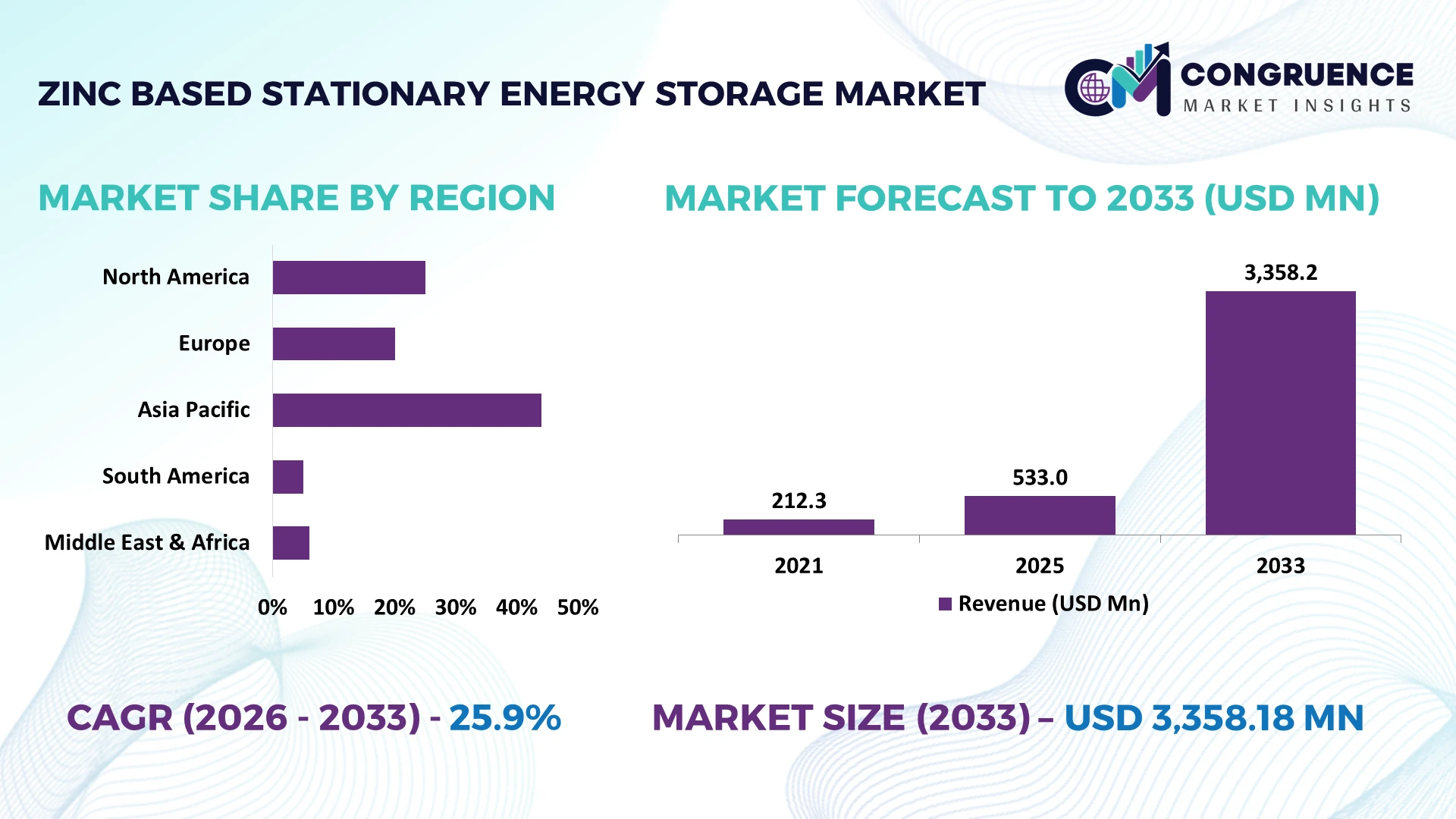
The Global Zinc-Based Stationary Energy Storage Market was valued at USD 533 Million in 2025 and is anticipated to reach a value of USD 3358.18 Million by 2033 expanding at a CAGR of 25.87% between 2026 and 2033. Growth is driven by renewable energy integration, demand for nonflammable battery chemistries, zinc supply chain availability, and deployment of long duration storage systems supporting grid stability.
The United States holds a strategically important position in the global zinc based stationary energy storage industry, with an illustrative 2025 market share of approximately 38%. Eos Energy Enterprises is advancing domestic zinc battery manufacturing, supported by a US Department of Energy loan guarantee of up to USD 303.5 million announced in 2024. Its Z3 technology targets approximately 3 to 12 hours of storage duration. Compared with China, which dominates lithium ion battery manufacturing, the United States is prioritizing domestic zinc battery production, grid resilience, and alternative battery supply chains.
Strategically, the modeled 38% United States market concentration and 12 hour zinc storage capability position domestic manufacturing, utility partnerships, and long duration energy storage integration as investment priorities.
Market Size & Growth: USD 533 million in 2025, reaching USD 3,358.18 million by 2033 at 25.87% CAGR, supported by grid flexibility investments.
Top Growth Drivers: Illustrative influence weights assign 40% to renewable integration, 35% to battery safety requirements, and 25% to domestic supply chain diversification.
Short Term Forecast: By 2028, modeled manufacturing improvements target 15% lower production costs through automated zinc electrode processing.
Emerging Technologies: Three priorities include zinc hybrid cathodes, aqueous electrolytes, and AI enabled battery management systems.
Regional Leaders: Illustrative 2033 allocations place North America at USD 1,410.44 million, Asia Pacific at USD 1,007.45 million, and Europe at USD 671.64 million.
Consumer / End User Trends: Utility applications lead an illustrative 45% demand allocation, supported by renewable energy integration and grid resilience projects.
Pilot / Case Example: In 2024, Eos advanced its Z3 zinc battery commercialization, targeting 3 to 12 hour discharge durations for stationary applications.
Competitive Landscape: Eos Energy Enterprises holds an illustrative 28% market participation estimate; Enerpoly, ZincFive, Urban Electric Power, and e Zinc compete through differentiated chemistries.
Regulatory & ESG Impact: Aqueous zinc batteries reduce reliance on flammable organic electrolytes, while United States clean energy incentives support domestic production.
Investment & Funding: Eos secured a conditional federal loan guarantee commitment of up to USD 303.5 million in 2024, supporting manufacturing expansion.
Innovation & Future Outlook: Advanced zinc electrodes and modular systems target 20% faster installation through standardized manufacturing and deployment architectures.
The Zinc-Based Stationary Energy Storage Market serves utilities, renewable energy developers, industrial facilities, commercial buildings, and critical infrastructure operators requiring dependable stationary power. Zinc hybrid cathode, zinc bromine, and zinc air technologies provide alternatives to conventional lithium ion systems, particularly where fire safety, material availability, and extended discharge duration influence procurement. Eos Energy Enterprises targets storage durations of 3 to 12 hours, supporting renewable energy shifting and grid reliability applications. United States manufacturing incentives and increasing attention to battery supply chain security are encouraging domestic production. These developments establish the foundation for evaluating technology competitiveness, manufacturing scalability, and strategic investment priorities.
The Zinc Based Stationary Energy Storage Market is becoming strategically important as utilities diversify battery procurement beyond lithium ion technologies and prioritize domestic manufacturing, fire safety, and extended discharge capabilities. Zinc based systems use abundant materials and aqueous electrolytes, reducing dependence on flammable organic solvents. The United States is restructuring battery supply chains through federal manufacturing incentives, while Eos Energy Enterprises advances domestic production of zinc hybrid cathode systems. Its Z3 technology targets 3 to 12 hours of discharge, addressing renewable energy shifting and grid reliability requirements.
Technology differentiation increasingly depends on installation economics, safety engineering, and operational durability. Compared with conventional lithium ion installations requiring extensive thermal protection, aqueous zinc systems offer potential reductions in fire mitigation complexity. An illustrative engineering model targets 15% lower auxiliary safety equipment expenditure and 10% faster installation through modular configurations. China maintains substantial lithium ion manufacturing capacity, while American developers emphasize alternative chemistry commercialization. Between 2026 and 2028, manufacturers are prioritizing automated electrode processing, standardized containers, and improved system integration.
Eos provides a practical example through expansion of its Z3 manufacturing platform in Pennsylvania. Utility developers are evaluating zinc batteries for longer duration storage and infrastructure resilience. Competitive leadership depends on validated system performance, reliable domestic supply chains, and scalable manufacturing partnerships.
Increasing renewable electricity penetration is strengthening demand for stationary batteries capable of supporting extended discharge and grid balancing. The International Energy Agency reported that renewable sources supplied approximately 32% of global electricity generation in 2024, increasing the importance of flexible storage resources. Eos Energy Enterprises targets 3 to 12 hour discharge durations through its zinc hybrid cathode technology. An illustrative utility procurement model assigns 40% of storage selection importance to discharge duration, 35% to safety performance, and 25% to supply chain reliability. United States utilities are expanding renewable integration projects, encouraging manufacturers to develop modular storage configurations. Eos is strengthening domestic production and commercial partnerships, positioning zinc systems for applications requiring longer discharge and reduced fire protection complexity.
Zinc based stationary batteries face structural limitations from smaller manufacturing volumes, evolving component supply networks, and competition with established lithium ion production. China dominates global battery manufacturing, creating significant purchasing advantages for incumbent technologies. An illustrative manufacturing cost model assigns 35% of production expenditure to active materials, 30% to cell assembly, and 20% to power electronics, leaving 15% for other components and overhead. Limited zinc battery production volumes restrict economies of scale and increase equipment utilization sensitivity. United States manufacturers must also establish specialized electrode processing and quality assurance infrastructure. Companies are addressing these constraints through localized supplier contracts, automated manufacturing, and standardized module designs. The decisive commercial requirement is reducing installed system cost without sacrificing durability or discharge performance.
Industrial resilience and distributed electricity infrastructure create opportunities for zinc based stationary storage beyond conventional renewable energy projects. Data centers, manufacturing facilities, and critical infrastructure operators require dependable backup capacity and reduced fire safety exposure. An illustrative deployment model targets 20% lower fire protection expenditure and 15% faster modular installation compared with conventional configurations. Zinc batteries operating across 3 to 12 hour discharge windows can support industrial peak management and extended backup requirements. In the United States, increasing electricity demand from digital infrastructure is strengthening interest in diversified storage technologies. Manufacturers are developing modular systems, advanced battery management software, and integrated power conversion partnerships. A distinctive opportunity involves replacing diesel dependent resilience architectures with storage configurations that support both emergency operation and routine electricity management.
Commercial deployment of zinc based stationary batteries requires consistent cycle performance, reliable control systems, and compatibility with established grid infrastructure. Unlike mature lithium ion platforms, emerging zinc technologies must demonstrate durability across varied temperatures, operating profiles, and discharge conditions. An illustrative engineering validation model targets 95% operational availability, 90% retained usable capacity after defined cycling, and 15% fewer unscheduled maintenance interventions. These figures represent design objectives rather than verified industry benchmarks. United States utilities require comprehensive interconnection studies, performance warranties, and integration with energy management platforms. Manufacturers must strengthen field testing, predictive maintenance, and power electronics partnerships to reduce deployment risk. Long term competitiveness depends on reproducible performance data, transparent degradation modeling, and dependable technical support throughout the operating lifecycle.
Automated Zinc Electrode Production Accelerates: United States manufacturers are transitioning from manual electrode preparation toward automated coating, stacking, and quality inspection. Eos Energy Enterprises is expanding its Z3 manufacturing platform in Pennsylvania. Illustrative production targets include 15% lower assembly costs and 20% higher equipment utilization. Manufacturers are integrating automated inspection systems and standardized electrode processing to improve production consistency, reduce material waste, and strengthen commercial delivery capacity.
Aqueous Electrolyte Formulations Gain Commercial Attention: Zinc battery developers are refining electrolyte chemistry to control dendrite formation, corrosion, and parasitic reactions. Illustrative engineering targets include 10% longer cycle life and 15% lower electrolyte maintenance requirements. Companies such as Enerpoly are developing rechargeable zinc battery platforms using aqueous chemistry. Improved electrolyte stability reduces replacement frequency and supports more predictable maintenance expenditure, strengthening technology differentiation during commercial qualification.
Modular Battery Architecture Reshapes Procurement: Stationary storage suppliers are standardizing battery enclosures, electrical interfaces, and factory assembled components. Illustrative deployment models target 20% shorter installation schedules and 10% lower onsite integration expenditure. United States grid interconnection requirements are encouraging manufacturers to coordinate power conversion equipment with battery controls. Standardized architectures also simplify spare parts management, enabling suppliers to support geographically distributed installations without duplicating extensive technical inventories.
Battery Recycling Integration Strengthens Material Recovery: Zinc battery manufacturers are examining closed loop material handling and recovery processes as sustainability requirements influence procurement. Illustrative recovery targets include 85% zinc material reclamation and 12% lower virgin material requirements. European battery regulations are strengthening lifecycle documentation and material traceability expectations. Manufacturers are developing recycling partnerships and improving material tracking systems, creating opportunities to reduce disposal costs and strengthen long term supply security.
Zinc-Bromine Batteries represent an estimated 34% of the global Zinc Based Stationary Energy Storage Market in an illustrative 2025 segmentation model, supported by established flow battery configurations, extended discharge capability, and suitability for stationary installations. Zinc-Ion Batteries account for approximately 26%, reflecting increasing interest in rechargeable aqueous systems and simplified cell architectures. Zinc bromine technology benefits from independent energy and power sizing in flow configurations, supporting applications requiring extended discharge and repeated cycling. Australian and American developers are improving electrolyte management, membrane performance, and system integration. Manufacturers are prioritizing standardized battery modules and improved power conversion compatibility to strengthen commercial deployment.
Zinc-Ion Batteries represent the fastest expanding technology category in the modeled scenario, supported by improvements in electrode stability, electrolyte formulations, and manufacturing automation. Zinc-Air Batteries offer high theoretical energy density but face rechargeability and performance limitations. Nickel-Zinc Batteries support high power applications, while Zinc-Manganese Dioxide Batteries attract interest through established materials and manufacturing familiarity. Battery developers are expanding research partnerships and pilot manufacturing capabilities. Investment priorities increasingly favor technologies demonstrating reliable cycling, scalable production, and competitive installed system costs.
Renewable Energy Storage represents an estimated 38% of global Zinc Based Stationary Energy Storage Market activity in an illustrative 2025 application allocation, reflecting requirements for solar and wind generation shifting. Grid Energy Storage accounts for approximately 29%, supported by electricity balancing, capacity management, and network reliability requirements. Zinc based batteries are attracting interest where longer discharge periods and reduced flammable electrolyte exposure influence project design. Eos Energy Enterprises targets approximately 3 to 12 hours of storage duration through its Z3 technology, supporting integration with renewable generation assets. United States developers are evaluating modular storage configurations, while manufacturers strengthen engineering partnerships and system integration capabilities.
Microgrid Storage represents the fastest expanding application category in the modeled scenario, supported by localized electricity management and increasing deployment of distributed generation. Backup Power remains important for critical infrastructure continuity, while Commercial Energy Management supports peak demand control and electricity consumption optimization. Battery manufacturers are developing configurable power electronics, remote monitoring capabilities, and standardized installation packages. Competitive positioning increasingly depends on matching discharge duration, operational availability, and installation requirements to specific customer applications rather than promoting uniform battery configurations.
Utilities represent an estimated 43% of the global Zinc Based Stationary Energy Storage Market in an illustrative 2025 end user allocation, supported by large installation requirements, grid reliability obligations, and renewable generation integration. Renewable Energy Operators account for approximately 24%, reflecting storage requirements associated with variable electricity production. Utility procurement emphasizes system availability, discharge duration, warranty conditions, and integration with existing grid infrastructure. Zinc based storage manufacturers are targeting these requirements through modular systems and extended duration configurations. United States utilities are strengthening storage procurement frameworks, encouraging suppliers to provide performance validation, predictable maintenance requirements, and dependable project delivery schedules.
Data Centers represent the fastest expanding end user category in the modeled scenario, supported by increasing electricity infrastructure requirements and demand for resilient power architectures. Commercial and Industrial Facilities deploy storage for operational continuity and electricity management, while Telecommunications Providers prioritize dependable backup power and compact installations. Manufacturers are developing application specific battery controls, service contracts, and integrated power conversion solutions. Competitive advantage increasingly depends on meeting distinct operating profiles and providing lifecycle support rather than relying exclusively on battery acquisition costs.
North America accounted for the largest market share at an estimated 42% in 2025 however, Asia Pacific is expected to register the fastest growth, expanding at a modeled CAGR of 29.5% between 2026 and 2033.
Domestic Zinc Battery Manufacturing and Grid Storage Commercialization
North America represents an estimated 42% of the global Zinc Based Stationary Energy Storage Market in 2025, supported by domestic battery manufacturing, utility procurement, and alternative chemistry commercialization. The United States concentrates industrial development through Eos Energy Enterprises, ZincFive, and other technology suppliers targeting stationary applications. Eos has advanced automated manufacturing of zinc hybrid cathode batteries in Pennsylvania, supported by a federal loan guarantee of up to USD 303.5 million finalized in 2024. Its Z3 technology targets discharge durations of approximately 3 to 12 hours, addressing grid flexibility and renewable electricity shifting. Canada contributes through zinc air technology development and industrial energy storage innovation. Regional manufacturers are strengthening electrode production, domestic supplier qualification, and utility partnerships. Procurement increasingly emphasizes fire safety, installation economics, and independently validated battery performance.
United States Market Outlook: The United States leads regional commercialization through Pennsylvania manufacturing facilities, advanced battery engineering, and federal industrial policy. Eos Energy Enterprises is expanding automated zinc battery production to support utility scale deployment. The Inflation Reduction Act provides qualifying domestic battery manufacturing incentives, including a production credit of USD 35 per kilowatt hour for eligible battery cells. American developers are strengthening grid integration capabilities, manufacturing automation, and long duration storage partnerships to improve competitiveness against imported lithium ion systems.
Battery Sustainability Regulation and Alternative Chemistry Development
Europe accounts for an estimated 20% of global Zinc Based Stationary Energy Storage Market activity in 2025, supported by battery technology research, renewable electricity integration, and industrial decarbonization policies. Sweden, Germany, and the United Kingdom maintain established battery innovation ecosystems, with growing attention to aqueous zinc chemistries and recyclable electrode materials. Sweden based Enerpoly is developing rechargeable zinc battery technology using abundant materials and aqueous electrolytes. European Union Battery Regulation 2023/1542 establishes progressive sustainability, documentation, and lifecycle requirements, influencing battery design and supplier qualification. Manufacturers are prioritizing material traceability, electrolyte stability, and production efficiency. Germany contributes advanced electrical engineering and grid integration expertise, while British research institutions investigate alternative electrochemical storage systems. Commercial differentiation increasingly depends on documented environmental performance, technical reliability, and compatibility with evolving European electricity infrastructure.
Sweden Market Outlook: Sweden maintains a strategic position through advanced battery research, industrial electrification, and Enerpoly's zinc battery development activities. The country's electricity system relies heavily on low carbon generation, creating opportunities for storage technologies supporting industrial flexibility. Enerpoly has advanced zinc battery manufacturing initiatives focused on aqueous chemistry and stationary applications. Swedish engineering expertise, renewable electricity availability, and European sustainability requirements strengthen the business case for localized alternative battery production and lifecycle optimization.
Battery Manufacturing Scale and Alternative Chemistry Diversification
Asia Pacific represents an estimated 30% of the global Zinc Based Stationary Energy Storage Market in 2025, supported by established electrochemical manufacturing infrastructure, renewable energy deployment, and advanced battery materials research. China dominates global lithium ion battery manufacturing and maintains substantial zinc processing capabilities, creating opportunities to diversify stationary storage technologies. Japan and South Korea contribute advanced electrode engineering, battery management systems, and materials research. Australia has developed zinc bromine flow battery expertise through companies such as Redflow, although its 2024 administration exposed commercialization and financing risks. Regional manufacturers are investigating zinc ion, zinc air, and zinc manganese dioxide technologies for stationary applications. Battery developers are strengthening electrolyte research, manufacturing process development, and industrial partnerships. Competitive positioning depends on converting established battery production expertise into commercially validated zinc storage systems without compromising reliability or installation economics.
China Market Outlook: China possesses extensive battery manufacturing infrastructure, zinc refining capabilities, and renewable energy development capacity. Its industrial advantage includes established electrode processing equipment, electrochemical materials supply chains, and integrated power electronics manufacturing. China accounts for more than 70% of global lithium ion battery cell manufacturing capacity, providing substantial transferable manufacturing expertise. Domestic research institutions are investigating aqueous zinc ion batteries and advanced electrode materials, while industrial suppliers evaluate alternative chemistry opportunities for stationary energy storage applications.
Renewable Electricity Expansion and Distributed Storage Integration
South America represents an estimated 5% of global Zinc Based Stationary Energy Storage Market activity in 2025, supported by renewable electricity investment and increasing interest in stationary storage alternatives. Brazil and Chile concentrate relevant electricity infrastructure development, with solar generation expansion creating additional requirements for dispatch flexibility. Chile's Atacama region has substantial solar resources, encouraging energy storage deployment to manage generation variability and electricity curtailment. Zinc based technologies offer potential advantages in applications prioritizing aqueous electrolytes and extended discharge. However, limited regional manufacturing infrastructure and established lithium ion procurement channels constrain immediate commercialization. Developers are evaluating alternative battery chemistries through technology partnerships and project feasibility assessments. Suppliers entering the region must address equipment import costs, technical support availability, and compatibility with local electricity market requirements.
Brazil Market Outlook: Brazil leads regional stationary storage opportunities through its large electricity system, renewable generation portfolio, and established industrial infrastructure. The country has more than 200 million inhabitants and extensive hydroelectric, solar, and wind generation assets. São Paulo concentrates electrical equipment manufacturers, engineering companies, and energy technology providers. Battery suppliers are evaluating industrial backup, distributed generation, and grid support applications. Local integration partnerships and dependable technical service networks remain essential for commercial adoption of emerging zinc storage technologies.
Energy Infrastructure Diversification and Industrial Storage Investment
The Middle East and Africa represent an estimated 3% of global Zinc Based Stationary Energy Storage Market activity in 2025, supported by renewable energy development, industrial electrification, and electricity infrastructure modernization. Saudi Arabia, the United Arab Emirates, and South Africa concentrate relevant storage investment opportunities. Saudi Arabia's Vision 2030 supports renewable generation expansion and electricity infrastructure diversification, while the UAE is investing in large solar installations and advanced grid technologies. South Africa's electricity reliability challenges create demand for distributed storage and industrial backup solutions. Zinc based batteries offer potential operational benefits where nonflammable aqueous electrolytes and longer discharge requirements influence system selection. Manufacturers are evaluating regional distribution partnerships, modular installations, and maintenance support arrangements. Project economics depend on local procurement requirements, grid compatibility, and reliable replacement component availability.
Saudi Arabia Market Outlook: Saudi Arabia is expanding renewable electricity infrastructure through national energy diversification programs and large solar development projects. Vision 2030 provides the strategic framework for industrial modernization and electricity system transformation. Riyadh and major industrial centers are strengthening energy technology procurement and grid development capabilities. Zinc battery suppliers can target industrial storage and renewable integration applications through local engineering partnerships. Qualification against established battery technologies remains essential for securing commercial projects.
Eos Energy Enterprises competes with Enerpoly and e Zinc in stationary storage, emphasizing domestic manufacturing, aqueous chemistry, and extended discharge. ZincFive and ZAF Energy Systems focus on nickel zinc performance, while Urban Electric Power targets rechargeable zinc manganese dioxide systems. An illustrative market model assigns the five largest suppliers a combined 58% share, not a verified concentration measure. Procurement differentiation centers on installed cost, cycle durability, safety, and delivery certainty. Modeled engineering targets include 15% lower assembly costs through automation, 10% shorter installation schedules through standardized modules, and 20% higher equipment utilization. Eos is expanding manufacturing automation, while emerging developers pursue electrolyte improvements, demonstration projects, and integration partnerships. Competition is shifting from laboratory performance claims toward independently tested systems, bankable warranties, and repeatable manufacturing. Limited operating histories and financing requirements remain barriers to entry. Winning suppliers must demonstrate durable performance, dependable delivery, and credible lifetime economics under actual grid operating conditions.
Eos Energy Enterprises, Inc.
ZincFive, Inc.
Enerpoly AB
e-Zinc Inc.
Urban Electric Power, Inc.
ZAF Energy Systems, Inc.
Gelion plc
Enzinc, Inc.
AEsir Technologies, Inc.
Salient Energy, Inc.
Current zinc battery technologies combine aqueous electrolytes, engineered electrodes, modular power electronics, and digital battery management systems. Zinc bromine flow batteries separate energy storage capacity from power conversion, while nickel zinc systems emphasize high power delivery. Eos targets discharge durations of 3 to 12 hours through zinc hybrid cathode technology. Compared with conventional manually assembled modules, automated electrode manufacturing targets an illustrative 20% improvement in production throughput and 15% lower assembly costs. Manufacturers gain stronger quality consistency and shorter delivery schedules.
Emerging technologies include dendrite resistant zinc anodes, electrolyte additives, and artificial intelligence assisted performance monitoring. Illustrative engineering targets include 12% longer cycle life through electrode stabilization and 10% fewer maintenance interventions through predictive diagnostics. Commercial adoption remains concentrated in demonstration projects and early manufacturing expansion rather than widespread utility deployment. Enerpoly and other developers are refining aqueous battery architectures, while integrators prioritize standardized controls and remote monitoring.
Between 2026 and 2028, disruptive advances will emphasize recyclable cell designs, automated material recovery, and grid responsive control algorithms. Modeled deployment targets include 15% faster commissioning and 10% lower lifecycle servicing expenditure. Companies combining manufacturing automation, validated durability, and integrated power conversion gain competitive advantages in utility procurement and industrial storage installations.
December 2024: Eos Energy Enterprises secured a USD 303.5 million federal loan guarantee supporting two Pennsylvania zinc battery production lines. The financing strengthens domestic manufacturing capacity, supply security, and utility procurement readiness for long duration storage projects. Source: energy.gov.
March 2025: e-Zinc received Canadian government funding support for zinc air storage commercialization at the Bull Creek wind facility in Texas. The planned 24 hour system targets renewable generation shifting, strengthening grid flexibility and demonstrating alternative chemistry applications. Source: canada.ca.
November 2025: ZincFive introduced its BC 2 AI nickel zinc battery cabinet for artificial intelligence data centers. Its 90 Ah cells support demanding power fluctuations, strengthening high density backup applications and equipment integration for critical computing infrastructure. Source: datacenterdynamics.com.
April 2026: ZincFive reported surpassing 2 GW of nickel zinc backup power delivered or contracted globally. The milestone demonstrates commercial traction in data center infrastructure and supports expansion of manufacturing capacity, customer deployment capabilities, and critical infrastructure partnerships. Source: zincfive.com.
The Zinc-Based Stationary Energy Storage Market Report examines technology commercialization, manufacturing capabilities, deployment economics, and competitive positioning between 2026 and 2033. Type segmentation covers Zinc-Bromine Batteries, Zinc-Ion Batteries, Zinc-Air Batteries, Nickel-Zinc Batteries, and Zinc-Manganese Dioxide Batteries. Application coverage includes Renewable Energy Storage, Grid Energy Storage, Backup Power, Microgrid Storage, and Commercial Energy Management. End-user analysis evaluates Utilities, Commercial and Industrial Facilities, Renewable Energy Operators, Data Centers, and Telecommunications Providers, emphasizing procurement requirements and operational performance.
Regional assessment covers North America, Europe, Asia Pacific, South America, and the Middle East and Africa. Technology evaluation addresses aqueous electrolytes, advanced electrodes, automated manufacturing, and intelligent battery management. Deployment indicators include 3 to 12 hour storage configurations and 2 GW of nickel zinc backup power delivered or contracted. The report supports investment planning, manufacturing expansion, technology partnerships, and competitive strategy.
| Report Attribute/Metric | Report Details |
|---|---|
Market Revenue in 2025 | USD 533 Million |
Market Revenue in 2033 | USD 3358.18 Million |
CAGR (2026 - 2033) | 25.87% |
Base Year | 2025 |
Forecast Period | 2026 - 2033 |
Historic Period | 2021 - 2025 |
Segments Covered | By Type
By Application
By End-User
|
Key Report Deliverable | Revenue Forecast, Growth Trends, Market Dynamics, Segmental Overview, Regional and Country-wise Analysis, Competition Landscape |
Region Covered | North America, Europe, Asia-Pacific, South America, Middle East, Africa |
Key Players Analyzed | Eos Energy Enterprises, Inc., ZincFive, Inc., Enerpoly AB, e-Zinc Inc., Urban Electric Power, Inc., ZAF Energy Systems, Inc., Gelion plc, Enzinc, Inc., AEsir Technologies, Inc., Salient Energy, Inc. |
Customization & Pricing | Available on Request (10% Customization is Free) |




