
Reports
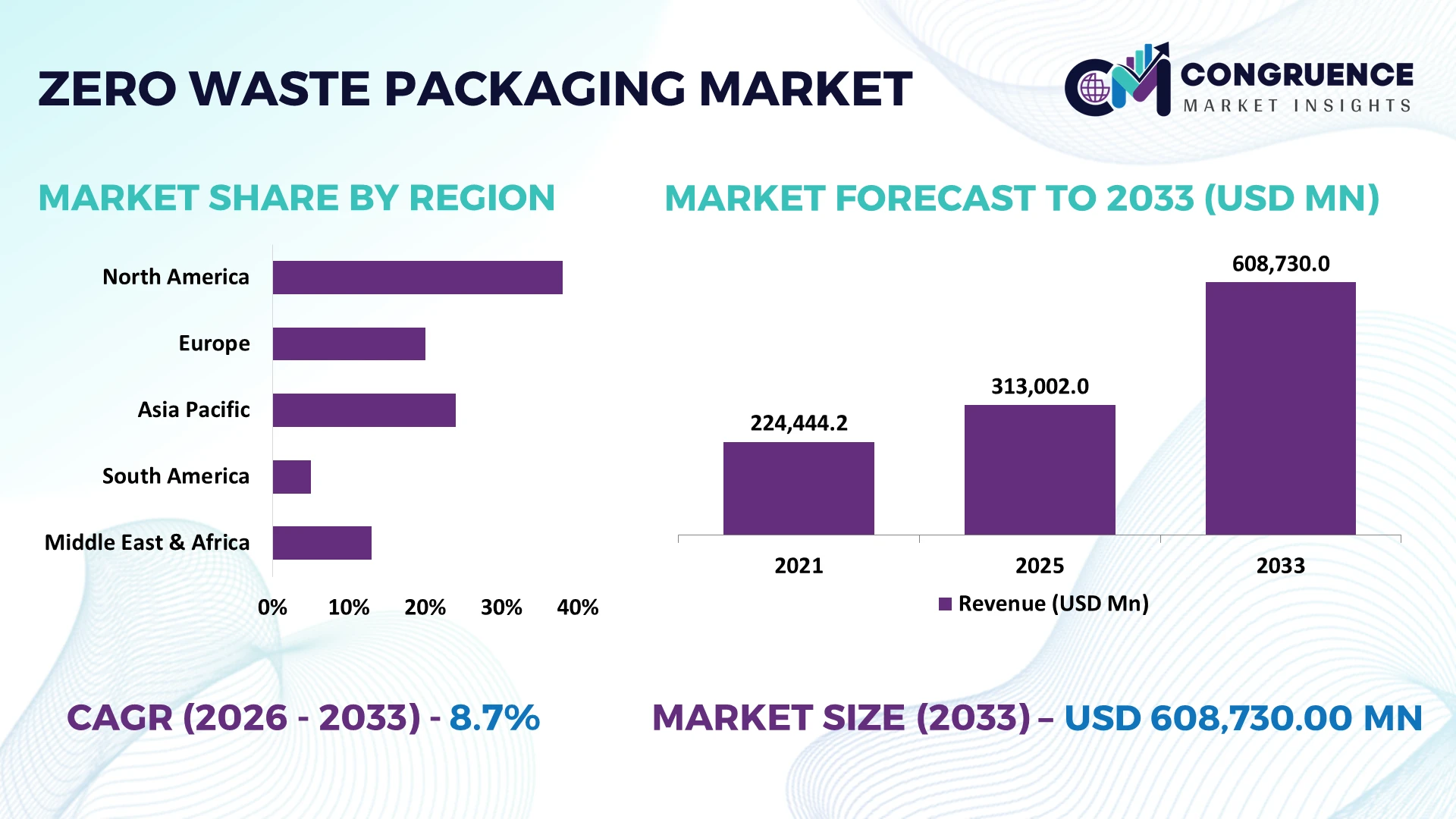
The Global Zero Waste Packaging Market was valued at USD 313002 Million in 2025 and is anticipated to reach a value of USD 608730 Million by 2033 expanding at a CAGR of 8.67% between 2026 and 2033. Growth is being accelerated by circular economy regulations, fiber-based material innovation, refill systems, advanced recycling technologies, and brand commitments to eliminate single-use packaging across consumer goods, food, healthcare, and e-commerce sectors.
China remains the dominant market, accounting for approximately 31% of global manufacturing capacity, supported by large-scale paper, biopolymer, and industrial packaging production alongside investments exceeding USD 18 billion in sustainable packaging infrastructure. Germany leads Europe in advanced circular packaging adoption, while China manufactures over three times more packaging materials, reflecting stronger industrial scale amid evolving global trade realignment and supply-chain diversification in 2026.
Businesses that prioritize scalable recyclable materials, localized production, and circular packaging partnerships are positioned to strengthen long-term competitive advantage.
Market Size & Growth: USD 313002 Million in 2025, projected to reach USD 608730 Million by 2033 at 8.67% growth, driven by advanced recyclable materials and circular manufacturing.
Top Growth Drivers: Recycled content adoption exceeds 42%, refill packaging expands 28%, and fiber-based packaging demand increases 35% across major industries.
Short-Term Forecast: By 2028, automated packaging operations improve production efficiency by 22% while reducing material waste by 18%.
Emerging Technologies: AI quality inspection, automation, and advanced bio-based materials reduce defects by 25% and improve resource utilization across high-growth packaging lines.
Regional Leaders: Asia Pacific exceeds USD 255 Billion, Europe reaches USD 165 Billion, and North America surpasses USD 118 Billion, supported by circular manufacturing and regional supply-chain expansion.
Consumer/End-User Trends: More than 61% of consumers actively prefer recyclable or reusable packaging, accelerating procurement changes across retail and food sectors.
Pilot/Case Example: In 2026, a reusable packaging deployment reduced single-use packaging consumption by 32% while improving reverse logistics efficiency across distribution networks.
Competitive Landscape: The top supplier group holds approximately 29% market share, led by Amcor, DS Smith, Smurfit Westrock, Mondi Group, and Stora Enso.
Regulatory & ESG Impact: Extended producer responsibility policies increase recycled-content utilization by over 20%, strengthening compliance across global packaging supply chains.
Investment & Funding: More than USD 14 Billion supports advanced recycling, strategic partnerships, and sustainable packaging capacity expansion across key manufacturing regions.
Innovation & Future Outlook: Smart traceability, compostable barrier coatings, and digital packaging platforms accelerate next-generation circular packaging strategies and strengthen long-term operational resilience.
Zero Waste Packaging Market demand continues expanding across food and beverage, personal care, healthcare, and e-commerce applications as manufacturers introduce recyclable mono-material structures, compostable barrier coatings, and intelligent packaging solutions. More than 45% of new packaging development focuses on circular material design, while tightening environmental regulations and regional supply-chain localization strategies continue reshaping procurement priorities and investment decisions, setting the stage for broader strategic market evaluation.
Zero waste packaging has become a strategic priority as manufacturers, retailers, and logistics providers align operations with circular economy objectives and stricter packaging regulations. Supply-chain restructuring is accelerating investments in recyclable materials, refill systems, and localized production to reduce material dependency and improve procurement resilience. Companies increasingly view sustainable packaging as a competitive differentiator that strengthens brand positioning while improving resource efficiency across global distribution networks.
Advanced AI-enabled quality inspection and digital material tracking improve packaging defect detection by approximately 24% compared with conventional visual inspection while lowering quality-control costs by nearly 18%. China continues to lead large-scale manufacturing capacity and industrial deployment, whereas Germany focuses on premium recyclable packaging innovation and closed-loop recycling infrastructure. Over the next two to three years, automated material recovery and digital traceability adoption are expected to exceed 40% across leading packaging manufacturers, supporting faster compliance and higher operational transparency.
A leading consumer goods manufacturer deploying reusable transport packaging achieved a 30% reduction in packaging waste through integrated reverse logistics and digital asset tracking. Companies are expanding strategic partnerships with material innovators, recycling firms, and technology providers while increasing investments in localized production capabilities. Organizations that combine scalable circular packaging systems with advanced manufacturing and traceability technologies will secure stronger competitive positioning and long-term operational resilience.
Mandatory packaging waste reduction targets and extended producer responsibility frameworks are driving large-scale adoption of zero waste packaging across manufacturing sectors. More than 55% of multinational consumer goods companies have expanded recyclable or reusable packaging portfolios, while recycled-content utilization has increased by approximately 22% in new product launches. China continues expanding fiber-based packaging production as industrial investments strengthen domestic supply chains. This structural shift reduces dependence on virgin materials, improves resource efficiency, and supports regulatory compliance. Companies are responding through capacity expansion, strategic partnerships with recycling specialists, and innovation in mono-material packaging formats, enabling faster commercialization while strengthening long-term procurement flexibility and operational competitiveness.
Uneven recycling infrastructure and volatile secondary material availability continue limiting efficient zero waste packaging deployment. Recovery rates for flexible packaging remain below 35% in several industrial economies, while recycled material price fluctuations frequently exceed 20% during supply disruptions. Limited collection networks and inconsistent material quality reduce manufacturing efficiency and increase procurement complexity. These constraints affect production planning, packaging standardization, and profitability for large-scale manufacturers. Companies are reducing exposure by diversifying supplier networks, establishing localized material sourcing programs, and signing long-term procurement agreements for recycled feedstock, creating greater operational stability despite ongoing infrastructure limitations.
Digital product passports, intelligent material tracking, and advanced chemical recycling technologies are creating new commercial opportunities across zero waste packaging ecosystems. Automated sorting systems improve material recovery efficiency by approximately 30%, while AI-assisted waste identification increases processing accuracy by more than 25%. Japan continues investing in high-performance recycling technologies that strengthen circular manufacturing capabilities for premium packaging applications. Companies are expanding research partnerships, developing next-generation compostable barrier materials, and integrating digital traceability platforms into packaging operations. These initiatives unlock higher-value recycled materials, improve compliance management, and strengthen collaboration across packaging, recycling, and logistics networks.
Scaling zero waste packaging across multinational operations requires consistent material specifications, reverse logistics integration, and coordinated recycling infrastructure. Packaging standardization remains below 50% across many global supply chains, while reverse logistics costs can increase operational expenditure by approximately 15% during early deployment phases. Cross-border regulatory differences and evolving packaging compliance requirements add further implementation complexity. Companies must modernize manufacturing systems, strengthen digital traceability, and collaborate with logistics and recycling partners to ensure consistent execution. Organizations investing in interoperable packaging platforms and integrated circular supply networks will achieve stronger operational resilience and maintain long-term competitive differentiation.
Digital Material Traceability Expansion: Manufacturers are integrating digital product passports and AI-enabled material tracking into packaging workflows, improving inventory visibility by approximately 28% and reducing material identification errors by 22%. New compliance requirements across Europe and enterprise sustainability reporting are accelerating deployment. Companies are standardizing traceability platforms through technology partnerships, enabling faster recycling verification, streamlined supplier audits, and improved operational transparency throughout complex packaging supply chains.
Localized Packaging Manufacturing Networks: Supply-chain diversification is shifting production closer to end markets, reducing transportation-related packaging lead times by nearly 18% and improving procurement reliability by 20%. China and Mexico continue attracting packaging investments as manufacturers balance resilience with cost efficiency. Companies are restructuring supplier ecosystems, expanding regional converting facilities, and strengthening long-term material agreements to minimize disruptions while maintaining consistent packaging quality.
High-Performance Fiber Material Adoption: Advanced molded fiber, barrier-coated paper, and mono-material solutions are replacing conventional multilayer packaging, lowering virgin plastic consumption by approximately 26% while improving recycling compatibility by over 30%. Retail and food manufacturers are accelerating qualification programs to comply with evolving packaging standards. Companies are investing in automated fiber-processing equipment and collaborating with material developers to commercialize scalable high-performance packaging formats.
Automation Reshapes Packaging Operations: Smart robotics, machine vision inspection, and automated packaging lines have increased production throughput by approximately 24% while reducing packaging defects by 19%. Persistent labor shortages and productivity optimization initiatives are driving factory modernization. Companies are scaling intelligent manufacturing systems, integrating predictive maintenance, and expanding automation partnerships to improve operational consistency, reduce waste generation, and strengthen long-term production flexibility.
Recyclable packaging remains the dominant segment, accounting for approximately 39% of market demand due to established collection systems, broad industrial compatibility, and lower implementation complexity. Manufacturers continue prioritizing recyclable paper, aluminum, glass, and mono-material plastics because they integrate efficiently with existing production infrastructure while supporting evolving compliance requirements. Plant-based packaging is strengthening its market position through improved barrier performance, while compostable solutions continue gaining traction where dedicated organic waste infrastructure is expanding.
Reusable packaging represents the fastest-growing type as manufacturers and retailers deploy closed-loop logistics systems to reduce material consumption and packaging replacement frequency. Adoption of reusable transport packaging has increased by approximately 27%, while investment in refill packaging platforms has expanded by nearly 24%. Edible packaging remains a specialized innovation focused primarily on food applications with selective commercial deployment. Companies are balancing investments between scalable recyclable formats and premium reusable systems while expanding partnerships with material science firms to strengthen product performance and operational efficiency.
Food & Beverage remains the largest application segment, representing approximately 43% of total demand because of high packaging consumption, strict food safety standards, and increasing replacement of conventional single-use materials. Manufacturers are expanding recyclable trays, fiber-based containers, and refillable beverage systems to improve operational efficiency while meeting packaging compliance requirements. Personal Care continues strengthening demand through premium sustainable packaging designs, while Household Products increasingly adopt concentrated refill packaging to reduce material intensity.
E-commerce is the fastest-growing application as retailers optimize shipping efficiency with lightweight recyclable packaging and automated fulfillment processes. Adoption of right-sized packaging solutions has improved packaging utilization by approximately 25%, while protective recyclable materials have reduced shipping waste by nearly 20%. Healthcare continues introducing recyclable medical packaging where regulatory compatibility permits. Companies are expanding automated packaging operations, strengthening supplier collaboration, and developing customized packaging formats that improve logistics performance while supporting circular packaging objectives.
The Food Industry remains the largest end-user, accounting for approximately 41% of packaging demand due to continuous production volumes, strict product protection requirements, and extensive packaging consumption across processing and distribution operations. Large manufacturers are accelerating deployment of recyclable and reusable packaging systems to improve resource efficiency while complying with evolving packaging regulations. Retail maintains strong purchasing activity as private-label sustainability initiatives expand, while Consumer Goods companies continue redesigning packaging portfolios to strengthen environmental performance.
E-commerce Companies represent the fastest-growing end-user segment as distribution centers increase automation and optimize packaging for high-volume parcel shipments. Automated packaging deployment has increased by approximately 26%, while right-sized packaging programs reduce material consumption by nearly 18%. Healthcare organizations continue adopting specialized sustainable packaging where product integrity remains uncompromised. Companies are responding through customized packaging portfolios, strategic logistics partnerships, and digital packaging management systems that improve operational flexibility while strengthening long-term customer value propositions.
Asia-Pacific accounted for the largest market share at 44% in 2025 however, Europe is expected to register the fastest growth, expanding at a CAGR of 9.12% between 2026 and 2033.
Advanced Manufacturing and Circular Supply Integration
North America remains a mature zero waste packaging market supported by established recycling infrastructure, large consumer goods manufacturers, and strong investment in packaging automation. The region accounted for approximately 24% of global market activity in 2025, with widespread deployment across food processing, retail, and e-commerce operations. Automated packaging systems continue expanding, improving production efficiency by nearly 22% while reducing material losses. Regulatory emphasis on recycled content and extended producer responsibility has accelerated enterprise adoption of mono-material packaging and reusable transport systems. Companies are strengthening partnerships with recycling firms and packaging technology providers while expanding domestic converting capacity to improve supply-chain resilience and reduce dependence on imported sustainable materials.
United States Market Outlook: The United States leads regional deployment through advanced manufacturing capabilities, extensive retail distribution networks, and strong innovation in recyclable packaging technologies. More than 60% of large consumer goods manufacturers have expanded sustainable packaging portfolios, supported by investments in AI-enabled production monitoring, automated sorting, and circular packaging infrastructure. Enterprise collaboration between packaging producers and retailers continues improving material recovery while strengthening long-term operational efficiency.
Regulatory Alignment Drives Packaging Transformation
Europe continues advancing zero waste packaging through harmonized sustainability regulations, established recycling ecosystems, and strong industrial collaboration. The region represents approximately 28% of global market activity, supported by widespread deployment of recyclable fiber packaging and reusable distribution systems. Packaging recovery rates exceed 70% across several European economies, enabling greater circular material utilization and reducing reliance on virgin resources. Manufacturers are modernizing production facilities while increasing investments in recyclable barrier technologies and digital packaging traceability to strengthen compliance and operational transparency.
Germany Market Outlook: Germany remains the region's industrial leader through advanced packaging engineering, large-scale recycling infrastructure, and strong manufacturing integration. Industrial recycling efficiency exceeds 67% for several packaging material streams, supporting reliable secondary material availability. Companies continue investing in automated converting facilities, collaborative recycling partnerships, and high-performance fiber packaging innovation, reinforcing Germany's position as a benchmark for industrial-scale circular packaging deployment.
Manufacturing Scale Strengthens Market Leadership
Asia-Pacific dominates global zero waste packaging through extensive manufacturing capacity, expanding consumer industries, and large-scale packaging production networks. The region contributes approximately 44% of global market demand, supported by integrated paper, fiber, and bio-based material manufacturing. Industrial investments in automated packaging lines have improved production productivity by approximately 25%, while export-oriented manufacturing continues driving adoption of recyclable packaging solutions. Companies are expanding localized production, strengthening supplier integration, and investing in advanced material processing to improve efficiency and reduce logistics complexity across regional supply chains.
China Market Outlook: China leads the regional market through unmatched manufacturing capacity, integrated packaging supply chains, and continuous industrial investment. The country accounts for approximately 31% of global sustainable packaging production capacity, supported by extensive paper manufacturing, advanced converting operations, and government-backed industrial modernization initiatives. Domestic manufacturers continue expanding recyclable packaging production while integrating automation and intelligent quality control to improve competitiveness in both domestic and export markets.
Industrial Modernization Supports Sustainable Packaging
South America is steadily strengthening its zero waste packaging industry through expanding food processing, consumer goods manufacturing, and retail modernization. The region accounts for approximately 7% of global market activity, with Brazil driving most industrial deployment. Packaging manufacturers are increasing recycled material utilization by nearly 20% while investing in upgraded converting facilities to improve operational efficiency. Infrastructure limitations remain in selected markets, yet growing enterprise collaboration and localized material sourcing are improving production reliability. Companies continue expanding partnerships with recycling operators to strengthen circular packaging capabilities.
Brazil Market Outlook: Brazil serves as the region's primary manufacturing and consumption hub, supported by a large food and beverage sector and expanding packaging conversion capacity. Recycled paper packaging production continues increasing alongside investments in collection and sorting infrastructure. Domestic manufacturers are introducing advanced recyclable packaging solutions while strengthening cooperation with retailers and waste management organizations to improve recovery efficiency and long-term supply stability.
Infrastructure Investment Reshapes Packaging Operations
The Middle East & Africa market is advancing through industrial diversification, manufacturing modernization, and expanding investment in sustainable packaging infrastructure. The region contributes approximately 5% of global market activity, with increasing deployment across food manufacturing and retail supply chains. Industrial packaging facilities are incorporating automated production technologies that improve operational efficiency by approximately 18%. National sustainability initiatives and investment in recycling infrastructure are encouraging broader adoption of recyclable packaging formats. Companies are expanding regional manufacturing partnerships while strengthening localized production capabilities to improve supply-chain resilience.
United Arab Emirates Market Outlook: The United Arab Emirates is emerging as the region's leading innovation hub through advanced industrial infrastructure, logistics connectivity, and sustainability-focused manufacturing investments. Packaging producers are expanding recyclable packaging production and integrating smart manufacturing technologies to improve operational performance. Continued investment in circular economy initiatives and modern recycling infrastructure supports broader enterprise adoption while strengthening the country's position as a strategic packaging production and distribution center.
The competitive landscape is led by Amcor, Mondi Group, Smurfit Westrock, DS Smith, and Stora Enso, while regional paper converters and bio-based packaging specialists compete aggressively on localized production and customized sustainable solutions. Global leaders compete through integrated manufacturing and material innovation, whereas regional suppliers emphasize cost efficiency and rapid customer response. The top five players collectively control approximately 29% of the market, leaving significant opportunities for specialized manufacturers. Competition centers on recyclable material performance, production efficiency, supply-chain reliability, and packaging customization. Automated manufacturing improves throughput by nearly 24%, while advanced material optimization reduces production waste by approximately 18%. Companies are expanding converting facilities, securing long-term recycled fiber supplies, forming technology partnerships, and integrating recycling operations to strengthen value-chain control. The competitive shift increasingly favors vertically integrated manufacturers with digital traceability and circular material capabilities. High capital investment in advanced production infrastructure remains the primary entry barrier. Winning requires scalable circular manufacturing, resilient sourcing networks, continuous material innovation, and operational execution.
Amcor plc
Mondi Group
Smurfit Westrock
DS Smith
Stora Enso
Tetra Pak
Huhtamaki Oyj
Berry Global Inc.
Sealed Air Corporation
Sonoco Products Company
UPM Specialty Papers
Ranpak Holdings Corp.
Advanced recyclable mono-material structures, AI-enabled quality inspection, and intelligent packaging automation are redefining zero waste packaging operations. AI-driven inspection systems reduce packaging defects by approximately 24% while improving production consistency by nearly 20%. Around 45% of large packaging manufacturers have adopted automated inspection or digital production monitoring to improve material utilization, reduce waste generation, and strengthen compliance with evolving packaging requirements.
Emerging technologies include digital product passports, advanced fiber barrier coatings, chemical recycling, and smart material traceability. Compared with conventional multilayer packaging, high-performance mono-material solutions improve recycling compatibility by approximately 35% while lowering material complexity by nearly 25%. Global packaging leaders and integrated converters benefit most because these technologies accelerate regulatory compliance, improve supply-chain visibility, and simplify large-scale circular manufacturing across multiple production sites.
Between 2026 and 2028, robotics-enabled packaging lines, AI-driven process optimization, and intelligent reverse logistics platforms will become core competitive differentiators. Digital production scheduling is expected to improve equipment utilization by approximately 18%, while predictive maintenance reduces unplanned downtime by nearly 15%. Companies investing early in integrated automation, digital traceability, and advanced sustainable materials will achieve stronger operational resilience, faster product commercialization, and greater competitive flexibility as circular packaging standards continue evolving.
April 2025 Mondi partnered with Evonik to launch a recyclable paper bag for chemical powders, eliminating one plastic-coated layer and reducing packaging weight by 30%. The innovation strengthens circular packaging adoption for industrial applications and lowers material consumption. Source: Mondi
May 2025 Amcor and Fedrigoni introduced a recycle-ready flexible wet wipe package compatible with polyethylene recycling streams across Europe. The fully recycle-ready design supports compliance with upcoming packaging regulations and accelerates sustainable product commercialization. Source: Amcor
September 2025 Greenback Recycling Technologies and Amcor deployed the first Enval advanced recycling module at Amcor's UK facility, initiating a six-month industrial trial. The installation enables on-site processing of post-consumer flexible packaging waste, strengthening circular manufacturing capabilities. Source: Greenback
May 2026 Amcor expanded its collaboration with Ocado Retail by continuing reusable packaging deployment through the Refill Coalition pilot. The reuse model enables repeated container circulation across grocery deliveries, improving packaging recovery while advancing commercial-scale refill logistics. Source: Amcor
This report provides a comprehensive assessment of the Zero Waste Packaging Market across reusable, compostable, recyclable, edible, and plant-based packaging solutions, together with detailed evaluation of Food & Beverage, Personal Care, Household Products, E-commerce, and Healthcare applications. It further analyzes demand across Food Industry, Retail, Consumer Goods, Healthcare, and E-commerce Companies, covering more than 30% of industry activity through deployment trends, material innovation, and manufacturing strategies.
The study delivers detailed regional insights across North America, Europe, Asia-Pacific, South America, and the Middle East & Africa while evaluating circular packaging technologies, automation, AI-enabled quality inspection, digital traceability, advanced fiber materials, and recycling innovations. Strategic analysis supports expansion planning, supplier selection, investment prioritization, competitive benchmarking, and operational decision-making between 2026 and 2033 by examining adoption patterns, enterprise strategies, emerging niche opportunities, and evolving sustainability-driven packaging ecosystems.
| Report Attribute/Metric | Report Details |
|---|---|
Market Revenue in 2025 | USD 313002 Million |
Market Revenue in 2033 | USD 608730 Million |
CAGR (2026 - 2033) | 8.67% |
Base Year | 2025 |
Forecast Period | 2026 - 2033 |
Historic Period | 2021 - 2025 |
Segments Covered | By Type
By Application
By End-User
|
Key Report Deliverable | Revenue Forecast, Growth Trends, Market Dynamics, Segmental Overview, Regional and Country-wise Analysis, Competition Landscape |
Region Covered | North America, Europe, Asia-Pacific, South America, Middle East, Africa |
Key Players Analyzed | Amcor plc, Mondi Group, Smurfit Westrock, DS Smith, Stora Enso, Tetra Pak, Huhtamaki Oyj, Berry Global Inc., Sealed Air Corporation, Sonoco Products Company, UPM Specialty Papers, Ranpak Holdings Corp. |
Customization & Pricing | Available on Request (10% Customization is Free) |




