
Reports
The Global Yard Tractor Market was valued at USD 1,587.2 Million in 2025 and is anticipated to reach a value of USD 2,435.9 Million by 2033 expanding at a CAGR of 5.5% between 2026 and 2033. Growth is being driven by port automation, high-frequency trailer movements, distribution-center expansion, and the transition toward electric and connected terminal tractors.
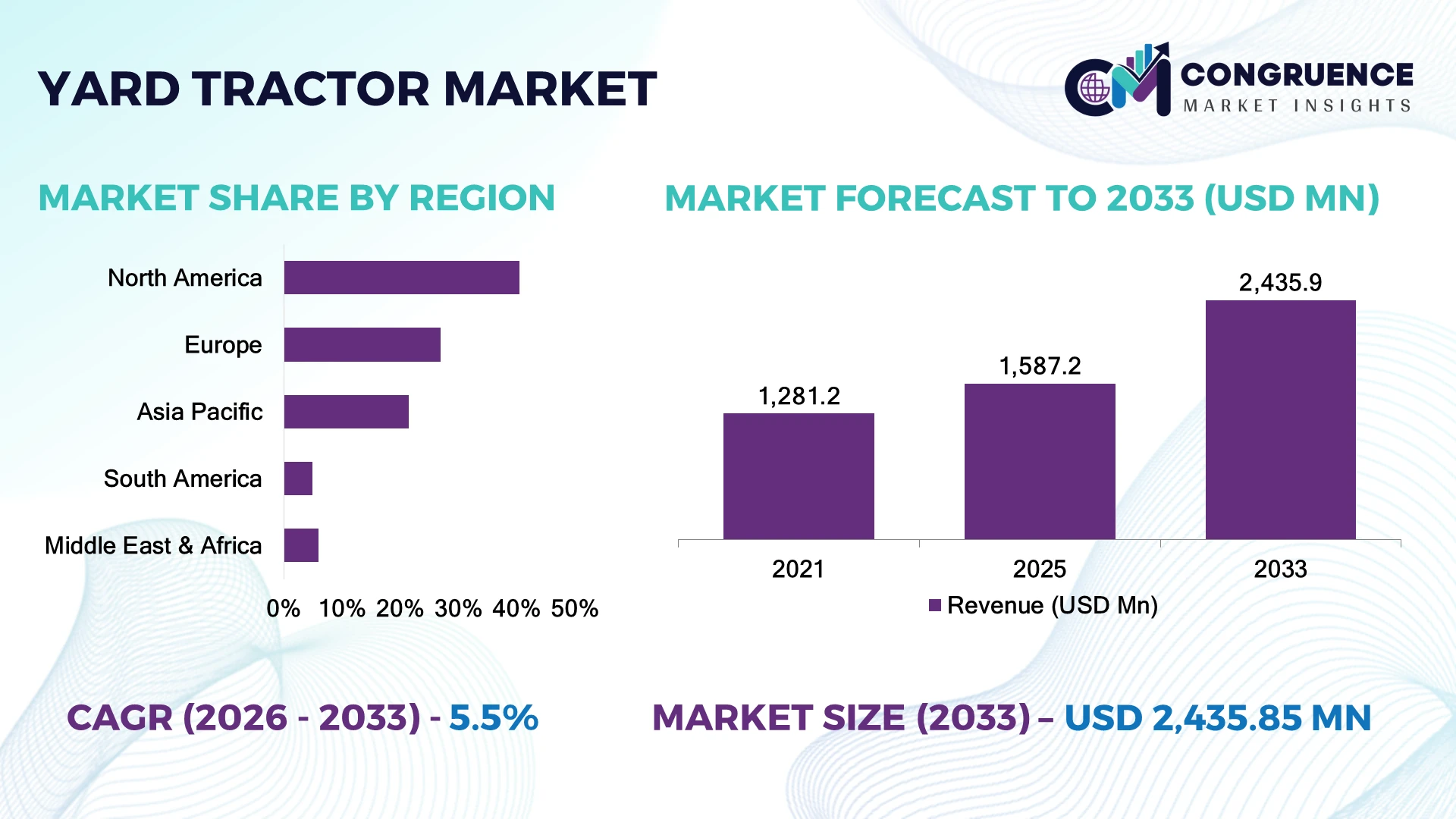
The United States represents approximately 40–43% of global yard tractor demand, supported by large-scale ports, intermodal terminals, retail distribution, and manufacturing logistics. Kalmar Ottawa alone has produced more than 90,000 terminal tractors, illustrating the depth of the North American installed base. Europe has a stronger electrification orientation, while North America remains more diesel-intensive; electric models increasingly offer 105–210 kWh battery configurations and charging up to 150 kW. Red Sea shipping disruptions have also reinforced investment in resilient regional logistics and high-throughput yards.
Strategic implication: Fleet operators are prioritizing tractors that combine uptime, electrification readiness, automation, and lifecycle service rather than standalone vehicle capacity.
Market Size & Growth: USD 1,587.2 million in 2025 to USD 2,435.9 million by 2033 at 5.5% CAGR, supported by automated ports and distribution-center modernization.
Top Growth Drivers: Port automation 31%, distribution logistics 27%, and fleet electrification 22% represent the leading demand drivers.
Short-Term Forecast: By 2028, connected fleet controls can improve tractor utilization 5–10% while reducing non-productive travel 10–15%.
Emerging Technologies: Battery-electric drivetrains, autonomous yard tractors, AI dispatch, machine vision, and predictive telematics are reshaping advanced yard operations.
Regional Leaders: North America is projected at approximately USD 0.85 billion, Europe USD 0.68 billion, and Asia-Pacific USD 0.58 billion by 2033, with electrification strongest in Europe.
Consumer/End-User Trends: Ports and distribution centers increasingly prioritize high-uptime equipment, while electric deployment is moving from pilot fleets toward multi-unit procurement.
Pilot/Case Example: In 2025, Kalmar commercialized its third-generation electric terminal tractor after 240 hours of climate-controlled testing, including operation from -22°F to 122°F.
Competitive Landscape: Kalmar holds a leading installed-base position, competing with Terberg, Orange EV, Capacity Trucks, Autocar, and other regional manufacturers.
Regulatory & ESG Impact: Zero-emission yard programs can eliminate tailpipe emissions and support fleet decarbonization targets, accelerating electric replacement in controlled operating environments.
Investment & Funding: Public incentives are increasingly supporting electric yard tractor purchases, including Canadian zero-emission vehicle grants used in 2026 fleet deployments.
Innovation & Future Outlook: Autonomous electric tractors, automated charging, digital twins, and fleet orchestration will shift competition toward integrated vehicle-software-infrastructure solutions.
The Yard Tractor Market is increasingly concentrated in container terminals, intermodal hubs, manufacturing plants, and high-volume distribution centers where repetitive short-haul movements justify specialized equipment. Electric and automated models are gaining traction, with battery configurations reaching 210 kWh and automated systems targeting 10–15% reductions in non-productive travel. North American fleet modernization and European zero-emission requirements are accelerating procurement changes, while supply-chain restructuring is increasing the value of flexible, high-uptime yard equipment. These shifts establish electrification, automation, and fleet intelligence as central strategic themes for the market.
Yard tractors are becoming strategic logistics assets because ports, warehouses, and manufacturing campuses are under pressure to move more trailers with less idle time, lower emissions, and fewer operator constraints. The shift is particularly visible as supply chains diversify around regional manufacturing, nearshoring, and persistent shipping-route disruptions. Fleet operators are therefore evaluating yard tractors as part of broader material-flow infrastructure rather than as isolated vehicles.
Technology is materially changing operating economics. Electric drivetrains eliminate many engine and transmission components, reducing routine maintenance requirements by approximately 20–30% versus comparable diesel architectures. Automated dispatch and route orchestration can reduce non-productive travel by 10–15% in suitable yards. Europe is moving faster toward electric deployment, while North America combines a larger installed base with expanding battery-electric adoption.
Over the next 2–3 years, procurement will increasingly favor connected and automation-ready platforms. Kalmar's Forterra partnership and Terberg's automated electric terminal tractor programs demonstrate how manufacturers are combining vehicle engineering with autonomy software. Ports and distribution centers with repetitive routes will lead deployment because asset utilization is easier to optimize. Competitive positioning will increasingly depend on integrated charging, software, service, and vehicle capabilities rather than tractor hardware alone.
Port and distribution-center automation is increasing demand for specialized yard tractors as operators target higher trailer throughput with fewer manual movements. Automated dispatch and telematics can improve tractor utilization by 5–10%, while optimized routing reduces non-productive travel by 10–15%. U.S. logistics hubs are accelerating deployment as labor availability remains a constraint in high-cycle yards. Electrification adds another replacement trigger, with battery-electric tractors reducing routine maintenance requirements by approximately 20–30% versus comparable diesel equipment. Manufacturers are responding through autonomous-ready platforms, fleet-management integration, and charging partnerships. The non-obvious shift is that procurement is increasingly based on total yard productivity rather than tractor horsepower, favoring suppliers capable of integrating vehicles with terminal operating systems.
Yard tractors operate continuously in stop-start conditions, making battery degradation, tire wear, hydraulic servicing, and charging infrastructure significant ownership considerations. Battery-electric configurations can require charging infrastructure investments equivalent to approximately 10–20% of vehicle acquisition cost, while extreme temperatures can reduce effective battery performance by 10–20%. U.S. and Canadian winter operations therefore require thermal-management engineering and charging redundancy. Imported battery components also expose manufacturers to supply-chain volatility, particularly where critical minerals and power electronics remain concentrated across Asian supply networks. Companies are mitigating exposure through localized component sourcing, multi-year battery contracts, modular powertrains, and mixed diesel-electric fleets. The key constraint is not vehicle availability but maintaining predictable uptime across high-frequency operating cycles.
Autonomous electric yard tractors present a high-value opportunity in repetitive container terminals, fulfillment centers, and manufacturing campuses. Controlled routes can support 15–25% reductions in manual intervention, while coordinated charging can improve vehicle availability by 5–10%. China is expanding automated port infrastructure, while U.S. distribution campuses increasingly evaluate autonomous yard movements to address labor-intensive trailer shuttling. The next opportunity lies in software-defined fleet orchestration that coordinates tractors, dock scheduling, charging, and trailer positioning rather than automating vehicles independently. Manufacturers are investing in drive-by-wire platforms, machine vision, and remote supervision, while technology providers are forming partnerships with terminal operators. This creates a recurring software and service layer alongside conventional equipment sales.
Scaling autonomous yard tractors requires reliable integration between vehicle controls, warehouse-management systems, terminal operating systems, charging networks, and safety infrastructure. Poorly coordinated workflows can reduce effective utilization by 10–15%, even when individual vehicles operate autonomously. Cybersecurity is also becoming material as connected tractors exchange operational data with cloud platforms and enterprise systems. U.S. ports and large distribution campuses face additional complexity from mixed fleets, legacy equipment, variable trailer layouts, and human-driven vehicles sharing the same operating zones. Manufacturers must invest in redundant sensing, geofencing, remote-control capability, cybersecurity architecture, and standardized APIs. The non-obvious challenge is fleet coexistence: successful deployment depends less on autonomous driving alone and more on synchronizing every movement around the tractor.
Electric Fleets Move Beyond Pilots: Battery-electric yard tractors are shifting from demonstration units toward multi-vehicle deployments, with 105–210 kWh battery configurations becoming commercially relevant and fast charging reaching approximately 150 kW. Operators are increasingly pairing tractors with dedicated charging infrastructure, reducing maintenance exposure by 20–30% while improving emissions performance at ports and distribution campuses.
Remote Supervision Gains Traction: Autonomous yard operations increasingly use centralized supervision rather than fully independent vehicles. Remote intervention can reduce on-site manual involvement by 15–25%, while automated dispatch improves fleet utilization by 5–10%. U.S. logistics operators are testing controlled-yard autonomy where predictable routes and geofenced environments reduce complexity. Manufacturers are responding with drive-by-wire platforms and redundant sensing.
Charging Becomes Fleet Infrastructure: Operators are redesigning depots around charger placement, load balancing, and vehicle scheduling rather than treating charging as an accessory. Coordinated charging can improve fleet availability by 5–10% and reduce peak electricity demand by approximately 10–15%. Companies are integrating energy-management software with telematics, particularly where multiple electric tractors operate simultaneously.
Yard Intelligence Becomes Integrated: Digital yard platforms increasingly connect tractor location, trailer status, dock availability, and maintenance data into one operational workflow. Real-time visibility can reduce search and repositioning activity by 10–15%, while predictive maintenance can improve equipment availability by 5–8%. The emerging shift is toward software coordinating mixed fleets, allowing operators to modernize existing diesel assets alongside new electric and autonomous tractors.
Diesel yard tractors retain scale while electric platforms accelerate replacement
Diesel yard tractors account for approximately 72–76% of the global market, retaining dominance because of established fueling infrastructure, long operating ranges, rapid refueling, and suitability for continuous heavy-duty cycles. Electric yard tractors represent roughly 14–18%, while hybrid and alternative-powertrain models comprise approximately 8–12%. Diesel remains the mature volume segment, particularly across North American logistics hubs, but electric models are gaining share as fleet operators prioritize lower maintenance and emissions. Battery-electric tractors can reduce routine maintenance requirements by approximately 20–30%, strengthening their economics in high-utilization yards.
Electric is the fastest-shifting type, supported by port decarbonization programs and improving charging infrastructure. Manufacturers including Kalmar, Terberg, and Orange EV are expanding electric portfolios, while fleet operators increasingly evaluate total cost of ownership rather than acquisition price alone. Hybrid systems retain relevance where charging infrastructure is constrained, creating a transitional pathway for mixed fleets.
The International Council on Clean Transportation reported in 2025 that zero-emission heavy-duty vehicle deployment is accelerating across major commercial transport markets, strengthening the business case for electrified high-utilization equipment.
Container terminals lead while automated distribution yards expand fastest
Container terminals represent approximately 43–47% of yard tractor demand, reflecting intensive trailer and container movements across ports, intermodal facilities, and transshipment hubs. Distribution centers account for around 28–32%, while manufacturing plants and other industrial yards represent approximately 22–26%. Port operations remain the largest application because tractors operate continuously and require high maneuverability, rapid coupling, and exceptional uptime. Distribution yards are shifting faster toward electric and autonomous equipment as warehouse automation expands and operators seek tighter coordination between dock scheduling and trailer positioning.
Automated and connected deployment is strongest in high-volume logistics environments, where digital dispatch can improve utilization by 5–10% and reduce non-productive travel by 10–15%. Manufacturers are therefore developing application-specific configurations, integrating telematics, drive-by-wire systems, machine vision, and remote supervision. U.S. ports continue prioritizing high-throughput equipment, while European logistics facilities increasingly emphasize zero-emission operation, shifting procurement toward integrated vehicle-and-infrastructure packages.
The International Transport Forum highlighted in 2025 that port automation and digitalization are increasingly being deployed to improve operational efficiency and resilience, supporting greater adoption of connected cargo-handling equipment.
Ports remain the largest buyers as distribution operators accelerate electrification
Port and terminal operators account for approximately 45–49% of global yard tractor demand because of continuous container movements, high asset utilization, and dependence on specialized terminal equipment. Distribution and logistics companies represent roughly 30–34%, while manufacturing and industrial operators account for approximately 18–22%. Ports remain the mature demand base, but distribution and logistics operators are adopting electric and connected tractors more rapidly as warehouse networks become increasingly automated and trailer volumes rise.
Distribution operators increasingly prioritize flexible charging, remote diagnostics, and fleet orchestration, with connected systems improving utilization by approximately 5–10%. Port operators remain more focused on durability, uptime, and automated container handling, while manufacturers often require customized tractors for repetitive internal movements. Suppliers are responding with application-specific configurations, leasing and service packages, charging partnerships, and software integration. The competitive opportunity is shifting toward logistics operators seeking scalable multi-site fleets, particularly in the United States, where large distribution networks can standardize equipment and maintenance across multiple facilities.
The 2026 State of Logistics Technology findings from fleet-industry research indicate that connected fleet technologies are now mainstream among large commercial operators, reinforcing demand for integrated telematics, automation, and fleet-management capabilities.
North America accounted for the largest market share at 40.5% in 2025 however, Asia-Pacific is expected to register the fastest growth, expanding at a CAGR of 6.7% between 2026 and 2033.

High-throughput logistics hubs accelerate connected and electric fleet deployment
North America represents approximately 40.5% of the global Yard Tractor Market, supported by extensive container terminals, intermodal facilities, distribution centers, and manufacturing campuses. The United States contributes more than 85% of regional demand, with California, Texas, Georgia, and major Midwest logistics corridors representing important deployment clusters. Large fleet operators are increasingly replacing aging diesel units with connected and battery-electric tractors, particularly in controlled-yard environments. Electric platforms can reduce routine maintenance requirements by approximately 20–30%, while telematics-enabled dispatch improves utilization by 5–10%. Manufacturers are strengthening regional service networks and expanding autonomous-ready product portfolios. Port modernization and nearshoring of manufacturing are also increasing demand for high-availability yard equipment capable of supporting greater trailer throughput without proportional increases in fleet size.
United States Market Outlook: The United States remains the primary North American market because of its extensive freight infrastructure and concentration of large distribution campuses. Major ports across California, Texas, New York/New Jersey, and Georgia operate high-frequency trailer and container movements. Fleet replacement is increasingly tied to uptime, emissions compliance, and automation readiness, with battery-electric tractors gaining particular relevance in fixed-route yards.
Zero-emission logistics accelerates electric terminal tractor adoption
Europe accounts for approximately 27% of global Yard Tractor demand, with Germany, the Netherlands, France, the United Kingdom, and Belgium representing major industrial and port deployment centers. Regulatory pressure on commercial emissions is shifting procurement toward battery-electric and automated equipment, particularly at ports and distribution facilities operating within controlled zones. Electric tractors can reduce drivetrain-related maintenance requirements by approximately 20–30%, while automated dispatch can improve utilization by 5–10%. Manufacturers are increasingly integrating charging systems, telematics, and autonomous-ready controls into new platforms. Port modernization around Rotterdam, Antwerp-Bruges, Hamburg, and other major logistics gateways is strengthening demand for specialized low-emission terminal equipment.
Germany Market Outlook: Germany is a strategically important market because of its large automotive manufacturing base, inland logistics network, and highly automated industrial facilities. Yard tractors increasingly support repetitive material movements between production buildings, warehouses, and distribution points. Fleet operators are prioritizing electric drivetrains and digital fleet monitoring, while industrial campuses benefit from predictable routes that simplify charging and autonomous deployment.
Port expansion and manufacturing scale reshape regional fleet demand
Asia-Pacific represents approximately 21.5% of the global Yard Tractor Market and is the fastest-expanding regional market, supported by containerized trade, manufacturing clusters, e-commerce fulfillment, and large-scale port development. China accounts for more than 45% of regional demand, followed by Japan, South Korea, India, and Southeast Asian manufacturing hubs. Chinese ports are accelerating automated container-handling systems, creating stronger demand for autonomous-ready terminal tractors. Battery-electric deployment is also expanding as operators target lower operating costs and emissions. Manufacturers are combining local production with software integration and charging partnerships, while high-volume industrial sites increasingly specify customized tractors for repetitive internal logistics.
China Market Outlook: China leads Asia-Pacific demand through its extensive port infrastructure, manufacturing ecosystem, and rapidly automated logistics facilities. Major coastal ports increasingly integrate automated guided vehicles, intelligent dispatch, and electric equipment into container-handling workflows. High-volume terminals can achieve stronger asset utilization from coordinated vehicle scheduling, while domestic manufacturers benefit from localized battery, power-electronics, and vehicle-component supply chains.
Brazilian logistics modernization strengthens specialized yard equipment demand
South America contributes approximately 5% of global Yard Tractor demand, with Brazil accounting for nearly 60% of regional consumption. Container terminals around Santos and other major logistics corridors represent important deployment centers, while agricultural exports, food processing, automotive manufacturing, and distribution facilities create additional demand. Yard tractors remain predominantly diesel-powered because of established fueling infrastructure and comparatively limited commercial charging networks. Operators are increasingly evaluating connected fleet-management systems that can improve utilization by 5–10% without requiring immediate powertrain replacement. Brazil's port modernization and expanding intermodal infrastructure are encouraging equipment suppliers to strengthen service coverage and offer flexible financing, maintenance contracts, and application-specific configurations.
Brazil Market Outlook: Brazil provides the strongest South American demand base because of its large export-oriented logistics system and concentration of container, agricultural, and industrial freight. The Port of Santos is particularly significant for high-frequency yard movements. Operators increasingly prioritize reliable tractors with telematics, remote diagnostics, and strong local service support, while electric adoption remains concentrated in controlled facilities where charging infrastructure is easier to deploy.
Port investment and logistics-hub development expand specialized fleet requirements
Middle East & Africa accounts for approximately 6% of global Yard Tractor demand, with the UAE, Saudi Arabia, South Africa, Egypt, and Turkey representing important deployment markets. Gulf logistics hubs are investing heavily in automated ports, free zones, distribution centers, and multimodal infrastructure, creating demand for high-uptime terminal tractors. The UAE and Saudi Arabia together represent more than 45% of regional demand, supported by major maritime and logistics investments. Automated dispatch and telematics are gaining traction as operators seek 5–10% higher fleet utilization. Suppliers are responding through regional service centers, electric product introductions, and partnerships covering charging, automation, and fleet management.
United Arab Emirates Market Outlook: The UAE is the region's leading strategic market because of its large container terminals, free-zone logistics infrastructure, and concentration of international distribution activity. Jebel Ali provides a major operating environment for high-cycle terminal equipment, while port automation supports adoption of connected and autonomous-ready tractors. Fleet operators increasingly value equipment uptime, remote diagnostics, and integrated fleet control as logistics volumes become more technology-intensive.
Kalmar, Terberg, Capacity Trucks, Autocar, and Orange EV compete, with global port-equipment specialists facing North American purpose-built manufacturers and electric-focused challengers. The top five are estimated to control 55–60% of global yard tractor supply. Competition centers on vehicle price, uptime, electrification, customization, service reach, and software integration: electric platforms can cut routine maintenance 20–30%, while telematics can improve utilization 5–10%. Kalmar and Terberg are expanding electric and automated portfolios; Orange EV scales purpose-built battery-electric fleets; Autocar emphasizes customized severe-duty platforms; Capacity combines diesel, alternative-fuel, and electric options. Partnerships increasingly join OEM platforms with autonomy providers, charging specialists, and logistics operators. The competitive shift is moving from mechanical durability toward integrated vehicle-software-infrastructure packages, particularly in controlled ports and distribution yards. Entry barriers include engineering validation, service networks, charging integration, and fleet qualification. Winning requires dependable uptime, scalable electrification, application-specific customization, and lifecycle support that converts technology investment into measurable yard productivity.
Kalmar
Terberg Special Vehicles
Capacity Trucks
Autocar
Orange EV
TICO Tractors
MAFI Transport-Systeme
MOL CY
BYD
SANY Heavy Industry
Konecranes
Hoist Material Handling
Volvo Trucks
CVS Ferrari
Current yard tractor technology is moving from conventional diesel powertrains toward battery-electric drivetrains, telematics, automated dispatch, and drive-by-wire controls. Battery-electric tractors now commonly use 100–210 kWh packs, while fast charging can reach 150 kW. Connected telematics can improve fleet utilization by 5–10% through location, idle-time, and maintenance data. Adoption is strongest in controlled port and distribution environments where repetitive duty cycles simplify electrification.
Emerging platforms integrate machine vision, geofencing, remote supervision, predictive diagnostics, and autonomy. Automated routing can reduce non-productive travel by 10–15% versus manually coordinated movements, while predictive maintenance can improve equipment availability by 5–8%. Kalmar, Terberg, TICO, and Orange EV benefit as buyers prefer integrated vehicle, software, charging, and service packages. The competitive advantage is shifting toward systems that reduce labor dependence without sacrificing uptime.
During 2026–2028, autonomous electric fleets, charging optimization, and fleet orchestration will become key procurement criteria. Compared with legacy diesel tractors, electric platforms can reduce routine maintenance requirements by roughly 20–30% because they eliminate oil changes, engine servicing, and transmission-related maintenance. Digital twins and AI dispatch will strengthen multi-asset coordination. Suppliers combining hardware, software, infrastructure partnerships, and lifecycle support will capture premium deployments as operators prioritize measurable uptime, predictable energy costs, and scalable automation.
May 2026 Kalmar launched the fully electric TT7 EV for European ports, yards, and logistics operations, adding a zero-emission model to its TT7 series. The launch strengthens electrification options for demanding shunting applications and supports low-emission fleet modernization. Source: kalmar.com
January 2025 Terberg, Embotech, and APM Terminals signed for 30 automated electric terminal tractors at Maasvlakte II, with service targeted for 2027. The deployment converts validated pilot testing into scaled autonomous operations and strengthens integrated port-automation procurement. Source: terberg.com
March 2024 California Energy Commission reported Everport Terminal Services demonstrated 20 LNG-fueled and five battery-electric yard tractors at the Port of Los Angeles. The project provided evidence for lower-emission cargo-handling equipment and informed technology deployment across freight logistics. Source: energy.ca.gov
June 2026 Orange EV deployed its 2,000th electric terminal truck to Coke Canada Bottling, reaching more than 370 and 97% average uptime. The milestone demonstrates commercial scale for electric yard tractors and strengthens fleet confidence in reliable availability. Source: orangeev.com
The report evaluates the global Yard Tractor Market across diesel, electric, hybrid, and alternative-powertrain configurations, covering container terminals, rail yards, distribution centers, manufacturing facilities, and other specialized industrial applications. End-user analysis distinguishes port operators, logistics companies, manufacturers, retailers, and third-party logistics providers, with emphasis on high-cycle deployment and fleet replacement requirements.
Regional coverage spans North America, Europe, Asia-Pacific, South America, and Middle East & Africa, including major logistics hubs and emerging industrial markets. The study assesses battery-electric powertrains, autonomous navigation, telematics, AI-based fleet orchestration, predictive maintenance, charging infrastructure, and drive-by-wire systems. With ports representing approximately 43–47% of overall application demand and electric tractors increasingly using 100–210 kWh battery systems, the report supports equipment investment, geographic expansion, fleet modernization, technology selection, partnerships, competitive positioning, and strategic planning through 2033.
| Report Attribute/Metric | Report Details |
|---|---|
|
Market Revenue in 2025 |
USD 1,587.2 Million |
|
Market Revenue in 2033 |
USD 2,435.8 Million |
|
CAGR (2026 - 2033) |
5.5% |
|
Base Year |
2025 |
|
Forecast Period |
2026 - 2033 |
|
Historic Period |
2021 - 2025 |
|
Segments Covered |
By Type
By Application
By End-User
|
|
Key Report Deliverable |
Revenue Forecast, Growth Trends, Market Dynamics, Segmental Overview, Regional and Country-wise Analysis, Competition Landscape |
|
Region Covered |
North America, Europe, Asia-Pacific, South America, Middle East, Africa |
|
Key Players Analyzed |
Kalmar, Terberg Special Vehicles, Capacity Trucks, Autocar, Orange EV, TICO Tractors, MAFI Transport-Systeme, MOL CY, BYD, SANY Heavy Industry, Konecranes, Hoist Material Handling, Volvo Trucks, CVS Ferrari |
|
Customization & Pricing |
Available on Request (10% Customization is Free) |




