
Reports
The Global Xylitol Market was valued at USD 111.0 Million in 2025 and is anticipated to reach a value of USD 165.4 Million by 2033 expanding at a CAGR of 5.11% between 2026 and 2033. Growth is driven by expanding sugar-reduction formulations, wider use of xylitol in oral-care products, pharmaceutical excipients, and low-calorie food applications, supported by advances in biomass-based production and purification.
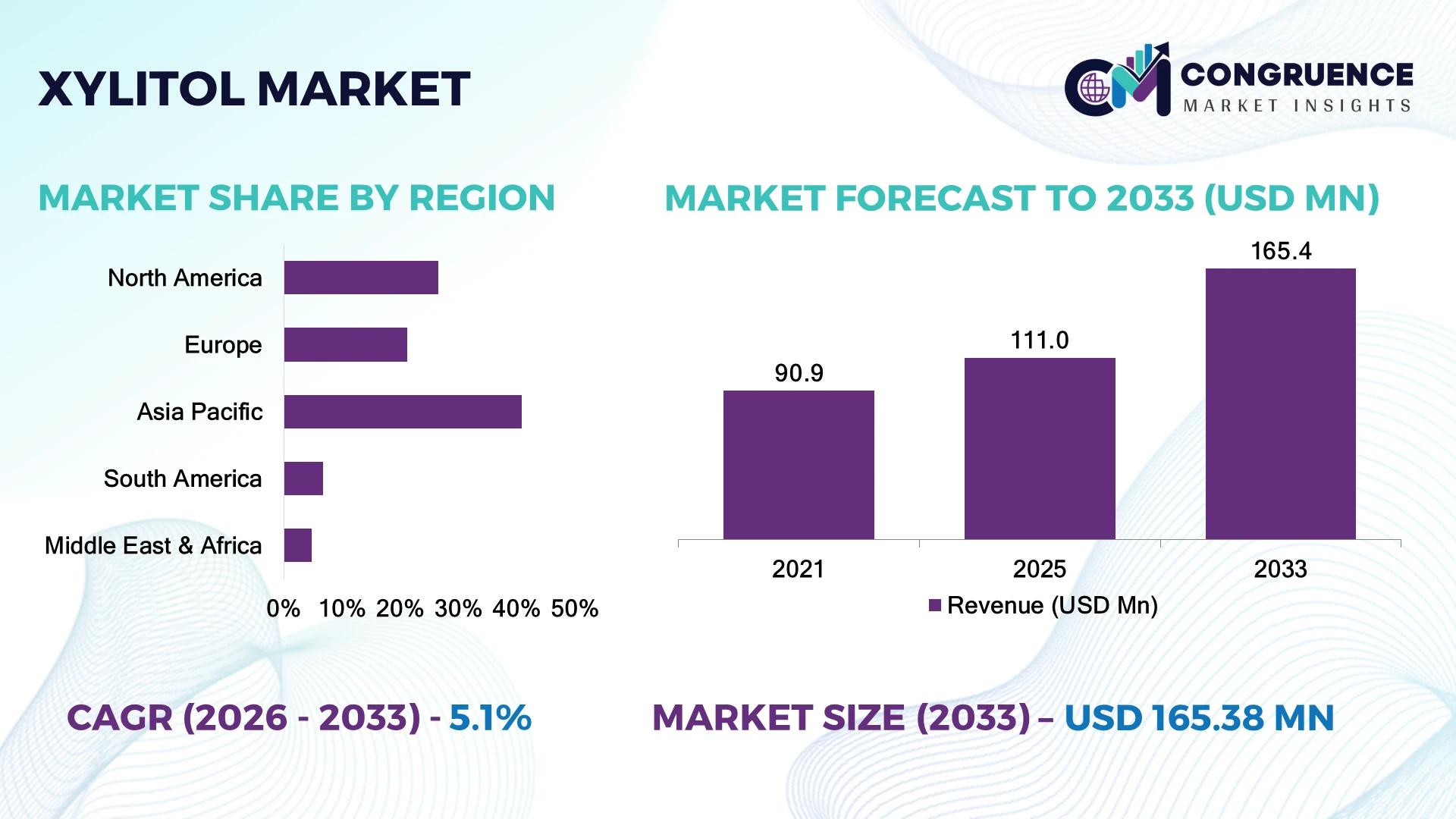
China remains the dominant production base, accounting for an estimated 40%+ of global xylitol manufacturing capacity, supported by established corn-cob processing infrastructure and export-oriented chemical production. The United States follows with stronger downstream adoption across oral care, confectionery, and nutraceutical applications. China’s manufacturing scale exceeds the U.S., while U.S. premium-product adoption is stronger, particularly in dental formulations. Supply-chain diversification following disruptions in global trade is encouraging manufacturers to strengthen regional sourcing and processing capabilities.
Strategically, companies prioritizing localized feedstock access, efficient purification, and high-value oral-care applications are positioned to capture the strongest opportunities.
Market Size & Growth: USD 111.0 Million in 2025 and USD 165.4 Million by 2033, supported by sugar-reduction formulations and advanced biomass processing.
Top Growth Drivers: Oral-care adoption 35%; reduced-sugar formulations 28%; pharmaceutical applications 19%.
Short-Term Forecast: By 2028, automated purification can reduce processing costs by 8–12% while improving production efficiency by 10%.
Emerging Technologies: Biomass conversion, membrane purification, and automated crystallization are improving product consistency by 10–15%.
Regional Leaders: Asia Pacific leads with approximately USD 67 million by 2033; North America approaches USD 45 million; Europe reaches about USD 32 million, with premium formulation adoption increasing.
Consumer/End-User Trends: Approximately 30% of new oral-care formulations increasingly prioritize sugar-free or reduced-sugar sweetening systems.
Pilot/Case Example: 2024 biomass-processing upgrades improved xylitol recovery efficiency by approximately 12% through optimized purification and crystallization.
Competitive Landscape: China-based producers hold an estimated 35–40% combined production position, with major competition from established chemical, food-ingredient, and specialty-sweetener manufacturers.
Regulatory & ESG Impact: Sugar-reduction and clean-label initiatives are supporting approximately 10% higher formulation activity, while biomass utilization reduces feedstock waste.
Investment & Funding: More than USD 100 million in cumulative capacity, processing, and formulation investments is supporting regional expansion and supply-chain diversification.
Innovation & Future Outlook: Next-generation fermentation, higher-purity grades, and integrated biomass processing are shifting competition toward yield efficiency, traceability, and specialty applications.
Xylitol demand is increasingly concentrated in oral-care products, sugar-free confectionery, functional foods, and pharmaceutical formulations. Approximately 30% of formulation activity is linked to reduced-sugar positioning, while improved crystallization and biomass purification are enabling higher-purity grades. Supply-chain restructuring is also encouraging manufacturers to diversify feedstock and production locations, creating a stronger foundation for premium xylitol applications.
Xylitol is becoming strategically important because manufacturers are moving beyond conventional sweeteners toward ingredients that combine sweetness, reduced caloric impact, and functional oral-care benefits. The shift is strengthening competition across food ingredients, dental products, pharmaceuticals, and nutraceuticals while increasing the value of high-purity grades and reliable feedstock supply.
Modern biomass conversion and automated purification systems provide measurable advantages over older batch-oriented processes, with optimized facilities achieving roughly 10–15% higher recovery efficiency and lower material losses. China retains the strongest production scale through integrated agricultural-processing infrastructure, while the United States and Germany show stronger downstream specialization in oral care, functional foods, and pharmaceutical formulations. Over the next 2–3 years, automated quality control and regional sourcing are expected to improve production consistency by approximately 8–12%.
A practical deployment model combines corn-cob or other lignocellulosic feedstock processing with continuous purification and crystallization, reducing waste and improving batch uniformity. Companies are responding through capacity modernization, technology partnerships, localized sourcing, and specialty-grade development. Competitive advantage will increasingly depend on production yield, traceability, application-specific purity, and resilient supply networks.
The strongest growth driver is the shift toward higher-efficiency biomass conversion and specialty xylitol formulations. Modern processing can improve recovery efficiency by 10–15%, while automated crystallization can reduce production losses by 8–10%. China’s established corn-cob processing ecosystem gives manufacturers an important feedstock and cost advantage, while U.S. and European producers emphasize premium oral-care and pharmaceutical grades. Supply-chain disruptions since the Red Sea shipping crisis have reinforced the value of localized processing and shorter logistics routes. Producers are responding by upgrading purification systems, securing long-term agricultural feedstock contracts, and expanding specialty-grade capacity. The non-obvious advantage is that processing efficiency, rather than raw-material availability alone, increasingly determines producer margins and supply reliability.
Feedstock economics remain a structural constraint because xylitol production depends heavily on agricultural residues and energy-intensive purification. Raw-material and energy fluctuations can alter manufacturing costs by 8–15%, while smaller producers often operate with 10% or less cost flexibility. China benefits from concentrated agricultural-processing infrastructure, but exporters remain exposed to freight volatility and international trade disruptions. Europe faces additional pressure from energy costs and stringent processing requirements. Companies are reducing exposure through multi-country sourcing, long-term feedstock contracts, process optimization, and higher-value specialty grades. A key operational insight is that scale alone does not guarantee profitability: plants with weaker purification yields can lose their cost advantage even when feedstock prices remain stable.
The strongest opportunity lies in specialty-grade xylitol for dental care, nutraceuticals, pharmaceuticals, and functional foods. Premium formulations can command substantially higher value than commodity sweetener applications, while automated purification can improve usable output by 10–15%. India, South Korea, and Southeast Asia offer expanding opportunities as food manufacturers introduce sugar-reduction formulations and modern oral-care products. Fermentation-assisted processing and advanced membrane separation are emerging technologies that can improve resource utilization and product consistency. Companies are positioning through R&D partnerships, localized production, and application-specific formulation development. The non-obvious opportunity is to integrate xylitol production with agricultural-residue processing, converting low-value biomass into higher-margin ingredients while reducing waste-management costs.
Long-term competitiveness depends on scaling production without compromising purity, batch consistency, or environmental performance. Specialty applications can require purity levels above 99%, making process-control requirements substantially stricter than commodity sweetener production. Variations of 5–10% in feedstock composition can affect conversion performance, while inadequate automation increases quality-control workload and batch variability. Producers in China are investing in integrated processing, whereas manufacturers in North America and Europe are emphasizing digital monitoring and application-specific quality systems. Companies must address these pressures through process sensors, automated quality assurance, workforce training, and technology partnerships. The strategic challenge is not simply expanding capacity; it is creating repeatable high-purity production that satisfies increasingly demanding food, pharmaceutical, and oral-care specifications.
Solid Formats Still Dominate: Solid xylitol continues to account for about 89.7% of market usage because powder and granules simplify handling, storage, blending, and dosing. Liquid formats are gaining traction in syrups and beverages, with adoption rising around 10% as manufacturers seek faster dissolution and formulation flexibility. Producers are upgrading packaging and automated dispensing systems to reduce handling losses.
Biomass Supply Chains Restructure: Corn-based production represents about 48.2% of xylitol type demand, while manufacturers are diversifying wood, agricultural-residue, and alternative biomass inputs. Supply-chain disruption and freight volatility are pushing producers in China toward integrated feedstock procurement and localized processing. This restructuring improves input security and can reduce procurement exposure by roughly 8–12%, strengthening production continuity.
Oral-Care Formulations Intensify: Sugar-free chewing gum and oral-hygiene products are becoming more technically differentiated, with xylitol incorporated into approximately 40% of targeted sugar-reduction formulations in selected product categories. Toothpaste, mouth-rinse, lozenges, and dental-mint manufacturers are increasing high-purity specifications and automated quality testing. The 2025 WHO focus on reducing free-sugar exposure is reinforcing formulation attention toward non-cariogenic sweetening systems.
Digital Quality Control Expands: Producers are deploying inline moisture monitoring, automated crystallization controls, and digital batch tracking to address tighter purity requirements. Advanced process controls can improve batch consistency by 8–12% and reduce manual quality checks by roughly 10%. Chinese and European manufacturers are increasingly integrating sensors with production execution systems, shifting xylitol operations from periodic testing toward continuous process verification.
Corn xylitol remains the leading type, accounting for approximately 48.2% of global xylitol demand in 2025. Its dominance reflects abundant corn-processing infrastructure, scalable feedstock availability, established conversion pathways, and comparatively predictable production economics. Birch xylitol retains a premium position where natural-source positioning and specialty formulations command greater value, while wood fibrous sweetener remains relevant for producers with established forestry-residue supply chains. Other xylitol types represent the emerging segment, supported by diversification into alternative biomass and newer production pathways. Companies are increasingly prioritizing feedstock flexibility rather than relying on a single raw-material stream, with alternative-source development gaining strategic importance as supply-chain volatility increases.
The fastest-changing area is the other-types category, where manufacturers are testing plant-derived and process-enhanced inputs to improve yield and sustainability. Production optimization can deliver roughly 8–12% efficiency improvements, shifting investment toward flexible reactors, purification systems, and feedstock partnerships. The business implication is clear: corn xylitol protects scale economics, while alternative types create differentiation and supply resilience.
Food and beverage represents the leading application, accounting for approximately 40.4% of global xylitol consumption in 2025. Demand remains concentrated in sugar-free confectionery, bakery products, beverages, and functional formulations because xylitol provides sweetness with reduced caloric impact and favorable formulation characteristics. Chewing gum remains especially important within the application mix, while confectionery manufacturers are expanding sugar-replacement formulations. Personal care and nutraceutical applications remain smaller but increasingly specialized, with manufacturers using xylitol for taste, humectancy, and functional positioning. Companies are responding through customized ingredient blends, formulation partnerships, and expanded supply agreements with food processors.
Pharmaceutical applications are emerging as a higher-value growth area, particularly in oral formulations, syrups, and nutraceutical products requiring consistent purity. Food and beverage manufacturers continue to optimize dry blending and automated dosing, while pharmaceutical producers are tightening impurity specifications and batch controls. Approximately 10–15% efficiency gains are achievable through improved formulation and automated ingredient handling. This creates a two-speed market: food and beverage delivers scale, while pharmaceutical and personal-care applications improve product-value density.
Human end-use represents the dominant end-user group, accounting for an estimated 90%+ of xylitol utilization because the overwhelming commercial base is concentrated in food, oral care, pharmaceuticals, nutraceuticals, and personal-care products. Commercial buyers prioritize consistent purity, predictable sweetness, regulatory compliance, and dependable supply, particularly for high-volume confectionery and oral-care production. Animal applications remain niche, while wild-bird uses represent a very small specialized category. Companies therefore concentrate capacity, quality systems, and distribution infrastructure on human-consumption applications, where procurement volumes and repeat-order potential are substantially stronger.
The fastest strategic shift is within specialized human-health applications, particularly oral care and pharmaceutical formulations, where buyers place greater emphasis on specification control rather than commodity pricing. Premium-grade demand is encouraging producers to invest in purification, traceability, and customized technical support, while food manufacturers remain focused on cost-efficient bulk supply. Approximately 8–12% improvements in process consistency from automated quality monitoring are strengthening the economics of high-specification production. The non-obvious implication is that end-user competition is increasingly determined by quality-assurance capability, not simply xylitol availability.
Asia Pacific accounted for the largest market share at 40.8% in 2025 however, Asia Pacific is expected to register the fastest growth, expanding at a CAGR of 6.73% between 2026 and 2033.
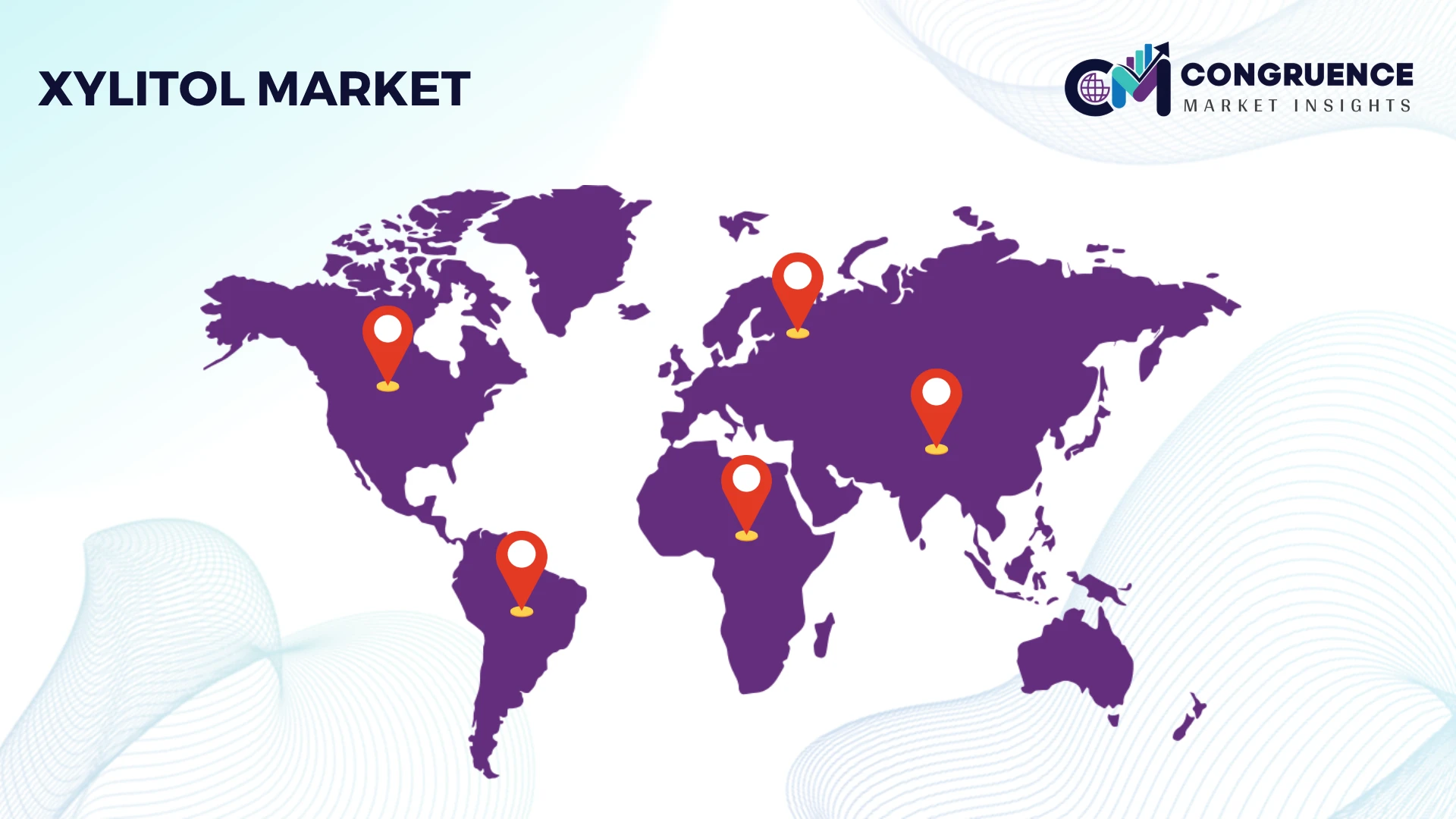
North America represented approximately 26.5% of the global xylitol market in 2025, supported by strong consumption in chewing gum, confectionery, oral care, pharmaceuticals, and nutraceuticals. The United States dominates regional activity, with an estimated 21.6% of global market value, reflecting its large consumer base and sophisticated food and dental-product manufacturing ecosystem. High-purity xylitol is gaining importance as manufacturers reformulate sugar-free products and develop functional oral-care lines. E-commerce and specialty health distribution are also broadening access to xylitol-containing products. Companies are responding through formulation partnerships, premium-grade development, and expanded supply agreements. The key operational shift is toward higher-specification ingredients rather than commodity sweeteners, allowing suppliers to protect margins while meeting increasingly stringent formulation requirements.
United States Market Outlook: The United States remains the principal North American market, supported by established confectionery production, pharmaceutical manufacturing, and advanced oral-care commercialization. Its estimated 2025 market position of about USD 179 million demonstrates substantial consumption scale. Manufacturers are increasingly prioritizing high-purity grades, directly compressible formats, and customized ingredient systems for functional products. The country's mature distribution infrastructure also enables rapid commercialization across retail, dental, and nutraceutical channels.
Europe accounted for approximately 21.2% of the global xylitol market in 2025, with demand concentrated in Germany, the United Kingdom, France, and Nordic markets. The region benefits from mature sugar-free food markets, established oral-care consumption, and strict product-quality requirements. Germany alone represented approximately 5.4% of global market value, highlighting its role as the region's principal commercial hub. European manufacturers are increasingly incorporating xylitol into reduced-sugar confectionery, dental products, pharmaceutical formulations, and functional foods. Sustainability requirements are also influencing feedstock selection, processing efficiency, and supplier qualification. Companies are investing in traceability, high-purity production, and formulation partnerships to meet evolving consumer and regulatory expectations. The strategic shift is toward premium, specification-driven applications where quality assurance and sustainability credentials increasingly influence procurement decisions.
Germany Market Outlook: Germany holds the strongest position in Europe's xylitol market through its established food-processing, pharmaceutical, nutraceutical, and oral-care industries. Its estimated 2025 market value of about USD 44.9 million reflects significant downstream consumption. German manufacturers emphasize high-purity food and pharmaceutical grades, supported by stringent quality-control practices and strong consumer awareness of sugar-reduced products. Powdered xylitol remains particularly relevant because of its storage stability, handling efficiency, and suitability for confectionery and dietary formulations.
Asia Pacific led the global xylitol market with a 40.8% share in 2025, combining substantial manufacturing capacity with strong consumption across China, Japan, India, and South Korea. China is the dominant industrial hub, accounting for approximately 18.0% of global market value, while Japan contributed about 7.9%. The region's advantage comes from integrated agricultural-processing infrastructure, corn-residue availability, established sweetener manufacturing, and sophisticated food-processing networks. Producers are expanding automated purification and crystallization to improve consistency and reduce processing losses. India is also becoming strategically relevant as food, pharmaceutical, and nutraceutical manufacturers increase sugar-reduction formulations. Companies are strengthening local sourcing and export-oriented production to reduce exposure to international logistics volatility. Asia Pacific's non-obvious advantage is the combination of feedstock availability and downstream manufacturing density, enabling suppliers to serve both commodity and specialty applications efficiently.
China Market Outlook: China is the most strategically significant country in the global xylitol industry because of its manufacturing scale, feedstock ecosystem, and export infrastructure. Its estimated 2025 market value of approximately USD 149.4 million represents nearly 18% of global demand. Major production clusters benefit from access to corn-processing residues and established biochemical manufacturing capabilities. Producers are increasingly integrating purification, crystallization, quality control, and packaging within larger facilities, strengthening cost competitiveness and supply reliability for domestic and international buyers.
South America represented approximately 6.7% of the global xylitol market in 2025, with Brazil serving as the principal commercial and manufacturing hub. Regional demand is concentrated in sugar-free confectionery, functional foods, oral-care products, and imported specialty ingredients. Brazil's large food-processing industry provides a strong downstream platform, while expanding modern retail and pharmaceutical distribution are improving access to xylitol-based formulations. Import dependence remains strategically important because local production infrastructure is less developed than in China or North America. Companies are therefore emphasizing distributor partnerships, inventory planning, and localized formulation support. Supply-chain diversification is becoming more important as freight costs and currency fluctuations affect imported ingredients. The operational opportunity is strongest for suppliers able to combine reliable regional inventory with technical formulation assistance for food and oral-care manufacturers.
Brazil Market Outlook: Brazil is the region's most significant market because of its extensive food-processing base, large confectionery industry, and expanding functional-product portfolio. Manufacturers increasingly use sugar-reduction ingredients in confectionery and specialty foods, creating a broader downstream platform for xylitol. The country's established pharmaceutical and personal-care distribution networks also support application diversification. Strategic suppliers are strengthening distributor relationships and regional warehousing to reduce lead-time exposure and improve availability for industrial buyers.
The Middle East & Africa market accounted for approximately 4.8% of global xylitol demand in 2025, with consumption concentrated in higher-income Gulf markets and selected African urban centers. The region's strongest opportunities are linked to premium oral care, sugar-free confectionery, nutraceuticals, and functional food products. Modern retail expansion and pharmaceutical distribution are improving access to specialty sweeteners, while health-focused product portfolios are encouraging manufacturers to diversify beyond conventional sugar. The principal constraint remains limited local xylitol manufacturing infrastructure, leaving many buyers dependent on imports. Companies are responding through regional distribution agreements, inventory hubs, and partnerships with food and pharmaceutical formulators. Saudi Arabia and the United Arab Emirates are particularly important commercialization centers because their modern retail and healthcare infrastructure enables faster adoption of premium ingredients.
Saudi Arabia Market Outlook: Saudi Arabia offers the strongest strategic position in the region through its expanding food-processing, pharmaceutical, and modern retail infrastructure. Demand is increasingly concentrated in sugar-free confectionery, functional foods, oral-care products, and nutraceuticals. The country's large-scale retail and healthcare networks provide manufacturers with efficient routes to market, while local food-production investments support broader ingredient adoption. Suppliers are increasingly using regional distributors and warehousing partnerships to shorten import lead times and improve supply reliability.
Roquette Frères, Cargill, DuPont, Zhejiang Huakang Pharmaceutical, and Shandong Futaste compete across global ingredient supply, specialty grades, and cost-efficient Asian production. The top five players collectively hold approximately 44% share, indicating a moderately consolidated structure. Competition centers on price, purity, process technology, and supply reliability, with production-efficiency improvements of 8–12% increasingly separating cost leaders from smaller suppliers. Asian producers emphasize scale and feedstock integration, while Western players compete through formulation expertise, regulatory support, and customer customization. Huakang’s vertical integration and Cargill’s fermentation technology strengthen technology-led competition, while Roquette emphasizes premium formulation capabilities. The competitive shift is moving from commodity volume toward high-purity, application-specific products and resilient sourcing. Entry barriers remain high because validated production processes, feedstock security, quality certifications, and global distribution require substantial investment. Winning requires integrated supply chains, superior process economics, reliable quality, and differentiated application support.
Cargill, Incorporated
DuPont de Nemours, Inc.
Zhejiang Huakang Pharmaceutical Co., Ltd.
Shandong Futaste Co., Ltd.
Shandong Longlive Bio-Technology Co., Ltd.
Ingredion Incorporated
zuChem Inc.
Foodchem International Corporation
Mitsubishi Corporation Life Sciences Ltd.
Merck KGaA
Yusweet Xylitol Technology Co., Ltd.
DFI Corporation
Spectrum Chemical Manufacturing Corp.
Chemical hydrogenation remains the established production technology, while fermentation-based and enzymatic routes are gaining strategic attention. Fermentation can reduce dependence on conventional chemical conversion and improve process selectivity by roughly 8–12% in optimized workflows. Cargill is advancing genetically modified yeast and fermentation processes, while Asian producers continue improving hydrogenation, purification, and crystallization systems. Adoption of advanced process technologies remains concentrated among larger manufacturers with integrated production facilities.
Automated purification and crystallization are becoming more important for high-purity xylitol. Compared with manually controlled batch processing, digital monitoring can improve consistency by approximately 8–10% and reduce process losses by 5–8%. Inline sensors, automated moisture control, and process analytics allow manufacturers to identify deviations earlier and reduce quality-assurance workload. High-volume producers benefit most because continuous monitoring creates stronger economies of scale and supports pharmaceutical-grade specifications.
From 2026–2028, fermentation, enzymatic conversion, process automation, and biomass-integrated production will reshape competitive positioning. Fermentation-based systems benefit technology-focused producers seeking lower process variability, while established hydrogenation plants retain cost advantages through mature infrastructure. The decisive competitive angle will be integration: manufacturers combining feedstock control, conversion technology, purification, and automated quality management will achieve stronger yields, faster scale-up, and more reliable specialty-grade supply.
May 2024 Wisdom Natural Brands launched SweetLeaf Xylitol Reduced Calorie Sweetener, its first single-ingredient xylitol product, delivering 10 calories per serving and 40% fewer calories than sugar. The expansion strengthened its natural-sweetener portfolio and broadened retail positioning. Source: sweetleaf.com
July 2025 Zhejiang Huakang Pharmaceutical, Zhejiang Gongshang University, and COFCO Nutrition and Health Research Institute published research on xylitol’s role in propionate synthesis through gut-microbiota cross-feeding. The study carries an Impact Factor of 11.6, strengthening functional-health positioning. Source: huakangpharma.com
November 2025 LOTTE Wellfood launched a new Lotte Xylitol health-functional-gum campaign. The brand held more than 85% of South Korea’s xylitol-gum market, with annual sales of approximately KRW 75 billion, reinforcing oral-care leadership. Source: chosunbiz.com
July 2025 Cargill advanced genetically modified yeast and fermentation processes for xylitol production through published patent activity. The technology targets biological production pathways and represents a shift beyond conventional chemical conversion toward engineered fermentation. Source: WIPO Patents
The Xylitol Market Report evaluates the industry across major product types, applications, and end-user categories, covering established and emerging production pathways, formulation requirements, and supply-chain structures. Coverage spans corn-based, birch-based, wood-derived, and alternative xylitol types, alongside food and beverage, oral care, pharmaceutical, nutraceutical, confectionery, and personal-care applications. End-user analysis distinguishes major human-use categories from specialized applications.
The report provides regional analysis across North America, Europe, Asia Pacific, South America, and the Middle East & Africa, with country-level assessment of manufacturing concentration, adoption, infrastructure, and investment activity. Technology coverage examines hydrogenation, fermentation, enzymatic processing, purification, crystallization, and automation. Competitive analysis covers leading manufacturers and ingredient suppliers, supporting investment planning, capacity expansion, sourcing decisions, partnership development, application targeting, and competitive positioning through 2026–2033.
| Report Attribute / Metric | Details |
|---|---|
| Market Revenue (2025) | USD 111.0 Million |
| Market Revenue (2033) | USD 165.4 Million |
| CAGR (2026–2033) | 5.11% |
| Base Year | 2025 |
| Forecast Period | 2026–2033 |
| Historic Period | 2021–2025 |
| Segments Covered |
By Type
By Application
By End-User
|
| Key Deliverables | Revenue Forecast; Market Trends; Growth Drivers & Restraints; Technology Insights; Segmentation Analysis; Regional Insights; Competitive Landscape; Regulatory & ESG Overview; Recent Developments |
| Regions Covered | North America; Europe; Asia-Pacific; South America; Middle East & Africa |
| Companies Profiled | Roquette Frères; Cargill, Incorporated; DuPont de Nemours, Inc.; Zhejiang Huakang Pharmaceutical Co., Ltd.; Shandong Futaste Co., Ltd.; Shandong Longlive Bio-Technology Co., Ltd.; Ingredion Incorporated; zuChem Inc.; Foodchem International Corporation; Mitsubishi Corporation Life Sciences Ltd.; Merck KGaA; Yusweet Xylitol Technology Co., Ltd.; DFI Corporation; Spectrum Chemical Manufacturing Corp. |
| Customization & Pricing | Available on Request (10% Customization Free) |




